Tag: religious

  • Kids most benefited genre in Chrome DM week 41

    Kids most benefited genre in Chrome DM week 41

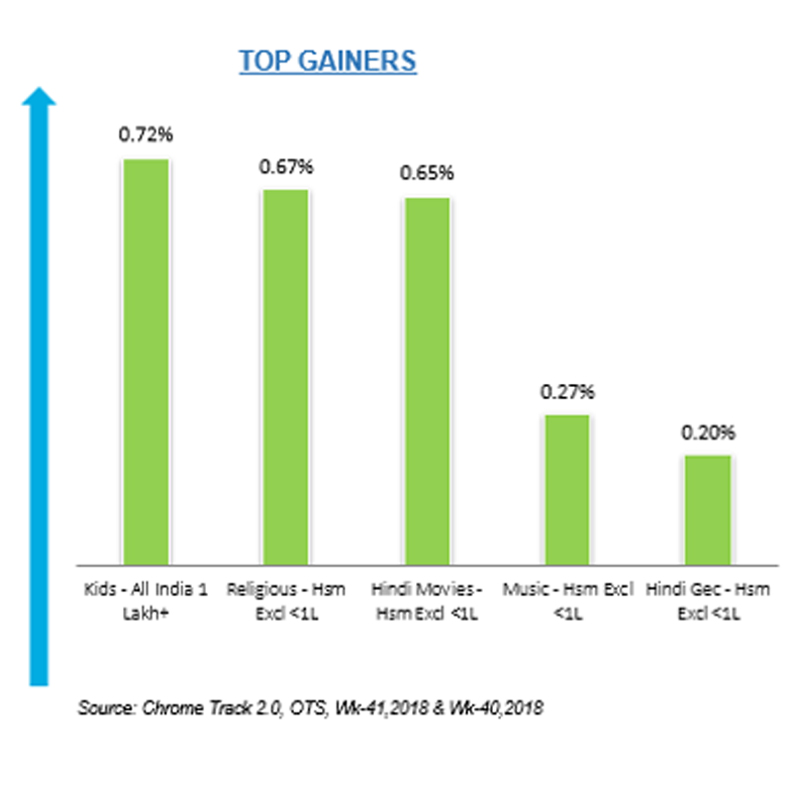
    MUMBAI: With a growth of 0.72 per cent as compared to last week (40), the kids genre marked the highest opportunity to see (OTS) among all categories in week 41 of Chrome Data Analytics & Media.

    In the kids genre, Nickelodeon gained the highest OTS with 91 per cent in All India 1 Lakh+ market.

    OTS is the actual census-based percentage connectivity of a channel spread across 81 million homes, as reported by Chrome DM, across analogue cable, digital cable and DTH.

    The second position in the gainer’s list of OTS was grabbed by the religious genre with the growth of 0.67 per cent in HSM excluding the less than 1L-market. Aastha was the most benefitted channel in this category with 97.7 per cent.

    The third position in the gainers was garnered by the Hindi movies genre in HSM excluding the less than 1L-market with 0.65 per cent OTS. Rishtey Cineplex gained the highest OTS with 94.1 per cent.

    The music genre was at the fourth position in the list with 0.27 per cent growth and 9X Jalwa catered to 94.5 per cent OTS in HSM excluding the less than 1L-market.

    The fifth position in gainers list was bagged by the Hindi GEC genre with a growth of 0.20 per cent. In this category, Star Utsav topped the OTS chart with 99.7 per cent in HSM excluding the less than 1L-market.

    Also read:

    Hindi news benefited most, Sports  genre most affected: Chrome DM week 22

    Demand for regional commentary in tier 3 & 4 towns: Chrome DM

    Discovery Jeet gets good spread at launch

    Jeet storms the market with big debut week reach

  • English News, Religious & Music HSM genres lose: Chrome DM

    English News, Religious & Music HSM genres lose: Chrome DM

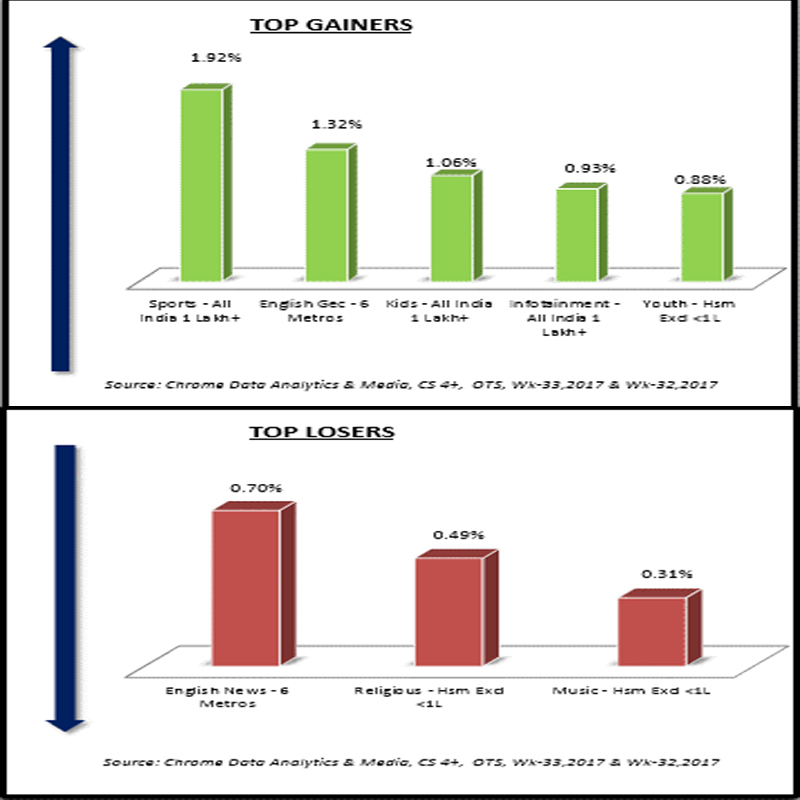
    MUMBAI: ‘Sports – All-India’ genre has emerged as the most benefitted genre with 1.92 per cent. DD Sports has topped the chart with 95 per cent opportunity to see (OTS) in week 33, Chrome Data Analytics & Media reported.

    Among the losers this week, the English News genre in six metros decreased by 0.70 per cent. In this genre, however, Loksabha TV was the top gainer with 93.8 per cent OTS.  Religious- HSM Excl <1L genre dropped by 0.49 per cent this week wherein Sanskar stood at number one with 95.9 per cent OTS. Music- HSM Excl <1L recorded a fall of 0.31 per cent. However, Sony Mix emerged as the leader in the genre with 90.8 per cent OTS.

    Among gainers, next in the tally was English GEC genre which bagged the second spot in the chart, seeing a growth of 1.32 per cent in six metros. Colors Infinity lead the genre with 47.7 per cent OTS.

    With a growth of 1.06 per cent, ‘Kids- All India’ grabbed the third spot. In the kids genre, Nickelodeon stood at number one with 88.6 per cent OTS. This was followed by ‘Infotainment – All India’ genre on the fourth position with 0.93 per cent with NGC leading the chart with 92.3 per cent OTS.

    Last, but not the least, the Youth genre in the Hindi-speaking market (HSM) stood at the fifth position with a growth of 0.88 per cent. MTV topped the genre with 90.7 per cent OTS.

    ALSO READ :

    Movies Now & DD Sports top respective genres: Chrome DM (updated)

    English GEC genre grew by 0.24%, CNBC Awaaz most hit: Chrome DM

  • English entertainment gains; Hindi GECs lose: Chrome

    English entertainment gains; Hindi GECs lose: Chrome

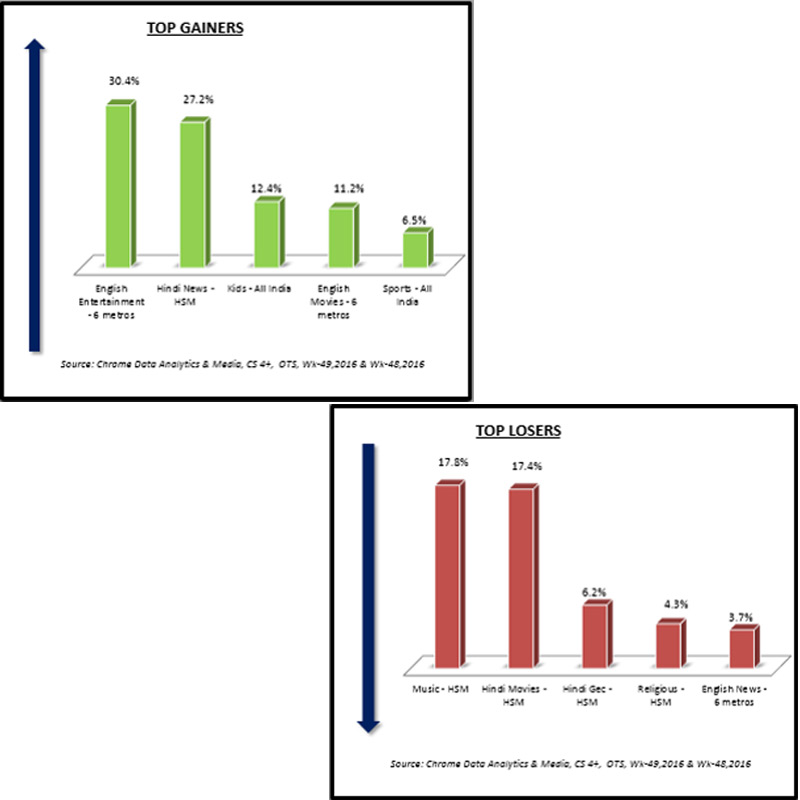
    MUMBAI: English Entertainment emerged as the number one gainer in week 39 of Chrome Data and Analytics. The sector registered 30.4 per cent opportunity to see (OTS) and Comedy Central led the genre with 45.6 per cent OTS.

    Next in the row is Hindi News in Hindi-speaking market (HSM) which recorded 27. 2 per cent of OTS With DD News leading the sector with 97.7 per cent OTS.

    Kids genre on an all-India basis registered an increase of 12.4 per cent of OTS. Cartoon Network bagged the first position in the sector with 81.0 per cent of OTS. English Movies on the other hand grabbed the fourth slot in the list of gainer with 11.2 per cent of OTS and Movies Now emerges as the number one channel with 46.9 per cent of OTS.

    Last but not the least, the sports genre across India registered 6.5 per cent OTS with DD Sports leading the sector with 91.7 per cent OTS.

    The music genre, Hindi Movies, Hindi GEC, religious and English news are among the sectors which fail to garner positive ratings.

    The music genre this week witnessed a drop of 17.8 per cent of OTS led the top loser list and Sony Mix topped the genre with 90.8 per cent of OTS. Hindi Movies in HSM dropped by 17.4 per cent with Max leading the space with 93.0 per cent of OTS.

    Along with Hindi movies genre, Hindi GEC too saw a drop and decreased by 6.2 per cent. DD National garnered 98.9 per cent of OTS.

    Religious sector witnessed a fall of 4.3 per cent of OTS and Aastha led the list with 98.9 per cent. English News in six metros registered 3.7 per cent fall. Lok Sabha emerged as the most affected channel with 93.5 per cent of OTS.

  • English entertainment gains; Hindi GECs lose: Chrome

    English entertainment gains; Hindi GECs lose: Chrome

    MUMBAI: English Entertainment emerged as the number one gainer in week 39 of Chrome Data and Analytics. The sector registered 30.4 per cent opportunity to see (OTS) and Comedy Central led the genre with 45.6 per cent OTS.

    Next in the row is Hindi News in Hindi-speaking market (HSM) which recorded 27. 2 per cent of OTS With DD News leading the sector with 97.7 per cent OTS.

    Kids genre on an all-India basis registered an increase of 12.4 per cent of OTS. Cartoon Network bagged the first position in the sector with 81.0 per cent of OTS. English Movies on the other hand grabbed the fourth slot in the list of gainer with 11.2 per cent of OTS and Movies Now emerges as the number one channel with 46.9 per cent of OTS.

    Last but not the least, the sports genre across India registered 6.5 per cent OTS with DD Sports leading the sector with 91.7 per cent OTS.

    The music genre, Hindi Movies, Hindi GEC, religious and English news are among the sectors which fail to garner positive ratings.

    The music genre this week witnessed a drop of 17.8 per cent of OTS led the top loser list and Sony Mix topped the genre with 90.8 per cent of OTS. Hindi Movies in HSM dropped by 17.4 per cent with Max leading the space with 93.0 per cent of OTS.

    Along with Hindi movies genre, Hindi GEC too saw a drop and decreased by 6.2 per cent. DD National garnered 98.9 per cent of OTS.

    Religious sector witnessed a fall of 4.3 per cent of OTS and Aastha led the list with 98.9 per cent. English News in six metros registered 3.7 per cent fall. Lok Sabha emerged as the most affected channel with 93.5 per cent of OTS.

  • DD Bharati commences cultural and religious season

    DD Bharati commences cultural and religious season

    NEW DELHI: The public broadcaster Doordarshan’s channel DD Bharati has slated several programmes to establish its identity as the television channel reflecting the art and culture of the country.


    Jewels of Hindustani Classical Music, a programme specially curated from the archives of stalwarts of Hindustani vocal and instrumental musicians who are alive and are virtually legends is commencing this evening.


    The first telecast at 9.00 pm with repeat telecast at 5.00 am and 1.00 pm features Begum Parveen Sultana of the Patiala Gharana followed by Vidushi Kishori Amonkar of the Jaipur- Atrauli Gharana. The legendary Pt Jasraj will be featured tomorrow at the same time.


    The programme, especially curated by Kumud Diwan and Yatindra Mishra, delves into their gharana, their musical genius, and their musical journey etc.   


    Coinciding with Dussehra and Diwali next month, DD Bharati will commence telecast of Ramayana from 27 September at 10.30 pm with repeat the next day at 6.30 am and 2.30 pm. It will be a series of presentation of ballets and documentary on the Ramkatha traditions prevalent in India.


    The Ramayana or Ramkatha tradition is pervasive not only in India but throughout South East Asia. Stories revolving around Ram, Sita and Lakshman penetrate through rural and urban, mundane and religious, sacred and secular domains. They defy categorization of art as folk or classical, rural or urban, textual or oral. Literary, oral, kinetic and pictorial aspects intermingle to generate multiple renditions of the text in different locales and contexts; each rendition with unique local flavour and linguistic distinction. The performative aspect of the text makes it fluid, accessible and adaptable. It accounts for its preservation, survival, transmission and mobility, cutting across boundaries of time and space. Every region has its own particular form and style of singing and reciting the story.


    Earlier this week with the start of Mahalaya, DD Bharati in association with the Girnar Kendra of Doordarshan presented ‘Maa Ni Chundari Lehrai’ from its rich collection of archives. A series of Garba presentation especially done and performed during the Navratra Festival was telecast with repeats the next day.


    DD Bharati also presented Devi Darshan from 24 September at 10.30 pm through a series of dance ballets and documentary celebrating the festivities of Durgaostav. Durga Puja festival is a 10-day long festival that starts off on Mahalaya (the day of the new moon) – the first day when Goddess Durga is believed to come into the world to destroy the evil.  The festival ends up in Dashumi- the last day when the Goddess Durga is believed to go back to her heavenly home, leaving behind the trails of happiness, goodness and purity. This is the day of the Lord’s victory over evil and is celebrated as Vijay Dashami or Dussehra. The salient ritual of Durga Puja spans a five days period Maha Sashti, Maha Saptami, Maha Ashtami, Maha Nabami and Vijaya Dashami.

  • BBC announces religious programming this Easter

    MUMBAI: BBC has announced that this Easter BBC Religion and Ethics reflects on the life and legacy of Jesus through major documentaries, sacred music, readings and live worship.

    BBC One will broadcast The Royal Maundy Service on 21 April live from Westminster Abbey, presented by Huw Edwards. The service coincides with Her Majesty Queen Elizabeth II‘s 85th birthday, the first time this has happened during her reign.

    The service will see some of Her Majesty‘s subjects receive the gift of Maundy money as recognition of the work they have done in their communities. Music during the service will include Praise To The Holiest In The Heights, Give Almes Of Thy Goods and Handel‘s Zadok The Priest.

    For Holy Week, BBC One presents a special documentary does Does Christianity Have A Future? Ann Widdecombe looks at the changing face of Christianity in the UK and asks if there is still a role for an established church.

    Also during Holy Week, BBC One will broadcast The Story Of Jesus, a two-part series that explores the life and teaching of Jesus, using the very latest archaeological, historical and theological research with dramatic reconstructions of key moments in the Gospels.

    The Story Of Jesus is a co-production for BBC One between CTVC and Big Book Media.

    On BBC Radio 3, Joan Bakewell explores the beliefs of artists, thinkers, religious leaders and other public figures in a returning series of Belief, broadcast Monday to Friday during Holy Week. Guests for the week are: comedian Omid Djalili, philosopher Raymond Tallis, novelist Salley Vickers, composer Tarik O‘ Rega, and American theologian Stanley Hauerwas.

    To mark Good Friday, BBC One presents What Is The Point In Forgiveness? Historian Bettany Hughes explores the notion of forgiveness throughout history. Bettany undertakes a journey through more than 2,000 years to find out whether and how forgiveness has benefited humankind.

    Just after 3 pm, as Christians mark the hour of Christ‘s suffering in words of prayer, readings and music, BBC Radio 4 presents Good Friday Liturgy. Professor Tina Beattie, Director of the Digby Stuart Research Centre for Catholic Studies at Roehampton University, visits Jerusalem and what may have been the actual places of trial, suffering and resurrection in the story of Christ‘s Passion.

    On BBC Radio 2, Aled Jones presents At The Foot Of The Cross. St Albans Cathedral is the glorious setting for meditation in words and music for Good Friday. Music, poetry and readings from the Bible read by Hugh Bonneville and Emma Fielding tell the story of the crucifixion with, at its centre, a complete performance of Fauré‘s Requiem.

    On the Saturday of Holy Week (Easter Eve), Radio 4 provides an early start to the day with spiritual comment and prayer on Prayer For The Day with the Bishop of London, the Rt Rev Richard Chartres.

    And in The Lamentations Of Jeremiah, on Radio 3, Catherine Bott looks at the poems in the Book Of Jeremiah and considers what inspired so many composers to set these dark texts to music. Music features includes pieces by Brumel, Heinichen, Durante, Byrd, Tallis, White, Palestrina, Lassus, Victoria and Zelenka.

    Choruses and hymns will also reflect the emotions and power of the gospel later on Easter Eve, with the welcome return on BBC Two of Easter From King‘s which tells, in words and music, the story of the last days of the earthly life of Jesus and his resurrection. Music sung by the world-famous Chapel choir, directed by Stephen Cleobury, includes Lotti‘s Crucifixus, pieces from Handel‘s Messiah and Mozart‘s Ave Verum Corpus.

    On Easter Morning, worship on the BBC begins in the Sunrise Service on Radio 4. The Dean of Liverpool Cathedral Metropolitan Cathedral Canon Anthony O‘Brien presents a service for the beginning of Easter Day. Joyful Easter carols include: Ye Sons And Daughters, Walking In A Garden, I Know That My Redeemer Lives and Thine Be The Glory.

    Sunday Worship, Easter Day, also on Radio 4, will come live from St George‘s Chapel Windsor Castle. The joy of Easter is celebrated in a communion service from the Book Of Common Prayer, live from St George‘s Chapel, Windsor Castle. Hymns include Jesus Christ Is Risen Today, This Joyful Eastertide, and Thine Be The glory. The Preacher and celebrant: The Revd Dr Hueston Finlay.

    BBC One will show live Easter Day Eucharist from Salisbury Cathedral. The service will be introduced by the Dean of Salisbury, the Very Rev. June Osborne, who will also preach and the President is the Rt Rev. Dr Christopher Herbert. The programme opens with the lighting of the Paschal Candle, symbolising the Light of Christ, which will be lit from a bonfire outside the Cathedral just before dawn on Easter morning.

    BBC One will also transmit Pope Benedict XVI‘s traditional Easter message and blessing Urbi Et Orbi, “to the city and the world”.

    Songs Of Praise on BBC One celebrates Easter Day with traditional hymns from Wesley Memorial Church in Oxford, plus songs from tenor Wynne Evans and mezzo-soprano Melanie Marshall. Actors Bill Paterson and Tamsin Greig read the Easter Story from the King James Bible.
  • No entry for states, political parties, religious bodies into broadcasting: Trai

    NEW DELHI: The Telecom Regulatory Authority of India today ruled out the entry of political parties into broadcasting, and also said religious bodies may not be permitted to own their own broadcasting stations and teleports.

    Similarly, state governments, urban and rural local bodies etc should not be allowed entry into broadcasting, noting that their interests can be adequately met by Prasar Bharati by imposing certain public service broadcasting obligations on private broadcasters. Trai has also recommended that the state governments and their organs should stay away from distribution activities.

    Trai also said certain public service broadcasting obligations be imposed on broadcasters in the country. The preparation of content for public service broadcasting may be done by individuals including private broadcasters, NGOs, social action groups, in addition to Prasar Bharati, DAVP, state governments and their organs.

    The Central Government (Ministry of Information and Broadcasting) may set up a regular body to approve and certify programmes as being fit for broadcast as part of the public service broadcasting obligation.

    To begin with, every private broadcaster may be mandated to carry such approved programmes at least for a total duration of 30 minutes in a week.

    Trai took this decision after considering the relevant Constitutional provisions, the Constituent Assembly debates, the recommendations of the Sarkaria Commission and the judgments of the Supreme Court, and feedback received from the stakeholders.

    These recommendations have been made by Trai in its report on “Issues relating to entry of certain entities into Broadcasting and Distribution activities”. It said in order to provide funds for such public service broadcasting programmes, a Fund known as the Public Service Broadcasting Obligation Fund should be established on lines similar to the Universal Service Obligation (USO) Fund in the telecom sector, and by imposing an annual Public Service Broadcasting Obligation levy on the private broadcasters in the country and a predetermined share from the percentage of gross revenue being paid by the identified stakeholders in the broadcasting sector.

    With reference to political parties, Trai said broadcasting channels provide “reasonable access” to recognized political parties during the run up to elections to Parliament and to the State Legislative Assemblies.

    The Ministry of Information and Broadcasting may seek the guidance of the Election Commission and may frame appropriate guidelines in this regard, having regard to the importance of the free flow of information to the public during the electoral process.

    In case permission has earlier been granted to any religious body for a television channel, provisions should be made for “an appropriate exit route within a time limit of three to four years to such religious bodies.”

    Denial of entry to religious bodies would be in conformity with the secular fabric of the Constitution. Trai has recommended that the disqualifications as contained in the relevant provisions of the Broadcasting Bill 1997 (which could not be enacted into law) regarding disqualification of religious bodies may be incorporated in the proposed new legislation on broadcasting.

    However, such disqualification should not be construed to mean that religious contents in the broadcasting channels is to be disallowed. Such religious content should be in conformity with the appropriate content code or programme code as prescribed from time to time by the government.

    The Ministry of Information and Broadcasting had requested Trai, by its reference dated 27 December, 2007, to examine the matter of allowing certain entities including State Governments, urban and local bodies, 3-tier Panchayati Raj bodies, publicly funded bodies, political bodies and religious bodies to enter into broadcasting activities which may include starting of broadcast channels or entering into distribution platforms such as cable services and DTH.

    Trai released a Consultation Paper on 25 February 2008 on the issues arising out of the reference. The Consultation Paper covered issues as to whether it would be in the interest of the broadcasting sector and in the interest of the public at large to permit the Union government and its organs, the state governments and their organs, urban and rural local bodies, political bodies, religious bodies etc. to enter into broadcasting and distribution activities like cable TV and DTH. The consultation paper also raised the issue whether permitting the state governments and their enterprises to enter into broadcasting sector would have impact on the Centre-State Relationship and the inter-se relationship among the states.

    This was followed by an Open House Discussion (OHD) held in New Delhi on 16 April 2008. The Authority has, after carefully examining several Constitutional and legal issues arising out of the reference and after carefully considering the views of stake-holders and the prevailing international practices, arrived at these final recommendations.

    As far as entry of state governments into distribution platforms such as cable TV, DTH, etc. is concerned, the Authority says the country already has six DTH operators, about 6000 multi-system operators, and nearly 60,000 cable operators. In the interest of fair competition and a level playing field, and considering the need to ensure proper enforcement mechanism equally applicable to all the players in the field, suitable provisions for exit route within three to four years have been provided wherever state governments and their organs have entered such distribution activity.

    For similar reasons and the need to prevent misuse of distribution platforms by any of the players on political or other considerations and also the need to prevent any problems relating to enforcement measures against the service providers involved, Trai has recommended that urban and local bodies, political bodies, religious bodies and other publicly funded bodies may not be permitted into distribution activities like cable television and DTH.