Tag: regional content

  • Hoichoi’s first independent property Tangra Blues debuts on the platform

    Hoichoi’s first independent property Tangra Blues debuts on the platform

    KOLKATA: Bengali OTT platform Hoichoi’s first independent property, Tangra Blues, premiered on the platform on Saturday a month after its theatrical release while simultaneously being available in multiplexes.

    Directed by National Award-winning director Supriyo Sen, along with National Award-winning cinematographer Ranjan Palit, and music director Nabarun Ghosh, the film is an underdog story of a band that refuses to die and rewrite its destiny through music. 

    Ahead of its World Premiere on Hoichoi, Tangra Blues had opened to an overwhelming response and rave reviews in theatres a month back on 15 April. The film is inspired by the lives and struggles of Sanjay Mandol & group, Kolkata’s most popular waste band group, who went on to become a runner-up in a popular talent reality show in the country.

    The film stars renowned actors Parambrata Chatterjee and Madhumita along with Saimul Alam, Oishani Dey, and Atmadeep Ghosh among others.

    Hoichoi revenue & strategy VP Soumya Mukherjee said, “With our huge bank of World Premiere movies and Original Shows, we are prepared to provide entertainment to our user base even at a time like this. Tangra Blues being our first independent property, we are excited for our users across the globe to enjoy it from the safety and comfort of their homes. At Hoichoi, we endeavour to bring great content and latest releases on our service for our users to experience.”

  • Regional to prevail as 2020 buzzword for OTT

    Regional to prevail as 2020 buzzword for OTT

    MUMBAI: All major streaming services in India are keeping regional markets at the heart of their expansion strategy. In the last two years, regional has persistently guided the contenders in the over-the-top (OTT) ecosystem and 2020 is not going to be an exception. Some of the major platforms have already tasted success in the regional markets while others are looking at those markets as the next growth frontier. South Indian languages are undoubtedly the ones getting higher priority but other markets like Marathi, Bengali, Punjabi are also emerging gradually.

    Since its grand entry in the crowded OTT space, ZEE5 has emphasised on three ‘Vs , one of those is vernacular. In 2019, ZEE5 had at least one original web series come out in six different languages each month on an average in regional languages including Marathi, Bengali, Telugu and Tamil. The parent company also mentioned in its third quarter result – Kaale Dhande in Marathi, God of Dharmapuri in Telugu and Karoline Kamakshi in Tamil received positive reviews.

    ZEE5 India programming head Aparna Acharekar also explained while talking about the regional strategy that it definitely differs across the markets. Factors like penetration of data or adoption of OTT services, that particular language consumer’s affinities for his language, openness to other languages, etc., influence the strategy widely.

    “I cannot have a one size fit approach for everyone. I am looking at the show that has to cut across say largely Hindi speaking audiences, then my themes will be different because they are exposed to a whole lot of that. Today other competition also, who has entered the OTT space, is largely first creating Hindi content. So whatever I create as a benchmark starts getting compared in Hindi to another benchmark created by another OTT. But we are leaders in other languages and no one has actually come closer, the smaller players have tried little, local players are there. But there is no national-level player who can say let me try to take on the regional market. So, each market has to be looked at differently,” she added.

    Moreover, ZEE5 provides an option to change the display language of the app. If a consumer is not comfortable navigating in English, he can change the display language to Hindi or other regional languages. The platform has seen an uptake in that alternative display adaptation. “In fact with every passing month, we see more uptake of this and we see the relative share of English as a display language is going down and regional language is actually going up,” Aparna said in an earlier interview.

    The young player on the block which already has created a buzz with its Hindi shows, MX Player also has “a very clear regional strategy”. MX Player chief content officer Gautam Talwar stated that a big show is coming up in Marathi including big names Swapnil Joshi, Satish Rajwade along with two other big shows in pipeline. The platform is focusing highly on south-Indian languages, as Talwar shared.

    “We have some shows in Punjabi, which are in the pipeline. And we have two interesting shows in Bhojpuri coming up. I am so sure that if these two shows are so interesting that if we dub them in other languages, we will get the extraordinary viewership in other regional languages as well. Regional is a big strategy for us moving forward,” Talwar added.

    As per a recent report unveiled by Hotstar, 63 per cent of total online entertainment consumption happens in the non-metro centres of India, and Lucknow, Pune and Patna rank above Hyderabad, Bengaluru and Kolkata in consumption of content. YouTube also reported over 95 of its users watched videos in a regional language.

    Other than home-grown players, international streaming services that are keen on Indian expansion are also looking at regional content. According to media reports, a robust content licensing both in Hindi and other regional languages is in Netflix’s pipeline. Amazon Prime Video has a robust catalogue of blockbuster movies across languages. Amazon Prime Video India content director and head Vijay Subramaniam said that the platform will ramp up its language catalogue in Malayalam, Kannada, Gujarati and Punjabi while they want to take up Tamil, Telugu further a few notches. While it tasted the water with one Telugu show, he added that Tamil and Telugu shows are in development.

    Smaller players like The Viral Fever (TVF) are not ignoring the promising sector. “We are actually looking at regional shows in 2020. We are working on Marathi shows. We want to line up shows in Tamil and Telugu. In 2020, we will get into regional space and we will later expand into other languages,” TVF chief content officer Sameer Saxena commented.

  • Regional content start-up Matrubharti enters video streaming space

    Regional content start-up Matrubharti enters video streaming space

    Matrubharti, a vernacular content start-up which has been providing a curated platform for content creators to publish ebooks and snackable social media content in regional languages such as Hindi, Gujarati and Marathi besides English, has today announced that it has diversified its content offerings by entering the video streaming space with the launch of Matrubharti Vishesh.

    Matrubharti Vishesh is a premium, exclusive content section housed in the Matrubharti app and website for streaming of regional theatrical plays, short films, OpenMics (live poetry recitals and stand-up comedy) and literature festivals. Users can also gain first access to newly published books under this section.

    Going Beyond Ebooks: Stories in Video Format

    Matrubharti today has a community strength of over 7.5 lakh with active contributors in excess of 18,000. Since its inception in 2015, Matrubharti has helped authors publish 26,000 ebooks, which have been downloaded 7.5 Million times by 7 lakh readers. The platform also has over 2.5 lakh poems in text and image format across 4 languages.

    Explaining his rationale behind Matrubharti’s entry into the video streaming space, Mahendra Sharma, Co-Founder and CEO, Matrubharti said, “Videos are the most popular format of creative expression and OTT apps are riding this wave. We at Matrubharti wanted to target and engage more of India’s youth so that they can showcase their creativity on our platform, and also help them to connect with content in their mother tongue.  It was therefore the need of the hour for us to plug videos into our platform and earn more screen time from them.”

    Matrubharti began experimenting with stories in short form video format since the beginning of this year with shows such as Morning Maza, Raat Ke Jazbat and curated stories under its Kahani Metro initiative which have an App Jockey (AJ) narrating the stories with a run time of  about 3-5 minutes.

    The content library today has over 500 such short form video stories.

    Content Sourcing: The Offline Way

    While a significant number of videos on the platform are User Generated Content (UGC), the Ahmedabad based start-up has partnered with elite authors, poets, theatre groups to source exclusive content for its Vishesh segment. As part of its content sourcing strategy, it has forayed offline to forge event partnerships

    “It helps us reach offline audiences, strengthens our community and post the event, we get a huge set of videos for our platform from the performers”, Sharma said.

    The content library has more than 10,000 videos of poetry recitals from 50+ events and over 100 videos of regional theatrical plays, making it the only other platform other than Hotstar in India to stream plays.

    Engagement, Monetization and Future Plans

    The launch of Matrubharti Vishesh comes on the back of Matrubharti’s participation in US-based Gray Matters Capital’s digital accelerator program – GMC Calibrator.

    “From a monetization standpoint, videos open up avenues for Matrubharti to partner with brands and making its freemium revenue model a viable one”, said Omkar Kulakrni, GMC Calibrator Program Head, Gray Matters Capital. He added, “Since March 2019, the engagement rate on the Matrubharti app has gone up by 15-20% post behavioural science interventions and increased emphasis on data driven decision making.”

    “Matrubharti aspires to reach a user base of 1.8 million by adding content in 3 more regional languages – Tamil, Telugu and Malayalam by 2020. In 5 years, Matrubharti is aiming for a pan-India presence with content in 21 Indian languages, and users in excess of 10 Crore. We will be partnering with regional film production companies for web series and are aiming to become the Netflix of Bharat with our video content.”, signs off Sharma.


  • Team Pumpkin strengthens regional language content capabilities

    Team Pumpkin strengthens regional language content capabilities

    MUMBAI: To match pace with the ever-evolving dynamics of the digital marketing industry, Team Pumpkin has taken an initiative to strengthen its regional language content capabilities. It has developed a core team of regional language languages which includes Punjabi, Hindi, Marathi, Tamil, Malayalam, Gujarati, Urdu, Telugu, Marwari, Nepali, Kannada, Odia, Bengali.

    Team Pumpkin’s main focus is to develop original content in regional language languages instead of getting it translated. The new regional language languages support team includes writers, proofreaders and voice-over artists who are based across 3 offices – Delhi, Bangalore, and Mumbai

    Team Pumpkin co-founder and CBO Swati Nathani commented, “We put a lot of thought and insight into our work and our learning has been that regional language content is the need of the hour. It helps break barriers and reach every corner of this diverse country. By developing a team for regional language content, this is the edge we will be offering our clients and helping them to widen their prospects across the nation.”

    Team Pumpkin offers all aspects of regional language content including audio, video, text, and has already worked on many regional language content pieces for clients like MamyPoko Pants, Hindustan Coca-Cola Beverages, and Axis Bank.

  • Spuul’s Bhojpuri bet for growth

    Spuul’s Bhojpuri bet for growth

    MUMBAI: Every over the top (OTT) platform is raging about India’s diverse market and untapped opportunity. While others are testing the water with Tamil, Telugu, Bengali and Marathi apart from the regular fanfare of English and Hind shows, Singapore based Spuul is going the Bhojpuri way as well.

    The platform already had some Bhojpuri content but about six to seven months ago, it felt the need to renew its attention towards this deprived market since rural audiences are warming up to video content now.

    Spuul content head Girish Dwibhashyam also thinks that as a high number of people from Bihar migrate to other parts of the country, Bhojpuri content has a market across the country as well as within the state. Cheaper data, affordable handsets have made the digital video space class agnostic. “Consumption from the hinterland has multiplied in the last one and half years. Bhojpuri has assured viewership not only in Bihar but also across India,” he says.

    Currently, the platform is only focusing on Bhojpuri movies starring popular actors like Dinesh Lal Yadav. Dwibhashyam claims that the movies they have are the most popular ones of recent past produced by renowned production houses. Aashik Aawara, Nirahua Chalal Sasural 2, Sangram, Rakhtbhoomi, Action Raaja, Nehle Pe Dehla, Muqabala, Jaanam are some of the most popular Bhojpuri movies streaming on Spuul. As the platform has a huge diaspora audience too, it might add catch-up content in certain markets. Initially, the platform has seen a lot of traction from tier II, tier III cities.

    “Right now our ultimate goal is to be a place where Bhojpuri speaking audience can come and watch videos, not only movies but also other kinds of content going forward. But at least when it comes to movies we want to be top for Bhojpuri speaking audience for the content in the language they speak,” he comments on the objective of revamping Bhojpuri library.

    When it comes to content curation, the team focuses both on external analysis and internal data. The popularity of stars, the popularity of the movie, box office collection are among the major factors which act as a catalyst for adding a movie to the catalogue.

    “Couple of years back we had Bhojpuri movies. We have some consumption numbers on the actors who have done well on our platforms. We keep improvising and regularly track which movies are being consumed in what way.  When we started out with the catalogue of Bhojpuri movies six-seven months back, first we did a lot of observation to which stars are doing well, which movies, what type of movies are doing well. Then accordingly, we have added new movies,” he adds.

    It has competition because ZEE5 and ALTBalaji are both foraying into this market as well. Moreover, content king YouTube has hundreds of viral Bhojpuri videos which get good traction. Hence, to cope with the upping competition in this market Spuul needs to update its library continuously.

    But Dwibhashyam believes the growing Bhojpuri market has scope for multiple players. In addition to that, differentiating content will also play a key role. According to him, the Bhojpuri OTT market has not reached that stage where competition will start affecting the players.

    For promoting its new catalogue, Spuul is primarily emphasising on digital marketing only. It has done a large number of digital ads targeting certain geographies and native speakers along with consumer PR. Other than digital, he claims Spuul has been mentioned in local newspapers recently which helped it to create a buzz in the local market.

    Dwibhashyam thinks it is in the right direction based on the promising initial response. In a bid to gain a stronger foothold across the country, the OTT platform will soon announce an important development for Bengali content too.

  • Zee5 launches 20 originals to drive up subscription

    Zee5 launches 20 originals to drive up subscription

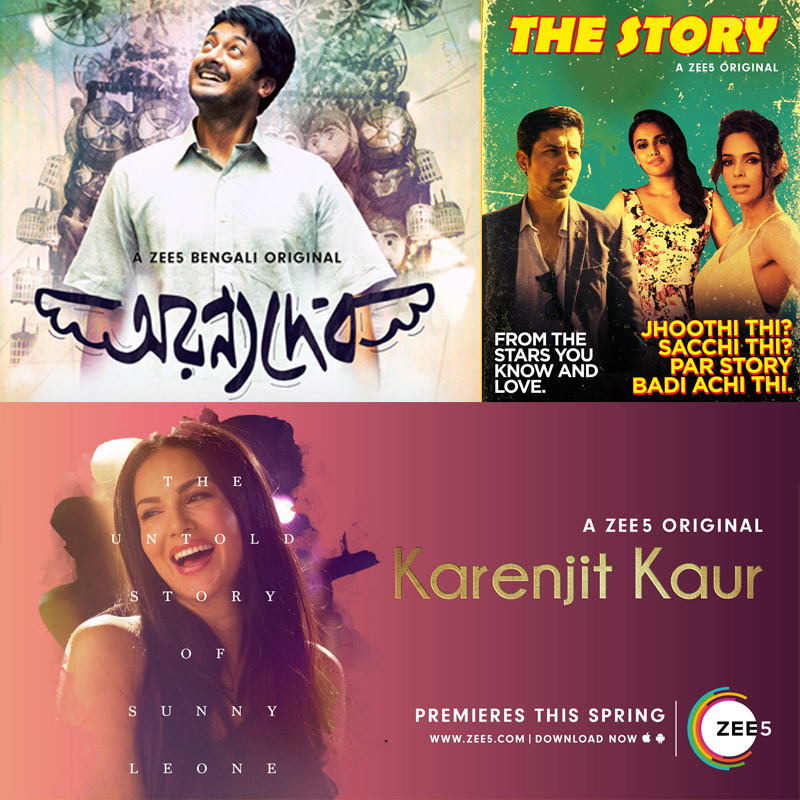
    MUMBAI: Within days of entering the market, over-the-top (OTT) player Zee5 has announced 20 original shows across a variety of languages and genres to be launched by the end of April 2018 under Zee5 Originals. The regional languages in focus are Marathi, Telugu, Tamil, Malayalam and Bengali.

    Most of them are web series but three are Hindi short films along with one Bengali movie. The company has been brainstorming for a year to decide what will attract millennials. As a result, seven genres have been targetted–thriller, action, drama, comedy, satire, biopics and reality.

    The company is working towards driving up monetisation by putting all the content behind a paywall. Currently, Zee5 earns from both AVOD and SVOD but aims to increase the share of the latter going forth.

    Every month will see the launch of one new web series and one short film taking the total tally to over 90 shows by the end of March 2019.

    The most eye-catchy of the bunch is Karenjit Kaur, a biopic of Sunny Leone where you can see how she shot to stardom in Bollywood from an adult film actress. Other Hindi shows on offer are Life Sahi Hai 2, Lockdown, Babbar Ka Tabbar, Zero Kms, Table Number 5, The Story, The Big Cover Up and Dhatt Teri Ki and three Hindi short films Mehmaan, Tamashree, Sone Bhi Do Yaaron. There are two Marathi web series Liftman and Horn OK Please, two Telugu web-series Nanna Koochi, Chitram Vichatram, two Tamil web-series Kallachirippu, America Mappillai, one Malayalam web-series Utsaha Ithihasam and one Bengali movie Aranya Deb.

    Speaking to media, Zee International and Zee5 CEO Amit Goenka said, “Our aim is to present thought-provoking and relatable content which stirs emotions, triggers conversations and leaves the viewers feeling entertained and refreshed. Zee5 Originals will feature a library of exclusive content which is relatable, understated, bold, progressive and layered making for an immersive experience keeping our core target engaged and stimulating their entertainment appetite in a language of their choice.”

    Zee5 digital head Archana Anand admitted that without any hard and fast regulation yet, there is more freedom. But she also mentioned that corporate honchos were aware of the type of content that needs to be shown or while keeping things fun and exciting.

    The ongoing concerns regarding data security on online platforms can keep viewers on their guard. Anand, however, said that the platform was committed to keeping people’s data secure and was even consulting international companies for strengthening it.

    A separate tab for kids’ content is on its to-do list by next month. Production of kids’ content will be ramped up in future along with acquisitions. The Zee network will leverage its global reach to tap into the vast Indian diaspora spread over the world.

    In an earlier interview Zee Entertainment Enterprises Ltd MD and CEO Punit Goenka said, ““Zee5 is poised to be the largest digital platform for Indian entertainment in the world, bringing the best of live television, Indian and international TV shows, movies and videos to viewers in the language of their choice and across all internet connected devices.”

    Also Read :

    OTT experts discuss future of India’s hybrid market

    OTT players up the ante with niche content

  • FB targets next billion Indians with local content and Express Wifi

    FB targets next billion Indians with local content and Express Wifi

    MUMBAI: Like Google, Facebook understands that in order to increase their market share of the digital ad pie, it is crucial to target the next billion users. And hence a strong strategy is needed for its India operations. The next billion users on the platform are what will drive its business, both in terms of scale of operation and revenues.

    Facebook is committed to this endeavour, says its south Asia and India managing director Umang Bedi and has taken major steps to keep the platform right, real and relevant for its Indian users.

    India has one of the highest percentages of people accessing Facebook via their mobile phones. Out of the 85 million active monthly users who access the platform from India, 81 million do it through their mobile devices. Nearly 95 per cent of the traffic Facebook gets from India is mobile. Needless to say, Fb has given special care to enhancing user experience in India on Facebook by making the platform functional even under slow internet.

    “For us that is a welcome news. The wider the reach of internet, and mobile, the better we can connect businesses to their right audience,” shared Bedi.

    The company’s flagship project, and perhaps most controversial in the local market, Free Basics, was designed to address the issue of internet penetration in rural India , but failed to move opinion in its favour resulting in its ban by the Telecom Regulatory Authority of India (TRAI) earlier this year due to its conflict with principles of net neutrality in the market.

    “Since the government’s mandate, Facebook has ceased all operations of Free Basics and concentrated on other sectors instead,” Bedi gave a short response when quizzed about Free Basics in a recent interview.

    To push forth FB’s internet.org initiative in India, the social media giant has instead launched what it calls ‘Express Wi-Fi’, which too promises to help connect rural India digitally.

    “We have recently piloted Express WiFI that works with telecom operators, internet service providers, and local entrepreneurs to help expand connectivity to underserved locations around the world. We’re currently live in India, and are expanding to other regions soon,” Bedi shared.

    While Bedi doesn’t clarify whether Express WiFi would also follow Free Basic’s principle of zero charges on data, its page on internet.org defines it as “ fast, affordable and reliable internet” hinting that the service will cost users some money, in-line with the TRAI directives.

    Bedi shares that the biggest challenge Facebook faces in penetrating the further into the market is its relevance in India through local content. “Even the international mobile operators association GSMA recognises the single biggest issue of mobile and internet penetration in India is producing relevant local content for the right device in the right format,” shared Bedi. Making the platform available in 12 Indian languages is another step forward in the direction along with promoting content partnerships with several regional players.

  • FB targets next billion Indians with local content and Express Wifi

    FB targets next billion Indians with local content and Express Wifi

    MUMBAI: Like Google, Facebook understands that in order to increase their market share of the digital ad pie, it is crucial to target the next billion users. And hence a strong strategy is needed for its India operations. The next billion users on the platform are what will drive its business, both in terms of scale of operation and revenues.

    Facebook is committed to this endeavour, says its south Asia and India managing director Umang Bedi and has taken major steps to keep the platform right, real and relevant for its Indian users.

    India has one of the highest percentages of people accessing Facebook via their mobile phones. Out of the 85 million active monthly users who access the platform from India, 81 million do it through their mobile devices. Nearly 95 per cent of the traffic Facebook gets from India is mobile. Needless to say, Fb has given special care to enhancing user experience in India on Facebook by making the platform functional even under slow internet.

    “For us that is a welcome news. The wider the reach of internet, and mobile, the better we can connect businesses to their right audience,” shared Bedi.

    The company’s flagship project, and perhaps most controversial in the local market, Free Basics, was designed to address the issue of internet penetration in rural India , but failed to move opinion in its favour resulting in its ban by the Telecom Regulatory Authority of India (TRAI) earlier this year due to its conflict with principles of net neutrality in the market.

    “Since the government’s mandate, Facebook has ceased all operations of Free Basics and concentrated on other sectors instead,” Bedi gave a short response when quizzed about Free Basics in a recent interview.

    To push forth FB’s internet.org initiative in India, the social media giant has instead launched what it calls ‘Express Wi-Fi’, which too promises to help connect rural India digitally.

    “We have recently piloted Express WiFI that works with telecom operators, internet service providers, and local entrepreneurs to help expand connectivity to underserved locations around the world. We’re currently live in India, and are expanding to other regions soon,” Bedi shared.

    While Bedi doesn’t clarify whether Express WiFi would also follow Free Basic’s principle of zero charges on data, its page on internet.org defines it as “ fast, affordable and reliable internet” hinting that the service will cost users some money, in-line with the TRAI directives.

    Bedi shares that the biggest challenge Facebook faces in penetrating the further into the market is its relevance in India through local content. “Even the international mobile operators association GSMA recognises the single biggest issue of mobile and internet penetration in India is producing relevant local content for the right device in the right format,” shared Bedi. Making the platform available in 12 Indian languages is another step forward in the direction along with promoting content partnerships with several regional players.