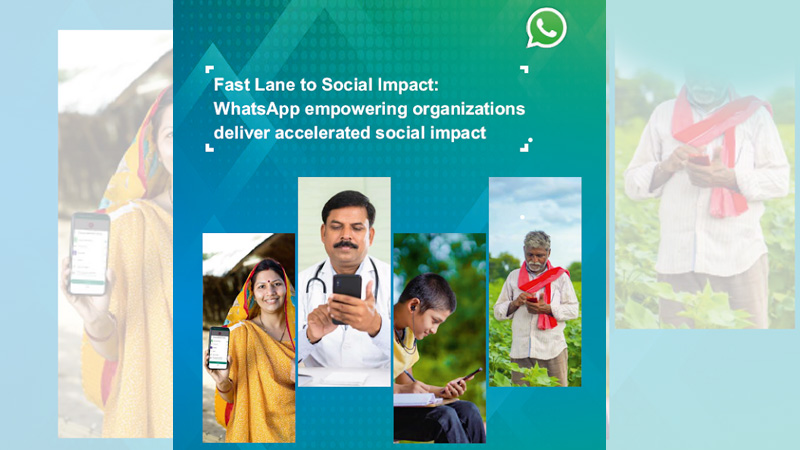
Mumbai: WhatsApp has released its impact report titled ‘Fast Lane to Social Impact’ that explores the pivotal role the platform plays in the lives of Indian users, empowering small businesses to thrive in today’s digital economy and powering social welfare organizations to drive positive societal change, often being the digital enabler for the last mile.
The report curated by Redseer Strategy Consultants, delves into the multifaceted impact of the platform’s offerings – WhatsApp consumer app, WhatsApp Business App, and the WhatsApp Business Platform [API], highlighting how the platform has transformed the way people and communities interact and conduct business by facilitating seamless communication.
Commenting on the launch of the report, Meta India VP, Public Policy, Shivnath Thukral said, “WhatsApp has emerged as a pivotal tool, revolutionizing the way individuals, businesses, and social welfare organizations communicate and operate. From supporting women entrepreneurs to providing skill development for the unemployed or even ensuring parents stay engaged with their children’s education — organizations are successfully harnessing the capabilities of the platform for driving positive social change. The success stories in the report are a testament to WhatsApp’s transformative potential and how its supporting different segments of society thrive in India’s rapidly evolving digital landscape.”
Empowering India’s MSMEs and boosting entrepreneurship
WhatsApp Business App has provided micro, small businesses and solopreneurs across India a democratized gateway to discover new markets and serve their customers, along with building a professional digital identity for their business.
WhatsApp Business has enabled small businesses to streamline operations and easily receive and fulfill orders online, helping them increase efficiency and expand their reach, including access to international markets. In turn, boosting entrepreneurship by providing local businesses and startups access to digital tools that put them on an equal footing with large enterprises.
. Moreover, The Confederation of All India Traders (CAIT) and Meta’s ‘WhatsApp Se Wyapaar’ program aims to digitally train and upskill 10 million local traders on the WhatsApp Business App. The partnership will be implemented in 11 Indian languages across all 29 Indian states.
. The partnership also provides 25,000 traders access to the Meta Small Business Academy, offering certification that enhances digital marketing skills.
Powering social welfare organizations to scale impact
WhatsApp has enabled numerous social welfare organizations in India to deliver impactful solutions in areas such as education, healthcare, financial inclusion, and women empowerment, driving positive social change and transformation at the grassroots.
. Mann Deshi Foundation supports over 100,000 rural women entrepreneurs by providing financial literacy and access to business opportunities across markets through their WhatsApp chatbot. So far, they have digitally trained over 15,000 women, 85 per cent of them being rural beneficiaries.
. Other use cases include NGOs leveraging the platform to scale initiatives like reducing period poverty, empowering pregnant women with comprehensive healthcare and baby care knowledge, and upskilling young professionals for better employment opportunities.
Building citizen services for efficient e-governance
WhatsApp has supported government agencies across the country to deliver efficient and inclusive citizen services. There are several innovative and impactful use-cases ranging from complaint resolution, promoting digital health technology, driving cybersecurity awareness, delivering local utility services, offering efficient and sustainable public transportation services, among many others.
. The National Consumer Helpline (NCH) is effectively using WhatsApp to streamline grievance and query resolution systems for a hassle-free experience. The chatbot enables consumers across India to raise complaints, access grievance records to track status updates and allows the government to spread awareness about consumer rights.
Additional Use cases and Impact numbers:
Social Welfare Organisations:
. Rocket Learning has leveraged WhatsApp in its mission to reduce early-stage learning poverty. By effectively employing WhatsApp for local dialect messages, it is able to empower parents to double engagement time, yielding a 30 per cent test score improvement and enabling 80 per cent of children to recognize numbers and describe pictures by age six.
. WhatsApp significantly contributes to Pinkishe’s mission of reducing period poverty by helping them reach the extremely remote parts to drive impact. The foundation has successfully conducted 5,000+ menstrual education sessions through WhatsApp.
. Robin Hood Army amplifies their food bank impact via volunteer groups, automated volunteer onboarding and donation processing, logistics coordination and simplified donor communication on WhatsApp. So far they have successfully garnered 240,000 active volunteers, covering 300+ cities covered with 30 per cent of new volunteers joining them through WhatsApp.
MSMEs:
. A small grocery store in Bhubaneswar uses WhatsApp to take orders and handle payments online. Customers get quick updates and bills, efficient door-step deliveries, while the store serves more areas—helping the local business grow alongside bigger grocery chains. The store showed 1-2 per cent direct revenue growth, with 10-12 per cent orders from WhatsApp and saves hours everyday by reducing customer queues.
. A housewife from Srirangam turned entrepreneur with an artificial jewelry business on WhatsApp. She shares product information via catalogs, accepts orders, and shares personalized offers to stay connected with her customers. The platform has helped her gather design feedback, grow her business, and balance entrepreneurship with family life. 20 per cent of her orders are from WhatsApp and she saves hours everyday by operating digitally.
. A fashion retailer based out of Lajpat Nagar market in Delhi, has been using the WhatsApp Business app for the past year and saw better visibility for its products amongst customers by using the catalog feature, leading to better sales and 10-12% revenue growth.
Government Organisations:
. Madhya Pradesh CM Helpline is using WhatsApp to help citizens voice their complaints and disseminate crucial public information, along with helping ensure safety and security of women through a 24X7 helpline.
. Bengaluru Metro is revolutionizing commuters’ experience, making life seamless and efficient through ticket booking on WhatsApp. It helps tailor experience and information by adding favourite stations, managing payment cards, and accessing fare details, routes and timetables.
. Cyber Dost, an initiative by the Ministry of Home Affairs, Government of India effectively uses WhatsApp to educate people about cybercrimes and online safety by sharing safety best practices and crucial information to drive user awareness and engagement.