Tag: RED FM

  • ‘Challenge is to convert local advertisers’ contribution to 50 per cent from 25 per cent’ : Abraham Thomas – Red FM COO

    ‘Challenge is to convert local advertisers’ contribution to 50 per cent from 25 per cent’ : Abraham Thomas – Red FM COO

     Red FM has gone through a sea change after the Living Media Group sold it to a consortium including Hyderabad-based Value Labs, NDTV and Malaysia-based Astro. Then Sun TV Ltd. acquired a 48.9 per cent stake to build a national footprint, synergising with its South India operations.


    Red FM has grown over the period, claiming to hold top spot in the lucrative market of Mumbai. It has also grown its base in Delhi and Kolkata.


    In an interview with Indiantelevision.coms Nasrin Sultana, Red FM COO Abraham Thomas throws light on some of the pertinent issues that plague the FM radio sector in a Bajate Raho style.


    Excerpts:

    What do advertisers identify with the Red FM ‘Baajate Raho’ brand?
    Advertisers associate Red FM as a young, energetic and pro-active brand. Any product or brand that targets between the 15-35-year-olds likes to get associated with Red FM. Even the local advertisers in each city where we operate – Delhi, Mumbai and Kolkata – are putting money on us as our content is wholly local.

    What about the listenership growth at Red FM in the recent past?
    The Red FM brand has been created with our innovative content and our ‘Bajate Raho’ attitude. We have moved from just being a radio brand to a FM station. Listeners identify Red FM as a station of expression. We have also ventured into TV. Our annual on-ground Bajaate Raho awards is going to air on Sony Entertainment Television.


    In terms of listenership, we have been consistently in the number one spot in Mumbai for the last seven to eight months. In Delhi we were a bit behind. Now we have climbed to the number two spot there. In Kolkata, we are the only station which play only Bollywood superhits unlike other FM stations which have Bengali music too.

    With Sun TV Ltd. picking up a stake in Red FM, what has this meant at the operational level?
    In the operational level, there has not been much change. In the ad sales front, the network is able to sell a national package to any advertiser.

    FM broadcasters are seen complaining about advertisers’ preference of TV and print over FM radio. Has it improved over the years?
    Advertisers have gradually started to realise the potential of the medium. The industry has seen a two-way expansion – growth from existing markets and new geographies with FM phase II expansion. In the last fiscal, the FM industry has expanded to deep pockets of the country. Definitely this attracts advertisers as FM radio is seen as an innovative mode of advertising in the smaller towns.


    In Red FM national advertisers pull 75 per cent revenue while the local advertisers constitute the rest. The big challenge is to convert the 25 per cent into 50 per cent. Only then can the FM radio sector expand its share in the overall ad pie which currently stands at 3.4 per cent.

    Has the launch of Ram (radio audience measurement) made any impact since advertisers can now have data to back up their spend?
    Unlike the TV industry, advertisers and FM broadcasters are not using Ram figures on a week-on-week basis. But a 4-6 week data provides a clear trend which we use to pitch to advertisers. Besides we use the trends which come out of time spend, cumulative and Tarp (target audience rating point) data to design and conceptualise our shows. They indicate content stickiness and the profile of the audience.


    The Ram figures have demystified a myth that we most often had. Pre-Ram, we neglected the weekend slot thinking that listenership is slender. Now we are concentrating on the weekend slot as well. The Ram figures clearly indicate that there is a strong listenership population even on weekends. Earlier when there was no data to refer to, most of the FM stations played back-to-back music with no jock talk.

    What are the other trends that the Ram figures indicate?
    Listeners start stepping in from 7:30-8:30 in the morning. This increases gradually, so much so that it beats TV viewing audience. But after 1:30-2 pm, listenership slides down. The 2-5 pm band faces a tough competition from the TV audience as during this time most of the general entertainment channels (GEC) have original content in the afternoon band. Radio listenership reaches its peak after 5:30 pm.


    There was another believe among us that highest listeners come in from the car listeners. However, Ram data proves this wrong as there are few listeners on the drive. Most of the listeners come in from mobile and personal set listening.

    Are you content with the Ram week-on-week data or you wish for some improvisation?
    Yes, it has been useful. At least something is better than nothing. We were not able to use the data of Indian Listenership Track (ILT) as it was out only on a quarterly basis. It was difficult to use the dated trends. The Ram figure is a good indicator. The best method in this connection is the electronic meter of mapping listeners. Only a few countries use that methodology as it is very expensive.


    The ideal thing to do in India is to have three different methodologies in three different types of market. The small markets can have Day-After-Recall (DAR) methodology, the big markets can use Daily Diary methodology while the metros can depend on Electronic methodology. But the Electronic methodology is not feasible in India as it is very expensive.

    The Indian Premier League (IPL) had its devastating effect on GECs and multiplexes. Has the FM industry felt the heat?
    IPL has been beneficial for us. Red FM is the official radio partner of Mumbai Indians IPL team. To cheer up the team, Red FM turned into Blue FM for one day. Red FM has woven both content and contest around cricket to promote the team. Vinod Kambli is our special cricket expert. He does a cricket review of the last day’s match in a humorous way.


    We also had a contest where the winners were taken to one of the matches when Mumbai Indians was involved. The winners were taken in an open bus to cheer the team with Red FM’s RJs.


    With innovation in content and different contests, there has been a spike in the listeners. But I can’t say for sure if this has been primarily because of IPL because school and colleges are closed for vacation. During this time of the year, we have spikes in listenerships. But we do not have corresponding figures as Ram was not available last year during this time.

    Is the Association of Radio Operators of India (AROI) pressurizing the government to take any decision on the issue of music content pricing?
    AROI is a new body. We have many an issue out of which pricing of music is one of them. I believe through AROI the matter will be sorted out.

    As one of the senior VPs of AROI, what do you think could be the possible solution?
    The FM industry needs a single leadership to sort out things. Large stations can pay more for music. The charge should vary according to category of the stations like A, B, C, D, E.


    The other could be if there is a revenue sharing model between the FM station and the music company.

    What are the other areas that AROI is concentrating on?
    Apart from the music rights issue, AROI is working upon methodology of listenership and finding new talent in the industry. With the expansion of the market, there is talent crunch which every station is finding difficult to address.

    How do you see Trai’s recommendation of allowing 49 per cent foreign equity in FM radio sector?
    It is a welcome move. The FM industry will see a growth with foreign players taking interest in the local medium.

    Do you think that the FM industry will see a change once news is allowed in the FM broadcasting as recommended by Trai?
    Yes, it will bring change to the industry but not to Red FM. Red FM is a total entertainment station for the masses. But there may be some operators who could position themselves as news FM stations to beat the cluttered market.
    How do you see Trai’s recommendation of multiple licensing in the same district?
    It would be a wonderful thing for the FM industry. Differentiation will come in after multiple license is allowed. It will pave way for niche stations. In the present situation very few stations dare to go the niche way as it fears losing a chunk of listeners. But with multiple licensing, stations can experiment a lot adding to the growth of the industry.
    Which are the different platforms you are experimenting with to build brand awareness?
    We have done good work in the brand activation front with our Red Activ team. We have expanded our footprint in the mobile vertical too by our exclusive tie-with Mobile2win. We syndicate our properties like Kamla Ka Hamla and Angry Ganeshan. Mobile2Win has a tie-up with the telcos by which subscribers can download our properties as ring tone, caller tone etc. But good revenue is yet to come from this activity.
  • Radio listenership growth slowing down in metros

    The message is loud and clear: growth of radio listenership in the two metros of Mumbai and Kolkata is slowing down. Even Delhi is seeing single-digit growth.

    Mumbai has seen a marginal 0.7 per cent quarter-on-quarter rise at 5 million while Kolkata grew 1.14 per cent at 4.24 million.

    Delhi beat this trend with listenership jumping 8.1 per cent to stand at 6.23 million.

    This is the latest findings of the Media Research Users Council (MRUC) commissioned Indian Listenership Track (ILT).

    The MRUC listenership data takes into account the age group above 12 years. The field work was conducted between 17 February and 28 April, 2007, covering a sample size of 4500 in each metro. The research firm uses the day-after-recall (DAR) method.

    What is particularly disturbing is that listenership is tending to stagnate in the advertisement-rich market of Mumbai. FM radio operators promote their stations heavily in the Mumbai market.

    Radio Mirchi Deputy CEO Prashant Panday contributes the overall slowdown to the absence of differentiated content. “The listeners can not differentiate one radio channel from the other. There is need for us to provide them with a varied programme mix. Niche radio station is required to widen the listenership base.”

    Agrees Red FM COO Abraham Thomas, “Segmentation of content is the only solution for speeding up listenership growth.”

    AC Nielson director client service ND Badrinath, however, attributes the slow growth to no adequate efforts from radio broadcasters to ‘shake up.’ He explains ‘shaking up’ as aggressive marketing and brand promotion. This is despite new players entering into the marketplace, he adds.

    How the players stack up?

    In Mumbai and Delhi, the big gainers are Radio City 91.1 FM and Radio One 94.3 FM. While Radio City has seen a 19 per cent quarter-on-quarter rise of listeners in Mumbai and 3.6 per cent in Delhi, Radio One’s listenership has gone up 23.8 per cent and 10.7 per cent in these two metros. Both these broadcasters have no operations in Kolkata.

    “Despite having no marketing actvities, our growth is relatively stronger. After the shift of Radio One’s frequency, there was a huge set back in our listenership. But we have come back,” says Radio One VP programming and brand Vishnu Athreya.

    Radio Mirchi, however, stays at the top. In Delhi it has 3.65 million listeners. Red FM lags behind at 2.11 million while Radio City is at 1.66 million.

    The gap is narrower in Mumbai with Radio Mirchi having 1.97 million listeners followed by Radio City at 1.85 million.

    Radio Mirchi, however, has lost a good amount of listenership in Mumbai and Kolkata. The number of Radio Mirchi listerners in Mumbai declined from 2.23 million to 1.97 million (11.73 per cent fall). In Kolkata, Radio Mirchi lost 16.94 per cent from 2.53 million to 2.10 million listeners. But in Delhi it has achieved a growth of 4.5 per cent.

    Admits Panday, “We have recognised the decline, but we never look at a single city data. We are the largest network and with the widest coverage. One reason for the dip could have been because we overplayed on cricket during the World Cup. Nobody was really interested after India’s exit. Listeners basically want music from FM stations.”

    Big 92.7 FM, a late entrant, has something to cheer about in Mumbai with a quarter-on-quarter growth of 31.1 per cent (1.22 million). But the disturbing trend is in Delhi and Kolkata where it has slipped by 8.2 per cent and 14.5 per cent respectively, according to the ILT data. Delhi, in fact, is one market where it has still to make a major impact with 0.6 million listeners.

    Big FM COO Tarun Katial dismisses such conclusions, “I am not aware of any such data. We do not subscribe to MRUC. I am waiting for the RAM ratings from TAM Media Research which will use the diary method. Only then we will get a clear picture.”

    A big gainer in the Delhi market has been Red 93.5 FM which has seen a 17.5 per cent rise. While in Mumbai it has gone up 8 per cent (1.56 million), it has shed 1.4 per cent in Kolkata.

    Industry observers, however, feel that this may be a temporary setback. Listenership can expand in the three metros with heavy marketing, they say.

    And many, like Katial, are waiting for the diary radio measurement system before they come to any hasty conclusions. Till then, they would like to believe that they are growing radio listenership in the three metros.

  • ‘In-house researches are very questionable’ : Abraham Thomas – Red FM COO

    ‘In-house researches are very questionable’ : Abraham Thomas – Red FM COO

    Sitting in a make shift office with everything from ‘superhit music’ to the constant chatter of the Red FM staff around thrown in, I sit down to interview Red FM COO Abraham Thomas who mentions that the brand new FM station office will be up and ready in a few weeks. The station has every reason to celebrate – the recently declared ILT results show Red FM at number 2 in Delhi and number 3 in Mumbai.

    Indiantelevision.com’s Sujatha Sreedharan catches up with Abraham Thomas to understand the story behind those numbers and what is up the Red sleeve for the year ahead.

    Excerpts:

    The ILT 2007 Round 1 numbers threw up a surprise. Despite all the hype and hoopla around radio players, the listenership has actually seen a decline. What do you think are the reasons for this?
    Although the ILT numbers are more or less in line with our in house research, I am clearly surprised as well that despite all the high profile launches in Phase II, programming innovations and advertising concepts, listenership has dropped by 6 to 7 points in Mumbai and Delhi. I don’t know whether it’s the anomaly in sampling or data, but I would have expected it to at best stay flat. There has been a lot of effort to increase listenership, so these numbers have definitely come as a surprise.

    With radio, the basic question that arises is about ILT and its methodology. I know that people are suddenly distancing themselves from the results or abandoning the data. But my point is that we shouldn’t throw the baby out with the bath water. There are shortcomings in the ILT – the MRUC has not really been proactive and has not been looking at the broadcasters’ concerns as they should.

    More than a year ago, I had raised the issue of cross checks. A couple of suggestions I had passed on included – a simple cross check whereby after the sampler is asked ‘what radio station are you tuned in to’, also ask him to give the name of a radio jockey from that station or a radio show on the station he listens too. Even if one of these questions is answered correctly, one can actually validate that data. MRUC agreed and said that these suggestions would be implemented but again they have gone back to their old ways.

    The other suggestion we had made is that the IRS use mastheads in its survey. Radio surveys can also include audio mastheads or get the users to identify a stations’ brand jingle or ask them to identify a station’s logo id. It’s not very difficult to do such a survey. So I am extremely disappointed with the lack of any user interactive activity.

    So yes, there are shortcomings but I maintain that these are early days still. I’ve always believed that the trend across the different waves tell a story. And it is these trends that we should look at.

    Are there other methodologies that we could look at? What works internationally?
    We could look at some of the international methodology. Some of the players are now advocating what is called ‘diary method’. In this method the smaller player might be at a slight advantage as the sampler who is impaneled is is forced to maintain the dairy and is therefore more conscious of the radio listened to. However, the shortfall here is that you are not capturing the information when you are listening to it. You’re filling in the data when someone comes to collect it. So it still goes back to ‘the top of the mind’ function.

    But I still believe it works because you are conscious of what you are listening to. You can also tackle the shortcoming by collecting the diaries twice a week. It will be that much closer to the point of listening and therefore the errors could get eliminated. Like I mentioned, the small players might get some benefit since they will be listed. All in all, I am saying that we have to have a more robust method.

    You spoke about players who have disowned ILT and rely on their own listenership tracks. Isn’t that an unhealthy trend?
    I am not against in house research. We do a lot of our own in house research for our programmes and to understand our market. The fact is that when radio players disown a currency like ILT, it is a short sighted approach and we are doing a lot of harm to the medium. If you want advertisers to put in more money, you have to allow them to justify this ‘more money’. For this you need a common currency. Overall in house researches and listenership tracks are very questionable. You might call it Maruti or Indica or whatever it is you call it, but bear in mind that you are doing more harm to the medium than good.

    Because of this emerging scenario, people tend to rubbish all the research. We have to collectively arrive at one common industry currency and that is the only way to grow the ad pie. In fact that is the only way all of us can survive.

    So for a two-month-old player to disown a listenership track is very shortsighted. I don’t think they are doing justice to their own medium.

    The branding story for Red FM with its ‘baajate raho’ attitude has worked for it. Is aggressive branding a need for radio players to stand out from the cluttered space?
    Has the ‘bajaate raho’ branding worked for us? Yes, of course it has. But it’s a combination of different things. I think one of our hallmarks is that we are a ‘mass player’ doing the same things as other stations but trying to do it differently.

    We’ve been consistent with our music. We’ve been consistent with our attitude – both on air and off air. Whether its our RJs or the aggressive on ground activity we get into, they are all in sync with our branding. In fact on ground activation has played a big role for us. We’ve been visible in local trains, buses, cabs, at shopping malls or traffic signals- every time you’ve seen us there is that single consistent thought on ‘local issues’ that has made us stand out. Our music is consistently super hit. We don’t play different music at different day parts. This absolute consistency with the Bajaate Raho attitude – RJs, music, advertising- on air and off air- has really been a driving point for us helping us stand out from the clutter.

    Mumbai plus Delhi – which are what the advertisers really look at at least for now- we have managed to stay at a number two (Delhi) and close to the competition at number three (Mumbai). In Delhi especially we lead the competition by at least 2 lakh (200,000) listeners. We expect to increase that lead in the next wave.

    ‘Packaging by definition means discounting’

    The branding effort by radio players is evident; but when it comes to the differentiation factor it becomes elusive? Adult Contemporary Hits (AC), Contemporary Hits Radio (CHR), super hit only ….radio players may throw this in as differentiators. But is this the only differentiation point we have?
    Firstly and strategically as a brand we look at consumer benefit on two levels. At one level we are offering them a very functional benefit – Entertainment. Music, cricket, Bollywood, music and even the local programming all of these form part of mass entertainment that we look at. In this stage we have decided to be a mass market player and therefore we have decided to stick with content which is not very different from what others are playing.

    Within music, like I mentioned, 24 hours a day we play the same music. It’s like a hot water strategy, you open the hot water tap and that’s what you get all the time. There’s no retro at night and house wife in the afternoon kind of music. We also promise that every song we play is not just a hit, it is a super hit and we arrive at that through our research.

    This is very different from our competition which no doubt plays a variety of music but it may be a hit song, or an unheard of before song or even a tomorrow’s hit. We are very clear that we play the super hits of today.

    We also believe that there is an aggressive differentiation on the emotional level- through content and packaging. That is the differentiation best exemplified by our ‘baajate raho’ line. If there is a topic that touches or concerns a common man in that city, we will play it, we will bajaao it. Clearly over the last year and a half, bajaate raho has become a local parlance. We have Bollywood coming on air and saying ‘please don’t bajaao us’, we have cricketers saying ‘you bajaaoed us today’. We have on air properties like Angry Ganesan, Kamla ka Hamla and Sharmajis ‘bajaaoing’ different issues. We have created a personality around Red FM.

    This functional and emotional benefit combined together is what sets us apart from competition. We also believe that this is a rule of three. The top three players will make most of the money. If you want to be in the top two or top three then you have to be mass market.

    If you are willing to be a niche, then you concentrate on different genres of music and programming formats. So you have to decide whether you want to position yourself as a mass player or a niche player. We clearly decided to be a mass player and we are gunning for leadership. Niches can be profitable too, provided you find your niche and market it aggressively.

    In a three to four player market, radio stations staying ‘mass’ may have seemed plausible. But in a multiple player city like Mumbai and Delhi, will it help to stay ‘mass’.
    In our case, we’ve consciously tried to build personalities within the radio with RJs like Malishka and Nitin who are likely to bajaao you if you meet them on the streets or within the studio. So our RJs, music, cricket will help us stay mass and we will try and build a personality for our station to stand out.

    There are format radios coming up that claim more music less talk or on the other hand talk radio. What’s in store for these stations?
    There are radio stations that are looking to play Hindi plus English music and for sure they will get their audience. You can go entirely English or play regional music – Punjabi, Gujarati, Marathi – you can differentiate on the context of language. You can also create a differentiation in terms of the content – for example talk radio.

    It is possible that these players might struggle in the beginning to monetize their content. While the top three will run away with all the money, the rest will find it better to define their target and then it depends on how well you service your segment.

    You can be a comfortable niche and make money. I believe that within a year or two radio stations and their audiences will get more defined. People will know where to go for what kind of music. One thing is very clear. You cannot be all things to all people. The leader who came into the market first, positioned himself very consciously.

    The radio entrants now will be forced to sharply focus their audience. The flip side of focus is that you have to give away one part. You decide your turf and then you focus.
    Within the mass space – 70 to 80 percent of the ad pie will be taken away by the top three.

    With the sheer number of players entering the markets, is there a fear that the space is getting cluttered or there are chances of a consolidation happening anytime soon?
    That is not what international trends show us. There are other cities in the world which have a number of stations catering to different tastes. There is a space for more stations to come up. But one of the reasons why we are still not getting a sense of differentiation is also because it is not possible to have more than one brand in the same city. When stations are allowed that there will be greater branding as well more genres of radio operating in the space. For now, since you are allowed only one station you want to be the biggest and the best.

    Given these constraints, where do you go from here?
    We have decided to be an entertainment station and if we have decided to be in the entertainment space then we have to work around these parameters. If we want to get into news and current affairs, then those are additional avenues. If cricket commentary was to be allowed tomorrow and I want to carry it on my existing station, I would have to do that at the cost of my music. There will be incremental new players who will come in and take those slots.

    But currently we look at a void in Bollywood entertainment and we are filling up that space. But the regulatory policies are fairly good and we are happy the way we are progressing for now.

    Almost every radio player says that – very happy with the way things are…
    If you were part of the Phase I, paying those exorbitant fees, you would be very happy with the playing field today as well.

    Non traditional advertising or activation units may be the new mantra but radio players have identified its benefits pretty early on. But where does it go from here?
    If you look at the three media- print, television and radio – there is a very distinct line dividing content and advertising. In television, you might blur these lines with programme placement and contests but in radio it is a seamless medium.

    Advertisers have been asking to be included into radio content a lot more, without being too obtrusive. Advertisers then started asking us to help them with 360 degree solutions for some of their products. We had a Ford Fiesta come to us and say that we have a car parked at a mall, can you have an RJ come down and do some gig around it.

    More and more people are asking that extra bang for the buck. This is the genesis of activation. It has also helped that advertisers have complained that there is a lack of a single, credible agency to carry out its promotions nationally. This is where we step in.

    Red Activ works on two premises- we build properties on which multiple brands can be built. The 93.5 Car rally worked that way. We also do single brand activation, where we look at solutions for clients. It is a natural extension for us and our medium is used to drive footfall for the client.

    In this advertiser driven scenario, do you think having a station presence across the country would help. Would you look at scaling up?
    The activation is an idea business. It is about an idea which the brand can then ride. Radio is a medium between the idea and the operation. It is driven from the fact that I have an idea, not that I have a radio station and therefore I look at activation.

    Sure it’s an advantage if you have a station in that city so that you can leverage the local market as well.

    On the same note, some radio players believe that the success of a radio station is in leading a particular city not in its scale.
    Fact is if you want to reach your audience and advertiser in a particular city, you have to be relevant in that city; you should connect in that city. This is the basic premise on which the advertisers work. I don’t want to be a number 6 player in Pune; I want to be a number one or two in any market.

    That is the first factor. Then is the issue of packaging. If I am in twenty cities then it is easier for me to package it in all these cities collectively. I believe I am number six in 45 cities; therefore I give you a discount of 10 rupees. But what is your relevance in priority markets? It is the priority markets like Mumbai and Delhi that sets the trend.

    Packaging by definition means discounting. In our media industry, people don’t package their media collectively. They will sell television separately, radio separately and print separately.

    We believe that we have to sell premium. You can’t just fall back on sheer scale; you have to be relevant in each city.

    But please bear in mind, that at the end of the day, packaging means discounting.

    Considering that the Phase II cities are mostly non metros, are advertisers even excited about this kind of packaging?
    The non metros opening up are relevant to sectors like FMCG or telecos but the bulk of the advertising is still restricted to the top 8 metros. What happens is in the smaller markets it is the local advertising that will have a dominant role.

    So while in the larger cities, 70 percent is corporate advertising and 30 percent is local, in non metros the story will be reverse. Besides the smaller markets are markets of tomorrow, while these are markets of today. So yes, you will have to invest in the markets of tomorrow as well.

    They will create new advertisers and pull advertising away from local media.

    You’ve been called a reminder medium, a secondary medium, an incremental medium. But are you still playing second fiddle to mainstream mediums?
    Right now we get three percent of the advertising pie, while internationally that number is closer to a 6 to 8 percent. In Sri Lanka, the radio advertising amounts to almost 20 percent. Unless the share becomes about 8 to 10 percent, it is not viable for the advertiser and we understand that.

    Secondly in other countries, radio evolved and developed before television came in. In India, it is the reverse. There is a lot of television hangover that is happening. Until recently, the creative agency, the client and the planner were more worried about meeting their objectives in the primary market – television and print. In radio, they invariably did not have the time to create ads for the medium and would pass off television jingles to play on the radio station as well.

    Lastly and more critically, there is not enough information to justify the advertiser’s faith in the medium. We’ve spoken about the methodology, it encourages confusion. Unless you get a currency where advertisers can confidently say ‘yes I can put my money over here and this is the reason I want to do so’ the ad pie will not grow.

    But it is changing. Brands are being launched on radio. We’ve created a creative solutions team within our station that works for various clients – we say that don’t give us those television commercials, give us a brief and we will create an ad that is more relevant to the medium.

    But data that justifies the spend is a big concern. Most radio players however look at this as an advantage to pick and fight over each other instead of viewing it as an industry issue. They look at it and say … ‘good!let the small players bleed; we will look at how to milk this best’. There is a bit of a short term consideration. It will be a while before this matures into a more robust industry body.

    What would the road map for Red FM look like in the coming year??
    Radio is projected to grow rapidly. The growth however is more geographic at this stage. Within the city, the growth is encouraging but at a slow pace.

    In our case, we realized that a lot of our listeners are connected to our personalities, our RJs, our properties like Angry Ganesan or Kamla and therefore we have made them available to download on the mobile phone. We launched an initiative called the Red Mobile. We work with mobile2win and you can download all these properties for a price. That’s a logical extension. We are also looking at our net presence. In fact our site should be up this month. It will be interactive – celeb chats, blogs, trivia – you will find them all.

    Right now of course we are looking at cricket. We have contests, tie ups and loads of prizes. As part of this initiative we have a tie up with Sports Bar at Phoenix Mills in Mumbai. We plan to extend this to other cities as well.

    Radio is no longer a passive medium. It is now well and truly an active medium both for the listener and the advertiser. By the end of this year we will look at local advertisers and how to target them as well.

    But bottom-line – We are gunning for leadership.

  • Red FM presents ‘live’ music preview of Nishabd

    Red FM presents ‘live’ music preview of Nishabd

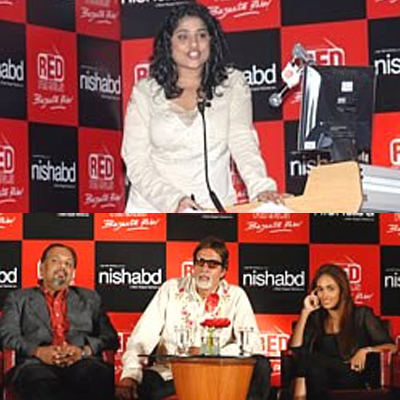
    MUMBAI: Red FM promises constant innovative programming to its listeners. Keeping in line with this, the station presented a ‘live preview’ of Ram Gopal Varma’s soon to be released film, Nishabd at a press conference on 17 February.

    Director RGV along with Vishal Bharadwaj, Manmohan Shetty, Amar Mohile, Bhushan Kumar and the star cast Amitabh Bacchan and Jiah Khan were present at this unique preview which was aired across all its FM stations live. Recreating a radio studio right on the stage , RJ Malishka presented the show chatting with the director, music director and stars of the movie.

    Commenting on this unique initiative Red FM COO Abraham Thomas said, “This is first for any radio station in India. With this event we have raised the bar in terms of providing excellent content and innovative programming for our listeners. This association helps Red FM further strengthen its commitment towards bringing the best of Bollywood for its listeners!”

    Speaking about the music launch, director Ram Gopal Varma said, “Nishabd is a beautiful movie with a very sensitive subject and needs to be promoted with extreme maturity. Red FM has done an excellent job of showcasing the music of the film and we are extremely pleased with the kind of reach the movie has received with this first ever live music premiere on Red FM.”

  • What Women Want

    It’s a socio political statement that became a mass movement. Today countries across the world celebrate it. It is ironic that what started out as a protest movement to discuss the terrible working conditions and low wages for women in a textile factory in New York City has been reduced to a jamboree of commercial messages that media indulges in every year.

    So we at Indiantelevision.com, decided to step out of the circle and ask a few women in power across the board what they thought about Women’s Day and whether at the end of all the lip service paid to them and their talent, corporates were actually sensitive to their needs. A range of answers, most of them positive of course, lead us to believe that corporates are indeed sensitive to their women employees. But it is also a sign of times that most women we spoke to take pride in the fact that they have made it to the top not because of organizational support, but despite it.


    It’s a large talent pool out there waiting to be explored and exploited. Is it time media organizations take heed. Perhaps it is.

    Here is a look at what some power women had to say –

    Vyas Gianetti creative chairwoman and chief creative officer, Preeti Vyas Gianetti says: “The business scenario in India still works within man made structures. It is a highly competitive field and women are proving to be an important human resource. Studies indicate that women are much better at handling relationships; they are better team workers and team builders, more inclusive and surprisingly – bigger risk takers. Women are also more defiant in defeat, that is, they have an attitude that screams ‘I’ll show you… I’ll do this better next time’.”

    So are corporates recognizing this trend?

    “I would say that there is an increased appreciation of women’s talents in the corporate sphere today than ever before. But we have to admit that it is a slow process. Some corporates are agnostic to the change; some others are taking their time but are making the effort. I know that the HR policies and therefore thewomen leaders in a corporate like ICICI get a huge boost but the media is catching up too.

    “I also think that corporates would be ignoring the innate leadership capacity of a woman at their own peril. Greater acceptance needs to come in and in fact will.

    “Also the glass ceiling affect is an internal proposition and most women have already broken through it. The need to restructure corporate policies will occur but once again, these are not compromises that a corporate is making. They are merely augmenting a process that will benefit their talent at work.

    “That said, any such support by a corporate cannot be forced. That kind of culture must evolve and will evolve over a period.”


    Madison Media Group CEO Punitha Arumugam takes a clear position about why women should not ask for concessions or privileges from their organizations. “Is media woman friendly? But why should they be. I think corporates judge you by your capability and not what priorities you may or may not have. As for the whole myth of a glass ceiling, I think women broke that a long time ago. My whole point is, ‘why should corporates be held responsible for the personal choices we make.’ So sure, women might want to prioritize their family but then they will also have to fend for a back up or support system. To make an organisation responsible for it is unfair. And making work an excuse for neglecting a family or not having a family is not right either.”

    Nick VP & GM Nina Elavia Jaipuria who has experience in advertising, FMCG and media believes that there is no real gender bias or preference within the media industry, both genders are given an equal opportunity to deliver. As far as balancing work with family, it works in the same manner for males as well. 

    Jaipuria adds, “Its more about the intent, you have to prioritise. If you want it to happen, you have to make it happen. And as for juggling work and home, multi-tasking is what women do best, its comes naturally.”


    CNBC TV 18 anchor Shereen Bhan is a recognizable face in the field of business television. She tell us why corporates may have to look at some of their talent and provide support to them if they intend to retain them. She says, “I think with media the problem that we essentially would talk about is time. Fortunately in media we also have a ‘flexi time’. We do not keep predictable time but that also means that if we are not talking a 9 to 5 job, we are also not talking about being at work 24/7.

    “I think what corporates need to address is the question of a support system for all its employees and not based on gender alone. Should we have special privileges? Increasingly corporates do step in and look at a particular talent and see if it’s worth their while to accept certain demands. This is not a case of bias, but then you also have to prove your merit before you get special privileges.

    “Also, I think, the reason why one might notice fewer women at the top is simply because women do opt out themselves and this might have nothing to do with the organisation. You can’t be everything to everybody. So yes, in the case of some women, the glass ceiling is purely internal.”

    Times Now anchor Mini Menon gives a thumbs up to most organizations she has worked with as well. “I think when you work with professional corporate organizations you do not have to worry about gender concerns. I have worked as a reporter across organizations like BiTV, Star, CNBC and now Times Now and they have all been equally sensitive. So whether you are talking security during reportage, late nights or even living conditions while on report assignments, the news organisation has been most supportive.

    “While I was at CNBC and closer to my delivery date I was given the choice to work fewer hours or even now at Times Now I am given complete freedom. But apart from the sensitivity issue, I think most women also understand that if an organization goes that extra mile for you, you have to be equally responsible at work.”

    Red FM RJ Malishka, who has just completed a marathon shopping session gearing up for the morning Women’s Day special, huffs and pants through the conversation when she says, “Radio is at a nascent stage and although it is male dominated, being fewer in number is an advantage. Yes, there are pre set ideas and lines are drawn clearly between men and women junta at work, Red still tends to be more supportive of us women.”

    Does she ever wonder what it would be like to do the balancing act between being a mother and a cool RJ all at the same time? “You have a field like advertising and you know you will be working crazy hours there. My sister has to work crazy schedules and I always tell her to quit because really, it’s bad for the ovaries. That said, I can almost imagine a day when I will wheel in a pram into the radio on air studio and say ‘Be quiet, mama needs to go on air for the next 30 minutes’.” Cool mom, indeed.

    ShowM’s Ravina Raj Kohli says that she has never faced any such discrimination during her ongoing career in media. “It becomes a problem when you think of it as a problem,” she asserts. 

    TV 18 web property IndiWo editor Swapna Chidambaram says, “I believe that the media is one sphere that allows you to choose the hours you want to work. It gives you the freedom to be a free lancer if you should so choose.”

    “Earlier, women picked 9 to 5 jobs and were satisfied. Today they venture out, look at a vast variety of disciplines and choose to work in a competitive arena. Today you have more female photographers choosing what was once a male domain. The talent pool has increased and this is certain to contribute to even more women leaders.

    “A more important issue that I would place stress on is that women should take an equal onus to perform. In media women can prove themselves based on talent and dedication and rise based on merit alone. So today, we need to establish ourselves as expert writers, photographers or whatever our chosen domain is and NOT on account of being a “woman” in a man’s world or anything.”

    UTV broadcast COO Zarina Mehta explains that because the media industry is still new, 7-8 years old, it is largely dominated by women. “I believe everyone is given an equal chance and that just goes to show what women can do. Maybe, in other industries like banking and engineering there still exists a bias. 

    “I don’t believe in Women’s Day!” staunchly declares Mehta.

    Strong words we admit. But is it such a rosy picture after all? The predominantly female team at Indiantelevision.com thinks that’s just one more facet to a woman at work. It ain’t all good, but there’s no point complaining. As for the organizations, amidst all the celebrations and cake cutting, it would be a great time to sit back and reflect on what can be done to give women power the impetus it clearly needs.

    On that note, Happy Women’s Day!

  • ‘Radio will certainly see consolidation next year’ : Apurva Purohit – Radio City CEO

    ‘Radio will certainly see consolidation next year’ : Apurva Purohit – Radio City CEO

    The radio industry is poised to make its next big leap as radio stations gear up to implement the Phase 2 licenses. The metros have been covered and it is now the turn of the smaller cities to experience FM magic. Radio City has been a pioneer in the FM boom with the first ever FM station in India- Radio City, Bangalore set up in 2001.

    Five years on Radio City CEO Apurva Purohit details the changes in this dynamic industry and all the challenges it’s yet to face in an interview with Sujatha Shreedharan from Indiantelevision.com

    Excerpts:

    The Phase 2 bidding has seen the major networks, including Radio City, expanding their footprints to cover mini metros. What are the unique challenges one would face when it comes to setting base in a small local setting?
    Clearly, when we had decided to go in for the second phase of bidding we had decided to restrict ourselves to metros and mini metros only. Essentially what we were saying is that we will go for the top 15 cities where we have over 70 per cent of the advertising revenue and they are in certain tone and manner and feel similar to the large towns we have been operating in.The only exception is the whole Maharashtra belt which includes Ahmednagar and the smaller stations. And this is a call that we took because networking is allowed only in these cities which means you set up your network in Ahmednagar and run Sangli and Nanded from that station. We took that call because we wanted a network station in our portfolio. Also Maharashtra is a rich state and works from the advertisers perspective. We also believe that our SEC A and B market are not dramatically different in these regions whether it is in terms of sophistication, exposure to media or even exposure to FM. They may be at different life stages but in terms of consumer, percentage of SEC AB population, income level or education or even ethos they are broadly similar. Also you must remember that we have been running the Lucknow FM station for five years. We have the experience of running a FM station in a mini metro and we hope to translate this experience into other smaller cities.

    What about the language and flavor of these upcoming FM stations?
    Radio City does believe in typically adapting itself to the local flavor. At the same time you must remember that we are positioned as a premium, up market SEC AB kind of stations. Therefore our language mix does tend to be different from the typical mix than a mass station is concerned. For instance in Bangalore we do run a lot of English, Hindi and Kannada whereas the other stations are typically Kanada stations. In Chennai, we are very much English and Tamil. In that sense, the kind of RJ talk will be focused on the premium market.

    What about a city like Pune?
    You know Pune is culturally very similar to Mumbai, so that is the kind of mix one is likely to find. Of course it will be adapted to the local culture of Pune which is rich in theatre or Marathi music.

    With the setting up of stations in mini metros, Radio City will now look at dual competition – from existing network players who are also setting up their stations as well as from single city players. How will you tackle that?
    Certainly the local players have taken a single city or selected a particular city because of various reasons like their already established status in say print or publishing. So they are very focused and are able to get into a mass position because they are local. Besides radio while it may have a national brand, does tend to also try to be local. So there is competition. Big, small, single city networks – they are equal competition. The other thing is that I think the position we have taken which has evolved over the last five years is differentiated not only from single city players who are local or mass but also the network player. What I am trying to say is that single city players tend to take the bottom end of the pyramid – local, regional, SEC ABC, while network players have taken the SEC AB kind of position which is mass but on a network level. Direct competition is therefore the network players, while local stations tend to be competition to players like RED FM.

    What about advertising revenue accruing from mini metro stations?
    In fact content is where you could say that differentiation gets greyer. As far as revenue is concerned, that’s a no-brainer since we are trying to get ads from the corporate clients and large national players. In that sense the local players are no competition. The question to ask is – Is the advertiser trying to buy radio because you also have print or is the advertiser trying to buy a good network which is either number one or two. We are very clear that we as a network focus on the right kind of network in 15 of the top cities. In revenues there is no competition. As far as content goes, there will be competion with local players.

    A few years ago, differentiators were perhaps easy to identify within the few radio players. With the numbers growing how does one still hold on to or reinvent that differentiator?
    I think the whole industry is in a state of flux. My opinion is that now, when the newer players come in they will have to recognize that if they want to grow the listenership pie they better come in with different options. The newer guys have to come in with different languages or different formats and personally if you ask me that is not happening right now. All the newer guys have really not lived up to our expectations of trying to build a differentiator and as you are rightly saying therefore today there is a mass of similar feel players. You could also say that there are certain brands which have been there for five years and therefore they have equity and there are others which are just entering the market and they are broadly similar. You must also remember that the investments in brand building have happened only recently. Before this the whole industry was struggling to find its own feet. In that sense the industry is still very nascent in terms of trying to build an image for itself. Given those kind of issues and challenges, we have been trying to portray Radio City as a brand, say, which is different from a Radio Mirchi perceived as a more aggressive and in your face – teeny bop kind of station to our more softer, slightly older 25- 30 years, premium listenership. And that has developed over a period of time and is becoming clearer only over the past year or so. Sure, the differentiation worked in a non competing market. Today, however, you have to take it to the next level and we at Radio City are doing exactly that- pushing this whole process of identifiable branding to the next level.

    Could you explain how you plan to do so?
    It is a little premature to say that, except that the intent is very much there. But if you had to look at international examples certainly there are differentiations that could be built in at the psychographic and demographic segment. Even demographically, what an 18-year-old youngster wants is different from what a 25- year-old youth wants although they may fall under the similar youth category. So if there is a difference in the kind of music they aspire to hear, they must be given that. And the radio that pushes this difference will be the radio station that stands out in the long run. I think where people have failed is that they have tinkered with the branding or marketing story but have done nothing different with the product. At Radio City we are very clear that we will only talk about the differentiation when we can actually demonstrate it in the product. No one has made that differentiation although we have tried various innovations. With Mughal-e- Azam or Babbar Sher or more chat shows. But we believe that we can really fine tune the product far far better.

    Is there a sense that this overdependence on Bollywood by all FM stations is the real cause of similarity in programming?
    I think that there is Bollywood and then there is an equally vibrant music industry although we tend to put them all in the same basket. But if you remove the animal out of the Bollywood cage, then you will realize that there is almost a 100 years worth of beautiful music. It’s just that a lot of it happens to be mostly from Hindi cinema. Ultimately it’s the music of the nation. All of us are using popular music and that is a fact of life. We are ultimately mass stations aren’t we? If we were niche stations we would have jazz. But it’s not fair to say that Indian radio stations are equal to Bollywood and therefore ‘Che!’ They are not different. Internationally also all mass stations do look at popular music. Almost 80 per cent of international stations play popular music except that they are able to differentiate themselves in terms of appealing to a particular target group or by playing only a particular ‘sound’. Unfortunately in India, we are yet to go to that second level. This can be due to various reasons- nascent industry, unsound policies. Besides how old is this industry? About five years old. Out of which four years we spent struggling to stay afloat. It’s very easy to beat up this industry with the ‘Bollywood tag’. But we’ve barely stabilized over the past two years. So there’s no doubt that the differentiation has to come and will come. And it will be led by pioneers like Radio City. If you ask me, even within the context of popular music you can differentiate.

    How long do you think this process of evolution will take place?
    According to me FM started evolving last year when the government announced regulatory corrections and a fresh package. Look at the growth since then. We have grown in stations. The number of players in each city has also increased and even in terms of content – you have an Indigo which plays English music or a Fever FM which experiments with format radio. So one phase of evolution has already happened. The second phase of evolution will start now where players like us really chart out our different positions which will happen in the coming six months. Then there will be an era where there will be more consolidation and regrouping. Some players will fall by the wayside, some players will push ahead. In the next year there will certainly be a lot of consolidation. Then there is the station setup, scaling up. A year ago radio city had about 100 people. We are now looking at having about 300-500 people in the next few months. Isn’t that a spurt? The natural evolution in any other industry would have been ten years; we have done that in three years.

    ‘The natural evolution in any other industry would have been ten years; we have done that in three years’

    Do you believe that there is bound to be a clutter with the number of radio stations coming in?
    I don’t think there will be a clutter, but in the frenzy to launch radio stations I believe that learning will not happen as it should. Learning and qualitative inputs. There is no luxury to actually test market a product or try a pilot launch. Now you say, lets launch first and we’ll figure out in the market if it needs to be changed.

    There is a huge debate over the tools used to measure listenership and advertising on radio. What does Radio City turn to?
    Of course the first thing that this industry needs to do is set up a robust currency to determine advertising and listenership. There is a strong movement towards it and sooner rather than later it will have to evolve. We prefer to use NRS and then we have Synovate which does our brand research for the last three quarters. We are just waiting for the industry to stabilize before we declare these findings publicly. We are looking at listenership understanding, listenership pattern in different cities, psychographic and demographic pattern.

    Is the industry complaining about the FDI regulation in radio which allows for only 20 per cent foreign equity?
    Currently we are happy with whatever the government has allowed considering we spent five years working hard to convince them. We are quite ecstatic about what we got. I think the government itself needs to realize that the industry is in a state of buoyancy and it must give whatever impetus it can – news and current affairs license, networking, multiple frequencies or FDI. Quite honestly, the first three rather than FDI.

    Is Radio City looking at multiple licenses and what kind of stations would you be interested in?
    Yes we would. But for now it would be like blue sky gazing. We would look at news and current affairs, different genres of music, spirituality or even different languages.

    Is there a worry about lack of a sizeable talent pool to choose from?
    Talented and skilled people is something all radio stations are worried about. Where does one get trained people from? You have to do your own training. Fortunately we realized sometime ago and we have invested reasonably in increasing the skill set. Since we’ve been here for five years, we have had a large number of people working for us. Even then it has been a challenge for us.The other problem is of course being attractive enough as an employer for a talent pool to come to us. We try to build ourselves as a brand which is informal or a fun place to work. Very ‘un media’ is how I would describe it.

    What does the re entry of Star mean to Radio City?
    It is purely an investment decision at a shareholder level. At the operational level of the company it has zero impact. And besides we have alliances with most networks as clients or media partners – DNA, Zee, Sony and Star. So there won’t be any special content tie ups with Star. So operationally nothing, it’s purely an investment decision.

    Can you give a comparative understanding of how radio looks – 2006 versus 2007?
    In terms of the ad pie there has been no dramatic change. While there has been a 30 to 40 per cent growth, there will be no big change since the new stations have not been all set up and operational. Between 2005 and 2008 one is looking at doubling the industry. It will grow from 2.5 to a minimum 5 per cent simply due to geographical coverage area. In fact we would have more than doubled if there were far more genres on offer. It won’t go up to a 60 per cent unless people start segmenting and providing different products. If I were a new player, that’s a question I would ask.

    What about the revenue and listenership growth at Radio City in the past year?
    Revenue wise we have clocked a 40 per cent growth last year. As for listenership, if I were to give a Bangalore example it has grown from 1.5 million to about 2.5 million listeners which is almost 60 per cent growth.
    Radio City has also jumped on the bandwagon to have celebrity RJs on air?
    We are very clear that a celebrity won’t work unless it’s what the programme wants or what the brand wants. Using a celebrity just for the heck of it won’t work. Taking a TV star and putting him on radio is just gimmicky. We concentrate on RJs in terms of their music understanding power. Sonu Nigam speaks about Mohammed Rafi, Roop Kumar Rathod talks about ghazal maestros. In so far as the celebrity enhances the music experience on our audience, we’ll entertain the concept. And this is the case for all radio stations, not just Radio City.
    What about the music industry and the high rate of fees it charges radio stations?
    Somewhere we will have to understand that radio will only help drive their CD and DVD sales.The cost of purchasing music must be justified. We as a large network may deal with it but what about smaller stations.
    Radio City recently tied up with Vibgyor Brand Services for on ground activation? What kind of details have been discussed since the launch?
    We are in the process of client briefings with various advertisers. We are already offering one level of on ground activity. But our clients are asking us for more than just sales promotions. They want more exciting ways of integrating our client’s needs.
    What according to you would be the next fillip for radio?
    The next fillip is of course the launch of stations in 91 cities. After that, the sky is the limit. How we use radio with net, outdoors, events, with new age media will also come under sharp focus. Look at radio and mobile. Radio used mobile much better than television. We receive 2-3 million text messages from one city, while television sees that number nationally. As for us, currently we are in the process of setting up our stations in Gujarat – Surat and Ahmedabad – and are in the process of employing people.
  • RADIOACTIVE

    Radio Mirchi has it, Red FM has it, so too Big FM, and now Radio City has gone and got itself one too.

    We are talking about radio activation units- the latest buzz word in radio. Although new to Indian airwaves, activation units in media have been a global trend.

    Indiantelevision.com does a quick check to see how ‘active’ is radio?

    According to radio studies conducted internationally, in most markets, radio manages to garner around 4-5 per cent of the mass media spend. Compare that to the latest TAM AdEx study (total media ad market 2006) where radio clocked in at 3 per cent. It‘s important to note that, private radio in India came into being with Radio City in July 2001. That‘s only about six years into its existence and private FM players are already looking at a 58 per cent ad revenue growth across media. (Figures: 2006 versus 2005)

    So what makes radio an attractive option for advertisers?

    Given that Radio is perceived as a personal medium, radio can bring brands closer and speak to the consumer at their level. Radio has a culture of response where listeners frequently interact with their station which they see as accessible. Couple that with the fact that a below the line event would promote both the client‘s brand and the radio station connect with its audience and you have a win-win situation. No wonder then that radio stations are adapting to the expanding market by providing add on services to their advertisers in the form of ‘activations‘ or non traditional revenue (NTR).

    ‘Experiencing a product via radio‘

    While print and television still attract the advertiser, the emphasis is shifting towards activation and non-traditional media, since the clutter level in the television space is very high. Also ad avoidance by listeners in radio is almost nil in comparison with 68 per cent in newspaper and 44 per cent in TV, and local reach makes radio a very effective medium of advertisement.

    Besides, radio offers far tighter targeting which means reducing wastage or spill over. Radio brings brands closer, as listeners identify with their radio station and see it as aimed at people like them; radio is better able to communicate the tone or character of a brand.

    Radio also offers tighter timing – within a particular time band, day of week or even week of month. This time specific character of radio is helpful since listening is highest when shops are open. So one can target a Pizza Hut ad in the afternoon and follow it up with a below the line creative activity around the product and have the consumer reaching over for a pizza takeaway immediately.

    Talking about the trend of setting up activation units by radio stations, Mirchi Activations, head Gautam Shahane says, “Activation units offer a synergy between below the line and above the line advertising. It allows access to multiple touch points through multiple creatives in a focused area. It allows immediacy, and so promoting an event can be in real time. More importantly radio can monitor responses to a particular activity almost instantly and fix it whether it‘s the lack of footfalls at an event or a change in the pitch, creative or running a contest.”

    Mirchi Activations set up as a separate unit in 2005 although the FM station had been providing BTL (below the line) services even prior to this.
    Perhaps the greatest strength of a below the line activity created by radio is its understanding and relationship with a geographical area, its people and its culture.

    He says, “We see that Pune is a booming real estate sector, so we approach clients like real estate developers or builders. We would do that in Kolkatta as well as we see a demand there. But in a Bangalore we would target the BPO or IT sector since that‘s where our client and audience both connect. Similarly, we have properties that showcase different cities in a month long cultural extravaganza.”

    ATL advertsising is more strategic and planned while BTL can be more tactical and with the kind of reach we have within the A and B category towns, our activation can be converted to a pan India initiative.”
    Most radio advertisers include FMCG, durables, auto, telecom, retail, BFI‘s (insurance, tax planning etc.)

    “This quarter will see a lot of BFI‘s clamoring for BTL activities as fiscal year end approaches,” explains Shahane.

    Red FM activation unit is an in house team called Red Active. Red FM COO Abraham Thomas explains, “We approach activations in two ways. There is activation solutions for multiple brands through a single event as long as they are non competing brands. The other approach is the single- client driven ground activation. So we will have the RED FM drive where we partner with several brands. At the same time we have a auto client like Ford who approaches us and we put a spin on that campaign through car displays at a shopping mall and integrated programming around it.”

    Why would an advertiser approach a radio station and not an event management firm for activation?

    The answer is unanimous within radio circles. Most agencies or event management companies only form part of the implementation or execution part of the campaign. An activation programme by a radio station would mean being involved in every stage of the campaign right down to monitoring the footfalls and response for the client.

    Shahane insists that radio stations claim “ownership” for the entire campaign and that is why they are attractive to advertisers.

    Also radio stations own certain unique properties that can be aligned to a brand and maximize opportunities for the client. “We partner with them on each event. It is also an opportunity to showcase our brand, and we are very sensitive to this fact. We know best how to use radio to promote events, and supplement it with other media on a case to case basis. But the strengths of radio are utilized to the optimum to promote events.”

    Mirchi Activations works with a tagline that reads ‘Not Just Radio‘. With the mammoth Times Group network behind it, it isn‘t just a tall claim. But do established networks necessarily convert to more successful activities?
    Not so says Thomas. “Although we do offer 360 degree solutions to a client and will use multimedia campaigns to promote his product, we are an independent station. Besides, every media utilized by the client would cost him a separate amount. So it would depend on how cost effective we decide to make the event.”


    ‘Big Reach‘ for Big FM

    Big FM marketing head Anand Chakravarthy adds, “With television the reach is usually national. Our clients often complain about a spillover on television advertising. So if Surf excel is looking at targeting women in Rajkot – on television they may not find their right target audience mix. But radio can easily manage that.”

    Radio City became the latest FM channel to add ‘activation‘ to its range of brand value services after Red FM‘s Red Activ and Radio Mirchi‘s Mirchi Activation. While Red and Mirchi ‘activations‘ are in house, Radio City has announced its strategic alliance with Vibgyor Brand Services.

    Radio City marketing head Rana Barua says, “Vibgyor has a senior representative on our team and the client meetings and briefs are discussed together. So we offer a one stop solution to the client. Since we act as a one stop window to our client we offer both productivity and speed.”

    Interestingly, ad spends by print houses and television networks are also seeing an increase on radio.

    As stations become more targeted they would also evolve into strong and distinctive brands, and they would deliberately cultivate their brand values in all their on-air and off-air activities – events, contests, helplines, etc. Once the brand values are established, advertisers could leverage them to give a positive effect to their own messages.

    Big FM has lined up an advertising and marketing budget of Rs 450 million across the country until March 2007. The money will be distributed across the various Big FM stations according to their revenue generations. The FM station also plans to use all traditional media, below-the-line activities as well as have used cable and cinema spots.

    Thomas says, “Red Active is a single point contact for the advertiser. Earlier, you‘d have an event taking place in Calcutta and the sales and marketing guys in Mumbai trying to figure out the response or check if the creative was being executed according to the brief. With a Red Active in place we take over the entire process from discussing brief, to providing creative solutions to implementation to measuring response. The aim is to provide an extra bang for the client‘s buck.”

    Chakravarthy says “In Mumbai, we had taken over the entire Inorbit Mall for a month for our client Coke and had a New Year‘s carnival. Our advantage is that we have a very large network of 11 stations.” He also informs us that it is the smaller markets that now look at activations.

    Not all activations are related to advertising alone or so say radio heads. Big FM organized a New Year‘s party for the Indian army and Red FM also ties up with the Tata Cancer Research institute for spreading awareness of breast cancer.

    Then you have a few exceptions to the rule as well.

    Fever FM operating in Delhi and Mumbai used artiste management company ‘Only Much Louder‘ for activations during its own launch but has no plans to set up a separate unit so far.

    Only Much Louder, co founder, Vijay Nair details the kind of campaign they mounted for Fever FM. “Since the idea was ‘less talk, more music‘ we had people donning chef costumes or dressed up as clowns lining the streets in various parts of the city with their mouths sealed shut and placards that read ‘No recipes, only music‘ or ‘No silly jokes, only music‘.”

    Fever FM station director Mumbai Sajjad Chunawala says, “We are a very small team in marketing right now and have no plans to set up a separate activations unit. But as our clients approach us, we may take on the job or outsource it depending on the client needs.

    Judging by latest trends a lot of traditional advertisers are also ready to take the risk and try the medium.

    HLL was a predominant print and television advertiser but has now included radio in its media mix. Chakravarthy tells us that HLL‘s ad spend is now divided at a 50/ 50 mix with radio playing a huge role.

    HLL advertises almost 60 percent of its brands on radio with about 2 to 3 percent dedicated to radio advertising. Mindshare Fulcrum‘s national activations head Himanshu Shekhar opines, “We use media for kinds of effects – Incremental or Impact. Radio is still seen as a ‘impact medium‘.

    Activations help radio stations connect their brands with the audience as well.

    So Radio Mirchi benefits not only in terms of revenues but also in terms of on ground presence, visibility and an opportunity to be at a consumer touch point. Activations have truly demonstrated the power of radio in driving response or footfalls.

    Last word

    Radio offers tremendous opportunities for advertisers and media planners need to explore various options by which they can effectively use radio in their media mix. Conversely, broadcasters need to develop the market by being more responsive to the advertiser‘s needs. This will provide an opportunity for the market to arrive at the final verdict on the effectiveness of the medium.

    Chakravarthy says, “In a country size like India, it is not necessary to touch every market but everybody in a certain market. What radio activation manages to do is amplify the effect of advertising. The advantage of radio is that any ground level activity or below the line marketing becomes amplified.”
    Thomas says, “Red Active is a single point contact for the advertiser. Earlier, you‘d have an event taking place in Calcutta and the sales and marketing guys in Mumbai trying to figure out the response or check if the creative was being executed according to the brief. With a Red Active in place we take over the entire process from discussing brief, to providing creative solutions to implementation to measuring response. The aim is to provide an extra bang for the client‘s buck.”

    Barua concurs, “Advertisers no longer want just plain vanilla advertising. It‘s important that the consumer is able to feel and touch the product. Activation allows for that experiential marketing.” Although declining to discuss specific clients Barua says that briefs have been discussed and the newest player in the activation field will soon launch events and properties associated with its station.

    Shekhar brings in the planning perspective when he says, “If we had to divide the HLL radio advertising spend according to ATL and BTL advertising it would have to be 3/7. The trend is to allow for more integrated programming and content led advertising rather than just plain vanilla advertising. The Surf excel campaign which we conducted across all stations was one of the single biggest campaigns where each radio station adapted it with a different creative. In that sense, it was unique. The power of the medium to cut across all target groups and appeal to both emotions and humour is immense and this is where its strength lies.”
  • Reality comes to Radio

    Picture this: D-day is set.The trousseau finalised. Guests invited, food and music taken care off, and yes the local FM station and radio jockeys have confirmed their presence.You got that right. If the latest trends in radio programming are to be believed, reality could well be inching its way from television towards radio.

    Radio Mirchi experimented with the reality format when it invited couples in the city to send in their entries so that the FM station could be part of their big day. Mirchi Haain Baraati had the listener tuned into all the tips and trends one needs to know to make the ceremony a special event. But the highlight of the show was the on air wedding.

    Mirchi decided to cash in on the wedding season frenzy and invited one lucky couple to tie the knot “on air”. The station shadowed the couple as they went shopping, drew up guest lists and shared all the joys and anxieties with its listeners.

    Wedded to reality : Mirchi Hain Baarati contest

    Radio Mirchi vice president and regional head programming Riya Mukherjee is excited as she talks about this new format. But she is wary of calling it ‘reality radio‘ and prefers the term ‘participatory radio‘. Obviously referring to the slew of ‘bare all‘ reality television shows she says, ‘As a radio station, Mirchi doesn‘t endorse invading into people‘s privacy or the hidden camera approach. As long as it is with the consent of the people involved it is perfectly viable to do this kind of participatory radio.‘

    Purists may take offence to the term ‘reality radio‘, which hasn‘t really been coined or bandied about, at least in the Indian context. To put things into perspective let‘s begin with what is reality television before switching to a wholly different medium.

    Reality television programming or non-scripted programmes comprise reality TV entertainment, game shows and talent shows where the main events within the programme are not pre-determined by writers and producers but are the result of actual events happening during the show.

    Television producers first started looking at reality shows as an alternate means of programming which would be cost effective as they are based on ‘real‘ people in ‘real‘ circumstances. No scriptwriters, no paid actors or extravagant sets and the plot thickens as viewers can alter the course of the show with votes through calls and text messages.

    In terms of a programming innovation, television networks lapped it up. Reality entertainment like dance shows, talent hunts and game shows ruled across channels.

    Reality on radio though is a different ball game. Partly because of the nature of the medium, the first refrain one is likely to hear is ‘But all of radio is reality‘. Red FM COO Abraham Thomas laughs and takes a long pause before he decides to tackle the issue. “Radio is not scripted. So in that sense most of radio is reality. If it is about a RJ hunt, campus hunt or a Children‘s day special with a kid RJ hunt then yes, the concept of reality in radio is catching up. What make shows like American Idol or Indian Idol interesting are the judges trading insults, shocked expressions, participants crying in despair or relief. Now that‘s a challenge for radio to emulate. So if we can capture the full essence of a reaction on radio, we would be open to it.”

    Radio City programming head Vikas Varma adds, “A show like Bigg Boss works great on TV, however on radio the same format transplanted would not work. It would need to be heavily modified and simplified. Having said that, the basic hook of Bigg Boss is very strong, using that hook as the seed and planting it in the fertile soil of radio would create a new plant called ‘radio ka big boss‘.

    While reality hunts are used by FM stations to make auditions for its RJs more interactive, reality challenges are now creating a buzz. Radio One 94.3 FM had its Mumbai RJ Jaggu take up a weight loss reality challenge on air. The idea was a promotion pitch for Saffola Gold called Mission 10k where Jaggu would have to lose 10 kgs within a span of 3 months. Since Jaggu along with Tarana hosts the morning segment, daily updates on his challenge were available to listeners. Jaggu also maintained a print diary of sorts on his column in the daily Mid-Day.

    Weight Watchers on Radio One 94.3FM

    The highs and lows of his weight loss programme were followed by listeners who could call in to share their own experiences or goad him on to his rather strict diet. Lapses on his part were analysed and criticized.

    Similarly, Red FM RJ Malishka threw the perennially crowded Mumbai city a challenge when she asked the listeners to travel in a packed Virar-train at peak hours and get off at Andheri station. The radio production crew waited at the station to capture the emotions of those who completed the task.

    But is reality radio limited to promotional campaigns and gauntlets thrown out by radio jockeys? “I think this is just the tip of the ‘reality ice-berg‘. Reality formats are not only about contests or do-and-dare or reporting live from an event. The art of creating good reality radio is about creating a story out of reality that plays itself out without a script and the end cannot be easily predicted. Its main hook should be the emotional connect with the listener,” says Varma.

    Out of studio: Red RJ Nitin takes a spin on Delhi roads

    Mirchi‘s Mukherjee endorses the view that radio jockeys are the real stars on radio. “Today it is easy to touch the star called RJ. You can meet him, invite him home or share a cup of tea. But if you look at the Mirchi Haain Baarati format, the radio jock was just an anchor or a stringer of events. The real focus was on the couple Gaurav and Priya.”

    Big 92.7 FM decided to stretch the concept a little further when it launched ‘Big Break‘, the first of its kind Bollywood reality hunt on radio.

    Big FM national creative director Vishal Mull asserts, “Big FM decided to go the reality way with two new concepts – Big Break and Nakli No.1. Big Break invites applications nationally for the next hero in a Bollywood movie called ‘Who will be Shekhar‘, the station will track the chosen hero through the making of the movie. No identities will be revealed until the completion of the movie. The idea is to create a mystery and drama around the lead of the film and capture this on air. Little snippets about the ‘hero‘ will be revealed to whet the listener‘s appetite.”

    Of course, this ensures a sizeable buzz around the film as well. With judges like Raj Kumar Santoshi, Vishal Bharadwaj, Anurag Basu and Ajay Devgan, a mystery ‘lead actor‘, highs and lows of making a movie reported right from the sets and an unknown character catapulted to stardom – what could be a better recipe for reality radio.

    So what is holding back radio stations from exploring this format further?

    Most of the programming heads we spoke to want to play it safe and make sure that the programming doesn‘t take away from the music. While Radio One vice president programming and brand Vishnu Athreya is doubtful about the medium‘s ability to catch the finer nuances of reality shows he also agrees that if a particular situation is tweaked to suit the demands of the medium, reality on radio can be explored. “Currently, most radio stations focus on music as their key driver. Also packaged radio is an alien concept. By that yardstick, everything on radio is real,” he says.

    Red FM‘s Thomas concurs, “Today radio is a music driven entertainment proposition in India.” That pretty much sums up why most radio stations flirt with this format but are not willing to go the whole hog just yet. But with reality television in India having come of age this is a success formula too tempting to pass up.

    Meanwhile …. who wants to hear Big Boss go on air?

    INDUSTRY SPEAK

    Radio City programming head Vikas Varma – I strongly believe that one of the way forward in creating great entertainment on radio will be ‘reality radio‘. This needs to be created in context of the radio medium and not be transplanted directly from TV.

    Red FM COO, Abraham Thomas – If we can make it relevant to the medium, reality on radio can work.

    Radio One, vice president programming and brand Vishnu Athreya Shows need to be structured to suit the radio medium. Unlike television, where a special segment can be created, in the case of radio, circumstances will have to be tweaked to fit the audio medium.

    Radio Mirchi vice president and regional head programming Riya Mukherjee – All you require is a portable audio instrument or a recorder and you can have an interaction right outside the studio. In that sense, working on a reality radio format requires lot less in terms of production and costs.

    Big FM national creative director Vishal Mull – It is difficult to create personalities on radio but reality in radio is a strong possibility if we can manage to convert visual imagery into interesting audio formats.

  • Baajate Raho Awards by Red FM

    Baajate Raho Awards by Red FM

    MUMBAI: Radio now gives its listeners a chance to vent their anger, frustration and disgust at the some of the craziest acts and people of 2006.The Baajate Raho Awards are a RED FM programming property.Last year the awards were aired only in Mumbai.This year the channel has taken the awards to all three cities-Mumbai, Delhi and Kolkatta.

    The idea behind the Baajate Raho awards is to celebrate excellence in stupidity. Suresh Menon who mimics a Bollywood actor as the theme voice for the Bajate Raho Awards kickstarted the Bajaoo! campaign on 7 January RED FM.
    Listeners can vote for their pick amongst some hilarious nominations by calling or through sms. Lucky voters can win prizes through the day and will be called back on each show for a chat with the FM station’s RJs.

    The voting process started on 7 January and will go on till 17 January.Each category will be promoted on air over two consecutive days and the winner will be declared at the end of the second day.

    Some of the nominees include:

    Cricketer of the Year Award

    Navjot Singh Siddhu – Unke tv aur news shows ke liye..
    Bhaji – unka voh sexy quarter walla ad ke liye Ganguly – Unke lambi Holiday Ke Liye Yuvraj – Unke Dhamakedar Bud-day Patti Ke Liye..

    Sabse Zyaada Mehnat Karne Walla Music Director Award

    Shantanu Moitra – Angrezi Gayak Cliff Richards ke “Theme for a Dream” gana ke liye Pritam – “Saudi band Guitara ke Ya Ghali” gana ke liye Pritam Chakraborty – Indonesia se “Peter Pan” karke ek band ka gana “Tak bishak” ke liye Neend Ki Goli Award Umrao Jaan – Mattress lao !

    Vivah – Actress lao !

    Kabhi Alvida Na Kehna – Light Band Karo ! Babul ( last minute entry )

    Mumbai ki Shaan Award

    Will also extend to Dilli ki Shaan and Kolkatta Ki Shaan Matunga railway workshop ke paas voh unofficial sauchalay.
    Andheri East – Saki Naka ka voh ek hazar saatva walla (1007th) paathole.Local train ki Video Coach ! – jahan video mein ladies compartment dikhai deta hai

    Ajeeb “O” Gareeb Harkatein Award

    Aryaan Vaid ka vote out hone ke baad rona Anu – Ek Ladki Anjani Si – Plastic Surgery ke Baad sirf Muh Nahin, poora Body change hota hai..height , weight , awaaz aur acting bhi change ho jata hai.Manav Aur Shweta ka sim card khareed kar baatna , contest jeetne ka naya tareeqa.. Mr. Khana Pakana – Sanjeev Kapoor ka Nachna.

  • Red FM strengthens Delhi operations

    Red FM strengthens Delhi operations

    MUMBAI: FM radio station Red FM has appointed Akash Verma as the station head for Delhi. He joins Red FM from Coca-Cola India.

    In his career spanning over a decade he has been actively involved with business management, innovations, consumer / customer marketing, media sales and events. He has extensive experience in communication development, project management, channel marketing, P&L management, consumer promotions, alliance management & consumer insights.

    As the station head he will look into the P&L accountability for Delhi station and will also be responsible for all functions like marketing, sales, programming, scheduling, finance and HR.