Tag: Recommendation

  • Netflix rescues users from streaming indecisiveness with ‘Play Something’

    Netflix rescues users from streaming indecisiveness with ‘Play Something’

    KOLKATA: ‘What to watch now?’ – there is probably no Netflix user who has not thought of this. Now, the global streaming giant is ready to rescue viewers from the conflict with its new ‘Play Something’ feature.

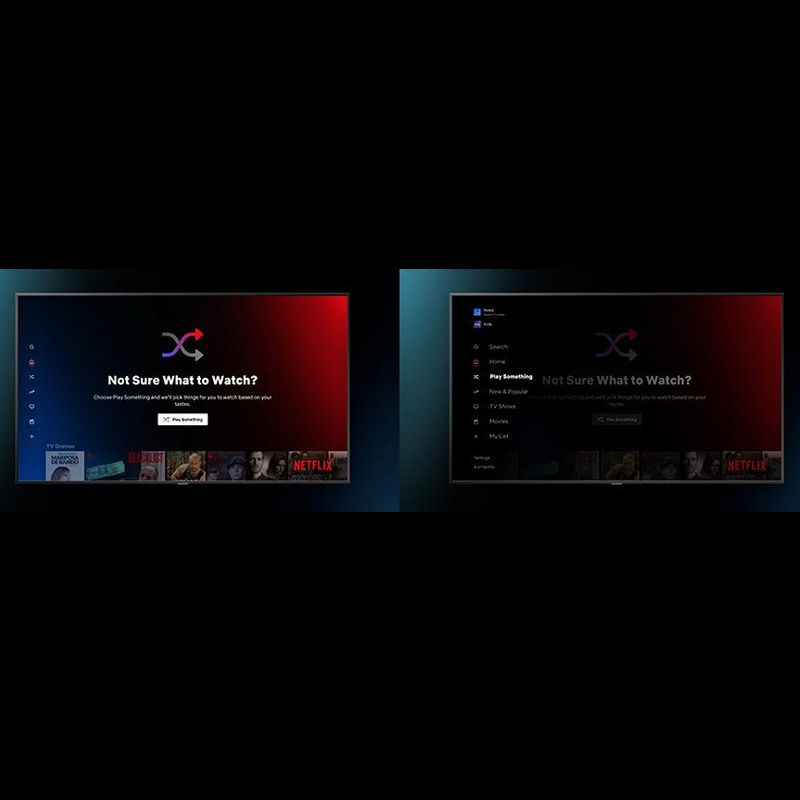
    A Netflix user who presses the new ‘Play Something’ button will be shown a film or show based on his or her interest. If the user does not like the recommendation, they can move on with ‘Play Something Else’ to see a new set of options that include an unfinished series or film.

    “There are times when we just don’t want to make decisions. A Friday evening after a long work week. A fridge full of food but nothing jumps out. A family movie night where no one can agree. We’ve all been there. Sometimes you just want to open Netflix and dive right into a new story. That’s why we’ve created Play Something, an exciting new way to kick back and watch,” Netflix product innovation director Cameron Johnson said.

    Play Something can be found in multiple ways: underneath user profile name, the tenth row on your Netflix homepage, the navigation menu on the left of the screen. While the company is rolling out the feature globally, it is currently limited to TV based versions – that is, it is not available on mobile phones, laptops or tablet devices for now. Earlier this year, the streaming giant introduced a new feature that automatically downloads recommended content for users on their smartphones.

  • Tata Sky introduces a new age feature Smart Guide

    Tata Sky introduces a new age feature Smart Guide

    KOLKATA : Reinforcing its commitment towards building customer centric innovations, Tata Sky, India’s leading content distribution and Pay TV platform has introduced ‘Smart Guide’ –a new-age feature that enables each customer to discover and consume content on television in a smart way. The new feature has been activated on all HD and SD set top boxes paving the way for an enhanced and bespoke TV viewing experience.

    These recommendations can be easily accessed through the newly revamped guide that appears on the television screen with the press of the guide button on the Tata Sky remote. The channel guide screen offers thumbnail views of the most watched channels, genres and platform services by the subscribers, under the banners – ‘Your Top Channels’, ‘Trending Channels’, ‘Favourite Genre’ etc. based on a subscriber’s viewing history and the time spent viewing a particular channel or genre. The feature not only gives quick access to the most viewed channels but also recommends more channels based on the genres you like to watch. In case of multi-connection homes, recommendations will be different for the primary and secondary set-top box in line with individual preferences.

    Read more news on Tata Sky 

    Commenting on the upgrade,  Tata Sky chief commercial and content officer Pallavi Puri  said, “While digital platforms have developed the ability to personalise experiences, on broadcast television this hasn’t been offered so far in a significant way.  With the latest software upgrade, our HD and SD set-top boxes now offer smarter recommendations based on a subscriber’s content consumption patterns leading to an enhanced TV viewing experience.”

    As part of the update, the linear search feature has been further enhanced to enable subscribers to search for channels via channel name, offering a hassle-free way of switching to their favourite channel. Linear search can be directly activated from the banner, guide grid and full screen video by only pressing the ‘0’ button on the remote, thereby offering subscribers a faster and smarter option to discover their preferred content. 

    The software update has been successfully completed on more than 15 million set top boxes.

  • AIDCF submits recommendations to I&B; asks for removal of 8% AGR on cable broadband

    AIDCF submits recommendations to I&B; asks for removal of 8% AGR on cable broadband

    MUMBAI: Broadband is the way forward for multi system operators (MSOs) who are looking at improving their average revenue per user (ARPU). Understanding the pain areas of the operators who are looking at expanding their broadband base, the newly formed MSO association- All India Digital Cable Federation (AIDCF), recently met the Information and Broadcasting Ministry (I&B) on the issue of 8 per cent AGR being charged on MSOs offering broadband services.


    During the meeting a five point recommendation was submitted to the Ministry, which later will be submitted to the Department of Telecommunications (DoT). The recommendation reads:


    1)      Remove the 8 per cent AGR applicable for MSOs who are offering broadband services.


    2)      It has requested the Government to support MSOs for right of way and protection of infrastructure laid on ground. MSOs offering broadband services feel that the pole charges levied by some states are huge. Also, to set up the broadband service, expensive equipment needs to be installed on streets and poles. According to AIDCF, as of now, there are no rules per se, to protect the equipment which costs anywhere between Rs 7000 to Rs 10,000. The association, through the recommendation, is asking the Government to protect the expensive equipment, so that the MSOs can start installing the infrastructure.


    3)      The association has asked the Government to rationalise import duties on network equipment. While the Government has plans for ‘Digital India’ and ‘Make in India’, there are still certain infrastructure related products which are not being manufactured in the country, and hence have to be imported. The association has thus asked the Government to rationalise the import duties being charged on these goods, until someone from the country starts manufacturing them.


    4)      It has requested the Government, like in the case of Telecom, to provide infrastructure status to the cable broadband network. With the infrastructure status, MSOs will become eligible for easy bank financing, in addition to overseas fund raising to expand their broadband base.


    5)      Allow use of Universal Service Obligation (USO) fund for wireline network rollout in the country.


  • TRAI sees role of local cable operators in helping broadband grow

    TRAI sees role of local cable operators in helping broadband grow

    NEW DELHI: The Telecom Regulatory Authority of India (TRAI) has called for an audit by an independent agency of all allocated spectrum, both commercial as well as spectrum allocated to various PSUs/Government organizations. Stressing the urgency, it has said this ought to be a national priority and must be undertaken within three months.


    In its recommendations on “Delivering Broadband Quickly: What do we need to do?” prepared after consultations with stakeholders, TRAI has noted that current availability of spectrum in local service areas (LSAs) is about 40 per cent of that available in comparable countries elsewhere. There is therefore ‘a crying need for assignment of additional spectrum for commercial telecom services.’ There is need to align spectrum bands with globally harmonized bands to achieve interference-free coexistence and economies of scale.


    There is a need to lay down a clear roadmap for spectrum management, which should state the requirement and availability of spectrum for each LSA as well as for the whole country. This roadmap should be made available publicly to ensure transparency.


    Wireless Planning Commission


    In a far reaching recommendation, it has said that Wireless Planning Commission (WPC) should be converted into an independent body by de-linking it from the present Department of Telecom ‘hierarchy and either converting it into a statutory body responsible to Parliament or transferring it to an existing statutory body.’ 


    ‘Even in a more limited role of assigning solely commercially available spectrum, there is a strong case for an institutional overhaul of WPC to realise goals of institutional efficiency, transparency in decision-making and full disclosure of decisions,’ it says.


    Right of Way


    There is a need for enunciating a National Right of Way Policy to ensure uniformity in costs and processes. 


    Role of Local Cable Operators (LCOs)


    In another major recommendation, it said cable television operators should be allowed to function as resellers of Internet Service Provider (ISP) license holders to enable them to take advantage of their cable network to provide broadband. Implementation of digitisation of cable services to Phase II and III cities should be done in a time-bound manner.


    Satellite Regulations


    There is need to separate Licensor, Regulator and Operator functions in the satellite space domain to conform to best international practices of free markets. The issue of coordination of additional spectrum in the 2500-2690 MHz band with the Department of Space needs to be addressed urgently, so that this band can be optimally utilised for commercial as well as strategic purposes.


    NOFN


    The ‘multi-layered structure for decision making’ for national project NOFN for laying optic fibre is ‘just not suitable for a project that needs to be executed in mission-mode’ and the structure needs immediate overhaul.


    There is need for Project implementation on Centre State Public-Private Partnership (CSPPP) mode by involving State Governments and the private sector. The award of EPC (turnkey) contracts by BBNL to private parties through international competitive bidding needs to be planned. Such contracts can be given region-wise with clear requirements for interconnection with other networks, as well as infrastructure sharing with other operators who would like to utilise this network. A commercial model around this will need to be suitably deployed.


    Telecom Towers


    Referring to towers, it said single-window, time-bound clearance should be encouraged for installation of towers to ensure the rapid development of national networks. Extensive consumer awareness and education programmes should be organised so that consumers fully understand the latest scientific information on EMF radiation and its potential impact on health.


    Referring to Right of Way, it said single-window clearance is an imperative for all Right of Way proposals at the level of the States and in the Central Government. All such clearances have to be time-bound so that Telecom Service Providers and infrastructure providers can move rapidly to project execution. Ideally, single-window clearance should be administered online with a defined turnaround time. The reasons for denial of RoW permission should be recorded in writing.


    To promote fixed line BB, the license fee on the revenues earned from fixed line broadband should be exempted for at least five years. The infrastructure of PSUs is lying unutilised and thus they should be mandated to unbundle their network and allow sharing of outside plant (OSP).


    The Government needs to encourage local and foreign companies to build ‘Data Centre Parks’ on the lines of industrial parks, SEZs etc. by providing them land, infrastructure and uninterrupted power supply at affordable rates.


    Both Central and State Governments will have to act as model users and anchor tenants through delivery of e-Government services including e-education, e-governance, m-health, m-banking and other such services. Schools are the ideal and convenient point for early initiation to broadband services. Government schools in the rural and remote areas can be provided subsidy from the USOF for broadband connectivity. The cost of CPE (desktop/laptop/tabs etc) is a major barrier to the adoption of broadband services. TSPs may be allowed to offer CPE bundled tariff schemes. Revenues from such offers ought to be exempted from the applicable license fee at least for a certain number of years (say for three years). 


    In addition, there are a large number of recommendations of the Authority on which decisions of the Government are still awaited. The Government needs to act quickly on these recommendations as we have already lost too much time. These include, inter alia, on Spectrum Trading, Spectrum Sharing, Open Sky Policy, Infrastructure Sharing, Microwave Access and Backbone Spectrum.


    The Authority had issued the Consultation Paper on “Delivering Broadband Quickly: What do we need to do?” on 24 September last year to discuss issues contributing to broadband penetration in India and to solicit stakeholders’ views on action required to be taken both by the Government and the private sector to accelerate the proliferation and use of broadband in the country. The comments and counter-comments received from the stakeholders were placed on the TRAI’s website. An Open House Discussion was held on 30 October 2014 in New Delhi with the stakeholders. 


    The Authority noted with serious concern the slow penetration and adoption of broadband in the country.  India ranks 125th in the world for fixed broadband penetration with only 1.2 per 100 inhabitants having access to fixed broadband; the global average is 9.4 per 100 inhabitants. In terms of household penetration within developing countries, India is ranked 75th with a penetration of 13 per cent. In the wireless broadband space too, India is ranked 113th with a penetration of 3.2 per 100 inhabitants. In terms of ‘ICT access, ICT use and ICT skills’, India ranks 129th out of total 166 countries. Indonesia (106), Sri Lanka (116), Sudan (122), Bhutan (123), Kenya (124) are ranked above India. India is categorised in the Least Connected Countries Group of 42 countries that fall within the low IDI group.