Tag: Ravi Desai

  • Rebuilding consumer trust, meeting altered expectations: Brands on the 2021 challenge

    Rebuilding consumer trust, meeting altered expectations: Brands on the 2021 challenge

    MUMBAI: Our world, as we know it, changed irrevocably last year in the wake of Covid2019. As people everywhere struggled to make sense of an evolving reality, organisations too were forced to reassess and recalibrate their businesses in a bid to survive and grow. Consumer behaviour having gone through a paradigm shift during the pandemic, has posed additional challenges for brands. There is understandably uncertainty on all fronts.

    In order to understand the strategies devised by top brands to tackle the challenges of this global crisis and to look beyond it, the Indian Society of Advertisers (ISA), in association with the Free Press Journal and ABP Network, organised a two-part webinar – Brands and Consumers: 2021 and Beyond.

    While the first part of this series on the manufacturing sector was held last week, the second part on the service sector was held on Wednesday with some of the best marketing minds from across the service sector. The panel discussion that followed aimed to share the best practices during the pandemic and the way to look forward with hope.  

    The session was moderated by ISA executive council member and former Johnson & Johnson MD Narendra Ambwani. Panelists included Thomas Cook (India) president & group head-marketing, service quality, financial services & innovation Abraham Alapatt, Aditya Birla Capital CMO Ajay Kakar, Jio Platforms group vice president- advertising & innovations Mohit Kapoor, and Amazon India’s director, mass & brand marketing international Ravi Desai.

    Opening the session, Ambwani spoke about how post-Covid, brands face many challenges with consumers‘ expectations as well as behaviours changing. He shared the main question confronting the industry today: “what are the lessons learnt in overcoming the disruptions posed by lockdown, WFH and fears caused by Covid.” Alapatt voiced his opinion on how the travel sector was the most affected in the crisis with the entire industry’s demand going down to “zero”, in part due to the physical restrictions in place. “The past twelve months have given a learning equivalent to twelve years,” he stated.

    From a marketer’s perspective, he encapsulated the year gone by into six Cs of 60 days each, with the first 60 days being a state of “confusion”, turning to “concern” in next 60, then going on to “careful” where the initial paranoia had subdued, proceeding to a mix of “cautious + careless” when the lockdowns eased and finally learning to “coexist” with the pandemic and the restrictions.

    Sharing Thomas Cook’s marketing strategy during the crisis, he highlighted the importance of staying connected to the consumer via newsletters and surveys, while reassuring them on the safety protocols being adopted by the company. The travel company also guaranteed the customer’s financial security by giving them the freedom to reschedule or cancel flights without monetary loss. 

    Aditya Birla’s Ajay Kakar agreed with Alapatt on the importance of remaining connected with the customer, while also stressing on brand visibility and relevance. Being primarily from the health and life insurance sector, he said it was equally crucial to be there for existing customers and listen to their concerns, rather than only focus on new customers. He agreed that the sector benefited from people having time to spare to finally explore investing in the capital market.

    Jio’s Mohit Kapoor was more upbeat regarding the past year, although he admitted that the April 2020 quarter was the worst in many years for the company. He shared the forecast of Jio’s smartphones reaching a market of 800 million from existing 500 million, paving the way for a ‘2G-Mukt Bharat’. He predicted that social is the way forward for commerce with social networking sites like Facebook and Instagram seeing a huge spike in users. He also touched on the upcoming relevance of social gaming and e-sports genres with India becoming one of the biggest gamers markets.

    Amazon’s Ravi Desai was also quite optimistic about the e-commerce giant’s prospects in the past, as well as the coming year. As he put it, “consumers’ needs for a wide selection of products, delivered quickly and safely is not going to change,” even with local retailers opening up and customers stepping out to buy. His advice to brands: To look for the ‘permanent’ factor in their business module which will remain relevant to customers, and to focus on that core part.

    Summing up the main takeaways for brands from the discussion –

    u  Stay connected and relevant to customers

    u  Reach out and reassure existing customers

    u  With changed consumer-expectations, brands that step up will remain in the game

    u  Trust is the keyword – rebuilding and reassuring customer’s trust in a crisis

    After the bloodbath of last year, the travel industry is on the road to recovery, with a huge spate of bookings for the months of November and December, shared Alapatt. He added that Maldives, which had never figured in the top destinations for Indians now, had single largest visitors from India. Even enquiries post-lockdown were record-breaking, indicating that people were frustrated after remaining indoors for so long. With prices lower than ever and great travel deals, he concluded that things can only look up from hereon for travel and tourism. At the same time, he emphasised there was no compromise on the safety factor of customers, and that adding safety value to a brand where required will pay dividends with customers willing to pay for the extra. He cited the example of Thomas Cook’s partnership with Apollo, to enable the customer to avail the ‘doctor-on-call’ facility while travelling.

    In conclusion, this optimism was shared by all other service sectors when it came to looking forward at 2021 and beyond. They surmised that this was a powerful opportunity for the hospitality and service sector, with the worst over and behind them. And that in this pursuit, the relevance and value of customer engagement has grown even more significant for all brands.

  • Amazon Echo says experience everyday magic in new campaign

    Amazon Echo says experience everyday magic in new campaign

    MUMBAI: In today’s world, where people are worried that the growth of technology is drawing them apart, Amazon Echo’s new campaign aims to bring Indian families together with its smart speaker technology. The campaign stitches together an Indian family’s everyday situations that lead to small moments of everyday magic enabled by the Amazon Echo device.

    Conceptualised by Ogilvy Bangalore and directed by Aarthi Kakkad of Curious Films, the films tell the story of an Indian family where the father, mother and daughter encounters an endearing family moment that is relevant to a daily family setting. One film captures a sweet moment of the father being caught off guard by the mother and daughter secretly dancing to the tunes of a popular Bollywood song. While the other film encapsulates the traditional bond between a father and daughter.

    Ogilvy Mumbai executive creative director Neville Shah, “The simplicity of creative was broken down to one thing. How can the Echo be part of your everyday; like a family member. And since this is an extremely new category, familiarizing people with the use of the product is key.”

    “With the successful launch of Echo, Indian consumers have shown that they are more than ready to adopt new technologies which are relevant to them. The current campaign is continuation of our launch campaign about how Echo fits seamlessly in the lives of consumers and makes everyday moments special,” adds Amazon India director mass and brand marketing Ravi Desai.

    Ogilvy South senior vice president for head of planning Anirban Roy mentions, “The category is at a nascent stage and hence demonstrating relevant use cases of Amazon Echo was critical for us. We are trying to build the category and at the same time trying to create a positive disposition towards us.”

  • Amazon’s festive season ad asks consumers to splurge with their ‘Dil-Dimaag’

    Amazon’s festive season ad asks consumers to splurge with their ‘Dil-Dimaag’

    MUMBAI: Amazon India has kicked off the upcoming season with its campaign ‘Dil-Dimaag’.

    Aimed at preparing customers for the festive season, the campaign showcases the ease and convenience of shopping on amazon.in  in some of the most loved categories of smartphones, home appliances, kitchen and fashion. 

    The campaign features three different TVCs and is on air from 20 August 2018.

    Each TVC starts with the omnipresent dilemma between the heart and the mind highlighting the various benefits of buying on Amazon such as wide range of top brands, scheduled and damage free delivery, 48-hour installation and 30-day return policy. The Dil-Dimaag campaign seeks to establish Amazon.in as the preferred choice for customers buying needs, be it festive shopping or daily essentials.

    Conceptualised by Leo Burnett Orchard and directed by Jerald Packiasamy of Still Waters Films, the campaign brings alive the heart and mind through twin characters in the film and showcases the eternal debate between the two when it comes to shopping online. With the heart (dil) eventually convinced as the mind (dimaag).

    Amazon India director for mass and brand marketing Ravi Desai says, “When it comes to shopping on Amazon we see that there is a conflict between the heart and mind of consumers. There is a desire to shop on Amazon but they are held back by certain things which they are unaware of. The Dil-Dimaag campaign seeks to help customers understand our offerings better especially in categories where purchases are planned in advance. The upcoming festive season will be the biggest celebration yet on Amazon.in where customers can expect the widest selection, the best deals and maximum savings.

    “As a lead-up to the festive season, our campaign seeks to provide information and clear doubts as our customers prepare their shopping lists. This season is going to be our biggest ever in terms of traffic, new customers, digital payment adoption as well as sales,” he adds. 

    Leo Burnett Orchard executive creative director Neel Roy mentions, “Each of the stories we chose to execute is based on insights into various concerns with online shopping. Your mind and heart are always in a state of conflict. When doubts get clarified with logical answers, decision making becomes easy. So we chose a simple storytelling format with a small twist. We told these stories using twins. It was a fun way to execute ‘Dil and Dimaag’ that conveyed our intended message that when both mind and heart agree, your decision becomes a whole lot easier.”

  • Amazon says out with the old in Great Indian Sale ads

    Amazon says out with the old in Great Indian Sale ads

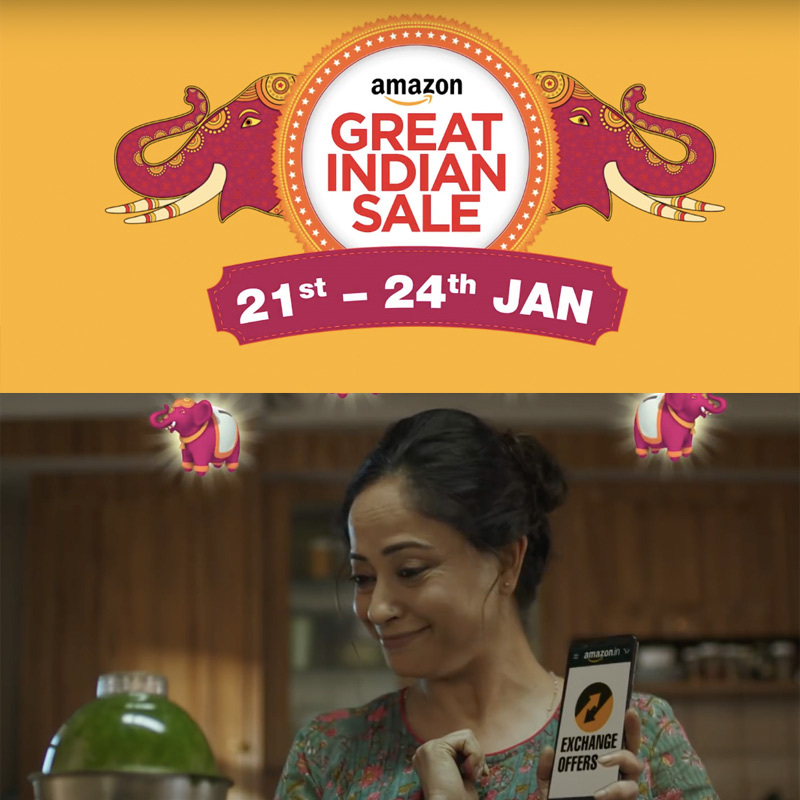
    MUMBAI: E-commerce giant Amazon has launched its new campaign ‘Ab Sehan Kyun Karna’ in tandem with its first Great Indian Sale for 2018. The message to the customers is to do away with the old and usher in the new for the new year.

    The campaign features a series of ads on various situations in which customers break out of the spiral of managing with the next best thing. The campaign ads have been directed by Rajesh Krishnan of Soda Films.

    Conceptualised and created by Leo Burnett Orchard Bangalore, the campaign was brought to life through four TV ads that seamlessly bring together unique features of Amazon and overlays it with the Indian shopper’s mindset of adjusting with an old/damaged product in order to save money.

    The first film opens in an Indian kitchen, where the lady of the house is having a conversation with the mixer about how she has lived with its many tantrums over the years.

    The second film is set in a typical Indian bachelor pad. We see the protagonist using his old phone in spite of a loose charging port. Both the ads then change their tone with the characters declaring that the old mixer and phone have to go, especially since the Amazon Great Indian Sale is around the corner.

    With this campaign, Amazon wants to tap into the cultural truth that people in India generally manage with less-than-desired products and wait for special occasions such as anniversaries and birthdays to replace/upgrade them. The focus of the new campaign is the emotional and cultural conditioning that creates a barrier to accessing the goods Indians want.

    Amazon India director mass and brand marketing Ravi Desai says, “We understand that customers sometimes manage with old/defective products or without some products in order to postpone expenses. Considering Amazon’s constant quest to be earth’s most customer-friendly company, we wanted to put our best foot forward to address this behaviour. The Amazon Great Indian Sale with its big deals, extra cashback, no cost EMI and exchange options gives customers the perfect opportunity to replace those run-down products with new, upgraded versions while still saving money.”

    Leo Burnett Orchard national planning head Rohitash Srivastava adds, “Indians wait for right occasions to buy/replace things. Diwali, birthdays, auspicious occasions have been such marquee days. Our ambition was to let people look at the Amazon Great Indian Sale as one such occasion. Working with this insight, we nudged people to not adjust any longer with the old or postpone the new.”

    The campaign is supported by a robust 360-degree communication that spreads across digital, press and outdoor.