FICCI Frames 2016: Day 1



MUMBAI: For a meet that is perhaps the largest in the country covering all all media and entertainment platforms, it was heartening to see the the universe of M & E industry gthered under one roof.
FICCI Frames 2016 is up and rolling. ‘Change or Perish’ says the LED backdrop and that’s the theme of the 17th edition.
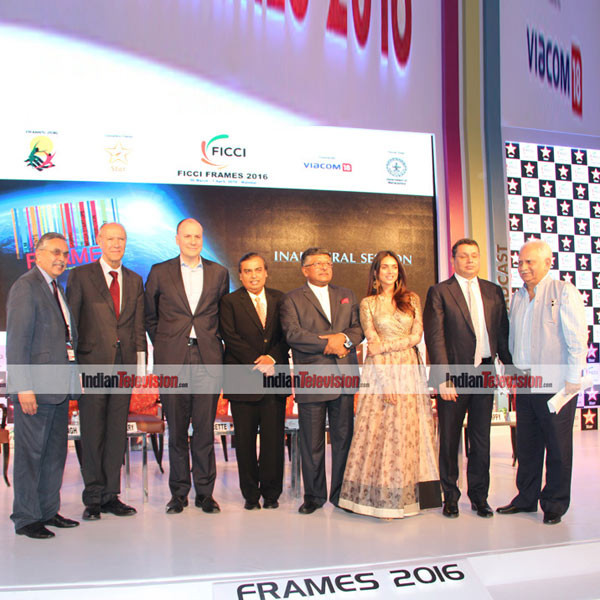
And Communication and Information Technology Minister Ravi Shankar Prasad, Star India CEO Uday Shankar, Reliance Industries Ltd Chairman and MD Mukesh Ambani FICCI Entertainment wing Chairman Ramesh Sippy, Discovery President J B Perrete, and FICCI Secretary General Deedar Singh showed the way forward.
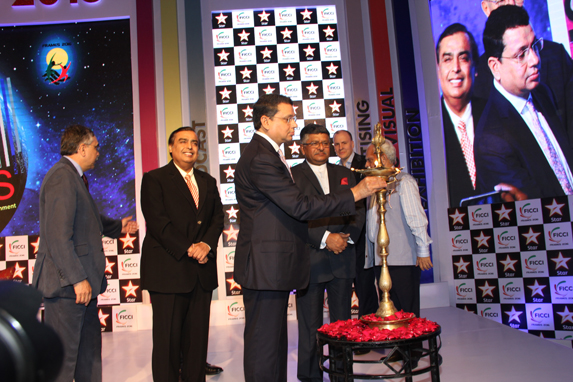
Star India CEO Uday Shankar, FICCI Chairman Ramesh Sippy, Minister of Telecom and Information Teachnology, Discovery President JB Perrete, and Deedar Singh secretary general FICCI were among the dignataries who lit the lamp to mark the beginning of the edition.
“Cable TV continues to struggle, struggling to be relevant in the ever changing scenario. Digitization is still to taste success; and the content is becoming more and more redundant. Overall the M&E sector is the same as it was while the timelines have changed and changed again,”
Those opening lines by Star India CEO Uday Shankar touched many raw nerves, welcomes by loud claps at the inaugural session of the FICCI FRAMES 2016.
But he added that even as there are certain teething issues that the industry is facing, there are great happenings to talk about too. In his un-orthodox manner, he touched on these. “But at the same time there is a disruption happening, there are four young boys who made more headlines than any other content creators. They took on the biggest of the players be it Mark Zukkerberg’s Facebook when their friendly internet’s neutrality came under threat. They had the guts to keep a name that the news channels in India chose not to pronounce wholly. They call them AIB.”
Talking about his own network, he said “the biggest launch in the media and entertainment industry was not a newspaper, nor a TV channel but an app. Hotstar drove the wave, 5crore times the app was downloaded, more people watched EPL on Hotstar than on TV and this is how India is changing.”
He also spoke about the global success story: “Imagine where Netflix Facebook were 10 years back and see the empire they have made in such a short span. Also remember the best animators are no longer sitting in California, they can now be spotted in Goregaon. Priyanka Chopra is now a global star and now India needs to be a global leader.”
Concluding his remarks, he said: “The whole country today is looking at what Mukesh Ambani is busy with, there is a wave of expectation and the expectation is from Ravi Shankar Prasad (C and IT Minister) too. They are the two stakeholders on whom the digital wave depends. Hope they do the best as that will be the best of media and the entertainment Industry.”
Reliance Industries Chairman and MD Mukesh Ambani said: “I was here in 2004 when the industry was 2 billion dollars strong, and today it is 18 billion dollars strong. It is a great success and but there are miles to go. I believe the industry will be a 100 billion dollar one in the next decade, which means we have a major task in our hands.”
Referring to the theme of the annual meet, he said: “There could not be a better theme than Change or Perish. To my mind digitization is the key to the industry’s success and that’s why we have JIO which can be called as the world’s largest startup.”
He was confident that with the launch of Jio, India will be among the top ten in the next few years from the current rank of 155 among the top countries using mobile data. “Jio will provide coverage, and wherever you are you will be able to access. Quality will be 40 to 80 times faster than at present. Quantity and capacity currently is 0.15 GB per annum, with capacity of over 10 GB per user per annum We will be affordable to consumers, and I believe affordability is the key “
India, he said, will leapfrog and be a leader in the digital world. The world is moving from "orality to visuality. Images and videos will rule the digital world. Human beings and our thinking are linear. Technology is an exponential idea. Exponential changes will create large opportunities," he said.
Sharing his analysis he said, “The world is graduating to a telemedia world. The focus will be on all from all. The telco will focus on content, the broadcaster will invest on technology and producers will have new delivery platforms. We are all part of a telemedia world. Downloading has now become streaming, linear has become interactive.”
Ambani drew light on the way forward. “Abundance will be a global trend. Data is the new oil of this industry, and intelligent data is the petrol. It is not about technology – it is about humanity, the true power of technology is in the evolution of humanity. All our efforts need to be to make India the leader in 21st century. Together we can make India the leader with more than one-sixth of humanity residing in India.”
MUMBAI: For a meet that is perhaps the largest in the country covering all all media and entertainment platforms, it was heartening to see the the universe of M & E industry gthered under one roof.
FICCI Frames 2016 is up and rolling. ‘Change or Perish’ says the LED backdrop and that’s the theme of the 17th edition.
And Communication and Information Technology Minister Ravi Shankar Prasad, Star India CEO Uday Shankar, Reliance Industries Ltd Chairman and MD Mukesh Ambani FICCI Entertainment wing Chairman Ramesh Sippy, Discovery President J B Perrete, and FICCI Secretary General Deedar Singh showed the way forward.
Star India CEO Uday Shankar, FICCI Chairman Ramesh Sippy, Minister of Telecom and Information Teachnology, Discovery President JB Perrete, and Deedar Singh secretary general FICCI were among the dignataries who lit the lamp to mark the beginning of the edition.
“Cable TV continues to struggle, struggling to be relevant in the ever changing scenario. Digitization is still to taste success; and the content is becoming more and more redundant. Overall the M&E sector is the same as it was while the timelines have changed and changed again,”
Those opening lines by Star India CEO Uday Shankar touched many raw nerves, welcomes by loud claps at the inaugural session of the FICCI FRAMES 2016.
But he added that even as there are certain teething issues that the industry is facing, there are great happenings to talk about too. In his un-orthodox manner, he touched on these. “But at the same time there is a disruption happening, there are four young boys who made more headlines than any other content creators. They took on the biggest of the players be it Mark Zukkerberg’s Facebook when their friendly internet’s neutrality came under threat. They had the guts to keep a name that the news channels in India chose not to pronounce wholly. They call them AIB.”
Talking about his own network, he said “the biggest launch in the media and entertainment industry was not a newspaper, nor a TV channel but an app. Hotstar drove the wave, 5crore times the app was downloaded, more people watched EPL on Hotstar than on TV and this is how India is changing.”
He also spoke about the global success story: “Imagine where Netflix Facebook were 10 years back and see the empire they have made in such a short span. Also remember the best animators are no longer sitting in California, they can now be spotted in Goregaon. Priyanka Chopra is now a global star and now India needs to be a global leader.”
Concluding his remarks, he said: “The whole country today is looking at what Mukesh Ambani is busy with, there is a wave of expectation and the expectation is from Ravi Shankar Prasad (C and IT Minister) too. They are the two stakeholders on whom the digital wave depends. Hope they do the best as that will be the best of media and the entertainment Industry.”
Reliance Industries Chairman and MD Mukesh Ambani said: “I was here in 2004 when the industry was 2 billion dollars strong, and today it is 18 billion dollars strong. It is a great success and but there are miles to go. I believe the industry will be a 100 billion dollar one in the next decade, which means we have a major task in our hands.”
Referring to the theme of the annual meet, he said: “There could not be a better theme than Change or Perish. To my mind digitization is the key to the industry’s success and that’s why we have JIO which can be called as the world’s largest startup.”
He was confident that with the launch of Jio, India will be among the top ten in the next few years from the current rank of 155 among the top countries using mobile data. “Jio will provide coverage, and wherever you are you will be able to access. Quality will be 40 to 80 times faster than at present. Quantity and capacity currently is 0.15 GB per annum, with capacity of over 10 GB per user per annum We will be affordable to consumers, and I believe affordability is the key “
India, he said, will leapfrog and be a leader in the digital world. The world is moving from "orality to visuality. Images and videos will rule the digital world. Human beings and our thinking are linear. Technology is an exponential idea. Exponential changes will create large opportunities," he said.
Sharing his analysis he said, “The world is graduating to a telemedia world. The focus will be on all from all. The telco will focus on content, the broadcaster will invest on technology and producers will have new delivery platforms. We are all part of a telemedia world. Downloading has now become streaming, linear has become interactive.”
Ambani drew light on the way forward. “Abundance will be a global trend. Data is the new oil of this industry, and intelligent data is the petrol. It is not about technology – it is about humanity, the true power of technology is in the evolution of humanity. All our efforts need to be to make India the leader in 21st century. Together we can make India the leader with more than one-sixth of humanity residing in India.”
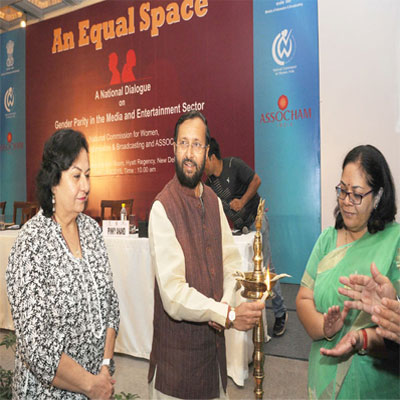
NEW DELHI: The advancement in technology has made it possible to essay any kind of role in the media and entertainment industry but there is need for proper grooming and training of females in various non-conventional roles in the industry.
This was the general view at a discussion on “An equal space: Gender parity in media and entertainment sector” held here by the National Commission for Women (NCW) in partnership with the Information and Broadcasting Ministry and ASSOCHAM.
The participants felt that technology and digitisation has changed the scenario – for example, equipments were now lightweight as compared to the earlier times and women are entering into various roles like make-up artists, stuntwomen etc.
In his inaugural address, Environment Minister Prakash Javadekar said that the world had lost a lot by not giving women equal opportunities and not recognising their talent.
The Minister emphasised that women have qualities like compassion, conviction, consistency and courage which are their unique strengths. There is no difference between men and women in terms of capabilities and men need to be sensitised regarding their attitude towards women, he added.
NCW chairperson Lalitha Kumara Mangalam said even today, an invisible barrier exists in the media and entertainment industry where women do not get equal opportunities. She said various factors like lack of training and lack of family support are responsible for this situation. “The percentage of women working in this sector is also very low. Even today people do not find this sector as a good place to work,” she added.
Filmmaker Ramesh Sippy opined that women should be portrayed as empowered characters in the films to send the right message to society. “Female artistes should be encouraged to participate in non-conventional roles in films, which help to eliminate misconception of the entertainment industry being projected as biased,” he added.
The inaugural session was followed by technical sessions. Deliberations were held on various issues such as equal opportunity for women in media and entertainment, enabling and empowering women at M&E workplace and skill and capacity building.
It was noted that the news industry has much more presence of women as compared to their male counterparts, the participants opined but a lot needs to be done to encourage women to join this sector and establish themselves into the system.
Personalities related to the M&E industry like actor and director Rajat Kapoor, actresses Divya Dutta and Rajeshwari Sachdev also participated in the seminar. Senior Advocate and Additional Solicitor General of India Pinky Anand, Indian Institute of Mass Communications DG Sunit Tandon, former I&B Ministry director (Films) Nirupama Kotru, National Film Development Corporation (NFDC) MD Nina Lath Gupta, and senior journalist Rahul Kanwal, amongst others were panelists in the discussion.
MUMBAI: While the fourth estate is known both as a conscience keeper of society as well as shaper of public opinion, is the freedom of speech for the media under pressure in recent times? Speaking on the same were BBC Global News presenter Matthew Amroliwala, NDTV managing editor Manika Raikwar, Equus founder and Counselage India managing partner Suhel Seth, and FICCI entertainment committee co-chair Ramesh Sippy at a panel discussion at the ongoing FICCI Frames 2015. The session was moderated by Association of International Broadcasters UK CEO Simon Spanswick.
The witty Seth had the audience in constant applauding mode. He began saying that the current Censor Board chief in India was an idiot. “If words like Bombay are banned in a film, why don’t the jokers also approach the High Court of Bombay? Again, we have some very good judges and some very bad judges. Society must mirror the varied aspirations of society,” Seth said.
He was of the strong opinion that the press in India had abused its power for far too long. “Most channels today are on sale and are driven by commercial interests. Times Now is clean but is a noise factory. We are in very troubled times and there is grave danger to the freedom of press in India. We are ruled by a right wing party and fringe elements have arisen. Instead of discourse and debate, people are resorting to violence,” he opined.
When questioned by Spanswick on ethics being compromised because of revenue, Raikwar posed a counter question, “How do you get revenue for a costly business medium?” She was of the opinion that transparency was the key by informing the masses about which news packages were sponsored and which were not. “Mint, for example and NDTV too, clearly mention to viewers if there is a conflict of interest in their stories either in a box or a scroll,” she informed. It was upto the audiences then to make a choice in believing what stories were true or were planted.
Agreeing with her, Amroliwala opined that if indeed audiences knew what they were reading and watching, then they would be able to pin point closely what the news factor was in a story. “The BBC is all about trust and we don’t deviate from it, which is our USP,” he remarked.
Seth at this point said that increasingly today TV editors were writing newspaper columns and newspaper editors vice versa appeared on television. “These editors appear on television because they can’t write. They are supposed to inform people through their writing about strong opinions of current events,” he said. He then went on to attack the Badal family of Punjab. “The Badals own the biggest channel in Punjab and also control the distribution system,” he added.
Spanswick queried if people trusted these channels, to which Seth implored, “What else will people watch? They don’t have a choice.”
As the talk revolved around journalistic ethics, Sippy commented that unparliamentary language was become parliamentary language across the world and everyone was in a race to grab eyeballs. Raikwar felt that the edit page of a newspaper was largely important as it is today becoming the main news page. “There is space for opinion but it has to be clearly narrated and spaced,” she voiced. She also noted that there would be times when journalists would commit unintentional errors in their stories. In such a scenario, the best way forward was to issue to apology and move on. “It is all about trust,” she stressed upon.
Spanswick then quizzed the panel if the media in India was able to reflect society well enough through their creative products? Seth was of the opinion that every film reflected a certain section of society. “While the film Haider was dedicated to Kashmiri pundits, the narrative of the film had nothing to do with them. We have to evolve through self-restraint. It’s also sad to note how religion today is being used as a political weapon whereas people of feeble intellect are running the censor board,” he said.
“How can one counter this?” asked Spanswick. Seth said that Sippy and Inc. could come up with movies that spoke of such phenomenons without going overboard. Sippy replied that in recent times two films, Oh My God and PK touched upon religion. “They were using restraint through humour,” the filmmaker highlighted. Raikwar said that the attitude of ‘sab kuch chalta hai’ (anything goes) should stop and the consumer being the key would be the ultimate judge of a news item.
Amroliwala in conclusion stated that the pictures the BBC used for a particular story, the content and the language used was very important to the pubcaster. “This is absolutely crucial in our news reporting,” he highlighted.
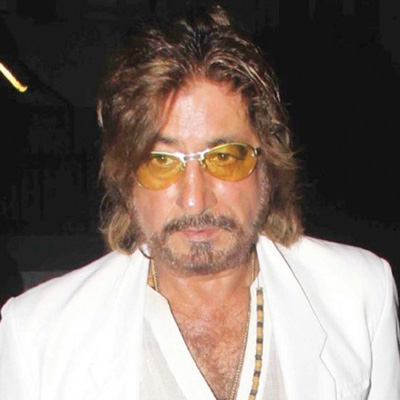
MUMBAI: Actor Shakti Kapoor admires young actor Rajkummar Rao. The National award winner has found a fan in Kapoor. They are working together in upcoming movie ‘Shimla Mirchi’ with popular actress Hema Malini and Sholay director Ramesh Sippy.
According to the sources, Rajkummar Rao, Shakti Kapoor and Ramesh Sippy all gelled well during the shoot. Chatting with each other, Kapoor got to know that Rao has graduated from Film and Television Institute of India, Pune. He was more than happy to know that as he himself has graduated from there and makes him Rao`s senior.
Kapoor says, “We have both graduated from Film Institute of Pune, which makes me his senior. He`s a good human being and an amazing actor.”
Kapoor and Rao both have pivotal roles in ‘Simla Mirchi’ and with Ramesh Sippy as the skipper of the ship, the movie is touted to be next year`s blockbuster.

NEW DELHI: More than 25 films and documentaries are to be screened during the eight days of the Indian Film Festival at Filmhuis Den Haag and Theater Dakota in the Hague.
The programme will go beyond the classic Bollywood films, stir debate and present a realistic picture of today’s India in all of its colour and diversity. The festival audience will have a wide choice of contemporary film by a number of independent directors from India and the diaspora.
The Festival being held for the fourth time will take place from 22 to 29 October includes the screening of the 3D version of the classic ‘Sholay’ directed by Ramesh Sippy. The Indian Film Festival The Hague is part of Holland India Festivals The Hague.
Highlights of the festival include the opening film ‘Traces of Sandalwood’ by Maria Ripoll on 22 October. The film set in Mumbai and Barcelona recently won the Audience Award during the Montreal World Film Festival 2014.
Other highlights include the documentary ‘Without Shepherds’ as well as the dramas ‘With You, Without You’ (Oba Nathuwa Oba Ekka) and ‘Vara: A Blessing’, the short animation ‘True Love Story’ and the documentary ‘Tropical Amsterdam’.
The festival will also feature visits by Indian film directors and producers.
The photography exhibition ‘Bhopal: Facing 30’ by Francesca Moore portrays the site of the 1984 Bhopal disaster and those affected 30 years on. The expo can be seen in the Filmhuis.
Other side events include a ‘Cinemas of India’ seminar at Leiden University, a panel discussion on the cinemas of India, a lecture for children on tigers (in Dutch), an India Dance Festival film programme, a cooking class and a yoga workshop. There will be a workshop for children on animation during the Festival.
These films originate from various regions in India, each with their own language and culture. The Festival this year will also have some films from the neighbouring countries Pakistan and Sri Lanka, as well as films that are set in both India and Europe.
A number of these films reflect on the lives of women who manage to break through the traditional barriers that restrict them in many ways. Another film shows the brave efforts of the young Dalits – the ‘Untouchables’ – who no longer accept their inferior position in society.
The festival this year will expand to film theatres in Amstelveen, Eindhoven, Hertogenbosch and Utrecht. This makes it possible for more people to marvel at the beauty of Indian cinema. Different kinds of multiple screening passes make it possible for film lovers to enjoy as many films as possible.
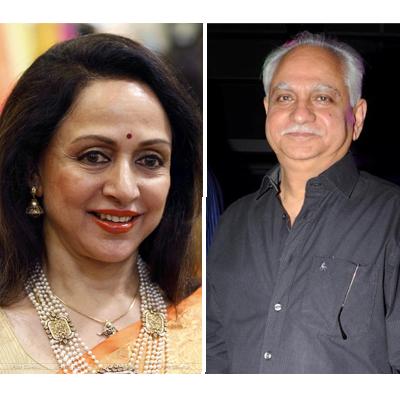
MUMBAI: Legendary director Ramesh Sippy will be directing once again, a film called Shimla Mirchi starring Hema Malini and Rajkummar Rao.
Actress opposite Rajkummar Rao is yet to be finalised. The film goes on the floor in August and is a sweet, romantic story with its quirky twists.
Ramesh Sippy’s cult classic Sholay was released 39 years back in 1975, when he created the character of Basanti with his favourite actress Hema Malini. Sippy is going to work with Hema Malini after Sholay in Shimla Mirchi and like his other films, the first letter of his next film is also with the letter ‘S.’
Sippy always chose to make diverse films right through his career in spite of him being a blockbuster director. While he began with mature love story Andaz, he went on to making comedy Seeta aur Geeta, action adventure Sholay, slick action Shaan, family drama with Shakti, to romantic love story Saagar.
Rajkummar Rao opted out of the film to be made on Chetan Bhagat’s ‘Revolution 2020’ for Ramesh Sippy’s upcoming Shimla Mirchi.

MUMBAI: Aptly titled, “Cuts So Deep: Are We Sacrificing Creativity at the Altar of Morality?”, one of the sessions on the first day of FICCI Frames 2014 spoke about those ‘cuts’ in the films that leave a deep mark in the memory of the filmmakers. Most of the times, these cuts suggested by the Central Board of Film Certification (CBFC) doesn’t even make sense to the people who were involved creatively in the making of the film.
The debate, in the presence of esteemed guests like Sudhir Mishra, Ramesh Sippy, Ravi Kottarakara, Kajol and the newly appointed CEO of CBFC Rakesh Kumar, highlighted many issues that filmmakers are grappling with because of the guidelines stated in the archaic Cinematograph Act of 1952.
However, the film industry is pinning its hopes on the new government for amendments to the Cinematograph Act.
At the session, the filmwallahs brought to the fore how the guidelines push them back by many years by not giving them the freedom that’s actually their right.
“When a director shoots a scene, he envisions it in a certain way. If there’s a smoking scene, an atmosphere is created with that. When it is cut, the shot loses its charm,” remarked Mishra while putting across an example.
Another major issue discussed was that of a scroll on the frame showing smoking, sex scenes etc for which filmmaker Anurag Kashyap has even gone to the court and the matter is still pending in the court.
Another point that came up during the discussion was of giving ‘A’ certificate to certain films based on real issues that need to be promoted all across, while some films just because they come from ‘bigger’ banners are passed with U or U/A even when they have ‘bold’ scenes.
To deal with all this, a committee headed by Justic Mukul Mudgal is travelling across the country to take suggestions from the film fraternity across India, the audiences and all the other stakeholders involved.
While Rakesh Kumar from CBFC was left in a fix with complex questions being posed to him, Film and TV Producers Guild of India CEO Kulmeet Makkar came to his rescue by stating that the industry needs to be patient for a little more time. “Since the revised guidelines have already been formed, we may expect things to change pretty soon,” said Makkar, also revealing that 18 of the suggestions discussed in Chennai have already been accepted.
It seems the film industry can soon hope for better days ahead.