Tag: Ramdev

  • Ruchi Soya to merge with Patanjali Ayurved under the name ‘Patanjali Foods’

    Ruchi Soya to merge with Patanjali Ayurved under the name ‘Patanjali Foods’

    Mumbai: Baba Ramdev-led Ruchi Soya Industries on Monday stated it will evaluate the most efficient mode to merge Patanjali Ayurved Ltd’s food business with itself and further decided to change the name of the company to Patanjali Foods Ltd.

    Ruchi Soya recently raised Rs 4,300 crore through a follow-on public offer (FPO).

    In its regulatory filing, Ruchi Soya apprised that the board of directors, in the meeting held on Sunday, “gave in-principle approval to evaluate the best way to amalgamate the food business of Patanjali Ayurved Ltd. “

    The board authorised the officials of the company to negotiate, finalise and conclude the terms and conditions of the proposed deal.

    Last month, Baba Ramdev announced that in the upcoming months, Patanjali Ayurved will transfer all food business to Ruchi Soya. Patanjali Ayurved would operate in the non-food, traditional medicine, and wellness space.

    Patanjali Group acquired Ruchi Soya in 2019 for Rs 4,350 crore through insolvency proceedings.

  • MIB clears TV channel applications; Rathore calls for stakeholder meets

    MIB clears TV channel applications; Rathore calls for stakeholder meets

    NEW DELHI: Within days of Rajyavardhan Rathore given independent charge of the Ministry of Information and Broadcasting (MIB) by the PM Modi-led government after removal of his senior Smriti Irani, the organisation has been galvanised into action. What’s more, important issues are being discussed, including clearances of three new TV channel applications and meetings being called with broadcast industry stakeholders to debate matters like use of foreign satellites versus Indian ones.

    The three TV channels that have been reportedly given initial government go-ahead — further processes like bank guarantees, etc need to be completed — include Aastha Kannad, Aastha Tamil and Aastha Telugu. All these channels are Indian language off-shoots of the religious product Aastha network that at present broadcasts in Hindi.

    Though critics may say the government has given the nod to three TV channels in South Indian languages belonging to Vedic Broadcasting Ltd (VBL), which is controlled by Yoga guru`Patanjali’ Ramdev’s close associate Acharya Balkrishna and considered close to the present BJP-led government in New Delhi, independent observers feel at least MIB has started taking a stand on applications, a process that was halted for the last nine months or so for various reasons.

    Media industry sources indicated that over 100 applications for TV channels are pending at MIB. And, such applications include ones from big and small broadcast companies.

    VBL is controlled by majority shareholder Balkrishna, who, along with Ramdev, bought it in 2011 from the people who had started a religious TV channel few years back airing yoga shows, religious sermons and some cultural programmes.

    When VBL is searched on Google, one is taken to www.acharyabalkrishna.com where it is indirectly stated that Balkrishna is the managing director. It is further stated: “Vedic Broadcasting Limited is also part of his vision. It [’s a] pioneer & leading socio-cultural network in India. Astha & Astha Bhajan Channel is propagating Indian culture and heritage, Health, Ayurveda, Education, Yoga, Values and Morals, Devotional songs, Spiritual meetings, talks, etc. The channels are available globally covering the continents of Asia, Africa, Australia, Europe and North America (USA & Canada), thus, enabling global organisations an opportunity to reach followers and other viewers worldwide.”

    Meanwhile, both government and industry sources indicated that MIB, under Rathore, is attempting to be a breath of fresh air, if not completely turn over decisions taken earlier under Irani. One such step in that direction was to start convening meetings with TV channels and their holding companies in an attempt to try to address some of the concerns.

    In one such meeting held this week, the representatives from the broadcasting company owning and operating over 30 TV channels in India were asked about their concerns. Also present were government officials from Department of Space and Indian space agency ISRO.

    When the issue of migration to an Indian satellite from foreign ones was brought up by the TV channel reps in the meeting, it was conveyed to them politely that it would be in the national interest to do so, though those having existing contracts could be allowed, in all probability, to go through with contractual obligations.

    One of the concerns relating to leasing space on foreign satellites is that ISRO, according to industry sources, was unwilling to come forth with data on disaster and backup management in case an Indian satellite, through which a TV channel is beaming, for example, sputtered or developed some snag.

    The sources said that more such meetings are in the pipeline with other broadcasting companies.

  • Day 1 at Goafest 2018 sees Baba Ramdev make major announcements

    Day 1 at Goafest 2018 sees Baba Ramdev make major announcements

    GOA: They say the advertising sector is for hardcore creative people and by working round the clock all year, one needs an escape from it now and then. Goafest is one such adverting event that brings together all the creative minds in the industry to celebrate, sit back and enjoy three days in the beaches of Baga!

    The 13th edition of Goafest hosted by The Advertising Agencies Association of India (AAAI) in association with The Advertising Club commenced yesterday. 

    Captains of the industry MK Anand, Vikram Tanna, Nakul Chopra, Vikram Sakhuja, Ashish Bhasin, Ajay Kakkar and Jaideep Gandhi lit the ceremonial light.

    Pepperfry CMO and head of new business Kashyap Vadapalli began the session by speaking about the brand’s own growth story. The company wanted to promote Indian artisans and craftsmen and build honesty and transparency in the company. Today, Pepperfry has streamlined its business, and taken supply, mixed with technology, to the Indian consuming class. “We worked towards standardising the entire category. Since we were very close to manufacturers, it helped us bring value to the Indian consumer,” said Vadapalli. 

    He mentioned that Pepperfry has launched 10 house brands that contribute to 50 per cent of their business, 27 studios across 15 cities in the country and is planning to launch 12 more. The key learning from Kashyap’s session was to constantly evolve and listen to the consumers and their needs. 

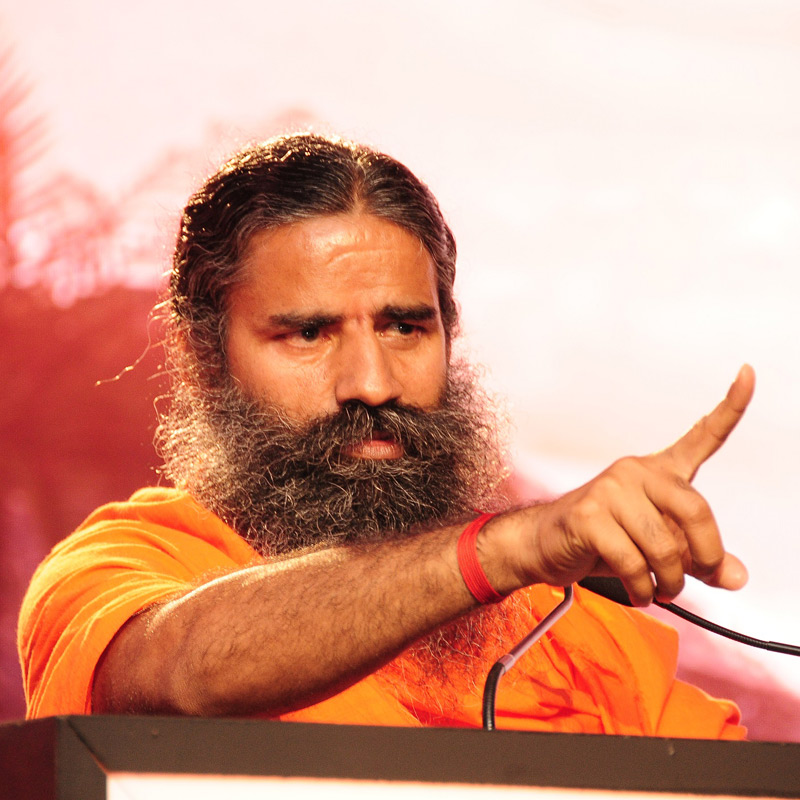
    Next up, was a man who came swathed in a saffron loincloth, a.k.a Baba Ramdev – the mind behind India’s largest swadeshi (domestic) FMCG brand Patanjali. After starting classic style with a gayatri mantra, he dived deep, full Hindi, into how everything, from knowledge, emotions, actions, expertise, experience, skills, innovation, research, resource, and even waste converts to wealth.

    Even though he had humble beginnings from an agriculture background, he was never scared to dream of a prosperous country, even for the poor, and the biggest financial powerhouse. “I only had one question: What can I do about this country? From farming to retailing, I haven’t studied anything, but the world is enough to teach me lessons. When you come face to face with reality, it teaches you lessons no conventional course can teach,” said Ramdev. 

    An avid rebellion of MNCs that he is, Ramdev mentioned that he made Patanjali a Rs 500 crore brand without any major investment in advertising as opposed to MNCs who believe in creating a fairy tale picture while selling every product. He said, “We don’t believe in having glamourous ads as we want our products to speak for themselves and only highlight the product’s benefits or ingredients.”  He also announced that with the growing profit rate of Patanjali, the company will double its turnover in 2019. 

    Peppered with laughter, yoga, life lessons, jokes and harsh doses of reality, he shared the essence of his being: Jo karo, usko pura karo, 100 per cent daalo apna. Usko beech me mat choro, which translates to – Whatever you do, do it whole-heartedly. Give your 100 per cent and don’t leave anything mid-way. He also stressed that companies should not focus on cost cutting as it leads to delivering poor quality products which will result in a great fall for the company sooner or later. Companies also need to have an open mind about implementing newer technologies into their systems since the world is going digital and technological advancement is the need of the hour today. 

    While he encouraged everyone to take risks, he also said, “Whatever you do, do it without ego. Give it all. There is nothing called destiny.” Without any inhibitions, he also added that while some people depended on hard work, some relied on destiny and some believed in cheating. “I believe in universal justice. If you cheat, you might grow for 10 years tops. What will you do after that? Same is the rule for destiny. Work on your work; not on Gods.” 

    During his session, Ramdev also publicly announced that Patanjali will venture into selling liquid milk and other dairy products by next year. He also confidently declared that the company will also launch kids-wear, activewear, accessories and fashion clothing for men and women by 2021. He concluded his session by publicly announcing that Patanjali will also launch its own mineral water very soon and the company has already started work in that area.

  • TV news coverage of corruption issues up 11 times: CMS study

    TV news coverage of corruption issues up 11 times: CMS study

    MUMBAI: Television news channels are crusading against corruption as never before. Corruption coverage in primetime bulletins by the six television news channels during 2005 to 2011 have grown over eleven times in terms of percentage, a research study by CMS (Centre For Media Studies) Media Lab reveals.

    Though the coverage of corruption-related issues by TV news channels as well as newspapers have increased substantially, especially during Anna Hazare‘s fast in August, petty corruption involving vulnerable sections of people are yet to become a concern for the media.

    The study – ‘Face of Corruption in News Media 2011‘ – says that the priority is for scams and scandals rather than for systematic issues and correctives that need to be pursued. The far off and grassroots level corruption hardly figured.

    It said the coverage related to corruption issues was well over eight per cent of primetime and six per cent of front pages from January-June 2011, but during Anna‘s fast the coverage overall went up to over 60 per cent of primetime of news channels and mostly live coverage.

    “Reporting on corruption in news media between the year 2010 and 2011 has doubled. However, during July – September of 2011 alone the coverage has more than tripled,” noted CMS director PN Vasanti in the report. “Since the Anna Hazare crusade, there are initiatives all around and all across the states towards curb, contain corruption and the compulsions. With the kind of spread of e-seva and e-governance services, and transparency movement gaining ground, hopefully news media would take up reporting these in 2012 and expedite the process of decline of corruption.”  
         
      Mainstream news media attached priority to scams and scandals involving high-profile personalities. “Most of the corruption covered in 2011 involved individuals, but with high profiles and of high scams. English channels focused relatively more – both on institutions and individuals; while Hindi news channels focused relatively more on individuals in their coverage of corruption,” the report stated.

    The study pointed out that there were seven scandals, which were reported more often in the stories of news media – channels, newspapers and radio – during the period of the study. Of these, four were to do with government (2G, CWG, Adarsh, Bofors), two were to do with civil society (Ramdev and Anna Hazare) and two (Hasan Ali and Citi Bank) were from private / corporate.

    “The news channels focused more on scams referring to politicians and bureaucrats and to big public utilities / services (like CWG, DGCA, GNDA, etc). CNN-IBN had only 21 percent for covering such corruption against as high 90 percent of Aaj Tak and 81 percent by Star News. Even DD News had 42 percent coverage to do with corruption involving or referring to bureaucrats. In all, major stories covered by news media were analysed. By and large they were all chasing the same stories, and even same way,” said the report.

    This CMS Media Lab study for January – June 2011 involves analysis of primetime (7– 11 pm) coverage of corruption by news media. It includes front pages of six newspapers (Dainik Jagran, Dainik Bhasjar, Hindustan, The Hindu, The Times of India and Hindustan Times), six news channels (NDTV 24×7, CNN-IBN, Zee News, Star News, DD News and Aaj Tak) and AIR news.