Tag: Ram Mandir

  • Fortune unveils plans for Ram Mandir consecration celebrations in Ayodhya

    Fortune unveils plans for Ram Mandir consecration celebrations in Ayodhya

    Mumbai: As the holy city of Ayodhya gears up for the consecration of Ram Mandir on 22 January, Adani Wilmar, one of the largest food & FMCG companies in India, unveils its plans to join the celebrations on this historic occasion.

    The company, under its renowned brand Fortune, has curated a series of delightful activities that promise to add to the festive spirit. Adani Wilmar MD and CEO Anghsu Mallick stated, “The consecration of Ram Mandir in Ayodhya is a momentous occasion for every Indian. In keeping with Fortune’s brand sentiment of ‘Ghar ka khana, ghar ka khana hota hai’, we are proud to be a part of this celebration, as this historical event is akin to a festival that celebrates the essence of being Indian. Just as one in three households uses Fortune, our presence in this significant moment is a testament to our commitment to nurturing traditions and mirroring the spirit of India through our products. This celebration is like the joyous gatherings around a traditional home-cooked feast. It’s a time to come together, share stories, and revel in the rich tapestry of our cultural heritage, much like the values Fortune upholds on a daily basis.”

    In keeping with Fortune’s brand sentiment of ‘Ghar ka khana, ghar ka khana hota hai’, the focus is on celebrating the joys of some traditional home-cooked specialties. Towards this, the brand has crafted some impactful and memorable activations to engage visitors:

    . Jalebi sampling spree: Over seven days, Fortune plans to distribute over 25,000 delightful jalebis shaped in the form of the ‘Bloom’, which is the ‘Fortune logo’. This innovative activation is poised to create a buzz during the celebrations, serving as a sweet ode to Lord Rama, whose favoured dessert was Jalebi.

    . Fortune special pakoda platter: Fortune will introduce a unique pakoda platter, made exclusively with the brand’s products, at 10 snack shops across the city. This 15-day campaign promises to add a delightful twist to the beloved local snack.

    . Fortune mega-bhog: Fortune is set to organise a one-day event of bhog on a grand scale. This’mega-bhog’ will feature a delicious feast, prepared with the brand’s products, for over 5,000 people.

    Additionally, plans are afoot for impactful below-the-line (BTL) activities such as gate branding, hoardings, shopboards, and kiosks to capture the attention of the large congregation of devotees who will gather in Ayodhya.

    Simultaneously, the brand is also leveraging television with its sponsorship for the entire duration of the Shrimad Ramayana, which coincides with the celebrations at Ayodhya. The sponsorship will integrate Fortune Master Brand, Chakki Fresh Atta, Soyabean Oil, Mustard Oil, Soya Nuggets, Besan, Rice Bran Oil, and Kohinoor Basmati Rice. Television commercials for all these categories will be on air for this duration.

  • RAK Ceramics now embraced by Ayodhya Project – A continuing legacy

    RAK Ceramics now embraced by Ayodhya Project – A continuing legacy

    Mumbai: RAK Ceramics has a long-standing history of partnering with prestigious projects across India, including the Kashi Vishwanath temple complex, the UP PWD project, airports of Lucknow, Chennai, Bangalore, and Delhi, prominent IITs like Kanpur, Tirupati, and Patna, medical colleges like AIIMS, and important projects like BHU, ISRO, and NTPC to name a few. However, the Ram Mandir project is considered the grandest of them all. This project strengthens the relationship between Indian consumers and RAK Ceramics, highlighting the company’s commitment to excellence and consistent quality. RAK Ceramics has a state-of-the-art manufacturing facility in Samalkot, Andhra Pradesh, with 30,000 square meters of vitrified tiles and 3000 pieces of sanitary ware production daily. The company also has two joint venture plants at Morbi, Gujarat, which have played a pivotal role in India’s story.

    Speaking about this, RAK Ceramics India Pvt Ltd CEO Anil K Beejawat said, “While our products are used in tens of thousands of projects globally every year, this prestigious association is one of a kind. To be associated with a project embedded in the cultural, religious, and social life of the people of Bharat is a matter of great pride for RAK Ceramics.”

    As a part of the project, high-quality products are used in various key areas of the Ram Temple Complex, including the pilgrim’s facility centre, fire post, pilgrims toilet, main receiving substation, staff locker male/female, waiting hall, and UPS room, etc. These are high-footfall areas that will serve millions of visitors each year. The project demanded nothing less than the best quality of products, and that’s where RAK Ceramics prevailed.

    Furthermore, Beejawat said, “The Ram Mandir at the Ram Janmabhoomi at Ayodhya is much more than a modern architectural marvel. It is the epitome of faith of all Indians the world over. It’s symbolic of the real identity of Bharat and the re-emergence of one of the oldest civilizations on this planet. We have participated in numerous globally renowned projects such as Wembley Stadium, Atlantis – The Palm, Burj Khalifa, Burj Al Arab, Grand Hyatt Washington, and iconic airports like Heathrow and Dubai. With this opportunity to be a part of the Ram Temple Complex, we have added another unmatched accomplishment to our repertoire. We are keenly looking forward to the grand opening of the temple on 22 January.”

    RAK Ceramics is one of the largest ceramic brands in the world, with the capacity to produce 118 million square meters of tiles, 5.7 million pieces of sanitaryware, 26 million pieces of porcelain tableware, and 2.6 million faucets yearly at their state-of-the-art plants across the United Arab Emirates, India, Bangladesh & Europe. The company is gearing up for more exciting projects and other important associations in the near future.


  • Parimal Bharat Vasi Agarbatti & Republic Media Network launch anthem celebrating Ram Mandir grandeur

    Parimal Bharat Vasi Agarbatti & Republic Media Network launch anthem celebrating Ram Mandir grandeur

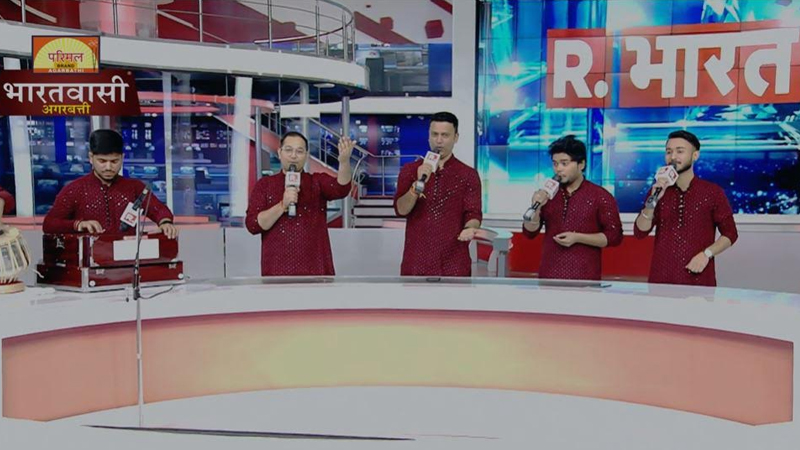
    Mumbai: In a historic collaboration, Parimal Bharat Vasi Agarbatti, a leading name in the realm of spiritual fragrances, and Republic Media Network, India’s foremost news and entertainment conglomerate, proudly present an anthem song that resonates with the divine aura of the Ram Mandir’s ‘Pran Pratistha’ Ceremony scheduled for 22 January 2024.

    “We are thrilled to partner with Republic Media Network for this exceptional project,” said Parimal Bharat Vasi Agarbatti director Vijay S.G. “We endeavor to create an anthem that not only pays homage to the divine abode of Lord Ram but also becomes a source of inspiration for millions of devotees across the globe.”

    The anthem, crafted with musical and lyrical finesse, captures the spirit of unity, devotion, and the cultural heritage embodied by the Ram Mandir. The collaboration between Parimal Bharat Vasi Agarbatti and Republic Media Network reflects a shared commitment to promoting and preserving India’s rich cultural and spiritual tapestry.

    Republic Media Network CEO Hersh Bhandari expressed enthusiasm about the collaboration, stating, “It’s an honor that the anthem will exclusively be unveiled on the entire Republic Media Network, which reaches every third person in the Indian TV Universe once a month, boasting a viewership of 27 Crore across four channels – Republic TV, Republic Bharat, R. Bangla, and R. Kannada.”

    The anthem will be officially launched on 20 January 2024, and will be available on various platforms of Republic Media Network for audiences to experience the divine journey through music. Parimal Bharat Vasi Agarbatti and Republic Media Network extend an invitation to everyone to join in this celebration of spirituality, unity, and cultural richness.


  • Doordarshan is to run a special news bulletin titled ‘Ram Ki Paidi’

    Doordarshan is to run a special news bulletin titled ‘Ram Ki Paidi’

    Mumbai: Meticulous arrangements are being made for the smooth and successful conduct of the consecration ceremony of the Shri Ram temple in Ayodhya Dham, being held on 22 January 2024. Prime Minister Shri Narendra Modi will perform the ‘Pran Pratishtha’ as per prescribed rituals. It is expected that more than 8,000 guests will visit the temple on this day, followed by lakhs of devotees from 23 January onwards.

    Live Telecast

    Elaborate arrangements have been made for a LIVE telecast of the ceremony. The entire event would be live-telecast in 4K quality by Doordarshan, on DD News and DD National channels. On 23 January 2024, Doordarshan will do a LIVE telecast of Aarti and the Opening of Shree Ram Temple for the public.

    Doordarshan shall share the clean feed of the event in Ayodhya on 22 January 2024 with ANI TV and PTI Video. All TV channels which are subscribers to the agency can obtain feed from there.

    For other National and International broadcasters, a YouTube link with a key to a clean feed will be generated. This link will be shared with the concerned broadcasters upon their request. In order to obtain the YouTube link, domestic broadcasters may place their request with the Press Information Bureau. International TV Channels would need to place their request directly with Prasar Bharati. Contact details are available in the PIB Media Advisory, which can be accessed here.

    Channels also have the option of patching to DD News, in case a clean feed is not required. Courtesy may be given to Doordarshan in this case. PIB will issue photographs and press releases of the event, in English, Hindi, and Indian state languages.

    Ayodhya Media Centre

    A Media Centre is being set up at Ram Katha Sangrahalay in Ayodhya with limited capacity, where large LED TVs will be set up to facilitate viewing of the telecast. The Media Centre will be equipped with a Wi-Fi facility for media persons to file their stories.

    Portal for Media Passes

    The media organizations desirous of covering the event from Ayodhya may apply through PIB’s centralized portal, latest by 6 p.m., 17 January 2024; based on which security passes will be issued, through state administration. The portal can be accessed here.

    Special Programmes by Doordarshan

    Besides the live telecasts, Doordarshan is running a Special News Bulletin titled Ram Ki Paidi (राम की पैडी)) during 1 January – 15, 2024. From 5 P.M. -8 P.M., there will be a special live programme titled “श्री राम अयोध्या आये हैं” (Shri Ram Ayodhya Aaye Hain) which will include daily Ayodhya round-up, guest discussions, special stories, and vox-pop.

    Health Facilities

    Efforts are being made to make information on medical care facilities at Ayodhya available on the website of the local administration in Ayodhya and the Ram Janmabhoomi Trust, in order to facilitate people in getting adequate medical assistance. A team has been sent from JPNA Trauma Centre, AIIMS, New Delhi to impart training to around 200 health workers in Ayodhya from January 12 – 15, 2024.

    The government of India is likely to establish a Bhishm Emergency Response facility at Ayodhya during the Pran Pratishta ceremony and allied programmes.

  • ShareChat presents #AyodhyaKiTicket: A virtual celebration of Ram Mandir consecration

    ShareChat presents #AyodhyaKiTicket: A virtual celebration of Ram Mandir consecration

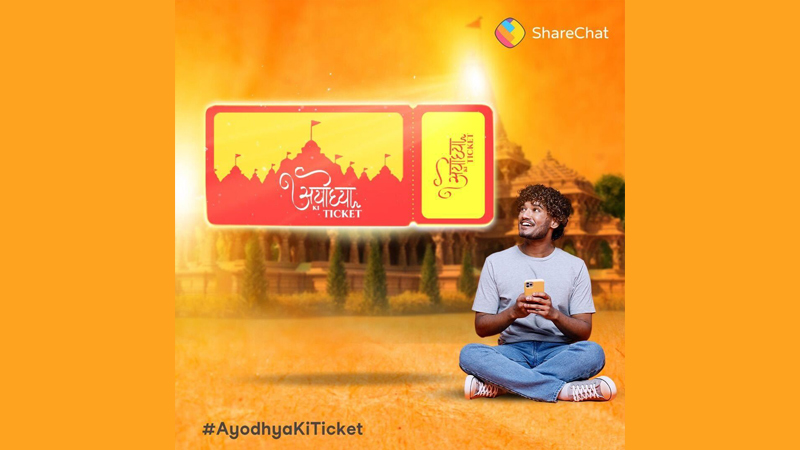
    Mumbai:  Can’t be in Ayodhya for the Ram Mandir consecration? ShareChat will bring the festivities to you! ShareChat, a multilingual social media
    platform, announced the launch of #AyodhyaKiTicket, a comprehensive in-app campaign to bring the historic consecration of the Ram Mandir in Ayodhya to
    every user, right at their fingertips. ShareChat, the destination for all trending content launches this week-long campaign, starting from January 15 to 22 January inviting users to experience the vibrancy of Ayodhya through a range of in-app activities designed to engage and connect its community nationwide.

    Through #AyodhyaKiTicket, ShareChat will take the user experience beyond simple viewing, transforming the platform into a virtual portal to Ayodhya’s grand celebrations where users can witness the consecration of Ram Mandir live and light up Sri Ram Jyoti from home using an interactive web card. In addition, the app will also have trending tags, featuring informative content pieces throwing light on topics such as history, Ramayan, Sanatana Dharma, and preparation around the temple consecration. Furthermore, to cater to diverse interests and enrich the user experience, special tags will be curated to keep the users updated on the latest happenings around Ram Mandir’s consecration, featuring content on guidelines, administrative updates, celebrities visiting

    Ayodhya, and more. Users can also tune into exclusive Live Chat Rooms to listen to Ramayan Path and take part in daily quizzes.

    Talking about the campaign, ShareChat & Moj senior director, content strategy and operations Shashank Shekhar said, ‘ShareChat & Moj said
    “ShareChat celebrates the cultural richness of our nation and with this campaign we aim to bring the essence of Ayodhya closer to every user, fostering a sense of togetherness during this historic moment. No matter where you are, ShareChat will be your #AyodhyaKiTicket. Join millions of users as they experience this momentous occasion through interactive features, insightful content, and a shared sense of community.”

    Join in this unique and immersive experience, to honor the legacy of Lord Ram, on ShareChat with #AyodhyaKiTicket.

  • ‘Tryst with Ayodhya: Decolonisation of India’

    ‘Tryst with Ayodhya: Decolonisation of India’

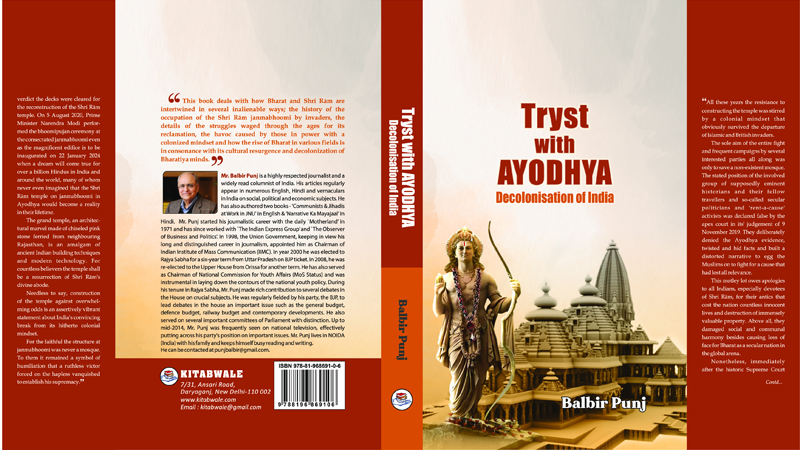
    Mumbai: ‘Tryst with Ayodhya: Decolonisation of India’ by Balbir Punj is slated for release on 13 January 2024, at 2.30 pm onwards in Multipurpose Hall, Indoor Stadium, Delhi University, New Delhi. This book deals with how Bharat and Shri Rām are intertwined in several inalienable ways; the history of the occupation of the Shri Rām Janmabhoomi by invaders, the details of the struggles waged through the ages for its reclamation, the havoc caused by those in power with a colonized mindset and how the rise of Bharat in various fields is in consonance with its cultural resurgence and decolonization of Bharatiya minds.

    This book emphasises that the resistance to the construction of the temple was stirred by a colonial mindset that obviously survived the departure of Islamic and British invaders. The sole aim of the entire fight and frequent campaigns by several interested parties all along was to save the structure that had ceased to be a mosque long back and somehow prevent the construction of the temple at the Janmabhoomi site in Ayodhya. The stated position of the involved group of supposedly ‘eminent historians’ and their fellow travellers and so-called secular politicians and ‘rent-a-cause’ activists were declared false by the apex court in its judgement of 9 November 2019. They deliberately denied the Ayodhya evidence, twisted and hid facts and built a distorted narrative to egg the Muslims on to fight for a cause that had lost all relevance.

    This mischievous lot owes apologies to all Indians, especially devotees of Shri Rām, for their antics that cost the nation countless innocent lives and destruction of immensely valuable property. Above all, they damaged social and communal harmony besides causing loss of face for Bharat as a secular nation in the global arena. It’s noteworthy that the judgment delivered by the five-member Supreme Court bench was unanimous.

    With the inauguration of the Shri Ram Temple slated for 22 January 2024, a dream will come true for over a billion Hindus in India and around the world, many of whom never even imagined that the Shri Rām temple on Janmabhoomi in Ayodhya would become a reality in their lifetime. The grand temple, an architectural marvel made of chiseled pink stone ferried from neighbouring Rajasthan, is an amalgam of ancient Indian building techniques and modern technology. For countless believers the temple shall be a resurrection of Shri Rām’s divine abode.

    Needless to say, construction of the temple against overwhelming odds is an assertively vibrant statement about India’s convincing break from its hitherto colonial mindset. Several aspects of Ayodhya and the Shri Rām Janmabhoomi temple have been commented upon and debated over the past few decades, in particular post 1984. Many questions, some of them puerile, have been raised to confound the issue. Did Shri Rām really exist? What is the proof that He was born in Ayodhya? What is the evidence that the very spot of His birth is the Janmabhoomi? Is His story chronicled in the Rāmāyan merely a figment of imagination? Why does one need a temple when Shri Rām is omnipresent? Why not build a hospital or public toilets at that site since the country needs these more than another Shri Rām temple?

    Most of these questions are neither innocent nor genuine but reek of mischief. Shri Rām’s antiquity is proven by itihās, as history is termed in Indian wisdom. The Rāmāyan, along with the Mahābhārat and Purāns, is a part of itihās. The issues that Janmabhoomi is the birthplace of Shri Rām and that He is the seventh incarnation or avatar of Bhagwān Vishnu are matters of faith supported by tradition and numerous historical accounts going back several millennia. All religions in the world are invariably sustained by faith as are most of their special religious places which draw legitimacy from parables and fables their followers believe.

    The book claims that demolition of Babri structure on 6 December, 1992 was a Gandhian solution to the problem. Considered a moral compass of the world, Gandhiji was asked how to deal with a situation when a mosque is forcibly built on someone else’s land. He dealt with the vexed issue in ‘Young India’ on 5 February 1925. Here are excerpts,

    “…The question of mosques built on another’s land without his permission is incredibly simple. If A is in possession of his land and someone comes to build some things on it, be it even a mosque. A has the right at the first opportunity of pulling down the structure. Any building of the shape of a mosque is not a mosque. A building to be a mosque must be duly consecrated. A building put up on another’s land without his permission is a pure robbery. Robbery cannot be consecrated. If A has not the will or the capacity to destroy the building miscalled mosque, he has the right of going to a law court to have the building pulled down… So long as I own property, I must defend it whether by the force of law-courts or by the force of my own strong arms… “

    The author asserts that the Shri Ram Janmabhoomi would have been resolved immediately after the independence but for the colonial attitude of Pandit Jawahar Lal Nehru. The author accuses Nehru nursing of hate against Hindu religion and its traditions. According to author’s assessment, Nehru was highly influenced by Marxism; and his outlook towards India and Hindus was shaped by the alien education system introduced by TB Macaulay.

    The book alleges Nehru did a volte-face on the Somnath temple issue, and had an opportunistic streak. At Sardar Patel’s instance, a cabinet meeting in December 1947, presided by Nehru had decided not only to rebuild the Somnath Temple, but also finance its reconstruction. However, at Gandhiji’s instance, it was later decided that instead of Government funding Somnath construction, it should be rebuilt with donations from public. Accordingly, a Trust headed by Dr. K. M Munshi, a cabinet minister, was formed to oversee the temple construction.

    Gandhiji was assassinated on 30 January 1948 and on 15 December 1950 Sardar Patel breathed his last. After the demise of two stalwarts— Gandhiji and Sardar Patel, the Book alleges that Nehru’s attitude towards the Somnath temple project changed completely. After a Cabinet meeting in early 1951, Pandit Nehru called Dr. Munshi, and told him, “I do not like you trying to restore Somnath. It is Hindu revivalism.” After the Somnath temple was completed, Dr Rajinder Prasad, the then President of India, was requested to inaugurate it. When, President Prasad agreed to inaugurate the temple, Nehru asked him not to do so.  The irony is, the President was merely respecting a decision that the Nehru cabinet had taken earlier. In a parliamentary democracy, the president is expected to go by the Cabinet decision. And the President was following that convention. The Prime Minister and the President had a stand-off on the issue because Nehru had conveniently changed his mind on the issue.

    The book asserts, Pandit Nehru’s antipathy was not limited to Somnath or the Shri Rām temple in Ayodhya; it extended to all Hindu temples as such. Delivering his inaugural address at a seminar on architecture in Delhi in 1959, Nehru said:

    “Some of the temples of the South, however, repel me in spite of their beauty. I just can’t stand them. Why? I do not know. I cannot explain that, but they are oppressive, they suppress my spirit. They do not allow me to rise, they keep me down…

    …The dark corridors — I like the sun and air and not dark corridors”.

    In contrast, he found Taj Mahal ‘astoundingly beautiful’, saying,

    “The Taj Mahal is, of course, one of the most beautiful things anywhere and it is a delight to the eye and to the spirit to see it. It represented, as all architecture represents to a large extent, the age in which it grew. You cannot isolate architecture from the age, from the social conditions, from the thinking, from the objectives and ideals of that particular age…”

    This book claims that Nehru was essentially a choice of the British who saw in him a successor who could effortlessly step into their shoes and carry on with the colonial system established by their empire. Based on sources, Author reveals that on 2 September 1946, Nehru took the following oath affirming his allegiance to the British Empire,

    FORM OF AFFIRMATION OF ALLEGIANCE

    I, Jawaharlal Nehru, do solemnly affirm that I will be faithful and bear true allegiance to His Majesty, KING GEORGE THE SIXTH, Emperor of India, His Heirs, and Successors, according to law.

    FORM OF AFFIRMATION OF OFFICE

    I, Jawaharlal Nehru, do solemnly affirm that I will well and truly serve our Sovereign, KING GEORGE THE SIXTH, Emperor of India, in the Office of Member of the Governor General’s Executive Council, and that I will do right to all manner of people after the laws and usages of India without fear or favour, affection or ill-will.”

    The book which runs into 436 pages with over 1.28 lakh words, 12 annexures and about 500 references, claims that Shri Ram Janmabhoomi had ceased to be Hindu-Muslim issue post-Independence. Quoting relevant sources, the author asserts that there was near unanimity in Ayodhya over the issue of building a temple at the Ram Janmabhoomi site, following the mysterious appearance of idols in the intervening night of December 22 and 23, 1949. All kinds of differences, be they social, political, class and caste were subsumed by the shared adoration and love for Rām Lallā and strong faith that this very piece of land was undoubtedly His Janmabhoomi. Everyone in the temple town and in Lucknow seemed at peace with the new emerging reality.

    For the believers the emergence of Rām Lallā was a divine phenomenon. A surprise statement by Abdul Barkat, a Muslim police constable on duty at the Police outpost at Rām Janmabhoomi on the night between 22 and 23 December 1949, made before a magistrate later further strengthened the devotees’ belief of the divinity of the episode that midnight. More than 12 Muslims of Ayodhya gave affidavits supporting the Hindu claim about the Ram Janmabhoomi. Baba Abhiram Das, the prime accused in the case relating to the installation of Rām Lallā in the shrine, was subsequently in 1960 gifted an ancestral house and land in Kanhipur village in neighbouring Barabanki district of Uttar Pradesh by Qayum Kidwai, a munificent Muslim. Abhiram Das built a Hanumān temple on the gifted land.

    The Hindu-Muslim dimension to the controversy was given by those who had their own ideological axe to grind. They looked at the vexed issue from a colonial perspective in which the indigenous culture and traditions held an inferior position. Basically, the colonialists were fighting to retain the status quo. The local Muslims, barring some remnants of the feudal Islamic rule, were not interested in the Babri structure because as per law and Islamic tradition it had ceased to be a mosque long back.

    This book also claims that for the Hindus, the Babri structure at Janmabhoomi was never a mosque. To them it remained a symbol of humiliation that a ruthless victor forced on the hapless vanquished to establish his supremacy.

    Why build a temple, and not university or a hospital instead? A place of worship such as temple, gurdwara, mosque, church or synagogue is a prerequisite for sustaining any faith. These religious institutions help the believers organize themselves as communities and provide the necessary ambience and facilities to help them further their spiritual and ritualistic pursuits. Apart from such regular places of worship every religion has some sites that are particularly sacred or of special interest to the followers of that particular faith because of multiple reasons; be they mythological, historical or emotional.

    For instance, Mount Sinai is a sacred site for Jews and Christians because it is there that Moses is believed to have received the Ten Commandments from God. Although there is no archeological or historical evidence to back this article of faith, except perhaps that the Commandments are mentioned in the Bible (Exodus 19-24), for the believers it is above all else a matter of faith. Other venerated places include the Dome of the Rock and the Al-Aqsa Mosque in Jerusalem, both of which are highly revered sites. The Al-Aqsa Mosque is believed to have been built over the Prophet Mohammad’s footprint in the rock. It again points to the importance and legitimacy of matters of faith and belief that no one questions. It may then be asked why were questions about the necessity for a Shri Rām temple in Ayodhya raised? Because of double standards prevalent in the Indian public life.

    The book asserts that the Ayodhya dispute was avoidable and the Ram Temple would have come up at the Janmabhoomi site without any problem after independence but for the colonial attitude of Pandit Nehru and his fellow travellers who were deeply entrenched in the system.

    Rahul Gandhi’s harping on his Brahmin lineage, wearing a janeyu over a kurta and doing selective pre-poll temple hopping are comical attempts to paper over his own and his party’s disconnect with the country. Stopping the construction of the Shri Rām temple at the Janmabhoomi was made into a litmus test for ‘secularism’ and the ‘safety’ of Muslims in the country. The unanimous verdict delivered by the Supreme Court’s constitutional bench, paving the way for the construction of the Shri Rām temple has proved beyond doubt that it was a completely false construct. Today, the magnificent Rām Lallā temple standing in Ayodhya surely sends a powerful message; the end of colonisation in Bhārat has started and almost reached a terminal stage; and with this end of the last vestiges of colonisation none can stop Bhārat’s march forward.