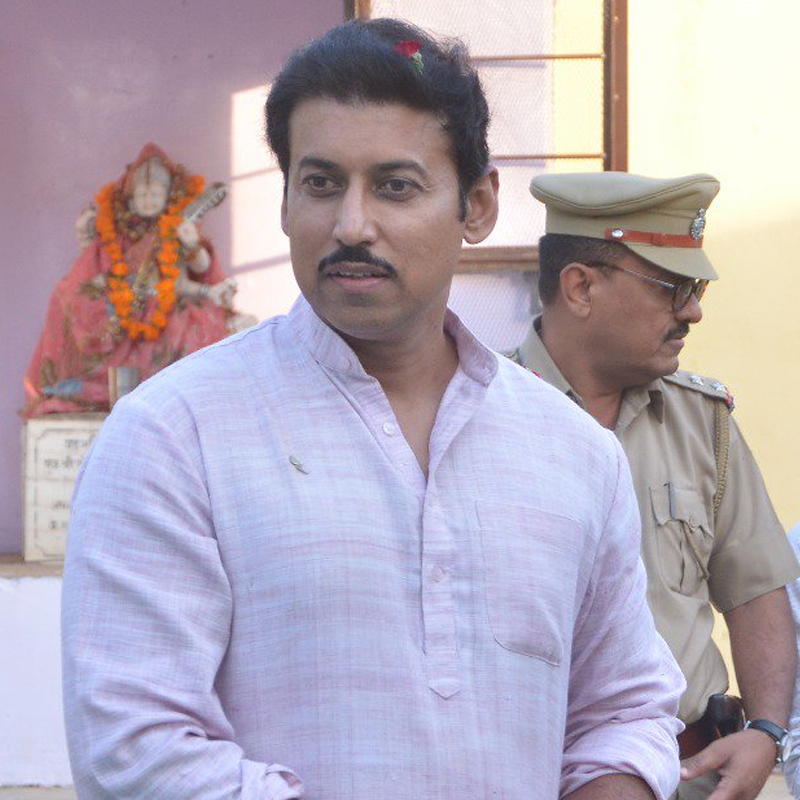
Tag: Rajyavardhan Rathore

  • DAS deadline extension ruled out, govt claims 66% seeding done

    NEW DELHI: The Government reiterated today that there was no question of extension of the final phase of digital addressable systems for cable television in the country.

    Minister of state for information and broadcasting Rajyavardhan Rathore told the Parliament that Phase I, II & III of the Cable TV Digitisation have been completed successfully except in Tamil Nadu state, which is pending due to court cases.

    The fihal phase covering the Rest of India had originally been fixed for 31 December 2014 and later modified to 31 December 2016. It had now been further modified to 31 March 2017 on disposal of court cases.

    At the outset, he said Cable TV digitisation in the country is being implemented in four phases according to a Ministry notification of 11 November 2011 which had laid down the phase wise timelines which were subsequently amended.

    Phase I covering the Metro cities of Delhi, Mumbai, Kolkata and Chennai was originally slated for 30 June 2012 and modified to 31 October 2012. The second phase covering 38 cities (with population more than one million) was slated for 31 March 2013.

    The third Phase was to cover all other urban areas (Municipal Corporations/ Municipalities) and was originally slated for 30 September 2014 and modified to 31 December 2015.

    He said this cut-off date could not be achieved due to stay/extension granted by some Courts. On the disposal of the court cases in December 2016 and in order to provide time for transition of those subscribers who had not switched to digital mode of transmission, the Ministry allowed time upto 31 January 2017.

    For Phases I and II 100% requirement of set top boxes has been met except in Tamil Nadu. For Phase III & IV, the Ministry had developed a MIS online software for collection of seeding status of STBs. Since the area of Phase III & IV overlap, the combined state wise seeding progress for these two phases is 66.79 per cent minus Tamil Nadu.
  • DD national channel had a weekly viewership of 172 million in ’16

    NEW DELHI: The gross viewership of Doordarshan’s national channel in 2016 was 172 million per week as compared to 133 million per week in 2015 and 155 million per week in 2014.

    Minister of state for information and broadcasting Rajyavardhan Rathore has told the Parliament that the computation had been done under the New Consumer Classification System (NCCS).

    Being a public service broadcaster, the minister said in reply to a question that the pubcaster cannot therefore be guided purely by Commercial motive to produce high TRP ratings programmes.

    Section 12 of the Prasar Bharati (Broadcasting Corporation of India) Act 1990, the primary duty of the Corporation is to organise and conduct public broadcasting services to inform, educate and entertain the public.

    In accordance with these objectives, Doordarshan produces programmes encompassing the objectives of public service broadcasting.

    He said that DD telecasts a variety of programmes for viewers in rural areas through its entire network of 23 Satellite channels (24X7) including six National, one International, and 16 RLSS (Regional Language Satellite Services) channels.

    Apart from this, Doordarshan has launched DD Kisan Channel to meet the special requirement of farmers and viewers in rural areas. Its programme content includes core agriculture, weather, rural development and entertainment for the benefit of viewers in general and farming and rural community in particular.

  • Prasar Bharati’s main role is of pubcaster, not revenue generator, says Rathore

    NEW DELHI: Stressing that revenue generation is not the main objective of Prasar Bharati, the Parliament was today told that the pubcaster is generating its revenue through Internal Extra Budgetary Resources (IEBR) to meet its operating expenses.

    Minister of state for information and broadcasting Rajyavardhan Rathore said in reply to a question that the government was providing 100 per cent salary support to Prasar Bharati, apart from plan grant for creation of capital assets and content development.

    He said that Prasar Bharati’s primary mandate was to organise and conduct public broadcasting service with the intent to inform, educate and entertain the public and to ensure a balanced development of broadcasting on radio and television in the country.

    Listing various achievements as an outcome of measures taken in recent years, he said the capability of the direct to home platform FreeDish had been increased from 59 to 104 TV channels of which 80 are already on air, and orders had been placed for implementation of Indian Conditional Access System (iCAS).

    (DD sources told indiantelevision.com that these 80 were on MPEG-2 , while the remainder will be on MPEG-4 which has been tested and the auction process to fill those slots has already been initiated.)

    Apart from DD Kisan, the minister added, that 24-hour Doordarshan channels had been launched in Bihar, Madhya Pradesh, Uttar Pradesh, Rajasthan and Saptagiri from Vijaywada.

    The technical facility for launch of new TV Channel DD Arunprabha for the north east had been completed.

    Earth stations had been set up at Indore, Rajkot, Vijayawada and Jalpaiguri and the earth station at Leh, Chandigarh, Hisar, Panaji, and Port Blair (except RF equipment) had been modernised.

    Other steps included:

    High Definition television (HDTV) studios set up at Delhi and Mumbai; digitisation of 39 studios; commissioning of a permanent studio set up at Dehradun; multichannel automated playback facility set up and installation of multi camera studio production facility in HDTV format in progress at Central Production Centre in Delhi; Media Asset Management for archive system set up at Kolkata; HDTV outside broadcast (OB) vans supplied at Delhi and Mumbai; and six Digital Satellite News Gathering (DSNG) vans deployed.

    Referring to status of transmitters, he said 19 digital High Power Transmitters (Digital Video Broadcasting-and Generation Terrestrial) (DVB-T2) had been supplied and 16 digital HPTs commissioned; four HDTV transmitters supplied and installed; a HPT commissioned in Cannanore, apart from a Very Low Power Transmitter (VLPT) at Joginder Nagar.

    Ageing HPTs had been replaced by new 10 KW HPTs at 14 locations and 111 auto-mode LPTs supplied & commissioned.

  • Govt committed to self-regulation on issues of freedom of press: Rathore

    NEW DELHI: Minister of State for Information and Broadcasting Rajyavardhan Rathore today said the Government believes in the philosophy of Self Regulation regarding to the issues related to freedom of Press.

    The Minister was speaking with a UNESCO delegation led by its Assistant Director General for Communication & Information today in New Delhi Frank La Rue.

    The delegation apprised the Minister about the varied activities of UNESCO in the field of Media and Communication. Possible areas of collaboration with the Government were also highlighted by the delegation.

    The Minister said Community Radio will address the information needs at the grassroot level, providing updates on different local and relevant issues in their own language and dialect.

    He said the Government stood committed in its objective to provide the last mile connectivity through various communication platforms including Community Radio which has been provided a big push through various initiatives.

    He said the Ministry has increased the subsidy for setting up CRS from 50 per cent to 90 per cent in the North Eastern States and 75 per cent in other states subject to a maximum limit of Rs 7,50,000. In order to make it more participatory, varied set of participants including Universities and NGOs have been permitted to set up CR stations in the country.

  • Naidu concerned over stereotypical portrayal of women

    NEW DELHI: Information and broadcasting minster M Venkaiah Naidu expressed concern over the stereotypical portrayal of women in movies which led to increased objectification.

    The minister said media should play a greater role in informing women about their rights and Nari Shakti programmes should be encouraged across media platforms. It was imperative to draw from the valuable contributions and examples set by great women leaders and intellectuals who have adorned the history of our nation.

    Speaking at the celebration of the 100th episode of the DD News programme Tejaswani devoted to women empowerment at which Minister of State Rajyavardhan Rathore was also present, Naidu said gave another example of media playing a positive role when he said the #SelfieWithDaughters campaign launched by Prime Minister through his Mann ki Baat on All India Radio became a worldwide phenomenon trending among top five across the world.

    Naidu also felicitated 14 Tejasvini from different walks of life on the occasion. The Minister also inaugurated the Tejaswini YouTube link on the occasion.

    He urged Prasar Bharati to play a vital role in spreading the message of the numerous schemes the government for the girl child, adolescent girl and women. Creating and developing programmes which carried the message, preferably in a subtle manner, of the latent talent and strength women possessed.

    Some iof the Tejasvinis honoured are:  

    1.  Deepa Malik, Paralympic 2017 Silver Medalist

    2.  Pandita Anuradha Pal, World’s First Woman Professional Tabla Player

    3.  Sonal Mansigh, Bharatnatyam Artiste

    4.  Pragya Ghildiyal, Best Sports person with disabilities

    5.  Santosh Yadav, Mountaineer

  • Content with subtitles on India, Ukraine pubcasters discussed

    MUMBAI: India and Ukraine have agreed to strengthen the bilateral cooperation between the twocountries through the medium of Cinema. The cooperation would be worked out through a policy and institutional framework to showcase films through the medium of Film Festivals and utilizing the Film Facilitation Office platform established by India. The screening of films with subtitles was also discussed in order to reach out to people. These issues were discussed during the meeting between M Venkaiah Naidu, Minister for Information & Broadcasting, and Ukrainian delegation led by Mr. Iurii Artemenko, Member of the Parliament of Ukraine and Chairman of the National Council of Television and Radio Broadcasting of Ukraine today in New Delhi. Minister of State for Information & Broadcasting Col. Rajyavardhan Rathore and Secretary I&B were also present during the discussions.

    During the discussions, Naidu said that the Ministry of Information & Broadcasting would extend all possible support to promote exchange programs between public broadcasters of the two countries, content creation, screening and distribution of films. The possibility of translating programs and content and providing subtitles in respective languages of both the countries was also discussed with respect to the Public Broadcasters of both the countries.

    Naidu also apprised the delegation about the Film Facilitation Office recently setup in the Ministry to facilitate single window clearance for film makers. The FFO act as a facilitation point for film producers and assist them in obtaining requisite permissions, disseminate information on shooting locales as well as the facilities available with the Indian film industry for production/post production.

    Iurii Artemenko said that Ukraine Government were taking efforts to organise an Indian Film Festival in Ukraine to promote Cultural ties between the two countries through the medium of Cinema. He extended a personal invitation to I&B Minister for the Film Festival to be organised in the near future. He also expressed interest for showcasing programmes based on Indian weddings, Touristic places such as Rajasthan and different Indian Cuisines.

    Deliberations were also held for organising Film Festivals showcasing each other’s movies in respective countries and the possibility of participating in Film Festivals as Partner Countries.

  • No proposal to bring news portals under PRB or PCI Acts

    NEW DELHI: The Information and Broadcasting Ministry is not considering making the provisions of Press and Registration of Books (PRB) Act 1867 and Press Council of India Act 1978 applicable to the news portals as these Acts are meant to govern print media sector only.

    Parliament was informed by Minister of State for I and B Rajyavardhan Rathore that according to the Allocation of Business Rules, the Electronics and Information Technology Ministry (MEITY) has been tasked to administer Information Technology Act 2000, under which the digital newspapers or news-disseminating portals fall.

    Rathore said the Government had formulated new guidelines for Central Government advertisements on websites. The policy of Directorate of Advertising and Visual Publicity has been made effective from 24 May 2016 for releasing government advertisements on online platform (such as Google, Yahoo etc.).

    The policy sets out criteria for empanelment of suitable agencies and Rate fixation for advertisements on websites. The new Policy is available on the DAVP website under the heading ‘Electronic/New Media’ sub-heading ‘New Media Policy guidelines for empanelment and rate fixation for Central Govt. Advertisements’.

    The PRB Act is applicable to printed newspapers only and not to online newspapers. Similarly, PCI Act only deals with news items of printed newspapers / journals etc.

    Also Read:

    http://www.indiantelevision.com/television/tv-channels/news-broadcasting/network18s-news18com-re-branded-as-pradeshcom-160204

    http://www.indiantelevision.com/headlines/y2k13/mar/mar32.php

  • DTH STBs: Interoperability to be ensured with MeiTY & BIS help

    NEW DELHI: The information and broadcasting ministry has decided to refer to the electronics and information technology ministry and the Bureau of Indian Standards the issue of ensuring interoperability of set-top boxes for the direct to home industry.

    Minister of State for I and B Rajyavardhan Rathore told the Parliament that the Telecom Regulatory Authority of India (TRAI) had on 23 July 2014 recommended replacement of license condition at clause 7.1 of the existing DTH guidelines.

    The clause stipulates that “The Open Architecture (Non-proprietary) Set Top Box (STB), which will ensure technical compatibility and effective interoperability among different DTH service providers shall have such specifications as laid down by the Government from time to time” and TRAI in its recommendations on “Issues relating to New DTH Licenses” wanted the clause to read: “The STB offered by a DTH service provider shall have such specifications as laid down by the BIS from time to time.”

    TRAI further recommended that BIS should come out with updated specifications for STBs from time to time and while doing so, BIS shall consult TRAI and that the license conditions should mandate the licensee to comply with the tariff order/scheme prescribed by TRAI for commercial interoperability.

    As reported in mid-December 2016, the Bureau of Indian Standards (BIS) had failed to come out with specifications with regard to interoperability of STBs (set-top boxes) meant for DTH (direct-to-home) platforms.

    An information and broadcasting ministry source was answering a question by indiantelevision.com in response to a reply in the Parliament.

    The minister had said the ministry had accepted recommendations of the Telecom Regulatory Authority of India (TRAI) that it should work with the BIS and the Department of Electronics and IT to ensure such set-top boxes.

    Also Read:

    http://www.indiantelevision.com/dth/dth-services/no-bis-specification-yet-for-interoperable-dth-boxes-161210

    http://www.indiantelevision.com/specials/year-enders/the-growth-of-dth-in-india-170116

  • Report illegal TV channels, Govt alerted

    NEW DELHI: While stressing that the law was clear that no cable operator could beam any private TV channel which had not been registered with the Government, the minister of state for information and broadcasting Rajyavardhan Rathore said today that a total of 889 private satellite channels had been given valid permission under Uplinking/ Downlinking Guidelines as on 31 January 2017.

    Rathore told the Parliament that Sub Rule 6(6) of the Cable Television Network Rules 1994 specifies that no cable operator shall carry or include in his cable service any television broadcast or channel which has not been registered by the Central Government for being viewed within the territory of India.

    The Ministry has from time to time issued advisories to State Governments to constitute State and District Level Monitoring Committees for broadcast content monitoring.

    The Ministry on 8 July 2016 issued an advisory to the Chief Secretaries of all States/UTs Governments, the District Collectors and the Multi System Operators (MSOs)/ Local Cable Operators (LCOs) to ensure that no unpermitted TV channel, are transmitted/ re-transmitted in the Cable Networks and to take action against the defaulter under the provisions of the Cable Television Networks Act 1995 to stop transmission of these channels.

    In pursuance to this, necessary action had been taken by authorized officers and FIR lodged against the concerned LCO. 

    In mid-2016, the Ministry had also written to the Home Ministry to bring to its notice any illegal channels being beamed in the country.

    However, the I and B Ministry had last month put on its website a list of 899 as at the end of 2016, with nine new television channels cleared in December 2016.

    According to that list, permission had been initially granted to 1054 channels but later the licences of 155 channels had been cancelled. The 899 channels included 500 general entertainment channels and 399 news and current affairs channels.

    Of these, while 788 were allowed to uplink and downlink in India, 20 were permitted to uplink from India but not downlink in the country and 91 channels uplinked from overseas were permitted downlinking into India.

    Also Read:

    Peace TV Saga: 24 TV channels identified unfit for telecast in 2015 by India

    HC terms Care World TV ‘ban’ as illegal

  • No plan to turn AIR, DD into corporate entities

    No plan to turn AIR, DD into corporate entities

    NEW DELHI: The government is not considering any proposal to make Doordarshan and All India Radio as separate corporate entities, the Parliament was told.

    Minister of State for Information and Broadcasting Rajyavardhan Rathore said that the two organisations are being professionalised in accordance with the recommendations of the Sam Pitroda Committee submitted three years ago.

    He said that a panel of secretaries had been set up to examine the report and suggest other ways to modernise the organisations. But, the panel had not submitted any report so far, Rathore said.

    (Prasar Bharati Board had set up committees earlier to go into the various recommendations of the Sam Pitroda Committee and some action has already been initiated, Ministry sources told indianteleision.com.)

    Prasar Bharati was established as an autonomous corporation on 23 November 1997 under the Prasar Bharati (Broadcasting Corporation of India) Act 1990. The Act provided full functional autonomy to Prasar Bharati. The general superintendence, direction and management of Prasar Bharati is vested in the Prasar Bharati Board which exercises all powers and does all acts and things on behalf of the Corporation, as enshrined in the Act including disciplinary and full supervisory powers over its employees.

    Prasar Bharati being the public broadcaster has been mandated to organize and conduct public broadcasting services with the intent to inform, educate and entertain the public. Since Public Broadcasting is largely non-commercial, the Government continues to financially support Prasar Bharati.

    Also Read:

    Expedite Prasar CEO appointment, govt urged

    Budget ’17: Prasar Bharati grant-in-aid down, film sector’s aid up

    Overhaul and strengthening of DD in full swing