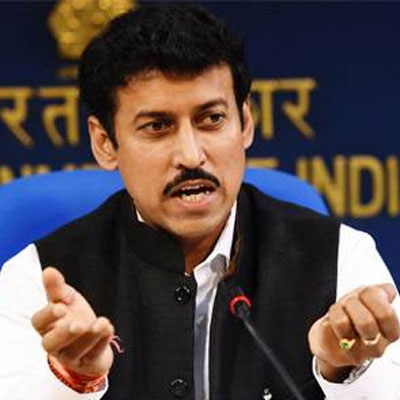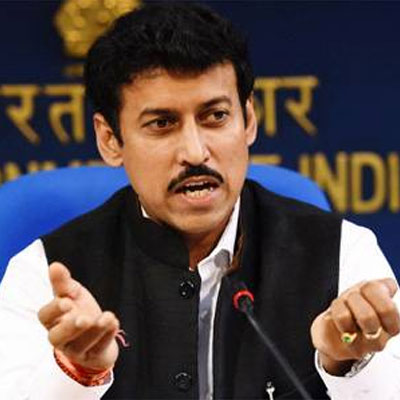
Tag: Rajyavardhan Rathore

  • Reflect on constructive and meaningful engagement through cinema: Naidu

    NEW DELHI: President Pranab Mukherjee has said that the creation of the Film Promotion Fund would help promote and motivate talented independent filmmakers to promote their work across the globe in various International Film Festivals.

    Mukherjee described the film industry as a microcosm of India which celebrated the diversity of languages, customs, religions and culture.

    Indian Cinema and its diversity convey underlying spirit of brotherhood, tolerance, acceptance and co-existence, he said, adding that the inherent strength of the unity in spite of diversity was the cultural heritage inherited through the ages.

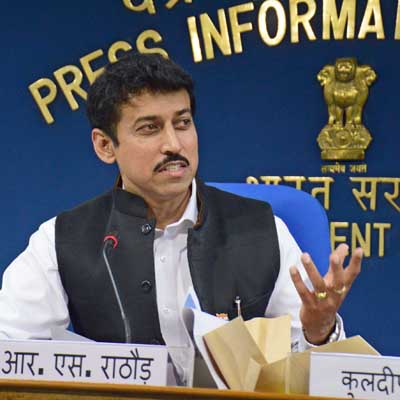
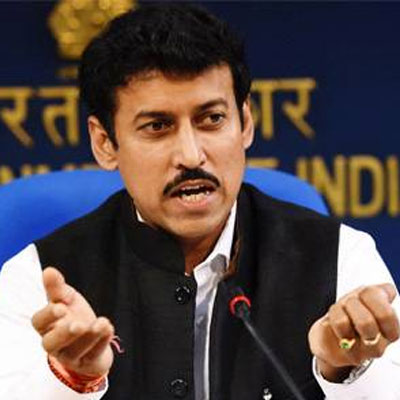
    The President was speaking after giving away the 64th National Film Awards for 2016. Information & Broadcasting Minister M Venkaiah Naidu and MoS Rajyavardhan Rathore were also present on the occasion.

    The National Film Awards were presented on 3 May as it is the day on which the first-ever indigenous feature ‘Raja Harishchandra’ by D G Phalke was released in 1913.

    The President also conferred this year’s Dada Saheb Phalke award to K Viswanath, renowned film director and actor, for his outstanding contribution to the growth and development of Indian cinema. A presenter of classical and traditional art, music and dance, K Viswanath has been a guiding force in the Indian film industry.

    Naidu said care and caution should be taken while depicting stories of tragedy and all stakeholders should reflect on the creative, constructive and meaningful engagement through the medium of cinema.

    Indian cinema had remarkably showcased the vast richness of the country’s cultural diversity, beautiful landscapes and languages and had been a great unifying force in promoting national integration, he said.

    While complementing the film industry, he said filmmakers had set their mind on delivering excellence and promoting societal values. The film industry should join hands to facilitate mission the making of developed India as it had strong influence on society and its values.

    He said movies that had won awards focus on a variety of issues and themes ranging from discrimination, love, historical relationships and relevant social challenges. He added that the National Film Awards showcase the capacity to set standards and to recognize the efforts of Indian filmmakers and artists who achieve heights.

    Speaking about the Films as a medium of communication, Naidu said it was the most beautiful form of expression that encompassed a multitude of visual arts such as music, dance and drama. It was also a medium through which contemporary socio- economic, political and cultural issues of individuals and society are showcased. The language of cinema is a universal one. It has been a powerful tool to reach out to people transcending the boundaries in society.

    The Feature Film Central panel was headed by eminent filmmaker Priyadarshan, popularly known for his Malayalam movie Kanchivaram among others. The Chairperson for the Non–Feature Film Jury was Raju Mishra while the Chairperson for Writing on Cinema Jury was Ms. Bhawana Somaaya. The Most Film Friendly State award jury was chaired by Telugu director Radha Krishna Jagarlamudi.

    In feature films, the highest number of awards went to Hindi (11) followed by Marathi (9); Malayalam (7); Tamil (5); Telugu, Bengali and Kannada (4 each); Assamese (3), and one each to Gujarati, Konkani and Manipuri. One award each also went to two languages not in Schedule VIII of the Constitution: Moran and Tulu.

    While the Marathi film ‘Kasaav’ by Sumitra Bhave & Sunil Sukthankar got the best feature film award, and actor Akshay Kumar for ‘the Hindi film ‘Rustom’ and Surabhi C M for the Malayalam film ‘Minnaminungu–the Firefly’ won the top awards for acting.

    Rajesh Mapuskar for the Marathi film ‘Ventilator’ has been named best director in the Awards for 2016. The state of Uttar Pradesh has been named as the Most Film Friendly state and Jharkhand gets a special mention in this category which was announced for the first time last year.

    ‘Fireflies in the Abyss’ by Chandrashekhar Roy got the best non-feature film award, while G. Dhananjayan was named best film critic and ‘Lata: Sur Gatha’ by Yatindra Mishra was given best book on cinema award.

    The full list of awards can be seen at http://www.dff.nic.in/writereaddata/NFA64PressNote2016.pdf

  • Viacom18 chief: Indian media sector can create 10 mn jobs over next decade

    NEW DELHI: Making a strong case for the Indian media and entertainment (M&E) sector as a major employment generator in the country and which can blunt job automation up to an extent, Viacom18 group CEO Sudhanshu Vats said that it, along with ancillary sectors, has the potential to “create at least 10 million” jobs over the next decade.

    “I say this because in other sectors also the skills needed in our sector will be the same ones needed to ensure that the workforce remains competitive. Therefore, in a future where jobs are going to get automated, our sector (M&E) is part of the (employment) solution,” Vats said while delivering a keynote address at the CII-organised Global Exhibition on Services 2017 at Greater Noida, on the outskirts of Delhi.

    Pointing out that in a future where jobs are going to get automated and India’s M&E sector can lend a helping hand, Vats exhorted on Tuesday policymakers present from India and abroad at the event that they must do everything in their power to “grow” the M&E sector over the next decade. “For my industry colleagues from different parts of the world, no matter which country or sub-sector of our industry you represent, I’m going to explain to you why the singular stereotype of ‘Indian content’ is a myth and why you need to help our industry shatter this myth as you take our message to the world,” he added.

    In an address, given in the presence of Indian and foreign dignitaries, including Minister of State for Information & Broadcasting Rajyavardhan Rathore, Vats went beyond clichés and said, “World over the economic narrative is moving from simply GDP growth and wealth-creation to ‘job creation’. And this is important, because as societies evolve, it is extremely important for the growth to be equitable and productive.”

    According to Vats, discussions in India have focused around the importance of India’s services sector in exports, job creation and GDP growth or the need for India to build the M&E sector as the next IT sector given the ‘creativity endowment’ or “slightly more nuanced” themes such as inter-linkages between manufacturing and services policy measures that can unleash the country’s true potential.

    “However, I am going to take a different two-pronged approach. An approach that is both critical and interesting. Most of you here will agree with me when I say that in the new world of media where OTT platforms have become mainstream and digital audiences are much sought after, it’s important to tailor-make messages that are relevant to the audience,” Vats said in an address that mixed practical economics with policy-making, adding he had two distinct messages for “two distinct sets of stakeholders” that have gathered at the GES 2017.

    “If you look at the pace at which jobs are changing, you’ll be surprised. If my 18-year-old daughter told me 10 years back that she wanted to be an ‘app designer’ I wouldn’t have understood what she meant. Ten years back the first I-phone was launched and Android came much later. India has a workforce that’s anywhere in the 460-480 million range and 10-15 million Indians are being added to the workforce each year. This is likely to continue for another 10 years at least,” Vats said highlighting the USP of India — growing workforce.

    And, then he went on to explain his theory why India’s M&E sector was an important clog in the country’s overall economic growth: “Automation won’t make all jobs across a sector or two redundant but certain ‘kinds of jobs’ (especially ‘routine ones’) across several sectors redundant. If you break down jobs performed by us in the M&E sector, a large bulk of them is actually non-routine. This is because of the importance of creativity in everything that we do and the need to create content that will appeal to human beings, making our sector a key creator of high-value-added jobs that will be relatively ‘automation-proof’ in the future.”

    Dwelling on the versatile content with universal appeal that India generates annually, which should be taken advantage of globally, Vats told the audience, “The versatility of our content is mind-boggling. We have created a mega-property out of a local sport; we have regional language content on a wide variety of themes (mythological, super natural, comedy, drama, action, mystery, animation, etc.); we have our own non-scripted formats; we have a wide variety of films in different languages – our spectrum of content is endless. All you need to do is to find the right partner and make the right effort in taking these stories to your part of the world.”

    Vats message to the audience and Indian policy-makers was simple, yet clear: over the next decade, India’s growth, coupled with the government’s measures, might be able to absorb some of the growing job-seekers, but closer to 2027, it is likely to find itself in a spot where even if the supply of jobs matched the demand, the skill sets needed might not match those available with job-seekers as a “robot can perform those jobs better”. Hence, M&E sector with its vast opportunities could be a savior.

  • DD FreeDish poised to increase channel capacity to 250

    NEW DELHI: Doordarshan DTH platform FreeDish, which already has a capacity of 124 channels including HD channels, will soon getting approval to increase this capacity to 250 channels over the next two years. The minister of state for information and broadcasting Rajyavardhan Rathore told the Parliament that Doordarshan’s DD National Channel has been uplinked in the High Definition (HD) format since 1 January this year.

    With analogue having been largely switched off, many stakeholders feel that FreeDish is the best option in Phase IV which covers rural India. The Ministry had itself said  in the Parliament last month that HITS (Head-end In The Sky), private DTH and DD FreeDish are the options in remote rural areas while discussing the issue of the concerns expressed by operators that over 20 per cent of rural and remote areas were not financially and technically viable.

    The only free-to-air DTH platform in the country, FreeDish – which conducted its 33rd auction this week – earned Rs 2.8665 billion through auction of 54 slots in six auctions from 30 March 2016 to 14 February 2017. In comparison, DD had earned Rs 1.8034 billion in 2015-16. The last e-auction – the 32nd e-Auction – on 14 February 2017 fetched Rs. 655 million.

    Despite the reserve price of Rs 48 million, the highest bid for a slot was Rs 73 million for Sony Pal. The reserve price in the first five auctions was Rs 43 million and was raised to Rs 48 million in the 32nd auction. The reserve price for the 33rd auction was Rs 80 million.

    A new era begun with the adoption of MPEG4 helping FreeDish take the first major step to mark towards its target of 104 television channels by March end with its 32nd e-auction which helped it cross the capacity of eighty channels. FreeDish touched the figure of 104 with its 32nd Auction.

    In line with the ‘Digital India’ and ‘Make in India’, DD has decided to implement Indian CAS (iCAS) on DD Free Dish Platform. iCAS (which is an initiative of the central government) is being introduced in 24 MPEG-4 channels. The introduction of iCAS will provide enhanced viewing experience.

    DD officials said these additional 24 MPEG-4 SDTV channels will be available to viewers in FTA mode. The existing viewers will continue to get 80 SDTV channels, but will have to obtain iCAS-enabled authorised set-top boxes for accessing all 104 channels.

    Although FreeDish will remain free to air with no monthly or periodic fee, the viewers will be required to register with DD FreeDish on getting the new STB from Doordarshan authorised STB dealers.

    DD earned Rs 980 million in 2014-15, Rs 1800 million in 2015-16, and Rs 1040 million till September in 2016-17.

    FreeDish was launched with a modest bouquet of 33 channels in December 2004, and now carries eighty TV channels and 32 radio channels. This includes 22 Doordarshan channels and two parliamentary channels, seven general entertainment channels, 18 movie channels, 13 news channels, seven music channels, three religious channels and eight channels of other genres. All All India Radio stations also piggy-back on the platform.

    Also read

    MIB favours switching to DTH if consumers have problems with MSOs or LCOs

    FreeDish aims to reach 150 channels, earned Rs 3 bn in a year

  • DD Kisan viewership is 7.2m a month, received Rs 800m govt funds for 17-18

    NEW DELHI: A sum of Rs 1.2225 billion was released from 2014-15 to 2016-17 to Prasar Bharati by the information and broadcasting ministry for Dordarshan Kisan Channel.

    The total fund allocated for 2017-18 is Rs 800 million, the minister of state for information and broadcasting Rajyavardhan Rathore has told the Parliament.

    Fund allocated to DD Kisan are:


    2014-15

    2015-16

    2016-17

    260 million.

    262.5 million.

    700 million.


    The annual operating cost incurred by the channel in the year 2014-15 is Rs.231.1  million. .


    DD Kisan was launched in May, 2015. The source of revenue is commercial advertisements aired during the programme. The revenue earned by DD Kisan other than government funding, since its launch from May, 2015 is:


    Period

    Revenue

        April, 2015 to March 2016

    Rs 14 million

        April, 2016 to February 2017

    Rs 19 million

    In reply to another question, he said DD Kisan has introduced two daily News Bulletins at 1:30 pm and at 07:00 pm.

    The channel continuously receives feedback from its viewers. There is a daily one hour live interactive programme “Hello Kisan”. The farmers can call on the toll free line to ask questions to experts or give their opinion. The channel takes their reactions for improvising the content.

    A number of field based shows and programmes are also planned. There is a direct communication at grass root level with the channels’ representatives. The social media links such as web, Facebook and Twitter are also prominently displayed on the channel so that viewers can give their suggestions. Feedback/suggestions, as available, are regularly analysed for improving the programmes and content on the Kisan Channel.

    These programmes are produced continuously depending upon the requirement of the channel. There is no proposal at present to translate the programme in other regional languages.

    Answering another question, he said Doordarshan telecasts agriculture programmes through its network on National Channels as well as other DD regional channels.

    DD Kisan is available throughout the country. As a new initiative, a daily programme titled “Uttar Purvi Rajyon Se” has been scheduled which contains programmes from North Eastern states in their respective languages.

    Viewership of DD Kisan channel according to data received from Broadcast Audience Research Council is an average 7.2 million per month.

    : :

    Average Monthly Viewership (in million)

           Market: All India

    Month

    DD Kisan

    January      2016

    8.8

    February     2016

    15.3

    March         2016

    7.3

    April            2016

    6.7

    May             2016

    4.3

    June            2016

    4.5

    July             2016

    5.6

    August        2016

    6.4

    September  2016

    7.1

    October       2016

    8.2

    November   2016

    5.5

    December   2016

    5.8

    January       2017

    7.3

    February     2017

    7.3

    Average

    7.2

  • Govt. again rules out IMC reconstitution, says checks adequate

    NEW DELHI: The Government has once again ruled out any reconstitution of the Inter-Ministerial Committee which examines complaints against television channels.

    The minister of state for information and broadcasting Rajyavardhan Rathore told the Parliament this week that the IMC “already includes representatives from various Ministries concerned and the industry.”

    He also said that the existing provisions contained in the Programme & Advertising Codes and the existing mechanism are considered adequate to regulate content of private satellite TV channels. “No shortcomings have been found in the functioning of the IMC”, he added.

    Similar questions have been asked in this and previous sessions and the government has repeatedly said there is no proposal to reconstitute IMC.

    Content telecast on private satellite TV channels and transmitted/re-transmitted through the Cable TV network is regulated in terms of the Programme and Advertising Codes prescribed under the Cable Television Networks (Regulation) Act 1995 and Cable Television Network Rules 1994 framed thereunder.

    The Act does not provide for pre-censorship of any programme or advertisement telecast on such TV channels. However, all programmes and advertisements are required to be in conformity with the said Programme and Advertising Codes.

    The IMC functions under the Chairmanship of Additional Secretary (I&B) and comprises officers drawn from Ministries of Home Affairs, Defence, External Affairs, Law, Women and Child Development, Health & Family Welfare, Consumer Affairs, Information & Broadcasting and a representative from the industry in Advertising Standards Council of India (ASCI) to take cognizance suo-motu or look into specific complaints regarding violation of the Programme and Advertising Codes.

    He said the IMC functions in a ‘recommendatory’ capacity. The final decision regarding penalties and its quantum is taken by the Ministry on the basis of the IMC recommendations.

  • Visiting filmmakers’ new visa category will boost industry & tourism, says Uday Shankar

    NEW DELHI: The initiative to introduce a new category of visa for film makers to shoot films in India “will bring in multiple benefits as our young artists and technicians will get opportunities to be part of international projects and M&E verticals like studios and animation will get much needed exposure”, FICCI Media and Entertainment Committee Chairman Uday Shankar has said.

    Welcoming the Government’s decision, he said, “This is a right step taken at the right time as it will simplify the visa process and ease the entry of artists and technicians into India.  I am also happy to note that the Film Visa and the Film Facilitation Offices (FFOs) are going to be set up to handle such applications.”

    “More importantly, when these movies are released internationally, it will put India as a great tourist destination and thus promote India’s tourism potential”, Shankar added.

    Minister of state for information & broadcasting Rajyavardhan Rathore  yesterday said that the new category of visa to foreign filmmakers is a step taken by the Government to ease issues related to their entry into the country for film making and shoots. The step is a positive move to promote  India as an attractive filming  destination to the world.

    Also read

    Film Visa & FFO make India filming destination: Rathore


  • DD ad budget crosses Rs 33 million at fag end of 2016-17

    NEW DELHI: Doordarshan has released an additional Rs 216,000 for advertising and publicity taking the total revised estimate to Rs 33.796 million, just as the financial year 2016-17 coming to a close.

    In an order of 30 March 2017, DD Directorate General approved the release of Rs 38.8 million for 71 units against a total demand of over Rs 57.6 million.

    Intially allocated Rs 47.58 million for the year for advertising and publicity, the field unit had surrendered a sum of Rs 14 million earlier.

    However, the additional sum was given to meet exigency expenses.

    The amount was given against the non-plan and Internal and Extra-budgetary Resources of Prasar Bharati.

    Earlier, stressing that revenue generation is not the main objective of Prasar Bharati, the Parliament was told that the pubcaster is generating its revenue through Internal Extra Budgetary Resources (IEBR) to meet its operating expenses.

    Minister of state for information and broadcasting Rajyavardhan Rathore said in reply to a question that the government was providing 100 per cent salary support to Prasar Bharati, apart from plan grant for creation of capital assets and content development.

  • Block illegal DTH FTA, space dept told

    NEW DELHI: The Department of Space has been asked to block the signals of Asia Broadcast Satellite Free-to-air channels which is beaming in India without the permission of the Ministry.

    Minister of State Rajyavardhan Rathore said this had been done keeping in view the national security angle. He said the I and B Ministry is the licensing authority for DTH broadcasting services in India and it has received no application or reference from ABS for DTH operations.

    Meanwhille, he told Parliament today that there was no violation of Downlinking guidelines by permitted Broadcasters on account of providing signals to unauthorised DTH operators. In order to deter the permitted Broadcasters (channels) from violating the downlinking guidelines, he said the Ministry had issued a Web Notice on 23 December 2015: 

    http://mib.nic.in/WriteReadData/documents/Notice_to_all_Broadcaster_Private_TV_(Channels)_registered_with_MIB_.pdf

    After the Ministry had learnt from Telecom Regulatory Authority of India (TRAI) that ABS had started providing permitted free to air (FTA) channels, the Home Ministry was consulted from the security angle and its implication from national security perspective.

    The Home Ministry said the transmission of DTH service by ABS is without any application to the I and B Ministry and not in line with the guidelines of that Ministry.

    Clause 5.6 of the Article 5 of Downlinking guidelines issued by Ministry of I&B stipulates that all the Broadcasters (Channels) shall provide Satellite TV channel signal reception decoders only to MSOs/Cable Operators registered under the Cable Television Networks (Regulation) Act, 1995 or to a DTH operator registered under the DTH guidelines issued by the Government of India or to an Internet Protocol Television Service Provider duly permitted under their existing Telecom License or authorized by Department of Telecommunications or to a HITS operator duly permitted under the policy guidelines for HITS operators issued by the Ministry 

  • DAS: MSOs, LCOs give low figure of STB seeding, official sources admit it’s under 80%

    DAS: MSOs, LCOs give low figure of STB seeding, official sources admit it’s under 80%

    NEW DELHI / MUMBAI: Even as the nation has stepped into an era of full cable television digitisation, there are mixed reports coming in from around the country about the situation on the ground.

    While the government had issued a warning to all broadcasters, multi-system and local cable operators about action if they fail to switch off analogue, there are reports from almost every region that Phase IV covering rural India has still a long way to go before full implementation of digital addressable system happens.

    The Government had, in mid-January, told the Task Force that while the seeding of set-top boxes in Phase III was almost complete, the figure for Phase IV was 32 per cent. Minister of state for information and broadcasting Rajyavardhan Rathore told the Parliament in mid-March that around 67 per cent seeding of set-top boxes had been achieved in Phase III and IV while it was total in the first two phases, minus Tamil Nadu.

    A ministry source told indiantelevision.com that the figure had already crossed around 75 per cent in the final two phases. Not wanting to be named, the source ruled out any more grace period, and said that several MSOs and LCOs act only after a final warning, and therefore the chances were that the figure may be higher than those given by him.

    However, since there is no plan to help the poor acquire STBs, it is unlikely that the figure would be much higher.

    In Tamil Nadu, where there is a court stay in operation since Phase I, the state government run Arasu Cable TV Corporation (TACTV) warned MSOs and LCOs against switching off analogue signals anywhere in the state after 31 March 2017.

    Pointing out that the centre had refused to grant DAS licence to TACTV because recommendations of the Telecom Regulatory Authority of India do not permit state-owned TV or distribution networks, an MSO told indiantelevision.com that the case had been gong on for so many years primarily because the Central Government was not clearabout its stand and keeps taking adjournments.

    Meanwhile, in neighbouring Telangana and Andhra Pradesh, MSOs and LCOs said that around 40 per cent of Phase III had still to be fully seeded and the figure was bound to be higher in Phase IV areas. One MSO not wanting to be named said that there was an area in Hyderabad dominated by a particular community where even law had limited reach where analogue signals continued unchecked. “Whatever had been fixed a long time ago, remains,” the MSO said.

    Interestingly, a consumer body Citizens Welfare Society had moved the High Court for the twin states saying that, while the government had made it mandatory that DAS signals should be implemented, there was nothing in law to say that analogue has to be switched off and pleading that the two should be allowed to co-exist till people take to DAS voluntarily. Though the case was not admitted, the bench of the Court heard the viewpoints of several MSOs, LCOs, and consumer bodies over twenty hours for the few days and reserved its orders on 20 February 2017. This order is still awaited keenly by consumers as well as MSOs and LCOs.

    Siti Network Limited (Essel Group) executive director & CEO V D Wadhwa said that analogue signals had been switched off in the East Zone. Network 18/Viacom18 Group distributor Indiacast Media Group CEO (and Jio Media head – content acquisition/ alliances) Anuj Gandhi also said that analogue had been switched off in compliance with the deadline set by the Government. However, sources said that completely shutting off analogue signals in other zones may be a challenge.

    Meanwhile, an MSO in Assam said that while digitisation was complete in Guwahati, it had not even covered fifty per cent of rural Assam. In Madhya Pradesh and Chhatisgarh, MSOs and LCOs interviewed said around 40 per cent seeding had taken place in Phase IV but pointed out that the confusion because of the tariff orders had resulted in direct-go-home players targeting consumers.

    Reports from Uttar Pradesh and Uttarakhand said that while the broadcasters had switched off digital signals in most areas of Phase IV, tthis may trigger some protests over the next few days from consumers as the figure of seeding of set top boxes was very low. The DTH players were also active in these areas.

    Maharashtra Cable Operators Federation sources told www.indiantelevision.com that the broadcasters had switched off analogue signals, but rural Maharashtra which faced extreme poverty was still largely uncovered by DAS STBs. However, he said he would have a more tangible report over the next two days.

    Cable Operators Association of Gujarat president Pramod Pandya said that 80-90 per cent of the state had gone digital, but some broadcasters were still supplying analogue signals in certain areas. Meanwhile, it is learnt that Reliance Jio is planning to bring in cheaper STBs soon, though these may not have many fancy features.

    Phase I covering the Metro cities of Delhi, Mumbai, Kolkata and Chennai was originally slated for 30 June 2012 and modified to 31 October 2012. The second phase covering 38 cities (with population more than one million) was slated for 31 March 2013.

    The third Phase was to cover all other urban areas (Municipal Corporations/ Municipalities) and was originally slated for 30 September 2014 and modified to 31 December 2015 which was extended to 31 January 2017 and the final phase to 31 March 2017.

  • Film Visa & FFO make India filming destination: Rathore

    NEW DELHI: The minister of state for information and broadcasting Rajyavardhan Rathore has said the new category of visa to foreign film makers is a step towards easing issues related to their entry into the country.

    Both the Film Visa and the Film Facilitation Office (FFO) aim at promoting India as an attractive filming destination to the world.

    Rathore said this during a meeting with the Russian Delegation led by the vice minister of telecom and mass communication of the Russian Federation Alexey Volin here.

    During the discussions, Rathore apprised the delegation about the National Centre of Excellence for Animation, Visual Effects, Gaming and Comics (AVGC) to be set up in Mumbai by the Ministry. Both the Ministers agreed to explore the possible collaboration between the two countries in the field of animation, graphics and visual content.

    Cooperation between the field of content generation and content delivery mechanisms for different target audiences, specially children and young people was also discussed.

    The Ministers while discussing the role of films as medium of cultural exchange between the countries emphasized on exhibiting films in each other’s country through the medium of Film Festivals.

    A possible collaboration between the National Film Development Corporation and its counterpart from the Russian Federation in the Film Bazaar was also discussed.

    AlsO Read :

    Rs 125 million incurred on Film Heritage Mission this year

    Online film certification starts, 33% rise in ‘shoot’ permission

    Film piracy: Govt has no ‘losses’ figure, industry estimates Rs 180 bn a yr