Tag: Rajyavardhan Rathore

  • Exhibition by DAVP, Outreach Programme by DFP inaugurated in Rajasthan by Rathore

    Exhibition by DAVP, Outreach Programme by DFP inaugurated in Rajasthan by Rathore

    NEW DELHI: Minister of State Rajyavardhan Rathore has said that women have excelled in all fields and have made everyone proud of their achievements.


    Speaking at the Special Outreach Programme on ‘Beti Bachao Beti Padhao’ organized by the Directorate of Field Publicity, Ministry of Information and Broadcasting at Dhankya in Jaipur, Rathore said that he could win the Olympic Medal because of the immense support provided by the two women in his life- his mother and wife.


    Rathore also inaugurated the three-day exhibition ‘Ek Bharat Shreshta Bharat’ organized by the Directorate of Advertising and Visual Publicity and released a special cover on Beti Bachao Beti Padhao brought out by the Department of Posts Rajasthan Circle. 


    Rajasthan Minister of Urban Development and Housing Rajpal Singh Shekhawat and Directorate of Field Publicity Principal DG Neelam Kapoor were also present on the occasion.

  • Fifth National Community Radio Sammelan to commence in capital, Jaitley to inaugurate

    Fifth National Community Radio Sammelan to commence in capital, Jaitley to inaugurate

    NEW DELHI: The fifth National Sammelan for Community Radio Stations will be inaugurated in Delhi on 16 March by Information and Broadcasting Minister Arun Jaitely.


    Minister of State for I&B Rajyavardhan Rathore will also be present on the occasion.


    The Sammelan will bring together Community Radio Operators, policy makers, Ministries/Departments, the UN and other International bodies like UNICEF and UNESCO and other stakeholders for exchange of ideas and cross learning.


    The sessions will highlight the vision of the Community Radio movement in India and its role in setting the agenda on the development discourse at the local level. 

    The three-day workshop will discuss several important issues such as the role of community radios in good governance, sustainability, content sharing and programming for development. It will delve into the role that Community Radio can play in community learning, promoting livelihoods and agriculture, promoting water conservation and sanitation, strengthening Panchayati Raj Institutions, financial inclusion, legal literacy and facilitating access to justice for marginalized communities.


    A compendium containing inspiring stories of community radios from all over the country will be released. 

    The National Community Radio Awards would also be presented to promote better programming on CR stations and motivate CR operators to achieve goals of community empowerment. 

    The Ministry has been organising the National Community Radio Sammelan every year since 2011. The Ministry has also been organising intensive Awareness Workshops in various parts of the country to increase awareness about Community Radio. Sixty three Workshops have been organized so far. These workshops have proved to be useful not only to operate Community Radio Stations in an effective way. 

    The Ministry has so far issued 409 permissions to set up community radio stations in the country. Out of this, 179 stations have become operational while others are in the pipeline.


    The Ministry has also streamlined the approval process for setting up of Community Radio Stations. The applicants can now apply online and track the status of their pending application through a Comprehensive Community Radio Management Information System. A Facilitation Centre has also been set up, with a Toll Free number (1800-11-6346) for providing information. Efforts have also been taken by the Ministry to enable Community Radio Stations to sustain themselves. The Ministry has also introduced a Plan Scheme to provide financial assistance to existing and new community radio stations for infrastructure/equipment/training/capacity building etc. 


    The Ministry has also been advocating with various stakeholder Ministries like Health, Rural Development, Panchayati Raj, Science and Technology and Tribal Affairs to use the medium of CR to reach out to the masses.  

  • Media can transform rural poor’s life by providing info on central scheme: Rathore

    Media can transform rural poor’s life by providing info on central scheme: Rathore

    NEW DELHI: Minister of State for Information and Broadcasting Rajyavardhan Rathore has said that media can transform the lives of the people living in rural areas by providing information about welfare schemes.


    He said that the emergence of internet and social media has brought about an information revolution in the country. He underlined that there is need to build capacities of rural journalists for establishing better reach to the people in rural areas. 


    He stated this in a message read out at the opening of a one-day Regional Media Conference organized by the Press Information Bureau (PIB) on strengthening information dissemination on Government policies and programmes in rural areas at Jobner near Jaipur this week.


    About 70 regional journalists including stringers of newspapers and news channels participated in the one-day conference.


    One of the major objectives of the conference was receiving feedback from journalists working in rural areas on their information needs. During the interactive sessions, the participants wanted more interactions of this kind in the future and wanted a mechanism for enhanced information flow from PIB on central government schemes to rural journalists.


    In his keynote address, senior journalist Yashwant Vyas said that rural journalists have a major role in highlighting issues of local importance on which they should report fearlessly. Senior journalists Rajendra Boda, Pratap Rao, Ashok Chaturvedi and Shakti Singh addressed journalists on issues including role of different media in effective information flow in rural areas. A session on the role of media in disaster management was conducted by Bijendra Singh, who is officer on Special Duty of the State Disaster Management Department of Rajasthan. 


    The participants were also given orientation on the role of new/social media in information dissemination.

  • Paid news to be checked under amendments to Press & Registration Act: Rathore

    Paid news to be checked under amendments to Press & Registration Act: Rathore

    NEW DELHI: The Government will include provisions for checking the menace of paid news in the amendments to the Press and Registration of Books Act.


    Minister of State for Information and Broadcasting Rajyavardhan Rathore told the Lok Sabha that based on the recommendations of the Standing Committee on Information Technology, inclusion of provisions in the Act “would also be pursued as per extant guidelines”.


    In the amendments proposed to the PRB Act, the Ministry has also proposed inclusion of a section which says ‘paid news’ means publishing any news or analysis in the publication for a price in cash or kind as consideration.


    Earlier in November 2013, the Government had said it intended to bring ‘reproduction of any newspaper in electronic form’ within the ambit of the Act.


    The amendments, which have been placed on the website of the Ministry, also says that “facsimile edition” of a publication means an exact replica in full or in part of the original edition of a foreign publication ‘in so far as the contents concerned and may not include title,’ subject to the condition that any page is not published in part.


    The Government also proposes to establish a Press and Registration Appellate Board to be constituted by the central government, by notification in the official gazette, consisting of a chairperson and another member, to be nominated by the Press Council of India, established under Section 4 of the Press Council Act 1978 from among its members.


    It says that any dispute relating to registration of newspapers or publications would be referred to a “specified appellate authority” that may be prescribed by the central government.


    Under the amendments, publication means newspapers, magazines, journals or newsletters printed periodically and published in India ‘including its reproduction in electronic form or any syndication, facsimile edition, and Indian editions of periodicals published outside India.’

  • CBFC took unilateral decision to put list of offensive words on hold: Rathore

    CBFC took unilateral decision to put list of offensive words on hold: Rathore

    NEW DELHI: The Parliament was informed on 13 March that the list of 28 “objectionable and abusive” words suggested for banning from Indian films by Central Board of Film Certification (CBFC) chairman Pahlaj Nahalani was held back. This, because a need was felt to consult on the same with people from different sections of society.


    Minister of State for Information and Broadcasting Rajyavardhan Rathore told the Lok Sabha today that the decision in this regard had been taken by the Board in a meeting on 23 February.


    The Minister also said that the list of objectionable words circulated by Nihalani on 12 February this year had been compiled by regional offices of the CBFC in 2003.


    Meanwhile, a Ministry official told Indiantelevision.com last month that any decision in this regard may have been taken at the level of the Board or by its chairman, who had issued the list leading to protests from some members.


    Rathore had earlier said, “CBFC under the Ministry certifies films for public screening in accordance with the Cinematograph Act, 1952 and Cinematograph (Certification) Rules, 1983. Section 5B of the Cinematograph Act, 1952 provides principles for guidance in certifying films. Guidelines for certification of films notified under the Cinematograph (Certification) Rules lay down among other things that CBFC shall be guided by the following principles in this regard: (i) human sensibilities are not offended by vulgarity, obscenity or depravity; and (ii) such dual meaning words as obviously cater to baser instincts are not allowed.”


    In a circular to the producers’ association and regional officers, the Board had last month listed several “objectionable words” that are being used in films and directed its regional officers to ensure a ban on the list of cuss words. It also aimed to seek more conformity from directors and scriptwriters on cultural matters and political correctness. It also said Mumbai should be used in place of Bombay.


    The list led to a Twitter war of words, where some members said Nihalani had taken the decision unilaterally.


    However, Nihalani told Indiantelevision.com that he was within his rights to issue the list as he was only using the powers given to him under the Cinematograph Act and was only referring to words that the Certification Guidelines do not allow.

  • Puthiya Thalaimurai’s office bombed; I&B state minister condemns attack

    Puthiya Thalaimurai’s office bombed; I&B state minister condemns attack

    MUMBAI: News is a tough business is something we all know. But it can be life threatening too.  That’s something journalists at Tamil news channel Puthiya Thalaimurai must be feeling.


    The channel’s office in Chennai was attacked by four men on two motorcycle who hurled crude bombs packed in a lunch box at 3 am on Thursday morning. No one was inured nor was there any damage to Puthiya Thailaimura’s office.


    Media reports indicate that the channel had become the target of fringe right wing fundamentalist groups who had been threatening its management ever since it aired promos about a programme debating the importance of mangalsutra in India. A cameraman working for the channel was assaulted earlier this week by some protesters who had gathered  outside its office.


    The channel’s management decided to not go ahead with the telecast, say reports, and sought police protection. Even though that was provided, it did not deter the attackers.


    The attack led to protests from journalists associations in Chennai who protested that media freedom was increasingly coming under pressure in India. While earlier, it was restricted to print media, it had now extended to TV reporters too.


    The police announced later in the evening that it had identified the six attackers from CCTV footage and arrested them.  All the suspects reportedly belonged to Hindu Illaignar Sena, a little-known outfit functioning from Koyambedu, in Chennai.


    Union Minister of state for Information and Broadcasting Rajyavardhan Rathore later in the day told PTI that the the act against Puthiya Thailaimura’s office was “unacceptable”.


    He told the news service that “this is not acceptable in our country. The programmes of television are governed by a programe code which is part of the Cable Television Networks Rules, 1994. Viewers are free to write to us (I&B ministry), to the News Broadcasters Association, Broadcasting Content Complaints Council (BCCC) or to Advertising Standards Council of India (ASCI) if its regarding any advertisement if they feel. Nobody is allowed to take law in his hand. ”

  • Prasar Bharati makes 55 essential appointments for AIR & DD

    Prasar Bharati makes 55 essential appointments for AIR & DD

    NEW DELHI: In what it terms as a victory, Prasar Bharati has managed to appoint around 55 people in one stroke in All India Radio (AIR) and Doordarshan (DD).


    The pubcaster has been permitted such a large number of appointments in one go after 21 years. These appointments, said to be the first batch, have come after the pubcaster struggled for three years to get clearances.


    Prasar Bharati CEO Jawhar Sircar said in a tweet that the pubcaster had more than 2000 units to man and there were over 17,000 vacancies.


    The government had told Parliament last week that 3067 of the 3452 identified as essential category posts in AIR and DD, to be filled through direct recruitment, have already been revived.


    Another 38 middle/senior level programme posts have already been revived through deputations, Minister of State for Information and Broadcasting Rajyavardhan Rathore said.  


    The Minister admitted that there are 16,764 vacancies in AIR and DD as against a sanctioned strength of 46,756.  


    He said the Sam Pitroda Committee had recommended a complete manpower audit of the pubcaster and also draw up a re-deployment scheme. The Ministry had already asked Prasar Bharati to prepare an action plan in this connection, the Minister said.  


    Earlier in June last year, the then I&B Minister Prakash Javadekar had given his clearance in principle to setting up Recruitment Boards for Prasar Bharati, and Indiantelevision.com had learnt that a total of 1154 technical posts had been cleared by the relevant selection committees.


    These include programme executives, transmission executives, technicians, engineering assistants and duty officers, sources in Prasar Bharati said.


    The pubcaster has not had any senior-level recruitment since it came into being in September 1997, and the sources said that those posts which could not be filled out of these were held up because there is no Prasar Bharati Recruitment Board.


    As of early 2013, there were 1362 vacancies in Group A, 1,584 in Group B, 4863 in Group C and 2272 in group D in All India Radio. In Doordarshan, 724 posts are vacant in Group A, 1140 in Group B, 2871 in Group C, and 1451 in Group D.


    AIR and DD had total staff strength of 33,800 against a total sanctioned strength of 48,022, leaving a gap of 14222 posts.


    The most critically affected areas were the Programme Wing and the News Services Division (AIR)/DD News.


    The Committee for Information Technology in 2012 regretted that Prasar Bharati had failed to live up to the assurance given by then Prasar Bharati CEO that the Recruitment Boards for Prasar Bharati would be set up by 31 March, 2011.


    It is understood that the Union Public Service Commission and SSC had both refused to select for a non-Governmental organization, thus creating a new problem for the Ministry as well as Prasar Bharati.


    The proposal for setting up a Prasar Bharati Recruitment Board was approved by Prasar Bharati Board on 21 July, 2010 and discussed in the Ministry. A final proposal was referred to the Department of Personnel and Training on 15 February, 2011. DOP&T concurred with the proposal in June 2011 and the comments of the Department of Expenditure (DOE) were also received on 28 September 2011.


    The DoE had requested that a separate proposal be formulated for creation of posts for the secretariat of Prasar Bharati Recruitment Board and also requested for drafting of agreement containing terms and conditions of the members of the Board. This had been done and the proposal sent to DoE in February 2012 and then to the Law Ministry.  
  • MIB mulls amendments permitting live coverage of counter-terrorism measures by security forces

    MIB mulls amendments permitting live coverage of counter-terrorism measures by security forces

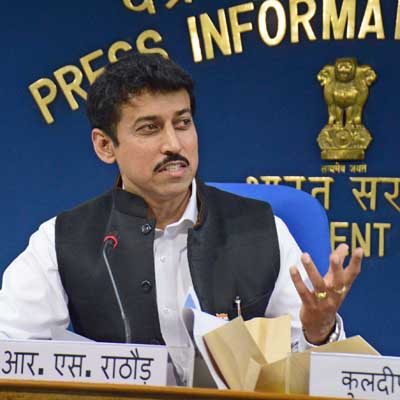
    NEW DELHI: The Information and Broadcasting Ministry (I&B) is considering a proposal to prohibit live media coverage of counter terrorism operations by security forces. 


    Minister of State for I&B Rajyavardhan Rathore told Parliament that the Home Ministry wants amendments in the existing laws in this regard.


    The issue of coverage by television channels is presently part of the self-regulation guidelines drawn up by the News Broadcasting Standards Authority of the News Broadcasters Association. The Press Council of India had issued similar guidelines with regard to print media. 


    These guidelines were drawn up after the 26 November, 2008 attacks in Mumbai. Following a controversy that live telecasts of the counter-terrorism operations were in all likelihood been seen by the masterminds in Pakistan who had planned the attacks.


    As far as Prasar Bharati is concerned, it is governed by the Programme and Advertising Code which is also part of the Cable TV Networks (Regulation) Act 1995 and therefore equally applicable to private television channels.


    The Inter-Ministerial Committee examines complaints under the Act and the Rules drawn up a year earlier in 1994.

  • Apex Court yet to decide on matter of inducting DD correspondents in Indian Broadcasting Service

    Apex Court yet to decide on matter of inducting DD correspondents in Indian Broadcasting Service

    NEW DELHI: The Supreme Court is still to decide on an appeal by the Government against orders of the Central Administrative Tribunal (CAT) Hyderabad and Andhra Pradesh High Court that television news correspondents and assistant news correspondents in Doordarshan should be considered to be inducted into the Indian Broadcasting (Programme) Service.


    The orders of November 2000 and March 2014 of CAT and the High Court respectively also said these staff should be provided with all benefits of service and be considered for promotion to JAG in accordance with their experience, eligibility and suitability. The High Court had stayed the matter with regard to taking the news correspondents into the IB(P)S.


    Minister of state for Information and Broadcasting Rajyavardhan Rathore told the Rajya Sabha today that TV NCs /TV ANCS were engaged as Artists on Casual contract basis for a period of six months in 1988. In March 1989 it was decided to engage them as “Artists” on a fresh contract of five years. In May 1993 they were declared as regular temporary Government Servants with retrospective effect from 1988.


    In the absence of Recruitment Rules for this cadre, they could not be granted promotion. However, eligible officers were given Assured Career Progression/Modified Assured Career Progression.


    Two posts of Special News Correspondent and one post of Principal Correspondent were created on 27 August 2010 to open the promotional avenues in the cadre in pursuance of the order of the Principal Bench of CAT in Delhi. No appeal was filed by the Centre.


    The Recruitment Rules for these employees have been notified on 24 March 2014 which provide for promotion to the higher grades.

  • Action taken against 50 channels since 2012 for programme or advertising code violation

    Action taken against 50 channels since 2012 for programme or advertising code violation

    NEW DELHI: Action has been taken against three television channels so far in 2015, of which two have been taken without issue of any show cause notice.


    Colors was issued an order on 8 January relating to the programme Fear Factor Khatron Ke khiladi – Darr ka Blockbuster following a show cause notice sent initially on 22 May last year.


    Lemon TV was issued a warning on 19 January for telecast of programme Khauf Ke 10 Destination.


    NTV Telugu News was taken off air for seven days following an order on 19 January for telecast of a song-based programme Cine Colors containing obscene visuals.


    Minister of State for Information and Broadcasting Rajyavardhan Rathore told the Rajya Sabha today that apart from these, action was taken 16 times in 2012, 32 times in 2013 and 22 times in 2014 against various channels on violation of Programme and Advertisement code.


    Action was taken – including warnings – against 49 channels between 2012 and 2115. This includes nine channels, which figured more than once in the list of actions taken from 2012 onwards.


    This includes advisories issued to all channels in 12 cases between 2012 and 2013 against telecast of certain advertisements or to ensure that the Censor Certificate is shown before telecast of a film, avoid unnecessary scenes of road rage and rash driving, reporting on children, comparison of speech of the Prime Minister with the speech of other political leaders on Independence Day 2013, telecasting programmes promoting blind belief, telecast of inflammatory and provocative news/programmes in a sensational manner, and direct telecast of the events round the clock  relating to public demonstrations likely to encourage violence and against maintenance of law and order and likely to promote anti-national attitudes.