Tag: Rajiv Gandhi

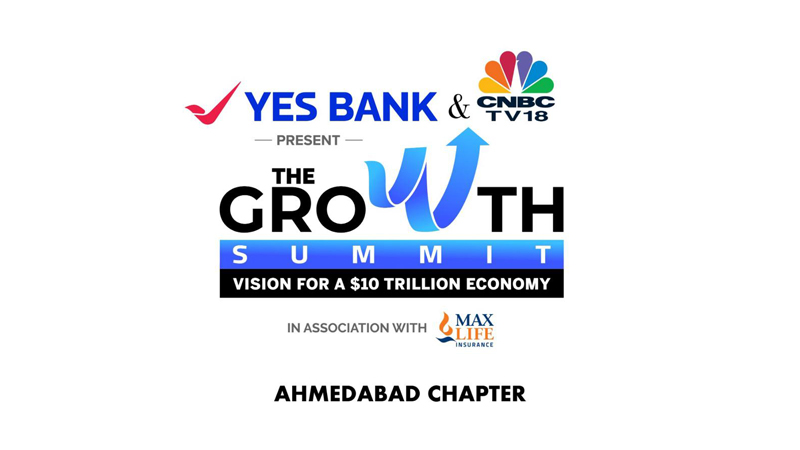
  • YES BANK and CNBC-TV18 partner for ‘The Growth Summit’ Ahmedabad edition

    YES BANK and CNBC-TV18 partner for ‘The Growth Summit’ Ahmedabad edition

    Mumbai: The second edition of YES BANK and CNBC-TV18’s – The Growth Summit: A vision to a $10 trillion economy, in association with Max Life Insurance, was held in Ahmedabad, Gujarat. The event convened policymakers, industry leaders, startup founders, innovators, and academic experts to deliberate on crucial factors essential for India’s economic progress. Central to the Summit’s discussions was the government’s ambitious 25-year plan aimed at positioning India as the world’s third-largest economy with a GDP of $10 trillion.

    In his opening remarks at the Summit, YES BANK MD & CEO Prashant Kumar said, “Gujarat emerges as the cornerstone of India’s economic ascent, contributing a staggering 33% to the nation’s exports in FY 2022-23. With ambitions to reach a $1 trillion economy by 2030, Gujarat’s leadership extends beyond traditional sectors, fostering a thriving ecosystem for innovation and infrastructure development. As the world’s largest diamond hub in Surat and the birthplace of India’s first operational greenfield Smart City, Gujarat positions itself as the beacon of opportunity. The state is poised to absorb the influx of businesses seeking alternatives to China, catalysing India’s journey towards economic supremacy.”

    During his address, Kumar announced the launch of ‘Yes Private’ in Ahmedabad, which is the Bank’s newest market offering that aims to partner HNI Business owners and C-Suite executives in their endeavour to leverage the opportunities on the road towards a $10 trillion Indian economy.

    He added, “Yes Private has been thoughtfully curated to complement the retail and wholesale banking offerings in the market. It integrates the Bank’s expertise across the spectrum and brings a full-stack product suite for HNIs across family banking, business banking, wealth management and succession planning needs. The programme also lays out extraordinary privileges and experiences for clients pertaining to their distinct lifestyles in India and abroad.”

    The event kicked off with a thought-provoking discussion on ‘Strengthening Indian Business from Within’ in conversation with Rasna chairman & MD Piruz Khambatta. He stated “India’s growth narrative must encompass more than just development; it must address the challenges faced by its youth, including migration due to inadequate resources like clean water and air. India’s trajectory of growth, akin to that of South Korea, Germany, Japan, and China, is undeniable, yet we must define our unique growth model. As we navigate through discussions, let’s advocate for an inclusive ‘India model’ of growth that acknowledges both its benefits and challenges, fostering sustainable progress for generations to come.”

    Subsequently, panel discussion on the topic ‘From India to the World: Unleashing A New Era of Global Ambitions’ with Ashish Soparkar (MD, Meghmani Organics), Dr Vishal Rajgarhia (director, Finecure Pharmaceuticals Ltd) Rajiv Gandhi (MD & CEO, Hester Biosciences) Chirag Pan (MD & CEO, Pan Healthcare) and Behram Mehta (founder & MD, Aava Natural Mineral water) captivated the audience at the summit.

    The event progressed with an engaging conversation on ‘India’s Role as A Global Hub of Growth’ featuring AMUL (GCMMF) MD Jayen Mehta, where he said, “Agriculture is the base of our economy. However, in terms of numbers, still agriculture contribution is less than 20%. Hence, we need to support agriculture and farmers, while also working on doubling their income which is also the professor policy of the government. These efforts will help in supporting the number of people associated with agriculture which is more than 60-70 per cent of the population. The country still depends on agriculture as part of its primary income. So this is where a combination of policies that are pro farmer, pro-development and pro-market is the way forward for our country. So if you can build a bridge and if only 20% of us convert our regular food into organic food, the GDP from agriculture will rise. These are very, very small and objective steps one has to take and organisations like ours are working towards the same using the cooperative model and building the country.”

    In a special address, Max Life Insurance MD & CEO Prashant Tripathy added, “As India makes significant strides towards its ambitious goal of becoming a 10 trillion-dollar economy by 2030-31, there’s a growing need for India Inc. to partner with the government and democratize the benefits of this growth. It’s imperative that we ensure the advantages of our economic progress reach every segment of the society. There’s a strong call for players in the life insurance industry to align their strategies with IRDAI’s vision of ‘Insurance for All by 2047’- which calls for inclusive insurance coverage for India at large. Further, innovation and customisation must guide our product offerings to cater to the diverse and distinct needs of modern consumers, while distribution channels need to evolve to deliver convenience at every touchpoint, be it digital or otherwise. As we move forward, cross-functional collaboration supported by collective action will serve as the cornerstone for fostering inclusive growth, contributing to the shared prosperity of our nation.”

    The evening continued with an engaging panel discussion ‘Scaling the Global Value Chain’, with insights from industry experts Vineet Mittal (director, Navitas Green Solutions) Dr Viranchi Shah (national president, IDMA and director, Saga Laboratories) Aditi Gupta (managing partner, Menstrupedia) Sandeep Mittal (MD, Corrtech Energy Ltd) and Ravi Bhamidipaty (MD, TCT Ventures). They shared valuable insights on navigating global markets, contributing to an enriching discussion for the audience.

    Taking the evening towards its end a thought-provoking session conducted by leading neuroscientist & NeuroLeap founder Kumaar Bagrodia on ‘The Neuroscience of Investing’ was held.

    Concluding the summit was the final enticing conversation between CNBC-TV18 anchor Shruti Mishra and Indian cricketer Mohammed Shami. Talking about his journey, Shami said, “If your hard work and luck are in your favour, then I don’t think anybody can stop you. You just have to stay loyal to your game and keep working hard. I believe nobody can take away my luck from me. My family has been incredibly supportive and has played an integral role in my journey.”

    The Ahmedabad edition of ‘The Growth Summit – vision for a $10 trillion economy’ underscored India’s trajectory towards economic prosperity, as industry leaders and experts converged to chart a path towards a $10 trillion economy. With diverse voices and ideas from different industries of Gujarat, the summit left an indelible mark on the audience and shared a unique vision for India’s journey towards achieving its ambitious economic goals. The upcoming Summits are to be held in Bangalore, Delhi and Hyderabad in the weeks to come.  

    For more information visit: https://www.cnbctv18.com/ms/thegrowthsummit/

  • The Summit brought together visionaries to shape the development agenda.

    The Summit brought together visionaries to shape the development agenda.

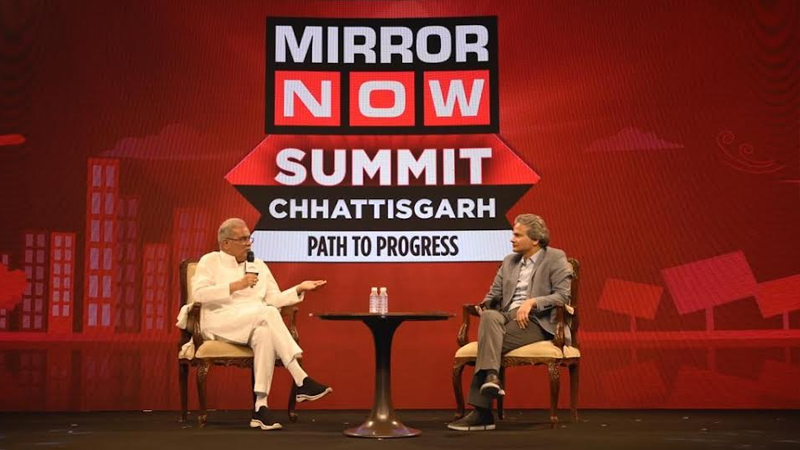
    Mumbai: Mirror Now, the channel that represents the voice and issues of every Indian citizen, hosted the Mirror Now Summit – Chhattisgarh today in Raipur. Themed ‘Path to Progress,’ the Mirror Now Summit brought together State leaders and visionaries to shape a holistic development agenda for the State. The Summit spotlighted critical sectors essential for Chhattisgarh’s progress and economic advancement.

    Chief guest and chief minister of Chattisgarh Shri Bhupesh Baghel, speaking about the initiatives taken by the State government for nurturing Chhattisgarh to progress,said that the State government has implemented a series of effective measures, including debt waivers, value addition to agricultural produce, and initiatives aimed at enhancing farm income. “These concerted efforts have yielded positive results, notably a significant reduction in the Naxal movement within the state. This accomplishment reflects the government’s commitment to addressing economic challenges in the region and fostering a more stable and secure environment for its residents,” he said.

    Talking about women reservation bill, Baghel emphasised that for the central government to demonstrate a genuine commitment to enacting the women reservation bill, it should ensure its implementation for the 2024 elections, including reservations for women in the Scheduled Caste (SC) and Scheduled Tribe (ST) categories.

    Baghel attacked the BJP government stating that the people in the country especially the women are facing the blunt of extreme price rise of basic commodities. “To divert their attention and capture votes, such allurements are being offered. The women reservation bill won’t be possible till 2029 elections as the 2021 census has still not been conducted,” he said.

    He stated that the congress party welcomes the bill on women’s reservation as it was the brainchild of the Rajiv Gandhi government.

    According to Baghel, the Congress party is never involved in caste-based politics and is demanding caste-based census to ensure benefit to the most deprived sections of the society.

    “The caste-based census is not just for Politics or for the votes; Reservation does not reach to many marginalised castes even now. Also, the benefits of the various government schemes are not able to reach to each and every section of the society. Unless and until the caste-based, economic status-based census is not done it is futile to come out with any welfare programme as it would not reach the more needy section of the society,” he said.

    On the topic of “One nation, one poll,” Baghel has expressed concerns that this proposal, while appearing to create a unified electoral process, may be primarily motivated by a political agenda to garner votes for the BJP government. It is crucial, he suggests, to ensure that such reforms are carried out with genuine intentions and in the best interest of the nation.

    The plan to boost employment through the Gothan and GodhanNyay scheme, as highlighted by Bhupesh Baghel, focuses on the development of cow shelters. “Out of the 10,200 Gothan schemes initiated, an impressive 6,500 of these cow shelters have achieved self-reliance. Under this scheme, the state government incentivized farmers by offering Rs 2 per kilogram of cow dung, which was subsequently converted into valuable vermi compost. The state government has already disbursed approximately Rs 265 crore to farmers and generated revenue of Rs 300 crore by selling the compost back to the same farmers,” he said.

    Delivering the keynote address, Times Network CEO & MD MK Anand said, “In Chhattisgarh, we are witnessing a model for the future—8% GSDP growth in FY23, outpacing the national average, yet securing India’s second-best fiscal health. This isn’t just about numbers; it’s about a balanced portfolio in agriculture, manufacturing, and services, combined with transformative gains in public health and women empowerment. The Mirror Now Summit serves as a critical event in envisioning a Chhattisgarh that harmonizes double-digit growth, cultural ethos, and environmental stewardship. I’m confident that discussions and deliberations with the State leaders and visionaries will forge pragmatic solutions and a resolute action plan to propel the State’s progress.”

    The Mirror Now Summit in Chhattisgarh witnessed the participation of distinguished personalities including Dr. Kamalpreet Singh, Secretary, Agriculture Production Commissioner, who shed light on Chhattisgarh’s Sustainable Agriculture Revolution, Pradeep Sharma, Advisor to CM (Agriculture), shared insights into the state’s efforts in enhancing farming methods for economic growth, Nand Kumar Sai, Chairman, CSIDC, contributed to discussions on the state’s holistic progress, and Dr. Alok Shukla, Principal Secretary, Chhattisgarh, highlighted Chhattisgarh’s commitment to accessible, high-quality healthcare services, Atal Shrivastava, Chairman, Chhattisgarh Tourism Board, emphasised on theState’s rich cultural and natural heritage.

  • ‘Republic TV’ hires Chitra Subramaniam as advisor

    ‘Republic TV’ hires Chitra Subramaniam as advisor

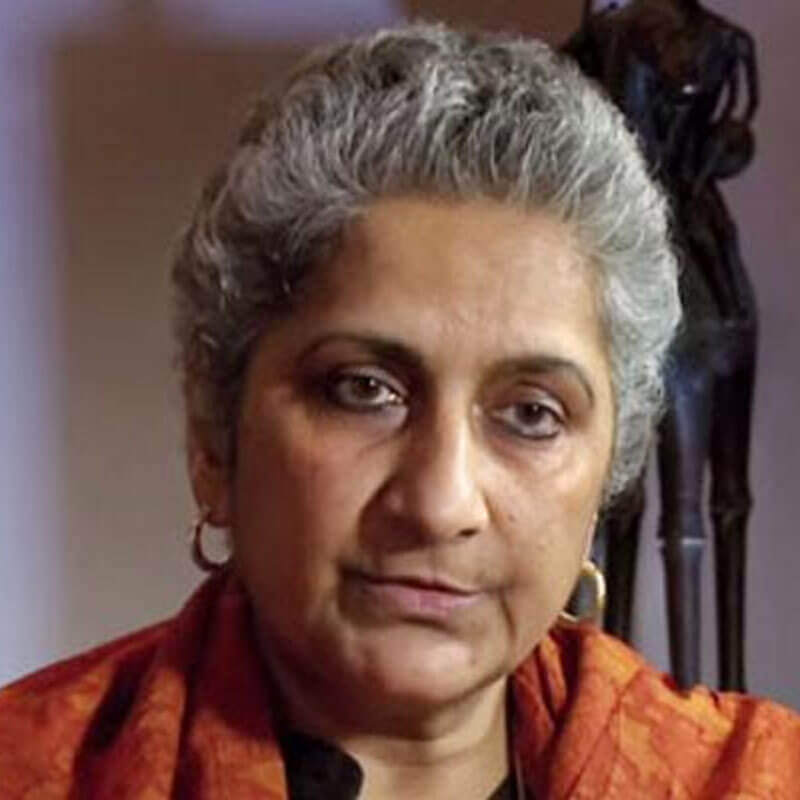
    MUMBAI: With two decades of journalistic experience in the field, Chitra Subramaniam has joined hands with Arnab Goswami in his new venture Republic TV. She is known for her investigation of the Bofors scandal which led to the electoral debacle of former PM Rajiv Gandhi in 1989.

    Goswami said, “I am privileged to work with Chitra Subramaniam. We look up to her for her high standards of journalism and integrity. Our editorial team is delighted to welcome her on board.” Subramaniam has also reported widely on trade (GATT-WTO) and arms control and covered the Bosnia war from the front lines.

    Subramaniam added, “I am pleased to collaborate with Arnab and his team. It’s young, fresh, fearless, pan-Indian and ambitious – attributes that Indian journalism can do with at this juncture. I hope I can live up to the expectations placed on me.”

    Taking a break from journalism, she was part of the former Norwegian Prime Minister Dr. Gro Harlem Brundtland’s campaign team for the post of Director General of the World Health Organisation (WHO). She became the lead person for policy analysis and communications for WHO’s Cabinet Project Tobacco Free Initiative which resulted in the coming into force of the Framework Convention on Tobacco Control (FCTC), the world’s first treaty entirely devoted to health. Subramaniam then went on to set up her own company in Switzerland doing market research and media analysis for Fortune 500 companies promoting ethical business practices between India and Europe. In 2014, Subramaniam returned to active journalism and co-founded online news portal – The News Minute.

  • ‘Republic TV’ hires Chitra Subramaniam as advisor

    ‘Republic TV’ hires Chitra Subramaniam as advisor

    MUMBAI: With two decades of journalistic experience in the field, Chitra Subramaniam has joined hands with Arnab Goswami in his new venture Republic TV. She is known for her investigation of the Bofors scandal which led to the electoral debacle of former PM Rajiv Gandhi in 1989.

    Goswami said, “I am privileged to work with Chitra Subramaniam. We look up to her for her high standards of journalism and integrity. Our editorial team is delighted to welcome her on board.” Subramaniam has also reported widely on trade (GATT-WTO) and arms control and covered the Bosnia war from the front lines.

    Subramaniam added, “I am pleased to collaborate with Arnab and his team. It’s young, fresh, fearless, pan-Indian and ambitious – attributes that Indian journalism can do with at this juncture. I hope I can live up to the expectations placed on me.”

    Taking a break from journalism, she was part of the former Norwegian Prime Minister Dr. Gro Harlem Brundtland’s campaign team for the post of Director General of the World Health Organisation (WHO). She became the lead person for policy analysis and communications for WHO’s Cabinet Project Tobacco Free Initiative which resulted in the coming into force of the Framework Convention on Tobacco Control (FCTC), the world’s first treaty entirely devoted to health. Subramaniam then went on to set up her own company in Switzerland doing market research and media analysis for Fortune 500 companies promoting ethical business practices between India and Europe. In 2014, Subramaniam returned to active journalism and co-founded online news portal – The News Minute.

  • Bajaj Electricals eyes Rs 5,000 crore turnover in fiscal 2014-15

    Bajaj Electricals eyes Rs 5,000 crore turnover in fiscal 2014-15

    KOLKATA: To commemorate completion of 75 years of business in 2013, Bajaj Electricals, has kept aside Rs 15 crore out of the Rs 60 crore earmarked for advertising and promotion during fiscal 2013-14 for both above the line (ATL) and below the line (BTL) activities. The company has tapped all media and even created a software application (app) to mark the occasion.


    What’s more, the manufacturer of lights, fans and home appliances is targeting a sales turnover of Rs 5,000 crore in fiscal 2014-15.


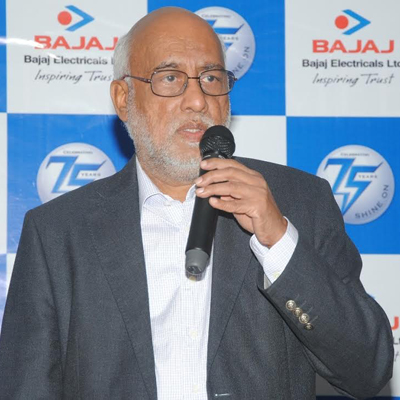
    Bajaj Electricals chairman and managing director, Shekhar Bajaj, confirms: “In the current fiscal (2013-14), we are looking at a turnover of Rs 4,200 crore. In the next fiscal (2014-15), the company is looking at a turnover of Rs 5,000 crore.”


     Of Bajaj Electricals’ six strategic business units – engineering and projects, home appliances, fans, lighting, luminaries and Morphy Richards – the company will continue to focus on home appliances, wherein it is practically the market leader.


    “Every year, on an average, the company sells 37 lakh irons and more than 15 lakh mixers,” informs Shekhar Bajaj, stressing that the company will remain focused on low-end home appliances and will not venture into the white goods’ sector. “We are practically the market leader in almost the entire home appliances segment comprising fans, toasters, OTG and others. We have a competitive edge in that segment,” he adds.


    As for engineering and projects, Bajaj Electricals joint managing director Anant Bajaj informs that as on 1 December, 2013, the division’s order book stood at Rs 2,100 crore approximately. Of which, orders worth nearly Rs 1,000 crore are from rural electrification projects, a majority of them under the Rajiv Gandhi


    Gramin Vidyutikaran Yojana. Plus, the unit will start the next fiscal (2014-15) with an order book of about Rs 1,500 crore; he adds.


    The engineering and projects vertical clocked revenues of Rs 1,200 crore in the current fiscal and is looking to clock Rs 1,500 crore in the next fiscal, concludes Anant Bajaj.

  • Relive India’s 80s with NGC

    Relive India’s 80s with NGC

    MUMBAI: The 1980s was one of the most ‘happening’ decades in the history of India. It wasn’t just in one segment that the country witnessed change. While Indira Gandhi’s assassination was one of the biggest events of the decade leading to communal violence and political turmoil, there were other interesting events like India’s victory in the Cricket World Cup. The introduction of national telecast and colour TV in 1982 was one of the biggest events of the country.

    Debarpita Banerjee says, the 80s was the decade that was responsible for paving the path ahead for a young, middle-class India, with a liberal perspective.

    Now, National Geographic Channel as part of its series The 80s is giving its viewers an opportunity to revive the memories of the 80s with a special feature on India. So far, the series according to the channel officials has got a pretty good response. While the whole series has been received well, the episode titled Tear Down These Walls which focuses on the many literal and cultural walls brought down globally during the decade, has had the highest viewership.

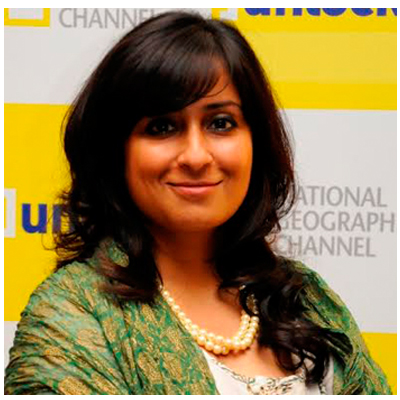
    NGC VP and Fox International, marketing Debarpita Banerjee says that across six weeks, the series has managed to revisit some of the most significant global events of the decade. “What I think genuinely worked was the fact that every viewer could relate to it, in their own personal way. Whether you were an 80s child or not, you are sure to have been left with some or the other lasting impression of the decade,” she says and adds that with a fairly good response to the series, it just made more sense to have one episode exclusively dedicated to India.

    Indira Gandhi and Kapil Dev after India won the cricket world cup

    “The decisions, the tragedies, the fads…this was the decade that was responsible for paving the path ahead for a young, middle-class India, with a liberal perspective. This episode will give the viewer both an analytical, as well as a nostalgic viewpoint of the ‘80s,” she says.

    To make the episode interesting and content-oriented, the channel has got on board many eminent people like established journalists, culturists, film-makers and eminent researchers, such as Vinod Dua, Anurag Kashyap, Mark Tully, Mahesh Bhatt, among others, whose anecdotes and commentary are strung in the feature to give the viewers a better perspective of the era.


    However, since there was a time restriction of just one hour duration, the channel had to make some tough choices in terms of the topics that would be covered. It had to ensure that the focus remains on events that were frontrunners in changing the course of India’s history. “Keeping this in mind, we chose personalities, who are not only stalwarts in their own fields, but served as eye-witnesses, as well as fans of this fascinating decade. Once they got to know that it was the 80s they were to talk about, the rest was easy,” says Banerjee.   

    Rajiv and Sonia Gandhi

    Filmmaker Mahesh Bhatt, who was at the helm of his career during the 80s, recalls the era with a lot of fondness. Talking about the TV set, to which the Indian common man suddenly got an access to, he says: “Well, an Indian suddenly realised there was a way to amuse himself by staying at home…and community viewing – the family. India woke up to this thought that television was consumed by the entire family and that was the beginning of what is called ‘the great television revolution’ which was going to take place with the satellite age. I think the Indian loves to be at home with his family and listen to the stories which his father and grandfather told him, but nuanced in a modern way.”

    However, Ogilvy & Mather executive chairman & national creative director India, Piyush Pandey explains it in a better way. He says: “It’s not that in the late 70’s, people were not watching Doordarshan, but with the coming of colour television and its availability in households, one was very clear that this medium was going to go a very long way. We are a very audio-visual country anyway, we love our movies, we love story telling and we love emotions. TV was the best medium that was just waiting to be unleashed. And, it got unleashed in ’82. I think everyone, every marketer; every advertiser knew that this was the medium that was going to be the most powerful one in the days ahead.”

    The Indian audience was introduced to colour TV in 1982

    Since the episode is packed with many such info and interesting stories from the era, it made more sense for the channel to go all out to promote it and thus it has activated a digital campaign across Facebook and Twitter for the episode. “There is a radio campaign across Delhi, Mumbai and Bangalore as well taking the listeners on a retro ride of ad jingles from the 80s and Mile Sur Mera Tumhara…,” says Banerjee.

    Nokia Lumia 1020 is the presenting partner and Hindware Italian Collection is the co-presenting partner of the series.

  • ASCI upheld complaints against 177 out of 201 ads

    ASCI upheld complaints against 177 out of 201 ads

    MUMBAI: In July 2013, ASCI’s Consumer Complaints Council (CCC) upheld complaints against 177 ads. Most of the misleading ads were from the education sector and promising 100 per cent job placements was one of the recurring unsubstantiated claims made by the advertisers. This was followed by health and personal care category.

    The CCC found following claims in print ads by 94 different advertisers were not substantiated violating the ASCI Guidelines for Advertising of Educational Institutions and hence the complaints against ads by International Marine, Sri Balaji Education & Charitable Trust – Rajiv Gandhi College of Engineering &Technology, National Institute of Event Management, Marine Engineering Training Institute, among many more were upheld.

    Complaints were upheld because of unsubstantiated claims that they ‘provide 100 per cent placement/and/or they claim to be the no.1 in their respective fields’ by the institutions.

    In the second category, health and personal care product or service, the CCC found the claims in ads of 52 advertisers, released in the press to be either misleading or false or not adequately/scientifically substantiated and hence violating Chapter I of the ASCI Code. Some of the health care products or services ads also contravened provisions of the Drug & Magic Remedies Act.

    For instance, the TVC of  L’Oreal’s Garnier’s Pure Active Neem Face Wash claims that it is ‘enriched with real Neem’ and it is ‘the first ever face wash that removes pimples and marks’.  Rich Feel Trichology Centre claims  that they are ‘world‘s first hair thinning treatment with plant stem cell extracts , reduces hair fall , restores hair regeneration and increases hair growth’.   

    Other examples were of Ponds Age Miracle in print advertisement claiming ‘Look up to 10 years younger with disclaimer in small print ‘With regular use’. Nivea for Men Dark Spot Reduction in TVC claimed that the face wash has a 10X formula that removes dark spots and gives a spotless face

    In the consumer durable category, the CCC concluded that the claims mentioned in these six advertisements and cited in the complaints below were not substantiated.  The advertisements contravened Chapter I of the Code. For example, HUL’s PureIt Water Purifier in its TVC claimed that the ‘Use of PureIt and save money on three gas cylinders in a year’.

    Complaint against Tata Teleservice ad was upheld as the CCC concluded that the claim, “Unlimited 3G data for Rs 250”, was misleading as the disclaimer mentions that “3G data would be upto 1 GB only”.  The advertisement contravened Chapter I.4 of the ASCI Code. The super that appeared in the TVC was not clearly legible, thus contravening the Regulations of ASCI’s minimum lettering size of supers.

    In the media sector, the CCC concluded that the claims made by Bennett Coleman & Co E-Samay has a circulation of over three Lakhs as of April 2013 in Kolkata’, ‘It retained more than 85 per cent after changeover from subscription to cover price’, ‘The paper is now the undisputed Number two Bengali daily’ were not adequately substantiated and were misleading. The advertisement contravened Chapters I.1, I.2 and I.4 of the Code.  The complaint was upheld.

    On the happier note, the newly launched consumer friendly website from ASCI has also shown encouraging results as almost 25 per cent of the total complaints were registered through the Online Complaint and Monitoring Service (OCMS). With this new service, consumers can now lodge complaints through the new ASCI website, ASCI Facebook page, email, smartphones, toll free telephone or regular post.  Going forward, OCMS is going to play a crucial role in delivering transparency and speedy resolution of consumer complaints.

  • John Abraham gets award for Madras Caf

    John Abraham gets award for Madras Caf

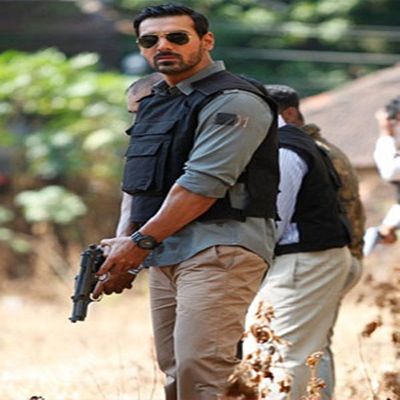
    John Abraham has been honoured with Pride of the Nation award for exploring the story behind India’s former Prime Minister Rajiv Gandhi’s assassination in Madras Cafe. The award was presented to the actor by Anti Terrorist Front’s chairman M S Bitta.


    The movie which revolves around the sensitive issues like the Sri Lankan civil war portrays John in the role of RAW agent. Despite the movie being banned in certain cities, Madras Cafe managed to break the clutter of commercial films and emerged as a hit.

    And now being inspired by real life patriotic stories, John also has future plans to make a movie on Abdul Hamid who was awarded with the Param Vir Chakra for his courage during the 1965 Indo-Pak war.

  • Madras Café to go the Bhaag Milkha Bhaag way

    Madras Cafe is sighting a tax free status for itself, after Bhaag Milkha Bhaag.


    Sources reveal that the movie opened a very important chapter in the history of India. While it was promoted as a film that was based in Sri Lanka, but at the end it was all about Rajiv Gandhi’s assassination.


    The source further goes on to clarify that it is against violence and terrorism of any kind. Since it involves more than just subtle messaging around, the film deserves to go tax free.


    The lead actor of the film John Abraham and director Shoojit Sircar, who have collaborated on the film wanted to see how the film will be received, before creating a case for considering tax exemption.


    A fellow filmmaker who does not wish to be named wishes that the film should be seen by maximum number of people and if John is contemplating a tax free status, he is very much right in his thought.


    Last heard, a case study was being readied for submission to various authorities in different states. To begin with, Maharashtra and Delhi are under consideration and other cities are expected to follow soon.

  • NBSA Chairperson Justice J S Verma passes away

    NBSA Chairperson Justice J S Verma passes away

    New Delhi : The Indian news broadcast industry lost a guide and mentor late last evening in the passing away of 80 year old Justice (Retd.) J.S. Verma, chairperson of the News Broadcasting Standards Authority (NBSA).

    Verma, a former chief justice of India and former chairperson of the National Human Rights Commission (NHRC), was appointed the first chairperson of the NBSA, a self-regulatory body set up by News Broadcasters Association (NBA), on 2 October 2008. He took over the role at a time when the government was making noises that the it would step in an censor the news TV industry if it did not get its self-censorship act together. His first major challenge had been to draw up guidelines for news channels, following the terrorist attacks in Mumbai a month or so into his appointment.

    The NBA has mourned his passing on. In a press note it said: “He believed that self-regulation in the broadcast media is the best way forward in achieving a balance between the media's duty to empower the participatory role of the people in governance. In his frequent interaction with members of NBA he would tell them that in a democracy, it was the media's duty to inform the people of everything of significance; but the right to inform did not include the right to mis-inform as the media's right is no greater than an individual's right, which was again subject to reasonable restrictions. He advised members that self-regulation was the best way so that there was no occasion for any outside intervention to regulate.”

    During the past four years of his association with NBSA, he took ‘pro-active steps to ensure that broadcasting standards improve. The entire electronic news broadcasting fraternity deeply mourns the passing away of this extra ordinary person who lived by his principles and convictions until the very end.’

    The Broadcast Editors' Association too condoled the passing away of Verma.

    In a condolence message, Information and Broadcasting Minister Manish Tewari said, ‘Justice Verma was an iconic personality, who gave jurisprudence, a new perspective with the judgements that he pronounced. As a firm believer of judicial accountability and probity, Justice Verma will always remain etched in public memory. The entire country deeply mourns the passing away of this extra ordinary intellectual who lived by his principles and convictions till the very end.’

    Prime Minister Manmohan Singh said Justice Verma was held in great respect as a public figure not only for his vast understanding and knowledge of law and the many path-breaking judgements he delivered as a Judge, but also for his deep sensitivity to the concerns of the common man and his fierce commitment to the public good. His service to the country continued even after his retirement as Chief Justice of India, and the positions he held included Chairman, National Human Rights Commission and Chairman News Broadcasters’ Standards Authority.

    Verma, born January 18 1933, was the 27th chief justice of India from 25 March 1997 until his retirement on 18 January 1998. After obtaining degrees of B.Sc. and LL.B. from Allahabad University, he joined the Bar in 1955; became a judge of the Madhya Pradesh High Court in 1972; its chief justice in 1985; the chief justice of Rajasthan in 1986; a judge of the Supreme Court of India in 1989; and then the chief justice of India. He was also the acting governor of Rajasthan, twice between 1987 and 1989.

    He headed the commission to inquire into the security lapses leading to Rajiv Gandhi’s assassination (1991-1992); and the Committee to suggest operationalisation of the Fundamental Duties (1998- 1999). He was the chairperson of the NHRC from 4 November 1999 to 18 January 2003. After demitting that office Verma engaged himself in pursuing matters of national and public concerns, and advocating measures for amelioration of the polity.

    In the aftermath of the gang rape in Delhi on 16 December 2012, the Indian government on 23 December 2012 appointed a three member committee consisting of J. S. Verma, justice Leila Seth and Gopal Subramanium as members to look into possible amendments of the criminal law to provide for quicker trial and enhanced punishment for criminals committing sexual assault of extreme nature against women. In view of the significance and urgency of the task, the committee undertook and performed the herculean task within 30 days.

    He is survived by his wife and two daughters who along with their families were with him at the time of his demise.