Tag: Rajan Anandan

  • Rural India to dominate next set of internet users

    Rural India to dominate next set of internet users

    MUMBAI: India, with over 300 million internet users, is the second largest mobile market of the world, only after China. But, 300 million out of 1.2 billion population, surely leaves a lot of room for improvement. Urban India dominates 33 per cent of India’s total population, which means the next set of internet users will majorly come from the rural part, where people mostly communicate in their regional language.

    The recently launched ‘Internet Saathi’ initiative by Google India in association with Tata Trusts and Intel promises to bridge the language gap. Speaking to Indiantelevision.com Google south east Asia and India VP and managing director Rajan Anandan said, “Google will introduce more and more regional languages with more technical upgradations. Also, the voice search feature will be strengthened to make the use of internet easier for the rural part of the country.”

    As per analysis, in the first six months of 2015, India is estimated to have added 52 million internet users of which 50 per cent (26 million) have come from rural India. For the first time India is going to witness equal growth rate.

    But the discrimination of internet is not only limited to rural and urban, but very much evident in male and female also. A large part of rural India considers internet as a tool for male counterpart. Only 12 per cent women from rural India uses internet and it is highly important to change this mindset, do away with the fear and make women from rural India active part of internet explosion.

    “We are working with various partners to help spread awareness about the benefits of being online amongst women. While we have now started the ‘Internet Saathi’ initiative, in association with Tata Trusts and Intel, earlier we had launched a new film to inspire young digital natives to bring their mothers online. There are a large number of educated women in India with internet access in their households, but they still do not use it. We are targeting them with our initiative,” informed Google country marketing director India Sandeep Menon.

    India now has over 100 million online shoppers, 200 million plus wireless internet users, 140 million smartphones, over 85 million 3G users out of which 9.3 million were added in past three months. But when Prime Minister Narendra Modi speaks about ‘Digital India’, he dreams of 1.2 billion people benefiting from digital. But to achieve that, the rural-urban, male-female barrier needs to be tarnished as soon as possible with various initiatives.

    When it comes to frequency of internet usage, reports signify that a good 61 per cent of users are daily users. About 18 per cent access internet several times a day, 10 per cent users at least use it once a day and 33 per cent access it on all seven days of the week.

    If we take the example of mobile phones, the multiplications happened only once the device was made affordable in the rural and sub urban part of the country. India is a mass country with aspiration in every eyes and internet, if used adequately, can be a tool to achieve dreams in rural part where hi-tech education is yet to reach.

    Also, e-commerce can grow at a double speed if rural India starts shopping online. While infrastructure and pricing of wireless data puts India on the back foot, Initiatives like ‘Digital India’ and ‘Internet Saathi’ enthralls optimism. It remains to be seen how Modi, Google, Tata, Ambani, Mittal strategises to take internet to rural India.  
  • Tata Trusts, Google India and Intel team up to launch Internet Saathi

    Tata Trusts, Google India and Intel team up to launch Internet Saathi

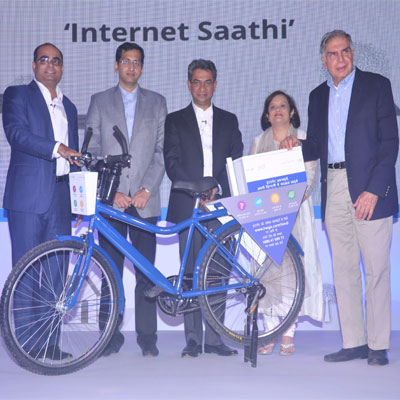
    MUMBAI: The definition of philanthropy is changing with time. In a philanthropic move and in keeping with the ‘Digital India’ campaign started by Prime Minister Narendra Modi, business giant Tata Trusts and digital ruler Google India have tied up to launch a special programme called ‘Internet Saathi’ to empower women and their communities in rural India by enabling them to use internet and benefit from it in their daily lives.


    The joint initiative is aimed at bridging the technology gender divide, which currently puts women in rural India at further risk of getting marginalized in the society as the world around them benefits from going online. The ‘Internet Saathi’ initiative adds on to the ‘Digital India’ vision of the country. The launch event was also attended by Tata Trusts chairman Ratan Tata.


    The initiative will provide basic training on the usage and benefits of internet for women through specially designed internet cycle carts which will be used to visit areas in villages which women can easily access and also learn more from the internet.


    Built on the back of a cycle, the cart is modeled on India’s traditional distribution system that is used to carry everything right from ice-creams to industrial supplies. The operator or the ‘Internet Saathi’ keen to train the women, would be akin to the village postman who was the single point contact for the village with the outside world both in terms of information as well as communication. Tata Trusts, with its vast field based ecosystem, will manage the on-ground rollout with its partners whereas Google will invest in providing the internet-enabled carts and the training content.


    Google South East Asia and India VP and managing director Rajan Anandan said, “While women are making rapid progress on adoption of internet in urban areas, women in rural India are being left behind. Today only 12 per cent of internet users in rural India are women. We need to come together to address this challenge and empower women in rural India through training and programmes that can truly transform their lives. We are delighted to partner with the most respected and well known Tata Trusts who have years of experience in managing programmes of this scale. By combining our strengths, I am confident that we can achieve great results and overcome the challenges of providing easy access and digital education to women in rural India.”


    “Tata Trusts strongly believes that innovative use of technology should be at the core of all its interventions that are undertaken for the benefit of the communities. Internet connectivity has become a fundamental need in any society and improves literacy and access to information that is instrumental for socio-economic development. We are glad that this joint initiative with Google will reach out to the rural communities, especially women in our country and we are confident that it will contribute towards their empowerment and also self-sustenance,” Tata Trusts executive trustee R Venkataramanan.


    Speaking to Indiantelevision.com, Google country marketing director India Sandeep Menon asserted, “With this initiative we will educate and empower women of rural India about internet and take them a step closer to entrepreneurship which will enable them to be self dependent. The next set of internet users will be totally different as majority of them will come from the rural part so it’s very important to make them aware about internet.”


    The initiative will also be supported by Intel who has been a long term partner of Google India’s Helping Women Get Online initiative. “We believe that the vision of Digital India will empower every Indian citizen with equal opportunities irrespective of cast, creed and gender. At Intel, we believe that skill development and innovation are imperative for realizing the Digital India vision and we are very proud to collaborate with Google and Tata Trusts on the ‘Helping Women Get Online’ initiative especially as we celebrate the Digital India Week,” said Intel vice president SMG, managing director- South Asia Debjani Ghosh.


    The initiative will kick off from Gujarat, Rajasthan and Jharkhand and will be rolled out across the country eventually reaching out to over 4500 villages and 5 lakh women and rural communities across rural India over the next eighteen months. The internet cart would be available in the village for a minimum of two days every week for over a period of four to six months. It will create awareness and also try to ensure that adequate training is provided to use the devices till women are confident of using them independently. Once the cart has completed the training in a cluster of three villages, it will be moved to the adjoining cluster for completion of a similar cycle. The training of women, and the community at large would be ensured by involving SHG federations / local NGO members as trainers.


    Google’s helping women get online is an initiative to create awareness about the benefits of internet amongst 50 million women in India. Under this initiative, Google conducts various outreach and educational programmes. The programme includes an awareness module, coupled with hands-on training modules aimed at teaching women how to use the internet, including via mobile devices. Since the launch of this initiative, Google has directly trained over 1.5 million women on the basics of the internet.

  • InstaLively raises $120,000 from Angel investors

    InstaLively raises $120,000 from Angel investors

    NEW DELHI: InstaLively, the first mobile app in the world, which can live stream directly in HD from any android phone to YouTube, has recently raised $120,000 from six Angel Investors.


    InstaLively is the first end-to-end live streaming solution, available both on mobile and the desktop.


    The six Angel Investors, who have invested about Rs 75 lakhs ($120,000) into this new venture includes Outbox Ventures’ Niraj Singh, MeraEvents, Google India MD Rajan Anandan, Slideshare co-founder Amit Ranjan, GSF founder Rajesh Sawhney and German investor AECAL.


    The primary aim of the fundraise is to capture the global live streaming market. The target market includes events ranging from entertainment to corporate to personal events (like birthday parties and weddings). 


    In the past two months, the company has successfully piloted with marquee clients like Google, Mary Kom, NASSCOM for Start-ups, NrityaBharati, GSF, Meraevents and Belgian Embassy amongst others.
     

    InstaLively helps broadcast videos to the cloud in just a single click. The technology is such that using the InstaLively mobile app, one can live stream to YouTube directly from an Android phone with a single click. Moreover, InstaLively has also builtDesktop Apps (Windows & Mac) to live stream from a professional camera.


    The USP of InstaLively is that it integrates seamlessly into one’s YouTube channel and has two live streaming modes – “Do-it-Yourself” OR “Get External Help.” In the latter, the nearest videographer comes to your location on the click of a button to live stream or record the event into your YouTube channel.


    InstaLively co-founder Karthik Vaidyanath said, “Our technology is way superior to live streaming apps like Meerkat, Stre.am or any other app doing the rounds lately. Cross-platform low bandwidth video delivery is important in Asian market and closely integrating with YouTube, InstaLively facilitates it way better than any other LiveStreaming solution in the market today.”


    Sawhney added, “InstaLively is bringing together the video delivery capabilities of YouTube with the real time reach of Social Media.”

  • Contest for PMO mobile app launched; winner gets trip to US

    Contest for PMO mobile app launched; winner gets trip to US

    NEW DELHI: A contest has been launched for development of a mobile app for the Prime Minister’s Office (PMO).  


    Prime Minister Narendra Modi in his recent address at the 25th foundation day of the National Association of Software and Services Companies (NASSCOM) had announced the intention to launch a mobile app for PMO. 

    The Government’s citizen engagement platform MyGov will host this contest in association with Google. The contest will be organized over the next three months in three areas of ideation, wireframe development and app development. The best app will be then presented to the PMO. The team developing the wining app will get a chance to visit the headquarters of Google in the United States. 

    The contest is open for all citizens of India above the age 18 years, who are registered on MyGov (https://mygov.in). Participants can submit their entries on the contest page. Each phase will be assessed by an independent jury constituted by MyGov. 

    Speaking on the launch, Communication & Information Technology Minister Ravi Shankar Prasad said views of the citizens collected through the MyGov and other forum have been incorporated into railway and Union Budgets. 


    The need to tackle benami properties and the idea for introduction of sovereign gold bound scheme have come through some suggestions from the people. He said this Government wants to take follow up action on ideas obtained through crowd sourcing and also wants to use social media for public good. 

    Deputy secretary R S Sharma gave an overview of the Digital India programme, whose aim is to first digitally connect all citizens of the government and then digitally empower them in participative process of policy making and being continuously informed of various government initiatives and programmes. 

    MyGov CEO Gaurav Dwivedi charted out the evolution of MyGov, since its launch on 26 July last year and laid out some key features of the newly released MyGov Version 2.0. Google India managing director Rajan Anandan, who is MyGov’s partner in the contest, spoke of Google’s commitment to partner India’s digital drive at multiple levels.

  • “Digitisation will boost GDP growth” – Ravi Shankar Prasad

    “Digitisation will boost GDP growth” – Ravi Shankar Prasad

    MUMBAI: Taking a leaf out of Prime Minister Narendra Modi’s Digital India initiative, Union Minister of Communication and Information Technology Ravi Shankar Prasad today stressed on how the country’s growth is interlinked to this programme.
    “The government is dedicated to creating a digital ecosystem that will enable internet to touch the lives of all Indians,” Prasad, who was speaking at the 9th India Digital Summit of IAMAI, said.
    He further pointed out how it was imperative to create hubs in rural India that will help the growth of e-commerce, which remains unexplored so far. “Unless connectivity reaches every village of India, the dynamics of growth will remain unchanged,” he said.
    Speaking on access, Prasad said, “It took 30 years to cover 10 lakh kilometres of optic fibre laying, and in just next three years, seven lakh kilometres will be added, making rural connectivity a reality.”
    Releasing the IAMAI &The Boston Consulting Group (BCG) report India@Digital.Bharat, Prasad said, “For the internet economy to touch $200 billion by 2020 that will contribute five per cent of GDP, we need to move at a fast pace towards computer literacy. The other key areas which will help the internet economy to grow is mobile internet. The government is committed to digitisation and we look at extensive public-private partnerships (PPP) to the have successful implementation.”
    The India@Digital.Bharat report establishes that India is headed towards an internet economy worth $200 billion by 2020, that will contribute five per cent of the GDP growing at 23 per cent compared to 13 per cent overall.

    As the following chart shows, Internet in India by 2018 will be more mature and mobile will be more predominant.

    The number of internet users in rural areas will touch 210 million by 2018, aiding India’s internet user base to cross 500 million by 2018.

    Speaking at the launch of the report, BCG senior partner and director Alpesh Shah said, “India will have more than half a billion internet users in the next three years – this growth has the potential to fundamentally change the way in which consumers save, learn, play, move and work. However, the extent of shift will depend a lot on how the government and the industry come together to unlock the true potential of the internet.”
    IAMAI chairman and Google India managing director Rajan Anandan, stressed on the growth of internet in India and successful roll-out of the government’s Digital India programme. “India is the third country in the world to have over five Internet companies valued at over $1 billion. India is the fastest growing Internet country but we need to move from narrow band to broadband at the earliest,” Anandan said.


  • One-in-four digitally connected Indian will ensure growth of medium: IAA

    One-in-four digitally connected Indian will ensure growth of medium: IAA

    MUMBAI: The International Advertising Association (IAA) India Chapter conducted its 12th Webinar on 19 December 2014 as part of the ‘World Goes Digital’ webinar series.


    GroupM South Asia, veteran digital media specialist and managing partner, Tushar Vyas was a guest speaker in this series of the webinar.  As part of the GroupM South Asia ExCo, Vyas leads the digital media practice for GroupM South Asia. He is also responsible for investments and corporate business development.


    Commenting on the importance of the digital medium, Vyas said “The number of people who have embraced digital as a medium is a testimony to its growth and importance. There are 5 million smartphones being bought every month in India, which has ensured that 25 per cent of the Indian population is digitally connected.”


    IAA India Chapter & vice president, development (Asia pacific region) Srinivasan K Swamy commented, “Having experts like Tushar Vyas, ensures that our members and the fraternity in general gets the latest and most authoritative view on the digital media.”


    The Free Press Journal director and Webinar Series chairman Abhishek Karnani said “We were delighted to have Tushar Vyas addressing the 12th in the series of ‘World Goes Digital’ Webinar series hosted by the IAA India Chapter. These sessions go a long way in spreading the awareness of the digital media.”


    The International Advertising Association (IAA) India Chapter has hosted speakers like Citi India CMO Sanjeev Kapoor, Bookmyshow.com founder and CEO Ashish Hemrajani, Google India managing director Rajan Anandan, Linkedin India managing director Nishant Rao, Rediff.com founder Ajit Balakrishnan SAP chief story teller Julie Roehm, Hungama Digital Media managing director and CEO Neeraj Roy and mCordis co-founder & managing partner (EMEA) Paul Berney.


    Recently, Ram Subramanian and Rajjat Barjatya were also invited as guests on ‘World Goes Digital’ webinar series.

  • GroupM with Goggle to launch online Diwali Mela

    GroupM with Goggle to launch online Diwali Mela

    MUMBAI: WPP’s GroupM has announced its plans to launch an online platform called ‘Grand Diwali Mela’, which will be India’s largest festive season online destination.


    The initiative is supported by Google and will allow consumers to take the neighbourhood mela experience to their favourite screens – across mobile, tablets or desktops.  The ‘Grand Diwali Mela’ will go live on 1 October and last till the Diwali.


    Speaking about the unique initiative, GroupM south Asia CEO CVL Srinivas said, “As more Indians go online, digital media is already an integral part of our everyday lives. We have conceptualised a virtual Diwali mela for users in the country to experience the festive season in a specially designed online platform, where brands will showcase their latest products, run promotions and sampling along with all the fun and entertainment elements that are part of the festive season. Leading brands are excited about the potential of this initiative, and this could possibly become the largest digital activation platform for this festive season.”


    The ‘Grand Diwali Mela’ will bring together two of the biggest activities Indians like to indulge during any festive season, shopping and entertainment, as users experience in offline Diwali mela. Shopping is an integral part of our Diwali celebrations when the whole family spends on an array of product categories. Diwali is also a time of celebration with family and friends where music and movies and games are part of every get together. All these offline experiences will be available to online users at the ‘Grand Diwali Mela’.


    Google India country head Rajan Anandan added, “We are delighted to be working with Group M on this innovative platform, that will be first of its kind initiative to kick off the festive season in India. Our teams are very excited about this and we are sponsoring the effort that will be accessible across all kinds of devices – including mobile phones.”

  • Empowering women with internet can change India’s future, believes Google

    Empowering women with internet can change India’s future, believes Google

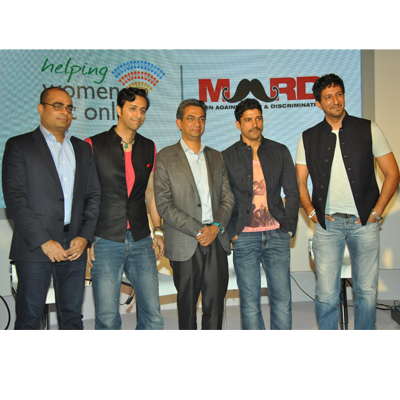
    MUMBAI: Google India today announced the launch of a new social campaign called #ReachForTheSky, in association with Farhan Akhtar’s MARD initiative to increase internet literacy among women in India.


    The joint campaign will also look to build support from existing Internet users and encourage more women to learn and use the internet to excel in their lives.


    Speaking about the campaign and the importance of getting women online, Google India VP and managing director Rajan Anandan said, “There are 616 million women in India and close to half are below the age of 25. Empowering the young women population with information and internet could transform India’s future.”


    In November 2013, Google India had launched its first digital literacy initiative campaign in India called ‘Helping Women Get Online’ (HWGO) in collaboration with Intel, HUL and Axis Bank.


    Along with boosting the overall internet adoption, the initiative aims to bridge the huge gender disparity prevalent India. “The first phase has been very successful. For the first time last year, the number of women using the internet has grown 35 per cent as against 31 per cent by men,” Anandan added.


    Anandan also revealed that this initiative is not a part of the company’s CSR and said, “Google’s mission is to get more people online and as the number of women using Internet increases, it would be a good thing for the country as well as the company.”


    Talking about the association and the launch of the campaign, Farhan Akhtar, said, “MARD is a progressive movement for a more gender equal world. There is lack of encouragement for women to use internet or technology and we need to come together to address this issue. Technology is not just the domain of men. I am excited to join this initiative, to gather support and encourage men to support and help young girls and women to learn and use the internet to improve lives.”


    Sharing more details about the campaign, Google India marketing head Sandeep Menon said, “Our mission is to help bring 50 million women online in India. In the last nine months we have undertaken a number of initiatives reaching over one million women across five states in India, covering 30 cities and 55 small towns.”


    The company has also been working closely with educational institutions for the campaign to reach the remotest parts of the country by imparting basic internet and computer training to students and teachers. The company has also have introduced HWGO Internet Cart, a mobile way of reaching out to women in villages to give them the internet experience and are planning to roll it across more states of the country.


    Talking about association with Akhtar, Menon reckoned, “Since the launch of HWGO, we have worked with a number of partners, HUL, Samsung, Aircel. One of the partners was MARD, and we soon realised our aims were very well aligned. It was a natural fit.”


    Menon also added that they would also launch two media campaigns. “Farhan will help us enroll multiple stars. There will be a number of familiar faces joining the cause as that is a powerful medium. Also, for people looking for facts and statistics, we will have a campaign that will provide statistical data to shake up people and inspire them to join the campaign.”


    To rope in more existing internet users to join the campaign to help get more women online, the company will be only opting for digital marketing.


    “We will be taking the digital route completely for this, not going to take the campaign on mainline media at this point of time. We will be propagating the campaign on different mediums and sites including Youtube, economictimes.com. The campaign will be launched across social media,” revealed Menon.


    MARD also plans for global outreach and will continue to address gender equality issues across the world and in India, MARD Canvas Talent CEO and Artist Innovations & Repertoire director Anurag Rao said, “MARD will work with content makers around the world in a pledge to engage hearts and minds through art and music, for a more gender equal world #ReachForTheSky is just the start.”


    The campaign was also launched with a musical work ‘Chulein Aasmaan’, composed by Salim-Sulaiman and performed by Akhtar and Shraddha Pandit. Written by the two of them, the song, that was released on Youtube today, highlights the importance of equal opportunity, possibilities and the impact it can have on women.

  • We have done a terrible job in broadband penetration: Rahul Khullar

    We have done a terrible job in broadband penetration: Rahul Khullar

    MUMBAI: The chairman of the Telecom Regulatory Authority of India (TRAI) Rahul Khullar is known for being vocal. While earlier he has voiced his opinion on various things including bringing transparency in the way telcos function, delivering his keynote address at the India Digital Summit of the Internet and Mobile Association of India (IAMAI) in the capital, he candidly admitted that the rollout of National Optic Fibre Network (NOFN) was not-so successful. He said, “We have done a terrible job in broadband. We are nowhere near to meeting target of NOFN and unless it is done, internet penetration cannot happen at the desired pace.”


    Referring to the fact that 80 per cent of new internet users are coming through 2G network, Khullar said, “Access and speed will determine penetration of smart-phones and internet. Unless there is reasonable pricing of spectrum and making spectrum available, we will not succeed.” He opined that the next government has to take immediate action on spectrum availability to have successful internet penetration in India.


    IAMAI chairman and Google India managing director Rajan Anandan, talking at the inaugural ceremony said: “India is adding four million active internet users every month. At this rate we will overtake the United States by end of this year to become the second largest internet market.”


    According to Anandan, India’s e-Commerce industry will be around US $100 billion in the next decade. However, investments of upward of US $3 billion will be required to reach that stage. “And that can only happen if FDI in e-Commerce is allowed,” said Anandan.


    “Given the dire strait of our finances, e-Commerce industry should embrace itself for taxation,” remarked Khullar, who also raised the issue of data protection, privacy and internet governance and said that industry members should come forward along-with civil society in creation of internet governance laws.

  • “Cyber security should be an integral part of national security” Narendra Modi

    “Cyber security should be an integral part of national security” Narendra Modi

    NEW DELHI: Gujarat Chief Minister and BJP Prime Ministerial candidate Narendra Modi’s valedictory speech was the highpoint of the just concluded eighth India Digital Summit organised by the Internet and Mobile Association of India (IAMAI).


    Addressing the audience through video link, Modi outlined his vision of a ‘Digital India’. “India is a repository of knowledge. Time has come to create a high-speed digital highway so that knowledge can be shared easily to enable empowerment of the people,” said he. “Access to information should have no barriers. And when we create such a digital environment, not only will governance be transparent, technology will ensure citizen governance.”


    Modi stressed upon provision of easy access to and availability of government services to people on their mobile devices. He even spoke of empowering farmers through this medium. In order to boost the agricultural sector, farmers need to have access to global knowledge and information in real-time; he said.  


    Mirroring IAMAI chair and Google India managing director Rajan Anandan’s contention that India would have a US $100 billion e-commerce industry within a decade, the Gujarat CM said e-commerce should drive every industry and every sector.


    Speaking of the need to make the national capital entirely Wi-fi-driven, he said, “This is where the world is moving, and we have to ensure that we start by making Delhi a wi-fi equipped capital.”


    Pointing out how every political party today is actively using social media to reach out to the masses, he said, “With social media, the common man has become powerful and can raise concerns.” While emphasizing the need to link cyber security to national security, Modi concluded his speech on a positive note saying: “Digital India will ensure that the world looks to India for the next big idea.”