Tag: Raj Kumar Yadav

  • Kai Po Che: Newcomers put up an impressive performance

    Kai Po Che: Newcomers put up an impressive performance

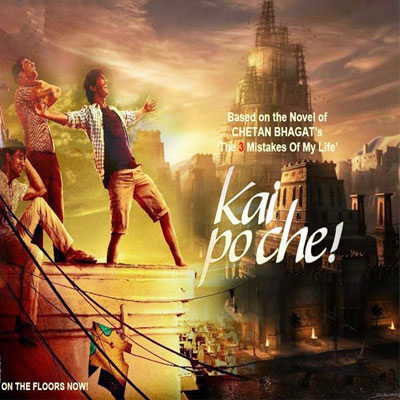
    MUMBAI: Kai Po Che is an adaptation of the Chetan Bhagat novel, Three Mistakes Of My Life, about three friends living the Gujarat dream – to become entrepreneurs. This is Bhagat‘s third book to be made into a film after One Night @ The Call Centre (Hello) and, Five Point Someone (3 Idiots).

    Producers: Ronnie Screwvala, Siddharth Roy Kapoor.

    Director: Abhishek Kapoor.

    Cast: Sushant Singh Rajput, Raj Kumar Yadav, Amit Sadh, Amrita Puri, Digvijay Deshmukh, Manav Kaul.

    Raju Hirani‘s 3 Idiots turned Five Point Someone into a cinematic miracle which went on to become the highest Hindi grosser so far. Kai Po Che has the tough task of bettering it or, at least, living up to it. To start with a small correction with spellings, it is ‘Chhe‘ in Gujarati language and ‘Che‘ means nothing in Gujarati.

    A pol in Ahmedabad is a congested one-track settlement where households live as one family; the main doors are always open and you don‘t have to knock to enter. It is typically an old Ahmedabad phenomenon and Hindu and Muslim localities usually share demarcations by a lane or two.

    Govind (Raj Kumar Yadav), Ishaan (Sushant Singh Rajput) and Omi (Amit Sadh) have grown up together in one such pol and are more like brothers than friends. Still, all three are poles apart. Yadav is practical and ambitious with entrepreneurial instincts, Rajput is a cricket fanatic and Sadh is all brawn and no brains, just happy to belong. The centre point of this pol is a temple where Sadh‘s father is the chief priest while his mama, Manav Kaul, is the trustee and treasurer with heavy leanings towards a political party.

    Yadav gives tuitions to local kids and helps his mother with her home industry of delivering popular Gujarati snacks like khakhras and theplas. However, his entrepreneurial side won‘t let him rest with just so little. Since Rajput is a cricket enthusiast and spends time coaching the neighbourhood kids, and Sadh‘s family controls the temple, he suggests they set up a shop in the temple premises selling sports goods. Nobody is convinced initially with the idea but, Sadh being his only nephew for whom he has grand plans in politics, Kaul finances and encourages them to go ahead. The shop is quite a success and there are picnics and celebrations for the trio.

    The lives of three friends are soon destined to follow different tracks. Yadav carries on with his zeal to expand and is in search for a bigger outlet somewhere in the developing parts of the city, finally settling on a mall, Sadh is gradually drawn into politics by Kaul while Rajput has finally found his calling; he has met a young Muslim boy, Digvijay Deshmukh, in who he sees potential to be a cricket star some day. Rajput takes it upon himself to train the boy with all his time and resources. That is when the 26 January, 2001 earthquake hits Gujarat. Among others it has also destroyed the mall in which the three had invested Rs 500, 000 loaned by Kaul.

    No sooner has the calamity been forgotten, the infamous Sabarmati Express episode happens a year later, leading to communal riots. The three have different priorities: Yadav is worried he has impregnated Rajput‘s sister, Rajput wants to save Deshmukh and his family members while Sadh, who has lost his parents in the train disaster, wants to avenge them and is on the move with rioting mobs.

    The first half of the film is all about three friends, their carefree life and finding a cause while post interval, the perspective changes to wider issues, the riots and how they changed lives.

    The feel good film suddenly turns heavy, stuffing in too much. The story of three friends through various moments in their lives does not touch the viewer at anytime. Being a period-specific story, the director has not been very particular about the city he is dealing with. The pol in the story opens on the main road showing traffic, there are green and yellow CNG rickshaws in 2001, and many malls in the making. None of this is accurate. The interiors are shown to be dull and drab which don‘t make for pleasant viewing. There is extensive use of Gujarati language but it neither has Ahmedabadi twang nor is pronounced properly by non Gujarati artistes. The title Kai Po Che has no relevance to the story and the film has just one passing kite-flying scene while kite flying is a passion in the city climaxing on 14 January every year. Also, the title, which is a cry that goes when an opponent‘s kite is cut, it means little to those outside of Gujarat and Mumbai. The songs are soothing.

    The new faces in the film, Yadav, Sadh as well as Rajput do very well while Amrita Puri in her brief role is suitably apt alternating between a coy girl and a bold one romancing her brother‘s best friend on the sly. Deshmukh is impressive. Kaul lives up to his part.

    Kai Po Che has been much hyped yet falls short of expected opening response. While some improvement may be expected over next two days, it may not be enough. 

    Zila Ghaziabad: Of gangs, guns and gore

    Producer: Vinod Bachchan.

    Director: Anand Kumar.

    Cast: Sanjay Dutt, Arsad Warsi, Vivek Oberoi, Paresh Rawal, Ravi Kissen, Chandrachur Singh, Sunil Grover, Minissha Lamba, Charmy Kaur, Eijaz Khan, Ashutosh Rana.

    Zila Ghaziabad is one of those local stories from Ghaziabad, UP, and considering the region, it is about violence and gang wars blended with politics and police to complete the chowkdy (gathering of four).

    The film is supposed to be inspired from a real life war between two Gujjar community gangs of the town, only turned up many notches in violence. In fact, the film is all about violence with a few item/dance numbers thrown in while all other aspects like relations and emotions are mere props.

    Vivek Oberoi wears desi garb, teaches youngsters under a tree and quotes Mahatma Gandhi. That is not all. He is a multi-talented man: a lawyer by qualification, he romances the town head‘s daughter and can even take to arms if it comes to it. The headman, Paresh Rawal, usually engages muscleman Arshad Warsi but is convinced when Oberoi suggests a legal route to solve a land dispute with Ravi Kissen. The sarpanch being the judge and jury, Oberoi wins the day for Rawal whose brother in law, Sunil Grover, is not pleased with his proximity either with Rawal or with his daughter, Charmy Kaur. Thus a couple of enmity angles have opened up.

    Grover, playing the old-fashioned villain, creates a rift between Warsi and Oberoi. Blood flows getting the media attention and it is time for the super cop, Sanjay Dutt, to enter. He metes out instant justice. There are no arrests and no court cases in his law book. Dutt seems to plan his strategies on a chessboard. He studies it like a tarot card and decides to let Oberoi and Warsi loose on each other and for them to fight it out between themselves. Dead bodies drop like nine pins: Chandrachur Singh, Rawal, some women and a horde of henchmen. Nobody is counting.

    Being UP, the politics and gangster nexus is inevitable. It is election time and gangster Kissen, aided by Warsi, decides to throw in his hat, with Oberoi‘s brother, Eijaz Khan, opposing him. Kissen wins hands down giving him a licence to rule the district and eliminate anybody who crosses his path. But before that, he has to eliminate Warsi who has now become a nuisance for him. So there are going to be some more gun fights and some hand-to-hand combat as well. In fact, the film is all about fights except when it breaks for an item number.

    All the while when the gangs are shooting at each other, Dutt does support one of them from behind the scene. You can‘t have Dutt in the cast and not have him be part of the action. Finally, when all the baddies have gone down, Oberoi survives to resume spreading Gandhi‘s philosophies again. His is one case where Dutt has made an exception and got him his due punishment instead of giving justice on the spot, a bullet in the head.

    Zila Ghaziabad has a number of artistes in its roster and as a new one arrives on screen, an old one makes way. Dutt, Oberoi, Warsi, Rawal, Singh, Kissen are all apt. The one who stands out in the lot is Grover. The girls Kaur, Minissha Lamba, and Divya Dutta appear intermittently with nothing substantial to do. Direction is routine and the locations, except a couple of passing ones, have no identification with Ghaziabad or the district. Cinematography is below par while editing is slack. Except for one item number, Baap ka maal…, music has no appeal. The fights are repetitive and the kind seen in many South remakes recently.

    Zila Ghaziabad is a poor fare, the kind they stopped making by 1980. It has been received very well in Ghaziabad and neighbouring districts but is poor elsewhere.

  • UTV’s Kai Po Che to premiere at Berlin Film Fest

    UTV’s Kai Po Che to premiere at Berlin Film Fest

    MUMBAI: UTV Motion Pictures‘ upcoming film Kai Po Che is scheduled to have its world premiere at the 63rd Berlin International Film Festival scheduled to go under way next month.

    The film, based on Chetan Bhagat‘s novel The 3 Mistakes of My Life, will be screened at the film festival on 13 February.

    The film, which stars newcomers Sushant Singh Rajput, Raj Kumar Yadav and Amit Sadh in lead roles, portrays the journey of three friends as they discover cricket, religion and business in their respective fields.

    Said Disney UTV Managing Director – Studios, Siddharth Roy Kapur, “We are incredibly proud that Kai Po Che has been selected for a world premiere at the Berlin Film Festival. What is even more creditable is that it is the only Indian film in the official panorama selection announced by the festival this year.

    For a film dependent entirely on its strong story line rather than its lineup of stars, this is a huge achievement and for that I would like to commend Abhishek Kapoor and his entire cast and crew for bringing all their talent and passion to bear, to make Kai Po Che a film for the ages.”

    Set against the backdrop of religious politics, the story of Kai Po Che underlines the three mistakes made by Govind. The film as well as the book is set in Gujarat and hence the title Kai Po Che.

    Thirty-one fictional features from 23 countries will provide insights into contemporary world cinema production at the 10-day-long Berlin ale festival.

    The film will hit screens in India on 22 February.

  • Talaash: A futile search

    Talaash: A futile search

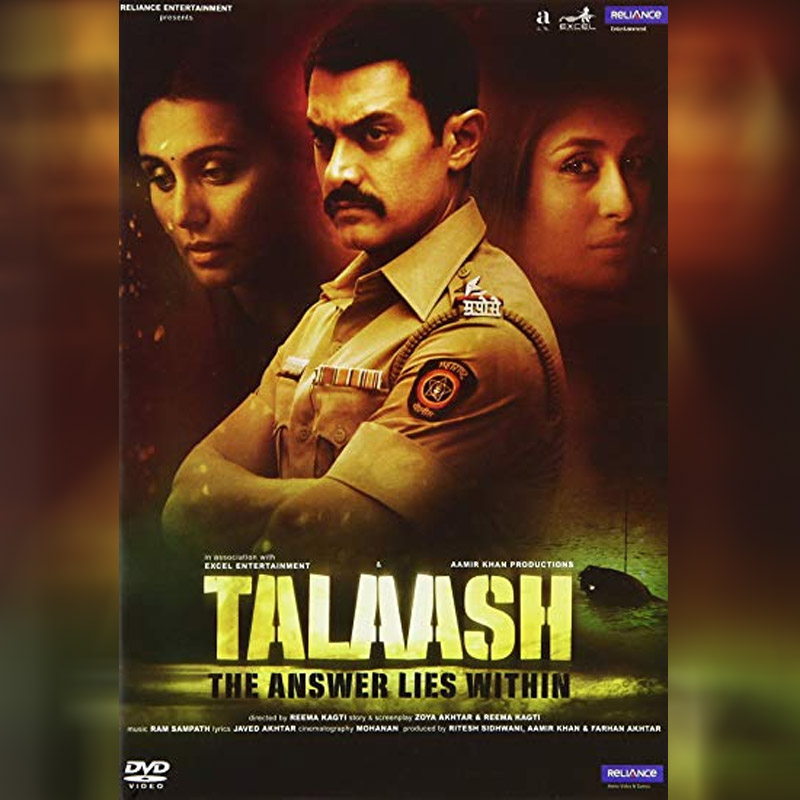
    MUMBAI: ‘I will come back to haunt you‘ must be the oldest phrase used in a relationship. It bears no logic but makes one wary. It is a supernatural shrap (curse). A lot of rumours have been spread about the ‘the end‘ of Talaash during its pre-release publicity; all suspected to be the makers‘ own PR gimmicks. But no gimmick is worth a cinema ticket costing 300 rupees. If gimmicks made money, why make films?

    Three young men go on a joyride, meet with an accident and dump the victim, who they presume is dead. Then the victim comes back to seek revenge! Whichever way you look at Talaash and whatever the efforts to ‘Indianise‘ it with supernatural and life-after-death angles, the ghost of ‘I Know What You Did Last Summer‘ haunts the film all through. Rest is all an exercise in convolution. The usual ‘inspirational‘ Hollywood films run for 100 minutes or less; so Talaash has a parallel story of Aamir Khan, and his spouse Rani Mukerji eternally pining for their son who died due to drowning. This helps stretch the film to 140 minutes. It is also the film‘s undoing.There is a lot of speculation about which foreign film has inspired Talaash. From the look of it, Talaash seems to have got its genes from the Hollywood film ‘I Know What You Did Last Summer‘, itself badly panned by media there but lapped up by moviegoers.

    Like any metro-oriented film, Talaash establishes its base city, Mumbai, in its title song. This is mainly the seedy side, the underbelly of the city, which includes the whores, the pimps, the nightlife and the violence. Then it goes on to establish its protagonists. This affirms that it is going to be a long-winded film.

    Three years after the joyride accident, a top film star dies in a freaky car accident on the same spot when his car swerves suddenly on an open road late one night and lands in the sea. Khan is a reputed encounter specialist but he is called in to investigate the accident since it involves a high-profile star. There are no evident clues and he is told that this is not the first time such an accident has happened at this spot. When not investigating the case, Khan, in tandem with his wife, Mukerji get into bouts of depression and brooding over their dead son. Khan thinks it was his fault but keeps punishing Mukerji by keeping away from her or avoiding communicating. He does not even want another child. Mukerji on her part is under psychiatric treatment until a neighbour, Shernaz Patel, acquaints her with a message from her dead son. "He wants to talk to his dada," she says.

    Being a mother, Mukerji tags along to communicate with her son through Patel. This leads to another flashpoint between the couple, Khan and Mukerji. Khan would rather have nothing to do with such mumbo jumbo.

    In the process of his investigations, Khan meets a prostitute, Kareena Kapoor, whose pimp was the last person to communicate with the dead film star. The pimp, who is suspected of blackmailing the star and who collected rupees 20 lakh from him just before the accident, is missing. Khan expects Kapoor to lead to him. Instead, she is only interested in leading him to a seedy hotel room with an invitation to make out!

    As some more bodies fall and some more red herrings are dropped, the film meanders on and on till it springs what the makers think is a surprise element. The mystery is solved the way it was created.

    Talaash is such a dry and insipid film that it becomes a drain on the viewer. It lags in almost all aspects. As the script is weak, the director never gets a grip on the film. Music is no help in the absence of romance. Farhan Akhtar‘s dialogue is generally mundane. His forte being wit, the film offers him no scope. Preferring to project the dark side of the metro, visually too the film provides no relief except, ironically, the accident site. The seafront location is pleasing to eye. And why choose red light area whores? Kapoor could very well have been a high class one and the film could have had some glamour and finesse! Khan has no historic moments and does nothing to satisfy his fans. Kapoor looks too glamorous for the kind of joint she works at. Mukerji, as a totally deglamourised housewife, does well. Among others, Nawazuddin Siddiqui shines. Patel, Raj Kumar Yadav, Suhasi Goradia and Subra Dutta lend fair support.

    Talaash is disappointing fare, for Khan fans as well as for box office prospects.