Tag: Raj Chengappa

  • South India drives growth, contributes one-third of GDP: Chengappa

    South India drives growth, contributes one-third of GDP: Chengappa

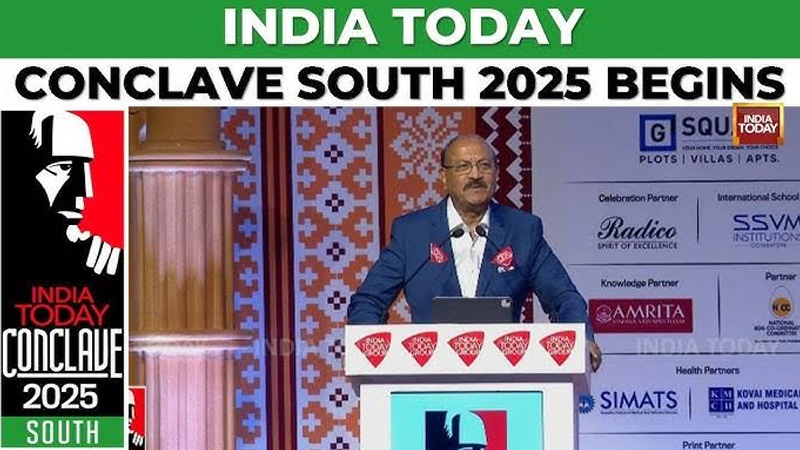
    MUMBAI: South India is the nation’s true economic powerhouse, declared India Today, group editorial director, Raj Chengappa, as he opened the India today conclave south 2025 in Coimbatore.

    In his welcome address, Chengappa noted that though the six southern states account for just 20 per cent of India’s population, they contribute nearly one-third of the country’s GDP. He called this unmatched productivity proof of the region’s economic dynamism, underscoring its pivotal role in shaping India’s growth story.

    Chengappa urged a change in perspective: South India should no longer be viewed as “down south” but as “up south,” reflecting its leadership across development, technology, governance, and culture.

    The two-day conclave, held on September 8–9 in Coimbatore, Tamil Nadu, brings together leading politicians, policy thinkers, entrepreneurs, cultural icons, and innovators. Under the theme ‘Ideas from the south, for the nation’, sessions will explore transformative forces shaping the region, from disruptive technologies and governance models to emerging economic opportunities and cultural identities.

    Over the years, the south conclave has become a premier platform for dialogue, sparking debates on governance, entrepreneurship, and technology. Building on this legacy, the 2025 edition aims to showcase how ideas from the south are increasingly aligned with national aspirations and how the region’s contributions are steering India’s socio-economic future.

  • Editors come out in support of NDTV

    MUMBAI: Editors of various reputed media organisations and well-known personalities yesterday came out in support of NDTV, the offices of which and residence of promoters were raided by CBI recently. The Press Club of India had organised a meet to protest against the attack on freedom of press.

    Senior journalist Rajdeep Sardesai said, “I believe in the present atmosphere, silence is not an option. This a moment when we have to be on the right side of history.”

    Senior journalist Kuldip Nayar said, “During the Emergency, nobody had to tell anybody what to do. Today, when we are facing more or less the same situation – not (to) that extent – all of us have to ensure we don’t allow anybody to muzzle free speech.”

    Senior journalist Raj Chengappa said: “Any attack or raid is a serious threat particularly if residences and offices are being raided in such a manner.”

    Senior journalist and former minister Arun Shourie said: “I have a couplet for Narendra Modi: He who was occupying this throne before you. He also had a similar belief that he was God. First they used incentives like ads, then a subterranean atmosphere of fear. Now, they are using a third instrument of overt pressure. They have made NDTV an example of that. Anybody who has tried to lay a hand on the press in India, has had their hand burnt. The CBI has not been able to answer the facts put out by NDTV. There is even an article on The Wire. The facts are irrefutable.”

    He added: “We have only three protections: our solidarity, the court, the protection of our own readers and viewers.”

    Former Rajya Sabha Member HK Dua said: “Last time, most of the press community did not stand up. They crawled, as (L.K) Advani famously said. Then came the defamation bill.
    We got together, it became a national movement. (Late prime minister) Rajiv Gandhi sought talks but we refused. The unity of the press won the battle. The bill had to be withdrawn as the people were against (it). Similar signs are visible now. Unless we are united, we can meet the same fate. This is a wake-up call, we have to be vigilant and cautious of such attacks.”

    Jurist Fali Nariman said: “Freedom after speech is what freedom of speech is all about.
    No one is immune from being prosecuted under a criminal offence, but the manner, circumstances give me reason to believe all of this is unjustified attack on press and media freedom. On 2nd of June, an FIR is lodged by the CBI — seven years after the event. Why it was not brought to light earlier was not mentioned earlier in the complaint. The CBI did not bother to find out. The first thing CBI is expected to do, once a such complaint is filed, is seek NDTV’s response. But that wasn’t done.”

    He added: “When any government agency files a complaint against a media company, it must first enquire from the owners what they have to say in the matter before conducting raids. This is not a matter of courtesy or favour, but a constitutional duty.”

    “Whenever there is a majoritarian government, there is this tendency. We must resist it,” he said.

    India Today group editor-in-chief Aroon Purie said: “I strongly believe the freedom of the media is inviolable in a democracy. Such a move also undermines basic tenets of free speech.”

    Senior journalist Shekhar Gupta: “This is an issue that concerns the mother of all our institutions – the free press. This is an assault on the free press. Social media got us all disoriented. I hope NDTV will continue to do what it is doing. Our job is to speak truth to power.”

    NDTV co-founder Dr Prannoy Roy said: Once I went to China, they asked me aren’t you a bit jealous of our skyscrapers? I said we have the best skyscraper: free speech. This is not just a flimsy case against NDTV. It is a signal to all of us: we can suppress you even if you haven’t done anything. Their message is: crawl, or we’ll come for you. I say: Stand up and they’ll never do.”

  • News Broadcasters Association expresses concern over NDTV raids

    MUMBAI: The News Broadcasters Association (NBA) has expressed its concern over the recent raids conducted by the Central Bureau of Investigation (CBI) on the residences of the promoters and office of NDTV, which is a long-standing member of the NBA.

    While the NBA maintained that no individual or institution is above the law, it condemns any attempt to muzzle the media and causing any interference in the free functioning of news operations. Such a move also undermines the basic tenets of free speech enshrined in the Constitution of India, an NBA statement issued NBA secretary-general Annie Joseph added.

    NBA hoped that CBI will not venture into concerted harassment of NDTV/its promoters, and must ensure fair and just investigation by adhering to equity, justice and good conscience.

    The Editors Guild of India had earlier expressed deep concern over the raids conducted by the Central Bureau of Investigation (CBI) on the offices of NDTV and its promoters on Monday. Entry of police and other agencies into the media offices is a serious matter, it added.

    NDTV had denied any wrongdoing and termed the raids as “stepping up the concerted harassment” of the news channel and an attempt to “undermine democracy and free speech” and “silence the media,” the release stated. While the Editors Guild maintains that no individual or institution is above the law, the Guild condemns any attempt to muzzle the media and calls upon the CBI to follow the due process of law and ensure there is no interference in the free functioning of news operations, the Guild release signed by office-bearers Raj Chengappa, Prakash Dube and Kalyani Shankar stated.

  • Editors Guild urges CBI to follow process of law, NDTV confirms loan repayment

    MUMBAI: The Editors Guild of India, in a press release issued on Monday night, expressed deep concern over the raids conducted by the Central Bureau of Investigation (CBI) on the offices of NDTV and its promoters today. Entry of police and other agencies into the media offices is a serious matter, it added.

    NDTV, in various statements, has denied any wrongdoing and termed the raids as “stepping up the concerted harassment” of the news channel and an attempt to “undermine democracy and free speech” and “silence the media,” the release stated. While the Editors Guild maintains that no individual or institution is above the law, the Guild condemns any attempt to muzzle the media and calls upon the CBI to follow the due process of law and ensure there is no interference in the free functioning of news operations, the Guild release signed by office-bearers Raj Chengappa, Prakash Dube and Kalyani Shankar stated.

    Updated NDTV statement: It is shocking that the CBI conducted searches on the NDTV offices and residence of the promoters without even conducting a preliminary enquiry. The CBI has been compelled to file an FIR based on a shoddy complaint by a disgruntled former consultant at NDTV named as Sanjay Dutt, who has been making false allegations. So far, he has not obtained a single order from any of these courts.

    Legal analysts are astounded that where courts have rejected giving any order in all these years, the CBI conducts raids based on what is a private complaint. The allegation appears to be for a loan which has been repaid by Prannoy Roy and Radhika Roy more than seven years ago.

    Even though crores of rupees of dues have not been paid by several industrialists and no criminal case has yet been registered against any of them by the CBI, the CBI has chosen not only to register an FIR, but also conduct a search for a loan which has been duly repaid to ICICI Bank. The allegation that no disclosure was made to SEBI and other regulatory authorities is not only incorrect but also does not clothe the CBI with any power to register cases and search which further amplifies the fact that the search by the CBI is only a witch-hunt against independent media.

  • Hoarded cash is flowing back into financial system, asserts Modi

    Hoarded cash is flowing back into financial system, asserts Modi

    MUMBAI: Economists, and not the government, had floated estimates that Rs 3 lakh crore black money was in circulation and would be extinguished as a result of demonetisation, the prime minister Narendra Modi said commenting on the dichotomy between the fact that almost 90 per cent of the demonetised currency returned to the banks and the perception that the above-stated figure of black money was in circulation.

    In his first interview after the 8 November demonetisation move, Modi has said that the exercise has achieved the goals it had set out, in an interview to India Today.

    In fact the government wanted the black money, which was “hoarded and kept out of the regular transactional economy, by people storing them in suitcases and cupboards or under the mattress” to flow back to the banking system. “This has left behind a permanent financial trail. This changes the game as the black money that did not have an address till now, has been tagged with one.”

    Modi has said that the exercise has achieved the goals it had set out—to attack corruption, black money, counterfeit notes, financing of terrorism and other activities threatening national security. “Decisive outcomes are clearly visible on all these fronts,” said the prime minister in an exclusive interaction with Raj Chengappa.

    “I was well aware of the magnitude and complexity of the challenge we faced in implementation. And I believe we have lived up to the same. It is no small thing that no significant incident of unrest has taken place in the country.”

    The prime minister defended frequent and multiple changes in the notifications regarding the implementation of demonetisation saying that there was a distinction between the government’s Niti (policy) and Ran-niti (execution strategy and tactics) and the two must not be put in the same basket. “The decision of demonetisation which reflects our Niti,is unequivocally clear, unwavering and categorical. Our Ran-niti however, needed to be different, aptly summarized by the age old saying of Tu Daal-Daal, Main Paat-Paat.”

    Modi also came candid about the rationale and timing of this historic yet controversial decision to render nearly 86 per cent of the country’s currency invalid. “We took the decision not for some short-term windfall gain, but for a long-term structural transformation. Our objective was to clean our economy and society of the menace of black money, purging the distrust, artificial pressures and other ills that came with it,” he said.

    Quoting global economists such as James Henry, Kenneth Rogoff and Larry Summers and recommendations of the 1971 Wanchoo Committee, the prime minister averred that the decision to demonetise high value currencies was taken 40 years late. “This step was in fact a critical crisis avoidance measure, as, if we had delayed it any further, the problem and its corresponding correction would have magnified exponentially in size and complexity,” he said.

    Countering the criticism that such a move was unwarranted when the economy was in good shape Modi said that the timing of it was a matter of common sense. “If India’s economy was weak, this decision could not have been made. It was consciously taken when the economy is in good shape, as such a sharp correction could have only been made then to fortify its foundations and give it a further boost.”

    The prime minister also sought to allay fears that country was staring at a cash crisis, which was unlikely to end, even after 30 December deadline. “Regarding printing of notes, the planning and strategy was based on India’s usage and requirements of currency. Very few people know that as per RBI’s evaluation, a substantial part of the Rs 1,000 and Rs 500 notes printed never make it into everyday circulation, and are instead hoarded and stocked away. Furthermore, the common man now has access to a wide variety of alternate digital payment mechanisms ranging from Rupay cards to online wallets and USSD payments,” he said.

    Modi also dismissed the Opposition’s allegation that the decision was a political move keeping an eye on the Assembly election in Uttar Pradesh. “On one hand they say I took this decision for political dividend, and on the other they say the people have been troubled and are deeply unhappy. How can the two go together?”

    The prime minister indicated that the government would carry forward tax reforms reducing the scope of discretion for income tax department officials. “The Revenue Department is already building a system where the entire process of assessment is done on-line without any need for the assesse to appear before the officer… selection of cases for scrutiny will be based on objective evidence rather than the whims and fancies of officers. The aim is to ensure that the honest tax-payer is not harassed or inconvenienced, while the tax-evader is efficiently caught and punished.”

    As the BJP-led NDA government has completed half of its five-year tenure, Modi envisaged his vision for India: “An India where the farmer is happy, the trader is prosperous, every woman is empowered and the youth gainfully employed. An India where every family has a house, and every household has access to the basic amenities of electricity, water and a toilet. An India which is Swachh from all forms of filth.”

  • Hoarded cash is flowing back into financial system, asserts Modi

    Hoarded cash is flowing back into financial system, asserts Modi

    MUMBAI: Economists, and not the government, had floated estimates that Rs 3 lakh crore black money was in circulation and would be extinguished as a result of demonetisation, the prime minister Narendra Modi said commenting on the dichotomy between the fact that almost 90 per cent of the demonetised currency returned to the banks and the perception that the above-stated figure of black money was in circulation.

    In his first interview after the 8 November demonetisation move, Modi has said that the exercise has achieved the goals it had set out, in an interview to India Today.

    In fact the government wanted the black money, which was “hoarded and kept out of the regular transactional economy, by people storing them in suitcases and cupboards or under the mattress” to flow back to the banking system. “This has left behind a permanent financial trail. This changes the game as the black money that did not have an address till now, has been tagged with one.”

    Modi has said that the exercise has achieved the goals it had set out—to attack corruption, black money, counterfeit notes, financing of terrorism and other activities threatening national security. “Decisive outcomes are clearly visible on all these fronts,” said the prime minister in an exclusive interaction with Raj Chengappa.

    “I was well aware of the magnitude and complexity of the challenge we faced in implementation. And I believe we have lived up to the same. It is no small thing that no significant incident of unrest has taken place in the country.”

    The prime minister defended frequent and multiple changes in the notifications regarding the implementation of demonetisation saying that there was a distinction between the government’s Niti (policy) and Ran-niti (execution strategy and tactics) and the two must not be put in the same basket. “The decision of demonetisation which reflects our Niti,is unequivocally clear, unwavering and categorical. Our Ran-niti however, needed to be different, aptly summarized by the age old saying of Tu Daal-Daal, Main Paat-Paat.”

    Modi also came candid about the rationale and timing of this historic yet controversial decision to render nearly 86 per cent of the country’s currency invalid. “We took the decision not for some short-term windfall gain, but for a long-term structural transformation. Our objective was to clean our economy and society of the menace of black money, purging the distrust, artificial pressures and other ills that came with it,” he said.

    Quoting global economists such as James Henry, Kenneth Rogoff and Larry Summers and recommendations of the 1971 Wanchoo Committee, the prime minister averred that the decision to demonetise high value currencies was taken 40 years late. “This step was in fact a critical crisis avoidance measure, as, if we had delayed it any further, the problem and its corresponding correction would have magnified exponentially in size and complexity,” he said.

    Countering the criticism that such a move was unwarranted when the economy was in good shape Modi said that the timing of it was a matter of common sense. “If India’s economy was weak, this decision could not have been made. It was consciously taken when the economy is in good shape, as such a sharp correction could have only been made then to fortify its foundations and give it a further boost.”

    The prime minister also sought to allay fears that country was staring at a cash crisis, which was unlikely to end, even after 30 December deadline. “Regarding printing of notes, the planning and strategy was based on India’s usage and requirements of currency. Very few people know that as per RBI’s evaluation, a substantial part of the Rs 1,000 and Rs 500 notes printed never make it into everyday circulation, and are instead hoarded and stocked away. Furthermore, the common man now has access to a wide variety of alternate digital payment mechanisms ranging from Rupay cards to online wallets and USSD payments,” he said.

    Modi also dismissed the Opposition’s allegation that the decision was a political move keeping an eye on the Assembly election in Uttar Pradesh. “On one hand they say I took this decision for political dividend, and on the other they say the people have been troubled and are deeply unhappy. How can the two go together?”

    The prime minister indicated that the government would carry forward tax reforms reducing the scope of discretion for income tax department officials. “The Revenue Department is already building a system where the entire process of assessment is done on-line without any need for the assesse to appear before the officer… selection of cases for scrutiny will be based on objective evidence rather than the whims and fancies of officers. The aim is to ensure that the honest tax-payer is not harassed or inconvenienced, while the tax-evader is efficiently caught and punished.”

    As the BJP-led NDA government has completed half of its five-year tenure, Modi envisaged his vision for India: “An India where the farmer is happy, the trader is prosperous, every woman is empowered and the youth gainfully employed. An India where every family has a house, and every household has access to the basic amenities of electricity, water and a toilet. An India which is Swachh from all forms of filth.”