Tag: Rahul Gandhi

  • ABP News-CVoter Poll: Modi Govt likely to return in 2024, South presents NDA challenge

    ABP News-CVoter Poll: Modi Govt likely to return in 2024, South presents NDA challenge

    Mumbai: The first opinion poll conducted by ABP News and CVoter before the 2024 Lok Sabha elections has thrown up interesting insights, bringing to light the public sentiment across the country on a range of issues, besides the choice of party and the prime minister post.

    According to the survey, the ABP News-CVoter opinion poll has predicted a third term for the NDA, with the ruling alliance getting 295-335 seats out of the total 543. The Congress, together with the opposition bloc I.N.D.I.A, is projected to get 165-205 seats, with Others settling for 35-65 seats. Zone-wise projections show BJP/NDA bagging 80-90 seats out of 153 in the East Zone, the highest 150-160 seats out of 180 in the North Zone, 45-55 out of 78 in the West Zone, and 20-30 out of 132 in the South Zone. The South is the only zone where the BJP/NDA is behind, with the Congress/I.N.D.I.A projected to win 70-80 seats. In the other three zones, the INC/I.N.D.I.A is projected to get 50-60, 20-30, and 25-35 in the East, North, and West, respectively.

    In the states too, the NDA appears to be comfortably ahead, according to the ABP News-CVoter opinion poll, with all BJP-ruled states, such as Madhya Pradesh (27-29), Chhattisgarh (9-11), Rajasthan (23-25), and Uttar Pradesh (73-75), looking to vote for NDA candidates. In Congress-ruled Karnataka too, the BJP is projected to win 22-24 seats with a vote share of 52 per cent against the Congress’ 4-6 seats and 43 per cent vote share. In MP, Chhattisgarh and Rajasthan, the Opposition alliance is projected to get only 0-2 seats each.

    The states where the Congress and I.N.D.I.A are ahead are – Telangana (9-11), Punjab (INC 5-7, AAP 4-6), Bihar (21-23) and Maharashtra (26-28). In West Bengal, where the I.N.D.I.A seat share will be a matter of debate, ruling Trinamool Congress could get 23-25 seats and INC+Left- 0-2, against the BJP’s 16-18, if the elections are held now.

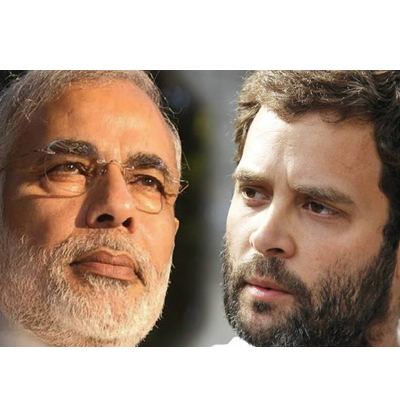
    ABP News-CVoter also carried out a snap poll during which it asked total of 13,115 respondents across the 543 Lok Sabha constituencies a range of questions and found interesting responses. According to the snap poll, PM Narendra Modi is overwhelmingly ahead as the country’s choice for the top post, with 58.6 per cent people willing to bring him back for a third term. Given only two candidates to choose from, Rahul Gandhi and Narendra Modi, a majority of the respondents picked the latter. Gandhi was, however, ahead in the race in three states and one UT and lagged with a margin of around 10 percentage points in two states (Telangana and Haryana). The southern states of Kerala and Tamil Nadu, besides Punjab in the north, kept the Congress leader ahead of Modi. Overall, Rahul Gandhi drew 32% votes for the PM post, with 4.4 per cent and five per cent respondents, respectively, picking ‘None of them’ and ‘Can’t say’ as their answer.

    On the question of how satisfied people are/were with the work of the current Prime Minister, a total of 47.2 per cent of people across India said they were “very much satisfied” with PM Narendra Modi’s work, while 30.2 per cent said they were “satisfied to some extent” and 21.3 per cent said they were “not at all satisfied”.

    An overwhelming majority answered in the affirmative when asked if the leadership changes made by BJP in Madhya Pradesh, Rajasthan and Chhattisgarh after registering victory in the recent assembly elections will benefit the party in 2024. In contrast, the response was mixed to a similar question posed in reference to the leadership changes made by Congress.

    Further, people across states (from both rural or urban areas) and groups think unemployment will be the main issue in the 2024 Lok Sabha elections, and a majority of them believe the issue of caste census won’t help the Opposition. A majority of people also think the BJP should form an alliance with the JD(S) in Karnataka, and that the party will give a tough fight to the Trinamool Congress in West Bengal.

    On questions related to Rahul Gandhi, the response was mixed when asked if his Bharat Jodo Yatra will help the Congress in LS polls, but more than 50 per cent of people on average said he, as Priyanka Gandhi Vadra, should contest the election from Uttar Pradesh. Rahul Gandhi wins hands down as the most preferred PM candidate from the I.N.D.I.A bloc. The respondents were given Nitish Kumar, Mamata Banerjee and Arvind Kejriwal as other options to choose from.

    The ABP News-CVoter opinion poll also found that a majority of the respondents think I.N.D.I.A. will not remain united till the 2024 elections. Also, 37.6 per cent people said they were “very much satisfied” with the work of the Central government led by BJP.

    To a question about what they think about “today’s India”, 45.1 per cent people said they found the country moving forward and their life too, while 25.3 per cent said the country is moving forward but not their life, and 22.4% said both the country and their life are in a poor state.

    Methodology:

    The survey findings and projections are based on CVoter Opinion Poll CATI interviews (Computer Assisted Telephone Interviewing) conducted among 18+ adults statewide, all confirmed voters.

    Survey date: 15 December to 21 December, 2023
    Sample size – 13,115
    Seats Covered 543
    Margin Of Error: .+_/_- 5% 
    Confidence Level: 95%

  • Sometimes people reveal their true position by mistake’: S. Jaishankar on Rahul Gandhi’s praise for China’s BRI

    Sometimes people reveal their true position by mistake’: S. Jaishankar on Rahul Gandhi’s praise for China’s BRI

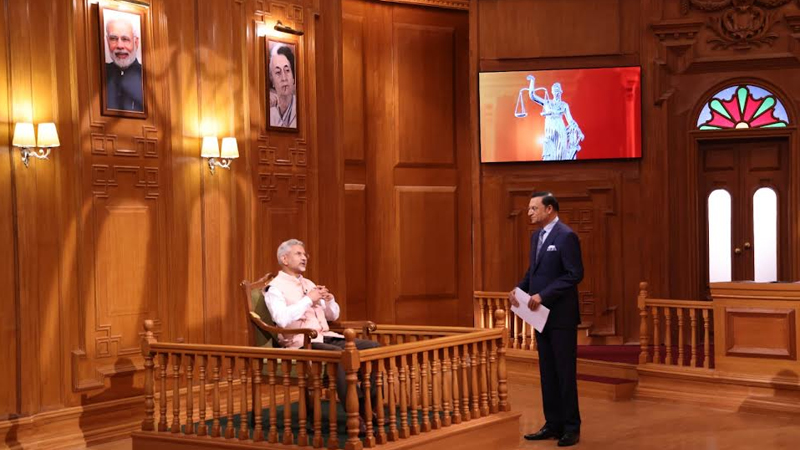
    Mumbai: Union external affairs minister S. Jaishankar in the upcoming episode of ‘Aap Ki Adalat’ took a swipe at Congress leader Rahul Gandhi for praising China for the Belt and Road (BRI) initiatives in Brussels while the G20 summit was being held in India. In a candid conversation with India TV chairperson and editor-in-chief Rajat Sharma, S. Jaishankar said ‘sometimes people reveal their true position by mistake’.

    S. Jaishankar, who will appear on the show this Saturday, a week after the successful G20 Summit, said that the timing of the comment was unfortunate. Replying to Gandhi’s urge for an ‘alternate vision’ to China’s coercive production model, Jaishankar says, “Look at the timing. India is organising the greatest event in history, where we should all come together and appreciate it, yet at that time, he is going out and condemning the country.”

    “Sometimes people reveal their true positions by mistake. Like when he praised the Belt and Road Initiative (BRI) when it passes through the Pakistan-occupied Kashmir (PoK). However, he refrained from stating that it infringes India’s sovereignty and territorial integrity,” he added.

    Speaking about the Pakistan-occupied Kashmir, he stated that PoK is an integral part of India and will remain so. He added that, “We have inherited the problem of Pakistan-occupied Kashmir” and it is difficult to say what will happen in the future. The former foreign secretary turned politician, also shared some inside details of the G20 summit and how India successfully gained consensus on the G20 Delhi declaration. Additionally, he explained how it would help the world at large and open doors of new opportunities.

    Renowned for his articulate and strategic communication skills in the world of international relations, EAM Jaishankar also touched upon several topics of international importance.

    In Rajat Sharma’s headline-making program ‘Aap Ki Adalat’, he spoke about Pakistan-occupied Kashmir (PoK), India’s ties with China, the rising Khalistan movement in Canada and India’s United Nations Security Council (UNSC) permanent membership.

    The union minister also shared his journey from a diplomat to a cabinet minister. This episode of the ‘Aap Ki Adalat’ will be aired on India TV on Saturday at 10 PM and repeated on Sunday at 10 AM and 10 PM.

  • ‘Enormous opportunity’: Brands upbeat about TV advertising in 2021

    ‘Enormous opportunity’: Brands upbeat about TV advertising in 2021

    MUMBAI: It would be safe to conclude from the BARC TV Universe 2020 figures that television remains our favourite form of video entertainment across India. The report, which showed that the number of TV viewers had gone up by more than 50 million to 892 million in the last couple of years, highlights how the power of television and consequently, television advertising remains steadfast and there’s nothing to halt its run! Little wonder then that advertisers are ready to bet big bucks on this old-fashioned medium. As these growing numbers prove, the ‘idiot box’ has proven remarkably resilient in an era of immense disruption, despite the threat of pandemic and emergence of new SVoD platforms.

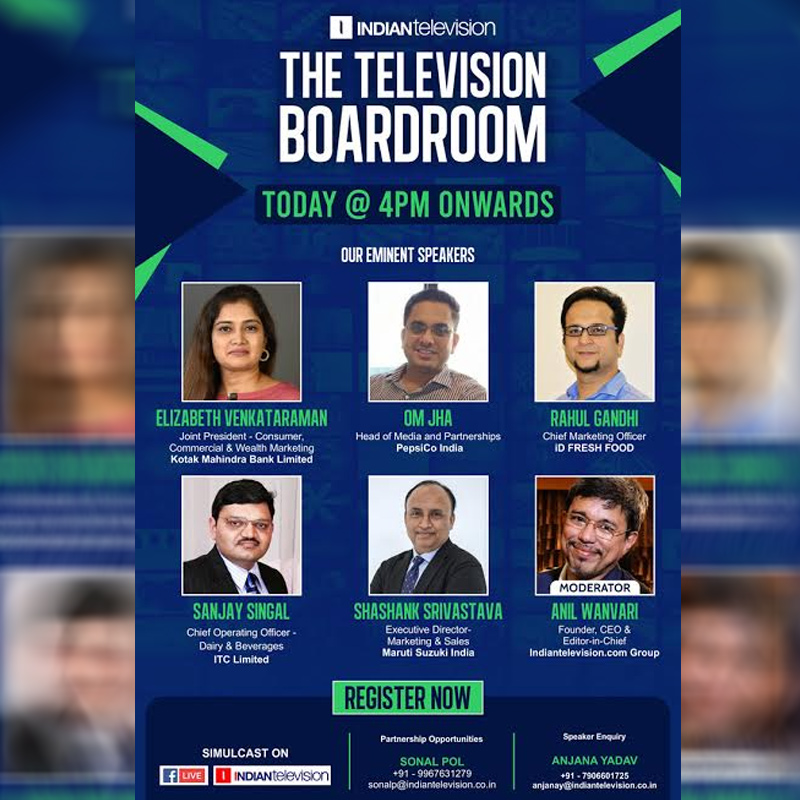
    At the virtual panel discussion The Television Boardroom- organised by Indiantelevision.com Friday, brands across sectors ranging from F&B to automobiles spoke about the whys and hows of TV still taking the biggest slice of the advertising pie. The panel, moderated by Indiantelevision.com's Anil Wanvari  comprised Kotak Mahindra Bank’s Elizabeth Venkataraman, PepsiCo India’s Om Jha, id Fresh Food’s Rahul Gandhi, ITC’s Sanjay Singal and Maruti Suzuki India’s Shashank Srivastava. 

    Brands buoyant about 2021

    While the uncertainty and turmoil caused by the pandemic leading to a virtual halt of film and television shoots in the country was a dampener, marketers remained optimistic about prospects of advertising on television, especially as compared to 2020. The panel tried to explore the mindsets of the TV-viewing consumers and also shared what their expectations from the medium are.

    Kotak’s Venkataraman made note of the unusual consumer viewing behaviour in the year gone by, which needed to be watched carefully to learn whether it sustains going ahead, as we come out of the pandemic. So while all agreed that TV viewership will be higher than 2019, there was a doubt on whether the levels that we see now would continue going ahead, with lockdowns being phased out and work and life calling.

    Srivastava shared his data on projections for TV ad spend in 2021 which are 12 to 13 percent higher than previous year’s. Overall hope and optimism from this year was that it will not be an out and out disruptive year like the year before. With expectations from vaccination drives and/ or herd immunity impact, the world is expected to settle in by mid-2022. Consequently, both viewership and marketer’s spending should improve this year on, was the general opinion.

    Role of branded content & impactful advertising

    Discussions also revolved around the roles branded content and impactful advertising can play in upping the television adex game. ITC’s Singhal spoke about its tie-up with Star during the pandemic called ITC Masterchef, which had insights from five star hotel chefs on how to cook up five-star-like fare, using ingredients already available in one’s kitchen. This got a lot of mileage, so there is definitely a space for branded content, but the need has to be there first, or it could fall flat, he felt.

    TV advertising consists of very short formats of 30-odd-seconds slots, hence to convey a larger picture of what the brand wants to talk about, branded content could help weave a brand story within the content very subtly so that the brand appears organically to the viewer. Brand integration can make it more relatable, without making it look like marketing -oriented.

    Brand association, integration and branded content gives one extra arsenal to marketers to push your product and gain brand recall, while telling the story of the brand, Srivastava said.

    However, contextual or relevance value along with understanding consumer’s needs is crucial for branded content to succeed. So, while TV offers the opportunity, for a brand to make it work is the challenge. That fear needs to be addressed for investment to come in this area. The impact also needs to be felt in numbers for it to be feasible.

    TV stands out for marketers with its impact and reach, and with third party organisations like BARC doing the measurement for the brand on TV modelling analytical capability on television has evolved to a different level. All the impactful advertising in IPL is a case in point – brands associated with IPL 2020 have become household names. Srivastava cited the IPL viewership touching a high of 400 billion viewing minutes in 2020. “There is no debate on the glory and size of TV advertising’s impact” stated Kotak’s Elizabeth.

    Alongside hard data it is also heavily intuitive, while being dependent on the brand objective. Hence there is also a role for a marketer’s gut instinct alongside the measurable impact was agreed overall.

    On looking at sports content beyond cricket

    Nothing beats or even comes close to cricket when it comes to sports in India is unanimously accepted. For television or brands to pick a sport and develop it, the nation must first adopt that sport, opined Jha. He cited instances to prove his point. Sony has been broadcasting football leagues for ages, while Star did a fantastic job with pro-kabaddi but the viewership is nowhere comparable to that of cricket.

    Panelists concurred that brands have been shy of investing in other sports for the same reason, unless it’s a niche region. There were hopes from Football and Kabaddi in this context. Maruti Suzuki is eyeing football as the next massy sport to look forward to in TV advertising, Srivastava shared. Venkataraman deemed Kabaddi as a local sport and also showed promise. There was a feeling that building up hype and hoopla around a sport league could help the sport, as transpired with kabaddi.

    All said and done, TV remains the best pick for a marketer today in India for ROI. And while it may not always be cheap, it is cost efficient for the kind of scale and resilience that the medium offers.

    Also, with television reinventing itself by evolving into smart TVs, which can be connected to the home Wi-Fi or an Amazon firestick, it will continue to remain relevant to consumers and the viewership can only grow from here. And with 90 million households yet to own a TV set in India, according to BARC data, that indicates enormous opportunity for brands in times to come.

  • Why TV remains the preferred mode of advertising for brands

    Why TV remains the preferred mode of advertising for brands

    MUMBAI: Cord-cutting may be a thing in the west, but in India, television still rules the roost when it comes to at-home entertainment. Consequently, there’s a tremendous amount of money spent on TV content and advertising on the medium. However, the Covid2019 pandemic altered this TV-centric state of affairs; now, with changing world scenarios and consumer behaviour, we have already seen and can expect further shifts in the way viewers and advertisers interact with content on TV. 

    Indiantelevision.com organised The Television Boardroom- a virtual panel discussion that explored how to fully understand TV audiences as well as the brand journey through TV today.

    The panel comprised esteemed representatives from the industry – Kotak Mahindra Bank joint president-consumer, commercial & wealth marketing Elizabeth Venkataraman, PepsiCo India head media and partnerships Om Jha, id Fresh Food chief marketing officer Rahul Gandhi, ITC chief operating officer- dairy and beverages Sanjay Singal, Maruti Suzuki India executive director – marketing and sales Shashank Srivastava and Indiantelevision.com's founder, CEO and editor-in-chief Anil Wanvari presided over the session.

    Why TV takes biggest slice of brands’ adex pie

    Maruti Suzuki’s Srivastava took the discussion ahead, sharing the company’s advertising spend – the auto-maker blows 40 per cent of its budget majorly on print, television is a close second at 30 percent and digital is at 25 per cent with the balance being split by radio, OOH and cinema.

    “We are using TV at the top end of the funnel for the reach, brand awareness and brand salience KPIs. Clearly television stands out as a huge medium of importance when it comes to these points,” he added.

    The executive director also shared how the growth in TV audience has been all-encompassing – not just in rural but also urban regions. Citing the example of how e-commerce giant Amazon was the third largest spender in advertising on TV in 2017-18 in India, he asserted that India is proving to be different from other countries when it came to the reach of television.

    Id’s Rahul Gandhi spoke about how the rhetoric question of ‘Who even watches TV?’ should be done away with because “out of the 133-crore people in India a sizeable 100 crore use TV as their primary source of entertainment still”. Thus, “there are many Indias within India with different indicators, which could come as a shock to the naysayers.”

    Also, with television reinventing itself by evolving into Smart TVs, which can be connected to the home wifi or an amazon firestick, it will continue to remain relevant to consumers and the viewership can only grow from here, was Gandhi’s opinion.

    Pepsi’s Jha agreed that “TV remains indispensable to not only consumers but also to marketers” who wish to leverage their brand’s advertising. A large part of marketing that happens in India is centred around TV, for most of the brands and product categories. Speaking about the soft drink brand, Jha said they cater to both spectrums of consumers- from the lowest socio-economic strata to the deepest pockets of our society. And television helps them to reach the last mile of this wide-ranging audience from the two ends of the spectrum. Hence the bulk of the beverage company’s spends would remain in television, he said.

    Where would a brand prefer to advertise on TV

    Recently released BARC stats have shown an upward mobility in TV viewing. The panel theorised that the pandemic seems to have increased the value consciousness of the average Indian. Jha pointed out that “if one had to communicate with 90 per cent of the audience in this country” you will have to go to a mass-heavy medium like television. And that this will only further improve with improving affluence of societies in lower GDP markets like Jharkhand, Bihar and Orissa – which presents a great opportunity for brands like Pepsi for which these are untapped markets.

    Even when it came to high value items like automobiles, Srivastava said that they still prefer television for more strategic brand building, launch and reaching even the interior vernacular regions, while print would be for tactical and lower end of the funnel. All agreed that these stats are highly encouraging, even for high value products. As, not only have the numbers but also the viewing time has spiked.

    “Which is a big vindication of the automaker’s investment of 300 crores currently in television- of which GEC takes up 100-120 crores,” Shashank shared, referring to the IPL viewership touching a high of 400 billion viewing minutes.

    Kotak’s Venkataraman made note of the unusual consumer viewing behaviour in the year gone by, which needed to be watched carefully to learn whether it sustains going ahead, as we come out of the pandemic. So while all agreed, TV viewership will be higher than 2019, but it will probably not remain at the levels that we see now.

    Perspective on TV advertising in 2021

    The jury is out on how many more covid waves the world has to contend with, before it can settle back into pre-Covid “normalcy”. It is apparent we need to learn to manage the waves, while learning to live with it without letting economic activity come to a complete standstill.

    The outlook for 2021 is more optimistic, that it will be more like 2019 rather than the previous year. Herd immunity or vaccination impact also bodes well for settling in by mid-2022. So both viewership and marketer’s spending should improve this year on, was the general opinion.

    “Projections for spending on TV adverts this year is 12 to 13 percent higher than previously,” Srivastava shared. There was overall hope and optimism from 2021 that it will not be an out and out disruptive year like the year before.

  • How brands view television advertising in 2021

    How brands view television advertising in 2021

    New Delhi: Television has been one of the most resilient and strongest mediums of communication, especially in India. Unlike other countries, where an increasing number of people are cutting the cord with pay-TV, India’s reach in television is only growing. Around 210 million households in India now own a TV set, an increase of 6.9 per cent from 197 million in 2018, according to the latest estimates released by TV monitoring agency Broadcast Audience Research Council (BARC) on Thursday.

    But the fast adoption of video streaming services has no doubt changed the dynamics of advertising on television. So, what are the factors that brands now take into consideration when they choose to advertise on general entertainment channels? Does the content matter or is it just the reach? What is the perspective on sports content? Other than cricket what sports content are brands looking at?

    Some of these questions will take centre stage at The Television Boardroom- a virtual panel discussion being organised by Indiantelevision.com at 4 pm on Friday, where some leading brands and advertisers will talk about the different genres of television (movies, infotainment, GEC, news, kids) and their thoughts on them. The event will explore various issues related to the future of television and how the expectations of advertisers from TV have evolved over the years.

    The panel will comprise esteemed representatives from the industry – Kotak Mahindra Bank joint president-consumer, commercial & wealth marketing Elizabeth Venkataraman, PepsiCo India head media and partnerships Om Jha, id Fresh Food chief marketing officer Rahul Gandhi, ITC chief operating officer- dairy and beverages Sanjay Singal, Maruti Suzuki India executive director – marketing and sales Shashank Srivastava and Indiantelevision.com's founder, CEO and editor-in-chief Anil Wanvari.

    The event will be streamed LIVE on the social media platforms of Indiantelevision.com. To join us for stimulating conversations and interesting insights on the issue, register at https://www.indiantelevision.com/television-boardroom/login-system/registration.php

  • Gujarat elections boost news channel ratings as Republic continues to lead English News

    Gujarat elections boost news channel ratings as Republic continues to lead English News

    BENGALURU: Rahul Gandhi’s shenanigans and Narendra Modi’s sudden and unexpected belligerence at rallies leading up to the Gujarat state assembly elections have resulted in bolstering sagging news viewership, especially for the English news genre. According to Broadcast Audience Research Council of India (BARC) data for week 49 of 2017 (Saturday, 2 December 2017 to Friday, 8 December 2017), combined ratings of the top-five English news channels (All India (U+R): NCCS AB : Males 22+ Individuals) increased by 12 percent as compared with the previous week.

     While the two politicians put on a spectacle for the viewers, it was the second-ranked Times Now that gained the most–both in terms of viewership as well as percentage of increase in viewership. The channel gained 0.138 million impressions and 22.2 percent increase in percentage of viewership growth during week 49 as compared to week 48 of 2019. However, this was not enough to beat its bête noire and displacer at the top spot–the Arnab Goswami-led Republic TV. Times Now was ranked second during the week under review (week 49 of 2017) with 0.759 million weekly impressions as compared to the genre leader Republic TV’s 0.819 million weekly impressions. Republic TV gained 0.11 million weekly impressions in week 49 and grew by 15.5 percent as against the previous week.

    At third was India Today Television in week 49 of 2017 with 0.339 million weekly impressions–the channel witnessed growth of 0.045 million weekly impressions, or 15.3 percent. Following India Today Television was CNN News 18 at fourth place with 0.233 million weekly impressions. CNN News 18 jumped a rank from the previous week’s fifth place with a gain of 4,000 impressions or 1.7 percent as compared to the previous week. Slipping a rank from the previous week’s fourth to fifth and losing 0.044 million impressions (losing 16.7 percent) was the Prannoy and Radhika Roy-led NDTV 24×7.

    Hindi News

    Hindi news channels also witnessed growth in ratings–the combined ratings of the top-five Hindi news channels-HSM (U+R): NCCS All : 15+ Individuals-grew by 6.6 percent in week 49 of 2017 as compared with week 48. All the channels in week 49 retained their week 48 rankings during the latest week. As expected, the biggest gainer during the week under review in terms of number of impressions as well as growth percentage was the genre leader Aaj Tak with a gain of 12.045 million impressions and growth of 11.1 percent. Aaj Tak recorded 120.442 million weekly impressions during week 49.

    At second place in the Hindi News genre in week 49 of 2017 was Zee News with 95.018 million weekly impressions. The Essel group’s premier Hindi News channel gained 5.110 million weekly impressions and viewership growth of 5.7 percent in week 49 as compared to week 48. India TV with 94.135 million weekly impressions was ranked third – the channel had gained 4.568 million weekly impressions and grown by 5.1 percent in week 49 as compared to week 48.

    At fourth rank in week 49 of 2017 was ABP News with 91.065 million weekly impressions. ABP News which recorded a gain of 2.6 percent and 2.288 million weekly impressions Completing the top five Hindi News channels quintet was News 18 India with 86.576 million impressions. News 18 India gained 6.269 million weekly impressions and its viewership grew by 7.8 percent in week 49 of 2017 as compared to week 48.

    Also read:

    MIB bumps up TV channel processing fee

    Hindi news channels alter programming for Gujarat elections

    Sun TV’s unassailable lead continues, while Zee TV leads Hindi across genre


  • Shah predicts bigger majority for Modi in ’19: India TV conclave

    MUMBAI: If the super-charged atmosphere, excitement, interactivity & the supreme participation is to be believed, India TV’s full-day mega conclave Samvaad seems to have again hit the right chord with the audience, even with its second edition.

    The who’s who from the corridors of power were seen participating passionately at the daylong Conclave held to analyse the three years of Narendra Modi’s government. Leading the pack was BJP president Amit Shah, fresh from his poll victories in UP, Uttarakhand, BMC and MCD elections. Shah went on to predict that even if the entire opposition united, the NDA led by Modi will secure a bigger majority in the 2019 Lok Sabha elections.

    Another headline came from Home Minister Rajnath Singh who hinted at the imminent possibility of another ‘surgical strike’. Surface transport minister Nitin Gadkari outlined his ambitious new projects. Textile minister Smriti Irani said that she would love to have a live debate with her Amethi rival Rahul Gandhi, while the law minister Ravi Shankar Prasad spoke of his government’s opinion of ‘triple talaq.’

    The afternoon session delved deep into the controversial issues, including a fiery debate on Ayodhya dispute, featuring MIM chief Asaduddin Owaisi and BJP leader Dr Subramanian Swamy and the Kashmir issue with pro-separatist lawyer Shabnam Lone crossing swords with J&K Deputy CM Nirmal Singh and Congress leader Manish Tewari.

    India TV editor-in-chief Rajat Sharma, along with channel’s leading anchors, grilled the illustrious participants including political heavyweights from the opposition benches.

    In his welcome address, India TV chairman Rajat Sharma outlined the highs & lows of the ruling regime, people’s expectations etc. while also drawing attention towards the charges made by the opposition, as he set the ball rolling for the day.

    MD & CEO Ritu Dhawan on India TV delivering yet another hugely successful Event said, “We are immensely pleasured by the type of unparalleled participation we manage to get for our initiatives.”

    “Not only does an effort like this touches the audiences in the best of the ways, this gets multiplied with the scale of the differentiated sets we specially create. This eventually becomes an intellectual and a visual treat for our audience,” she added.

  • “The journalism I follow is journalism of opinion:” Arnab Goswami

    “The journalism I follow is journalism of opinion:” Arnab Goswami

    GOA: The second day of the 10th edition of Goafest started with a zealous key note from Times Now editorial director and editor-in-chief Arnab Goswami.


    Seconding the image that he’s built with his different mode of journalism, Goswami said, “The formula of stating an opinion as a journalist is wrong is not true and my presence here today proves that. The journalism I follow is journalism of opinion and is not PR driven. If my opinion helps bringing about a change, I will opine and not shy behind the wall of neutrality. When you know there is something wrong, you don’t need to be neutral. When the facts prove something, you don’t need to be neutral.”


    A tad different in his approach to journalism when compared to his peers, Goswami has oft been accused of promoting sensationalism, being over the top loud and what not. In his keynote, the senior journalist addressed some of the accusations that have been levied on him time and again. They are as follows:


    Sensationalism: “I know I am accused of sensationalism. Let us go back to the initial stages of Times Now… a small kid was lying at the bottom of a 60 feet deep bore well. We covered it with supreme priority for three continuous days till the kid was rescued alive. We did it because a poor kid was always neglected. Had it been a politician’s or a celebrity’s child, the treatment would have been different. It is because of the OB Vans that the small kid’s life became a national issue and everyone was praying for the kid. We were accused of sensationalism after the coverage, but our coverage then ensured that no such bore well is left unfilled now, which saves small kids from facing the trauma that Prince went through and hence I am proud of sensationalizing, and if it does good to the people of India we will keep doing it.”


    Getting Too Involved in the Story: “I know I am accused of getting too involved in a story, which eventually ends up with me taking sides and compromising neutrality. In 2011, we got to know about a small accounting error from a group of Indians on British soil. We analysed the facts and the story was on air. Early next morning, young journalists came running to me and said: ‘Sir, Kalmadi is responding to our story.’ A small report shaking a person of Kalmadi’s magnitude was not normal. I got thousands of calls and one of them was from a person I love – the late Vinod Mehta. He told me: ‘What did you do? Why is everyone so anti-Arnab because of one report? There is something beyond what you have reported… dig deep and find out.’ The entire team got involved. We didn’t sleep, we didn’t think anything else and after a week of investigation, what we came out with was a historical moment for the Indian media — the unveiling of Commonwealth Game Scams, which started the journey of unveiling scams in the public forum. So if getting too involved brings in such revolutions, I promise in future too, no matter how much ever we are criticized, we will keep getting too involved.”


    Not Giving Chance To Others To Speak: “Well once I decided that I will let the other person speak and that day became a historical day for the Indian media. And the person was Rahul Gandhi. After that day, there is nothing more left for him to speak anymore. He came with a script in his head and my motive was to make him speak out of that script and the moment I succeeded in doing it, he revealed many hidden secrets. With that the people of India came to know about his feeble nature, which set the tone for the Narendra Modi led government. Well, now we don’t even know where he is, so it’s not that I don’t let others speak, it’s just that I stop them from speaking what they have pre-scripted and is not relevant and accurate.”


    The keynote was followed by a Q&A round where advertising fraternity representative Prasoon Joshi asked Goswami numerous questions. Answering on the ’Shame in Sydney’ episode that was run after India’s defeat against Australia in the ICC Cricket World Cup semi-finals, which saw substantial criticism on social media platforms, Goswami said, “I have no regrets on running that episode. Criticising a defeat is not a crime and we also appreciate them when they win. It is not something new. Over the years, we saw every defeat in a big match was aggressively criticised. Cricket fans had a problem with the word shame, which is a different argument. We are open to criticism but that doesn’t mean I have any regret airing that episode.”


    Goswami’s speech about how Times Now is all about bringing about a change amidst a gathering of advertisers and agencies, could have had multiple motives. However, that didn’t stop him from taking a dig at rivals. 


    While he didn’t exactly criticise others for airing content that he didn’t agree with, at the risk of sounding pompous, he said, “I think I hardly have any rivals.” Goswami’s intention was most likely to tell the advertising fraternity that Times Now was beyond competition when it came to viewership and popularity.

  • ET NOW decodes the most awaited #Budget2014

    ET NOW decodes the most awaited #Budget2014

    MUMBAI: As the Modi government gears up to present its first union budget, India’s number one business news channel ET Now is set to launch a power packed line up of shows. ET Now will be kicking off its special two-week long comprehensive programming from 30 June, 7:30 pm. Over 10 special shows will be aired in the run up to the big budget that will cover not just key sectoral expectations but also the economic imperatives of this make-or-break exercise. Given the significance of this budget, ET Now has aptly used the tagline ‘The Big Reset’ for its entire budget programming.


    Times Television Network managing director and CEO MK Anand said, “This is the new government’s maiden budget and ET Now will bring together leading experts across different fields in India, think-tanks, global investors and the country’s best editorial minds to decipher and analyse the union budget 2014. Through our shows, we aim to reach out to every Indian from industrialists to the common man by providing a detailed coverage on the run up to the budget and the budget day.”


    ET Now managing editor R Sridharan said, “We have the most powerful line up of seasoned experts in the business. ET Now will also have the most viewer-friendly screen and the fastest flashes. Our programming line-up caters every key stakeholder in the economy ranging from the CEO to the retail investor.  The viewers’ overwhelming response to our budget 2013 programming is a vindication of the tremendous value that our content delivers.”


    Times Now, ET Now and zoom CMO Jatin Bhatt said, “With all eyes on the much-anticipated budget from the Modi government, ET Now has put together an extensive programming line-up that will give audiences a holistic view on the Indian economy and the impact it will have after the union budget 2014 is announced.  For a channel like ours, union budget is an opportunity to present the most engaging and eclectic content that builds credibility among our existing viewers and helps generating new audiences.


    ET Now’s budget programming will be led by India’s most respected economist- Swaminathan Aiyar, who is also the channel’s consulting editor. Apart from Swaminathan Aiyar, other prominent economists like Bibek Debroy and Mythili Bhusnurmath will be commenting exclusively on ET NOW.


    The key shows are as follows:

    Budget 2014: The Politics of Budget

    Budget 2014 will be the budget presented by the new government in power. ET Now’s policy editor Supriya Shrinate to quiz the biggest political commentators on the politics that will be at play for budget 2014

    Date:  30 June, 7:30 pm


    Budget 2014: Cracking the Tax Code

    Panel discussion will focus on the key taxation issues in the run up to budget 2014. Some of the biggest tax experts and lawyers will be analysing the likely tax reforms and their impact on corporate India and the taxpayer.

    Date: 1 July, 7:30 pm


    Budget 2014: The Global View

    The show to decode the game changing reforms that could change market sentiment and attract foreign money, the expectations of the investors. Catch top global fund managers and market experts share their budget expectations exclusively on ET Now.

    Date: 2 July, 7:30 pm


    Budget 2014: The Market Makers Budget Special

    Stocks editor Nikunj Dalmia to interview big market voices on market expectations from budget and stocks and sectors to watch out for.

    Date: 3 July, 7:30 pm


    Budget 2014: Macroscope

    A discussion programme anchored by Mythili Bhusnurmath that gives a view of the macroeconomic imperatives faced by the government, and how the budget is likely to address them.

    Date: 4 July, 7:30 pm


    Budget 2014: What Markets Want

    Nikunj Dalmia to interview (three person panel) with three of the biggest market voices analysing the market expectations from budget 2014

    Date: 7 July, 7:30 pm


    Budget 2014: Rail Budget

    The Narendra Modi-led NDA government will announce its maiden railway budget in Parliament. Just as the general budget, the rail budget is also keenly watched by experts and the country as a whole. Watch the extensive coverage of the budget only on ET Now with eminent experts from various fields

    Date: 8 July, 11:00 am


    Budget 2014: Budget & India Inc

    A panel discussion anchored by ET Now’s national editor Sandeep Gurumurthi. It will bring together the top names from corporate India to talk about how the budget can spur growth, and give an impetus to the reform process. India Inc’s biggest CEOs will share their wish list.

    Time: 7:30 pm


    Budget 2014: Eco Survey 2014

    A detailed coverage of annual document of the ministry of finance. In the economic survey programming ET Now will speak to experts about the developments in the Indian economy over the previous 12 months and will also analyse the reforms roadmap of the govt.

    Date: 9 July; 11:00 am


    Budget 2014: An Agenda for the FM

    The biggest macro-minds and economists come together to present an agenda for the FM. Catch ET Now’s budget think tank:  Swaminathan Aiyar, Bibek Debroy and  Punita Kumar Sinha present an agenda for the FM. This show will be anchored by ET Now’s policy editor Supriya Shrinate.

    Time: 6:30 pm


    Budget Day programming

    The budget day will have budget special programming all through the day with ET Now’s best line of experts comprising CEO’s, economists, market experts and foreign investors.

    Stay tuned to ET Now all this budget season for the most credible and accurate analysis of budget 2014.

  • Rajdeep Sardesai and Arnab Goswami poles apart on future of journalism

    Rajdeep Sardesai and Arnab Goswami poles apart on future of journalism

    MUMBAI: The venue: the National Centre of Performing Arts auditorium in south Mumbai. The occasion: a panel discussion that preceded the Press Club of India’s Red Ink Awards. On stage were IBN18 editor-in-chief  Rajdeep Sardesai, Times Now editor-in-chief Arnab Goswami, and Dainik Divya Marathi chief editor Kumar Ketkar, O&M national creative director and chairman Piyush Pandey. And for a change it was they who were grilled by Star India CEO Uday Shankar, a former journalist himself. The topic: Elections 2014: were we fair or did we stoke the NaMo wave?’

    Shankar set the pace for the panel when he spoke first, stating that it is he who would be asking the questions and no one would be allowed to answer – in all probability taking a jab at Arnab. As the audience burst into laughter,  he then told Rajdeep to open the debate by speaking his mind.

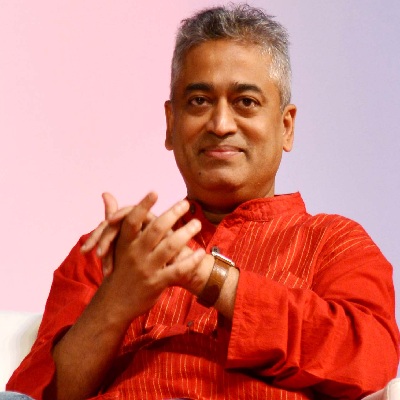
    Dressed as casually as one can get, in a red kurta, simple trousers and chappals, Sardesai delivered a hard hitting monologue on Modi and the kind of journalism that exists in India now.

    “Modi had the most  innovative and sustained campaign that we have ever seen in an Indian election,” he said, while pointing out that Congress president Rahul Gandhi was like a kid in kindergarten in front of Modi. But he also said that it was unfair to blame the media for creating the NaMo wave.

    “Some channels have abandoned the basic role of media. They are now doing cheerleading or supari journalism to get more viewers and ratings. Modi was not subject to the intense scrutiny in the last two years that the others were subject to. While he was brilliant with his social media strategy and communication he was spared the ignominy that others were subject to. Some channels elevated Narendra Modi to God. He is a good politician and communicator but not a messiah. Some journalists need to ask themselves if they want to do journalism or hagiography,” he added.

    On the other hand, Arnab instantly put himself and his channel in the spotlight by stating that one of the positives of being located in Mumbai, far away from the hub of channels (Noida) was that it keeps him disassociated with politicians.

    “I am not romantically involved with any political party so I don’t end up having a bitter break up with them. My distance with politicians is both physical and psychological. We in India are overawed by them. Modi was the focus because there was no competition. We are not dependent on politicians for ratings. There is no scientific evidence that Modi gets ratings,” he said while also stating that he wasn’t aware of this supari journalism that Rajdeep referred to.

    “The next 10 years of journalism to me are very bright,” said Arnab. A view that Shankar totally endorsed. Said he: “The future of journalism is bright because we do something that is essential to the society. We should not be cynical about the media, without them the country would not have been what it is.”

    However, Arnab’s view seemed to have irked Rajdeep who in the latter part of the discussion said, “We can state that in 10 years things will be great and things are going to change, but arrogance is the downfall of every journalist! At our time, it was never that what the anchor said would matter more than what the guests said.”

    Ketkar who comes from the print side of the media and was the senior most scribe on the panel let loose his spleen as he lambasted the electronic media for sidetracking and sideswiping print publications.

    “It is the electronic media that sets the tone for the next day’s morning headlines in the paper by these discussions. The people don’t set the agenda, the media does. The media has covered how miserable Bihar is but no mention of the Gujarat floods when Modi was campaigning at the height of his campaign trail. So, it is not just that you have to speak more about something, but by also not showing something you can stoke the fire,” he said.

    While the three editors did not refrain from taking digs and potshots at each other for the kind of journalism that is being resorted to, it was Piyush Pandey – the man behind the Narendra Modi election campaign –  who gave his insights on what led to NaMo wave. He pointed out that no matter what Modi did, he never gave the media a chance to ignore him; he made sure he was in the public eye, consistently giving out the right message that the public wanted to hear. “The media rode the Modi wave. It did not create it,” he said.

    While the very topic was sidelined, the editors were deeply engaged in pontificating on the state of journalism in the country with Goswami being the most optimistic about it.

    Having recently taken a month long break from his editorial duties, Rajdeep was the most vocal about the fact that news television needs to find its bearings quickly.

    “The idea that the television makes or breaks will not hold anymore. I really think that we have lost the capacity to go beyond the dramatic headline. We have lost our nerve. We need to introspect and ask ourselves : are we willing to do a serious interrogation of the Gujarat model, positive and negative?” he questioned. The fact that the BJP did well in places where cable TV did not reach efficiently was also brought out by Shankar and Sardesai.

    While the discussion didn’t see any real conclusion, it did end with a valuable point to ponder: whether journalists were getting too emotionally involved with politicians?

    Shankar had the last word on this. Said he:  “I think there is too much reverence even now in Indian media and on the other hand, there is too much emotional attachment. Either we are just cynical or when we go there we get sucked in. There has to be a balance in between. Overall, I think we shouldn’t be cynical about media. We have lots to capture and improve but without the media, this place, this country would be much worse.”