Tag: R Balki

  • Bajaj V and Paper Boat set trends in content marketing

    Bajaj V and Paper Boat set trends in content marketing

    MUMBAI: In the current state of disruption in the media and entertainment industry, two things have come forth as absolute truths — firstly, the need for brands to adapt and explore non-traditional marketing; and secondly the power of pure undiluted content.

    Be it GroupM’s This Year Next Year report or the KPMG – FICCI 2016 report, pick up any recognisable marketing study, and one can tell where the M and E industry is headed with double figure digital growth rates.

    Going with that idea, several brands and marketers are toeing the lines of content marketing. But few have gone ahead and taken a leap of faith with content and storytelling being the main focus.

    “We are used to seeing brands sponsoring television programs. ‘Buniyaad brought to you by Colgate’ is an example. But there is nothing ‘Colgate’ in Buniyaad. Whereas in the case of long format digital videos, the kind of content brands would go for is somewhere related to the concept of the brand. The format of digital allows you to experiment a lot more at a far lesser cost,” shared MullenLowe Lintas chairman and CCO R. Balki, on why it is viable for brands to produce their own content on digital.

    When asked, Balki named Leo Burnett’s campaign for Bajaj V as his favourite in the last year. At the same time, he referred to ‘Sons of Vikrant’ as a campaign, not a documentary. “Anything which is released around the bike is all part of building the brand. And that is why I say it is one of the most beautiful works I have seen recently.”

    When Bajaj released its new model for the commuter segment backed by the inspiring story of INS Vikrant, the power of weaving a story as the two wheeler’s brand identity was instantly revealed when record breaking units of the bike were sold on the very first day.

    But it didn’t end at that. Soon the brand launched a 16 minute video titled ‘Sons Of Vikrant’, conceptualised by its creative agency Leo Burnett, documenting the lives of the war veterans who were once aboard the warship.

    Bajaj Motorcycles marketing VP Sumeet Narang said, “As we delved deeper into Vikrant and started talking to people who worked on it, we realised that there are many untold stories and memories behind the naval battleship INS Vikrant and its heroes. Since we had brought back the essence of Vikrant in the form of V, we realised that the onus was also on us to bring these stories together and share them with the nation.”

    The video was launched through a gala event where the who’s who of the media and entertainment industry were invited. Amidst the glitz and glory, the anecdotes of life on INS Vikrant and war stories successfully created awe and inspired attachment around the warship. Suddenly Bajaj V wasn’t a two wheeler anymore, it was a story everyone wanted to own.

    “With Sons of Vikrant, our idea was to bring out the untold stories of INS Vikrant and the war veterans and share the feeling of pride with millions,” quipped Leo Burnett south Asia CEO Saurabh Varma when asked about the concept of releasing a documentary as part of the awareness building for a product.

    “To create this documentary, we met many people who were part of the war to learn their stories. The footage ran into hours, which we had to bring down to 16 minutes,” Varma added.

    Though the digital platform, without the time constraint, does lend itself for more creative exploration, it isn’t necessarily the long format that is working for the brands. As per Balki, digital audience is far more ADHD than a television viewer, with little patience for the content to take shape. “If the story is very well integrated with what the brand stands for, the content will bring benefits for the brand hugely, irrespective of the length of the video.

    “Fundamentally if you have a terrific piece of communication, the brand will benefit from it irrespective of the length of the video. Unless the film is very riveting people lose patience quickly. Some creatives grab on to the digital media thinking and finally they don’t have to fight with the client for the extra five seconds. I don’t think so. I feel a lot of the long forms we see are boring and could have been done shorter. If one wants to go beyond 60 secs they better have something compelling,” Balki simply stated.

    While Bajaj went the non-fiction way to bring out the real emotions people had for the warship and subsequently the bike, Hector Beverages’ flagship brand Paper Boat drinks, dabbled in non-fiction recently to achieve the same.

    The three and half minute video called Rizwan: The Keeper of the Gates of Heaven instantly transports the viewer into an incredible fairy tale of superhero saving the day that evokes all senses.

    “Paper Boat as a brand often speaks of different tastes and smells that can trigger memories, it is an important part of our brand communication. I realised that short films and features are a great way to tell such stories,” shared Paper Boat marketing head Parvesh Debuka.

    Soon Paper Boat’s agency Humour Me came up with Rizwan, written by Dhruv Sachdeva, which strongly resonated with the brand’s identity and therefore the brand went ahead with it.

    It has only been five days since the film has been put up on the brand’s YouTube channel and there are already 7,00,000 plus views, with positive comments like i forgot i was watching something else and this popped up” following the video.

    When asked how effective this brand communication has been compared to the traditional marketing tools, Debuka said, “It is hard to compare as the metrics are different. A brand communication is supposed to deliver a certain thing. Our 20 second spot for the Chilli Guava flavour did extremely well as well. It served the purpose of spreading awareness that we have that flavour. On the contrary Rizwan has taken our storytelling a notch higher, in terms of screenplay, the cinematic experience, in terms of animation. It is no longer creating awareness but building a bond.”

    Debuka is not opposed to the idea of brands producing their own content and exploring further visibility options with it. “For starters, a video such as this when released on the digital platform, garners way more eyeballs organically than what it would take to be visible on television. But as a piece of content it can be shown on television, and even cinema theatres for that matter, but then we will have calculate distribution cost, etc.”

    Going by the cost as well, a brand might come out with more in their pockets when making a video for the digital audience as opposed to putting up an ad spot on television. This window for a more ROI centric marketing is driving brands to go the content way. “Obviously when you end up making a TV commercial, you spend a little more than you would spend to make a film like Rizwan,” Debuka shared.

    Given the fanfare these brand produced contents have created, more brands are likely to explore the area more extensively and start producing their own content. One can’t help but ask if that will affect the way advertising industry works.

    “Agencies have to reorient themselves for the digital era. We are going to see more and more digital thinking in the works. It is no longer about marketing in digital platform but it is digital in marcom thinking. That’s a fundamental shift, and those that make this quick shift quickly and swiftly will survive. I wouldn’t say that agencies and other stakeholders in the system need to feel completely threatened by this new trend of brands making their videos. But since the industry is at a cusp of disruption now, some casualties are expected,” pointed out Vizeum India MD Shripad Kulkarni.

    While there is growing enthusiasm to see more work like Paper Boat’s Rizwan and Bajaj’s Sons Of Vikrant, industry veterans are also cautioning brands against jumping the content marketing bandwagon simply out of the herd mentality. “Often we see that people absorb good content for its own sake and completely forget the brand. Therefore the story needs to be well integrated with what the brand stands for, therein the content will benefit the brand hugely,” shared Balki.

    Echoing similar sentiments, Debuka added, “The primary requirement is how strongly enmeshed is your brand in the story. Whether it is told on television or digital or radio or even on the print platform. One has to ask if the brand can own that story. The content that a brand produces should be a natural extension of the brand communication. If that is not to be, then none of the mediums will work for the brand.”
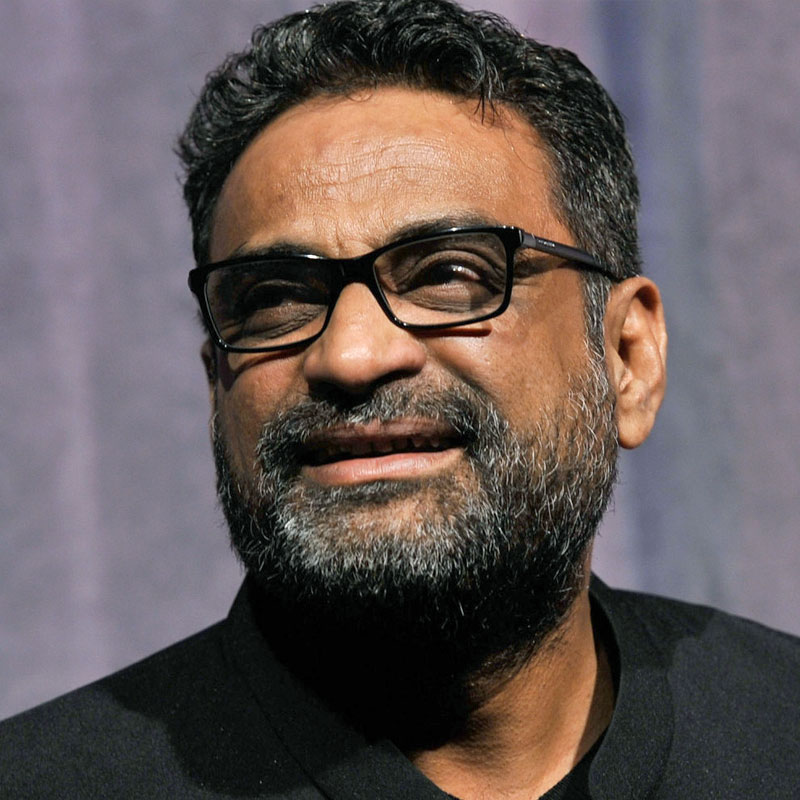
  • “MullenLowe Lintas doesn’t need me”: R. Balki

    “MullenLowe Lintas doesn’t need me”: R. Balki

    MUMBAI: Within the creative industry, there are very few people who are fiercely protective of their art and at the same time put no airs on about it.  R. Balakrishnan is one such person. Be it as the outstanding filmmaker that he is often referred as, or as one of the brightest minds in the creative business, or as the chairman of one of the fastest growing creative agencies in the country — Balakrishnan, or R. Balki as he is called, has not only walked the untrodden road, he has created his own way, thereby making it easier for others to walk down the path that he first walked upon.

    Time and again, the industry has been taken aback by his bold stances — be it his raising an eyebrow at advertising industry awards event or taking chances at the box office with extremely unconventional stories. As a director, filmmaker, writer and creative genius, R. Balki refuses to be judged by others. However, as the chairman and CCO of Mullen Lowe Lintas Group, he feels happy when his team is more capable than him.

    In a candid chat with Indiantelevison.com’s Papri Das, Balki discusses what is keeping young talent from excelling in the industry, his goals for Mullen Lintas in five years and the question that is uppermost in most minds in the industry – Will Mullen Lowe Lintas return to Goafest next year? Excerpts of the interaction:

    Q1. Between being a director and a chairman of an advertising agency, you have donned many roles. Which role do you identify yourself the most with?

    A: I always call myself a writer first, and not any of these.

    Q2. How do you manage to juggle between these multiple roles and do justice to all of them?

    Luckily, I don’t have to balance as much these days, especially when it comes to Mullen Lowe Lintas. It used to be difficult when I did my first couple of movies, because I was shuttling back and forth. Then I took a long break from movies and actually focussed on making sure that the agency could run without me. It took about four or five years to really plan for the next generation; to build the next team with people who can make you irrelevant and dispensable. Today I am the happiest person in the world to say that I am not really needed.  It takes a lot of time to build a team of that calibre, that’s what I have done. I guess I am reaping the benefits of that now (chuckles).

    Q 3 What qualities did you look for in your next generation team before handing them the baton?

    A: You need people who want to do things differently. You need resilient people to match the kind of resilient business we are in. It is not about just getting an idea, but to get an idea day after day, especially when they are being scrapped and rejected. It is indeed a task.

    Secondly I think it is such a people business. You can’t do everything on your own. You have to add value to people’s lives so that they can add value to the relationship. I think anybody who doesn’t understand the sensitivity to deal with creative people will find it difficult to lead and be part of the team.

    Q 4: How hands-on are you now when it comes to decision making within the agency?

    I am part of the meetings, but not as frequently as before. I don’t need to be there 24×7 every day. There are lot of people doing brainstorming and our clients respect their vision and are running with that.

    Q5 How did the team react to the company’s decision to not participate in awards?

    A: Firstly, I got one thing clearly straight: As an agency what do we stand for? What do we believe in? Are we going to be worried about what the world says, are we going to be judged by the world’s parameters? Are we going to enter Cannes and all other awards? We took a stance which was contrary to most of the agencies. We told ourselves ‘No we are not doing any of that stuff. Our work will speak for itself.’ Which it did, though it took some time! We didn’t have media support. We didn’t do a lot of PR and definitely didn’t get coverage for things like award shows etc. We were never in the news. But our work was speaking louder than ever, and the business was growing phenomenally because clients were happy with the work. But to have a stance like that as an agency and to make sure that the team buys that stance wasn’t easy. Most youngsters who come in the industry say we want fame and acknowledgement. So it was a tough stance to take as an agency and have the team believe and support that stance.

    Q6. Retaining talent seems to be an issue of concern within agencies currently. How do you think the industry should address that?

    A: I think every creative agency should strive to empower its next generation. Things can’t stop with the who’s who of this generation. There is no merit in holding the knowledge and keeping the command. We need to create a system where more and more people need to benefit from it. For that you need leaders who have vision to ensure that the system works.

    Q7. When it comes to new business, do you focus on new account wins or is retaining old clients more important?

    A: You have to retain clients’, there is no question of priority. Normally you do that by doing good work for them, doing the correct work for any brand that you get. And the same logic applies to the new businesses. If you can do efficient and relevant work for a brand, it will definitely work with you. Gone are the days when you could get business without doing work. There was a time when people used to think that good work was ‘one’ of the things that an agency needs to do, apart from big talk on relationships. Not anymore! You can have a great relationship and maybe talk a little more about the work because of the relationship, but it can’t survive long on that without work.

    Q8 Mullen Lowe Lintas has been presented as a competitive agency? Where do you derive that competition from, if not through awards?

    When I say Mullen Lowe Lintas is competitive, we are talking about doing better work. I don’t believe I need a jury to tell me if I am good enough. If I know that my work is better than most, I am happy. People often tell me that that distances and alienates creatives and puts them in a bubble, but let me tell you, there is no bubble in advertising. You take criticism all the time because you criticise yourself the most.  99 percent of the time you are criticising yourself. It is the one percent of praise that you seek from yourself is the toughest thing to do.

    Q9. After the restructuring last year, how well is the two agency structure working for the group? How well is Mullen Lintas doing?

    A: Yes the restructuring has worked for us. We had the talent pool to sustain a two agency structure and it was the right decision as well. Unlike most restructuring, we actually shifted some of our businesses from Lowe Lintas to Mullen Lintas. I am happy with the performance it has shown in less than a year. I hope it will be as big as Lowe Lintas in about 5 years.

    Q10. Since your presence at the Goafest 2016, the industry is speculating about the chance that Mullen Lowe Lintas will participate in the festival next year. Is that true?

    A: No. I don’t think so, whether I am part of Mullen or not, the agency will not participate.

    Q11. What is your goal within Mullen Lowe Lintas Group?

    A: I believe every person’s goal should be to leave a place better than what they walked into. I feel I have done the same with Mullen Lowe Lintas. That’s my earnest wish, to leave the company a better place for young creatives and advertising geniuses.

  • “MullenLowe Lintas doesn’t need me”: R. Balki

    “MullenLowe Lintas doesn’t need me”: R. Balki

    MUMBAI: Within the creative industry, there are very few people who are fiercely protective of their art and at the same time put no airs on about it.  R. Balakrishnan is one such person. Be it as the outstanding filmmaker that he is often referred as, or as one of the brightest minds in the creative business, or as the chairman of one of the fastest growing creative agencies in the country — Balakrishnan, or R. Balki as he is called, has not only walked the untrodden road, he has created his own way, thereby making it easier for others to walk down the path that he first walked upon.

    Time and again, the industry has been taken aback by his bold stances — be it his raising an eyebrow at advertising industry awards event or taking chances at the box office with extremely unconventional stories. As a director, filmmaker, writer and creative genius, R. Balki refuses to be judged by others. However, as the chairman and CCO of Mullen Lowe Lintas Group, he feels happy when his team is more capable than him.

    In a candid chat with Indiantelevison.com’s Papri Das, Balki discusses what is keeping young talent from excelling in the industry, his goals for Mullen Lintas in five years and the question that is uppermost in most minds in the industry – Will Mullen Lowe Lintas return to Goafest next year? Excerpts of the interaction:

    Q1. Between being a director and a chairman of an advertising agency, you have donned many roles. Which role do you identify yourself the most with?

    A: I always call myself a writer first, and not any of these.

    Q2. How do you manage to juggle between these multiple roles and do justice to all of them?

    Luckily, I don’t have to balance as much these days, especially when it comes to Mullen Lowe Lintas. It used to be difficult when I did my first couple of movies, because I was shuttling back and forth. Then I took a long break from movies and actually focussed on making sure that the agency could run without me. It took about four or five years to really plan for the next generation; to build the next team with people who can make you irrelevant and dispensable. Today I am the happiest person in the world to say that I am not really needed.  It takes a lot of time to build a team of that calibre, that’s what I have done. I guess I am reaping the benefits of that now (chuckles).

    Q 3 What qualities did you look for in your next generation team before handing them the baton?

    A: You need people who want to do things differently. You need resilient people to match the kind of resilient business we are in. It is not about just getting an idea, but to get an idea day after day, especially when they are being scrapped and rejected. It is indeed a task.

    Secondly I think it is such a people business. You can’t do everything on your own. You have to add value to people’s lives so that they can add value to the relationship. I think anybody who doesn’t understand the sensitivity to deal with creative people will find it difficult to lead and be part of the team.

    Q 4: How hands-on are you now when it comes to decision making within the agency?

    I am part of the meetings, but not as frequently as before. I don’t need to be there 24×7 every day. There are lot of people doing brainstorming and our clients respect their vision and are running with that.

    Q5 How did the team react to the company’s decision to not participate in awards?

    A: Firstly, I got one thing clearly straight: As an agency what do we stand for? What do we believe in? Are we going to be worried about what the world says, are we going to be judged by the world’s parameters? Are we going to enter Cannes and all other awards? We took a stance which was contrary to most of the agencies. We told ourselves ‘No we are not doing any of that stuff. Our work will speak for itself.’ Which it did, though it took some time! We didn’t have media support. We didn’t do a lot of PR and definitely didn’t get coverage for things like award shows etc. We were never in the news. But our work was speaking louder than ever, and the business was growing phenomenally because clients were happy with the work. But to have a stance like that as an agency and to make sure that the team buys that stance wasn’t easy. Most youngsters who come in the industry say we want fame and acknowledgement. So it was a tough stance to take as an agency and have the team believe and support that stance.

    Q6. Retaining talent seems to be an issue of concern within agencies currently. How do you think the industry should address that?

    A: I think every creative agency should strive to empower its next generation. Things can’t stop with the who’s who of this generation. There is no merit in holding the knowledge and keeping the command. We need to create a system where more and more people need to benefit from it. For that you need leaders who have vision to ensure that the system works.

    Q7. When it comes to new business, do you focus on new account wins or is retaining old clients more important?

    A: You have to retain clients’, there is no question of priority. Normally you do that by doing good work for them, doing the correct work for any brand that you get. And the same logic applies to the new businesses. If you can do efficient and relevant work for a brand, it will definitely work with you. Gone are the days when you could get business without doing work. There was a time when people used to think that good work was ‘one’ of the things that an agency needs to do, apart from big talk on relationships. Not anymore! You can have a great relationship and maybe talk a little more about the work because of the relationship, but it can’t survive long on that without work.

    Q8 Mullen Lowe Lintas has been presented as a competitive agency? Where do you derive that competition from, if not through awards?

    When I say Mullen Lowe Lintas is competitive, we are talking about doing better work. I don’t believe I need a jury to tell me if I am good enough. If I know that my work is better than most, I am happy. People often tell me that that distances and alienates creatives and puts them in a bubble, but let me tell you, there is no bubble in advertising. You take criticism all the time because you criticise yourself the most.  99 percent of the time you are criticising yourself. It is the one percent of praise that you seek from yourself is the toughest thing to do.

    Q9. After the restructuring last year, how well is the two agency structure working for the group? How well is Mullen Lintas doing?

    A: Yes the restructuring has worked for us. We had the talent pool to sustain a two agency structure and it was the right decision as well. Unlike most restructuring, we actually shifted some of our businesses from Lowe Lintas to Mullen Lintas. I am happy with the performance it has shown in less than a year. I hope it will be as big as Lowe Lintas in about 5 years.

    Q10. Since your presence at the Goafest 2016, the industry is speculating about the chance that Mullen Lowe Lintas will participate in the festival next year. Is that true?

    A: No. I don’t think so, whether I am part of Mullen or not, the agency will not participate.

    Q11. What is your goal within Mullen Lowe Lintas Group?

    A: I believe every person’s goal should be to leave a place better than what they walked into. I feel I have done the same with Mullen Lowe Lintas. That’s my earnest wish, to leave the company a better place for young creatives and advertising geniuses.

  • Star India is one of the very few to get its design right: Kyoorius’ Rajesh Kejriwal

    Star India is one of the very few to get its design right: Kyoorius’ Rajesh Kejriwal

    At a time when content and disruption are mentioned in the same breath in every digitally charged summit, design often takes a backseat. It’s an open secret that several marketers, be they traditional or digital, neglect design. In fact, a couple of years ago the understanding of the subject or its importance in driving brands was practically not there.  Very little was done in the country to drive conversations around design and innovation.

    Things would have remained the same, were it not for Kyoorius, a one stop place that connects designers, brands, creatives and every stakeholder in between. Kyoorius founder and CEO Rajesh Kejriwal welcomed the change that his endeavour brought to the industry. Its flagship awards show, Kyoorius Creative Awards and design and innovation conference Kyoorius Designyatra have set benchmarks year after year. Now the Kyoorius Creative Awards is in its 3rd edition and has the likes of R. Balki, Kartik Sharma, and Fergus O’Hare on board as jury members, while Kyoorius Designyatra celebrated ten years during its last edition. Kyoorius has also expanded with a marketing and communication division with MELT, where it focuses on emerging technology and digital marketing.

    In a candid chat with indiantelevision.com’s Papri Das, Rajesh Kejriwal opens up on the state of design in the industry, what to expect from Kyoorius Creative Awards and MELT 2016 and how most of the media brands haven’t cracked the design code.

    Excerpts:

    Is there anything new that we can expect at MELT 2016?

    This year at MELT we will have 14 halls with parallel sessions. The content itself is massive compared to last year with almost 60 speakers on board. We don’t like to emulate the whole ‘panel’ system as that gives the audience an information overload with no real crux.

    We have reached out to GroupM, SAP, Kinetic and Happy Finish who we expected to participate in this year’s MELT in Delhi. Now that we have postponed MELT and we are likely to hold it in August, we are actually looking at two expo areas. One would be heavy on new  technology that might interest marketers such as Gear from Samsung etc., and the other would have the GroupMs’ and Genesis, etc., of the industry.

    Why was MELT 2016 postponed?

    In every event we do, we ensure that the content we put out is very strong. I have to hand it to the curation team that felt the content and line-up for MELT, which was scheduled earlier this year, didn’t match up to standards, and therefore we rescheduled it.

    What have been the game changers in the design and creative industry?

    Digital was no doubt the biggest game changer. From the Indian perspective, in the last five years, the major change has been the acceptance of design by corporate India as a strategic tool, not an aesthetic one.  It is not looked at with a fresh perspective by business leaders now. Consider this as an immense change in the mindset of people. This has led to designers being treated with a lot more respect and seriousness. Because it is only when you have good clients with big budgets can you work wonders for them. If you are paid peanuts there is only so much you can do.

    According to you, which brand in India has made the best use of design in recent times?

    In the FMCG sector, I would say Paperboat is a success story when it comes to brilliant use of design. Right from the material it uses for packaging, its layout and how it is branded, Paperbaot has paid attention to detail, not just in terms of looks, but what that look conveys to its consumers. I am glad to see a newcomer in the field understanding and using design creatively. Fastrack from Titan has always stayed ahead of the design curve. It has nailed it down perfectly well.

    Royal Enfield India is currently using design very strategically. Flipkart and Myntra too have done a good job. But these are all what I call the new Indian businesses.

    What about the media brands?

    When it comes to media and broadcaster channels, I feel all of them really need to redo their designs except for Star India. If you look at their packaging logo and interface from a visual perspective, Star has got it right. All the other broadcasters do not understand how important a cohesive language branding identity is. Design defines the DNA of a channel, and its identity. It surprises me that they don’t understand its importance, because some of these networks have global reach. One would expect them to see how international media use their design.

    If you look at the packaging, and everything, it doesn’t reflect the brand identity of the channels. If one were to take away all text and show the channel to us, I can tell which one Star is, but any other brand would be a hard guess, because the visual language is missing. It is sad because that is what binds the consumers to the brand. Being in a mass consumer industry, broadcasters should get their design right.

    There is a tendency amongst some media organisations to rebrand themselves, and while they are at it, they change it in parts and pieces. I would hear from them that they have changed their show packaging without changing their identity branding. I think that is the wrong way to go about it. Design can’t be done in bits and pieces.

    What according to you is going wrong with the design industry in India?

    Where most designs go wrong is when the company or CEO decides what design suits the company. Design isn’t an opinion, it’s a solution. The right design isn’t as per the CEO’s fancy, but as per the consumer needs.

    Let me tell you the difference between the old India and new India. For old India designers, you would go to them as a client and ask for a logo. They would show you a logo and tell you it’s the best for you as it was ‘fresh’. Has any client in the world has asked for a stale logo? It clearly means the designers created a good looking logo, and told a story to fit the logo with the company, whereas a good designer will find that story before designing the logo. A good designer will figure out the strategy, the positioning, the brand identity, the target group and manifest that into a design. New India does it the latter way. But there is still a lot of India stuck to the old ways.

    You initially were from the paper and printing industry. What made you take interest in the design and creative field?

    Predominantly we were paper merchants who would purchase paper manufactured in other markets, bring it to India, brand it and sell it here. One of the ways to fuel these purchases was to influence the decision makers, i. e., the creatives and designers. Designyatra was first thought of to reach out to our clients and start a design revolution in India.

    To fuel this design movement, we had to expose the industry prevalent in India to what was happening globally, and make them feel proud of being designers. To do away with the bureaucracy involved in the entire system, I decided to go with the non-profit format.  Suddenly from being a vendor to the industry I was their friend, so Designyatra and Kyoorius definitely helped my paper business.

    From being a promotional method to becoming the actual business; tell us how did Kyoorius evolve?

    It happened soon after the paper industry slid downhill, though it didn’t happen overnight. Gradually the entire set up changed. While being a business man it wasn’t too difficult for me, it was a difficult transition for Kyoorius. Earlier it acted as promotion for my paper business. Now when the model changed, Kyoorius had to be sustainable or profitable.

    When it really came down to making a difference in the industry, Kyoorius actually had to be profitable, not run up losses. It had to be actually profitable and use that profit to make a positive difference in the industry. So that transition from not caring whether it made money or not to making Kyoorius sustainable was the real challenge.

    How did you manage this transition?

    Prior to this realisation we didn’t have sponsors. When we decided to make it sustainable, one of the obvious means for any conference to be functional is to have a sponsor. So we looked for one. This wasn’t easy because no one believed in the design industry in 2008 and 2009. In those days if you did something in the advertising sphere, major broadcasters would easily come on board. But design was an offbeat road to travel on that only a small breed of people was interested in.

    We were lucky in 2011, we managed to get Zee to take cognizance of the fact that design was important for the industry and the country and that’s how it came on board. And since then, Zee has remained a partner for Kyoorius and signed on year after year. We also started looking at pricing the tickets right, something which we didn’t pay attention to earlier.

    Post transformation what is the current structure of Kyoorius now?

    Currently we have two sides to Kyoorius. One is the marketing and communication section where advertising, media and digital, social media and emerging technologies or MarTech is covered, and the second is the design and innovation side.

    These are the two broad headers under which we operate, mostly because if you have a capable team, you can’t have a single event a year to keep it occupied.

    What is your take on sponsorship for events?

    For the creative awards, we have Colors, HT, Rishtey Happy Finish and Kinetic. Apart from this we have supporting partners like Addikt.tv etc.

    If an award show has to sustainably exist for a long period of time, in an ideal scenario, 80 per cent of the revenue should come from the ticketed sales or entries in guest registration. In India it is actually the reverse. Sponsorship is between 70 to 80 per cent while the rest is maybe tickets or miscellaneous.

    In our case thankfully, we have struck a healthier ratio with 60 per cent from sponsorship and 40 per cent from ticket sales. I hope we can soon invert this ratio for Kyoorius Creative Awards, as we have done for Designyatra.

    MELT is a difficult IP when it comes to ticket sales as it will always be about partners. I can’t charge each person Rs 20,000, so the prices for MELT tickets will always be lower. Given the content we showcase in MELT, the budget can only be met through sponsors.

    Last year it was Rs 8,000, and this year we are planning to have another optional ticket without dinner included that will be sold for  much less. It’s for those newcomers in the industry or students who want to attend, but for whom budget is an issue.

  • Star India is one of the very few to get its design right: Kyoorius’ Rajesh Kejriwal

    Star India is one of the very few to get its design right: Kyoorius’ Rajesh Kejriwal

    At a time when content and disruption are mentioned in the same breath in every digitally charged summit, design often takes a backseat. It’s an open secret that several marketers, be they traditional or digital, neglect design. In fact, a couple of years ago the understanding of the subject or its importance in driving brands was practically not there.  Very little was done in the country to drive conversations around design and innovation.

    Things would have remained the same, were it not for Kyoorius, a one stop place that connects designers, brands, creatives and every stakeholder in between. Kyoorius founder and CEO Rajesh Kejriwal welcomed the change that his endeavour brought to the industry. Its flagship awards show, Kyoorius Creative Awards and design and innovation conference Kyoorius Designyatra have set benchmarks year after year. Now the Kyoorius Creative Awards is in its 3rd edition and has the likes of R. Balki, Kartik Sharma, and Fergus O’Hare on board as jury members, while Kyoorius Designyatra celebrated ten years during its last edition. Kyoorius has also expanded with a marketing and communication division with MELT, where it focuses on emerging technology and digital marketing.

    In a candid chat with indiantelevision.com’s Papri Das, Rajesh Kejriwal opens up on the state of design in the industry, what to expect from Kyoorius Creative Awards and MELT 2016 and how most of the media brands haven’t cracked the design code.

    Excerpts:

    Is there anything new that we can expect at MELT 2016?

    This year at MELT we will have 14 halls with parallel sessions. The content itself is massive compared to last year with almost 60 speakers on board. We don’t like to emulate the whole ‘panel’ system as that gives the audience an information overload with no real crux.

    We have reached out to GroupM, SAP, Kinetic and Happy Finish who we expected to participate in this year’s MELT in Delhi. Now that we have postponed MELT and we are likely to hold it in August, we are actually looking at two expo areas. One would be heavy on new  technology that might interest marketers such as Gear from Samsung etc., and the other would have the GroupMs’ and Genesis, etc., of the industry.

    Why was MELT 2016 postponed?

    In every event we do, we ensure that the content we put out is very strong. I have to hand it to the curation team that felt the content and line-up for MELT, which was scheduled earlier this year, didn’t match up to standards, and therefore we rescheduled it.

    What have been the game changers in the design and creative industry?

    Digital was no doubt the biggest game changer. From the Indian perspective, in the last five years, the major change has been the acceptance of design by corporate India as a strategic tool, not an aesthetic one.  It is not looked at with a fresh perspective by business leaders now. Consider this as an immense change in the mindset of people. This has led to designers being treated with a lot more respect and seriousness. Because it is only when you have good clients with big budgets can you work wonders for them. If you are paid peanuts there is only so much you can do.

    According to you, which brand in India has made the best use of design in recent times?

    In the FMCG sector, I would say Paperboat is a success story when it comes to brilliant use of design. Right from the material it uses for packaging, its layout and how it is branded, Paperbaot has paid attention to detail, not just in terms of looks, but what that look conveys to its consumers. I am glad to see a newcomer in the field understanding and using design creatively. Fastrack from Titan has always stayed ahead of the design curve. It has nailed it down perfectly well.

    Royal Enfield India is currently using design very strategically. Flipkart and Myntra too have done a good job. But these are all what I call the new Indian businesses.

    What about the media brands?

    When it comes to media and broadcaster channels, I feel all of them really need to redo their designs except for Star India. If you look at their packaging logo and interface from a visual perspective, Star has got it right. All the other broadcasters do not understand how important a cohesive language branding identity is. Design defines the DNA of a channel, and its identity. It surprises me that they don’t understand its importance, because some of these networks have global reach. One would expect them to see how international media use their design.

    If you look at the packaging, and everything, it doesn’t reflect the brand identity of the channels. If one were to take away all text and show the channel to us, I can tell which one Star is, but any other brand would be a hard guess, because the visual language is missing. It is sad because that is what binds the consumers to the brand. Being in a mass consumer industry, broadcasters should get their design right.

    There is a tendency amongst some media organisations to rebrand themselves, and while they are at it, they change it in parts and pieces. I would hear from them that they have changed their show packaging without changing their identity branding. I think that is the wrong way to go about it. Design can’t be done in bits and pieces.

    What according to you is going wrong with the design industry in India?

    Where most designs go wrong is when the company or CEO decides what design suits the company. Design isn’t an opinion, it’s a solution. The right design isn’t as per the CEO’s fancy, but as per the consumer needs.

    Let me tell you the difference between the old India and new India. For old India designers, you would go to them as a client and ask for a logo. They would show you a logo and tell you it’s the best for you as it was ‘fresh’. Has any client in the world has asked for a stale logo? It clearly means the designers created a good looking logo, and told a story to fit the logo with the company, whereas a good designer will find that story before designing the logo. A good designer will figure out the strategy, the positioning, the brand identity, the target group and manifest that into a design. New India does it the latter way. But there is still a lot of India stuck to the old ways.

    You initially were from the paper and printing industry. What made you take interest in the design and creative field?

    Predominantly we were paper merchants who would purchase paper manufactured in other markets, bring it to India, brand it and sell it here. One of the ways to fuel these purchases was to influence the decision makers, i. e., the creatives and designers. Designyatra was first thought of to reach out to our clients and start a design revolution in India.

    To fuel this design movement, we had to expose the industry prevalent in India to what was happening globally, and make them feel proud of being designers. To do away with the bureaucracy involved in the entire system, I decided to go with the non-profit format.  Suddenly from being a vendor to the industry I was their friend, so Designyatra and Kyoorius definitely helped my paper business.

    From being a promotional method to becoming the actual business; tell us how did Kyoorius evolve?

    It happened soon after the paper industry slid downhill, though it didn’t happen overnight. Gradually the entire set up changed. While being a business man it wasn’t too difficult for me, it was a difficult transition for Kyoorius. Earlier it acted as promotion for my paper business. Now when the model changed, Kyoorius had to be sustainable or profitable.

    When it really came down to making a difference in the industry, Kyoorius actually had to be profitable, not run up losses. It had to be actually profitable and use that profit to make a positive difference in the industry. So that transition from not caring whether it made money or not to making Kyoorius sustainable was the real challenge.

    How did you manage this transition?

    Prior to this realisation we didn’t have sponsors. When we decided to make it sustainable, one of the obvious means for any conference to be functional is to have a sponsor. So we looked for one. This wasn’t easy because no one believed in the design industry in 2008 and 2009. In those days if you did something in the advertising sphere, major broadcasters would easily come on board. But design was an offbeat road to travel on that only a small breed of people was interested in.

    We were lucky in 2011, we managed to get Zee to take cognizance of the fact that design was important for the industry and the country and that’s how it came on board. And since then, Zee has remained a partner for Kyoorius and signed on year after year. We also started looking at pricing the tickets right, something which we didn’t pay attention to earlier.

    Post transformation what is the current structure of Kyoorius now?

    Currently we have two sides to Kyoorius. One is the marketing and communication section where advertising, media and digital, social media and emerging technologies or MarTech is covered, and the second is the design and innovation side.

    These are the two broad headers under which we operate, mostly because if you have a capable team, you can’t have a single event a year to keep it occupied.

    What is your take on sponsorship for events?

    For the creative awards, we have Colors, HT, Rishtey Happy Finish and Kinetic. Apart from this we have supporting partners like Addikt.tv etc.

    If an award show has to sustainably exist for a long period of time, in an ideal scenario, 80 per cent of the revenue should come from the ticketed sales or entries in guest registration. In India it is actually the reverse. Sponsorship is between 70 to 80 per cent while the rest is maybe tickets or miscellaneous.

    In our case thankfully, we have struck a healthier ratio with 60 per cent from sponsorship and 40 per cent from ticket sales. I hope we can soon invert this ratio for Kyoorius Creative Awards, as we have done for Designyatra.

    MELT is a difficult IP when it comes to ticket sales as it will always be about partners. I can’t charge each person Rs 20,000, so the prices for MELT tickets will always be lower. Given the content we showcase in MELT, the budget can only be met through sponsors.

    Last year it was Rs 8,000, and this year we are planning to have another optional ticket without dinner included that will be sold for  much less. It’s for those newcomers in the industry or students who want to attend, but for whom budget is an issue.

  • “This year’s’ was the best lineup of speakers at Goafest,” Nakul Chopra

    “This year’s’ was the best lineup of speakers at Goafest,” Nakul Chopra

    MUMBAI: Be it statistics or experience, Goafest 2016 has outdone previous editions by a healthy margin much to the pride of Goafest Organising Committee chairman Nakul Chopra.

    “We got lot of feedback on the spot in Goa, and most complimented the speaker sessions. They all also appreciated the leadership summits. For many, this year’s was the best line up of speakers atGoafest. Broadly speaking, the feedback has been good on the whole production of the event as well,” Chopra added.

    While on the one hand the likes of Arjuna Ranatunga,  Rajdeep Sardesai, Shobha De, Karan Johar, R Balki upped the ante of the celeb factor at the three day conference, international creative geniuses like Benny Thomas, Fergus O’Hare, Tara Marsh, Carter Murray and Jean Lin gave industry insights and look aheads from a mature market perspective.

    Looking at logistics and itinerary, “This year was a huge improvement on timings. While last year wasn’t bad either, for this one we managed to stay on time for the most part,” Chopra shared. While day one saw a slight delay at the Abbys, the organisers tried their best to make day two and day three awards nights within enjoyable timings and kept the delays under check.

    Speaking about the highlights of the three day Abbys Chopra said, “I am definitely happy about Publicis’ performance at the Abbys. We have won several metals for meaningful work and that makes me proud of the team.

    Between several small and big tweaks, the organising committee did manage to address several logistical and experiential issues, and introduced a fresh fervour to the advertising festival. “We tried introducing Wifi for all at the venues and the Goafest 2016 app kept everyone tuned in with the proceedings of the day, those inside the auditorium or outside on the lawn alike. The innovations were a huge success and we plan to work and make it even better for the coming year as well.”

    Going by sheer numbers, Goafest outweighed its predecessors fairly well. “The total number of organisations who participated, either through their delegates or through their entries in the creative Abbys has gone over 350 this year, which is saying something,” revealed Chopra..

    This year also saw the biggest number of sponsors for the advertising festival. While this couldn’t be confirmed, the very obvious branding on display for various media showcased the collective interest in making the festival more interactive and fun. Starting from the Times Network branding at the entrance to the several fun booths that TLC, ABP Live, Magic Bricks Now, Movies Now Plus, and ZOOM etc., set up across the festival, the sponsors truly livened up the three days in creative and interactive ways.

    Given the successful execution of this year’s Goafest, the bar is definitely set higher for next year. Chopra however is optimistic that this ‘ By the fraternity, of the fraternity and for the fraternity’ festival will only get bigger and better in years to come.


  • “This year’s’ was the best lineup of speakers at Goafest,” Nakul Chopra

    “This year’s’ was the best lineup of speakers at Goafest,” Nakul Chopra

    MUMBAI: Be it statistics or experience, Goafest 2016 has outdone previous editions by a healthy margin much to the pride of Goafest Organising Committee chairman Nakul Chopra.

    “We got lot of feedback on the spot in Goa, and most complimented the speaker sessions. They all also appreciated the leadership summits. For many, this year’s was the best line up of speakers atGoafest. Broadly speaking, the feedback has been good on the whole production of the event as well,” Chopra added.

    While on the one hand the likes of Arjuna Ranatunga,  Rajdeep Sardesai, Shobha De, Karan Johar, R Balki upped the ante of the celeb factor at the three day conference, international creative geniuses like Benny Thomas, Fergus O’Hare, Tara Marsh, Carter Murray and Jean Lin gave industry insights and look aheads from a mature market perspective.

    Looking at logistics and itinerary, “This year was a huge improvement on timings. While last year wasn’t bad either, for this one we managed to stay on time for the most part,” Chopra shared. While day one saw a slight delay at the Abbys, the organisers tried their best to make day two and day three awards nights within enjoyable timings and kept the delays under check.

    Speaking about the highlights of the three day Abbys Chopra said, “I am definitely happy about Publicis’ performance at the Abbys. We have won several metals for meaningful work and that makes me proud of the team.

    Between several small and big tweaks, the organising committee did manage to address several logistical and experiential issues, and introduced a fresh fervour to the advertising festival. “We tried introducing Wifi for all at the venues and the Goafest 2016 app kept everyone tuned in with the proceedings of the day, those inside the auditorium or outside on the lawn alike. The innovations were a huge success and we plan to work and make it even better for the coming year as well.”

    Going by sheer numbers, Goafest outweighed its predecessors fairly well. “The total number of organisations who participated, either through their delegates or through their entries in the creative Abbys has gone over 350 this year, which is saying something,” revealed Chopra..

    This year also saw the biggest number of sponsors for the advertising festival. While this couldn’t be confirmed, the very obvious branding on display for various media showcased the collective interest in making the festival more interactive and fun. Starting from the Times Network branding at the entrance to the several fun booths that TLC, ABP Live, Magic Bricks Now, Movies Now Plus, and ZOOM etc., set up across the festival, the sponsors truly livened up the three days in creative and interactive ways.

    Given the successful execution of this year’s Goafest, the bar is definitely set higher for next year. Chopra however is optimistic that this ‘ By the fraternity, of the fraternity and for the fraternity’ festival will only get bigger and better in years to come.


  • When stars collide: Karan Johar and R Balki on Goafest day 2

    When stars collide: Karan Johar and R Balki on Goafest day 2

    MUMBAI: Post lunch sessions are always a challenge at any event: between people busy with their extended luncheons, grouping to go on smoke breaks, and fighting the urge for a siesta and so the house is often checkered with empty seats.

    But Goafest presented a completely different picture on its second day with a packed house eagerly waiting for the afternoon knowledge summit to start. This was no surprise, as two of the biggest stars in advertising and film fraternity were the speakers and so when they took the stage, the audience welcomed the speakers with thunderous applause. It was hard to decide who got the loudest cheer — Karan Johar or R. Balki.

    ‘Won’t make an ad film’
    The conversation kicked off with the two giving their take on what connects the two industries represented. “I just know that advertising pays a lot of money to the actors and celebrities, making it easier and cheaper for us to cast them in interesting films,” joked the sharp Johar, before going on to share his utter displeasure when his shoots are moved thanks to an actor’s endorsement schedule.            

    Johar was also quick to say how money was still flowing strongly in advertisements, while ‘god knows that our (film) footfalls are falling.”

    If that is so, would Johar like to make an ad film himself? “Nope” came his quick and precise answer. His reason? When at one time he was asked to shoot an ad film for Shah Rukh Khan, Johar was subjected to the infamous PPM or Pre Product Meeting. That didn’t go down well, and since then he hasn’t dared to shoot another as film, chuckled Johar.

     ‘Digital”: a word that floats with few understanding it

    Given the chance, would Balki consider making a film on the digital platform? “Certainly. Why not? It isn’t much of a question of what medium but more of a content issue. If there is a story which needs to be told, it wouldn’t matter if it’s in the digital platform. Budget is a deciding factor as well depending on the kind of story one is telling and treatment they want to give it.”

    Johar said that ‘digital’ was one word floating about in his industry without a shred of comprehension of the medium meant to the industry. “I believe there is a tremendous potential in the medium, but right now, people are simply throwing the word around without actually understanding it.”

    Which is a serious threat to the industry, both the speakers agreed. Johar went on to add, “Footfalls have reduced by 10 to 12 per cent this year. There are multiple alternative mediums of entertainment for the audience. If filmmakers do not push up their content ante, and don’t empower the writers well, the industry will soon see its death.”

    ‘How we market films is all wrong’:

    A knowledge summit at Goafest is incomplete without a direct advertising and marketing question, and so Balki popped the question to Johar: Why has the film fraternity not approached the advertisers or vice versa to market their films better? Is what being done currently working for them?

    “If the amount of talent in Indian advertising in this very room could sell soaps well, or another product, they could do far more for the films. Why don’t we see more collaboration between the industries?”

    “As much as I love my industry, and how solid it is, we are a very big victim of the herd mentality,” confessed Johar. “Currently what you see us doing to promote a film has perhaps been done by one person and the rest followed. No one really sat and strategized what will work or not. There is no science to it and perhaps we need it. Maybe we should get some help to do some actual market research. Right now, we have these promotions and launch events where actors and actresses turn up wearing designer clothes, and only fashion sites are having fun. Is it helping consumers to come and buy a ticket and watch the film? I am not sure at all. This entire bubble is going to burst. Over Marketing of a film can sometimes kill the product. We need to change the way we market films because right now we are doing it all wrong.”

    ‘It’s a myth that products pay a lot to be in the films’

    When quizzed about product placement in films, Balki started off with clarifying misconceptions about this. “There is a science to it. You can’t just randomly place a product in a film just because a brand has paid you money. First of all, it’s a myth that products pay a lot to be in a film. All they help is may be in promoting the film. They do not help in making the film.”

    Balki continues, “product placement works when it is part of a given scene, not randomly posed there. People are getting clever, and clients are also getting smart and not wanting that kind of product placement. Brands and directors are realising that it is when s product is integrated into the storyline and has a real role to play in the story or a particular scene that the product gets the right mileage.”

    On being on the Social media, the necessary evil

    Celebrities, mostly in the film industry, love to hear about themselves and in this era of social media everyone has an opinion.

    The speakers were asked their take on free speech on social media. Johar said. “I confess I love hearing about, reading about myself. Be it good bad or ugly I need to know what people are talking about me. I don’t believe one can be like ‘I do not care’, in today’s world. One cannot be indifferent to the reality of our times. That’s what keeps you grounded. I think the social media is a good reality check for us celebrities. You can’t beat them, so you must join them. I am on all major social media platforms and very active online. I don’t need PR to write my twitter, it’s all me.”

    Balki had a dramatically opposite take on the subject. Taking a cue from Johar’s answer, Balki added, “I am deluded enough to think I am the worst. I do not people to tell me that, nor do I want people to tell me how good I am. I do not feel the need to listen to it. I find it tiring. I am not in it for the practically.”

    Parting shots

    While the entire session gave enough fodder to fill several online ‘powerful quotes’ sites, there were a few takeaways: Johar’s honest and straightforward acknowledgement that he is through and through ‘an unapologetic Hindi filmmaker’ and that he had no plans to make films in Hollywood.

    And Balki’s explanation of how people tend to judge creativity – on films or in advertisements: “We have defined patterns of creativity. We think good must be like this. We have a picture to what good should be and when we see something violently breaking that, the first reaction is to feel uncomfortable. Because people don’t care about innovation, they are simply looking for relativity. Pain is the biggest risk in taking the risk. It is a pain everyone who breaks a mould will live with for quite some time.”

  • When stars collide: Karan Johar and R Balki on Goafest day 2

    When stars collide: Karan Johar and R Balki on Goafest day 2

    MUMBAI: Post lunch sessions are always a challenge at any event: between people busy with their extended luncheons, grouping to go on smoke breaks, and fighting the urge for a siesta and so the house is often checkered with empty seats.

    But Goafest presented a completely different picture on its second day with a packed house eagerly waiting for the afternoon knowledge summit to start. This was no surprise, as two of the biggest stars in advertising and film fraternity were the speakers and so when they took the stage, the audience welcomed the speakers with thunderous applause. It was hard to decide who got the loudest cheer — Karan Johar or R. Balki.

    ‘Won’t make an ad film’
    The conversation kicked off with the two giving their take on what connects the two industries represented. “I just know that advertising pays a lot of money to the actors and celebrities, making it easier and cheaper for us to cast them in interesting films,” joked the sharp Johar, before going on to share his utter displeasure when his shoots are moved thanks to an actor’s endorsement schedule.            

    Johar was also quick to say how money was still flowing strongly in advertisements, while ‘god knows that our (film) footfalls are falling.”

    If that is so, would Johar like to make an ad film himself? “Nope” came his quick and precise answer. His reason? When at one time he was asked to shoot an ad film for Shah Rukh Khan, Johar was subjected to the infamous PPM or Pre Product Meeting. That didn’t go down well, and since then he hasn’t dared to shoot another as film, chuckled Johar.

     ‘Digital”: a word that floats with few understanding it

    Given the chance, would Balki consider making a film on the digital platform? “Certainly. Why not? It isn’t much of a question of what medium but more of a content issue. If there is a story which needs to be told, it wouldn’t matter if it’s in the digital platform. Budget is a deciding factor as well depending on the kind of story one is telling and treatment they want to give it.”

    Johar said that ‘digital’ was one word floating about in his industry without a shred of comprehension of the medium meant to the industry. “I believe there is a tremendous potential in the medium, but right now, people are simply throwing the word around without actually understanding it.”

    Which is a serious threat to the industry, both the speakers agreed. Johar went on to add, “Footfalls have reduced by 10 to 12 per cent this year. There are multiple alternative mediums of entertainment for the audience. If filmmakers do not push up their content ante, and don’t empower the writers well, the industry will soon see its death.”

    ‘How we market films is all wrong’:

    A knowledge summit at Goafest is incomplete without a direct advertising and marketing question, and so Balki popped the question to Johar: Why has the film fraternity not approached the advertisers or vice versa to market their films better? Is what being done currently working for them?

    “If the amount of talent in Indian advertising in this very room could sell soaps well, or another product, they could do far more for the films. Why don’t we see more collaboration between the industries?”

    “As much as I love my industry, and how solid it is, we are a very big victim of the herd mentality,” confessed Johar. “Currently what you see us doing to promote a film has perhaps been done by one person and the rest followed. No one really sat and strategized what will work or not. There is no science to it and perhaps we need it. Maybe we should get some help to do some actual market research. Right now, we have these promotions and launch events where actors and actresses turn up wearing designer clothes, and only fashion sites are having fun. Is it helping consumers to come and buy a ticket and watch the film? I am not sure at all. This entire bubble is going to burst. Over Marketing of a film can sometimes kill the product. We need to change the way we market films because right now we are doing it all wrong.”

    ‘It’s a myth that products pay a lot to be in the films’

    When quizzed about product placement in films, Balki started off with clarifying misconceptions about this. “There is a science to it. You can’t just randomly place a product in a film just because a brand has paid you money. First of all, it’s a myth that products pay a lot to be in a film. All they help is may be in promoting the film. They do not help in making the film.”

    Balki continues, “product placement works when it is part of a given scene, not randomly posed there. People are getting clever, and clients are also getting smart and not wanting that kind of product placement. Brands and directors are realising that it is when s product is integrated into the storyline and has a real role to play in the story or a particular scene that the product gets the right mileage.”

    On being on the Social media, the necessary evil

    Celebrities, mostly in the film industry, love to hear about themselves and in this era of social media everyone has an opinion.

    The speakers were asked their take on free speech on social media. Johar said. “I confess I love hearing about, reading about myself. Be it good bad or ugly I need to know what people are talking about me. I don’t believe one can be like ‘I do not care’, in today’s world. One cannot be indifferent to the reality of our times. That’s what keeps you grounded. I think the social media is a good reality check for us celebrities. You can’t beat them, so you must join them. I am on all major social media platforms and very active online. I don’t need PR to write my twitter, it’s all me.”

    Balki had a dramatically opposite take on the subject. Taking a cue from Johar’s answer, Balki added, “I am deluded enough to think I am the worst. I do not people to tell me that, nor do I want people to tell me how good I am. I do not feel the need to listen to it. I find it tiring. I am not in it for the practically.”

    Parting shots

    While the entire session gave enough fodder to fill several online ‘powerful quotes’ sites, there were a few takeaways: Johar’s honest and straightforward acknowledgement that he is through and through ‘an unapologetic Hindi filmmaker’ and that he had no plans to make films in Hollywood.

    And Balki’s explanation of how people tend to judge creativity – on films or in advertisements: “We have defined patterns of creativity. We think good must be like this. We have a picture to what good should be and when we see something violently breaking that, the first reaction is to feel uncomfortable. Because people don’t care about innovation, they are simply looking for relativity. Pain is the biggest risk in taking the risk. It is a pain everyone who breaks a mould will live with for quite some time.”

  • Digi Osmosis unique campaign for ‘Ki & Ka’

    Digi Osmosis unique campaign for ‘Ki & Ka’

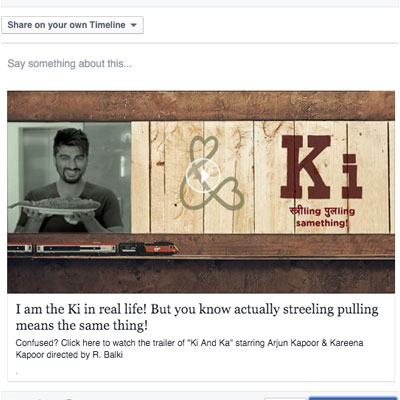
    MUMBAI: Digi Osmosis has crafted a unique campaign for R Balki’s latest production Ki &Ka from the T-Series Films stable by creating a special app for the Ki & Ka facebook page. Once the viewer has watched the trailer on Facebook, a question pops up asking the viewer ‘Who are you in your life, Ki or Ka?’. It further asks  viewers if they are the independent, career-oriented, outspoken Ki or the homely, loving and caring Ka. 

    After the viewer answers and clicks the share button, the trailer is shared on the user’s timeline on Facebook with another caption – ‘I’m Ka in real life but you know, ??????ling (Feminine) and ???ling (Masculine) means the same thing!’

    Commenting on the campaign Digi Osmosis founder Manish Kumar said, “For this trailer, the strategy was simple; there are thousands of people who identify with Ki&Ka on a very personal level. They will find it to be a very interesting activity and in turn share it with their friends. Their friends in turn, find it a quirky and engage with the trailer, repeating the process. This encourages share-ability, a factor crucial for social media and creates a simple viral chain garnering the reactions required. ”

    Ki & Ka director and producer R Balki mentioned that “It has been a terrific learning experience for me working with the Digi Osmosis team. I gave them the trailer of Ki & Ka and they just had a few hours to convert it into an active engagement piece rather than a passive experience. They developed an app embedded in the trailer to make the viewer see herself/ himself as the characters in the story and respond. Simple. Innovative. And really on the ball.”