Tag: Qalam 2001

  • Qalam 2001 gets off to exciting start

    Qalam 2001 gets off to exciting start

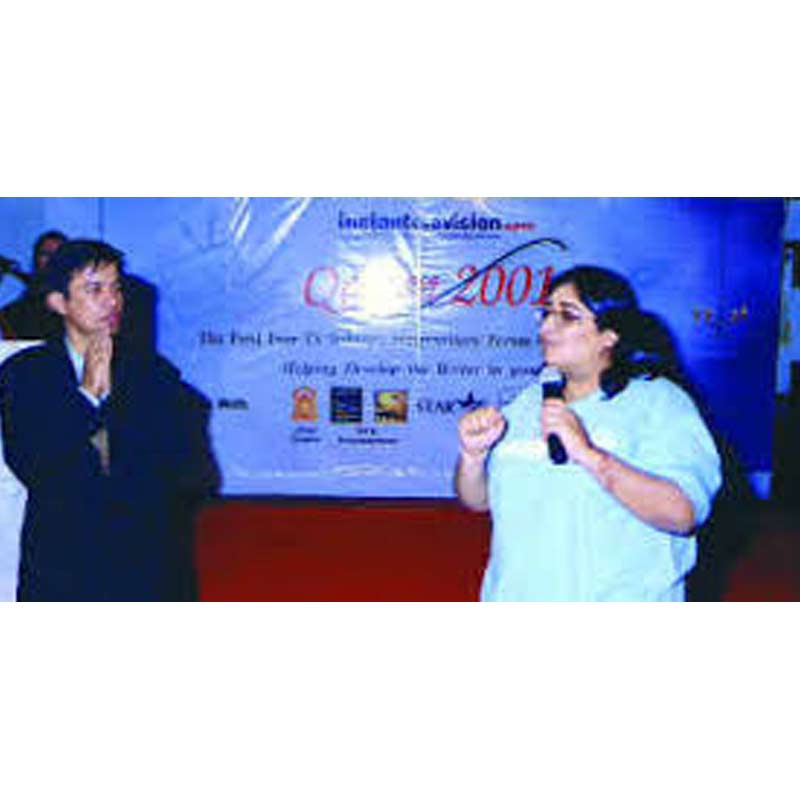
    Veteran, established and aspiring scriptwriters from all over Mumbai converged in a meeting of minds at India’s first ever TV scriptwriters’ workshop Qalam 2001, in Mumbai’s western suburb of Andheri on Thursday.

    The first day of the two-day workshop was marked by a wealth of information from the speakers, plenty of interactivity with participants and insights into the art of writing for television. Speakers included former Sony programming head Rekha Nigam, Tracinema creative head Vinta Nanda, eminent scriptwriters B M Vyas, Mir Muneer and Vipul D Shah and writers’ association representatives. The cohesive force in the two-day workshop is Joyce Thierry, a scriptwriter and instructor from the Vancouver Film School, Canada.

    The morning session commenced with Rekha Nigam charting out the ten commandments of scripting –

    • Know and respect thy target audience

    • Write for the medium

    • Learn to present your work

    • Never go to a channel with just one concept

    • Thou shalt not flog a formula

    • Innovate. Innovate. Innovate.

    • Thou shalt recharge your batteries.

    • God is in the details.

    • To thine own self be true.

    • Go forth and multiply.


    She spoke about the necessity of reaching viewers on their wavelength and language, constantly innovating and exploring new genres, keeping in touch with changing viewer tastes and the importance of presentation of a concept or story to a channel or production house.

    Joyce Thierry, who conducted the next session, explored the anatomy of a TV programme, maintaining that on television, characters matter more than the personality of actors, unlike in movies, where the hero often overshadows his reel character. Good research skills and an interesting point of view are, hence, an important component of any good script, she said.

    Among the suggestions that were thrown up during the course of the workshop, it was felt that channels should form focus groups for channel executives to help them feel the pulse of the viewers. The dearth of availability of scripts also hampered the study of earlier scripts by established and aspiring writers. While fear of theft of concepts often hinders a free exchange of ideas. speakers agreed that a writers’ guild, like ones in the US and Canada, would go a long way in protecting writers’ interests. The need for writers’ training institutes was also expressed by many participants in the workshop, while the need for policing channels to weed out detrimental material was also felt.

    The need for patience in a scriptwriter’s career was brought home by a budding participant who pointed out that most writers are often turned away from production houses at the gate itself. His lament about how was a security guard expected to judge the worth of his work (which is as far as he has been able to get thus far with the various production houses in the city).

    Vinta Nanda, best known as the writer behind the marathon serial Tara, spoke of the degeneration of content in television soaps and programmes. Social commitment, she said, need not necessarily mean making documentaries, but being sensitive to viewers’ tastes and thinking about the impact of their writing on the multitudes who watch TV. Television currently portrays a society that is non-existent, she said. Social workers have to spend days undoing the damage wreaked upon gullible audiences by regressive soaps, she pointed out.

    BM Vyas, in a lighter vein, pointed out that the most ordinary lives have a lot of drama in it. Speaking on the hows and whys of a serial, he said that bringing out this drama is as important as the story structure and communication techniques. Asserting the need to keep a balance when dealing with channels, he said a positive outlook was important. An antagonistic attitude would often mean the writer’s work not being given an airing while if the writer was willing to work within the constraints of the system there were myriad ways of subtly getting across positive messages, was how he saw it.

    Continuing the lighter note, Vipul D Shah noted that a writer should seek out characters from among his surroundings and then develop them with one’s imagination. “The characters have to be unique as well as identifiable”, he said. Comedy serials stipulate that the protagonists have a unique peculiarity, a certain style and a background, on the basis of which interrelationships and his reactions in adverse situations can be fleshed out.

    In his address on developing a comedy, Shah said that the genre is yet to get its due in a developing television industry like the Indian one, accounting for the high incidence of slapstick comedy current here.

    Participants also got an insight into the legal aspects of scriptwriting from Film Writers’ Association’s Rajbir Singh, who spoke of the problems faced by Indian scriptwriters. Most do not sign contracts with production houses, are often not given credits, and are sometimes not paid on time.

    Maintaining that scripts are a writer’s intellectual property, Singh said that the association safeguards interests of writers by getting producers to give writer their dues on time.

    The association registers screenplays, concepts and dialogues of writers and updates members about laws and changing regulations. Writers cannot be changed midway through a serial, he informed, without the permission of the earlier writer. Again, production houses have just one year’s rights on the writer’s script, after which it can be reclaimed, he said.

    Saans and Chunauti writer Mir Muneer stressed the need for budding writers to soak up literature, both English and Indian, in order to hone their writing skills. “One can start with adaptations of English plays, as a stepping stone to good scripts”, he said.

  • First ever Indian TV Scriptwriters Workshop in Mumbai on 20-21 December

    First ever Indian TV Scriptwriters Workshop in Mumbai on 20-21 December

    The Indian television industry’s first ever Scriptwriters Workshop and Forum, Qalam 2001, will be held in Mumbai on 20-21 December.

    Conceived by Indian Television Dot Com Pvt Ltd as the first event of Qalam, a TV Scriptwriters forum, the workshop will provide attendees an insight into the rudiments of scriptwriting, character development, dialogue writing, the process of getting scripts approved by TV producers and channels, and the pitfalls in the business.

    Endorsed by the Film Producers’ Guild of India and backed by Balaji Telefilms, Sony Entertainment Television, Star India and B.A.G. Films, the two-day workshop will be unique for the interactivity that has been built into it. Exercises will be allotted to attendees on which they will be provided feedback. For the first time, an eminent scriptwriter and instructor from the Vancouver Film School (Canada), Joyce Thierry is coming down to India to conduct the workshop in co-ordination with leading Indian scriptwriters. Among the eminent film and TV personalities who will address participants are filmmaker Mahesh Bhatt, scriptwriters Dr Achala Nagar, Anjana Sood, Ashwani Dhir, Ila Bedi Dutta, Mir Muneer, Rajesh Joshi, Vipul D Shah, Raman Kumar, Vinta Nanda, former Sony programming head Rekha Nigam and actor turned producer Soni Razdan.

    The workshop will end with a big bash and a special networking session on the evening of 21 December. Indiantelevision.com is aiming to present a select bunch of bright scriptwriters who will emerge out of the two-day gruelling sessions to the television industry, thus offering a unique opportunity for budding writers to showcase their talents and meet people who count within television -programming heads from TV channels, executive producers, creative directors from production houses and directors. The workshop will be held at Time & Again, Banquet Hall in the northern Mumbai suburb of Andheri (W).

    Says Thierry: “I am so excited about the prospect of interacting with Indian scriptwriters. I have been conducting workshops in Canada for some years now and I am looking forward to this experience.”

    Adds Star Plus creative director Deepak Segal: “Writing is integral to our existence in television because that’s from where our content flows. If you want an engineer you go to an engineering school, but where do you go if you want a scriptwriter? We decided to back Qalam 2001 because it is a first of its kind endeavour to develop writing talent and needs encouragement.”

    Adds Balaji Telefilms CEO Sanjay Dosi: “The script is the soul of any programme and it is a very creditable step by indiantelevision.com to promote scriptwriters and help them in honing their writing skills and it would go a long way in promoting new talent. The industry needs such kind of initiatives.”

    Information and television services company Indian Television Dot Com Pvt Ltd has earlier held the Indian Telly Awards 2001, the first ever television industry awards held in July this year. Says indiantelevision.com founder & CEO Anil Wanvari: “There is a paucity of trained television scriptwriters in India. This is a plaint I have often heard from the TV industry. After the Indian Telly Awards 2001, Qalam 2001 is an effort from our company to start what we hope will become de rigueur in television – training.”

  • Qalam 2001 :  Rajendra Singh

    Qalam 2001 : Rajendra Singh

    Participants also got an insight into the legal aspects of scriptwriting from Film Writers’ Association’s Rajendra Singh, who spoke of the problems faced by Indian scriptwriters. Most do not sign contracts with production houses, are often not given credits, and are sometimes not paid on time.

    Maintaining that scripts are a writer’s intellectual property, Singh said that the association safeguards interests of writers by getting producers to give writer their dues on time.

    The association registers screenplays, concepts and dialogues of writers and updates members about laws and changing regulations. Writers cannot be changed midway through a serial, he informed, without the permission of the earlier writer. Again, production houses have just one year’s rights on the writer’s script, after which it can be reclaimed, he said.

  • Qalam 2001 :  Rajendra Singh

    Qalam 2001 : Rajendra Singh

    Participants also got an insight into the legal aspects of scriptwriting from Film Writers’ Association’s Rajendra Singh, who spoke of the problems faced by Indian scriptwriters. Most do not sign contracts with production houses, are often not given credits, and are sometimes not paid on time.

    Maintaining that scripts are a writer’s intellectual property, Singh said that the association safeguards interests of writers by getting producers to give writer their dues on time.

    The association registers screenplays, concepts and dialogues of writers and updates members about laws and changing regulations. Writers cannot be changed midway through a serial, he informed, without the permission of the earlier writer. Again, production houses have just one year’s rights on the writer’s script, after which it can be reclaimed, he said.

  • Qalam 2001 :  Rekha Nigam

    Qalam 2001 : Rekha Nigam


    Rekha Nigam


    The 10 commandments of Scriptwriting

    The first day commenced with former Sony programming head Rekha Nigam charting out the ten commandments of scripting –

    • Know and respect thy target audience
    • Write for the medium
    • Learn to present your work
    • Never go to a channel with just one concept
    • Thou shalt not flog a formula
    • Innovate Innovate Innovate
    • Thou shalt recharge your batteries
    • God is in the details.
    • To thine own self be true
    • Go forth and multiply
    She spoke about the necessity of reaching viewers on their wavelength and language, constantly innovating and exploring new genres, keeping in touch with changing viewer tastes and the importance of presentation of a concept or story to a channel or production house.

    TV, as opposed to cinema, is an intimate medium in which you reach out to people in their drawing rooms, she said, requiring a writer to known and respect his/her target audience. A writer also needs to have the courage of his convictions when confronted with objections from channels and production houses, Nigam maintained. Apart from writing, a writer needs to keep reading, watching other media for trends and interact with peers in order to keep abreast with changes, she said. .

  • Qalam 2001 : Iqbal Rizvi

    Qalam 2001 : Iqbal Rizvi

    Location- Library room in her villa.

    Anita Sharma 28 years in age is sitting and reading a letter she has just received informing her that her father has expired and has left behind her his farmhouse. A father she last saw when she was 8. Her parents had divorced then.

    A tinge of sadness and guilt is on her face , a father she could have met but she never did try to. She gets up from a chair walks to the window looks out life goes on the streets and she looks up towards the sky and sees a plane we zoom to the plane .

    CUT TO

    She is coming out of the airport and is received by the farm incharge , her fathers man Friday Mr Samuels. The ride to the farm house is about 2 hrs he informs her along the way the farm incharge blabbers on about what the people are here but Anita is lost in her thoughts as she crosses through rugged locates and tinge of green breeze past her , suddenly finding herself in this scenario Anita feels lonely but a certain peace and is thinking about some of her moments with her father. ( which we show with flashes and sound bytes).

    Her reverie is broken by the fact that Mr Samuels mentions the cause of her fathers death and she wonders how tranquil such a place and left to themselves people can be tied up with her fathers death but realises a peculiar trait that all her fathers neighbours are male and anyone of them could be responsible especially when such hostile expressions greet her. She hesitantly enters her farm house full of her fathers presence and sees her father’s photo touches it and walks out into the porch and looks to the imposing mountains and ponders what to do next.

    LOC- library room

    LOC2- airport

    LOC3-rustic locates driving

    LOC4- farm house

    Characters – Anita , Mr Samuels , airport people and some villagers .


  • Qalam 2001 : Nisha Sharda

    Qalam 2001 : Nisha Sharda

    The name Aneeta Gulati says it all. Gulati exudes confidence, possesses flamboyant an sophisticated style, along shrewdness and dryness in her tone. .She is a business tycoon with a huge business empire -liquor comapany, garment exports, tv channel and a chain of restaurants in the name of Ecstasy. A perfect business woman she is. ..she knows how to crack deals by manipulating the excise duties in her favours, thereby increasing her rivals. She smokes dozens of cigarettes, drinks and leads a life of solitude. Emotions, feelings, love, relationships do not figure anywhere in her dictionary. .they are alien to her. …Perhaps because she was groomed like this by her grandmother.

    One fine day, Aneeta inherits a farmhouse and a coffee estate in Coorg and goes there to visit the place. ..She falls in love w.ith the plush greenary,heavenly divine place. She goes to the coffee estate and much to her amazement she sees a man seated on the machan(on stilts) gazing at the sky with his binoculars. She walks up to him and asks him ” What are you doing here”, in a very rude and dry tone. “I am talking to my mom;you interrupted us”, he replies with equal arrogance.

    Aneeta glares at this weird and crazy guy and he asks her “You??” I am Aneeta Gulati AND I own this estate and you? I am Rashid Kaul,” he replies with a scornful and cocky grin. “I am a hermit cum philosopher cum explorer.” There is a glint in his eyes which she noticed. He says, “come with me.”

    She follows him without feeling a trifle scared to the thick caves nearby and is astonished to see a row of colourful paintings based on episodes oflife,philosophy. She is bowled over and co-relates the paintings with her painful past, but does not mention it to Rashid. She says, “you paint pretty well .Your paintings speak of dark areas of life. “

    Aneeta goes back to her Mumbai .She could not could not let go of the cave paintings, his face, his smile. There was something magical, charming about him..a charm that attracted her like magnet to Coorg. She met Rashid .He sure did have an immense mesmerising power. She was gruff, arrogant and couldn’t let go of all this because of her stubborn, egoistical, ruthless nature. He, on the other hand was a cool minded human being who cherished life and loved nature… He was passionate about everything in life. Their diametrically opposite natures strike a chord….love. She fell in love with him and Rashid ‘ s charm and philosophy was enough to transform into a soft, loving and caring human being.He loved her too. She felt complete with him. She said, ” I have achieved happiness, solace and love, only thanks to you and this wonderful paradise; you have filled a void in my life”. She becomes vulnerable and submits herself to him.

    Months roll by and she gives birth to a son, who is born out of wedlock. Rashid hates her and filled with despise, he kills her son. Frantically in search of her son, Aneeta goes to the caves. She learns that Rashid killed her son brutally and also that Rashid was a FAKE!!!

    She was taken for a very very long ride……..

    Aneeta and Rashid come face to face. Her eyes are filled with tears as she blurts to him, “WHY HAVE YOU DONE THIS TO ME??” A dramatic situation where the truth is unfolded that he was no philosopher; but a partner of the rival company called ‘Galaxy’ and did all this to ruin her completely, she had to be taught a lesson for being ruthless, harsh , too proud and obssessed with her wealth and material world………. I took over your business by making you sign on the property papers and the business empire. You are now where you should be. ..” After saying all this to the much devastated Aneeta , Rashid takes a step backwards and takes a step backwards and takes a chopper and………

  • Qalam 2001 : Hasamukh Gandhi

    Qalam 2001 : Hasamukh Gandhi

    A posh car is manoeuvring itself from the Kuchcha, narrow road in the countryside . Nikita, a young girl in her mid -twenties is driving the car. Suddenly the car hits a bump and Nikita curses the road and her father for compelling her to undertake this journey. In a Flashback ,she remembers the conversation with her mother.****

    Mother consoles Nikita that it is indeed difficult to come to terms with such sudden and premature death of her father as Nikita loved him very much and although he did not approve of her life style , he also loved very much.

    Mother admits that even for she was surprised with her father’s will. Father had left for Nikita the huge farmhouse in a far off village . Nikita hates village life. However , mother urges Nikita to visit j ust once 150 acres farmhouse that her father cultivated with love and affection. If she just does not like farmhouse , she might as well sell it off and come back to Mumbai.

    Mother looks at Nikita meaningfully and slowly that it would also give her an oppurtunity to forget her long time over Rajeev and his betrayal . Camera takes a Close up of Nikita who nods thoughfully. (Flashback over)****

    Nikita stops the car as there are three roads going in different directions. She swears to herself that she is going to sell off the bloody thing. She finds a village boy and asks for direction. The boy keeps looking at her car ****

    Disturbed Nikita talks to herself that Rajeev never understood her love.{ Flashback.}****

    Nikita is horrified to find Rajeev in bed with another girl. However, Rajeev is unapologetic and accuses Nikita that she is a modern girl and he knows that she must have had her share of fun but he never complained about it. Shocked Nikita manages to say that she never even think about another boy forget about sleeping with one. Rajeev refuses to believe her and makes fun of her. Shattered Nikita storms out of the room and slowly collapses on the floor. {Flashback over.l *****

    Nikita wipes her tears and looks around as she finds the area absolutely deserted with no population or activities in sight. She feels lost. Suddenly her eyes lit up as she notices a signboard “NIKITA FARMS” with an arrow pointing the direction. *****

    Nikita stops in front of a barbed-wire kuchcha gate with the board Nikita Farms She comes out of the car and finds an old man running to her to open the gate- *****

    The watchman regrets the death of her father and informs a surprised Nikita that he was expecting her as her father had told him that Nikita would visit the farmhouse after father’s death. Nikita nods slowly as she looks at the one-storied outhouse. *****

    Nikita enters the bedroom and is surprised to see a photograph of her with her father and written words on the frame. “ I love you Nikita, daddy. ” Nikita s eyes fill with tears. *****

    Nikita is sitting on the chair in the open space sipping tea and looking around. She is mesmerised with the natural beauty, the landscapes and the beautiful mountain range. Unconscious of herself she begins to breathe deeply and her muscles begin to relax. She hands over the cup back saying that a cup of tea never tested so much better in her life before. The watchman is bewildered.****

    The night. On inquiry, the watchman explains that a young and very educated boy, some kind of expert on agriculture is the only other person in the vicinity. Nikita understands that the boy is &Bio-technologist.

    Nikita looks at her father ‘s photo and murmurs that her father has created a heaven on earth as she looks out of the window and vast tantalizing darkness *****

    A fresh looking Nikita walks towards the next farmhouse. Inside, she finds somebody sitting in a chair and reading a magazine, his back facing her. She calls out. The figure stands up and turns. Her face registers pleasant surprise.

    A handsome boy in his late twenties in designer outfit is staring back at her…

  • Qalam 2001 :  Vipul D Shah

    Qalam 2001 : Vipul D Shah

    Developing Humour out of Everyday Situations

    Vipul D Shah noted that a writer should seek out characters from among his surroundings and then develop them with one’s imagination.

    “The characters have to be unique as well as identifiable”, he said. Comedy serials stipulate that the protagonists have a unique peculiarity, a certain style and a background, on the basis of which interrelationships and his reactions in adverse situations can be fleshed out.

    In his address on developing a comedy, Shah said that the genre is yet to get its due in a developing television industry like the Indian one, accounting for the high incidence of slapstick comedy current here. and stressed on the need for imagination and a good memory to develop humorous characters in a script. One’s surroundings often provide the best fodder in developing interesting character profiles, he said, and regaled the audience with snippets of his own experiences. The important points a writer has to bear in mind are-

    • What the characters want out of life
    • Interrelationships between characters
    • How the characters react in adverse circumstances
    • Characters’ background/ general behaviour
    • Characters’ peculiar humour style that has to be developed.
  • Qalam 2001 :  Vivek Agnihotri

    Qalam 2001 : Vivek Agnihotri

    Director Vivek Agnihotri provided the perfect finale to the workshop with an interesting presentation on developing a script. He said that often the best source of stories is newspapers, history, myths and legends, family and childhood stories and travel. Dreams too are a rich source of potential stories, he said. “A well crafted plot should have a series of rising and falling action, tensions and climaxes … a good suspense plot is a roller coaster ride”, he said.

    Vision and technique, he said, are both important tools of scriptwriting, while dreams and travels can often be a rich source of content for scripts. The titles and loglines have to be pithy and to-the-point, Agnihotri stressed, while a solid plot is the single most important element in a successful suspense. Characterisation is just as important as the suspense curve, which as Agnihotri explained to a hooked audience – has to be circular, not linear. Tension inducing conflict is what holds a suspense drama together, he said. The most important aspect, finished Agnihotri, is a series’ quality – if you can watch the show with your grandchildren with pride, you have done it, he said.