Tag: Q2-17

  • Hathway revenue and operating profit up in third quarter

    BENGALURU: Indian multi system operator (MSO) Hathway Cable and Datacom Limited (Hathway) reported 25.5 per cent growth in Total Income from operations (TIO) and 46 percent growth in operating profits (EBIDTA) for the quarter ended 31 December 2016 (Q3-17, current quarter). The company reported TIO of Rs 337.6 crore in Q3-17 as compared to Rs 281.2 crore in the corresponding quarter of the previous year.

    The company’s EBDITA (earnings before depreciation, interest, taxes and amortisation or operating profit) including other income in the current quarter was Rs 66.6 crore (20 percent EBIDTA margin) and was Rs 45.4 crore (16 percent EBIDTA margin) in Q3-16. The company’s loss as per IND-AS in the current quarter increased to Rs 44.4 crore from a loss of Rs 41.2 crore in Q3-16.

    Hathway reported high growth in Cable subscription revenue, Activation fees and Broadband revenue, while placement revenue declined. The company’s broadband segment has been performing very well, as a matter of fact, among the national level MSOs’ Hathway has the highest subscription and revenue numbers among all of them. Like in the immediate trailing quarter, within Hathway, in Q3-17, Broadband subscription had the highest contribution to revenue, even more than Cable TV subscription revenue

    Hathway’s broadband subscriber base increased by 0.4 lakh in Q3-17 to 8.6 lakh from 8.2 lakh in the immediate trailing quarter. Consolidated broadband revenue in the current quarter as per IND AS increased 62 percent to Rs 127.8 crore from Rs 78.7 crore in the previous year. Consolidated Broadband ARPU in Q3-17 was Rs 654 as compared to Rs 631 in Q3-16 and Rs 643 in the immediate trailing quarter.

    Reported CATV subscription revenue as per IND AS in the current quarter increased 17 percent to Rs 114.1 crore from Rs 97.7crore in Q3-16 Hathway says that it has deployed 4 lakh STBs at a consolidated level. Standalone CATV ARPU in DAS Phase I was Rs 105, in Phase II areas was Rs 95. ARPU from phase III areas was Rs 45.

    Placement revenue as per IND AS in the current quarter declined 14 percent to Rs 70.4 crore from Rs 82.2 crore in Q3-16.

    Activation revenue as per IND AS increased 49 percent y-o-y in Q3-17 to Rs 21 crore from Rs 115 crore in Q3-16.

    Other revenue as per IND AS declined 43 percent in Q3-17 to Rs 4.3 crore from Rs 7.6 in Q3-16.

    Hathway’s Standalone Total Expenditure (without depreciation and amortization) in Q3-17 increased 14 percent to Rs 27.52 crore from Rs 239.4 crore in the previous year.

    Standalone Pay channel cost in the current quarter increased 10 percent to Rs 104.3 crore from Rs 94.5 crore in Q3-16. Standalone Employee Benefit expense in Q3-17 increased 19 percent y-o-y to Rs 23.3 crore from Rs 19.6 crore.

    Note: The unit of currency in this report is the Indian rupee – Rs (also conventionally represented by INR). The Indian numbering system or the Vedic numbering system has been used to denote money values. The basic conversion to the international norm would be:
    (a) 100,00,000 = 100 lakh = 10,000,000 = 10 million = 1 crore.
    (b) 10,000 lakh = 100 crore = 1 arab = 1 billion.

  • Q3-17: Jio affects Airtel revenue; Digital TV segment numbers up

    Q3-17: Jio affects Airtel revenue; Digital TV segment numbers up

    BENGALURU: Indian telecom major Bharti Airtel Limited (Airtel) reported 3 percent decline in total revenue for the quarter ended 31 December 2016 (Q3-17, current quarter) as compared to the corresponding year ago quarter. The drop was partially affected by a drop in revenue due to divestments of its Africa operating units, tower assets sale and merger of Bangladesh operations. However, like in the previous quarter, Reliance Jio’s entry has resulted in a drop in the company’s India mobile revenues which contribute a lion’s share to overall revenue.

    Airtel MD and CEO of India and South Asia regions Gopal Vittal said, “The quarter has seen turbulence due to the continued predatory pricing by a new operator. The present termination costs at 14 paise which are well below cost has resulted in a tsunami of minutes terminating into our network. This has led to an unprecedented year on year revenue decline for the industry, pressure on margins and a serious impact on the financial health of the sector. At the same time our commitment to provide a superior experience to our customers has led to revenue market share crossing a lifetime high of 33 percent. Airtel revenues grew by 1.8 percent Y-o-Y and our non-mobile businesses continue to grow at a healthy clip and now contribute a sizable 24 percent of our total revenues.”

    In consonance with Vittal statement, Airtel’s Digital TV Services segment (DTH segment) reported 17.7 percent year-over-year (y-o-y) increase in operating revenues for the quarter ended 31 December 2016 (Q3-17, current quarter). Also, Operating Profit (Earnings Before interest and Tax – EBIT) of the DTH segment in the current quarter increased 27.1 percent year-over-year (y-o-y).

    Airtel DTH reported revenues of Rs 873.5 crore in Q3-17 and Rs 742.2 crore in Q3-16. EBIT for the corresponding periods was Rs 68.4 crore (7.8 percent margin of the segment’s operating revenue) and Rs 53.8 crore (7.2 percent margin of the segment’s operating revenue), respectively.

    EBIDTA in Q3-17 also increased y-o-y – by 22.3 percent to Rs 302.6 crore (34.6 percent margin of the segment’s operating revenue) in the current quarter from Rs 247.4 crore (33.3 percent margin of the segment’s operating revenue).

    Subscription numbers, ARPU

    Airtel’s DTH segment added 14.82 lakh subscribers between Q3-16 and Q3-17, or a 17.3 percent y-o-y increase. It had 125.88 lakh subscribers as on 31 December 2016. Q-o-q, the segment witnessed a 1.5 percent growth (1.83 lakh adds) in subscribers from 124.05 lakh in Q2-17.

    ARPU in Q3-17 increased to Rs 232 from Rs 229 in the corresponding year ago quarter, but remained flat q-o-q as compared to the immediate trailing quarter.

    Airtel numbers

    Bharti Airtel Limited saw a 3 percent decline in operating revenue to Rs 23335.7crore in Q3-17 as compared to Rs 24065.9 crore in Q3-16.. Profit after tax (PAT) in the current quarter declined to less than half (declined by 54.5 percent) y-o-y to Rs 504 crore (2.2 percent margin) from Rs 1,108 crore (4.6 percent margin). The company attributes decline in profits to net interest costs of Rs 1,810 crore that have risen from Rs 1,360 crore in the corresponding quarter last year largely due to increased spectrum related interest costs. Further, forex and derivative losses for the quarter came in at Rs 126 crore compared to Rs 57 crore in the corresponding quarter last year as well as exceptional items net losses of Rs 114 crore.

  • Q3-17: Jio affects Airtel revenue; Digital TV segment numbers up

    Q3-17: Jio affects Airtel revenue; Digital TV segment numbers up

    BENGALURU: Indian telecom major Bharti Airtel Limited (Airtel) reported 3 percent decline in total revenue for the quarter ended 31 December 2016 (Q3-17, current quarter) as compared to the corresponding year ago quarter. The drop was partially affected by a drop in revenue due to divestments of its Africa operating units, tower assets sale and merger of Bangladesh operations. However, like in the previous quarter, Reliance Jio’s entry has resulted in a drop in the company’s India mobile revenues which contribute a lion’s share to overall revenue.

    Airtel MD and CEO of India and South Asia regions Gopal Vittal said, “The quarter has seen turbulence due to the continued predatory pricing by a new operator. The present termination costs at 14 paise which are well below cost has resulted in a tsunami of minutes terminating into our network. This has led to an unprecedented year on year revenue decline for the industry, pressure on margins and a serious impact on the financial health of the sector. At the same time our commitment to provide a superior experience to our customers has led to revenue market share crossing a lifetime high of 33 percent. Airtel revenues grew by 1.8 percent Y-o-Y and our non-mobile businesses continue to grow at a healthy clip and now contribute a sizable 24 percent of our total revenues.”

    In consonance with Vittal statement, Airtel’s Digital TV Services segment (DTH segment) reported 17.7 percent year-over-year (y-o-y) increase in operating revenues for the quarter ended 31 December 2016 (Q3-17, current quarter). Also, Operating Profit (Earnings Before interest and Tax – EBIT) of the DTH segment in the current quarter increased 27.1 percent year-over-year (y-o-y).

    Airtel DTH reported revenues of Rs 873.5 crore in Q3-17 and Rs 742.2 crore in Q3-16. EBIT for the corresponding periods was Rs 68.4 crore (7.8 percent margin of the segment’s operating revenue) and Rs 53.8 crore (7.2 percent margin of the segment’s operating revenue), respectively.

    EBIDTA in Q3-17 also increased y-o-y – by 22.3 percent to Rs 302.6 crore (34.6 percent margin of the segment’s operating revenue) in the current quarter from Rs 247.4 crore (33.3 percent margin of the segment’s operating revenue).

    Subscription numbers, ARPU

    Airtel’s DTH segment added 14.82 lakh subscribers between Q3-16 and Q3-17, or a 17.3 percent y-o-y increase. It had 125.88 lakh subscribers as on 31 December 2016. Q-o-q, the segment witnessed a 1.5 percent growth (1.83 lakh adds) in subscribers from 124.05 lakh in Q2-17.

    ARPU in Q3-17 increased to Rs 232 from Rs 229 in the corresponding year ago quarter, but remained flat q-o-q as compared to the immediate trailing quarter.

    Airtel numbers

    Bharti Airtel Limited saw a 3 percent decline in operating revenue to Rs 23335.7crore in Q3-17 as compared to Rs 24065.9 crore in Q3-16.. Profit after tax (PAT) in the current quarter declined to less than half (declined by 54.5 percent) y-o-y to Rs 504 crore (2.2 percent margin) from Rs 1,108 crore (4.6 percent margin). The company attributes decline in profits to net interest costs of Rs 1,810 crore that have risen from Rs 1,360 crore in the corresponding quarter last year largely due to increased spectrum related interest costs. Further, forex and derivative losses for the quarter came in at Rs 126 crore compared to Rs 57 crore in the corresponding quarter last year as well as exceptional items net losses of Rs 114 crore.

  • TRAI: FM Radio ad revenues move up in Q2-17

    TRAI: FM Radio ad revenues move up in Q2-17

    BENGALURU: After the recent slump in advertisement revenues by private FM radio stations in the quarters ended 30 June 2016 (Q1-17) and 31 March 2016 (Q4-17), the trend seems have been averted, albeit marginally for Q2-17 (quarter ended 30 September 2016, current quarter) according to the data released by The Telecom Regulatory Authority of India.

    According to TRAI data, radio combined ad revenues reported by 259 stations were Rs 502.13 crore or an average of Rs 1.94 lakh per station for Q2-17. This was slightly higher than the Rs 1.92 crore (combined revenue Rs 468.08 crore from 244 stations)for the immediate trailing quarter. Q2-17 ad revenue was however short by about Rs 10 lakh per station as compared to the corresponding year ago quarter for which TRAI reported combined ad revenue of Rs 481.56 crore (2.04 crore per station) from 236 stations.

    Please refer to Figure A below for FM Radio Ad Revenue over a five year plus period spanning a 22 quarter period starting with the quarter ended 30 June 2011 (Q1-12) until the quarter ended 30 September 2016 (Q2-17) as per TRAI data. The amounts are in Rs crore and rounded off to the nearest decimal place in the case of combined ad revenue and two decimal places in the case of Average Revenue per station.

    public://r-fig1.jpg

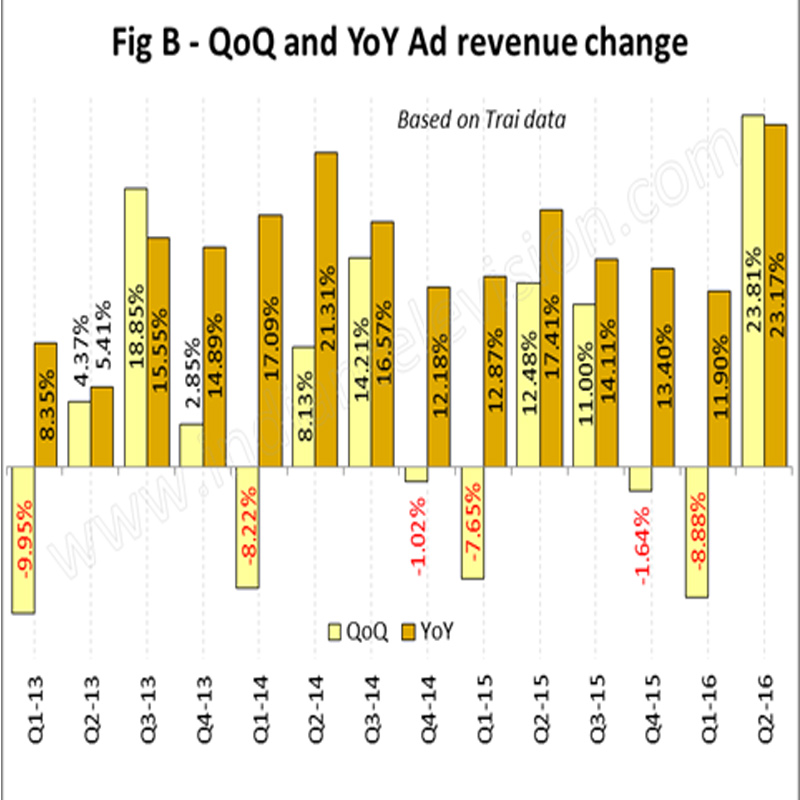
    In absolute terms, combined Radio ad revenue in Q2-17 increased 4.2 percent and 7.3 percent year-over-year (y-o-y, as compared to the corresponding quarter of the previous year) and quarter-over-quarter (q-o-q, immediate trailing quarter) respectively. Average revenue per station in the current quarter declined 5 percent y-o-y, but increased 1.1 percent q-o-q. The total number of stations in Q2-17 increased 9.7 percent y-o-y and 6.1 percent q-o-q.

    Please refer to Figure B for y-o-y and q-o-q changes

    public://r-fig2.jpg

    Conclusion

    Overall, despite the year-end and first quarter of a new fiscal drops, ad revenues as well as ad revenues per station show a linear increasing trend as more and more advertisers have begun to understand the value proposition this very local medium with a pan-India footprint can offer. Further, the third quarter of the fiscal (Q3, quarter ended 31 December) is also the festival quarter of the year in India – a sweet quarter as far as the radio industry is concerned. However, It remains to be seen how demonetisation has affected ad revenues for the fledgling medium for Q3-17. As mentioned above, during the third quarter of a fiscal radio ad revenues have historically been the highest.


  • TRAI: FM Radio ad revenues move up in Q2-17

    TRAI: FM Radio ad revenues move up in Q2-17

    BENGALURU: After the recent slump in advertisement revenues by private FM radio stations in the quarters ended 30 June 2016 (Q1-17) and 31 March 2016 (Q4-17), the trend seems have been averted, albeit marginally for Q2-17 (quarter ended 30 September 2016, current quarter) according to the data released by The Telecom Regulatory Authority of India.

    According to TRAI data, radio combined ad revenues reported by 259 stations were Rs 502.13 crore or an average of Rs 1.94 lakh per station for Q2-17. This was slightly higher than the Rs 1.92 crore (combined revenue Rs 468.08 crore from 244 stations)for the immediate trailing quarter. Q2-17 ad revenue was however short by about Rs 10 lakh per station as compared to the corresponding year ago quarter for which TRAI reported combined ad revenue of Rs 481.56 crore (2.04 crore per station) from 236 stations.

    Please refer to Figure A below for FM Radio Ad Revenue over a five year plus period spanning a 22 quarter period starting with the quarter ended 30 June 2011 (Q1-12) until the quarter ended 30 September 2016 (Q2-17) as per TRAI data. The amounts are in Rs crore and rounded off to the nearest decimal place in the case of combined ad revenue and two decimal places in the case of Average Revenue per station.

    public://r-fig1.jpg

    In absolute terms, combined Radio ad revenue in Q2-17 increased 4.2 percent and 7.3 percent year-over-year (y-o-y, as compared to the corresponding quarter of the previous year) and quarter-over-quarter (q-o-q, immediate trailing quarter) respectively. Average revenue per station in the current quarter declined 5 percent y-o-y, but increased 1.1 percent q-o-q. The total number of stations in Q2-17 increased 9.7 percent y-o-y and 6.1 percent q-o-q.

    Please refer to Figure B for y-o-y and q-o-q changes

    public://r-fig2.jpg

    Conclusion

    Overall, despite the year-end and first quarter of a new fiscal drops, ad revenues as well as ad revenues per station show a linear increasing trend as more and more advertisers have begun to understand the value proposition this very local medium with a pan-India footprint can offer. Further, the third quarter of the fiscal (Q3, quarter ended 31 December) is also the festival quarter of the year in India – a sweet quarter as far as the radio industry is concerned. However, It remains to be seen how demonetisation has affected ad revenues for the fledgling medium for Q3-17. As mentioned above, during the third quarter of a fiscal radio ad revenues have historically been the highest.


  • Hathway Q2-17 revenue and EBIDTA up; adds 1 lakh broadband subs

    Hathway Q2-17 revenue and EBIDTA up; adds 1 lakh broadband subs

    BENGALURU: Indian multi system operator (MSO) Hathway Cable and Datacom Limited (Hathway) reported 18.8 per cent growth in Total Income from operations (TIO) and 11.9 percent growth in operating profits (EBIDTA) for the quarter ended 30 September 2016 (Q2-17, current quarter). The company reported TIO of Rs 321.07 crore in Q2-17 as compared to Rs 270.35 crore in the corresponding quarter of the previous year.

    The company’s EBDITA including other income in the current quarter was Rs 54.9 crore (17 percent EBIDTA margin) and was Rs 49.05 crore (17.9 percent EBIDTA margin) in Q2-16. The company’s loss in the current quarter increased to Rs 40.45 crore from a loss of Rs 31.99 crore in Q2-16.

    High growth in Cable subscription revenue, Activation fees and Broadband revenue are chiefly responsible for the improved performance says the company. The company’s broadband segment has been performing very well, as a matter of fact, among the national level MSOs’ Hathway has the highest subscription and revenue numbers among all of them. Within Hathway, in Q2-17, Broadband subscription had the highest contribution to revenue, even more than Cable TV subscription revenue

    Hathway’s broadband subscriber base increased to 8 lakh in Q2-17 from 7 lakh in the immediate trailing quarter. Consolidated broadband revenue in the current quarter as per IND AS increased 67 percent to Rs 120.3 crore from Rs 71.9 crore in the previous year. Broadband ARPU in the current quarter increased to Rs 643 from Rs 616 in the corresponding quarter of the previous year, but declined from Rs 670 in the immediate trailing quarter.

    Consolidated reported CATV subscription revenue as per IND AS in the current quarter increased 12 percent to Rs 120.2 crore from Rs 107.5 crore in Q2-16 Hathway says that it has achieved a milestone of deployed 18 lakh STBs, of which 8 lakh STBs were deployed in Phase III & IV areas during Q1- 17. The company says that it has now digitized 92 percent of its cable TV universe. CATV ARPU in DAS Phase I increased to Rs 105 from Rs 100 in the corresponding year ago quarter.CATV ARPU in Phase II areas increased to Rs 90 from Rs 80 in Q2-16. ARPU from phase III areas was Rs 30.

    Placement revenue as per IND AS in the current quarter declined 23 percent to Rs 65.4 crore from Rs 84.8 crore in Q2-16.
    Activation revenue as per IND AS increased 37 percent y-o-y in Q2-17 to Rs 20.2 crore from Rs 14.7 crore in Q2-16.
    Other revenue as per IND AS declined 5 percent in Q2-17 to Rs 4.8 crore from Rs 5.1 in Q2-16.

    Hathway’s Standalone Total Expenditure in Q2-17 increased 19 percent to Rs 340.49 crore (99.6 percent of TIO) from Rs 286.19 crore (105.9 percent of TIO) in the previous year.

    Standalone Pay channel cost in the current quarter increased 22.3 percent to Rs 104.31 crore (32.2 percent of TIO) from Rs 85.56 crore (31.3 percent of TIO) in FY-15. Standalone Employee Benefit expense in Q2-17 increased 46.9 percent y-o-y to Rs 23.53 crore from Rs 16.02 crore.

    Note: The unit of currency in this report is the Indian rupee – Rs (also conventionally represented by INR). The Indian numbering system or the Vedic numbering system has been used to denote money values. The basic conversion to the international norm would be:

    (a) 100,00,000 = 100 lakh = 10,000,000 = 10 million = 1 crore.

    (b) 10,000 lakh = 100 crore = 1 arab = 1 billion.

  • Hathway Q2-17 revenue and EBIDTA up; adds 1 lakh broadband subs

    Hathway Q2-17 revenue and EBIDTA up; adds 1 lakh broadband subs

    BENGALURU: Indian multi system operator (MSO) Hathway Cable and Datacom Limited (Hathway) reported 18.8 per cent growth in Total Income from operations (TIO) and 11.9 percent growth in operating profits (EBIDTA) for the quarter ended 30 September 2016 (Q2-17, current quarter). The company reported TIO of Rs 321.07 crore in Q2-17 as compared to Rs 270.35 crore in the corresponding quarter of the previous year.

    The company’s EBDITA including other income in the current quarter was Rs 54.9 crore (17 percent EBIDTA margin) and was Rs 49.05 crore (17.9 percent EBIDTA margin) in Q2-16. The company’s loss in the current quarter increased to Rs 40.45 crore from a loss of Rs 31.99 crore in Q2-16.

    High growth in Cable subscription revenue, Activation fees and Broadband revenue are chiefly responsible for the improved performance says the company. The company’s broadband segment has been performing very well, as a matter of fact, among the national level MSOs’ Hathway has the highest subscription and revenue numbers among all of them. Within Hathway, in Q2-17, Broadband subscription had the highest contribution to revenue, even more than Cable TV subscription revenue

    Hathway’s broadband subscriber base increased to 8 lakh in Q2-17 from 7 lakh in the immediate trailing quarter. Consolidated broadband revenue in the current quarter as per IND AS increased 67 percent to Rs 120.3 crore from Rs 71.9 crore in the previous year. Broadband ARPU in the current quarter increased to Rs 643 from Rs 616 in the corresponding quarter of the previous year, but declined from Rs 670 in the immediate trailing quarter.

    Consolidated reported CATV subscription revenue as per IND AS in the current quarter increased 12 percent to Rs 120.2 crore from Rs 107.5 crore in Q2-16 Hathway says that it has achieved a milestone of deployed 18 lakh STBs, of which 8 lakh STBs were deployed in Phase III & IV areas during Q1- 17. The company says that it has now digitized 92 percent of its cable TV universe. CATV ARPU in DAS Phase I increased to Rs 105 from Rs 100 in the corresponding year ago quarter.CATV ARPU in Phase II areas increased to Rs 90 from Rs 80 in Q2-16. ARPU from phase III areas was Rs 30.

    Placement revenue as per IND AS in the current quarter declined 23 percent to Rs 65.4 crore from Rs 84.8 crore in Q2-16.
    Activation revenue as per IND AS increased 37 percent y-o-y in Q2-17 to Rs 20.2 crore from Rs 14.7 crore in Q2-16.
    Other revenue as per IND AS declined 5 percent in Q2-17 to Rs 4.8 crore from Rs 5.1 in Q2-16.

    Hathway’s Standalone Total Expenditure in Q2-17 increased 19 percent to Rs 340.49 crore (99.6 percent of TIO) from Rs 286.19 crore (105.9 percent of TIO) in the previous year.

    Standalone Pay channel cost in the current quarter increased 22.3 percent to Rs 104.31 crore (32.2 percent of TIO) from Rs 85.56 crore (31.3 percent of TIO) in FY-15. Standalone Employee Benefit expense in Q2-17 increased 46.9 percent y-o-y to Rs 23.53 crore from Rs 16.02 crore.

    Note: The unit of currency in this report is the Indian rupee – Rs (also conventionally represented by INR). The Indian numbering system or the Vedic numbering system has been used to denote money values. The basic conversion to the international norm would be:

    (a) 100,00,000 = 100 lakh = 10,000,000 = 10 million = 1 crore.

    (b) 10,000 lakh = 100 crore = 1 arab = 1 billion.

  • Jio impacts Vodafone India H1-17 results

    Jio impacts Vodafone India H1-17 results

    BENGALURU: Vodafone Group Plc (Vodafone group) reported Group organic service revenue up 2.3 per cent for the half year ended 30 September 2016 (H1-17).  H1-17 Group revenue declined 3.9 per cent to €27,054 million as compared to € 28,151 million for H1-6 (corresponding period of the previous year). H1-17 Vodafone Group reported organic EBITDA growth of 4.3 per cent to €7,906 million, supported by strong cost control. In real terms, EBIDTA declined 1.7 per cent from $8,039 million reported for H1-16.

    India numbers

    Vodafone India contributed about 11.1 per cent to Vodafone Group revenues and adds about 43.7 per cent to Vodafone group mobile subscriber base in the quarter ended 30 September 2016 or Q2-17. About 51.4 per cent of the group’s voice usage was from India in Q2-17 at 183,555 million minutes (Total group 357,034 million minutes).

    Vodafone India Service revenue grew by 5.9 per cent (quarter ended 30 June 2016 or Q1-17: 6.4 per cent, Q2-17: 5.4 per cent) in H1-17 to Rs 22,579 crore from Rs 21,321 crore in H1-16. Excluding regulatory drags including MTR cuts, roaming price caps and an increase in service tax, the quarterly rate of growth slowed from 7.7 per cent in Q1-17 to 6.3 per cent in Q2-17. This underlying slowdown was mainly driven by lower data revenue growth resulting from increased competitive pressure says the company.

    Data revenue growth slowed from 22 per cent in Q1-17 to 16 per cent in Q2-17. This was driven by a flattening of unique data user growth quarter-on-quarter, reflecting the impact of ‘free’ promotional offers from a new entrant, viz., Reliance Jio. 

    Vodafone group’s active data customer base at the period end was 69.6 million or 6.96 crore (Q1-17- 69.7 million or 6.97 crore). Overall data pricing declined 14 per cent year-on-year, while data usage per customer continued to grow strongly to 504MB (+28 per cent). Vodafone group 3G / 4G customer base continued to grow to 36 million (3.6 crore), up 51 per cent, and smartphone penetration was now 34.5 per cent says the company. Vodafone India reported revenue from data of Rs 4,617 crore. Data ARPU (for users more than 1MB) was at Rs 164 in Q2-17 versus Rs 158 in Q2-16.

    Voice revenue growth increased to 2.7 per cent in Q2-17 (Q1-17: 2.2 per cent) supported by a growing customer base. This was despite seasonally lower average minutes of use per customer. Total mobile customers increased 2.8 million (28 lakh) over the period, giving a closing customer base of over 200 million for the first time (Q2: 200.7 million or 20.07 crore).
    During the period Vodafone India added 4,100 new 3G sites, taking the total to 63,000. It also has 13,000 4G sites. In the Indian spectrum auction during October Vodafone India increased its total spectrum holding by 62 per cent. 

    Overall Vodafone paid Rs 20,300 crore (€2.7 billion), of which 92 per cent was on spectrum for the 12 circles in which it claims to be a market leader. Vodafone India plans to extend its 4G footprint from 9 to 17 circles by the end of the current financial year. These circles cover around 91 per cent of Vodafone India’s service revenues and 94 per cent of its data revenues.

    EBITDA grew by 2.6 per cent in H1-17 to Rs 6,704 crore from Rs 6,534 crore, with the EBITDA margin declining by 0.1 percentage points to 29.6 per cent due to higher network and customer acquisition costs, which were largely offset by significant operating cost savings says the company.

    The Vodafone Group intends to proceed with an IPO of Vodafone India as soon as market conditions allow. It does not expect this to take place during the current financial year.

    Company speak

    Vodafone group chief executive Vittorio Colao said, ‘We have further improved our performance during the first half of the financial year with Europe modestly ahead of our expectations – led by Germany and Italy – and good execution in AMAP. Our substantial network investments and ‘more-for-more’ propositions have allowed us to capture opportunities from strong data demand, supporting European mobile contract ARPU and continued growth in emerging markets. As Europe’s fastest-growing broadband operator, we are driving rapid uptake of our consumer fixed and TV services while our wholly converged Enterprise business continues to outperform its peers. We are now translating faster revenue growth into margin expansion, supported by our focus on cost efficiency.

    Competition in India has increased in the year, reducing revenue growth and profitability. We have responded to this changing competitive environment by strengthening our data and voice commercial offers and by focusing our participation in the recent spectrum auction on acquiring frequencies in the more successful and profitable areas of the country.

    Overall, we expect to sustain our underlying performance in the second half of the year and remain on track to meet our full-year objectives despite macroeconomic uncertainties. This performance allows for improved returns to our shareholders, as reflected by the growth in the interim dividend.

    Vodafone India managing director and CEO Sunil Sood commented: “Amidst a dynamic environment, we delivered a solid performance. We are well prepared for the increased level of competitive intensity that we are experiencing. We have strengthened our customer value propositions making Vodafone Play, your one window to the world of entertainment, launched exciting 4G offers – 9GB free on purchase of 1GB pack for new 4G handsets and revamped Vodafone RED for high end voice and data users. Further, we pioneered lifestyle propositions such as Vodafone U for young customers and Vodafone Flex, which allows customers to make a single recharge for voice, sms and data. We expanded our 4G footprint to 9 circles by launching services in 4 new circles. With the spectrum bought recently, we will roll out the Vodafone SuperNet 4G experience rapidly to 2,400 towns and in 8 additional circles by March. We continue to invest to expand our modern and scalable network with a strong backhaul, to support the increasing volumes and need for speed from both retail and enterprise customers. We remain committed to fulfill the evolving needs of our customers and leverage our global experience plus rich understanding of India to play a meaningful role in enabling Digital India.”

  • Jio impacts Vodafone India H1-17 results

    Jio impacts Vodafone India H1-17 results

    BENGALURU: Vodafone Group Plc (Vodafone group) reported Group organic service revenue up 2.3 per cent for the half year ended 30 September 2016 (H1-17).  H1-17 Group revenue declined 3.9 per cent to €27,054 million as compared to € 28,151 million for H1-6 (corresponding period of the previous year). H1-17 Vodafone Group reported organic EBITDA growth of 4.3 per cent to €7,906 million, supported by strong cost control. In real terms, EBIDTA declined 1.7 per cent from $8,039 million reported for H1-16.

    India numbers

    Vodafone India contributed about 11.1 per cent to Vodafone Group revenues and adds about 43.7 per cent to Vodafone group mobile subscriber base in the quarter ended 30 September 2016 or Q2-17. About 51.4 per cent of the group’s voice usage was from India in Q2-17 at 183,555 million minutes (Total group 357,034 million minutes).

    Vodafone India Service revenue grew by 5.9 per cent (quarter ended 30 June 2016 or Q1-17: 6.4 per cent, Q2-17: 5.4 per cent) in H1-17 to Rs 22,579 crore from Rs 21,321 crore in H1-16. Excluding regulatory drags including MTR cuts, roaming price caps and an increase in service tax, the quarterly rate of growth slowed from 7.7 per cent in Q1-17 to 6.3 per cent in Q2-17. This underlying slowdown was mainly driven by lower data revenue growth resulting from increased competitive pressure says the company.

    Data revenue growth slowed from 22 per cent in Q1-17 to 16 per cent in Q2-17. This was driven by a flattening of unique data user growth quarter-on-quarter, reflecting the impact of ‘free’ promotional offers from a new entrant, viz., Reliance Jio. 

    Vodafone group’s active data customer base at the period end was 69.6 million or 6.96 crore (Q1-17- 69.7 million or 6.97 crore). Overall data pricing declined 14 per cent year-on-year, while data usage per customer continued to grow strongly to 504MB (+28 per cent). Vodafone group 3G / 4G customer base continued to grow to 36 million (3.6 crore), up 51 per cent, and smartphone penetration was now 34.5 per cent says the company. Vodafone India reported revenue from data of Rs 4,617 crore. Data ARPU (for users more than 1MB) was at Rs 164 in Q2-17 versus Rs 158 in Q2-16.

    Voice revenue growth increased to 2.7 per cent in Q2-17 (Q1-17: 2.2 per cent) supported by a growing customer base. This was despite seasonally lower average minutes of use per customer. Total mobile customers increased 2.8 million (28 lakh) over the period, giving a closing customer base of over 200 million for the first time (Q2: 200.7 million or 20.07 crore).
    During the period Vodafone India added 4,100 new 3G sites, taking the total to 63,000. It also has 13,000 4G sites. In the Indian spectrum auction during October Vodafone India increased its total spectrum holding by 62 per cent. 

    Overall Vodafone paid Rs 20,300 crore (€2.7 billion), of which 92 per cent was on spectrum for the 12 circles in which it claims to be a market leader. Vodafone India plans to extend its 4G footprint from 9 to 17 circles by the end of the current financial year. These circles cover around 91 per cent of Vodafone India’s service revenues and 94 per cent of its data revenues.

    EBITDA grew by 2.6 per cent in H1-17 to Rs 6,704 crore from Rs 6,534 crore, with the EBITDA margin declining by 0.1 percentage points to 29.6 per cent due to higher network and customer acquisition costs, which were largely offset by significant operating cost savings says the company.

    The Vodafone Group intends to proceed with an IPO of Vodafone India as soon as market conditions allow. It does not expect this to take place during the current financial year.

    Company speak

    Vodafone group chief executive Vittorio Colao said, ‘We have further improved our performance during the first half of the financial year with Europe modestly ahead of our expectations – led by Germany and Italy – and good execution in AMAP. Our substantial network investments and ‘more-for-more’ propositions have allowed us to capture opportunities from strong data demand, supporting European mobile contract ARPU and continued growth in emerging markets. As Europe’s fastest-growing broadband operator, we are driving rapid uptake of our consumer fixed and TV services while our wholly converged Enterprise business continues to outperform its peers. We are now translating faster revenue growth into margin expansion, supported by our focus on cost efficiency.

    Competition in India has increased in the year, reducing revenue growth and profitability. We have responded to this changing competitive environment by strengthening our data and voice commercial offers and by focusing our participation in the recent spectrum auction on acquiring frequencies in the more successful and profitable areas of the country.

    Overall, we expect to sustain our underlying performance in the second half of the year and remain on track to meet our full-year objectives despite macroeconomic uncertainties. This performance allows for improved returns to our shareholders, as reflected by the growth in the interim dividend.

    Vodafone India managing director and CEO Sunil Sood commented: “Amidst a dynamic environment, we delivered a solid performance. We are well prepared for the increased level of competitive intensity that we are experiencing. We have strengthened our customer value propositions making Vodafone Play, your one window to the world of entertainment, launched exciting 4G offers – 9GB free on purchase of 1GB pack for new 4G handsets and revamped Vodafone RED for high end voice and data users. Further, we pioneered lifestyle propositions such as Vodafone U for young customers and Vodafone Flex, which allows customers to make a single recharge for voice, sms and data. We expanded our 4G footprint to 9 circles by launching services in 4 new circles. With the spectrum bought recently, we will roll out the Vodafone SuperNet 4G experience rapidly to 2,400 towns and in 8 additional circles by March. We continue to invest to expand our modern and scalable network with a strong backhaul, to support the increasing volumes and need for speed from both retail and enterprise customers. We remain committed to fulfill the evolving needs of our customers and leverage our global experience plus rich understanding of India to play a meaningful role in enabling Digital India.”

  • Sun TV posts improved y-o-y numbers for Q2-17

    Sun TV posts improved y-o-y numbers for Q2-17

    BENGALURU: Sun TV Network Limited (Sun TV) reported improved numbers across all important parameters for the quarter ended 30 September 2016 (Q2-17, current quarter) as compared to the corresponding year ago quarter (Q2-16).

    Sun TV reported 10.4 per cent higher year-over-year (y-o-y) revenue in the current quarter at Rs 625.49 crore as compared to Rs 567.55 crore in Q2-16.

    Revenue growth in Q2-17 was led by a 17 per cent y-o-y increase in subscription revenue at Rs 228.55 crore from Rs 195.32 crore, and a two per cent y-o-y increase in advertisement revenue at Rs 309.43 crore as compared to Rs 302.93 crore.

    The company’s Profit after tax or PAT improved 21.7 per cent y-o-y to Rs 270.35 crore (43.2 per cent margin) as compared to Rs 222.07 crore (39.1 per cent margin).

    Sun TV EBIDTA in the current quarter was Rs 466.32 crore (74.6 per cent EBIDTA margin), 8.3 per cent higher as compared to Rs 430.52 crore (75.9 per cent EBIDTA margin) in Q2-16.

    Total Expenditure (TE) in the current quarter increased 3 per cent to Rs 262.20 crore (41.9 per cent of TIO) as compared to Rs 254.61 crore (44.9 per cent of TIO) in the corresponding quarter of the previous year.

    Employee Remuneration and Benefits Expense (EBE) in Q2-17 increased 21.2 per cent to Rs 71.83 crore (11.5 per cent of TIO) as compared to Rs 59.27 crore (10.4 per cent of TIO) in Q2-16.

    Other expenses (OE) in the Q1-17 was 9.7 per cent higher at Rs 36.01 crore (5.8 per cent of TIO) as compared to Rs 32.83 crore (5.8 per cent of TIO) in the corresponding quarter of the previous year.

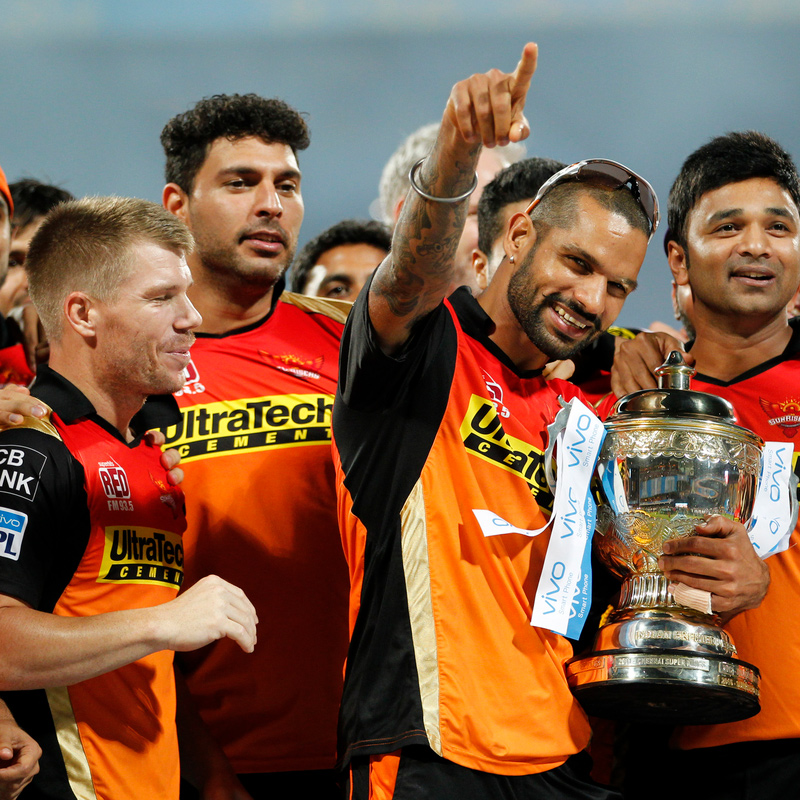
    IPL Franchisee Sun Risers Hyderabad

    Sun TV has paid franchisee fees for its IPL team SunRisers Hyderabad (SRH) of Rs 85.48 crore in Q1-17 as compared to Rs 85.05 crore in the first quarter of FY-16.

    The results of the half year ended 30 September 2016 (HY1-17) include IPL revenue of Rs 143.90 crore as compared to Rs 96.5 crore in HY1-16 and expenses of Rs 175.02 crore and Rs 143.25 crore for HY1-17 and HY-16 respectively.

    Note: The unit of currency in this report is the Indian rupee – Rs (also conventionally represented by INR). The Indian numbering system or the Vedic numbering system has been used to denote money values. The basic conversion to the international norm would be:
    (a) 100,00,000 = 100 lakh = 10,000,000 = 10 million = 1 crore.
    (b) 10,000 lakh = 100 crore = 1 arab = 1 billion.