Tag: Q2

  • Swiggy’s awe striking revenue surge feeds growth, but losses deepen

    Swiggy’s awe striking revenue surge feeds growth, but losses deepen

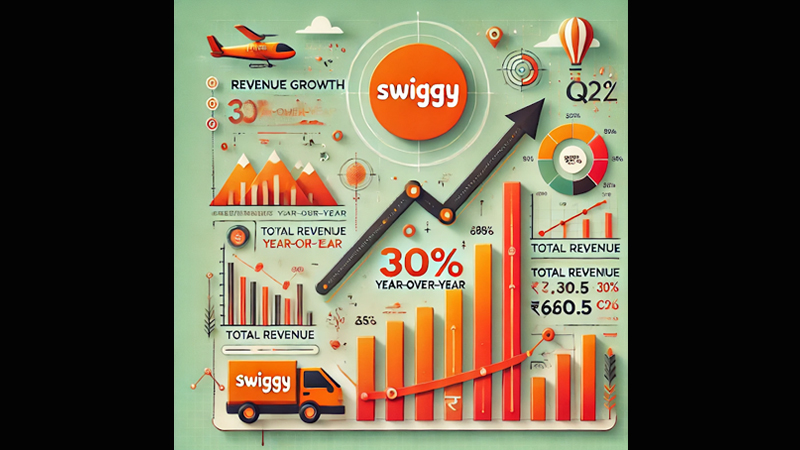
    MUMBAI: They bring us joy with a click, delivering steaming biryanis, comforting gulab jamuns, and all things delightful, right to our doors. But behind every pop notification—’Miss me?’ from our favorite desserts—lies a story of grit, ambition, and relentless pursuit. Swiggy, India’s food delivery and quick commerce titan, has filled our carts with convenience, but at a cost that has left its own coffers under strain. In its Q2 FY25 results, unveiled on 3 December 2024, Swiggy showcased an awe-inspiring surge in revenues by 30 per cent YoY to Rs 36,015 million. Yet, this celebratory crescendo is tempered by an echo of concern—net losses have deepened, reflecting the challenges of sustaining growth while keeping an expansive team and ecosystem thriving. It’s a tale as flavorful as their marketing, and as complex as their financials—balancing indulgence with accountability.

    Swiggy’s total revenue from operations increased by 30.2 per cent YoY, reaching Rs 36,015 million in Q2 FY25 compared to Rs 27,633 million in Q2 FY24. This leap reflects strong performance across key segments, particularly food delivery and quick commerce. However, the company’s consolidated losses stood at Rs 6,255 million for the quarter, marking an 8.6 per cent rise from the Rs 5,751 million loss recorded in the same period last year.

    The increase in expenses, driven by marketing, logistics, and employee benefits, strained profitability despite robust revenue growth. Total expenditure for Q2 FY25 amounted to Rs 43,095 million, a 22.8 per cent increase YoY. Swiggy’s continued focus on customer acquisition and brand building weighed heavily on its bottom line.

    Key drivers:

    ●   Food Delivery: As Swiggy’s flagship segment, food delivery generated Rs 15,745 million in revenue, reflecting a YoY growth of 22.9 per cent. Enhanced customer loyalty programs and competitive pricing played pivotal roles in this growth.

    ●   Quick Commerce (Instamart): Quick commerce revenues skyrocketed by 135.4 per cent YoY, reaching Rs 4,900 million, emphasising Swiggy’s commitment to diversifying its service portfolio. Strategic investments in dark stores and supply chain logistics have fueled this expansion.

    ●   Supply Chain and Distribution: This segment contributed Rs 14,526 million, up 22.0 per cent from the previous year, as Swiggy capitalised on its warehousing and fulfillment network to streamline FMCG distribution.

    ●   Platform Innovations: Revenues from platform innovations, including initiatives like Swiggy Genie, amounted to Rs 253 million but faced a decline from Rs 494 million YoY.

    Expansion comes at a cost

    Swiggy’s aggressive growth strategy comes at a significant cost. Employee benefits rose to Rs 6,073 million in Q2 FY25, up 13.2 per cent YoY, reflecting hiring and retention efforts in a competitive labor market. Delivery charges surged by 32.5 per cent to Rs 10,949 million, as Swiggy expanded operations in Tier II and Tier III cities.

    The company’s marketing expenses also increased, with advertising and promotional costs totaling Rs 5,371 million, up 8.8 per cent from the previous year. These expenditures underline Swiggy’s push to strengthen its market presence amidst fierce competition from rivals like Zomato and Blinkit.

    IPO milestones

    Swiggy’s listing on the NSE and BSE in November 2024 marked a significant milestone. The IPO raised Rs 115,407 million through fresh issues and offer-for-sale components. Proceeds were earmarked for expanding Instamart’s operations, enhancing technology infrastructure, and bolstering working capital.

    Additionally, Swiggy’s investment in its wholly owned subsidiary, Scootsy Logistics, reached Rs 1,600 crore. This infusion aims to optimise supply chain capabilities and support quick commerce scalability.

    Swiggy’s outlook hinges on its ability to navigate the profitability challenge. With over 70 per cent of revenues stemming from food delivery, diversifying its income streams is crucial. Quick commerce, which grew phenomenally in Q2 FY25, holds promise but demands continued investment.

    The company has also signaled its intent to strengthen customer engagement through tech-driven solutions and personalised services. However, the path to sustainable profitability will require stringent cost controls and efficiency enhancements across its operations.

    Swiggy’s Q2 FY25 performance paints a vivid picture of ambition clashing with financial challenges. Swiggy stands at a crossroads, its vision clear but the journey demanding resilience and bold decisions. For now, we wait—with curiosity and anticipation—to see what this culinary trailblazer serves up next in its quest to satisfy appetites and redefine the future of food.

  • Voltas Q2: Net profit sinks 26 per cent to Rs 80 crore

    Voltas Q2: Net profit sinks 26 per cent to Rs 80 crore

    MUMBAI: Consumer electronics firm Voltas has posted net profit of Rs 80 crore for the quarter ended 30 September 2020. This is a decline of 26 per cent from the same quarter last fiscal when the company reported net profit of Rs 107.3 crore.

    The consolidated total income for the period was higher by 10 per cent at Rs 1,651 crores as compared to Rs 1,495 crores in the corresponding quarter last year. Earnings per share (face value per share of Re 1) (not annualized) as on 30 September 2020 was Rs 2.37 as compared to Rs 3.22 last year. 

    The results take into account the effect of merger of a 100 per cent subsidiary-universal comfort products limited with effect from 1 April 2019, which has been approved by the National Company Law Tribunal on 11 September 2020.

    Consolidated segment results for the quarter ended 30 September 2020:

    Unitary cooling products for comfort and commercial use: The business achieved overall volume growth of 14 per cent contributed by growth of 11 per cent in room air conditioners, 20 per cent in commercial refrigeration products and 28 per cent in air coolers. Voltas continued to be the market leader and has sustained its no 1 position in the room air conditioner business and further improved its market share to 26.8 per cent in August 2020. Segment revenue increased by nine per cent and was Rs 572 crores as compared to Rs 526 crores in the corresponding quarter last year. Segment result was higher by 37 per cent at Rs 63 crores as compared to Rs 46 crores in the corresponding quarter last year.

    Electro-mechanical projects and services: Segment revenue for the quarter was higher at 15 per cent at Rs 928 crores as compared to Rs 809 crores in the corresponding quarter last year. Segment result was Rs 23 crores as compared to Rs 56 crores last year primarily due to conservative time based provisions, amidst liquidity constraints on some of the old legacy projects. Carry forward order book of the segment was higher at Rs 6,852 crores as compared to Rs 6,567 crores in the corresponding quarter last year.

    Engineering products and services: Segment revenue and result for the quarter were at Rs 93 crores and Rs 29 crores as compared to Rs 80 crores and Rs 25 crores, respectively in the corresponding quarter last year.

    Consolidated results for the six month period ended 30 September:  Impacted by the Covid2019 lockdown, the consolidated total income for the six months period ended 30 September 2020 was at Rs 3,015 crores as compared to Rs 4,192 crores in the corresponding period last year. Profit before tax was at Rs 223 crores as compared to Rs 408 crores last year. Profit after tax was Rs 161 crores as against Rs 274 crores in the corresponding period last year. Earnings per share (face value per share of Re 1) (not annualized) as on 30 September 2020 was Rs 4.82 as compared to Rs 8.21 last year.

  • Zydus reports 4.9 per cent sales growth in Q2

    Zydus reports 4.9 per cent sales growth in Q2

    MUMBAI: Zydus Wellness Ltd reported a growth of 9.3 per cent in gross sales for the second quarter ending 30 September 2020. The total income from top line sales was reported at Rs 3,420 million, up by 4.9 per cent (y-o-y). 

    PBT before exceptional items was down by 63.1 per cent to Rs 74 million (y-o-y). However, the same was up by 27 per cent before GST budgetary support that ceased for Sitarganj plant from January 2020 onwards.

    During the quarter gone by, key brands namely, Sugar Free, Everyuth Scrub and Everyuth Peel Off, Glucon D and Nycil continued to hold strong positions in their respective categories.

    The company continued to grow the categories and increase market share of its brands with new offerings and expanding its reach through e-commerce channels and building brand advocacy during the quarter.

    Glucon-D ImmunoVolt was launched to tap the heightened need of Immunity products for kids. The product is fortified with Vitamin C, Vitamin D, and Zinc to boost immunity. Complan was launched in an economical and handy 75 gram sachet priced at Rs 30 per pack. Sugar Free has seen brisk sales in the e-commerce channel and has grown at more than 100 per cent versus the corresponding quarter last year on this channel. The quarter also witnessed the launch of Everyuth Aloe Vera & Cucumber Gel in face moisturizers segment.   

    During the quarter, the wellness brand completed preferential issue and QIP issue of equity shares by raising Rs 3,499 million and Rs 6,500 million respectively from the above issuance, the proceeds of which will be used towards redemption of non-convertible debentures. As a part of a strategic initiative to pare down the debt, the company bought back its own non-convertible debentures of Rs 11,050 million which will help the company reduce the debt burden and deleverage the balance sheet. In the process of buying back its own non-convertible debentures of Rs 11,050 million, the company has paid a one-time debenture redemption premium of Rs 980 million which is recorded as an exceptional item in the financials for the quarter.

    The completion of buy back of non-convertible debentures will result in lower interest cost and shall have a positive impact on the earning per share (EPS) of the company over a period of time.

  • Netflix adds 10.1 mn subscribers in Q2; warns of slow Q3 growth

    Netflix adds 10.1 mn subscribers in Q2; warns of slow Q3 growth

    KOLKATA: It’s not a surprise that Netflix has added 10.1 million paid subscribers in the second quarter of 2020. With the massive shelter-at-home mandate brought in by the Covid2019 pandemic leading to another phase of digital acceleration, the streaming services have emerged as beneficiaries. Although it has beaten the expectations for this quarter, the third quarter subscriber addition guidance is low as the world is gradually adjusting to the pandemic effect and may not jump onto new subscriptions to fight social distancing.

    It forecasts 2.5 million paid net adds for the third quarter compared to 6.8 million in the prior-year quarter. “As we indicated in our Q1’20 letter, we’re expecting paid net adds will be down year over year in the second half as our strong first-half performance likely pulled forward some demand from the second half of the year,” Netflix said in a statement.

    Netflix has added 26 million paid memberships in the first half of 2020 while it achieved 28 million in the year 2019. However, it has mentioned that the growth is slowing as consumers get through the initial shock of Covid2019 and social restrictions. 

    The streaming giant has reported $6.15 billion revenue, 25 per cent growth year over year, while quarterly operating income exceeded $1 billion. Average streaming paid memberships in Q2 rose 25 per cent year over year while streaming ARPU increased 0.4 per cent year over year. Netflix has given a third-quarter estimation of $6.33 billion. 

    “Since our content production lead time is long, our 2020 plans for launching original shows and films continue to be largely intact. For 2021, based on our current plan, we expect the paused productions will lead to a more second-half weighted content slate in terms of our big titles, although we anticipate the total number of originals for the full year will still be higher than 2020,” it said on the pandemic impact on the content slate.

    It also spoke of competitors like WarnerMedia, Disney along with mentioning that Apple, Amazon have been growing their investment in premium content while also regarding TikTok as a competitor given its 'astounding' growth. However, it mentioned that Netflix continues to improve content and service at a faster pace compared to others.

  • Netflix’s first domestic subscriber loss in 8 years; misses international addition estimate

    Netflix’s first domestic subscriber loss in 8 years; misses international addition estimate

    MUMBAI: The streaming giant Netflix witnessed domestic subscriber loss for the first time in the last eight years since it separated its DVD mail-order system and streaming platform. In the second quarter (Q2) of 2019, Netflix also added nearly 2 million fewer international customers than expected.

    In contrast to the projected 5 million addition in international subscribers, Netflix only gained 2.7 million subscribers. On the other hand, the company also lost more than 100,000 subscribers in the US. The company in its letter to shareholders said that Q2’s content slate drove less growth in paid net adds than it anticipated. Netflix added that the missed forecast was more noticed in the regions where prices were hiked. However, the company also denied any impact of the increased competition on the Q2 results.

    “Additionally, Q1, there may have been more pull-forward effect than we realised. In prior quarters with over-forecasts, we’ve found that the underlying long-term growth was not affected and staying focused on the fundamentals of our business served us well,” the company said in a letter to its shareholders.

    The streaming platform has started the third quarter with a returning season of its hit show Stranger Things while the final season of another iconic show Orange is the New Black will be released in the quarter. The company expects the subscriber growth to return to more typical growth in Q3, and said it is seeing that in these early weeks of Q3. It also forecast Q3 global paid net adds of 7 million with 0.8 million in the US and 6.2 million internationally.

    However, Netflix posted revenue of $4.92 billion, in-line with Wall Street’s $4.93 billion estimate, and earnings of 60 cents per share beating analyst consensus estimates of EPS 56 cents. “Much of our domestic, and eventually global, Disney catalog, as well as Friends, The Office, and some other licensed content will wind down over the coming years, freeing up budget for more original content,” the company added.

    The company also highlighted building out its licensing and brand partnerships effort, which is optimising for fan and viewer engagement over revenue maximisation. It also noted during the launch of Stranger Things season 3, the platform partnered with best-in-class brands like Coke, Nike, Burger King, and Baskin Robbins to build deep connections with the fans.

    More importantly, it announced a very important move in its important international market India in front of the product initiative. “After several months of testing, we’ve decided to roll out a lower-priced mobile-screen plan in India to complement our existing plans. We believe this plan, which will launch in Q3, will be an effective way to introduce a larger number of people in India to Netflix and to further expand our business in a market where Pay TV ARPU is low (below $5). We will continue to learn more after launch of this plan,” the company said.

  • Will leverage past successful shows and characters: ALTBalaji’s Nachiket Pantvaidya

    Will leverage past successful shows and characters: ALTBalaji’s Nachiket Pantvaidya

    MUMBAI: Ekta Kapoor-led Balaji Telefilm’s digital arm ALTBalaji wants to distinguish its service with Hindi originals targeting the mass audience with a vision to create binge viewing habit among users. Moreover, while the platform has already delivered several hit shows since launch, the OTT platform is going to leverage past hits by launching more in the future.

    “You will see that we are going to make our past hits to a greater degree going ahead. Therefore in the second half of the year you will see the second season of Kehne Ko Humsafar Hain, the third season of Karle Tu Bhi Mohabbat coming through and what essentially we are signaling is that now we have got out of the 24 shows a bunch of hits which we were going to leverage going ahead which means that we can scale up the number of episodes and we need to do lesser creative work on creating characters. So the same characters will now be in progressive storylines so that is really what we are doing in the second half of the year. We are looking at the hits that have happened in the first half,” ALTBalaji CEO Nachiket Pantvaidya commented in an earnings call.

    As the platform has emphasised for a long time, it wants to create binge-watching habit among consumers by offering exclusive shows of different lengths. While many platforms are dabbling in several languages, ALTBalaji is initially focusing on Hindi content. However, going forward it will definitely not limit the possible offering to one language or one type of content.

    In terms of target audience, the company’s strategy has always been to look at both female and male, younger and older age group and premium and mass audience. Hence, content creation initiatives revolve around targeting all the profiles. Through data streams, the company gains the insights on what is working or not. As the management said in the earnings call, at any given time period it is producing 40 shows on the floor. Currently, they have production up till next year September-October going on the floors.

    While the OTT platform is seeing growth in revenue quarter over quarter, it is coming through both B2C, B2B2C routes. 70 per cent of the revenues are coming from partner and 30 per cent from direct subscribers. The release of shows in a more regular and systematic manner has worked as a turning point for the uptake. The company has also credited the overall environment of OTT growth as another reason. “People are buying more and more into telecom internet packages and that has also fuelled the acceleration in growth because we make original Indian content and we are able to reach urban mass target audiences and that has also in a way helped us accelerate our growth,” management commented.

    Standing with 2.3 million active subscribers, ALTBalaji’s current ARPU is Rs 140 per year or about Rs 12 per month. We exited last quarter at around 5 million subscriber base. “We are exiting this quarter at around 8.5-8.7 million subscriber base,” Pantvaidya commented. According to the App Annie data, which correlates the subscription that is made on the app store both at Apple as well as Google, it is consistently in the top 5. As its subscription rate and ARPU are probably in the lowest in those top 5 ranked players, the company estimates that they are in either number one or number two position in terms of consistently paid subscribers month after month. On the back of the ever-expanding internet user base in India and the growth in the library, the company expects further revenue growth in coming quarters.

  • DB Corp: Q2-2015; DB Corp radio operating profit up 2.6 times y-o-y

    DB Corp: Q2-2015; DB Corp radio operating profit up 2.6 times y-o-y

    BENGALURU: DB Corp Limited (DB Corp), home to flagship newspapers Dainik Bhaskar, Divya Bhaskar, Dainik Divya Marathi and Saurashtra Samachar reported a 1.8 per cent drop in Q2-2015 total income from operations (TIO) to Rs 449.32 crore from Rs 461.07 crore in Q1-2015, but saw an increase from the Rs 416.15 crore TIO reported in the corresponding quarter of last year.

     
    The company’s radio segment revenues however, went up 9.8 per cent in Q2 2015 to Rs 22.77 crore (4.7 per cent of TIO) from Rs 20.73 crore (4.2 per cent of TIO) in Q1 2015 and a massive 33.3 per cent more than the Rs 17.08 crore (3.9 per cent of TIO) in Q2 2014.

    While DB Corp’s Q2-2015 PAT fell 13.9 per cent to Rs 68.11 crore (14.2 per cent of TIO) from Rs 79.13 crore (16.2 per cent of TIO) in Q1-2015 and rose by 13.2 per cent  from Rs 60.16 crore (13.7 per cent of TIO), the company’s radio segment’s operating profit went up by 24.7 per cent in Q2-2015 to Rs 6.57 crore from Rs 5.27 crore in Q1 2015 and more than double (2.58 times) the operating profit of 2.54 crore in Q1-2014

    Let us look at the other Q2-2015 and HY-2015 figures reported by DB Corp

    DB Corp’s TIO for HY-2015 has been reported at Rs 969.41 crore which is 9.2 per cent more than the Rs 887.39 crore in HY-2014. It’s PAT for HY-2015 at Rs 147.23 crore (15.2 per cent of TIO) is 8.1 per cent higher than the Rs 136.26 crore (15.4 per cent of TIO) in HY-2014.

    The company’s total expenditure (TE) for Q2-2015 at Rs 377.53 crore was 0.7 per cent more than the Rs 374.99 crore in Q1-2015 and 9.1 per cent more than the Rs 356.15 crore in Q2-2014. During HY-2015, the company’s TE went up to Rs 752.52 crore from Rs 678.49 crore in HY-2014.

    The company reported 2.3 per cent lower raw material consumption in Q2-2015 at Rs 162.09 crore (33.8 per cent of TIO) versus the Rs 165.88 crore (33.9 per cent of TIO) in Q1-2015 and 7.8 per cent more than the Rs 150.36 crore (29 per cent of TIO) in Q2-2014. DB Corp’s raw material consumption in HY-2015 at Rs 327.97 crore (33.8 per cent of TIO) was 11.6 per cent more than the Rs 293.95 crore (33.1 per cent of TIO) in HY-2014.

     Segment Revenue

    DB Corp reports revenues from 5 segment: Printing and Publishing of Newspaper and Periodicals segment (Publishing); Radio business; events; internet and power.

    The company’s radio segment details have been mentioned above. The results of the other three segments are quite small as compared to the contributions to overall revenue by DB Corp’s Printing and Publishing of Newspaper and Periodicals and Radio Business segments.

     DB Corp’s Publishing segment revenue fell 2.6 per cent in Q2-2015 to Rs 449.32 crore from Rs 461.07 crore in Q1-2015 and rose by 8 per cent from Rs 416.17 crore in Q2-2014. Revenue in HY-2015 at Rs 910.39 crore was 7.7 per cent more than the Rs 845.32 crore in HY-2014.

    The segment reported a 15.2 per cent drop in operating profit in Q2-2015 to Rs 100.67 crore from Rs 117.95 crore in Q1-2015 and an increase of 2.9 per cent from Rs 97.27 crore in Q2-2014. Operating profit of this segment in HY-2015 at Rs 210.02 crore dropped 1.9 per cent from Rs 222.16 crore in HY-2014.

    According to the company, revenues from advertising reported a growth of 9 per cent y-o-y to Rs 361.0 crore in current period from Rs 331.1 crore in Q2 last fiscal, on a high base of Q2-2014.

    DB Corp Managing Director Sudhir Agarwal, said “We are happy to report a quarter of satisfactory performance driven by satisfactory advertisement revenue growth with strong traction from segments such as FMCG, real estate, Auto and Life Style categories. On an overall basis, we have ensured that our legacy and emerging markets maintain steady growth as we continue to focus on delivering a content-backed news product that has become an integral part in the lives of our readers in various age-groups and with diverse interests.

     
    Through continuous strategic reviews on product quality, DBCL is working diligently in each market to bring to its readers unbiased news reports based on local region-wise developments and on news of national importance. It is through this larger mission of unearthing the local potential that we continue to progress along the path of our vision to be the largest and most admired media brand enabling socioeconomic change.

    While the print media business segment on a self-growth momentum, we have maintained a steady focus on the non-print segment. 52 per cent of India’s population is 24 years or younger comprising audiences of Generation X, Y and Z. We have very successfully adapted ourselves to this digital and social era and are harnessing our strengths to offer greater value to audiences across radio, digital and mobile platforms.

    Over the past few months, macroeconomic sentiments have improved especially with several global institutions positively revising their India outlook, which has had a good impact on consumer and industrial confidence. We believe that the current outlook indicates broad economic stability and a pick-up in growth, which DBCL is very well positioned to capitalise on, given our inherent business strengths and position as the only media conglomerate that enjoys a leadership position in multiple states, and in multiple languages.”


    Click here to read the financial statement

  • Hindustan Media Ventures posts improved y-o-y, reduced q-o-q results for Q2-2015

    Hindustan Media Ventures posts improved y-o-y, reduced q-o-q results for Q2-2015

    BENGALURU: Hindi newspaper ‘Hindustan’, Hindi socio cultural magazine ‘Kadambini’ and children’s Hindi magazine ‘Nandan’ publishers Hindustan Media Ventures Limited (HMVL – not to be confused with HT Media Limited of Hindustan Times, Mint and Fever FM fame) reported a 18.7 per cent growth in consolidated total income from operations (TIO) in Q2-2015 to Rs 211.6 crore from Rs 178.2 crore in Q2-2014, but was 4.9 per cent lower than the Rs 222.6 crore in the immediate trailing quarter. The company reported TIO for HY-2015 at Rs 401.2 crore which was 14.1 per cent more than the Rs 351.6 crore in HY-2014.

    Note:  (1) 100,00,000 = 100 Lakhs = 10 million = 1 crore.

    (2) All the figures in this report are consolidated unless stated otherwise.

    Let us look at the other Q2-2015 and HY-2015 figures reported by HMVL.

    HMVL’s PAT in the current quarter at Rs 31.5 crore (14.9 per cent of TIO) was 26.5 per cent more than the Rs 24.9 crore (14 per cent of TIO) in the corresponding year ago quarter and 7.1 per cent lower than the Rs 33.9 crore (15.2 per cent of TIO) in Q1-2015. The company’s PAT in HY-2015 at Rs 65.3 crore (16.3 per cent of TIO) was 18.3 per cent more than the Rs 55.2 (15.7 per cent of TIO) in HY-2014.

    The company’s total expenditure (TE) in Q2-2015 was up 18.2 per cent at Rs 160.04 crore (75.8 per cent of TIO) versus Rs 135.7 crore (76.2 per cent of TIO) in Q2-2014 and 4.1 per cent lower than the Rs 167.2 crore (76.2 per cent of TIO) in Q1-2015. For HY-2015, HMVL has reported 18.6 per cent higher TE at Rs 327.6 crore (81.7 per cent of TIO) versus Rs 276.3 crore (78.6 per cent of TIO) in HY-2014.

    A major component of HMVL’s TE is cost of raw materials (RM). In Q2-2015, HMVL’s RM cost at Rs 84.8 crore (54.9 per cent of TE) was 201.1 per cent more than the Rs 70.6 crore (52 per cent of TE) in Q2-2014 and 2.3 per cent less than the Rs 86.8 crore (51.9 per cent of TE) in Q1-2015. HY-2015 RM cost at Rs 171.6 crore (52.4 per cent of TE) was 23.4 per cent more than the Rs 139.1 crore (50.3 per cent of TE) in HY-2014.

    The company’s employee cost in Q2-2015 at Rs 25.8 crore (16.1 per cent of TE) was 19.4 per cent more than the Rs 21.6 crore (15.9 per cent of TE) in Q2-2014. Its HY-2015 employee cost at Rs 55.4 crore (16.9 per cent of TE) was 28.8 per cent more than the Rs 43 crore (15.6 per cent of TE) in HY-2014.

    HMVL attributes the increase in its EBIDTA in Q2-2015 versus Q2-2014 to increase in advertising and circulation revenues. According to the company, it had a 12 per cent increase in advertising revenues to Rs. 142.2 crore from Rs. 127 crore primarily due to increase in advertising yields and volumes and also had a 11 per cent increase in circulation revenues to Rs. 49.6 crore.

    HMVL chairperson Shobna Bhartia said, “We are glad to report yet another quarter of sustained growth in revenue and profits. The company has registered steady revenue growth and coped with the challenge posed by rising input costs.
    Growth in both advertising and circulation revenue was driven by our strong performance in Uttar Pradesh and Uttarakhand, and continuing dominance in Bihar and Jharkhand. With a strong brand, growing readership, and a healthy balance sheet we are confident of continuing to deliver value to our shareholders.”


    Click here to read Financial Results

  • Hawkins ad spend flat in Q1-2015

    Hawkins ad spend flat in Q1-2015

    BENGALURU:  Indian pressure cooker manufacturer Hawkins Cookers Limited (Hawkins) spent Rs 3.37 core (34.1 per cent of Advertising and Sales Promotion or ASP) towards Advertising (Ad spend) in Q1-2015, 2.7 per cent lower than the Rs 3.46 crore (19.7 per cent of ASP) in Q4-2014 and 1.2 per cent more than the Rs 3.33 crore (39.4 per cent of ASP) in Q1-2014. Overall, ad spend was almost flat across the three quarters – Q1-2015, Q4-2014 and Q1-2014.

    Note: 100,00,000 = 100 lakh = 10 million = 1 crore

    The company’s ASP comprises ad spend and discounts. As per Fig 1 below, based on historical data over the nine quarter period starting Q1-2013 until Q1-2015 (current quarter), the company spends the maximum towards ads in Q3, the festive season in the country. In Q2 and Q4, it resorts more towards discounting.

    The company has been skewed more towards offering discounts as compared to advertising. Over the nine quarter period under consideration, the simple average ad spend in terms of percentage of ASP is 26.7 per cent, while the proportion of discount over the same period works out to 73.3 per cent of ASP.  This trend is likely to continue based on historical data across the nine quarters under consideration. The company in Q2-2015 is likely to resort significantly on offering discount and spend a lower towards advertising. Q3-2015 is likely to see the company’s ad spend go up significantly.

    The company’s highest ad spend over the nine quarters has been Rs 8.67 crore in Q3-2014 (49.3 per cent of ASP). Hawkins ad spend has been lowest in terms of rupees in Q4-2013 at Rs 0.35 crore (2.9 per cent of ASP), while the lowest in terms of percentage of ASP was in Q2-2013 at 2.8 per cent (Rs 0.37 crore).

    The company’s ASP in Q1-2015 at Rs 9.88 crore (10.2 per cent of Total Income from Operations or TIO) was 43.7 per cent lower than the Rs 17.55 crore (12.4 per cent of TIO) in Q4-2014 and 17 per cent more than the Rs 8.44 crore (11.2 per cent of TIO) in Q1-2014. ASP in terms of simple average in absolute rupees across the nine quarters under consideration is about Rs 13.01 crore.

    Hawkins TIO in Q1-2015 at Rs 97.20 crore was 31.5 per cent less than the Rs 141.87 crore in Q4-2014 and 29.1 per cent more than the Rs 75.31 crore in Q1-2014.

    While the company’s TIO across the nine quarters under consideration shows a linear upward trend, the company’s ASP seems to have flattened out linearly in terms of absolute rupees, and shows a slightly downward trend in terms of percentage of TIO. Please refer to Fig 1A below.

    Hawkins PAT for Q1-2015 at Rs 7.07 crore (7.3 per cent of TIO) was 46.1 per cent lower than the Rs 13.13 crore (9.3 per cent of TIO) in the immediate trailing quarter and 44.6 per cent more than the Rs 4.89 crore (6.5 per cent of TIO) in the corresponding year ago quarter. Please refer to Fig 2 below.

    Overall, on a linear basis, PAT seems to be moving upward both in terms of absolute rupees as well as percentage of TIO.

    Click here to read the financial result

  • GlaxoSmithKline healthcare Q2-2014 marketing spend down 24 per cent q-o-q

    GlaxoSmithKline healthcare Q2-2014 marketing spend down 24 per cent q-o-q

    BENGALURU: Nutritional products and OTC drug major GlaxoSmithKline Consumer Healthcare Limited (GCHL) spent 23.9 per cent less towards advertising and sales promotion (ASP) in the quarter ended 30 June 2014 (Q2-2014) at Rs 141.40 crore (14.6 per cent of Total income from operations or TIO) versus Rs 185.75 crore (16.6 per cent of TIO) in Q1-2014 and just 2.8 per cent more than the Rs 137.56 crore (15.5 per cent of TIO) in Q2-2013.

    The company’s nutritional product brands include Horlicks, Boost, Foodles , while its OTC drugs brands include Crocin, Eno and Iodex.

    Notes: (1) GCHL’s follows the calendar year and its fiscal ends on 31 December, hence quarter ended31 March is Q1, quarter ended 30 June is Q2, quarter ended 30 September is Q3 and quarter ended 31 December is Q4.

    (2) 100,00,000 = 100 lakh = 10 million = 1 crore.

    GCHL’s TIO in Q2-2014 at Rs 965.97 crore was 13.7 per cent less than the Rs 1119.82 crore in Q1-2014 and 8.5 per cent more y-o-y than the Rs 890.30 crore in Q2-2013. The company’s TIO shows an upward trend over a nine month period commencing Q2-2012 and ending with the current fiscal Q2-2014.

    In terms of actual rupees spent, the company’s ASP shows a slightly upward simple linear trend, while in terms of percentage of TIO, ASP seems to have flattened out. The simple average ASP across the nine quarters under consideration is Rs 148.42 crore, which means that the current quarter’s ASP is 7.9 per cent below par when compared to the average of the nine quarters under consideration in this report. Please refer to Fig 1 below.

    GCHL’s PAT in terms of absolute rupee value shows an upward simple linear trend, while in terms of percentage of TIO, the linear trend is flat, tapering downwards slightly, a fact that could easily change with a slightly higher than average PAT  in percentage of TIO terms in the next few quarters. The company’s simple average PAT across the nine quarters under consideration is 13.4 per cent of TIO.

    GCHL reported PAT of Rs 130.12 crore (13.5 per cent of TIO) in Q2-2104, 24.2 per cent lower than the Rs 171.71 crore(15.3 per cent of TIO) in Q1-2014 and 8.5 per cent more than the Rs 119.96 crore (13.5 per cent of TIO)  reported in the year ago quarter Q2-2013.

    GCHL’s analyst presentation says that its domestic sales have grown 10 per cent despite an extremely challenging environment. It has witnessed a 24 per cent drop in export sales due to certain one-offs and slowdown in Bangladesh. Overall, domestic growth can be attributed to a 3 per cent growth in volume and 7 per cent due to increase in pricing.

    Strong innovation led re-launches of sub-brands – Mother’s Horlicks, Horlicks Lite and Chocolate Horlicks were re-launched during the quarter. GCHL says that it ran new impactful campaigns on Mother’s Horlicks and Chocolate Horlicks, and has added focus on digital marketing during the current quarter.

    Click here to read the financial report

    Click here to read the unaudited financial report