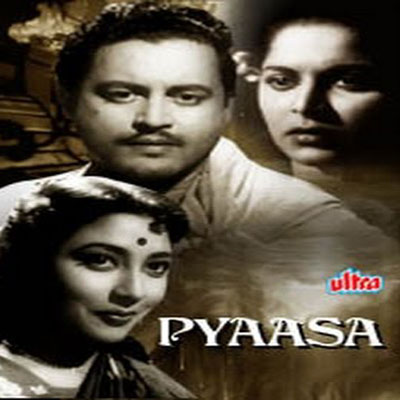
MUMBAI: Pyaasa – a timeless masterpiece by Guru Dutt has become the only Indian film restored by an Indian company for a world premiere in the competition section at the 72nd Venice Film Festival.
Ultra Media & Entertainment, which holds the negative rights of Pyaasa, had 45 experts working round the clock for over four months to restore and bring back the film to its original quality and showcase it globally.
Pyaasa will compete with 20 other restored films from all over the world for the coveted “Venice Classics Award” for the best restored film.
The 72nd Venice Film Festival will be held from 2 – 12 September 2015 in Venice.
The 1957 Pyaasa stars Guru Dutt, Waheeda Rehman and Mala Sinha.
The film has been restored completely for the Venice Film Festival with an objective of preserving and presenting it in its original quality to the global audience. Pyaasa will be screened on 11 and 12 September, 2015 in Sala Volpi auditorium at the Venice Film Festival.
Ultra Media & Entertainment CEO Sushil Kumar Agrawal said, “It gives us immense pleasure to present a cult classic like Pyaasa to the global audience. There is a huge fan following of Guru Dutt all over the world who have not been able to see this ageless magic in its original form and glory. It took us nearly four months to restore this film frame by frame and we are happy that the final outcome of the restored version can now be seen in its original form.”
“Out of the many classics that we have restored, Pyaasa has a special place in our hearts. It is one of the rarest gems of Indian cinema and we take great pride in preserving it and showcasing it globally. In fact the film has already created substantial buzz and we have several distribution enquiries from various parts of the world. We are also planning a major theatrical release of Pyaasa post its screening at the Venice Film Festival,” he added.
Ultra is planning to promote and market the film at the festival and is expecting demand from international distributors, sales agents, ancillary content aggregators and exhibitors for the restored version of Pyaasa at the festival.
The most challenging part after acquiring the rights was sourcing the authentic materials to complete the preservation. After much effort, Ultra found the original camera negatives of the film at an archive in India, However a lot of the parts of the negatives were either damaged or lost/
Ultra decided to use as much parts as possible from the original camera negative and a few parts were used from 35mm prints. A new digital transfer was created in 2K resolution on the ARRISCAN film scanner.This in-house technology of Ultra Studio & Digital Lab helped in applying a multidisciplinary, data-centric approach to the entire film’s restoration process.
Once the complete film was digitally transferred, came the most challenging part of restoration. Thousands of instances of dirt, lines, scratches, splices, warps, jitters and green patches were manually removed frame by frame under careful supervision by experienced artists The in-house talented professionals used a specialized film content mending and defect removal mechanism in their repair process. They carefully selected the best way to restore this priceless classic to its original quality.
The original monaural soundtrack was remastered at 24-bit from the 35mm optical soundtrack. Clicks, thumps, hiss and hum were manually removed frame by frame at the Ultra sound studio. The film will be presented in its original aspect ratio of 1.33:1 “Venice Classics” has been a crucial section of the Venice Film Festival, which has been premiering world class restored classics in the festival. The prime objective of this section is to bring back to spotlight old, underestimated and neglected films of the past, which have been restored an year back by film archives, cultural institutions or production companies around the world.
Over the years, Ultra has also restored various Indian classics like Chori Chori, Half Ticket, Paighaam, Insaniyat and Dil Tera Deewana amongst others.
