Tag: PwC India

  • PwC India and Kapture CX dial Up the future of agentic automation

    PwC India and Kapture CX dial Up the future of agentic automation

    MUMBAI: Call it the new CX factor where agents don’t just listen, they lead. In a major push towards redefining customer experience, Kapture CX, the agentic AI-powered CX platform, has partnered with PwC India to roll out a new generation of scalable automation solutions. The focus? Taking enterprises from task execution to intelligent orchestration, especially in sectors like Retail, Consumer, and BFSI.

    Unlike the typical chatbot hype, this alliance promises to deliver serious muscle behind the buzzwords. The partnership brings together Kapture CX’s proprietary LLMs and industry-specific AI approach with PwC India’s heavyweight experience in enterprise implementation and deep domain know-how.

    “Agentic automation is transforming how enterprises operate, shifting from task execution to intelligent orchestration. At PwC India, we’re helping clients lead this shift by harnessing this through purposeful collaborations. Our partnership with Kapture CX brings next-generation automation to the front lines of customer experience to drive smart efficiency and build agile, future-ready enterprises,” said PwC India chief client and alliance officer, Manpreet Singh Ahuja.

    The solutions will span contact centres, employee experience modules, and voice agents moving beyond generic automation to contextually intelligent interactions that can act, learn, and evolve.

    “With PwC India’s agentic automation solutions, we are paving the way for a smarter and more agile future for our clients. We are at the forefront of helping organisations reimagine the art-of-possible, enabling them to turn modern-day technology disruption into a competitive advantage,” said PwC India partner and leader of agentic automation Sumit Srivastav.

    Kapture CX’s AI isn’t just reactive, it’s proactive. Designed to automate workflows, enhance business operations, and cut costs, its AI agents aim to become a seamless extension of enterprise teams.

    “Partnering with PwC India marks a significant milestone for Kapture CX. Our AI agents are designed not just to respond but to act, automate workflows, and enhance business processes across industries. Together with PwC India, we are set to redefine how organizations harness Agentic AI for scalable, efficient, and cost-effective automation,” added Kapture CX co-founder and CEO Sheshgiri Kamath.

    Wrapping up the alliance’s vision Kapture CX VP for partnerships and alliances Nibha Kothari summed it up saying, “This collaboration is a strategic catalyst amplifying the potential of agentic AI to drive agentic automation at scale. By uniting Kapture’s advanced capabilities with PwC India’s enterprise depth, we’re delivering transformative, future-ready solutions. It’s been a privilege working alongside PwC India’s exceptional team, and we’re energized by the bold innovations we’ll shape together.”

    If you thought automation was just about bots, think again, this partnership is handing the mic to AI agents that know how to listen, lead, and leap ahead.

  • Business Today unveils jury for 13 edition of India’s Best CEOs Awards

    Business Today unveils jury for 13 edition of India’s Best CEOs Awards

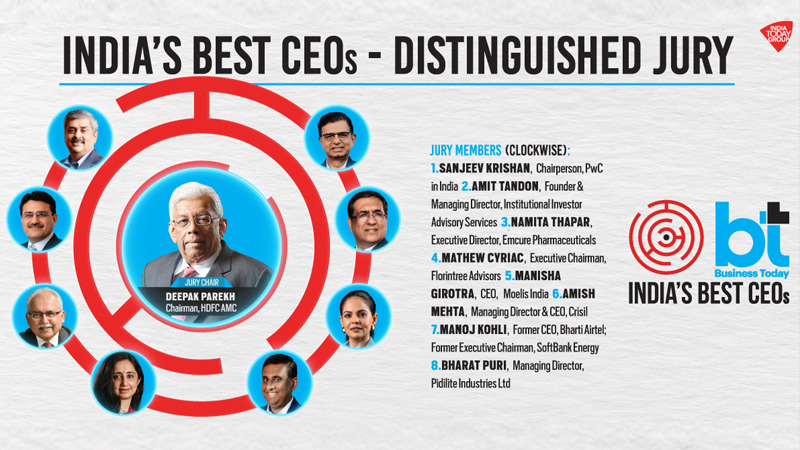
    MUMBAI: When it comes to celebrating corporate brilliance, Business Today leads the way. The 13 edition of BT India’s Best CEOs Awards is set to recognise the extraordinary leadership shaping India Inc., with the winners being adjudicated by a distinguished jury on 27 January 2025 in Mumbai.

    The prestigious annual awards, designed to honour excellence across industries, will be chaired by HDFC AMC chairman Deepak Parekh. A luminary in India’s financial sector, Parekh is celebrated for his visionary leadership and transformative contributions.

    Joining Parekh is a panel of ten eminent business leaders, bringing unmatched expertise and insight to the table:

    1. Bharat Puri, Managing Director, Pidilite Industries Ltd

    2. Sanjeev Krishan, Chairperson, PwC in India

    3. Manoj Kohli, Former CEO, Bharti Airtel; Former Executive Chairman, SoftBank Energy

    4. Amit Tandon, Founder & Managing Director, Institutional Investor Advisory Services

    5. Amish Mehta, Managing Director & CEO, Crisil

    6. Namita Thapar, Executive Director, Emcure Pharmaceuticals

    7. Manisha Girotra, CEO, Moelis India

    8. Mathew Cyriac, Executive Chairman, Florintree Advisors

    This stellar panel will evaluate CEOs on key performance parameters such as financial performance, strategic direction, successful M&A deals, shareholder returns, global expansion, and turnaround achievements.

    The awards programme selects its nominees from the BT 500 list, which ranks India’s largest firms by market capitalisation. In addition to its main categories, the awards feature special honours like Business Icon of the Year, Lifetime Achievement, and Impact Leader of the Year.

    For over a decade, PwC in India has served as a trusted knowledge partner, ensuring the evaluation process remains credible and rigorous. Their continued association underscores the legacy of integrity and excellence that defines these awards.

    The winners of the 13 BT India’s Best CEOs Awards will be revealed during a grand event on 21 March 2025 in Mumbai. This highly anticipated ceremony will celebrate the achievements of leaders whose contributions continue to inspire and transform Indian business.

    The BT India’s Best CEOs Awards are more than just accolades—they are a testament to the vision, resilience, and innovation that drive India’s economy. The 13 edition promises to once again spotlight those who have led with distinction and paved the way for a brighter, more prosperous corporate landscape.

  • PWC India & Indian entertainment & media growth projections for 2024-28

    PWC India & Indian entertainment & media growth projections for 2024-28

    MUMBAI: In July this year, PWC Global released its Global Entertainment & Media Outlook 2024-2028 which focused on global trends and growth. With the year coming to an end, PWC India decided to revisit Global Entertainment & Media Outlook 2024-2028  but from an India perspective. And here are  some of the data  points as sent out in a press release by PWC India. 

    PWC India believes that the Indian E&M industry is projected  to grow at a CAGR of 8.3 per cent to hit Rs 3,65,000 crore ($ 19.2 Billion) outpacing the 4.6 per cent global rate..

    Despite economic challenges and geopolitical tensions, global E&M revenues grew 5.5 per cent year-on-year, from Rs 13,891,000 crore in 2022 to Rs 17,359,000 crore in 2023. Currently, the US leads the global E&M market by revenue, with China in the second place and India at the ninth spot.

    PwC India chief digital officer & TMT leader Manpreet Singh Ahuja commented, “India’s entertainment & media sector is on the cusp of a major transformation. According to our report,  key growth drivers such as digital advertising, OTT platforms, online gaming, and generative AI are shaping the industry’s future. These rapidly expanding segments are positioning India as a global leader in innovation and growth. Businesses that adapt and innovate in these areas are poised to seize unparalleled opportunities in this dynamic landscape.”

    With India’s improved connectivity, rising ad revenues and favourable government policies around foreign direct investment (FDI), the country is predicted to see one of the highest growth rates in the next five years.

    The country’s large millennial and gen-Z population base of over 910 million has access to the world’s cheapest data costs. At present, India has 800 million broadband subscriptions, 550 million smartphone users and 780 million internet users. In fact, Indians are spending 78 per cent of their time on mobile phone apps related to E&M. Leveraging India’s strong growth trajectory in the E&M sector, the Indian government is set to host the inaugural Waves – a summit,  in the hope of boosting its E&M sector globally through stakeholder collaboration and innovation.

    With growing consumption and gross domestic product (GDP) growth in India, the ad market is projected to grow at a 9.4 per cent CAGR from Rs 1,01,000 crore in 2023 to Rs 1,58,000 crore in 2028, which is 1.4x the global average. Most of this growth will come from the digital front (internet advertising), which is expected to grow at a 15.6 per cent CAGR, rising from Rs 41,000 crore in 2023 to Rs 85,000 crore in 2028.

    Internet advertising’s year-on-year growth, which was 26 per cent in 2023, will remain in double digits throughout the forecast period (2024–28), and is expected to be 12.2 per cent in 2028.

    The shift towards cord-cutting is expected to accelerate. Traditional TV advertising will grow at a 4.2 per cent CAGR between 2023 to 2028, while global revenues are set to drop by -1.6 per cent. India is poised to become the fourth-largest TV advertising market by 2026.

    As per the 2024 outlook, other subsectors will also witness growth that surpasses global averages:

    * The total online gaming and esports revenue in India stood at Rs 16,480 crore in 2023 and is expected to reach Rs 39,583 crore by 2028, growing at a CAGR of 19.2 per cent. With the inclusion of real money gaming (as per PwC’s India Gaming Report ‘24) the total gaming and esports revenue would amount to Rs 33,000 crore ($ 4 billion) in 2023 and is expected to reach Rs 66,000 crore ($8 billion) by 2028 at a CAGR of 14.5 per cent. Globally, video games and esports revenue will increase at a CAGR of 8 per cent.

    * Over-the-top (OTT) will be the third-fastest growing segment with a CAGR of 14.9 per cent, putting the country in lead by 2028.

    * Infrastructure enhancements have supported massive growth in India’s out-of-home (OOH) advertising market which grew by 12.9 per cent in 2023. It is expected to continue to grow at a 7.6 per cent CAGR.

    * When it comes to print advertising revenues, despite a global decline at a CAGR of -2.6 per cent, India’s market is expected to grow at a rate of 3 per cent, making it the third  largest print market in the world by 2028

    * India’s cinema market continues to expand, growing at a 14.1 per cent CAGR.

    * The total music (live, recorded and digital) revenue grew from Rs 2,416 crore ($293 million) in 2019 to Rs 6,686 crore ($811 million) in 2023. It is expected to cross Rs 10,899 crore ($1.3 billion) by 2028, growing at a CAGR of 10.3 per cent.

    * At a 5.6 per cent CAGR, India will stand out as having the highest B2B revenue growth rate in the world over the next five years. In contrast, global B2B revenue growth is forecasted at a 1.9 per cent CAGR.
    The report highlights four key opportunities in the E&M sector.

    Internet advertising emerges as the fastest-growing market in Asia-Pacific and the second globally, with a projected 15.6 per cent CAGR (2023–2028). Companies can prioritise regulatory compliance and leverage data analytics to enhance trust and implement targeted advertising strategies.

    OTT platforms in India, the world’s fastest-growing, saw a 20.9 per cent rise in 2023, reaching Rs 17,496 crore ($2.1 billion), and are projected to double by 2028 (14.9 per cent CAGR). Focusing on advertising-supported tiers, market consolidation and regional narratives can boost engagement.

    Online gaming and esports are rapidly expanding, projected to represent nine per cent of the E&M sector by 2028. Promoting responsible gaming and investing in high-quality AAA games will position Indian studios on the global stage. Lastly, generative AI (GenAI) is set to transform content creation, personalisation and monetisation, with over 70 per cent of global companies expected to adopt it by 2025. Early adoption of GenAI in India can drive hyper-personalised content and dynamic advertising campaigns.

    The report also outlines strategic approaches for companies to enhance success. It recommends consolidation among regional or niche players through mergers and acquisitions to increase size and scale. It highlights the use of social media for marketing and distribution, as media companies leverage these platforms for content promotion.

    The report suggests innovation in content strategy, including esports, online gaming, and indigenous sports to meet changing consumer behaviours. It advises investment in cost optimisation through analytics, audits, and automation to lower operational and production costs. Finally, it points to the use of GenAI for creating hyper-personalised content discovery and improving user experiences, especially for regional players aiming to match the technological capabilities of global peers.
     

  • Moneycontrol PRO & Waterfield Advisors with PwC India returns with third edition of Indian Family Business Awards

    Moneycontrol PRO & Waterfield Advisors with PwC India returns with third edition of Indian Family Business Awards

    Mumbai: To honour and recognise families that have significantly contributed to India’s economic growth, entrepreneurial spirit, and job creation, Moneycontrol PRO, a fast-growing subscription service, and Waterfield Advisors, a leading independent multi-family office and wealth advisory firm, have united once again along with PwC India as the process partner to host the third edition of the ‘Indian Family Business Awards 2023’

    The previous edition of the Indian Family Business Awards in 2022 received an impressive response with 140 plus entries across various categories and 200 plus on-ground attendees. The upcoming 2023 edition of the event promises to be even grander.

    This year, the awards is segregated into five different segments – Super (under Rs 1,000 crore), Mega (between Rs 1,000 and Rs 5,000 crore), Giga (over Rs 5,000 crore), Best Startup Family Business (under Rs 1,000 crore & 5 years of existence) and Philanthropy Award (Best Family Business). To qualify for the awards, a family business must have been established in India and should be operational for at least 10 years, while start-ups must have been incorporated at least five years ago.  Additionally, the family should hold a majority stake and/or control in the business.

    Presented by Moneycontrol PRO, co-created with Waterfield Advisors, process partner PwC India, the Indian Family Business Awards 2023 will feature various categories – Best Family Business, Best Governance, Most Innovative, Disruptive & Transformational Family Business, Best Family Business Led by a Woman, Best Startup Family Business and Philanthropy. This year too the participation process involves self-nomination. Once nominations are submitted, the process partner to review the applications and determine their suitability under the various award categories and, where necessary, conduct personal interviews or meetings with them. They then submit their report to the Jury panel. The Jury panel then shortlist the winners post thorough discussions. The esteemed Indian family business award 2023 winners to be honoured and felicitated with a grand on-ground ceremony.  

    In its third year, the distinguished jury for the awards will include Soumya Rajan (Founder & CEO, Waterfield Advisors); Sonu Bhasin (Founder of FAB – Families and Businesses); Gopal Srinivasan (Chairman, TVS Capital Funds Limited); and Gaurav Dalmia (Chairman Dalmia Group Holdings).

    Waterfield Advisors founder & CEO Soumya Rajan stated, “We conceptualised the Indian Family Business Awards (IFBA) to honour India’s family businesses. At Waterfield, as trusted advisors to this illustrious community, we acknowledge their immense contributions to India’s economic progress. Over the first two seasons, we have laid the foundations for an event that is now much anticipated. We are excited for a grander third season and encourage family businesses across India to participate.”

    PwC India  Partner & Leader – Entrepreneurial & Private Business Falguni Shah stated, “As trusted advisors to family businesses, we are honoured to be the process partners for the India Family Business Awards (IFBA). This prestigious platform allows us to support and celebrate the best in the industry. We eagerly anticipate the journey of evaluating submissions from across the country, uncovering unique strengths, and providing insights that truly make these businesses stand out.”
     

  • Siti Networks CFO Vikram Singh Panwar resigns

    Siti Networks CFO Vikram Singh Panwar resigns

    MUMBAI: Even as all eyes have been focused on the drama at Zee Entertainment Enterprises, there’s been some developments at the troubled Subhash Chandra-owned Siti Networks too. Chief financial officer Vikram Singh Panwar put in his resignation a couple of days ago. The company filed a notice to this effect with the Bombay stock exchange on 9 August 2023. Panwar will continue with Siti Networks until the end of his notice period.

    Panwar had joined the company as CFO as recently as 15 April 2023. A chartered accountant with more than 18 years of experience, Panwar has been part of the digital and structural transformation journey of various companies in telecom, IT, apparel and textile, chemicals and consulting. Among the firms which he has worked with include:  HFCL, HCL Tech, PwC India, Raymond and PI Industries.

  • India’s entertainment & media industry to grow 8.8% CAGR by 2026: PwC Report

    India’s entertainment & media industry to grow 8.8% CAGR by 2026: PwC Report

    Mumbai: By 2026, the Indian entertainment & media sector is anticipated to grow by 8.8 per cent compound annual growth rate (CAGR) to reach Rs 4,30,401 crore. These figures are taken from PwC’s Global Entertainment & Media (E&M) Outlook 2022–2026, which is the 23rd annual analysis and forecast of E&M expenditures by consumers and advertisers across 52 territories.

    ”The Indian media and entertainment outlook for the next few years is quite unique. There is an exciting pace of growth of digital media and advertising led by the deeper penetration of internet and mobile devices in our market,” said PwC India partner & leader – entertainment & media Rajib Basu. “At the same time, traditional media will maintain their steady growth rate over the next few years. We shall see a very different profile of media and entertainment related businesses & revenue models emerging in the digital space once we have the rollout of 5G.”

    Key findings for India in this year’s Outlook include:

    OTT Video: The elimination of public entertainment and more time spent at home helped the total OTT revenue more than double in 2020. Revenue nearly doubled once more in 2021 as a result of this pattern. The market would still increase at a remarkable 14.1 per cent CAGR to reach Rs 21,032 crore in 2026, despite slower growth rates. Subscription services, which accounted for 90.5 per cent of revenue in 2021 and are projected to account for 95 per cent of revenue in 2026, are fueling this rapid growth.

    Video games & esports: India’s overall revenue from video games and esports is expected to rise by 18.3 per cent CAGR to Rs 37,535 crore by 2026 from Rs 16,200 crore in 2021. India is the third-fastest-growing market for video games in the world, behind Pakistan and Turkey, although still being a relatively small market given the size and population of the nation. Social/casual gaming accounted for Rs 13,244 crore, or 83.9 per cent, of India’s overall video game and esports revenue in 2021. Revenue from social/casual gaming is anticipated to grow at a 20.6 per cent CAGR and reach Rs 34,581 crore by 2026. The introduction of 5G technology to the market will be a key enabler of this segment.

    TV advertising: India’s TV advertising market had a -10.8 per cent fall over 2019 levels in 2020 as a result of the Covid-19 recession, which struck after several years of rapid expansion. This turned out to be a brief setback. This sector increased by 16.9 per cent to Rs 32,374 crore in 2021 as the country’s economy  started to expand again. By 2026, the market would have grown by 6.3 per cent CAGR, reaching Rs 43,410 crore. After the US, Japan, China, and the UK, India will soon rank as the world’s fifth-largest TV advertising market.

    Cinema: India is projected to expand at the highest growth rate among all segments throughout the forecast period, with a startling 38.3 per cent CAGR, to reach Rs 16,198 crore by 2026. India is now the third-largest market globally in terms of admissions after China and the US. More than 379 million cinema tickets were sold in India in 2021, a respectable rise over the 278 million admissions in 2020 (and higher than the 226 million admissions in the US in 2020) but a significant decrease (-85.4 per cent) from the 1.9 billion tickets sold prior to the pre-pandemic.

    Internet advertising: The Indian Internet advertising market is anticipated to grow at a CAGR of 12.1 per cent to Rs 28,234 crore by 2026. The mobile sector dominates the country’s Internet advertising business, accounting for 60.1 per cent of total revenue in 2021 and rising to 69.3 per cent by 2026 due to India’s market for mobile-first internet access. The mobile sector is dominated by display advertising, which generated 90.7 per cent of total income in 2021 but will drop to 88.9 per cent of the total in 2026. India’s revenue from wired Internet access was Rs 6,379 crore in 2021, and it is expected to grow at a CAGR of 6.3 per cent to Rs 8,829 crore by 2026.

    Out-Of-Home Advertising: One of the strongest comebacks globally is being made by the out-of-home (OOH) advertising market in India, which is expected to rise at a 12.57 percent CAGR to reach Rs 5,562 crore in 2026. One of the sharpest market downturns and the largest revenue decline among the main economies of the world, total OOH revenue recovered by 63.4 per cent in 2021 over the levels of 2020. The total OOH revenue in 2021 reached Rs 3,076 crore. The momentum of this rebound will carry over into 2022, and by year-end the market will be at the value Rs 4,084 crore.

  • VBS 2021: Customer remains king for cable & broadband industry

    VBS 2021: Customer remains king for cable & broadband industry

    NEW DELHI: In the aftermath of Covid2019, businesses and organisations across the world tried to make sense of what hit them as they weighed their futures against the new lessons that the pandemic taught them, unlearning some of the established tenets in the process. Industry experts largely agree that the television broadcasting, video-on-demand (VoD) and broadband ecosystem had it relatively better off with their customers homebound and skyrocketing demands for connectivity and content. However, swift technological evolution and even swifter changes in consumer behaviour and demands posed challenges on this front too.

    And these challenges are what the seventeenth edition of the Video and Broadband Summit attempted to shine a light on. The insightful discussions during the summit rounded off with a session focusing on ‘Customer First’ moderated by PwC India Partner Raman Kalra. The panelists included some eminent names from the industry, such as JioFiber president Anuj Jain, Siti Networks DGM Strategy Anurag Nigam, UCN Cable Network head – operations Debashish Mohanty, GTPL Hathway vice president Yatin Gupta and Shemaroo entertainment COO – broadcasting business Sandeep Gupta.

    Kalra opened the session by commenting about how customers today are spoilt for choice when it comes to choosing content to consume, with mushrooming VoD and OTT platforms and ever increasing channels of entertainment. He noted that despite the demands for content and internet broadband having hit the roof during the pandemic, the challenge of remaining relevant is a concern for both the service and content provider in the highly competitive market today. Kalra posed the question on what strategies can be adopted by the industry players so as to ensure they continue to acquire and retain their customer base, keeping in mind the constantly changing customer demands and behaviour.

    Jain agreed that “customer first is the fundamental pillar” for their business. He stated three crucial points for the same—

    ·       How to enable the “right plan” for the customer to get associated with the brand

    ·       How do you deliver customer onboarding, meeting the promises that you made in the plan

    ·       Third is “in life” wherein after the customer gets activated, your service has to  perform and if not, you must be aware and able to pinpoint where, when and what went wrong through data analytics. To further make his point Jain shared what is referred to as the ‘death of call center’ set-up wherein the business must know about the disruption in service, before the customer breaks it to them.

    Gupta shared insights on the major consumer demand shift in the last twelve-odd months of Covid. “It reflected a huge spike in terms of subscriber base for cable TV which flattened out later. But the broadband business has continued to grow because people are still working from home, kids are still studying from home.”

    In order to deal with the impact of consumers’ pressing demands, altered business strategies had to be deployed, shared Mohanty. “In the present scenario customers have multiple demands- linear TV, OTT Content, online classes, work-from-home- everything he needs from a single desktop or device, sometimes. Basically FTH- Fibre-To-Home is the best solution for connectivity at least for the next few years.”

    He went on to say, “UCN is doing a QOS (quality of service) survey – on what the customer feels about UCN connectivity quality and bandwidth. As of now we are providing 100 Mbps which we have increased to 300 Mbps with unlimited plans,” and added that with increasing consumer demands, if a business today fails to provide a particular service, then someone else will.

    Nigam interjected how nobody could have imagined a year back that the entire India would work from home one day. “All this has forced an average household to stick to the basics, that is focus on the necessities and be frugal for as long as they can,” he said. If this continues for too long, it will impact the industry on multiple levels, whether it’s the broadcaster or a distribution partner.

    Citing an instance from MSO consumer behaviour post lockdown, he shared how consumers had become selective while opting for TV packages. “Consumers have downgraded from high value content package to low value package or they have opted for standard definition (SD) DPO pack and topped it with ala carte HD channels, instead of taking an HD package. Why? Because the pricing of SD was lower than HD, this despite having an HDTV at their disposal.” Even multiple TV households were decreasing and hybrid TVs were getting replaced with OTTs during the lockdown.

    Debashish took the discussion further by adding that lack of “exclusivity” in HD channel content is a major factor, since the customer is getting similar content on SD at a lower price. “So channel packaging needs to be done as per customer requirement,” he remarked. Entry barrier is also due to the higher pricing, as compared to SD. Only if HD content differs and is exclusive can we see real change, was broadly agreed by all.

    Competitiveness has also gotten fiercer, which can adversely impact the revenue of the whole industry in the long run. “Hence it is time that all industry players come up with product differentiation- exploring new customer segments, converting customer service departments into ‘customer experience enhancement’ departments  which can only be achieved if all the stakeholders work together towards a common goal- that’s ensuring customer success,” stated Nigam.

    From a content perspective, Shemaroo’s Sandeep Gupta said, “At Shemaroo, content is evaluated based on customer taste. So content has to keep evolving for, at the end of the day, consumers come to us looking for entertainment. For broadcasting, we look into the research and BARC data.”

    The discussion then steered to customer acquisition and on what are the leading practices being taken by the industry to ensure it. Jio’s Anuj Jain began by admitting they focused more on delivering on customer expectations and less on marketing. He added that fibre being a cherry picking market and more localised, it’s a different challenge altogether.

    When it comes to the cable industry, it is mostly a “one or two sizes fits all” kind of business, admitted GTPL Hathway’s Gupta, with not much being looked into individual customer preferences as long as they get their pack of choice. This situation is slowly changing, the company has begun ‘know your customer’ processes to understand who is the customer first and inform them about the innovative products or services on offer. “We were one of the very few platforms that started a campaign targeted at all DTH players called ‘Chhatri hatao, GTPL lagao’ to remove the Dish and replace with GTPL Hathway subscription, which got a fair amount of response from consumers,” he added.

    Knowing your consumer is a part of the process to enhance consumer experience, which also involves proactively handling tech / troubleshooting issues. “With our one million subscriber base, the total data that is collected from every customer per week is one Petabyte of data- which captures every aspect of the customer experience data- any sync issues, freezing, buffering issues etc. This is how we make customers the focus and part of the process,” explained Jain.

    Factors like user outreach and bettering their experience goes on to ensure customer stickiness. Brands need to be consistent, facilitate continuity, safeguard connectivity of service and target smooth onboarding experience to achieve this goal, suggested the panelists.

    The session concluded by highlighting that there’s a need for businesses to invest deeply in knowing and engaging with their customers. Analysing customers’ content consumption data can also lead to rich dividends and RoI. “Deep data insights and data intelligence can lead to immense possibilities for businesses,” Kalra summed up. In conclusion, enhancing customer service and experience is a key component to the success and growth of every stakeholder in the industry.

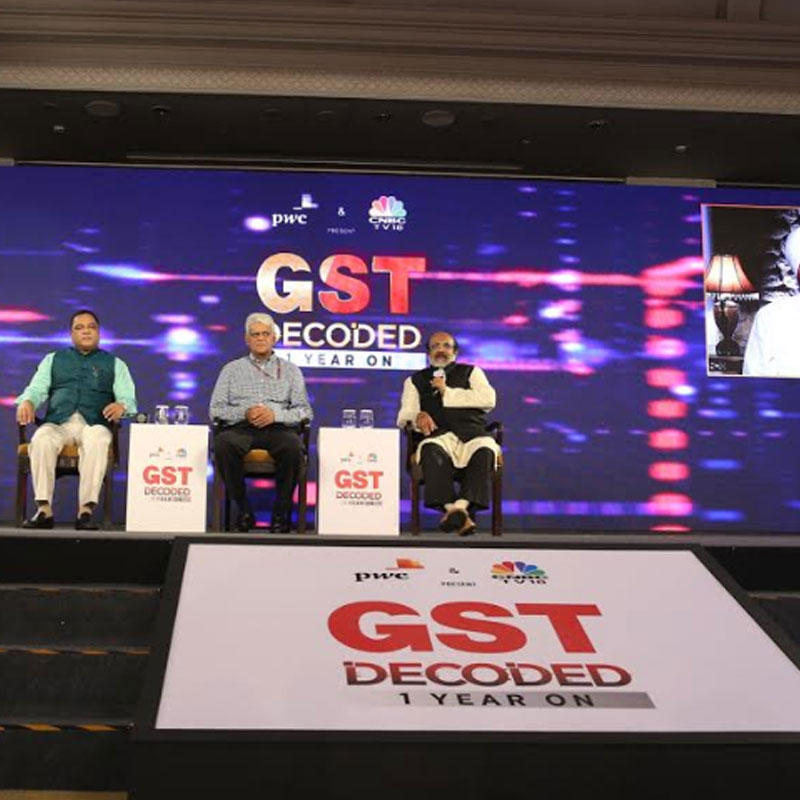
  • CNBC-TV18 in association with PwC India successfully highlighted impact of GST in first-of-its-kind forum – ‘GST Decoded – 1 Year On’

    CNBC-TV18 in association with PwC India successfully highlighted impact of GST in first-of-its-kind forum – ‘GST Decoded – 1 Year On’

    MUMBAI: Marking 1 year of completion of India’s boldest tax reform – GST Act, CNBC-TV18, the country’s foremost business news brand, in association with PwC India successfully hosted a first-of-its-kind-initiative ‘GST Decoded – 1 Year On’. A special report from PwC India titled ‘365 days of GST: A Historic Journey’ was also launched at this unique forum. The keynote address by Dr. Hasmukh Adhia, Union Finance Secretary emphasized on the GST achievements as well as the foreseen challenges.

    The prestigious conclave witnessed participation from key policymakers from the government such as Thomas Isaac, Minister of Finance – Govt. of Kerala, Manpreet Singh Badal, Minister of Finance – Govt. of Punjab and Mauvin Godinho, Panchayat Minister – Govt. of Goa and corporate luminaries Kabir Ahmed Shakir, CFO – Microsoft, Niranjan Gupta, CFO – Hero MotoCorp , Ashok Tyagi, Whole-time Director & Board Member – DLF, Nitin Saluja, Founder – Chaayos and Shyamal Mukherjee, Chairman – PwC who discussed and debated about the opportunities which can be tapped along with challenges that lay ahead.

    With an objective to capture the implications of the GST, panelists addressed how sectors like software enterprises, automotive, real-estate, and hospitality amongst many others had been affected by the reform over the last one year.  

    Below are the key talk points from the panel discussions at the forum:

    Dr. Hasmukh Adhia, Union Finance Secretary:

    We have released Rs 50,000 cr out of the Rs 2 lakh cr IGST collections to states as a provisional settlement. We are holding Rs 1.16 lakh cr for settlements with taxpayers
    We have to watch revenues before rationalizing the items under the 28% tax slab, removing items immediately is not feasible
    States like Punjab may require compensation for more than 5 years, but many states may not require compensation from Centre after 2-3 years
    Natural gas and aviation turbine fuel may come under GST
    Claiming wrong input tax credit is an area that can be plugged. There is a great scope to improve revenue collection
    Sugar cess has merits & demerits. Cess is not a bad idea if does not create compliance issues
    There is scope to bring certain items from 28% bracket to 18%
    First priority is to implement new #GST return forms. Second priority is compliance not with ‘danda’ but with ‘data analytics’… Data is the new ‘danda’
    Thomas Issac, Minister of Finance – Govt. of Kerala:

    The experience OF GST implementation in the first year has been rather disappointing for me
    Anti-profiteering clause is ‘ineffective’
    Small companies & unorganized businesses are in trouble
    We can discuss bringing petroleum products under GST but states must be compensated
    Centre should rollback fuel excise hikes, petrol, diesel price problem is solved
    Manpreet Singh Badal, Minister of Finance – Govt. of Punjab:

    40% of Punjab’s tax base has been subsumed. At the moment Punjab is a compensation state; worried about how we are going to run the state after 2022
    I would give 8/10 for implementing GST but only 2/10 for the way it was implemented
    Mauvin Godinho, Panchayat Minister – Govt. of Goa:

    It’s a splendid legislation that’s working very well
    Every political party should be complimented, all Indians united for one reform
    Sugar cess decision will be taken only if everybody is on board. GST Council is not run by majority
    Mahender Singh, Member (GST), CBIC:

    Compliance from taxpayers is a concern. It is a great challenge to convince people to pay tax
    If people don’t pay taxes they are causing harm to themselves. We will run out of patience with poor tax compliance
    It has been a rollercoaster ride & a great success
    Kabir Ahmed Shakir, CFO – Microsoft:

    Global peers show disbelief that we have implemented GST in such a diverse country

  • CNBC-TV18 and PwC India present ‘GST Decoded – 1 Year On’

    CNBC-TV18 and PwC India present ‘GST Decoded – 1 Year On’

    MUMBAI: The introduction of GST regime has been India’s boldest tax reform since Independence. To mark the completion of the first year under this act, CNBC-TV18, the country’s foremost business news brand, in association with PwC India has announced a unique initiative called “GST Decoded – 1 Year On.” This first-of-its-kind conclave is being planned with an intent to analyse and review the critical journey of the implementation of GST over the last year as well as explore the opportunities and challenges that lay ahead. The prestigious event will be held on June 28, 2018 at Hotel Taj Diplomatic Enclave in New Delhi.

    The conclave will welcome notable delegates bringing together decision-makers & policy architects from the centre, states, leading CEOs, CFOs, top tax consultants, economists and other corporate dignitaries under one roof for a discourse around GST, sharing their in-depth experience, insights and varied perspectives.

    On the policy front, the States viewpoint will be articulated in a special panel with representation from some of the key State finance Ministers & members of the GST Council such as Thomas Isaac, Minister of Finance – Govt. of Kerala, Manpreet Singh Badal, Minister of Finance – Govt. of Punjab, Mauvin Godinho, Panchayat Minister – Govt. of Goa. Dr. Hasmukh Adhia, Union Finance Secretary will be sharing the perspective of the Union government on the GST achievements in the past year and the anticipated challenges during the current financial calendar in a special Townhall session.

    India Inc will be represented by leading corporate voices including Kabir Ahmed Shakir, CFO – Microsoft, Niranjan Gupta, CFO – Hero MotoCorp , Ashok Tyagi, Whole-time Director & Board Member – DLF, Nitin Saluja, Founder – Chaayos, Rohan Shah, leading Lawyer & Tax Expert and Shyamal Mukherjee, Chairman – PwC India. These luminaries will be participating in a thought-provoking panel discussion, addressing how the corporate world, including sectors like software enterprises, automotive real-estate, and hospitality amongst many others has been impacted since the introduction of GST in India. The panellists will also highlight the advantages along with key challenges faced by the industry professionals during the first year of implementation of GST in the country. 

    The informative and riveting discussion will be followed by the launch of a special report from PwC India titled ‘365 days of GST: A Historic Journey’ and an address by PwC Indirect Tax Leader, Pratik Jain.

    TV18, CEO Forbes India & President – Revenue, Joy Chakraborthy said, “As the undisputed leaders in the Business News space, we at CNBC-TV18 constantly keep our finger on the pulse of the economic policy environment & India Inc’s reactions to it. ‘GST Decoded – 1 Year On’ is one such unique initiative focused on gauging the impact of GST rollout – one of the most ambitious fiscal reforms in the recent history of our country. It will be great to understand the effects of this tax regime from such an august gathering.”

    CNBC-TV18, Managing Editor, Shereen Bhan said, “The Channel has been the forefront of educating viewers about the GST. We launched the GST Helpline ahead of the July 1 rollout to help India Inc make the transition. Over the past year, through our GST Town halls and Ground reports, we have engaged with key stakeholders with an aim to assess and evaluate the implementation of this much-awaited reform. We have also put the spotlight on the changes needed to make the execution and administration more effective. As we start the journey into year two, we intend to continue our efforts to inform, engage and empower.”

    PwC, Partner and Leader Indirect Tax, Pratik Jain said, “Completion of one year of GST is a good time to reflect what has worked for India Inc and what not.  More importantly, it’s time to understand how businesses are changing on the ground and what Industry now expects the Government to do so that we are able to realize the real benefits that GST can potentially offer.  Having worked with hundreds of leading corporates in GST transition and now technology led compliance management, we at PwC are excited to be part of this momentous reform. Through this event, we look forward to continue playing a constructive role in consultations between the industry and policymaker.”

  • Raman Kalra joins PwC India as entertainment & media sector advisory leader

    MUMBAI: Raman Kalra has been hired as partner, PwC India – Entertainment & Media Sector Advisory Leader (and Emerging Technologies Leader). He is responsible for strategy through execution as: Entertainment & Media Sector Advisory Leader & Emerging Technologies Leader responsible for transformation agenda across Industries leveraging digital & new emerging technologies.

    Based in Gurgaon (Haryana), Kalra is an entrepreneur at heart with 24 years of experience in industry and consulting, with a strong track record in conceptualising, growing and managing businesses.

    Mentor & advisor to various start-ups across Digital Media, Education & Advertisement areas, he turned entrepreneur during 2015/16. He worked as Partner/Executive Director with IBM Global Business Services, India/South Asia as Country Head – Media & Entertainment Industry & also Lead Transformation Partner for Bharti Airtel.

    With a strong understanding of the industry domain & technology, Kalra had been acting as the trusted advisor to CxOs at different levels & functions across the industry segments. During his consulting tenure, he has successfully directed & delivered engagements across areas of business growth strategy & transformation, business process consulting, shared services & outsourcing, ERP & other industry focused technologies. Raman also has significant international experience working with diverse global teams in different geographies.

    At PwC, he is also responsible for transformation agenda across Industries leveraging digital & new emerging technologies like IoT, Cognitive Computing/Machine Learning, Augmented Reality (AR)/Virtual Reality (VR), Blockchain and Robotics.

    Prior to this assignment, Kalra curated StoreSay, India’s first integrated location based B2B2C marketplace for electronics, gadgets & appliances connecting trusted nearby brick & mortar stores with customers on one hand and with the distributors/manufacturers on the other hand. StoreSay was awarded among the Top 5 finalist in IBM B2C Start-up Star challenge across India in May 2016.