Tag: Punit Goenka

  • Zee Entertainment presents ‘Zee Bangla Cinema Originals’

    Zee Entertainment presents ‘Zee Bangla Cinema Originals’

    MUMBAI: Zee Entertainment Enterprises Ltd (Zeel) has been entertaining people of West Bengal with its GEC, Zee Bangla for the past 15 years. Further, with a vision of celebrating Bengali films and taking them to Bengali speaking people across the country, Zeel launched West Bengal’s first 24 hour movie channel, Zee Bangla Cinema (ZBC) in 2012. This year, the network has taken a new step by creating great films for television through its initiative – ‘Zee Bangla Cinema Originals.’


    Speaking on this initiative, Zeel MD & CEO Punit Goenka said, “At Zeel, we are constantly looking at creating new avenues of entertainment for our audiences and this innovative step is poised to help showcase more of the great works of the immensely talented directors of West Bengal. We are confident that Zee Bangla Cinema will fuel the growth of the West Bengal film industry.”


    This latest endeavour of ‘Zee Bangla Cinema Originals’ is an industry first for West Bengal. It is envisioned to contribute and continue the proud legacy of Bengali films by creating engaging original film content, which will be showcased exclusively on Zee Bangla Cinema. With a platform that reaches out to almost 7 million people on a weekly basis, ‘Zee Bangla Cinema Originals’ will enthrall the Bengali audience with a brand new film every month.


    ‘Zee Bangla Cinema Originals’ announces its first film titled ‘Ekla Cholo’, which will premiere on Zee Bangla Cinema on Sunday, 18 January 2015.


    Bengal has a rich legacy of creating cinema which is timeless. Film makers like Satyajit Ray, Ritwick Ghatak, Mrinal Sen, Rituparna Ghosh and many more have cultivated a global audience by creating engaging films. As a first mover in the market, Zee Bangla Cinema has always looked at providing high quality film entertainment to its viewers. With the largest Bengali film library, ZBC has been at the forefront of Bangla film entertainment.

  • BARC India to conduct roadshows in February

    BARC India to conduct roadshows in February

    MUMBAI: The Broadcast Audience Research Council (BARC) is all set for 2015, as it will hold roadshows in February on the GUI (Graphical User Interface) in Mumbai, Delhi, Kolkata and Bengaluru.

    It was in 2013 when the Council held its first round of roadshows that aimed at sharing the latest updates from BARC with all constituents across the entire broadcast value chain, and, equally important, to receive feedback and suggestions, so that the new television measurement system is completely robust, transparent and representative.

    Welcoming the New Year, the council thanked its stakeholders, vendors, partners and associates as well as highlighted its achievements. With more than 275 channels having ordered for embedders, all major networks in each region and across genres are now on-board.

    As it continues to reach out to the stakeholders for feedback, the playout monitoring facilities are in action and meta-tagging of content across watermarked channels is in full throttle in Mumbai and Bengaluru.

    It has also tested the end-to-end integration of the system, which is working perfectly fine. The technology handshakes are in place and ratings are being generated from the BARC system now.

    In continuation to unravel the puzzle of TV audience measurement system in India, BARC India shared a few learnings and insights on the importance of Relative Errors and Confidence Levels in audience measurement for new beginnings.

    BARC India and the importance of Relative Error

    Over the past few months, BARC India has highlighted its commitment to data robustness and has spoken about lower Relative Errors at high Confidence Levels. It has repeatedly highlighted that Relative Errors are an important factor to be considered whenever it evaluated the ratings data, or read any research report, for that matter.

    Relative Error and its impact on research data

    It is not possible to sample every individual (except perhaps, a Census); hence, sample surveys are undertaken. Statistics offer scientific methods to estimate phenomena across entire population by studying samples. Any sample survey suffers inherently from various errors. Owing to these, statistics never talk about an average (or mean) without talking simultaneously about a measure of dispersion, usually the standard deviation.

    A researcher has to balance between demands of greater accuracy and constraints of finite resources. Statisticians therefore work with defined ‘Confidence Intervals’ and ‘Sampling Errors’. One of these sampling errors is the ‘Relative Error’, or the deviation (in percentage) of the observed value from the actual (expected) value.

    Confidence Level (or Confidence Interval)

    Confidence Level is generally defined as a percentage or a decimal figure less than one. So, if a researcher says that the Confidence Interval is 90 per cent, what he means is that 90 per cent of the samples of the same size taken from the same population will produce results within a defined range.

    Relative Error

    A TV ratings measurement system estimates that the programme has 1 TRP with a standard deviation of 0.25. This means that the actual rating is expected to lie between 1-0.25 and 1+0.25 or 0.75 and 1.25. The relative error is simply 0.25/1.0 or 25 per cent.

     A simplistic explanation that may antagonise a purist, but can be explained simply in the diagram below:

    In other words, it is important for a research to ensure least possible Relative Error at the highest possible Confidence Level; else it risks generating data with such wide variance that it becomes meaningless. Just imagine saying that a programme has 1 TRP at the above Relative Errors.

    Factors affecting Relative Error

    The most important factor that affects Relative Error is sample size. Relative Error increases in geometric magnitude as sample size decreases, while it becomes independent of sample size beyond a certain threshold.

    Sampling is also relatively simpler when estimating a homogenous population and more complex for heterogeneous population. It is hence extremely important to have a significantly large sample size, especially when calculating estimates for large heterogeneous universe.

    On how BARC India intends to handle issues related to sample size to ensure robustness of data, the council shares a hypothetical scenario – A planner wishes to evaluate programme viewership for the following TG for a premium brand – males, NCCS AB, 40+ in Delhi

    Total Sample Size: 130

    Approx. sample size for a programme with a rating of 1 per cent viewers: 13

     A sample size of 13 is way too low to do any meaningful evaluation. Hence, BARC India would not encourage such evaluations.

     To circumvent this issue, BARC India intends to aggregate the data through one of the following means:

    •        Aggregate viewership data across two or more weeks

    •        Add more cities to the sample, aggregating geographically

    •        Instead of considering a particular individual programme or a limited time, evaluate a day part, thus aggregating by time bands

    Each of the above methods would increase the sample size and would allow the planner to make his decision based on robust relevant data. The BARC India Technical Committee is evaluating options of either hardcoding the aggregations in the pre-publishing stage itself, or allowing the planner to decide the aggregation based on his/her requirements. This decision would be taken only after seeing the data for all panel homes and assessing the pros and cons of each method.

  • Content differentiation has been the clear winner for Zindagi: Punit Goenka

    Content differentiation has been the clear winner for Zindagi: Punit Goenka

    MUMBAI: A result of ZEEL MD and CEO Punit Goenka’s gut feeling, Zindagi, the premium mass Hindi entertainment channel from the network, was meant to be a breath of fresh air in the cluttered market space.

    Launched six months ago on 23 June, the channel promised to break out of the usual set framework and melodrama with the shows never seen on Indian small screens. Keeping true to its philosophy and tagline Vasudhaiva Kutumbakam, shows from across the border were handpicked to meet the Indian sensibilities.

    With 32 GVTs in week 51 of TAM TV ratings, the channel targeting at the CS4+ AB in Hindi speaking markets (HSM) is happy with its performance, so far. “Extremely delighted with the launch and the subsequent response we are getting from the viewers. The channel has been received very well and has a rapidly growing loyal base,” says Goenka who believes that Zindagi has managed to create a new category in the Hindi entertainment space and is the only premium Hindi channel in India.

    The stories, when compared to the over-the-top (OTT) Hindi melodrama, have a realistic outlook. The natural settings and pragmatic acting make the shows like Humsafar, Maat, Kitni Girhain Baaki Hain stand true to its tagline ‘jodey dilon ko’. To top it all, it has made Pakistani actors household names so much so that many have entered Bollywood after the popularity gained here. “Zindagi has introduced many firsts on Indian televisions in the Hindi entertainment space today, be it finite nature of dramas or original soundtrack in every drama and many more,” pinpoints Goenka.

    “Content is king and since launch, all that has been shown on Zindagi has appealed to audiences (males and females) of all ages,” adds the channel business head Priyanka Datta.

    “The way we wanted to establish our channel, we have been able to achieve so,” says Zeel chief sales officer Ashish Sehgal. Butting the critics, who say that for a channel which wants to compete with the GECs hasn’t achieved the numbers needed to survive in the highly volatile market, Sehgal says, “TAM doesn’t have the ample sample size and most niche channels – English as well as infotainment – face the same number wrath.”

    He goes on to explain that in the country, when it comes to compartmentalisation of genres, English means niche and Hindi means mass, which doesn’t stand correct for a channel like Zindagi. Catering to the “evolved” viewers who have the disposable income, the channel wants to tell the brands that it is a perfect platform to cater to the premium TG.

    Started with only 20-25 clients, the channel now boasts of 100 clients. “We haven’t compromised on our pricing and are still getting new clients as well as repeat ones, which is a very good signal,” says Sehgal. The channel has jewellery brands, premium FMCG brands like P&G, Nestle amongst many others as its clientele. A 10 second ad rate at the core primetime demands from Rs 20,000 to Rs 25,000 while non primetime varies from Rs 8,000 to Rs 10,000.

    “The market is slowly accepting the channel as well as understanding its TG,” says Sehgal and adds, “One must understand that the channel was launched midyear and by then most media agencies had formed their key performance indicators (KPI) for their clients. Therefore, they either advised clients to come to us on their own or asked them to keep out. We are optimistic that things will change next year as agencies will support us and help us take our business higher.”

    With marketing budget being 25 per cent of the entire pie, the channel aims to double its clientele as well as make it more acceptable to brands in the coming year. “The year 2015, will see us escalating our charge as we will build on marketing campaigns and continue to get newer faces and stories,” highlights Sehgal.

    The channel isn’t affected by the two more channels, Sony Pal and Epic, which were launched after it. “Pal caters to SEC CD and Epic still has a long way to get people’s acceptance,” opines Sehgal while adding that Zindagi on the other hand has been able to tap into the audience’s mindset. “Unlike other established GECs also we have a very high, almost 90 per cent, engagement level with the fans on social media.” At the time of writing the article, the channel has 10.5k followers on Twitter while 314,971 likes on Facebook.

    With storyline as its hero and an agenda of generating beyond Rs 100 crore revenue in 2015, the channel hopes to breakeven by 2016.  “Clearly and most definitely content and the content differentiation from what has been seen on television in the Indian sub continent till Zindagi was launched, has proved to be the clear winner,” opines Goenka on what makes the channel stand out.

    On plans for the channel in the coming year, Datta says, “In the coming year, we will also start producing original content for Zindagi.”

    “After the phenomenally encouraging response to the channel, we will definitely stay the course where Zindagi is concerned and will create and source stories from different demographics that will appeal to the sensibilities of discerning audience and bring freshness to storytelling style in India,” concludes Goenka.


  • Zee’s progressive outlook for 2015

    Zee’s progressive outlook for 2015

    MUMBAI: As we gear to celebrate the ‘Happy New Year’, Hindi general entertainment channel Zee TV is looking for some changes.  It was on 14 December when viewers got to witness the channel sporting a new look which was unveiled at the Zee Rishtey Awards.


    With the new tagline ‘Har Lamha Nayi Ummeed’, the channel aims to capture the beauty of re-discovering a new ray of hope with every moment of life. Along with the new brand identity, Zee has also donned a fresh look with a new logo.


    It was in 2011 when the channel rolled out its new tagline ‘Umeed Se Saje Zindagi’, to which ZEEL MD and CEO Punit Goenka said that the company’s objective was to take forward a progressive outlook.


    While the previous slogan resonated with the content across Zee TV’s primetime shows, the new one’s core objective, according to Zee TV business head Pradeep Hejmadi is to get an audience that can contextualise all the shows in Zee’s environment. “Today what tends to happen when you pretext a context, audiences turn around and say ‘This can happen on any channel’. To us, it clearly tells us that most of the channels have not been able to very clearly define what you should expect and what you should not. That is important when your space is well-defined by the audience.”


    For the channel, it was important to create a proper mind space and then articulate it nicely. “Once the canvas is set then filling up the balance part of the painting is not very difficult,” asserts Hejmadi.


    Journey of six months…


    As an on-going exercise, the channel does brand equity measurement every quarter. Moreover, it also does regular interactions with the audiences on a daily basis for variety of shows and also for general brand conversations.


    On the brand, what the channel observed and heard clearly from the audiences was ‘Umeed Se Saje Zindagi’, which over a period of time, received decent responses. “It had literally celebrated life around umeed and its proposition of saying that ‘Our life becomes beautiful when there is hope’ was something that the audiences felt really nice about,” says Hejmadi. “What we were delivering through our shows was clearly umeed in different forms and authors, in different situations.”


    However, Hejmadi believes that there was a need for a shift from ‘Umeed’ to ‘Har Lamha’ because though the earlier brand proposition was not irrelevant but it was not sharpening any further for an audience to find relevance on an on-going basis.


    Hejmadi feels that this was the relevant next step. “Typically, any brand when feels that its proposition has been acknowledged, but is not giving them the kind of competitive advantage that one would like, it tends to recraft its communication and takes a step forward.”


    How it all began? The channel was brainstorming for nearly six months to get the right proposition in place. The research highlighted the various routes of communication to positioning line, what is valid and what will stay valid, what is flexible and inflexible if the channel can adopt and what can the channel do creatively with different things.


    Campaigns cracked quickly, comes the quick reply from Hejmadi. “It is just that the right creative person has to have the right strength of coffee to come up with a kickass idea. That happened in one day.”


    The new packaging for the channel has been designed and developed by Paris-headquartered design studio Les Telecreateurs. Zee Entertainment’s creative agency FCB Ulka crafted the advertising campaign, the music for which has been rendered by music director duo Salim Sulaiman.


    The new design dons a deeper shade of blue, as opposed to the erstwhile aqua blue, symbolising a “stronger, more dynamic edge.”


    Further, weekday fiction shows are represented by a “strong” shade of blue (which captures the faith and trust of Zee’s loyalists) and weekend fiction shows are represented by the colour yellow (which stands for warmth and optimism). Orange stands for weekend non-fiction (symbolising cheer, confidence and celebration), and the red packaging stands for movies and events (capturing both, excitement and youthful energy).


    Hejmadi feels that the new motif of the packaging is a spinning top, originally derived from the left top portion of the ‘Z’ itself. It spins, taking the form of a beautiful flower-like element. Here, each spine is perceived as a new lamha; every show of Zee TV is a new lamha, a new emotion, a new sense of exuberance, a new cherishable moment. And from this thought stems the new brand slogan ‘Har Lamha Nayi Ummeed’.


    The channels tested what are the associations with the softer blue versus the brighter blue logo. It clearly witnessed that the brighter blue logo was playing out as a lot more assertive, positive and younger. “We wanted to make it a lot more personal.”


    In umeed… the channel was celebrating hope as part of its lives and now with the new identity, in every moment there is a new hope that Zee TV will bring to the audiences’ table. Whether it is with Darpan’s pursuit of happiness and journey of hope in Bandhan or Sid’s journey in Jamai Raja or Urmi’s trials and tribulations in Doli Armaanon Ki.


    Will one see more progressive shows on the channel? Hejmadi feels that the new identity gives them a very interesting fabric to play with programming point of view. “In the current year there was a vision of how we wanted to craft our primetime shows and we have executed that. Now with the brand context very clear, we will think of building more interactivity and dialogue with the audience.”


    The channel will explore different kinds of content and lamhas which are yet unexplored. “Currently we are populating the campus with many dots, each of those dots being a different lamha. We will see which of these will turn into programming ideas or marketing initiatives.”


    The marketing fever…


    Zee TV has rolled out a 360-degree marketing campaign across Hindi speaking markets, to unveil this new identity. The channel has also brought on board popular music composers Salim and Sulaiman to compose an audio track to bring alive the essence of the new brand proposition.


    In the days ahead, the channel will reach out to its viewers, asking them to share their “Ummeed stories”, or “slices of their life that have the potential to inspire content on Zee TV, and be showcased on digital platforms.”


    Some of the most impressive, crowd-sourced stories will be compiled and showcased in a book that will be written by a best-selling author. Zee also plans to encourage its viewers to send videos of themselves in which they are dancing/singing to what the channel calls “an online talent repository.” The best entries will be recognised and awarded, on a monthly basis.


    The channel is spreading the new tagline across cities through hoardings showing its leading protagonists with their crossed fingers. According to Hejmadi, it is a universal symbol of hope. It is a symbol which instils people to instantly associate with and people who are hoping for a good/positive outcome. Moreover, it is a very easy thing for people to play out within the higher economic social classes.


    He believes that from a brand idea point of view, it is a very nice way to say a lot by doing very little. “Today when you try to get too explanatory in your communication, you lose the audience. That is why we have got the picture to do the questioning and the text to do the answering.”


    It is going to be a long marathon for the channel, which will run the marketing campaign in various legs. While the first was communicating the proposition; the second leg includes extending that into actual action.


    Brand experts feel that channels usually go in for re-branding when they need to signal some changes as far as the inherent brand value is concerned. “However, there are other factors at work as well. In some cases, when brands get old and lose their connect with audiences, a makeover helps them get a fresh lease of life and project a more modern image. Though it’s a good move taken by the channel, how it projects itself going forward with its content will be something to watch out for,” says a brand expert.

  • Zee TV’s four shows top this year’s fiction launches

    Zee TV’s four shows top this year’s fiction launches

    MUMBAI: There is no dearth of entertainment in the country of 800 plus channels. Every now and then, new channels and shows are launched to keep the momentum going.

    For Zee TV, one of the oldest and leading general entertainment channel (GEC) of the country, launching a number of new shows in a year is nothing new; every channel does so at regular intervals. But what is noteworthy is the fact that the channel has produced top four weekday fiction launches of 2014.

    If one takes a look at the opening week averages of all the fiction launches across GECs for the year, it is very clear from the numbers that who ruled the ratings charts. ‘Jamai Raja’ leads the pack with 5488 TVTs, ‘Satrangi Sasural’ that opened in week 49 with 4970 TVTs stands at number two,  ‘Bandhan’ with 4366 TVTs  and ‘Aur Pyar Ho Gaya’ with 4044 TVTs followed at number three and four, respectively.

    If that wasn’t enough, the channel’s other property, ‘Kumkum Bhagya’, according to TAM data provided by the channel, while a four-week average for the pre-wedding period (starting week 21’14 to week 24’14) stood at 3,263 TVTs, the show has seen a 127 per cent increase in viewership.    

    According to the channel’s business head Pradeep Hejmadi there are two reasons behind this. He explains, “Shows open well when two conditions are served. One, the concept strikes an interesting chord and second, the promotions are well crafted to sound inviting. We have done rigorous work to ensure we fire as desired on both these pre-conditions. Hence, the not-so-surprising, but certainly noteworthy success with our launches.”

    With growth as its top priority, the channel hopes to sustain the upward trend in at least some slots. “A careful assortment of variety across shows, clutter-breaking ideas/concepts, consistency in audience targeting have been the three key corner-stones of our successes,” points out Hejmadi.

    The channel doesn’t believe in rating itself, but rather leaves it to its audiences (current and prospective). “From the numbers, they clearly seem to rate us well, so we are motivated to up the ante on this further,” he says.

    With a strong weekday fiction line up and recently-launched new weekend properties like ‘Maharakshak Aryan’ and ‘Neeli Chhatri Wale’, the channel hopes to continue entertaining its viewers.

    “Interesting and inspiring concepts that will set the tone for the category…” is how Hejmadi wants to see 2015.


  • Zee TV evolves its core proposition

    Zee TV evolves its core proposition

    MUMBAI: It was in June 2011, when Zee TV announced a new brand identity featuring a new logo with a slogan ‘Ummeed Se Saje Zindagi’, conveying a progressive outlook for the channel. And keeping abreast with time, the channel has added another layer to its core proposition, making it even more relevant to everyday life scenarios that its viewers are faced with.


    Zee TV’s new brand slogan ‘Har Lamha Nayi Ummeed’ captures the beauty of rediscovering a new ray of hope with every moment of life.


    The new identity was unveiled by ZEEL MD and CEO Punit Goenka at Zee Rishtey Awards 2014.


    Speaking on the new packing, Zee TV business head Pradeep Hejmadi said, “Zee TV’s core proposition of ‘Ummeed se saje Zindagi’ was about a celebration and vindication of a woman’s emerging beliefs and a reflection of her changing hopes, dreams and optimism. This essence was embodied by each of our protagonists who emerged as role models and harbingers of hope for the masses. In that sense, Zee TV will always stand for Ummeed. It is the articulation that will change to reflect the changing times. Today, with India poised for growth, there is a feeling of ‘a new hope, every moment’.  Zee TV’s new slogan ‘Har Lamha Nayi Ummeed’ captures this spirit and its brand philosophy as also its content will reflect the same!”


    The new packing is designed and developed by design studio Les Telecreateurs. Zee TV’s aqua blue logo now makes way for a deeper shade of blue, lending it a stronger, more dynamic edge. The new motif of the packaging is a spinning top, originally derived from the left top portion of the ‘Z’ itself. It spins, taking the form of a beautiful flower-like element. Here, each spine is perceived as a new lamha. “Every show of Zee TV is a new lamha, a new emotion, a new sense of exuberance, a new cherishable moment. And from this thought stems the new brand slogan ‘Har Lamha Nayi Ummeed’. The color scheme of the new packaging is further fine-tuned to a strong blue for weekday fiction shows evoking the faith and trust of our viewers, yellow for weekend fiction signifying warmth and optimism, orange for weekend non-fiction that stands for cheer, confidence and celebration. The red packaging for movies and events represents excitement and youthful energy,” added Hejmadi.


    Zee TV has rolled out a 360-degree marketing campaign across Hindi speaking market (HSM) to unveil the new identity. The creative agency, FCB Ulka, has conceptualised a simple yet memorable visual device of ‘fingers crossed’ to bring alive the new proposition. The channel has also brought on board ace music composers, Salim Sulaiman, to compose a very upbeat and memorable audio pneumonic to bring alive the essence of the new brand proposition.   


    In the wake of this brand refresh exercise, the channel will call out to its viewers to share their ummeed stories – slices of their life that will go on to inspire content on Zee TV as well as be showcased on digital platforms. Some of the most impressive, crowd-sourced stories will even be curated into a book by a best-selling author. Zee TV also plans to encourage its viewers to begin contributing videos of their acting, dancing or singing to an online talent repository, with gratification for the best entries every single month.


  • Punit Goenka wins ‘Person of the Year 2014’

    Punit Goenka wins ‘Person of the Year 2014’

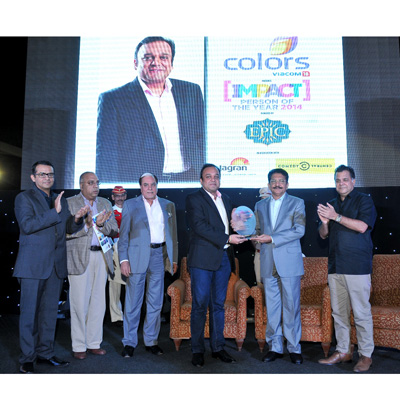
    MUMBAI: Zee Entertainment Enterprises Limited (ZEEL) MD & CEO Punit Goenka was awarded the prestigious IMPACT Person of the Year 2014 on December 05, 2014 at a glittering function held at the ITC Grand Central, Mumbai. The Governor of Maharashtra, Chennamaneni Vidyasagar Rao felicitated Goenka with the award in the presence of Essel Group and ZEEL chairman Dr. Subhash Chandra and exchange4media chairman Group Annurag Batra.


    Goenka won this award for his efforts in bringing about change in television audience measurement in the country, driving profitability in the broadcast sector and steering ZEEL to a steady rise.


    On accepting the award, Goenka said, “It is always a pleasure to get an award which recognizes your achievements, and for making a difference to the industry. But for me, this is a special one, since it also recognizes and applauds the human side and hence titled as ‘IMPACT Person of the Year’.”


    Goenka further added, “I would also like to take this opportunity to thank our Chairman, Dr. Subhash Chandra, for it is his pioneering vision and guidance, which makes us stand tall today ; my wife, Shreyasi, who has been a great support to me ; and of course my entire team at ZEE.”


    The Governor of Maharashtra, Chennamaneni Vidyasagar Rao, in his keynote address, congratulated Goenka, saying, “Goenka has not only risen through the ranks to head ZEE but has expanded its global footprint by offering an amazing variety of content through its channels.”


    The nominees for the 10th edition of the IMPACT Person of the Year were Sam Balsara, Chairman and Managing Director, Madison World, Piyush Pandey, Executive Chairman and Creative Director – South Asia, Ogilvy & Mather India, Prasoon Joshi, Chairman, McCann WorldGroup APAC & CEO, Punit Goenka, MD & CEO, ZEEL, BD Park, President & CEO, Samsung S West Asia and Sachin Bansal & Binny Bansal, CEO & COO, Flipkart. The selection process for IMPACT Person of the Year 2014 was handled by IMRB International. After receiving nominations, the final voting was done by a select few from across the advertisement, media and marketing fraternity. IMPACT’s editorial team then analysed the results to arrive at IMPACT Person of the Year 2014.


  • Star India CEO Uday Shankar is ‘Person of the Decade’

    Star India CEO Uday Shankar is ‘Person of the Decade’

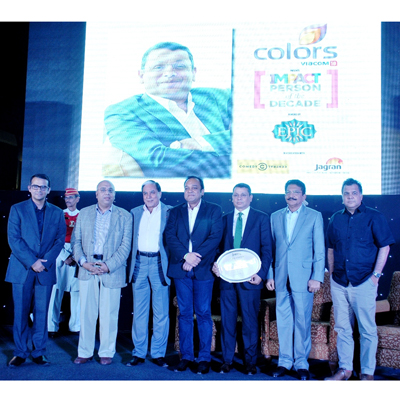
    Mumbai: Uday Shankar, CEO of Star India, received a significant industry award, The Impact Person of the Decade – 2014. Maharashtra Governor Chennamaneni Vidyasagar Rao gave the prestigious award to Shankar late last evening in the presence of media visionary Subhash Chandra, Chairman of Esselworld and Zee, and Annurag Batra, Chairman of the exchange4media Group.


    The award recognises the one individual who has made maximum and far-reaching impact on and influenced and helped shape the media, marketing and advertising industry tremendously over the last ten years.


    Maharashtra Governor C Vidyasagar Rao, addressing an audience packed with leaders and professionals of Indian media, marketing and advertising, said, “Shri Uday Shankar’s journey from being a journalist to head a large media organization has been spectacular. His agenda of driving a social change through programs like Satyamev Jayate has had a huge impact. In a country where cricket is a religion, he has brought to the fore games like Hockey and Kabaddi and demonstrated how these games could also be popularized in a changing world.”


    Accepting the award, Shankar said, “This is overwhelming – there is nothing more special than peer recognition.  I consider myself a creation of this industry, and for this industry to recognize that I might have made some impact on the last decade fills me with a sense of both — pride and gratitude.”


    Introspecting on winning the Impact Person of the Decade, Shankar said, “When I was informed by Impact that I am the person of the decade, I couldn’t help but reflect on my journey and what led me here…  I can say it in one word – collaboration.  That seems to be the one thing that I have done better and better and better over the last 10 years.” However, he added that “the willingness to collaborate has always been built on a solid conviction to do the right thing – not just for Star but for the entire industry and society. The conviction to not do regressive content, the conviction to not compromise the larger interest of community.”


    Shankar attributed his success at Star to his excellent team. “I think my success at Star and the success of Star India are results of not just an extremely talented team that I could put together but that this team collaborates with and compliments one another extremely well… my amazing team at Star has always rallied around to die for every single ridiculous plan that I have come up with,” he said. “This recognition is yours!”


    James Murdoch, Co-Chief Operating Officer, 21st Century Fox, said in a recorded message, “Uday Shankar is really driven by a belief in communications, and a belief that media and storytelling can make a positive difference. We’re enormously proud of Uday for being named the Impact Person of the Decade. It’s a great honour for him — one that he richly deserves. Star has always been a great innovator, and under Uday’s leadership, it has taken that to new levels.”


    Superstar Aamir Khan, in a recorded message, said, “I’ve known Uday for about five years now — his razor-sharp mind, his intelligence, his courage, his boldness to take difficult decisions… He believes in the impossible, and that’s why he achieves the impossible.”


    Media captain Aroon Purie, Chairman, India Today Group, said of Mr Shankar in a message, “He is a good thinker; obviously a great leader… I am delighted that he is getting this award. He has made a great impact on the industry, and I am sure that his leadership in Star, and also as part of the industry, will have a great impact in the years to come.”


    Annurag Batra, Chairman – exchange4media Group, said, “Across the years, Mr Shankar’s contributions to the entire space have been remarkable – whether through his mission for innovative and socially responsible content that is based on great storytelling, or the investments in and support of sports genres across Kabaddi, Football and Hockey and Cricket, and his remarkable efforts in aligning industry stakeholders for issues of industry and social significance. These, with several other reasons, are why the Impact editorial team selected Mr Shankar from a solid list of respected industry professionals for having impacted the industry and society in such a positive and significant way through his vision for both Star  and the industry. He is indeed a truly deserving winner of the top honour in the space of Media, Marketing and Advertising.”


    Click here to read Uday Shankar’s acceptance speech

  • Zeel gets a new chief commercial officer in Monojit Indra

    Zeel gets a new chief commercial officer in Monojit Indra

    MUMBAI: Zee Entertainment Enterprises Limited (Zeel) is on a hiring spree. The company has not only created a new position of chief business officer (CBO) and appointed Sunil Buch to head it, but also got a new chief commercial officer (CCO) in Monojit Indra on board.


    The position was vacant after Romil Ramgarhia had quit Zee in the month of August 2014. Indra joined the company on 3 November and will report to Zeel MD and CEO Punit Goenka. Sources close to the development confirmed the news to indiantelevision.com.


    An MBA student in rural management, prior to joining Zee, he has headed various roles at Marico. He had joined the company in 2001 as manager-buying and left as Marico International head supply chain and new country development after successful stint of 13 years. He has also worked at other companies like Nagarjuna Fertilizers and Chemicals, Clause International and AgriNet Solutions.


    When contacted, Zee spokespersons were unavailable for comment.

  • Sunil Buch joins Zeel as chief business officer

    Sunil Buch joins Zeel as chief business officer

    MUMBAI: Zee Entertainment Enterprises Limited (Zeel) has appointed Sunil Buch as its new chief business officer (CBO) to drive the business deliverables to the company.


    He joined the company on 3 November and will report to Zeel MD and CEO Punit Goenka. Buch will be responsible for effective and quick implementation of prioritised strategic initiatives across the organisation.


    Speaking on his appointment, Goenka said, “We are extremely happy to have Sunil join us as the chief business officer. As we work towards accomplishment of our Vision 2020 goals, we want to undertake enterprise-wide strategic initiatives that focus on not only enhancing business performance but also bring in operational excellence and efficiency across the network. We are confident that Sunil’s high degree of consumer connect, his creativity and communication skills coupled with his sharp business focus and ability to manage a wide spectrum will enable us to gain significant competitive advantage.”


    Commenting on his new venture, Buch said “I look forward to joining Zee at this exciting juncture. The path ahead is challenging yet filled with immense opportunity and I hope to contribute positively to this growth.”


    Sunil has over two decades of experience in functional and general management across various sectors including FMCG, advertising, media and entertainment and telecom retail. Prior to joining Zee, he was the business head – Reliance Own Retail at Reliance Communications. He has also worked at Colgate – Palmolive, Johnson & Johnson, Leo Burnett and Marico.