Tag: Pulp Strategy

  • Durr Group onboards Pulp Strategy as its Digital Agency

    Durr Group onboards Pulp Strategy as its Digital Agency

    Mumbai: Durr India, a subsidiary of the Durr Group, a global mechanical and plant engineering firm with expertise in the fields of automation and digitization has assigned its digital mandate to Pulp Strategy.

    As a part of the mandate, Pulp Strategy will handle B2B marketing for the brand’s owned digital platforms, including content marketing, content creation, and SEO. It will also be responsible for planning new digital initiatives for the brand.

    Durr India divisional manager Kabilan Veeraiyan said, “Pulp Strategy has shown a deep understanding of our digital consumer journey. They have demonstrated a data-driven approach and are aligned to our goals, and showed the experience and understanding for our need for data privacy, PII guidelines, etc., in addition to the required technical expertise. We look forward to working with them to increase our customer engagement, brand preference, and acquisition.”

    The account was won following a multi-agency pitch. The association was kickstarted with content marketing for the cross Industry and a diverse portfolio for B2B audiences of Dürr India.

    Pulp Strategy MD Ambika Sharma said, “Marketing to businesses is very different than marketing to individual consumers. That’s why B2B marketing is an entirely different marketing methodology, we take pride in the experience and expertise we have in not just B2B marketing but a keen understanding of technical content in the B2B context. We look forward to working with them towards an improved digital marketing practice and strengthening the brand’s digital presence.”

  • Pulp Strategy wins digital mandate for Whirlpool

    Pulp Strategy wins digital mandate for Whirlpool

    NEW DELHI: Whirlpool of India, a subsidiary of Whirlpool Corporation, has assigned its digital mandate to Pulp Strategy. The mandate covers markets in SAARC countries like Bangladesh, Nepal, Sri Lanka and so on. As part of the mandate, Pulp Strategy will handle the brand’s presence across all digital platforms, including building and managing technology, media planning, media buying, digital creative and content, and social media. The digital agency will also be responsible for planning and executing new digital initiatives for the brand.

    Shivram B, head SAARC, exports and NB unit, Whirlpool said “Pulp Strategy has shown a deep understanding of the digital consumer journey and is aligned to our goals. We are looking to work with them closely to increase our brand preference and engagement across touchpoints in DCJ leveraging their creative prowess and data-driven approach.” 

    The association was kickstarted with a new festive campaign that talks about the advanced ability of Whirlpool washing machines in hygiene and care. The washing machine is powered by an advanced in-built heater which removes up to 99.9 per cent germs and allergens and has the hot catalytic soak feature. The campaign went live in Bangladesh and the market saw a surge in washing machine demand. The consumer behaviour, language and platforms are unique to the country and the campaign which was Bangladesh-first leveraged this opportunity to strengthen awareness for Whirlpool washing machines amongst the audience. It was rooted in deep research about the market and consumer behaviour.

    The campaign was launched with a digital film focusing on the relationship between a mother and her child. The film treatment is candid, simple, rooted in consumer insight and highlights parents’ need to keep their kids safe from germs and infection while giving them the freedom they need to play and grow in these times. The ad reached millions of consumers digitally and was widely accepted with a high engagement and share rate. The campaign also had fun and peppy snackable video content. 

    Ambika Sharma, managing director of Pulp Strategy said, “We take immense pride in the work we have done previously for brands across the business spectrum, ranging from emerging start-ups to global brands. We are delighted to partner with Whirlpool, the team is bubbling with energy and has a strong insight into their consumer sub sets. Whirlpool has powerful products on its portfolio, vibrant, fast paced with immense potential in the digital space. In the coming times we will focus on improving engagement and infusing technology into the current digital practice while we work towards strengthening the brands digital presence.”


  • The modest kirana and its pandemic-induced evolution

    The modest kirana and its pandemic-induced evolution

    NEW DELHI: Sixty-nine-year-old Tejinder Singh, the owner of a kirana store in Ghaziabad, opens his shop at the crack of dawn every morning without fail for the last 21 years.  Not much has changed for him apart from the fact that Singh, and his store, faced a little cash crunch during the initial days of the lockdown in March.

    While e-commerce was battling red-tapes during lockdown, the local kirana stores were serving their consumers with doorstep deliveries. Within three months of lockdown, consumer spends in kirana stores increased by over 40 per cent.

    Singh sits at the counter with a mask covering half his face, disposable gloves and hand sanitiser next to him. Every customer who walks in has to first sanitise their hands before touching anything in the store. Singh has two staff and his two sons who assist customers with their purchases. He ensures that no one is without masks and gloves.

    “Lockdown came as a shock for every business. But we also saw this as an opportunity to help our customers with essentials. We provided door to door deliveries by following hygiene measures. We made several trips to godowns in private vehicles to bring goods to stores, personally because there was lesser manpower.  We start at 6 am in the morning every day and informed the customers about the goods when it became available again. We see new and younger customers coming to our stores or calling us to order. We are following the protocols and not letting sales staff into the store. We sanitise each and every product before handing it out to a customer,” Singh says.

    According to Pontem Integrated co-founder and BBDO Advertising former president Rajesh Sikroria even before Covid2019 outbreak, almost 90 per cent of India was still buying groceries and daily need items from kirana stores. As the pandemic struck and the country went into lockdown, even people who preferred organised mega retail stores or e-commerce for their daily grocery needs were left with no options. It took some time for organised retail and e-commerce to get their machinery going but the good old kirana was still there.

    “I believe there are a few things that have always worked in favour of kiranas; the Covid2019 crisis has just reinforced them. There is a greater trust and dependability on kirana stores because these people are a part of the community, so in case of a crisis, familiarity helps build that trust. A huge factor that works in favour of kirana is credit, which large stores and e-commerce companies cannot match. And lastly, very personalised service and the neighbourhood kirana always remains a faster option to get anything. Most of the mass FMCG brands have always had the largest share of their distribution pie residing with the kirana stores. But the last few years have also seen newer and some smaller brands focusing on only modern trade and eComm channels. A lot of such brands would have struggled and may continue to struggle for some time because of their absence from the biggest retail network,” Sikroria shares.

    Bizom recently released a report on India kiranas wherein it states that India’s retail ecosystem is unique from most parts of the world. Indians buy over 85 per cent of consumer products from small kirana stores, making its markets driven by general trade. 

    The report also mentions howSarsCov2 impacted the revenues of kiranas in March 2020. It says that kiranas saw a drop of 15 per cent in the number of transactions but picked up soon after as people started stocking essentials which saw a hike in the number of transacting and it somewhat lessened the impact of non-transacting outlets.

    In the initial phase of lockdown, many shopkeepers were struggling to replenish stocks. The kirana stores used to seek replenishment every two to three days. Items such as packaged flour, biscuits, soaps and instant noodles were no longer available and many had to wait for further supplies stating transportation being an issue. Fintech companies including Paytm, Google Pay, PhonePe are also bridging the gap between the store and the customers by making payments hassle-free experience. 

    FLC Marketing & Events business head India operations Rohit Shah says, “Panic-stricken and safety-conscious shoppers are visiting the traditional retail shops kirana stores to buy essential food items. The shoppers now avoid hypermarkets like Big Bazaar and Spencer’s to avoid huge public gathering and safety issues. Also, the new category of ‘work for and from home’ shoppers in the metros want to make short trips to neighbourhood stores due to time constraints. They also want to socialise for some time in kirana stores by maintaining social distancing parameters. Seeing and touching the product physically before buying also make people visit kirana stores. People are now experimenting in the kitchen. They demand kirana stores to stock items required to prepare new and age-old recipes and are ready to wait for long durations for unavailable products. People are even ready to buy local brands if they meet the requirement in the recipe.”

    The digital transformation of the kirana business that has been underway for the past few years was accelerated in the past three months, bringing more kiranas online, making buying and selling more efficient, digitalising bookkeeping and inventory management. Players like ShoppyFier, an online to offline hyperlocal deal discovery platform, sent out push notifications through which users can see all the offers/discounts running nearby and merchants can promote their long-term and short-term offers.

    As of February, India had 6.65 million kirana stores in the country, according to Nielsen. Unlike in the west, general trade stores in India form nearly 90 per cent of the country’s total trade. The overall contribution of supermarkets and organised grocery stores remains at 10 per cent. 

    Reportedly, the government is planning to set up a chain of 20 lakh retail shops called ‘Suraksha Stores’ across India which will provide daily essentials to citizens while maintaining stringent safety norms. The Suraksha Stores initiative will convert the neighbourhood kirana stores into sanitised retail outlets selling daily essentials while adhering to safety norms such as social distancing and sanitisation to control the spread of Covid2019.

    “It seems that big brands are now thinking of helping out the modest kirana stores to navigate the new normal. A consortium of brands is trying to partner with government and help convert the local kirana stores into sanitised, professional retail operations. This will see traditional kirana stores turning into registered ‘suraksha’ stores. They will be listed on the GoI’s Aarogya Setu App for following proper sanitation practices, using masks and gloves and implementing social distancing at their outlets,” Sikroria adds.

    Pulp Strategy founder and MD Ambika Sharma says that buying local and relying on your neighbourhood store has captured the consumer imagination but re-evolution of kirana stores will not impact sales of big brands.

    “For brands, this will not impact sales however it does call for the necessity of improving the supply and delivery channel to kirana stores. For gourmet brands, this shift may result in a dwindling uptake, with the advantage of impulse buying no longer available. Gourmet brands also do not have a strong supply channel with kirana stores and this would be an area of improvement as the trend becomes stronger,” she says.

    “All the brands that have effectively communicated about taking all the safety and precautionary measures, showed how they are taking care of the consumer and also set up ease of shopping have managed to stay afloat. Innovation has been the key to all brands to stay alive during this pandemic,” said Spicetree Design Agency founder Shiraz Khan.

    For Option Designs co-founder Rahul Gandhi, the kirana stores were able to sail through the storm of difficulties because of their alacrity to adaptability and agility. Where on the one hand they intensified their delivery services, on the other hand, they took to transformation by going digital which brought them overwhelming results.

    “In a similar way, brands must also adapt themselves to the changing situations. By understanding the changing consumer behaviour they must come up with some real brand strategies that are in sync with the needs or demands of the consumers. Brands must constantly upgrade themselves by innovating and that will help in reaching out to a wider consumer base,” he says.


  • Pulp Strategy adopts AI in the world of advertising

    Pulp Strategy adopts AI in the world of advertising

    MUMBAI: The changing advertising landscape is now being led by data-driven tools such as artificial intelligence (AI) and machine learning. Pulp Strategy, a full-service interactive, digital communications and technology agency, is also attempting to change the ad industry.

    About two years ago, Pulp Strategy founder-managing director Ambika Sharma became the sole equity owner, and since then there have been significant changes. The decision to re-haul management was taken with an aim to augment the growth trajectory of Pulp Strategy.

    Sharma says that the restructuring has helped Pulp Strategy tide over “vision mismatch and improve its agility to consolidate its domain leadership position as a leading independent digital creative agency in India redefining the brand-consumer interaction in today’s dynamic business landscape.”

    Sharma says: “The last two years we have evolved in services as well as talent. Our talent quotient has improved; we have a strong creative tech portfolio and marketing tech with AI solutions launched which give us an edge. The last two years have been interesting for business as we diversified our client portfolio to expand into oil and gas, cosmetics, personal care, non-profit and BFSI. Our product development portfolio has expanded as well.”

    The change has helped to further its aggressive growth plans while maintaining an industry-focused and innovation-driven approach. Pulp Strategy strengthened its focus more on content marketing, digital engagement, while simultaneously leveraging interactive new-age technologies like artificial intelligence and creative technology to expand its client portfolio.

    Spotting this changing trend, brands have started tapping the immense potential of these technologies to engage their target audience in innovative ways.  These cutting-edge technologies have opened up a new world of possibilities, where it could help brands  to increase the chances of successful consumer engagement, build stronger emotional connections and leave a lasting impression on the consumer’s long-term consciousness.

    “Two technologies leading the latest wave of consumer engagement nowadays are AR and visual programming. At Pulp Strategy, we have taken significant leaps in creating highly-engaging digital engagements with these technologies employing the Facebook Spark Augmented Reality platform,” she adds.

    In the artificial intelligence domain, the AI chatbot technology has the potential to bring path-breaking changes in the way marketers interact with their customers.

    Sharma notes: “The best thing about chatbots is that they are always on and send in responses round the clock, unlike email, social media and live chats. The chatbot understands every query, gives personalised responses and even takes a note of your past conversations, which ultimately leads to an improved conversation in the future.”

    Like every other company, Pulp Strategy is also bearing the brunt of Covid2019. "We are working with our clients to support Covid2019 communication and build on engagement via communication and messaging as we also recalibrate plans. Brands and consumers have to quickly learn the new way to operate in the coming months. Consumption patterns have been disrupted by the lockdown. Work from home and isolation has resulted in new behavioural shifts and some of these patterns are changing for the long term,” she concludes.

    Follow Tellychakkar for the consumer facing news & entertainment

  • Tupperware agency Pulp Strategy milks AIB post

    Tupperware agency Pulp Strategy milks AIB post

    MUMBAI: In today’s age of cutthroat competition, it is beyond a shadow of doubt that opportunities have become very scarce. However, if you keep your eyes on your target and ear on the ground, you can make wonders happen, and that’s precisely what Pulp Strategy a multi-award winning full-service marketing agency did.

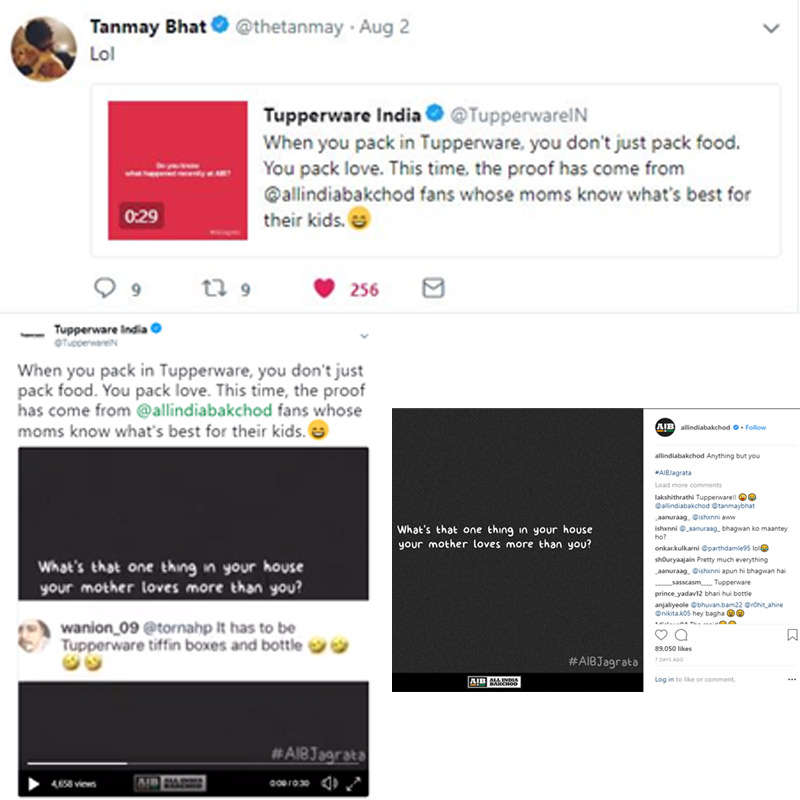
    Recently content creator All India Bakchod (AIB) had a post on Instagram which created a buzz. AIB asks its followers a random question under #AIBJagraata. This time, the question was “What’s that one thing in your house that your mother loves more than you?”

    The replies naturally included Tupperware given the strong market positioning of the kitchen accessory brand. But, Tupperware India (with its end-to-end marketing managed by Pulp Strategy) left no stone unturned to tap into this now-prevailing opportunity. The agency’s social media listening team proactively participated in the ongoing discussion and further amplified the overall engagement by taking it off to its own Facebook, Twitter, and Instagram handles.

    Pulp Strategy founder and managing director Ambika Sharma said, “At Pulp Strategy, we do not merely create opportunities, but also ensure that we tap into every single one that surfaces anytime, anywhere. This all-embracive approach is what has helped us in staying ahead of the curve always. I’m proud that the team at Pulp Strategy has yet again upheld that culture.”

    Within 24 hours, Tupperware India reached out to more than 25,000 people on Facebook and 1,686 people on Instagram, and all of that, without spending a single penny. The whole activity also caught the attention of Tanmay Bhat, the co-founder of AIB, who retweeted the Tupperware India post.

    This year, the marketing agency had also conceptualised and executed the #PressForConfidence campaign for Tupperware around International Women’s Day. The innovative campaign effectively used Facebook’s newly-released ‘press and hold’ feature to create an interactive content series and received massive participation on the social media platform.

  • Founder and MD Ambika Sharma becomes the sole equity stakeholder of Pulp Strategy

    Founder and MD Ambika Sharma becomes the sole equity stakeholder of Pulp Strategy

    MUMBAI: In a massive top-tier overhaul, the reins of Pulp Strategy have been taken over by its Founder and Managing Director Ambika Sharma. Ambika Sharma the Majority stake holder acquired an the balance equity stake of 22% for an undisclosed amount from the brand’s exiting minority shareholder and Director CFO Raj Vikram Singh, to become the sole equity owner of the multi-award winning full-service marketing agency.

    The restructuring has helped Pulp Strategy tide over vision mismatch and improve its agility to consolidate its domain leadership position as a leading independent Digital creative agency in India redefining the brand-consumer interaction in today’s dynamic business landscape.

    With the management overhaul that was finalised in Q3 of the Fiscal Pulp Strategy has experienced accelerated growth in H2, as it gears up for large-scale business expansion, with a singular focus on innovation driven by an in-depth understanding of the industry.

    With new client acquisitions including brands like Tupperware, Barco, Hero Electric, Proburst and Philips Avent, The agency is now looking to increase its focus on content marketing, digital engagement, while simultaneously leveraging interactive new-age technologies for its expanding client portfolio.

    On the development, Pulp Strategy, Founder and Managing Director, Ambika Sharma said, “As a young business it was important for us to maintain our agility as well ensure that our talent contributes towards the improvement of our offerings as well as our commitment to our clients. This decision to re-haul management has been taken with an aim to augment the growth trajectory of Pulp Strategy and to consolidate the agency’s market position. It will enable us to further our aggressive growth plans while strictly maintaining an industry-focused and innovation-driven approach.”

    Incorporated in 2011, Pulp Strategy at present drives revenue worth Rs. 443 million and is eyeing forward-thinking product and service offerings to support its market ascension and client base expansion. Its current and previous clientele includes the likes of Google, Philips, Microsoft, Michelin, Canon, Rolls Royce and Yahoo!, amongst others.

  • Pulp Strategy conceptualizes Tupperware’s #PressForConfidence campaign for International Women’s Day!

    Pulp Strategy conceptualizes Tupperware’s #PressForConfidence campaign for International Women’s Day!

    MUMBAI: Hardships and roadblocks are part and parcel of life. While everyone experiences them on a day-to-day basis, they are often more gruelling for women juggling multiple roles – that too without a single holiday! In order to honour the women and their hard work, Tupperware India launched its innovative International Women’s Day campaign, #PressForConfidence, on social media.

    As part of the campaign, Tupperware asked its audience several important questions on its tipping point, putting in more efforts than required, dealing with hope and despair, etc. The brand then, put forth these questions to their support system, i.e. women who support and motivate them on a daily basis. The participants shared their stories and personal experiences to celebrate the women in their life and #PressForConfidence.

    Tupperware India’s Managing Director, Shilpa Ajwani said, “When we invest in women, we invest in our community. Tupperware empowers them to grow professionally and personally, and seeks ways to enhance their livelihood by providing continued business and learning opportunities. This has been a binding ideology for us.”

    The campaign has been conceptualized and executed by Tupperware India’s digital agency, Pulp Strategy, which leveraged interactive content for higher engagement. The brand launched three teasers for the campaign inspired by International Women’s Day #PressForProgress as confidence is the foundation of progress and Tupperware believes in cultivating confidence.

    The flagship content pieces utilized Facebook’s new ‘Press and Hold’ feature. The engagement levels are at an all time high and social platforms are buzzing with participation.

    Pulp Strategy’s Founder, Ambika Sharma said, “Tupperware is a brand highly engaged with its audiences and community. It believes in creating delight with the small things and it was natural that we created the campaign #PressForConfidence with interactive content as the flagship.”

    This International Women’s Day, why not celebrate the people who make an impact in your life with Tupperware’s insightful campaign? Share your story of how you #PressforConfidence and how has it transformed your life!

  • Pulp Strategy takes disruptive route to launch new mobile game

    Pulp Strategy takes disruptive route to launch new mobile game

    MUMBAI: Imagine if a brand created a piece of content and consumers lapped it up weaving it into a magical fun filled visual story, which caught the imagination of 3.5 million people. What are the possibilities that it could create?


    Taking exactly this route, Pulp Strategy Communications embraced a disruptive campaign through online storytelling, to launch its latest gaming app Rescue’em. The campaign concentrates on breaking the existing clutter in the gaming paradigm to come up with a concept that swayed away from violence and bloodshed to be a stress buster instead. Strategists worked on a detailed story map that had an identified target audience, a powerful game plan matched with animation and processed with latest technology.


    Beginning with releasing a news video animated to announce Baby Bubba the cute sheep from Frolic Island is missing, Baby Bubba’s emotional parents appealed to the public to find Bubba. Sparking the curiosity of the people #BubbaMissing, started trending on Twitter as people generated conversations and content around the video driving over five lakh views on social media in just three days.


    The creative strategy was to generate curiosity among people and create a buzz around the game, while keeping all communication fun, trendy and bordering on hilarious. #BabyBubba, #FrolicInPanic and #RescueEm began trending in quick succession as the story unfolded.


    Pulp Strategy Communications spokesperson said, “We knew that with the general trend of not so positive topics on social media the clean, cuteness of missing Bubba and friends captured attention. The hashtag chosen was intriguing. People could relate to it and hence it was the ideal conversation starter. The animated video is as close to the real world as could be and the agony of parents other than Mr & Mrs Wools… well, who wouldn’t relate? It’s captivating online storytelling.”


    The promotional activity was divided into three phases:


    ·Phase one: The story of the character Bubba, missing from Frolic land was floated on social media. Hashtags like, #BubbaMissing & #FrolicInPanic started trending nationally for 11 hours. It witnessed millions of impressions and thousands of conversations trending. Various other activities like display media online, series of spoof episode videos of news reports from Frolic Island, sharing of videos via WhatsApp and strong social media reach based on content was carried out. 


    ·Phase two: In the second phase, the story gradually progressed with clues leading to the prime suspect called ‘Brutus’ and people started pouring their support with #SuspectingBrutus and #RescueEm on Facebook and Twitter.


    ·Phase three: The third phase was an off line phase where a candle light march was announced and the targeted audiences were enthused to participate in the vigil that was held at the Delhi zoo.


    There was live streaming of content on Twitter via very new tools Periscope and MeerKat. Consumers across five cities started holding candle vigils to support the cause via crowd sourced micro gatherings.


    The story line was built with vines, videos, news reports, mailers and social conversations that saw over a million views and engagements. Within 48 hours of releasing its first video, it gathered 40,000 views and over 300 shares across platforms.

  • Pulp Strategy wins NEC India’s biz

    MUMBAI: Pulp Strategy, a full service experiential marketing and communications agency, has been appointed as NEC India‘s activation and OOH partner.

    Pulp‘s role will essentially comprise creative responsibilities, OOH, activation and events.

    The account was won after a multi-agency pitch and will be handled out of agency‘s Delhi office.

    Pulp Strategy is now slated to handle OOH campaign as NEC India heralds the Indian Grand Prix 2012, in active collaboration with the Sauber F1 Team. NEC India is the premier partner of Sauber F1 Team.

    NEC India national marketing manager Vijayant Khatri said, “We are confident that our partner agency will play a critical role in achieving our marketing goals. Their energy and proactive approach has inspired confidence.”

    Pulp Strategy Communications managing director and CEO Ambika Sharma added, “NEC is a great brand, and we are proud to be a part of the NEC Sauber F1 Team campaign. We are a carefully constructed robust team that brings on board a strong and holistic approach to branding and activation. We look forward to partnering with NEC India.”

    NEC India is a wholly-owned subsidiary of NEC Asia Pacific (HQ: Singapore) and NEC Corporation (HQ: Japan), and works with its customers to develop solutions and services for a “ubiquitous” networking society. Leveraging on NEC‘s capabilities in integrating IT and networking technologies for a diverse customer base across governments, businesses, individuals and societies worldwide, NEC India customises solutions to construct large-scale, highly reliable, scalable and flexible IT and network systems.