Tag: PSLV-C35

  • ISRO’s PSLV-C35 launches seven other satellites successfully

    ISRO’s PSLV-C35 launches seven other satellites successfully

    MUMBAI: Around two hours  after lift-off and after placing India’s weather satellite ScatSat1 in a polar sun synchronous orbit at 720 km, the Indian Space Research Organisation’s (ISRO’s) PSLV C35 rocket fired once again. Following that maneuver, it placed another seven satellites in orbit at an altitude of 670 km.

    The seven satellites included two from Indian educational institutions (PISAT and Pratham) and three commercial initiatives from Algeria (Alsat-1B, 2B and 1N) and one each from Canada (NLS-19) and the US (Pathfinder 1).

    ISRO chairman AS Kiran Kumar called the Monday launch as a landmark day in its history. The reason: the PSLV C35 mission marked the first time that the space organization  had successfully fired the  polar satellite launch vehicle twice to place satellite in different orbital altitudes. And, it was also the longest PSLV mission tackled by ISRO. 

    ScatSat-1 has a lifespan of five years and it is meant to give e weather forecasting services through the generation of wind vector products,  while the the 10 kg Pratham developed by  by IIT Bombay intends to estimate the total electron count with a resolution of 1km x 1km location grid. PISAT from the PES University will explore remote sensing applications. 

    Algeria’s ALSAT-1B is an earth observation satellite (103 kg), ALSAT-2B a remote sensing satellite (117 kg) and ALSAT-1N (7 kg) a technology demonstrator. Canada’s NLS-19 is a technology demonstration micro satellite (8 kg) and Pathfinder-1 is a commercial high resolution imaging micro satellite (44 kg).

    Kiran Kumar said that ISRO’s next launch is slated for 4 October which is the communication satellite GSAT-18. 

    Congratulations poured into ISRO from all quarters right from Suresh Prabhu to M Venkaiah Naidu to the President Pranab Mukherjee to Shivraj Singh Chouhan to Nirmala Setharaman and finally from the prime minister Narendra Modi.

    Also Read:  ISRO’s PSLV-C35 takes off successfully, Scatsat1 launched

    Also Read:  ISRO to launch eight satellites using PSLV on 26 September
  • ISRO’s PSLV-C35 launches seven other satellites successfully

    ISRO’s PSLV-C35 launches seven other satellites successfully

    MUMBAI: Around two hours  after lift-off and after placing India’s weather satellite ScatSat1 in a polar sun synchronous orbit at 720 km, the Indian Space Research Organisation’s (ISRO’s) PSLV C35 rocket fired once again. Following that maneuver, it placed another seven satellites in orbit at an altitude of 670 km.

    The seven satellites included two from Indian educational institutions (PISAT and Pratham) and three commercial initiatives from Algeria (Alsat-1B, 2B and 1N) and one each from Canada (NLS-19) and the US (Pathfinder 1).

    ISRO chairman AS Kiran Kumar called the Monday launch as a landmark day in its history. The reason: the PSLV C35 mission marked the first time that the space organization  had successfully fired the  polar satellite launch vehicle twice to place satellite in different orbital altitudes. And, it was also the longest PSLV mission tackled by ISRO. 

    ScatSat-1 has a lifespan of five years and it is meant to give e weather forecasting services through the generation of wind vector products,  while the the 10 kg Pratham developed by  by IIT Bombay intends to estimate the total electron count with a resolution of 1km x 1km location grid. PISAT from the PES University will explore remote sensing applications. 

    Algeria’s ALSAT-1B is an earth observation satellite (103 kg), ALSAT-2B a remote sensing satellite (117 kg) and ALSAT-1N (7 kg) a technology demonstrator. Canada’s NLS-19 is a technology demonstration micro satellite (8 kg) and Pathfinder-1 is a commercial high resolution imaging micro satellite (44 kg).

    Kiran Kumar said that ISRO’s next launch is slated for 4 October which is the communication satellite GSAT-18. 

    Congratulations poured into ISRO from all quarters right from Suresh Prabhu to M Venkaiah Naidu to the President Pranab Mukherjee to Shivraj Singh Chouhan to Nirmala Setharaman and finally from the prime minister Narendra Modi.

    Also Read:  ISRO’s PSLV-C35 takes off successfully, Scatsat1 launched

    Also Read:  ISRO to launch eight satellites using PSLV on 26 September

  • ISRO’s PSLV-C35 takes off successfully, Scatsat1 launched

    ISRO’s PSLV-C35 takes off successfully, Scatsat1 launched

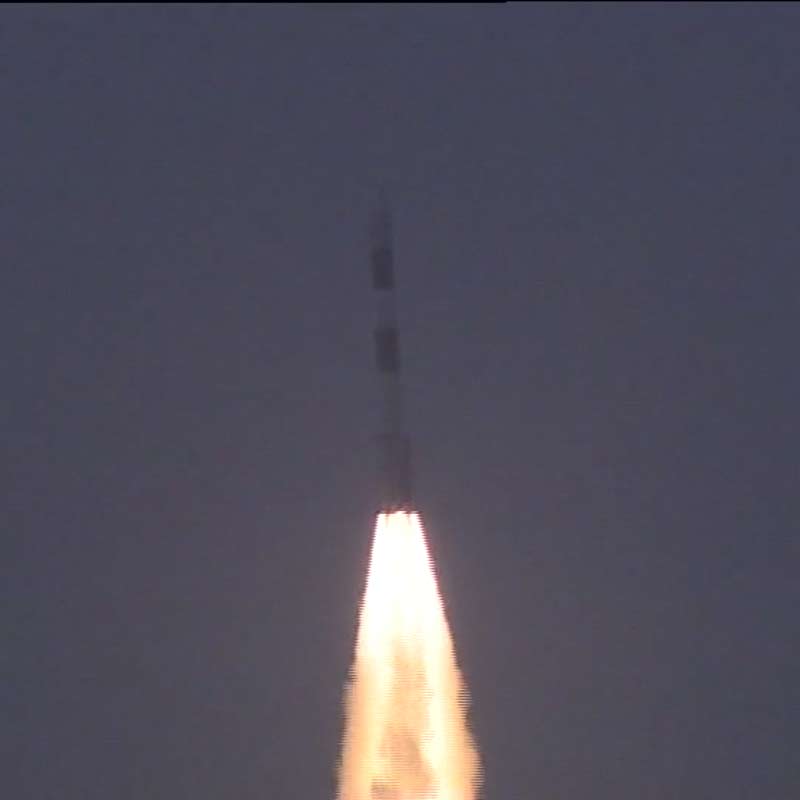
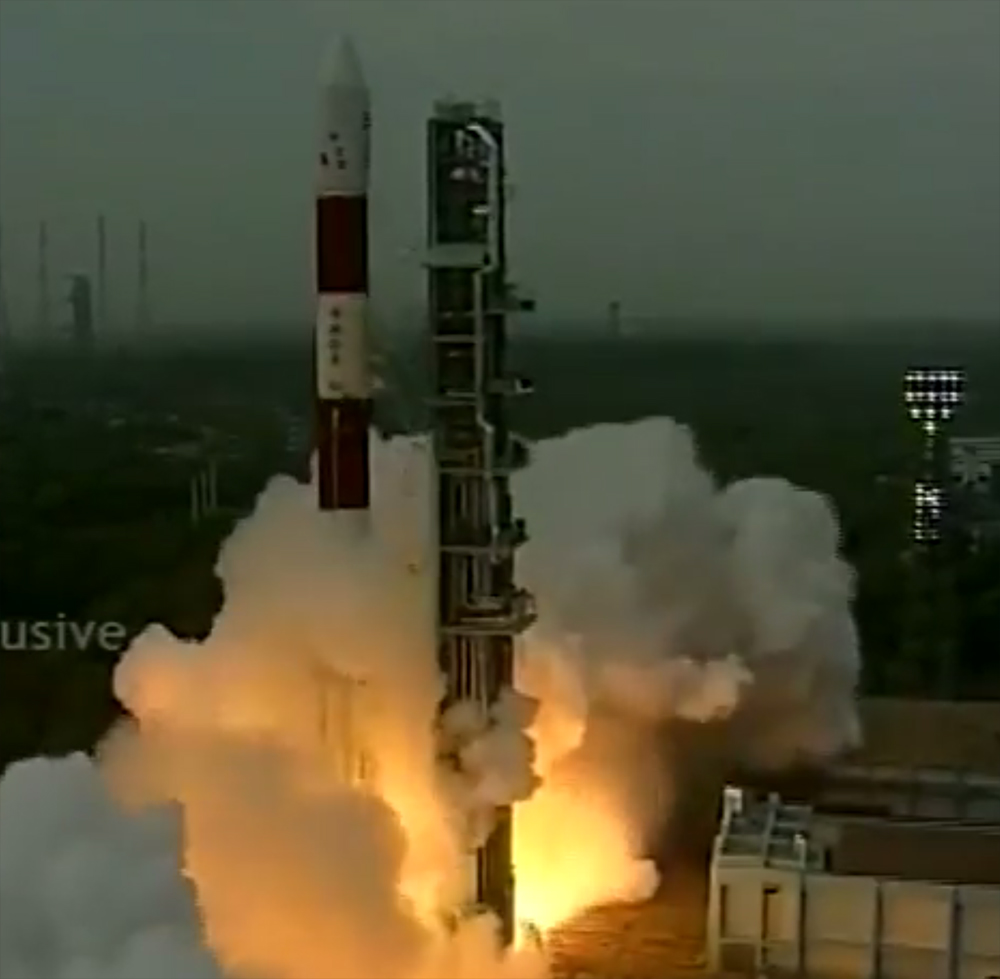
    MUMBAI: It’s another feather in ISRO’s cap. The Indian space outfit seems to be going from success to success. Earlier this morning at 9:12 am, its latest mission the PSLV-C35 lifted off immaculately from the Satish Dhawan Space Centre in Sriharikota. Around 17 minutes later, its fourth stage rocket engine was shut off and it launched one of its passengers, the ScatSat 1 satellite, into its orbit at height of 720 km., to the delight of ISRO scientists.

    Currently, the organization is waiting to fire the fourth stage engine again to send the remainder of its seven satellite payload into their orbit at a height of 670 km, between 11:25 and 11:28 am, according to ISRO updates.

    “This is a challenging two-in-one mission which puts India in a unique league of nations having the capability to achieve two different orbits in a single mission,” ISRO chairman AS Kiran Kumar was quoted as saying.

    Tweeted Prime minister Narendra Modi: “Moment of immense joy and pride for India. Congratulations to isro on successful launch of PSLV-C35/ScatSat1 & 7 co-passenger satellites. Our space scientists keep scripting history. Their innovative zeal has touched the lives of 125 crore Indians & made India proud worldwide.”

  • ISRO’s PSLV-C35 takes off successfully, Scatsat1 launched

    ISRO’s PSLV-C35 takes off successfully, Scatsat1 launched

    MUMBAI: It’s another feather in ISRO’s cap. The Indian space outfit seems to be going from success to success. Earlier this morning at 9:12 am, its latest mission the PSLV-C35 lifted off immaculately from the Satish Dhawan Space Centre in Sriharikota. Around 17 minutes later, its fourth stage rocket engine was shut off and it launched one of its passengers, the ScatSat 1 satellite, into its orbit at height of 720 km., to the delight of ISRO scientists.

    Currently, the organization is waiting to fire the fourth stage engine again to send the remainder of its seven satellite payload into their orbit at a height of 670 km, between 11:25 and 11:28 am, according to ISRO updates.

    “This is a challenging two-in-one mission which puts India in a unique league of nations having the capability to achieve two different orbits in a single mission,” ISRO chairman AS Kiran Kumar was quoted as saying.

    Tweeted Prime minister Narendra Modi: “Moment of immense joy and pride for India. Congratulations to isro on successful launch of PSLV-C35/ScatSat1 & 7 co-passenger satellites. Our space scientists keep scripting history. Their innovative zeal has touched the lives of 125 crore Indians & made India proud worldwide.”