Tag: Provocateur Advisory

  • Sudhanshu Vats to helm Asci in landmark 40th year

    Sudhanshu Vats to helm Asci in landmark 40th year

    MUMBAI: Pidilite Industries managing director Sudhanshu Vats has been elected chairman of the Advertising Standards Council of India (Asci) at its 39th annual general meeting, taking charge as the country’s advertising regulator-by-consensus enters its fourth decade.

    MullenLowe Global chief strategy officer S Subramanyeswar  moves in as vice-chairman, while industry veteran Paritosh Joshi of Provocateur Advisory becomes honorary treasurer.

    Founded in 1985 as a voluntary self-regulatory body, Asci is recognised by the Cable TV Act, Doordarshan, All India Radio and several key regulators. Its consumer complaints committee enjoys extraordinary acceptance for a voluntary code: in FY 2024-25, compliance hit 98 per cent for print advertising, 97 per cent for television and 81 per cent for digital. The supreme court has repeatedly cited Asci’s role in consumer protection.

    Vats said the council’s job has “never been more important” as advertising mutates with technology and new formats. “Our responsibility is to ensure advertising is executed with integrity—centred on the product promise, respectful of the community and mindful of consumers,” he told members. “Self-regulation provides guidance to the industry and assurance to the public. The simple principle is to keep the consumer’s interest front and centre.”

    Outgoing chairman Partha Sinha called his tenure “a comma in a sentence that keeps unfolding”. Over the past years, he said, Asci has “moved from being a watchdog to an enabler of responsible communication—partnering, not just policing,” and stepped “firmly into the digital arena, because responsibility cannot lag behind technology.”

    To mark its fortieth year, the council unveiled an ambitious agenda:

    * AdWise literacy drive – training more than a million schoolchildren to identify, question and evaluate advertising messages, reducing their vulnerability to misleading or harmful pitches.
    * Gen-Alpha research – an ethnographic study of children born into the touchscreen age to craft a framework for responsible advertising to the next generation.
    * New city offices – expansion of Asci’s physical footprint to Bengaluru and Delhi to deepen engagement across India.
    * Legal knowledge hub – a comprehensive online resource on advertising codes and laws, developed with leading law firm Khaitan & Co.
    * Podcast partnerships – a new series with The Logical Indian and Marketing Minds to spread awareness of responsible advertising.
    * Visual commitment badge – a mark members can display in their communications and on websites to signal adherence to the Asci code.

    Asci’s influence has widened well beyond complaint adjudication. The Asci Academy now drives education and thought leadership through masterclasses for marketers, faculty development programmes in media and advertising colleges, and a pre-production advisory service that helps advertisers check compliance before campaigns go live—avoiding costly post-release fixes.

    In recent years the council has published widely cited white papers on dark patterns, artificial intelligence in advertising, the depiction of masculinity and the trust deficit around digital influencers. It has issued pioneering guidelines on influencer conduct, cryptocurrency, green claims and gender stereotyping, earning two global awards for leadership in self-regulation.

    Looking ahead, Vats said Asci will “strengthen global partnerships and knowledge exchange with peer bodies worldwide, and invest in research, innovation and frameworks that respond to the realities of digital-first advertising.”

    For a voluntary body that began as a modest industry code, the next chapter promises to be anything but quiet.

  • Television and online medium need different approach for revenue making

    Television and online medium need different approach for revenue making

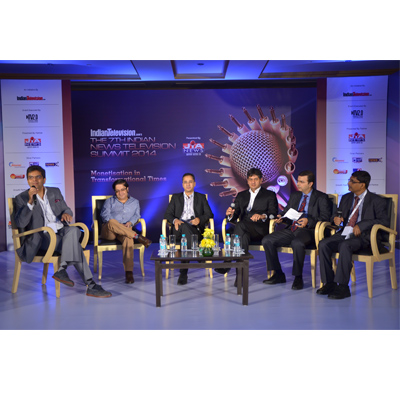
    NOIDA: The news television space is burdened with cash crunch. And addressing this core issue were the news industry giants at the 7th News Television Summit organised by indiantelevision.com. The Summit which began with a session on ‘Content monetisation through conventional and digital platforms of news channel’ was moderated by Provocateur Advisory principal Paritosh Joshi and attended by NDTV Group CEO Vikram Chandra, TV Today Network CEO Ashish Bagga, IBN18 Network CEO Avinash Kaul, Doordarshan ADG news Mayank Agarwal and Focus News Network group CEO Neeraj Sanan.


    Joshi began the session by asking Chandra how viewership data has changed since NDTV raised its voice against the alleged faulty ratings three years ago. Chandra said that they weren’t getting correct ratings and when they talked about it to others they were told to either swim with the tide or do something different which would get the TRPs. Soon after, they were joined by other broadcasters as well.


    Joshi then asked Bagga the secret behind Aaj Tak’s dominance in the genre for the last 10 years. Bagga highlighted that it was not easy to sustain its position given the tough environment. “There was reluctance from various quarters so it was necessary to push that credibility,” he said. He added that the network had grown 25 per cent since last year and while others were growing at just two to five per cent.


    Talking about the ad rates, Bagga said that the price for a slot on news channels, unlike the GECs is pitiable. However, TV Today has put its business on a sustainable model of 20 per cent y-o-y growth. “This has been done by quality, resource, building perception and getting the required numbers,” he said.


    Doordarshan, on being asked about its transformation, said that it had done a good revamp to maintain norms and standards. “People may feel that we put out the news stories a little later than the others, but that’s not the case. We are alert,” said Agrawal.


    He however agreed that a lot is still left to be done apart from the new programmes and the new look it has given to its anchors. “We have also set up new teams in order to cover news better and are also focusing on our online medium,” informed Agrawal.  


    Joshi also highlighted the fact that there is little differentiation in content between the news channels. Disagreeing with the observation, Kaul said that though it could be true, the approach of each channel for a story is different. “You can cater the news to different age groups and segment it differently,” he opined.


    Kaul is optimistic about the new rating system that will be brought out by BARC India. “This will bring in change to the type of content being produced,” he said.


    Joshi also brought out the common criticism that the news industry has to deal with. “Various quarters have said that while the news broadcasters crib about the bad business, the genre still sees new players getting into it every now and then. Is it the political money that is going into it?” questioned Joshi.


     Sanan at this point said that the reason for this was the fact that people see a lot of potential in news because of its ever growing consumption. “If all news channels give same content then that means there is a need for someone to come and stand out. If people are willing to pay and if you can package your content well then there is no reason why one cannot get into it,” he said.


    While digital is a growing platform, Joshi asked whether the algorithm that it follows is trustworthy with regards to journalism. Chandra highlighted the fact that even today the brand of an anchor is important. “When people come to the online medium, they want to come to trustworthy sources rather than a layman giving information,” he opined.


    Kaul said that with BARC India bringing in meters in the rural areas, the genre will have to strengthen its coverage in those areas as well. “With 4G and broadband making in-roads, we will be in a better state,” he said.


    Chandra stated that it was not right to replicate the TV business model for online and that digital was growing at a CAGR of 40 per cent.