Tag: Promoters

  • Dish TV’s Jawahar Lal Goel resigns from the board

    Dish TV’s Jawahar Lal Goel resigns from the board

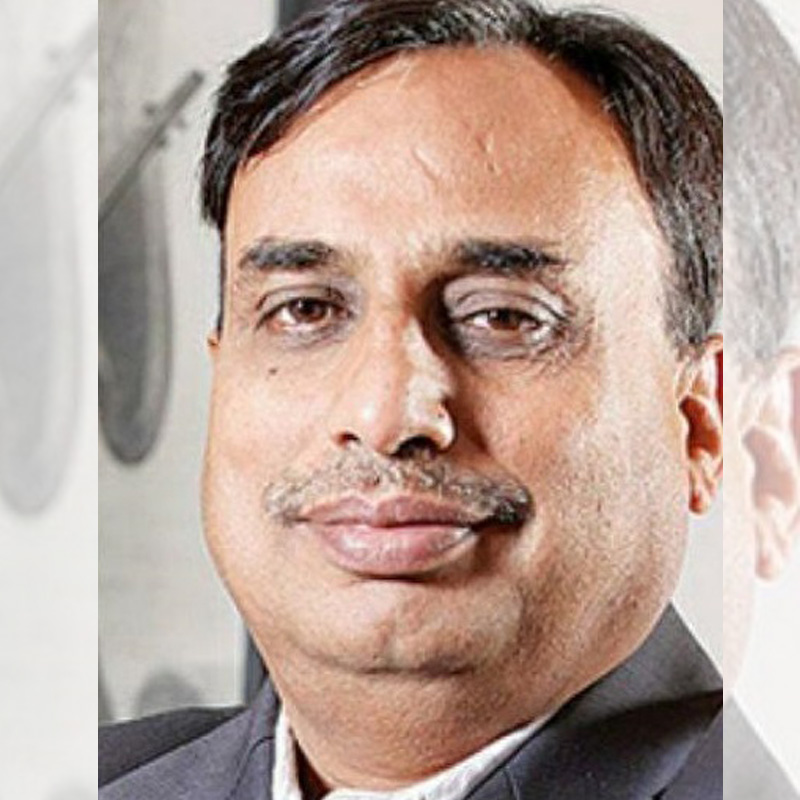
    MUMBAI: Dish TV, the DTH service provider has announced that director Jawahar Lal Goel has resigned from the board of the company. “Jawahar Lal Goel, Director…. has tendered his resignation from the company’s board of directors and committee/s thereof with effect from the close of business hours of September 19, 2022,” Dish TV informed in a regulatory filing.

    He is no longer the chairman of the company. Goel will vacate his position at the upcoming company’s AGM on 26 September, 2022.

    After the announcement, the share price rose by 10 per cent and hit the upper circuit.

    In June, over 75 per cent of shareholders voted against the reappointment of Goel as board’s managing director at the company’s extraordinary general meeting. After it happened, Goel had agreed to resign as Dish TV chairman ahead of the AGM.

    Yes Bank holds around 25 per cent stake in the company. It had been pushing for a board reconstitution and wanted the promoter family led by Goel to be removed. Yes Bank had cited corporate governance issues and Goel stepped down after engaging in a legal battle for a long time with Yes Bank.

    Earlier this month, Dish TV had agreed to appoint three of the seven independent directors, which were proposed by Yes Bank.

    The Goels own a six per cent stake in the company. They lost control over the company after banks seized the promoter’s pledged shares.

  • Ortel to issue shares worth Rs 8.75 cr to promoters

    Ortel to issue shares worth Rs 8.75 cr to promoters

    MUMBAI: The board of directors of Ortel Communications, the multi-system operator (MSO), has approved the issue of equity shares to promoter group entities.

    According to the release issued to the BSE, the company has proposed to issue 25 lakh equity shares at an issue price of Rs 35 per share to the promoters on a preferential basis for an aggregate amount of Rs 8.75 crore.

    Furthermore, the board has also approved the issue of 9 per cent cumulative, non-convertible, redeemable preference shares for an amount not exceeding Rs 10 crore by way of private placement for a period of five years.

    It has also approved the acceptance of fresh inter-corporate loan of Rs 8 crore at 9 per cent per annum for a period of five years.

    The board has convened an extraordinary general meeting of the company on 9 April to approve the issue of equity shares and redeemable preference shares.

  • Authentic brand promoters are far more rare and influential than sharers: Research

    Authentic brand promoters are far more rare and influential than sharers: Research

    MUMBAI: Brands often boast about the number of “likes”, “followers” and “tweets” they garner, but are these measures of brand advocacy too crude? Are people that “like” and “follow” everything true brand promoters?


    As companies grapple with the meaning and impact of social media on brands, Social@Ogilvy and SurveyMonkey join forces for a second year to study how to transform supporters into real, long-lasting advocates, who carry on the brand voice and promote it to others.


    Just as last year’s study showed that brands producing high quality content is critical to engage with social media users, this year’s global, 11-country online survey of more than 5,000 social media users shows that just because people are saying positive things about your brand, doesn’t mean they are real brand advocates. But, if one uses the right approach and techniques, they can be, and this global research sheds light on how.


    “Sharers”, “followers” and “retweets” are crude measures of true brand advocacy


    Majority of users are actively noticing and engaging with brands via social media, with the research showing that 84 per cent of respondents across the 11 markets say they had “liked” or “followed” a brand, product or service. Of those that have “liked” or “followed” a brand, 58 per cent have interacted directly with a brand and 79 per cent received a response back (shout out to social media managers everywhere!).


    The research did not observe any shortage of “social sharers” who not only follow a brand, but who proactively share their experiences: 58 per cent of respondents have communicated either positive or negative opinions about a brand with others.


    These social addicts, who typically stay glued to the likes of Facebook, YouTube and Twitter on a daily basis, exhibit similar behaviors but there are still key differences and steps to transforming “sharers” into brand promoters – those respondents who self-identified as being extremely likely to recommend brands and products to friends.


    While 58 per cent respondents are “sharers”, only 19 per cent are true brand promoters


    Authentic brand promoters are far more rare and influential than sharers, with the global research revealing notable differences to watch out for between them when looking to identify the profile of a promoter. 


    How do promoters interact via social media?


    .   They are intrinsically more active followers: 66 per cent follow brands on a regular basis, compared to only 52 per cent of sharers.

    .    Promoters follow brands in order to interact directly with them. 42 per cent of sharers do this compared to 52 per cent of promoters.


    Why do promoters interact with brands?


    .    A prime reason they follow brands is to be associated with them which 39 per cent do, versus only 28 per cent of sharers

    .    46 per cent also believe a brand’s reputation is important, compared to only 36 per cent of sharers

    .     They prefer to link a brand to their own personal identity, with 45 per cent saying they feel better about themselves after using a brand; only 35 per cent of sharers say the same


    What action do they evoke?


    .   The friends of promoters talk about brands much more: 59 per cent of promoters see their networks regularly mention brands and products, while only 47 per cent of sharers do the same

    .   They are much more likely to respond to their friends’ interaction with brands; 35 per cent would purchase a product if it was mentioned by a friend, compared to just 24 per cent of sharers


    Globally, these promoters share broadly similar characteristics


    True promoters have similar reasons for liking or following a brand, for example: 77 per cent want to hear about products, offers, or news, followed closely by 53 per cent who want to give direct feedback and 52 per cent who want to interact directly with an organisation. Promoters tend to surround themselves by like minds when it comes to their attitude towards brand interaction on social media: 91 per cent say their friends’ mentions of brands are largely positive.


    Quality is paramount with virtually everyone (91 per cent) saying this is why they would be extremely likely to recommend a particular brand or product to friends or colleagues. And, it’s the main reason why 61 per cent promoters would not recommend a brand or product.


    What brands should be careful of


    While both sharers and promoters have posted about a great brand experience on social media, 71 per cent of sharers and 60 per cent of promoters have also discussed terrible brand experiences online.


    Emerging economies breed a higher percentage of promoters


    Countries with the highest percentage of promoters live in emerging economies, like Brazil and India, where 42 per cent and 33 per cent respectively, fall into this category. Japan revealed the smallest percentage by far with just 1 per cent of promoters, followed by Germany and France (14 per cent each), and UK, Indonesia and Australia (15 per cent each).


    However, important cultural nuances are likely to be at play. For instance, Indonesia has a low number of promoters despite 70 per cent of respondents saying they’ve shared great brand experiences on social media. This could suggest that the more passive approach of advocacy via social sharing may be more popular in Asian countries. Equally, a low number of Japanese promoters could be attributed to the formal, more private culture – making them less willing to make personal recommendations online. To that effect, the majority of Japanese respondents (43 per cent) report in-person brand or product recommendations are most trustworthy.


    While it is clear people are more connected than ever – demonstrated by the sheer breadth of networks available to us – the research from SurveyMonkey and Ogilvy shows that it is the depth of connections that change our lives and the world around us.  


    Ultimately, brands need to build relevance and trust through content and connections if they wish to use social media to transform their brand, business and reputation. 


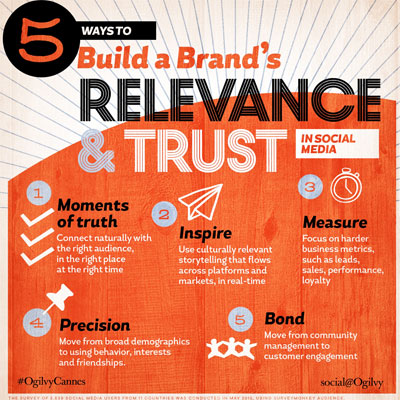
    5 steps that the research insists to garner brand relevance and trust in social media 


    1 .  Precision: Move from broad demographics to using behaviour, interests and friendships


    2.   Moments of truth: Connect naturally with the right audience, in the right place at the right time


    3.   Inspire: Use culturally relevant storytelling that flows across platforms and markets, in real-time


    4.   Bond: Move from community management to customer engagement


    5.   Measure: Focus on harder business metrics, such as leads, sales, performance, loyalty 


    “Companies need to move beyond collecting likes and retweets with meaningless content. Through genuine interaction and content designed to connect with true advocates, companies can drive forward their brand, business and reputation in ways not possible before this era of social media,” said Social@Ogilvy global managing director Thomas Crampton. 


    “Social media addicts may look like your most engaged consumers, but marketers need to stop looking at their data in silos to find their true advocates, By applying the Net Promoter Score methodology to social media users across the globe, we better understand the profile of a brand promoters: those who are extremely likely to recommend brands to friends and colleagues. To appeal to promoters, brands need to not only focus on quality but also reputation among friends or colleagues and that sense of worth that comes from being associated with a brand,” added SurveyMonkey vice president of marketing communications Bennett Porter. 

  • Siti Cable promoters pump in Rs 102.75 crore

    Siti Cable promoters pump in Rs 102.75 crore

    MUMBAI: India’s leading multi system operator (MSO) Siti Cable today announced to the Bombay Stock Exchange (BSE) that it had received an injection of Rs 102.75 crore from its promoters. This is the second tranche after the Rs 81 crore its promoters had pumped in March 2013.


    The announcement to the BSE states that “as per the terms of the 16.2 crore warrants issued on 19 March 2013 on preferential basis the allotment committee of the board of directors has upon receipt of the balance of 75 per cent consideration aggregating to Rs 102.75 crore approved allotment of 6.85 crore equity shares upon conversion of equal number of warrants at an issue price of Rs 20 per share to the allottees – Essel Media Ventures and Essel International.”


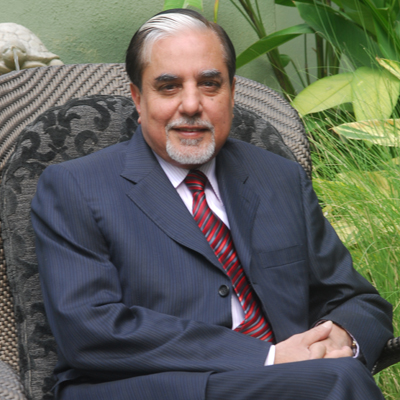
    Sources within Siti Cable point out that the promoters led by Zee and Essel group chairman Subhash Chandra is extremely bullish on the MSO’s prospects post completion of cable TV digitisation  nationally.


    The company’s CFO Sanjay Goyal confirms to indiantelevision.com that “the company had received clearances in March 2013 to bring in Rs 324 crore from the promoters in four tranches. As part of that Rs 81 crore flowed in that month itself. Though the promoter group had until September 2014 to bring in the rest, they plan on infusing the remainder of the money before 31 March 2014 to speed up the digitisation push.”


    The company’s CEO VD Wadhwa had in an interview to indiantelevision.com in January 2014 said that “Phases III and IV of digitisation has a total universe of about 90 million. Of these, we are targeting 6 to 7 million homes. At a gross level, we will require an investment of Rs 1200 crore. On a net basis, we are expecting an investment to the tune of Rs 600 crore. The funding of Phase III will be largely done through warrants’ funding of Rs 243 crore, which is likely to be invested by promoters before March 2014. Balance funding requirement will be met through internal accruals and raising of further equity, as may be required.”


    In September 2012, when the company had announced that it was raising Rs 324 crore via warrants to promoter firms, it was reported that after completion of the entire exercise, he total promoter shareholding will rise to 73.08 per cent from 63.43 per cent and that of the public will drop to 26.92 per cent from 36.57 per cent.


    Also read:

    Siti Cable gets Rs 810 mn first tranche from promoters

    WWIL to raise Rs 3.24 bn via warrants to promoter firms

  • Promoters’ stake in Network18 rises to 73% after rights issue

    Promoters’ stake in Network18 rises to 73% after rights issue

    MUMBAI: Raghav Bahl’s stake in Network18 has soared to 73 per cent after a muted response from the other shareholders to the rights issue but it is still not clear how much control Mukesh Ambani’s Reliance Industries Ltd (RIL) will have indirectly over the sprawling media company which has interests in television, internet, films, digital commerce, magazines, mobile content and allied businesses.

    RIL’s Independent Media Trust (IMT) was to provide the money the promoters of Network18 would require to subscribe to shares in the rights issues of both Network18 and TV18. The details of funds lent by IMT through investments in zero coupon optionally convertible debentures (ZOCDs) issued by the promoter companies are not yet available.

    A minimum amount of Rs 9.96 billion borrowed from IMT would result in a 51 per cent stake in the promoter companies of Network18 on conversion of the ZOCDs.

    Following the closure of the rights issue on 4 October, the promoter holding in Network18 Media & Investments Ltd has jumped by 51 per cent from its earlier stake of 48.30 per cent.

    This follows the increase in stakes of the six promoter companies which subscribed to the promoters’ entitlement in the rights issue and also to the rights entitlement unsubscribed by non-promoter shareholders.

    After the rights issue, the shareholding of the six promoter companies in Network18 has increased to 66.16 per cent from 36.90 per cent. After including the shareholding of other promoter group holdings, the total promoter stake in Network18 after the rights issue is 73 per cent.

    The six promoter companies are RRB Mediasoft, RB Mediasoft, RB Media Holdings, Watermark Infratech, Colorful Media and Adventure Marketing. These promoter companies are owned and controlled by Bahl, founder of Network18 group, and wife Ritu Kapur.

    Network18’s subsidiary TV18 Broadcast Ltd operates news channels CNBC-TV18, CNBC Awaaz, CNBC-TV18 Prime HD, CNN-IBN, IBN7 and IBN-Lokmat (a Marathi regional news channel in partnership with the Lokmat group of newspapers).

    TV18 also operates a joint venture with Viacom, called Viacom18, which houses a portfolio of popular entertainment channels – Colors, Colors HD, MTV, Sonic, Comedy Central, VH1 and Nick – and Viacom18 Motion Pictures, the group’s filmed entertainment business.

    Network18 offered 307 shares for every 50 shares held by its shareholders at a price of Rs 30 per share. Its subsidiary TV18’s rights issue of 41 shares for every 11 shares held by its shareholders at a price of Rs 20 per share closed on 15 October, but the details of the issue are still not available.