Tag: Project Kuiper

  • Global broadband subs hit 1.52 billion as fibre dominates

    Global broadband subs hit 1.52 billion as fibre dominates

    MUMBAI: Global broadband subscribers surged past 1.52 billion in the first quarter of 2025, marking a 1.21 per cent quarterly rise as South and East Asia drove expansion, according to Point Topic data. Yet the picture remains patchy, with 22 countries—up from 14 in the previous quarter—seeing subscriber numbers fall as consumers shift to mobile broadband or grapple with economic headwinds and market saturation.

    India topped the largest 20 fixed broadband markets with a blistering 4.7 per cent quarterly growth rate, whilst Britain stood out as an outlier, suffering a 0.3 per cent decline as fibre rollout failed to offset broader connection losses.

    Fibre-to-the-home and building connections now command 72.34 per cent of global fixed broadband subscriptions, cementing the technology’s dominance. Other fixed technologies saw their market shares shrink, bar satellite and fixed wireless access, which bucked the trend with spectacular annual growth of 47.4 per cent and 29.9 per cent respectively.

    The satellite boom was largely driven by Starlink breaching the 5 million customer mark, though growth has slowed due to capacity constraints and pricing pressures. Competition is set to intensify as Amazon’s Project Kuiper prepares for launch by year-end, with Britain expected among the first markets to go live following Ofcom approvals. Residential plans currently start at around £75 monthly.

    Fixed wireless access is reshaping rural connectivity, particularly in America and India, with aggressive investments from Reliance, Bharti, T-Mobile, Verizon and AT&T driving adoption.

    Industry consolidation is accelerating, with potential mega-deals including Charter’s merger with Cox in America and a possible carve-up of France’s SFR among Orange, Bouygues and Iliad. Meanwhile, sub-Saharan Africa represents untapped potential, attracting significant infrastructure investment targeting broadband expansion.

  • Elon Musk’s Starlink clears final regulatory hurdle in India

    Elon Musk’s Starlink clears final regulatory hurdle in India

    MUMBAI: Elon Musk’s satellite internet venture Starlink has finally received the green light from India’s space regulator, In-Space, clearing the last major regulatory roadblock to launch commercial operations in the country.

    On 8 July, the Indian National Space Promotion and Authorisation Centre (In-Space) Igranted Starlink permission to operate its Gen1 non-Indian GSO and NGSO satellite constellation for broadband services over Indian territory. The authorisation is valid until July 7, 2030.

    The nod includes specific frequency band allocations. For gateway beams, Starlink can use uplink bands of 27.5–29.1 GHz and 29.5–30 GHz, and downlink bands of 17.8–18.6 GHz and 18.8–19.3 GHz. For user terminals, the uplink band is 14.0–14.5 GHz (LHCP), while the downlink is 10.7–12.7 GHz (RHCP).

    The approval follows Starlink’s receipt of a Global Mobile Personal Communication by Satellite (GMPCS) licence from the department of telecommunications (DoT), positioning it as the third player—after Eutelsat-OneWeb and Reliance Jio—to secure full clearance to provide satellite broadband in India.

    Next on the to-do list: acquiring administrative spectrum from the government, setting up ground stations, and passing security compliance trials. Starlink plans to establish three gateway stations across the country as part of its rollout.

    Sources say the DoT will soon allocate trial spectrum to facilitate security demonstrations. Final spectrum pricing and allocation guidelines are also expected shortly, following recent recommendations from TRAI.

    Starlink has already inked deals with Indian VSAT providers, signalling a B2B and B2G push ahead of a consumer rollout. Insiders hint that Starlink could soon begin offering direct-to-consumer connections via its website, though pricing is still under wraps. A promotional plan pegged at Rs 840 per month is reportedly on the table, but not officially confirmed.

    The road to India hasn’t been easy. Starlink has waited since 2022 for regulatory approvals, facing national security concerns and policy disputes with Jio over spectrum allocation. Eventually, the government backed Musk’s view that satellite spectrum should be assigned, not auctioned.

    Meanwhile, Amazon’s rival satcom venture, Project Kuiper, remains stuck in regulatory limbo. Despite completing operational and security checks, its application is still under review. Kuiper is proposing a more ambitious infrastructure plan, including 10 gateways and PoPs in Mumbai and Chennai—well ahead of Starlink’s three.

    India, the world’s second-largest internet market, is shaping up as a critical battleground for satellite broadband. With Musk’s firm now officially in the race, the stage is set for a high-stakes space-age showdown.

  • Amazon’s Kuiper Project to launch first full satellite batch for global broadband

    Amazon’s Kuiper Project to launch first full satellite batch for global broadband

    MUMBAI: Amazon’s Project Kuiper is launching its first full batch of satellites into orbit. The “KA-01” mission, scheduled for no earlier than 12 pm EDT on Wednesday, 9 April  will deploy 27 satellites via a United Launch Alliance (ULA) Atlas V rocket from Cape Canaveral Space Force Station, Florida.

    The mission aims to establish a low-latency, high-speed internet service accessible globally. The first-generation satellite system will consist of over 3,200 low Earth orbit satellites. The KA-01 launch is a critical step in deploying this constellation.

    The satellites deployed in the KA-01 mission feature improvements over previous prototypes, including enhanced phased array antennas, processors, solar arrays, propulsion systems, and optical inter-satellite links. A dielectric mirror film has been applied to the satellites to minimize reflected sunlight, addressing concerns from ground-based astronomers.

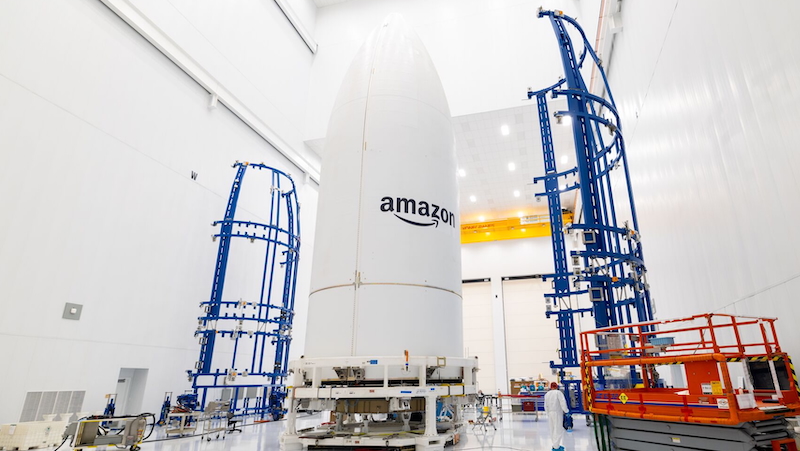
    The satellite payload is the heaviest ever carried by a ULA Atlas V rocket, requiring the rocket to fly in its most powerful configuration with five solid rocket boosters. The payload fairing measures 77 feet (23.5 meters) in height and 16.4 feet (5 meters) in width.

    Following launch and initial deployment by ULA, Kuiper’s mission operations center in Redmond, Washington, will manage the constellation. The satellites will use electric propulsion to ascend to their operational orbit of 392 miles (630 km), traveling at speeds exceeding 17,000 miles per hour.

    The mission’s primary objective is to achieve safe satellite deployment and establish end-to-end network connectivity. Future launches, including seven more on the Atlas V and 38 on ULA’s Vulcan Centaur, are planned to expand the constellation. Additional launches will occur with Arianespace, Blue Origin, and SpaceX.
    Amazon plans to begin delivering Kuiper internet services to customers later this year. The company is currently hiring to support the project’s development and deployment.

  • Amazon to launch satellites for broadband internet

    Amazon to launch satellites for broadband internet

    MUMBAI: An attempt by the e-commerce giant, Amazon to provide internet access is being made through its new initiative ‘Project Kuiper’ to build a network of over 3000 satellites, according to multiple filings made with the International Telecommunication Union last month.

    Amazon said in a statement that the long-term project will cater to people globally who lack basic access to broadband internet, the report mentioned.

    The company added that Project Kuiper will launch a constellation of low earth orbit satellites that will provide low-latency, high-speed broadband connectivity.  

    Amazon CEO Jeff Bezos is racing to pull his private space company Blue Origin out of start-up mode and move into production. Blue Origin is seeking to disrupt the legacy launch services market with reusable rocket technology.