Tag: Programme Code

  • MIB takes action on 163 violation cases of Programme Code against private channels in last 3 years

    MIB takes action on 163 violation cases of Programme Code against private channels in last 3 years

    Mumbai: The ministry of information and broadcasting (MIB) has taken action in 163 cases in the last three years and the current year against private TV channels found in violation with the Programme Code. The ministry took action through the issuance of advisories, warnings, apology scroll orders, and off-air orders.

    MIB had issued an advisory on 23 April to all private satellite TV channels to ensure strict compliance with the Programme Code under the Cable Television Networks (Regulation) Act, 1995 and rules framed thereunder.

    As per the advisory, the ministry observed that the reporting of the Ukraine-Russia conflict and the recent demolition incident in North-West Delhi were “misleading, sensationalist and have communal overtones.”

    Also Read: MIB condemns reporting of Russia-Ukraine conflict and Delhi demolition in advisory

    During the monsoon session of Parliament, the Lok Sabha asked the MIB whether it had taken action against TV channels which aired television debates allowing participants to air communally provocative and derogatory remarks. It also asked the government what action it has taken to prevent news channels from airing such debates on communal issues in the future.

    All programmes telecast on private satellite TV channels are required to adhere to the Programme Code laid down in the Cable Television Network Rules, 1994, framed under the Cable Television Networks (Regulation) Act, 1994. The Programme Code, inter alia, provides that no programme should be telecast that contains attacks on religions or communities, or visuals or words contemptuous of religious groups, or that promotes communal attitudes.

    The Programme Code under the Cable Television Networks Rules, inter alia, contains broad guidelines relating to content broadcast on private television channels. The central government has amended the Cable Television Networks Rules, 1994 to provide for a statutory mechanism for redressal of grievances and complaints of violations of the Programme Code and Advertising Codes of the broadcast by television channels.

    The Rules provide for three levels of complaint redressal mechanisms: Level I by the broadcaster; Level II by the self-regulating bodies of the broadcasters; and Level III by the oversight mechanism of the central government.

  • MIB condemns reporting of Russia-Ukraine conflict and Delhi demolition in advisory

    MIB condemns reporting of Russia-Ukraine conflict and Delhi demolition in advisory

    Mumbai: The ministry of information and broadcasting (MIB) has issued an advisory prohibiting satellite TV channels to transmit programming that is violative of the Programme Code under Cable Television Networks (Regulation) Act 1995. The ministry observed that the reporting of the Ukraine-Russia conflict and recent demolition incident in North-West Delhi are “misleading, sensationalist and have communal overtones.”

    Relating to the Ukraine-Russia conflict, the I&B ministry highlighted that TV channels have been making false claims and frequently misquoting international agencies/actors. That they have been using ‘scandalous headlines/taglines’ that are completely unrelated to the news item. And that many of the journalists and news anchors of these channels made fabricated and hyperbolic statements intending to incite the audiences.

    Similarly, the reporting for the incident in North-West Delhi “made use of provocative headlines and videos of violence that may incite communal hatred among the communities and disrupt peace and law and order,” according to the ministry. The coverage disrupted the ongoing investigation process by playing scandalous and unverified CCTV footage. By showing footage of a specific community thus aggravating the communal tensions and fabricated headlines sensationalising and giving communal colours to the actions of authority.

    The ministry also stated that in the news, “some of the channels broadcast debates having unparliamentary, provocative and socially unacceptable language, communal remarks and derogatory references which may have a negative psychological impact on viewers and may also incite communal disharmony and disturb the peace at large.”

    As per the provisions of the Programme Code, no programme should be carried in the cable service which (a) offends against good taste or decency (b) contains criticisms of friendly countries (c) contains attack on religions or communities or visuals or words contemptuous of religious groups or which promote communal attitudes (d) contains anything, obscene, defamatory, deliberate, false and suggestive innuendos and half-truths.

  • I&B ministry imposes additional penalties for violation of programme code

    I&B ministry imposes additional penalties for violation of programme code

    Mumbai: The minister of information and broadcasting, Anurag Thakur has informed the Rajya Sabha that there have been 37 instances between March 2005 and June 2021 where broadcasters were prohibited the transmission and re-transmission of a channel for a specified time period, or permission to downlink the channel was cancelled, due to violation of the programme code.

    The information and broadcasting minister was asked to give the status of Cable TV Networks Amendment (Regulation) Bill, 2020 which proposed to increase the penalties for violation of the Programme Code. He was also asked whether the government had imposed a monetary penalty or prohibited the transmission of a channel under the relevant provisions of the Cable TV Networks Amendment (Regulation) Act for violation of the Programme Code.

    “No monetary penalty has been imposed for the violation of Programme Code,” noted Thakur.

    The programme code comes under the Cable TV Networks (Regulation) Act, 1995 and Cable Television Networks Rules, 1994 contains broad guidelines related to content broadcast on private television channels.

    The matter of violation of the programme code and advertising code has been addressed by amending the rules vide government gazette notification number G.S.R. 416(E) on 17 June so as to include a complaint redressal mechanism by the broadcaster which prescribes the specific actions that can be taken by the central government for such violations.

    As per the amendments, if the government is satisfied that the programme of any channel is not in conformity with the programme code, it may, after giving an opportunity of hearing to the cable operator, and by an order in writing, prohibit the transmission or re-transmission of any such channel or programme in accordance with the provisions of section 20 of the Act.

    The rules provide for a three-tiered complaint redressal mechanism; Level I self-regulation by the broadcaster, level II self-regulation by self-regulating bodies of the broadcasters, and level III oversight mechanism by the central government.  

    The I&B minister had previously informed the Parliament on Friday that the government took action against 126 violations of the programme code between 2018 and 2021.

  • I&B ministry acted against 126 violations of Programme Code in last 3 years

    I&B ministry acted against 126 violations of Programme Code in last 3 years

    Mumbai: During 2018 to 2021, the Government took action against 126 cases of violation of Programme Code laid down in the Cable Television Networks (CTN) Rules, 1994 framed under Cable Television Networks Act, 1995. The action with respect to cases was taken by issuance of advisories, warnings, apology scroll orders, and off-air orders, said the ministry on Friday.

    “Government has an institutional mechanism for taking action in respect of private TV channels which are found to violate the Programme Code. The I&B ministry also issues advisories from time to time to private satellite TV channels for adhering to the Programme Code,” said the minister of information and broadcasting, Anurag Thakur in the ongoing monsoon session of the Parliament.

    The minister was responding to a query put forth in the Lok Sabha on whether the Government has taken cognizance of high decibel, sensationalist and slanderous news programmes/debates being hosted on Indian news channels. The Government was asked whether it has received complaints against news channels for violating the broadcasting guidelines and broadcasting fake news, hate and divisive agenda during the last three years.

    The Government was also asked whether it is planning to initiate any code of conduct or broad guidelines for the debates that happen on electronic media and the time by which final decision is likely to be taken in this regard.

    The Programme Code contains broad guidelines related to content broadcast on private television channels.

    The guidelines also provide that no programme should contain anything obscene, defamatory, deliberate, false and suggestive innuendos, and half-truths, and should not criticise malign or slander any individual in person or certain groups, segments of social, public and moral life of the country.

    The Rules provide for a three-level complaint redressal mechanism; Level I by the broadcaster, Level II by the self-regulating bodies of the broadcasters; and Level III by oversight mechanism of the Central Government.

  • Exercise restraint, Bengaluru police tells news b’casters

    Exercise restraint, Bengaluru police tells news b’casters

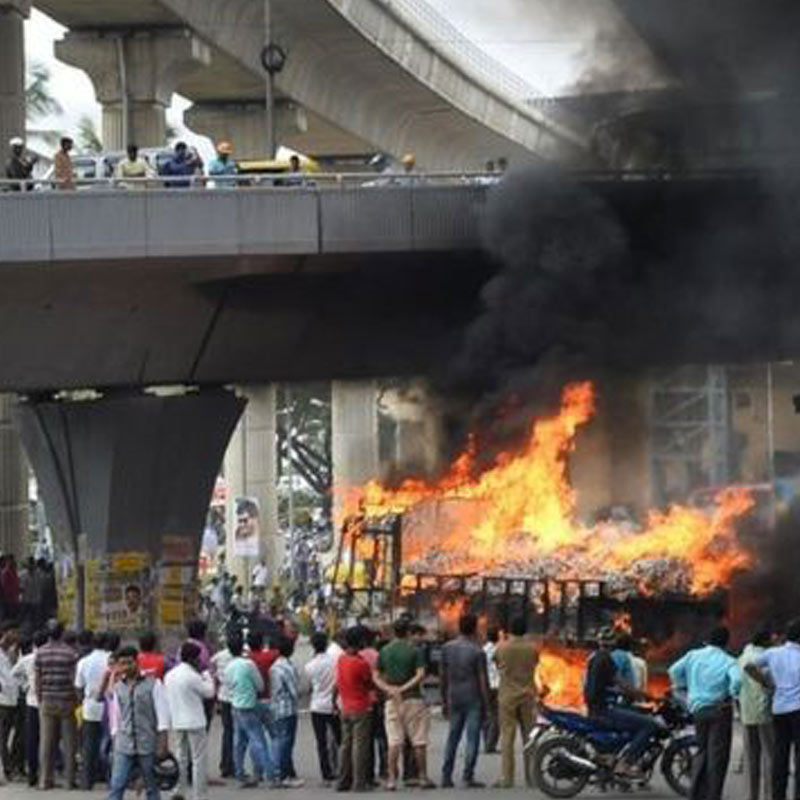
    NEW DELHI: Even as the Information and Broadcasting Ministry advised television channels to avoid life telecasts or file shots of violence or rioting linked to the Cauvery dispute, the Bengaluru Police has issued a similar directive for channels reporting from Karnataka.

    An order issued by Bengaluru police commissioner N S Megarikh yesterday advised television channels to follow the provisions of the Programme Code ‘scrupulously and exercise restraint and sensitivity while reporting such incidents and refrain from telecasting any material which  could ignite passions and create law and order problem in the city.’

    The directive also said that violation of its advisory may lead to prosecution of the offenders under the Cable Television Networks (Regulation) Act 1995.

    Noting that it had come to its notice that certain television channels had been telecasting provocative and inflammatory news / programmes relating to the Cauvery dispute including footage of violence, the advisory said that this may lead to further tension, resulting in a deterioration of the law and order situation.

    The Advisory quoted the relevant provisions in the Act as well as the uplinking and downlinking guidelines.

    Also read:
     

  • Exercise restraint, Bengaluru police tells news b’casters

    Exercise restraint, Bengaluru police tells news b’casters

    NEW DELHI: Even as the Information and Broadcasting Ministry advised television channels to avoid life telecasts or file shots of violence or rioting linked to the Cauvery dispute, the Bengaluru Police has issued a similar directive for channels reporting from Karnataka.

    An order issued by Bengaluru police commissioner N S Megarikh yesterday advised television channels to follow the provisions of the Programme Code ‘scrupulously and exercise restraint and sensitivity while reporting such incidents and refrain from telecasting any material which  could ignite passions and create law and order problem in the city.’

    The directive also said that violation of its advisory may lead to prosecution of the offenders under the Cable Television Networks (Regulation) Act 1995.

    Noting that it had come to its notice that certain television channels had been telecasting provocative and inflammatory news / programmes relating to the Cauvery dispute including footage of violence, the advisory said that this may lead to further tension, resulting in a deterioration of the law and order situation.

    The Advisory quoted the relevant provisions in the Act as well as the uplinking and downlinking guidelines.

    Also read:
     

  • Action “reportedly” taken against LCOs in Kurnool and Aurangabad showing Peace TV: Naidu

    Action “reportedly” taken against LCOs in Kurnool and Aurangabad showing Peace TV: Naidu

    NEW DELHI: Reiterating that action was taken against telecasting of unpermitted television channels, Information and Broadcasting Minister M Vekaiaih Naidu said today that such complaints were received against some cable operators from some districts such as Kurnool and Aurangabad regarding carriage of Peace TV channel.

    He told the Rajya Sabha that the complaints were forwarded to the District Collector for necessary action by the authorized officers under the Cable Television Networks (Regulation) Act 1995 and Rules 1994.

    “They have reportedly taken action”, the Minister added in reply to a question.

    The Ministry has also invited complaints by the general public regarding transmission of unpermitted satellite TV channels by cable operators on its social media platforms. These are also forwarded to the District Collectors for necessary action.

    Whenever instances are brought to the notice of thr Ministry regarding Uplinking of unpermitted TV channels through any Indian teleport, action is taken to stop the same as per the provisions of Uplinking guidelines 2011, he said.

    He said that the Cable Act and Cable Rules regulates the transmission and re-transmission of TV channels over the Cable Networks. The Authorized Officers (the District Magistrates, the Additional District Magistrates, the Sub-Divisional Magistrates and the Commissioners of Police within their territorial jurisdiction) under the Act are empowered to take action whenever violations of the Cable Act, 1995 are brought to notice.

    The Telecom Regulatory Authority of India (TRAI) has made recommendations on the regulation of ground channels in this regard.

    Meanwhile, he said his Ministry had on 8 July 2016 issued advisories to the State Governments and Union Territories, the District Collectors and the MSOs/LCOs that no unpermitted satellite channel such as Peace TV should be carried by the cable operators in the country.

    In addition, the Ministry has issued advisories from time to time to the State Governments and Union Territories to constitute State and District Level Monitoring Committees for recommending action against broadcast content being carried by the cable operators which are in violation of the Programme Code and the Advertisement Code under the Cable Act 1995.

    The Ministry has mandated Digitization of the entire cable network in the country by December, 2016 in a phased manner through the introduction of the Digital Addressable Systems (DAS). This measure is expected to address the issues of transmission of unpermitted TV channels, he added.

  • Action “reportedly” taken against LCOs in Kurnool and Aurangabad showing Peace TV: Naidu

    Action “reportedly” taken against LCOs in Kurnool and Aurangabad showing Peace TV: Naidu

    NEW DELHI: Reiterating that action was taken against telecasting of unpermitted television channels, Information and Broadcasting Minister M Vekaiaih Naidu said today that such complaints were received against some cable operators from some districts such as Kurnool and Aurangabad regarding carriage of Peace TV channel.

    He told the Rajya Sabha that the complaints were forwarded to the District Collector for necessary action by the authorized officers under the Cable Television Networks (Regulation) Act 1995 and Rules 1994.

    “They have reportedly taken action”, the Minister added in reply to a question.

    The Ministry has also invited complaints by the general public regarding transmission of unpermitted satellite TV channels by cable operators on its social media platforms. These are also forwarded to the District Collectors for necessary action.

    Whenever instances are brought to the notice of thr Ministry regarding Uplinking of unpermitted TV channels through any Indian teleport, action is taken to stop the same as per the provisions of Uplinking guidelines 2011, he said.

    He said that the Cable Act and Cable Rules regulates the transmission and re-transmission of TV channels over the Cable Networks. The Authorized Officers (the District Magistrates, the Additional District Magistrates, the Sub-Divisional Magistrates and the Commissioners of Police within their territorial jurisdiction) under the Act are empowered to take action whenever violations of the Cable Act, 1995 are brought to notice.

    The Telecom Regulatory Authority of India (TRAI) has made recommendations on the regulation of ground channels in this regard.

    Meanwhile, he said his Ministry had on 8 July 2016 issued advisories to the State Governments and Union Territories, the District Collectors and the MSOs/LCOs that no unpermitted satellite channel such as Peace TV should be carried by the cable operators in the country.

    In addition, the Ministry has issued advisories from time to time to the State Governments and Union Territories to constitute State and District Level Monitoring Committees for recommending action against broadcast content being carried by the cable operators which are in violation of the Programme Code and the Advertisement Code under the Cable Act 1995.

    The Ministry has mandated Digitization of the entire cable network in the country by December, 2016 in a phased manner through the introduction of the Digital Addressable Systems (DAS). This measure is expected to address the issues of transmission of unpermitted TV channels, he added.

  • NDTV issued show-cause notice on live coverage of Pathankot terrorist attack

    NDTV issued show-cause notice on live coverage of Pathankot terrorist attack

    NEW DELHI: News broadcaster NDTV has been issued a show cause notice for its live coverage of the security forces’ operations at Pathankot to flush out terrorists who were engaged in an encounter.

    Stating this in the Parliament, Minister of State for Information and Broadcasting Rajyavardhan Rathore said that the notice had been issued under Rule 6(1)(p) of the Cable Television Network Rules 1994.

    He said the Ministry had brought out amendments on 23 March last year in Rule 6 of the Rules to prohibit live coverage of operation by security forces. Rule 6 of Programme Code was amended by inserting a clause (p) under sub rule (1) whereby no programme should be carried in the cable service, which ‘contains live coverage of any anti-terrorist operation by security forces, wherein media coverage shall be restricted to periodic briefing by an officer designated by the appropriate Government, till such operation concludes.’

    Answering a question, he said in order to implement the Rules, the Home Ministry has issued Advisories to the States whereby the DGP of the State concerned has been designated as appropriate authority for specifying an operation and the spokesperson of the State Police has been made the designated officer for the purpose of briefing the media during the anti-terrorist operations.

  • NDTV issued show-cause notice on live coverage of Pathankot terrorist attack

    NDTV issued show-cause notice on live coverage of Pathankot terrorist attack

    NEW DELHI: News broadcaster NDTV has been issued a show cause notice for its live coverage of the security forces’ operations at Pathankot to flush out terrorists who were engaged in an encounter.

    Stating this in the Parliament, Minister of State for Information and Broadcasting Rajyavardhan Rathore said that the notice had been issued under Rule 6(1)(p) of the Cable Television Network Rules 1994.

    He said the Ministry had brought out amendments on 23 March last year in Rule 6 of the Rules to prohibit live coverage of operation by security forces. Rule 6 of Programme Code was amended by inserting a clause (p) under sub rule (1) whereby no programme should be carried in the cable service, which ‘contains live coverage of any anti-terrorist operation by security forces, wherein media coverage shall be restricted to periodic briefing by an officer designated by the appropriate Government, till such operation concludes.’

    Answering a question, he said in order to implement the Rules, the Home Ministry has issued Advisories to the States whereby the DGP of the State concerned has been designated as appropriate authority for specifying an operation and the spokesperson of the State Police has been made the designated officer for the purpose of briefing the media during the anti-terrorist operations.