Tag: print

  • Apurva Purohit steps down as the president of the Jagran Group

    Apurva Purohit steps down as the president of the Jagran Group

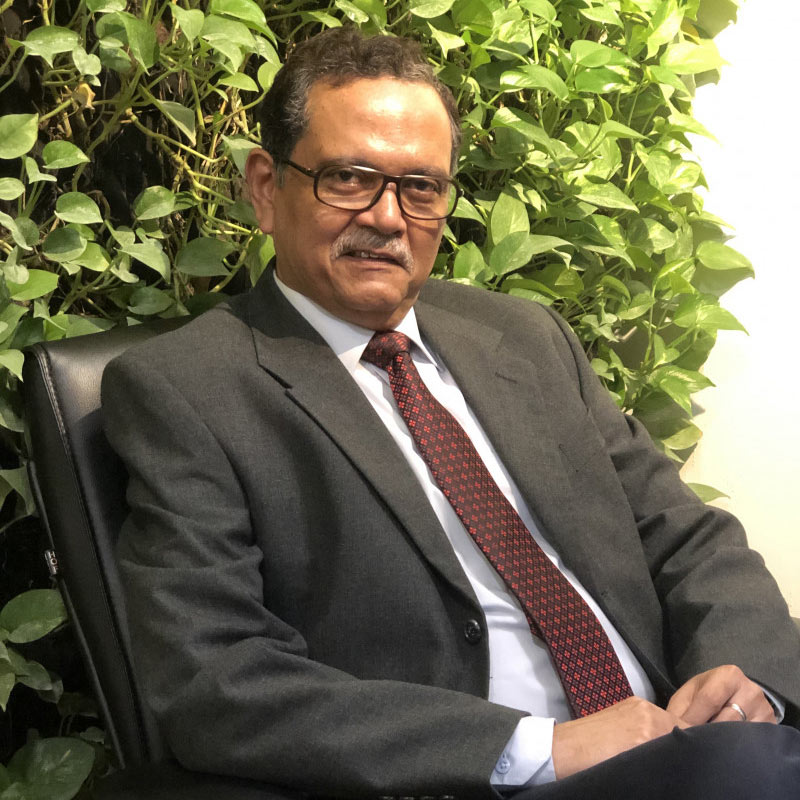
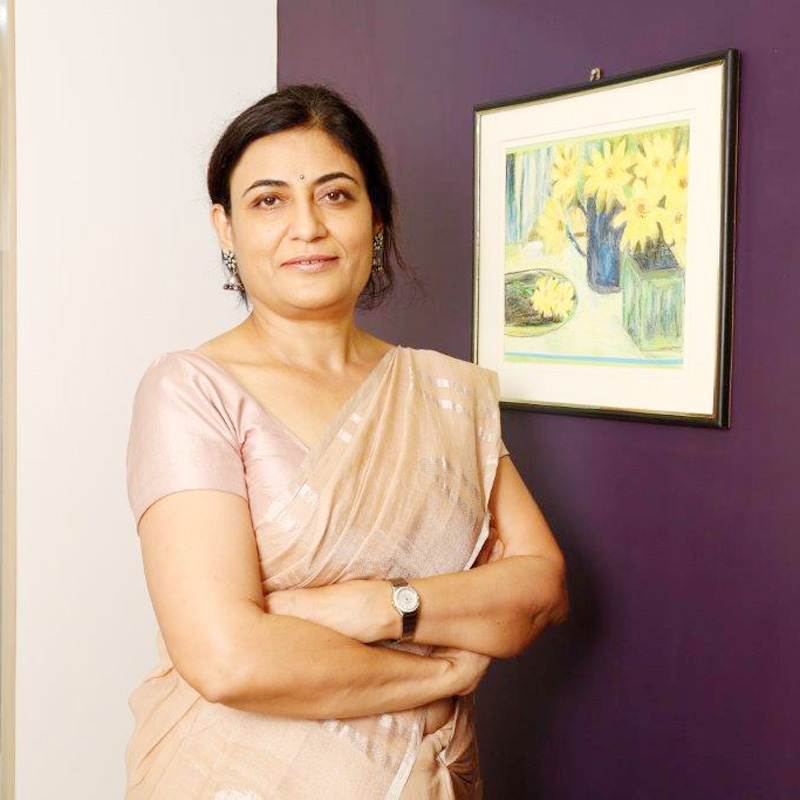
    Mumbai: Apurva Purohit, the president of the Jagran Group has announced her decision to step down, after working for over half a decade with the group and nearly 16 years with MBL (Radio City). She will remain with the organization till 30 June. 

    Purohit played a pivotal role in its transformational growth of Radio City as a leading brand in the FM radio industry. MBL went public in 2016 and is currently among the most valuable FM players in the public market. 

    “Apurva’s key strengths lie in her ability to simplify complex problems, build teams, and implement innovations and strategies in a focused and extremely effective fashion. Her understanding of consumer behavior and what drives change in people, and managing the tough business of media which requires both right and left brain thinking, and her business acumen have been invaluable to Jagran, especially in the last few difficult years. Her exit is a great loss to the Group,” said Jagran Prakashan Limited, group chief financial officer, R K Aggarwal. 

    In a statement released on Thursday, the company said Purohit helped the group to pivot from a deep-rooted reliance on its traditional print businesses to focus on new age emerging businesses. The strategies adopted under her tutelage and her emphasis on excellence in implementation have helped create strong and resilient verticals in radio, print, outdoor and digital with the ability to power through difficult economic scenarios, it added further. 

    Purohit has spent nearly 32 years in media, beginning with Lodestar to working in television, radio, print, and digital. “These three decades have given me incredible opportunities to build and scale up a diverse set of businesses – from fledgling ones like Radio City to new ventures like Times TV and supervising turnarounds in mature organizations like Zee TV. I will continue to use these experiences to mentor and guide CEOs and entrepreneurs to build valuable businesses, a role I have been doing for the past few years at Jagran and the other companies I am associated with,” Purohit said on Thursday. 

    Elaborating on her decision, Purohit added, “I have been reflecting recently, especially in this period of crisis, that it is the job of each one of us who has the ability and the resources to drive change, to worry about the economic situation around us and do everything in our power to create positive impact. This phase of my journey is about creating and funding businesses which work towards generating employment where it is needed, and at scale, a sorely needed initiative given the significant number of people who have been rendered jobless in the past year.”

  • Concerns about fake news on the rise in India: Ormax report

    Concerns about fake news on the rise in India: Ormax report

    Mumbai: Two out of three news consumers consider fake news a major challenge facing the country’s news organisations, showed the latest report released by media consulting firm Ormax Media.

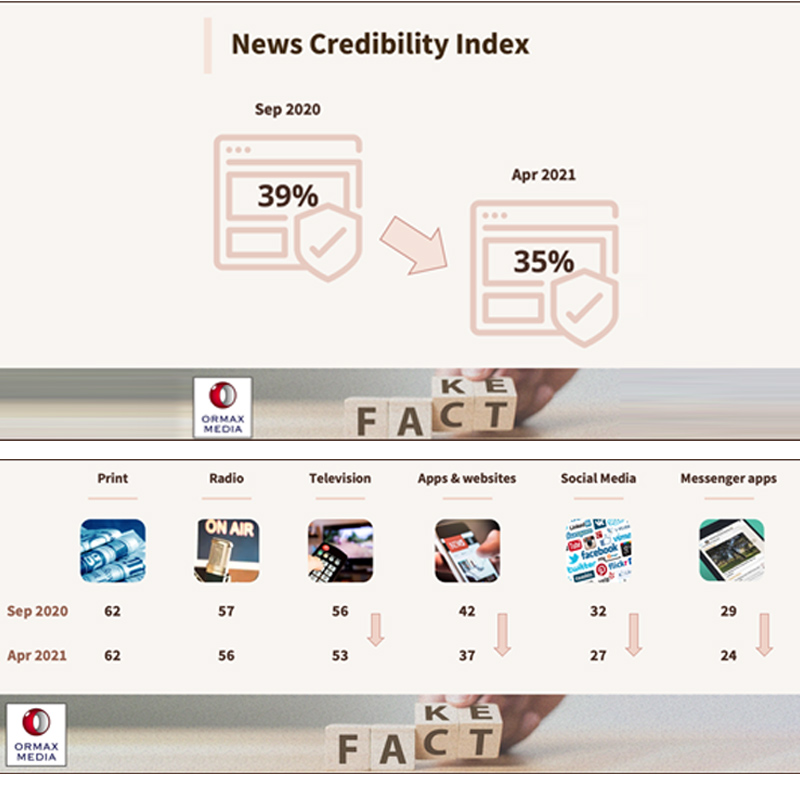
    According to the report Fact or Fake?, at least 65 per cent of the news consumers surveyed highlighted fake news as a major concern. The share of such individuals rose by four percentage points from last year, when the agency released the first edition of the report. Only 35 per cent news consumers feel that the news category in India doesn’t have any major fake news concerns, down from 39 per cent in September 2020.

    The findings are based on a survey of news consumers, which was conducted to measure the credibility of various news media, as well as their overall perception towards ‘fake news’. The survey covered around 1,000 urban news consumers (15+ years) from as many as 17 states and Union Territories in India. The questions were asked through computer-assisted telephonic interview.

    This is the second edition of the report, based on data collected in April 2021. The first edition was released on September 2020.

    According to the report, print media continued to lead in terms of credibility, as 62 per cent of news consumers generally considered the medium to be credible. Radio held on to the second position with 56 per cent consumers considering it as credible compared to 57 per cent in 2020. However, all other media platforms showed significant decline in credibility – television’s credibility index dropped from 56 per cent to 53 per cent and digital news apps and websites from 42 per cent to 37 per cent.

    The number of consumers (from the sample) who consider social media platforms to be credible also dropped from 32 per cent to 27 per cent and messenger apps from 29 per cent to 24 per cent. 

    Within social media, despite a drop since the last track, Twitter continues to rank on top with a news credibility Index of 47 per cent. No other social media or messenger app platform manages to touch even the 30 per cent mark, showed the survey.
     
    Ormax Media, founder and CEO Shailesh Kapoor said, “Concerns around fake news have been escalating worldwide over the last few years. But a drop from an already-low score of 39 per cent to 35 per cent within just seven months, does not augur well for the Indian news industry. In the midst of a pandemic, credibility of news becomes even more important. We hope to see television news and digital platforms address this concern more proactively, before it becomes a brand safety issue for advertisers using these media, and a cause for rejection for subscribers of paid news services”. 

    The report defines Media Credibility Index as a percentage of news consumers who find the news in a particular medium generally credible, respectively.

  • HUL tops personal care & hygiene advertisers on TV, print: TAM AdEx 2020 report

    HUL tops personal care & hygiene advertisers on TV, print: TAM AdEx 2020 report

    MUMBAI: The TAM Adex overview of advertising in the personal care and hygiene sector across TV, print, radio and digital media for the year 2020 has thrown up some significant insights. All four media witnessed a thumping recovery in Q4 advertising over Q1. The trends also reflected the growing importance of handwashing and sanitisation due to the Covid2019 scare.

    The personal care/hygiene sector witnessed 38 per cent growth in television ad volumes in Q4 of 2020, compared to Q1, according to the TAM AdEx overview of the segment across TV, print, radio and digital in 2020. Compared to Q1 of 2020, Q4 witnessed 3X ad insertion growth on digital, while ad space in print witnessed double digit share from November 2020 onwards. Ad volumes for the personal care and hygiene sector grew by 4X on radio in Q4 over Q2 of 2020.

    Television

    Ad volumes of the personal care/hygiene sector on TV increased by seven per cent in 2020 over 2019. Compared to Q1 of 2020, Q4 witnessed 38 per cent growth in ad volumes of this sector. Due to Covid2019, the lowest ad Volumes were observed in Q2, which includes the lockdown period. A drop recorded in personal care and hygiene sector advertising was seen during April 2020 over March 2020 due to the lockdown. However, during September-December 2020, ad volumes on television witnessed a double digit share. The GEC genre topped preference list of personal care/hygiene players during 2020.

    The top three product categories contributed more than 55 per cent to the ad volume share of the personal care/hygiene sector. Top 10 Advertisers accounted for more than 80 per cent share of ad volumes in 2020 with FMCG major Hindustan Unilever (HUL) topping the list. Among the Top 10 brands, five belonged to the toilet soaps category. Top 10 brands accounted for more than 30 per cent share of ad volumes in 2020 with Dettol Toilet Soaps topping the list.

    Print

    Ad space in print witnessed double digit share from November 2020 onwards. Compared to the first quarter of 2020, Q4 witnessed 45 per cent ad space growth in print publications.

    Ad space of the personal care/hygiene sector in print decreased by 19 per cent in last year over 2019. Compared to Q1 of 2020, Q4 witnessed 45 per cent ad space growth. Print ad space recovered to pre-lockdown level within four months of post lockdown period. Ad space in print witnessed double digit share in the months of September, November and December of 2020.

    Fairness creams leads the list of top 10 categories under the personal care/hygiene sector. Top 10 advertisers accounted for more than 65 per cent share of ad space in 2020 with HUL leading the list, followed by SBS Biotech. 

    Among four zones, north topped for personal care/hygiene advertising with 41 per cent share in print during 2020. Mumbai and Kolkata were the top cities in the west and east zone respectively as well as in overall India.

    Radio

    Ad volume for the personal care/hygiene sector on radio dropped by 11 per cent last year over 2019. Q3 of 2020 registered the highest advertising of personal care/hygiene on radio. Due to Covid2019, lowest ad volumes were observed in Q2 which includes the lockdown period. Highest share of ad volumes for personal care/hygiene sector registered during August to October of the previous year.

    Ad volumes for the personal care/hygiene sector grew by 4X in the fourth quarter over second quarter of 2020. On radio, ads for tooth pastes and toilet soaps ruled with more than 45 per cent of the total ad volumes.

    Maharashtra was the top state with 16 per cent share of ad volumes followed by Gujarat with 15 per cent share. Top 10 advertisers accounted for 74 per cent share of ad volume in 2020 with Vicco Laboratories leading the list. 

    Digital

    Ad insertions of the personal care/hygiene sector on digital decreased by 24 per cent in 2020 over 2019. Compared to Q1 of 2020, Q3 and Q4 witnessed 2X and 3X growth in ad insertions, respectively. The highest share on digital was observed during the festive period, that is, October-December 2020, which had 40 per cent share of total ad insertions on the medium.

    On the digital medium, tooth pastes and face wash were the top personal care/hygiene categories, with 24 per cent and 13 per cent share, respectively. The top 10 advertisers accounted for more than 75 per cent share of ad insertions in 2020, with GlaxoSmithkline leading the list.

    The top 10 brands accounted for 47 per cent share of ad insertions on digital in 2020. Sensodyne Rapid Relief topped the list with 11 per cent share of the total ad insertions for the personal care/hygiene sector.

  • M&E sector witnessed 24% degrowth in 2020: FICCI & EY report

    M&E sector witnessed 24% degrowth in 2020: FICCI & EY report

    KOLKATA: Following a pandemic hit year, the Indian media and entertainment (M&E) sector declined by 24 per cent to Rs 1.38 trillion in 2020, compared to Rs 1.82 trillion in 2019. However, the allied sector is already seeing recovery with improvement in revenues for most segments in the last quarter of 2020. It is expected to recover 25 per cent to reach Rs 1.73 trillion in 2021, touching almost pre-Covid level scale, according to a report by FICCI and E&Y.

    The report titled ‘Playing by New Rules: India’s M&E sector reboots in 2020’ states digital and online gaming were the only segments which grew in 2020, adding an aggregate of Rs 26 billion and consequently, their contribution to the M&E sector increased from 16 per cent in 2019 to 23 per cent in 2020.

    Other segments dropped by an aggregate of Rs 465 billion. Largest absolute contributors to the fall were the filmed entertainment segment (Rs 119 billion), print (Rs 106 billion) and television (Rs 102 billion). The share of traditional media (television, print, filmed entertainment, OOH, radio, music) stood at 72 per cent of M&E sector revenues in 2020.

    However, television stood as the largest sector despite a 22 per cent downturn in advertising revenues on account of highly discounted ad rates during the lockdown months. Moreover, the sector also witnessed a seven per cent fall in subscription income, led by the continued growth of free television, reverse migration and a reduction in ARPUs due to part implementation of NTO 2.0.

    On the other side, digital advertising did not see much impact, led by increased allocation from traditional advertisers who accelerated their investments in digital sales channels. SME advertisers continued to spend on the medium and experimented more with e-commerce platforms like Amazon and Flipkart.

    For the first time ever, OTT subscriptions surpassed the 50 million mark. From 28 million paid subscriptions, it went up to 53 million in 2020 leading to a 49 per cent growth in digital subscription revenues. Growth has been attributed largely to Disney+ Hotstar, which put the IPL behind a paywall during the year. Increased content investments by Netflix and Amazon Prime Video and launch of several regional language products also catalysed the growth, the report added.

    Online gaming crossed all the marks with 18 per cent growth helped by work from home, school from home and increased trial of online multi-player games during the lockdown. Online gamers grew 20 per cent to reach 360 million in 2020.

    Among the pandemic hit sectors, print’s revenue declines were led by a 41 per cent fall in advertising and a 24 per cent fall in circulation revenues. Theatrical revenues plummeted to less than a quarter of their 2019 levels, partly offset by direct-to-digital releases.

    “While the M&E sector usually grows faster than GDP, it also falls more than GDP degrowth, given the discretionary nature of advertising. In 2020, when the GDP fell by eight per cent advertising fell over 25 per cent while the sector overall fell by 24 per cent,” the report read.

    The M&E sector is expected to rebound in 2021 and double to around Rs 2.68 trillion by 2025, the recovery of various segments will vary albeit. TV, film, music will take one to two years, animation and VFX will take two to three years; print, radio, OOH will take the longest time, even more than three years.

  • What Santa could gift us this Christmas

    What Santa could gift us this Christmas

    MUMBAI: As children, Santa Claus was very real for us. Even if he sat under a fake Christmas tree in an Akbarally’s department store in Mumbai, with padding under his suit to give him that potbelly, and rouge on his cheeks, and a false snow white beard, which jiggled every time he said ‘Ho! Ho! Merry Christmas.’ For us, it was exciting to see other children big-eyed, nervous, eager smiles on their faces, as they waited their turn to get to Santa. Father Christmas, as he’s known in English folklore, embodies the very spirit of the season: that of love and giving.

    The world overall – and our media and entertainment industry –needs a lot of loving and giving this year. Bruised and battered by the Covid2019 induced lockdowns in various states, and countries, it is celebrating Christmas with severe restrictions in place. A new mutant strain of the SARS CoV2 virus that has popped up in the UK has made governments in almost every nation jittery. Curfews, various levels of lockdowns, and border closures have been re-imposed, once again choking the breath out of any economic revival that could have happened.  

    Fear is very much prevalent all around.  The season to be jolly appears to be pretty un-jolly. Christmas is going to be cold – really cold, without the warm emotions the season brings.

    The good news is that various vaccines are going to be available on a massive scale. But we don’t know clearly how long they will be effective; and how much time it will be before every one of us gets a jab.

    The good news is that jolly old Santa is still around. And if he is listening – which we are sure he is – we’d like him to shower the world with oodles of good gifts and tidings this Christmas 2020. Here’s a wish list from us at Indiantelevision.com for the world and the media and entertainment industry:

    ·    Miraculously, as if by sleight of hand or an act of God, the SARS CoV2 virus loses its potency, and does no harm to any human being. Yes, we cannot bring back the ones we have lost. But we can definitely do with knowing that we will lose no more and that we are free to go where we want to without terror coursing through our veins.

    ·    Now if that is not possible, ensure that the vaccines miraculously provide a permanent defence against the dratted bug and that with one fell stroke, every human being on this planet gets an injection. For that, the pharma companies and governments will have to be sensible, honest and get their acts together super quick.

    ·    The world we live in is a beautiful place. The lockdowns enabled us to see it for its beauty without the horrors and synthetic creations of mankind damaging it. Governments the world over and earth’s denizens need to remember this for eternity. Natural rather than artificial needs to be the mantra, if we want our future generations to enjoy it.

    ·    The economic engine needs to start chugging and gain momentum. Money, the magical fuel, needs to flow smoothly to enable this to take place.

    ·     Consumer sentiment needs to turn around from being cautious and hoarding to one which is open to spending and living life to its fullest.

    ·     For the media and entertainment industries, this means that brands will be willing to spend to get king and queen consumer to buy them.

    ·    Result: the print, television, OTT, cinema industries will serve as a good medium to induce consumers to make purchases through persuasive communications in the form of advertising and TVCs.

    ·    Net outcome: the red ink on the balance sheets of many a company will steadily turn to black.

    ·   The content that is pumped out on TV, cinemas, and OTT platforms is innovative and attracts sticky eyeballs, stickier than ever before.

    ·   Let new talent in every sphere of entertainment get a chance to flower, to showcase his or her skills.

    ·   Let inclusiveness be real, and be put into practice in day to day work: alternate sexualities, genders, differently-abled and folks from every caste and creed truly be given equal opportunity.

    This is our bucket list of what we would like Rudolf the red-nosed reindeer and his boss to bring us this year. It’s by no means comprehensive; it may not even be apt, but it is the message we are sending out to the universe; hopefully it will reciprocate in full measure.

    We would love you to share your wish list for Santa too. Do it. It can be fun. Please post in the comments below.

  • PubNation: How print players expanded digital operations amid Covid

    PubNation: How print players expanded digital operations amid Covid

    MUMBAI: The process of the digital transformation of the print industry has been ongoing for a while now, but the Covid2019 crisis accelerated the need for news publications to realign their objectives and operational model, and to look toward creating new avenues to diversify offerings. More than ever, media businesses will have to act now in order to capitalise on this current growth and ensure success in this new landscape and beyond. 

    Different news organisations came forward to discuss the effect of pandemic and how it accelerated their business at the two-day-long summit – PubNation (print and digital), organised by Indiantelevision.com in partnership with Quintyoe Technologies and Gamezop. The panel was moderated by Omdia content strategies senior principal Tim Westcott and included ET Online editor Deepak Ajwani, Moneycontrol editor Binoy Prabhakar, HT digital streams chief content officer Prasad Sanyal, Amar Ujala Ltd state editor Uttrakhand Sanjay Abhigyan, The Hindu strategy & digital editor Sriram Srinivasan and Mathrubhumi assistant editor-online K A Johny.

    During the pandemic a lot of publications were forced to take the digital route to stay in business. As the movement of people, transport and delivery came to a complete halt owing to lockdown, and readers unsubscribed due to economic constraints or risk of contracting the virus off of newspapers, the e-paper played an important role in these tough times.

    Starting off, Srinivasan revealed that The Hindu was among the first few publications to go digital and adopt a subscription-based model two years back. It is also among first few organisations to launch a paid version of the website. He added, “We have an e-paper, we provide dozens of newsletters. So, everything that is required for a digital publication is there. Then there are our sister publications also, including Business Line, political magazine Frontline and a sports magazine.”

    Amar Ujala, which has a very strong presence in Hindi heartland and is among the top five newspapers in the country, has shifted its focus towards creating digital content. The organisation is present in eight to nine states with more than 250 print editions. Amar Ujala has a very vibrant digital presence in the form of a website, YouTube and Facebook. 
     
    Echoing the sentiment, Sanyal mentioned that Covid20919 has accelerated the digital journey for Hindustan Times and the brand is looking forward to expanding its offering. “All the three outlets Hindustan Times, Hindustan and Live Mint are digitally present. During the pandemic, the company has launched three new segments HT automobile, HT tech and HT Bangla,” he added.

    A large number of media groups were already digital first and working towards ensuring that the customer experience is right and they were abreast with the content trends. Ajwani revealed that in March 2020, ET doubled its viewership. Said he: “We were effective, productive and were making a difference with whatever content we were producing from home. A lot of technology, collaboration with our print team has been around for the last three-four years. We have been connected with each other via multi-modes of technology. So, using our feet on the ground, and the skills of technology and the skills we have built online, we have had a very integrated approach from day one.”

    He further added, “Somewhere in the month of July, we saw that Covid2019 pandemic has accelerated our offerings. I believe there is no transition from print to digital. They both work in synergy. It is an omnipresent world, we are present wherever the reader wants us to be.”

    When the novel Coronavirus arrived in India, it came with more than its fair share of misinformation and fake news. People were in desperate need of verifiable, trustworthy news and they turned to print publications and their digital arms for it. In this regard, Prabhakar mentioned that Moneycontrol was focused on reaching out to its audiences and providing all the necessary information related to the pandemic. “Seeking viewer attention was never a problem for the organisation. Today, the lockdowns have been lifted and many of our readers have gone back to their daily routines, now the challenge once again is to how to seek the user’s attention,” he rued.

    The brand had diversified its offering to acquire and retain new users by expanding into the regional language space. It has three subscription-based products — Moneycontrol Pro, Moneycontrol Hindi and Moneycontrol Gujrati. 

    HT is also doing something similar, said Sanyal, and offers products for Gujarati and Hindi speaking audiences. The network closely works with all partners to deliver content.  

    K A Johny disclosed that it has a very powerful presence in both print and TV. He also shared that the driving force for Mathrubhumi is the trust of people. Covid2019 has only revived things for the organisation. Irrespective of the medium, he thinks that a platform of trust and credibility is the need of the hour.

  • PubNation: Agencies should look beyond just numbers for clients

    PubNation: Agencies should look beyond just numbers for clients

    NEW DELHI: While the local language market has always been a force to contend with in the Indian publishing industry – be it radio, print, TV, or digital – agency partners are not being active enough in providing the deserved monetisation support to them, said a panel discussing the state of local language market on day one of PubNation (print & digital), organised by Indiantelevision.com in partnership with Quintype and Gamezop, opined. 

    Moderated by Wavemaker India chief growth officer & south head Kishankumar Shyamalan, the session was attended by Punjab Kesari Group of Newspapers director Abhijay Chopra, Vikatan group MD B Srinivasan (Srini), Lokmat Media Ltd editorial director Rishi Darda, Mathrubhumi director – digital business Mayura Shreyams Kumar, and Eenadu general manager – marketing Sushil Kumar Tyagi. 

    The panel unanimously agreed that local content and publications have always been strong players in India, and this conversation about their relevance and sudden emergence comes up every time a new medium comes into the spotlight. 

    Chopra, who is a fourth-generation leader from Punjab Kesari Group, highlighted that they have existed in the market since 1948 and the audience was always there for the papers. 

    He said, “This point of local languages emerging comes from an advertising standpoint. What happened in the initial days was that we mostly had foreign advertisers and they advertised what they understood. So, English became their preferred language.”

    Srini, in the same vein, noted that India has always been a land of multitude of diversity and it is reflected in the comparative ad spends on television channels – but the same cannot be said for print. “Regional channels are far more successful than the English ones on TV. Sadly, that never reflected on to print publications,” he said. 

    Kumar stated, “We have been active in the regional market since forever. And there is a sense of trust within the readers as well as the advertisers when it comes to our content. So, I won’t say we are an emerging force. Yes, for digital, I can say that our presence is now being amplified but it is certainly not ‘emerging’, so to say.” 

    However, they are still not getting the commercial traction they deserve because the agency and client partners are not making enough efforts to reach out or discover their content capabilities. 

    To drive this point home, Chopra shared a personal experience: “I started this digital property called Yum; it’s all about food, recipes and other related stuff. So when it started gaining good traction, with the intent of monetising it, I mailed a presentation to an agency representative, who never got back to me. In fact, a few weeks down the line, the same advertiser that I was trying to get onboard got in touch with me via our Facebook channel.”

    He added that the clients (advertisers) do not have enough teams. And for most agency managers, the sole focus remains on completing the work and not actually doing research for good content. 

    Srini, supporting this thought, added, “I often wonder if there is any other metric beyond the numbers or ComScore that makes any impact on the planners. The discussion always starts with CTRs, CPLs, CPMs etc. Is there any willingness to look at our storytelling capabilities and the ability to provide the brands with a platform to engage better with their consumers?”

    However, he also agreed that the publishers themselves will have to take the responsibility to promote their content and increase visibility. 

    Tyagi highlighted that consumers are going to get back to credible sources to get their news and advertisers are also willing to associate themselves with credible publications. “The agencies should be coming to us asking what are your editorial policies, how are you dealing with the news, what are the cultural aspects, etc.” 

    Darda and Kumar also noted that advertisers and agencies should look beyond just numbers and take into consideration the impact and the trust metrics for any digital channel.  

  • PubNation: Are paywalls the future of digital news?

    PubNation: Are paywalls the future of digital news?

    MUMBAI: Covid2019 has impacted industries across the board but it also gave a massive fillip to digital adoption. People are using digital more than ever for most of their requirements – from buying groceries, to reading news, and seeking entertainment.

    The massive change in consumption habits has not gone unnoticed by media organisations and while some may think that the print industry is on the cusp of a digital revolution, the truth is that they have been preparing for this for a while now; upgrading their capabilities by investing in technology, video, content formats, creating properties and, most of all, training editorial teams. 

    In order to understand the new form of print media, its relevance as an advertising medium, the content that will define print publications in future, and technology that will shape the copies of tomorrow, Indiantelevision.com is hosting a two-day-long summit – PubNation (print and digital) in partnership with Quintyoe Technologies and Gamezop.

    One of the virtual panels focused on the convergence of print and digital, and how news will evolve and be consumed in the next three years. The panel was moderated by Omdia content strategies senior principal analyst Tim Westcott and included ET Online editor Deepak Ajwani, Moneycontrol editor Binoy Prabhakar, HT digital streams chief content officer Prasad Sanyal, Amar Ujala Ltd state editor Uttrakhand Sanjay Abhigyan, and Mathrubhumi assistant editor-online K A Johny.

    Abhigyan opened the session by sharing that till recently, Amar Ujala was known as a print maven, but the organisation has adopted digital at a rapid speed. It has a vibrant online presence in the form of a website, YouTube and Facebook pages. In current times, content diversification is of utmost importance, he stated. 

    But going digital also raises the question of modes of monetisation. Will the future of the digital news content be obscured behind paywalls?  

    The Hindu strategy & digital editor Sriram Srinivasan shared that the group was one of the first ones in the country to figure out that getting into a subscription model was inevitable. “We identified it a few years ago, before we even did it. We all saw where the online advertising was going and a lot of publishers were struggling to make it as a main source of revenue and it is still a problem. There is a limit to which the online advertising can support a publication,” he said.

    Prabhakar mentioned that Moneycontrol has a subscription product – Moneycontrol Pro, which has been around for the last two years and has managed over three lakh subscribers in the last 18 months. “We have been doing this because our business ambitions and editorial objectives were clearly aligned.” 

    Ajwani, who was representing one of the biggest publishers of the country, mentioned that for the last two years, ET Prime was running without any ads. However, they were the first website in the realm of business mulling to go the subscription route. Initially, the print team was helping them with great paywall content. Then they started with video content, deep-dive stories and experimenting with formats and graphics. Covid2019 further hastened the process of segueing from partial to complete paywall.

     “Initially we put out three articles with in-depth analysis and graphics behind the paywall on ETPrime.com. This July we integrated it into the ET platform and it became the membership platform for us. We redesigned an integrated website, launched a paywall mechanism, and a lot of changes were made and all this was done from home,” he detailed. 

    During the conversation, K A Johny disclosed that Mathrubhumi is planning to go behind a paywall and the teams are working towards this end. 

    Westcott wondered how these industry giants were going to make readers pay for their digital platform, to which Prabhakar admitted that building a subscription-based model is not easy. There are also hefty production costs to contend with. To make the content look worthy enough so that the readers pay for it, the organisation uploads weekly stock results and in-depth investigative reports.

    Adding to this, Ajwani said that it is important to make the user-experience more hassle-free and enjoyable. "I think both science and content are the subscription mantra." Sanyal agreed, chiming in with the reveal that the organisation is aware of what audiences read, and discovery of the kind of content that will be run on the site is driven by algorithms and not individuals. 

    It will be interesting to see how the content strategies of these platforms unfold in the long run and how willing users will be to pay for the content.

  • AndBeyond.Media wins programmatic monetisation mandate for Eenadu

    AndBeyond.Media wins programmatic monetisation mandate for Eenadu

    Mumbai: AndBeyond.Media has won the programmatic monetisation mandate for Eenadu. As part of this onboarding, AndBeyond.Media will work with Eenadu as a strategic partner to maximise their ad revenues via programmatic channels. This strategic partnership comes at a very opportune time as both the businesses have seen promising uptick in the last few months – with AndBeyond.Media now catering to 500+ premium publishers.

    As part of this alliance, AndBeyond.Media’s duties will include a managed header bidding solution along with offering high impact ad formats that can help to drive new incremental revenue streams for Eenadu. A holistic approach with the publisher will also help to create more competition on the ad stack for better performance, CPMs and fill rates.

    AndBeyond.Media chief business officer Pankil Mehta said, “We are delighted to have onboarded Eenadu and are excited to manage their programmatic ads solutions mandate. Being at the forefront of the latest and most advanced technology in terms of programmatic advertising, we are confident that we will be able to bestow the best-in-class products for Eenadu’s web assets. Our in-house team of seasoned professionals and our holistic platform with technology at its centre focuses on an integrated approach to optimise ad demand. With our expertise in offering programmatic advertising solutions to a number of publishers in the past, we have been able to drive guaranteed incremental revenue streams for Eenadu’s business and will continue to do so.”

    Eenadu GM Sushil Kumar Tyagi added, "Our business is forever growing and we believe the momentum of growth should not slow down. The need of the hour, hence, was to find the right partner to help better monetise and optimise the ads on our digital properties and for this, we are super thrilled to have partnered with AndBeyond.Media. This strategic and focused alliance with AndBeyond.Media has driven fruitful gains for our business.”

  • Over three decades, marketing has seen a paradigm shift

    Over three decades, marketing has seen a paradigm shift

    MUMBAI: On a long trip, the mode of travel may encompass an assortment including air, train, road, boat. Even within these legs, the experience could differ significantly, for example driving on a mountain road, versus regular old ride through the city.

    Similarly, a marketer’s journey over the last three decades has seen multiple metamorphoses, entailing a continuous need for change and adaptation.

    Those were the days, when planning media spends was a simple matter of allocating monies between Ramayana, Hindi feature films, and Chitrahaar on DD, with the option of throwing in Krishi Darshan for the adventurous rural marketer. The satellite TV boom, bringing in hundreds of channels and programmes, added complexity to media planning, and forced marketers to slice and dice the communication target group in terms of multiple demographic parameters. “Focused communication” really took shape in the nineties.

    And then the internet explosion, along with the advent of smartphones, dramatically changed the rules of the game. Digital marketing and social media are the buzzwords now. Engaging the viewer is paramount. Communication can now be targeted at a specific age group, even at a micro level of a city. Youth today interact with the world through their devices. TV viewing and print media are almost skipping this generation. Even a few years ago, advertising on live sports telecasts was a sure-fire way of reaching the youth. Today, even that is transitioning to the Hotstar and Cricbuzz of the world.

    This is having a significant impact on consumer buying behaviour, and the purchase decision-making process. The erstwhile classical marketing’s five step process – spanning problem identification, information search, evaluation of alternatives, purchase decision and post-purchase behaviour – is passé. The three Moments of Truth (MOT) theory has been flipped on its head.

    As per traditional theory, the first MOT is when the consumer interacts with the brand for the first time, say, on a supermarket shelf, and decides to pick up a brand, over others. The second MOT is when she experiences the brand, which may be once (for example, in a restaurant), or maybe multiple times (like a shampoo). A few proceed to the third MOT, and become advocates (positive) or critics (negative), based on their individual experiences. This journey has now been collapsed to what is termed the Zero Moment of Truth (ZMOT). Thanks to the explosion in internet usage, every new brand or product is now researched, where consumers are vicariously exposed to the entire journey at one shot, through others’ experiences. Managing social media is critical now. For example, while evaluating options to buy a car, if one comes across half a dozen negative comments about a specific brand, it is very likely that this brand will drop out of one’s consideration set.

    A few decades ago, there was allegedly a thumb rule across the world – that a happy consumer will tell five others, while a dissatisfied consumer will crib to 21 people. Today these numbers have magnified manifold, and are probably in thousands, if not millions, thanks to the power of viral posts in social media.

    30 years ago, fashion and lifestyle trends in the western world would take their own sweet time, maybe two to three years, to catch on in India. Today all brands need to keep pace with global innovations, since consumers are constantly exposed to these. Discerning powers of consumers, thanks to the plethora of information available, have taken quantum leaps. Earlier, ‘value-for-money’ was the key for mass marketing. Today’s informed consumer is willing to pay for value-added features, leading to the ‘money-for-value’ concept.

    Changes, and the necessity to adapt to these, will be keeping marketers on their toes. From print/radio/cinema, to TV (single channel to hundreds), to the internet with its multiple social media platforms, to live streaming and OTT – the milestones and the route map keeps evolving. It’s perhaps foolhardy to even attempt to predict what’s coming next.

    (The author is Navneet Youva stationery division chief strategy officer. The opinions expressed here are his own and Indiantelevision.com may not subscribe to them.)