Tag: print

  • Bihar Election 2020 – Political ad spend analysis: TAM data

    Bihar Election 2020 – Political ad spend analysis: TAM data

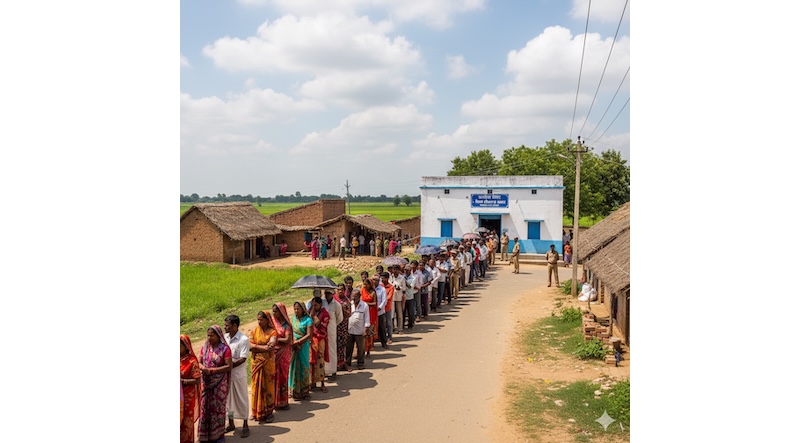
    MUMBAI: The battle for Bihar in 2020 wasn’t just fought on dusty village squares and opposition rallies. It raged across television screens and newspaper columns, with political parties unleashing millions in advertising rupees to woo voters. TAM Media’s advertising expenditure data reveals a lopsided affair: television gobbled up a staggering 93 per cent of all political advertising spend, leaving print media to scrap over a measly 7 per cent.

    The Bharatiya Janata Party emerged as the undisputed heavyweight, commanding 38.7 per cent of overall ad insertions—more than double its nearest competitor. On television, where the real money flowed, BJP’s dominance was even more pronounced at 41 per cent of all ad slots. The National Democratic Alliance, its coalition partner, secured 17.4 per cent overall, with an 18.6 per cent share on television.

    Congress, despite its third-place finish in overall spending at 17 per cent, displayed tactical nous in print advertising. The party ranked second in newspapers with 7.1 per cent of insertions as a standalone advertiser, while a Congress-led coalition (Congress-I/RJD/CPI variants) topped print spending at 15.7 per cent—edging past a BJP-led alliance’s 14.1 per cent.Top 5 ad spenders

    Rashtriya Janata Dal and Janata Dal United rounded out the top five, with 11.9 per cent and 8.9 per cent of overall insertions respectively. The fragmented opposition was evident in the numbers: 25 other parties collectively managed just 6.1 per cent of ad insertions, with print media seeing an even messier 44.6 per cent split among 15 smaller players.

    But the real story lies in the timing. TAM Media’s week-by-week analysis reveals a campaign that began as a whisper and ended as a roar. For the first six weeks—from early September through early October—political advertising barely registered on television. Print maintained a modest but steady presence during this period, with a slight peak in week three.

    Then came the deluge. From week seven onwards, television advertising exploded in a dramatic crescendo. By week nine (25-31 October), TV ad insertions hit their peak at 42 per cent of the entire campaign’s television spend—a staggering concentration just days before polling. Print advertising followed a similar trajectory, peaking at 31 per cent during the same crucial week nine, though it maintained a more consistent presence throughout the campaign compared to television’s late surge.

    The pattern is unmistakable: parties held their fire until voters’ attention was sharpest, then carpet-bombed the airwaves in the final fortnight. Week ten saw a slight decline as polling day arrived, but by then the damage—or persuasion—was done.

    The data, covering political advertisements across Bihar’s television channels and publications during the election period, paints a clear picture: in Bihar’s ad war, television was the main battleground, BJP brought the biggest guns, and everyone saved their ammunition for a final, frenzied assault on voters’ senses. Welcome to democracy, Bihar-style—where timing is everything and the biggest megaphone usually wins.

  • Cinema Halls to Smartphones: The Shift in Indian Entertainment Consumption

    Cinema Halls to Smartphones: The Shift in Indian Entertainment Consumption

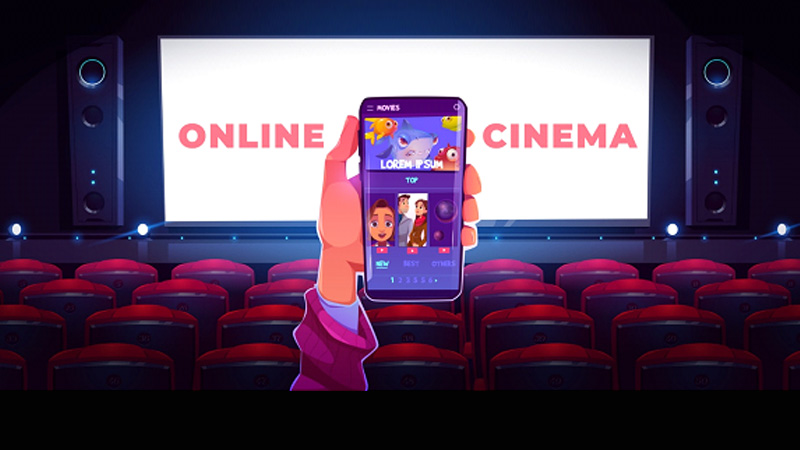
    India has long been among the world’s biggest film markets in terms of ticket sales, number of films produced, and theatre infrastructure. Over the past decade, the rise of digital streaming, cheaper data, and changing consumer behavior has pushed for a rebalancing.

    According to a recent EY research, the Indian media and entertainment (M&E) industry increased by 3.3% in 2024 and was valued at approximately INR 2.5 trillion (US$29.4 billion).

    Within that, digital media is the largest segment, and contributed around 32% of total revenues. In contrast, traditional media, like TV, print, and radio, saw drops in both advertising and subscription income.

    The Legacy of Cinema Halls

    For so long, the cinema has been the centrepiece of Indian entertainment. Big festivals, major star vehicles, and regional cinema in language hubs built the live-theatre experience. It was in the 2000s and 2010s when multiplexes in large cities boomed. Single screens remained relevant in smaller towns, and cinema halls generated major portions of film revenues.

    However, it can’t be denied that experiencing entertainment at the cinema can be a bit pricey. The cost of theatre tickets, travel, and supplementary expenses (food, parking) slows attendance for many films. Some mid-budget or smaller regional films struggle to recoup costs via theatrical alone. The impact of COVID-19 also forced many delayed releases or direct-to-OTT experiments, which in turn raised questions about the sustainability of cinema as the only route.

    Rise of OTT and Mobile-First Viewing

    India’s OTT universe in 2025 stands at 601.2 million people who watched at least one streamed or online video in the past month. That accounts for about 41.1% of the population.  
    Of those, 148.2 million are active paid OTT subscriptions (including through telecom bundles and OTT aggregators).

    Connected TV usage has surged: the number of Connected TV users is now 129.2 million, up 87% year-on-year.  This shift shows streaming is no longer confined to phones only, as viewers want larger screens and living room experiences as well.

    Data costs have fallen, smartphones have become ubiquitous, and broadband penetration has improved in urban and rural areas alike. Streaming platforms like Netflix, Amazon Prime Video, Disney+ Hotstar (now JioHotstar), Zee5, SonyLIV, and many regional players have scaled voice, subtitle, language localisation, and pricing to reach broader audiences.

    Sports-related platforms or communities, both legal streaming and fan engagement spaces, show another angle of audience shift. For instance, users who follow cricket or other live sports not only stream matches on OTT platforms but also use various digital forums and social media platforms.

    10CRIC and other similar websites are some of those online spaces where fans get access to the latest odds, team stats, and more. That reflects the way entertainment and live content spill over into related digital spaces, though the core viewing remains on OTT and smart devices.

    Regional Content and Language Diversity

    Regional language content is a key driver in this transformation. Ormax Media reports show that in 2024, the number of streaming originals in India dropped by about 18% compared to the previous year, after peaking in 2023. Still among originals, fiction series dominate (around 70% of OTT originals), and Hindi remains the dominant language with 65%share.

    Other languages, such as Bengali, Telugu, and Tamil, have growing representation. Platforms focused on regional content (e.g., those devoted to one language) are just really seeing stronger engagement in their markets.

    Viewers increasingly prefer content in local languages, with dubbed or subtitled versions helping content move across state borders. Films originally released in theatres are seeing extended life on OTT in regional markets.

    Economics: Theatrical vs OTT

    Releasing a film in theatres is expensive. Studios spend on distribution, digital or print delivery, big marketing campaigns, and then share a large cut with theatre owners. If a film doesn’t get a strong opening weekend, it often struggles to recover those costs.

    An OTT release works differently. Platforms can cut down distribution expenses, reach audiences across cities and smaller towns at once, and earn through subscriptions or ads. This makes it a safer option for mid-budget or niche films that may not draw big crowds in cinemas.

    Subscription Video On Demand (SVOD) and Advertising Video On Demand (AVOD) are also coexisting. Many platforms give both options. There is also bundling through telecom providers. Some films release theatrically and land on OTT after a window. Some would have direct-to-OTT release strategies, especially for smaller budgets or niche content.

    Technology, Platforms, and Interactivity

    Better mobile networks (4G, growing 5G), cheaper data, improved video compression, and smart TVs all push streaming quality up. Platform features like offline downloads, profiles, parental controls, and multi-device sync help retain users.

    Interactivity now matters. Live trivia, polls during shows, social features built into streaming apps, and second-screen experiences. Streaming of sports or live events gets further amplified by chat, fan forums, commentary, and behind-the-scenes clips.

    Hybrid content consumption (combining cinema and streaming) is becoming standard. Consumers may watch big action or festival films in theatres, but a large part of their weekly content diet comes from OTT. As streaming grows, the role of theatres adjusts.

    What the Future Looks Like

    Growth projections are strong, and the FICCI-EY report estimates the M&E sector will grow 7.2% in 2025. So, that’s about INR 2.7 trillion at a CAGR of about 7% to reach around INR 3.1 trillion by 2027.

    OTT audience and adoption are also expected to increase, though growth rates might moderate. Connected TV adoption will likely continue its sharp rise.

    However, platforms will still need to combine technology investment, pricing innovation, content localisation, and strong marketing to retain audience loyalty. Those who will are the ones likely to remain relevant for a long time. 

    Disclaimer:This article has been published without the journalistic or editorial involvement of Indiantelevision.com. IndianTelevision.com Group, or any of its affiliated websites. IndianTelevision.com Group does not endorse, subscribe to, or take responsibility for the content, opinions, or views expressed herein.

    Readers are further advised that Online Casino, Betting, Cryptocurrency products, Financial Investments/Engagements, NFTs, and products or calls-to-action related to Health, Booking, Wellness, and Food are largely unregulated and carry significant risk. There may be no regulatory protections or avenues for recourse in the event of financial losses or health-related risks arising from engagement with such products or services.

    IndianTelevision.com Group expressly disclaims any responsibility or liability for the information, views, announcements, declarations, or affirmations presented in this article. By choosing to proceed, the reader acknowledges and agrees that they do so at their own discretion and risk, and expressly absolve indiantelevision.com (IndianTelevision.com Group) from any potential legal claims, liabilities, or actions.

    The content provided is solely for informational and awareness purposes.
     

  • India’s ad market rebounds in H1 2025 as TV steals the show: Excellent Publicity report

    India’s ad market rebounds in H1 2025 as TV steals the show: Excellent Publicity report

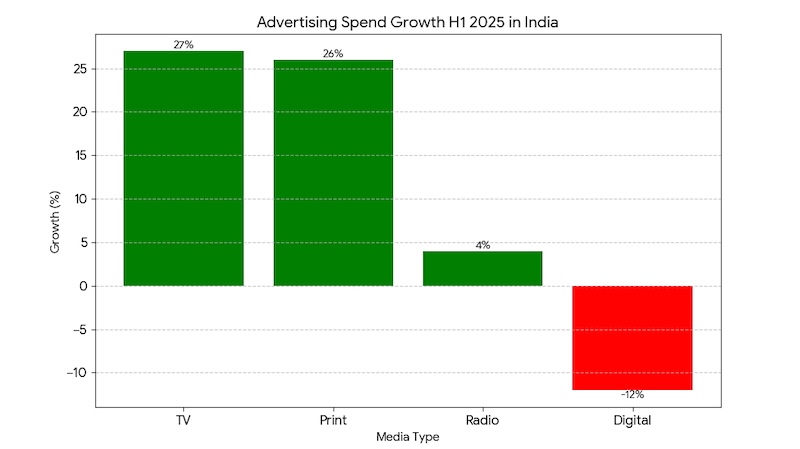
    MUMBAI: Here’s one report which is not talking of doom and gloom as far as ad spends in India are concerned. India’s advertising market kicked off 2025 on a high according to a half-yearly report by ad-tech and media planning agency Excellent Publicity, citing data from TAM Media Research, TAM AdEx and RCS India, reported Business Standard. The report said that  television powered ahead as the biggest gainer in the first half of the year, outspending print and radio, while digital was the lone laggard.

    Ad spends on TV per channel jumped 27 per cent year-on-year. Sports channels hoovered up 68.5 per cent of TV spends, trailed by general entertainment with 15.7 per cent. The e-commerce media, entertainment and social media category led volumes with a 25.6 per cent share. Star India kept its crown with 16.8 per cent of volumes, while Jio Hotstar topped the brand charts. Cellular services were the fastest risers, ballooning 17 times over the year.

    Print was no pushover either, posting a robust 26 per cent growth. Cars took pole position with 8.9 per cent of spends, while two-wheelers zipped ahead with a 31 per cent surge. Maruti Suzuki India was the top advertiser; Allen Career Institute, the top brand. Rajasthan led among states with 15.6 per cent of spends, and Delhi among cities with 7.1 per cent.

    Radio barely moved the needle, inching up 4 per cent. Properties and real estate dominated, cars followed, and pan masala muscled into the top 10. Maharashtra accounted for 19.3 per cent of radio spends, Delhi 18.1 per cent. Maruti Suzuki India again led advertisers, while Jeena Sikho Lifecare was the top brand.

    Digital, by contrast, shrank 12 per cent – the only medium to contract – though it logged the highest number of advertisers in three years. E-commerce online shopping led with an 11.2 per cent share. Amazon Online India was the top advertiser, Amazon.in the top brand. Programmatic buying made up 88.3 per cent of spends. Some niches bucked the trend: washing powders and liquids soared 21 times, perfumes and deodorants six times.

    “What’s really interesting is how brands are navigating a delicate balance,” said Excellent Publicity co-founder and director Vaishal Dalal.. “TV still captures attention, radio keeps the connection local and relatable, print is earning back trust, and digital is becoming sharper and more targeted.”

    Strangely the report did not talk about  outdoor spends. Was the situation hunky-dory in the sector like TV?

  • ITV Network Appoints Abhay Ojha as CEO

    ITV Network Appoints Abhay Ojha as CEO

    MUMBAI: ITV Network has appointed Abhay Ojha as chief executive officer for its television, print, digital and sports league business.

    Abhay brings over 25 years of experience across media and FMCG sectors, having previously worked with Zee Media, Star India, Zee Entertainment, Turner and Hindustan Unilever.

    Abhay’s expertise spans multiple industries, including media, FMCG, e-commerce, and financial modeling. He is a skilled change catalyst and financial strategist with a strong background in business management, digital transformation, investments, new business acquisition, and startups.

    Throughout his career, Abhay has successfully led multiple companies through digital transformations, resulting in millions of dollars in profit. His entrepreneurial spirit, passion for innovation, and strong business acumen have enabled him to achieve unprecedented success in launching new businesses.

    “His exceptional leadership skills and business acumen make him ideal to drive our organisation’s growth,” said ITV Foundation chairperson Aishwarya Pandit.

    “It’s an honor to join ITV network, an institution I have long admired and respected. I am drawn to ITV network because of the organisation’s clarity and consistency of purpose and am very excited to partner with the outstanding leadership team to lead the company into the future,” expressed Abhay.

    Abhay  holds a bachelor’s degree in science from Indore and a master’s in business management from IGNOU. In his new role, he will oversee the network’s expansion across multiple platforms and lead its digital transformation initiatives

  • TAM AdEx: Surge in political advertising during Maharashtra assembly elections

    TAM AdEx: Surge in political advertising during Maharashtra assembly elections

    Mumbai: As the election season approaches, the advertising landscape witnessed a surge in activity, especially across traditional mediums like TV, print, and radio. A recent report by TAM AdEx, a division of TAM Media Research, delved into the advertising patterns observed during the assembly election periods of September 2023 and October 2024. The report highlighted how political parties have strategically leveraged various media channels to maximize their reach and influence voters.

    The analysis focused on the ad insertions and ad volumes across different media platforms, comparing the data from the months leading up to the elections in 2023 and 2024. The study covered a range of advertising categories, primarily focusing on political ads, and provides insights into the evolving strategies adopted by political entities.

    The report noticed an increase in advertising across TV, print, and radio, particularly in the months leading up to the elections. Here’s a breakdown of the media usage trends:

    ●    Television remained the most dominant platform, capturing a large share of political ad insertions. This trend is attributed to TV’s extensive reach and ability to engage a wide demographic, making it a preferred medium for political campaigns.

    ●    Print media continued to play a crucial role, especially in regional advertising. Political parties leverage newspapers to reach specific voter bases, particularly in rural and semi-urban areas where print media retains substantial influence.

    ●    Radio also saw a noticeable increase in ad volumes, highlighting its importance as a medium for quick and cost-effective voter engagement, especially in local languages.

    The Ad Insertions data from the “Assembl Election – Ad Insertion” sheet reveals some interesting trends:

    ●    In September 2023, there was a moderate volume of ad insertions as political parties started ramping up their campaigns. However, by October 2024, there was a marked increase in ad insertions, indicating a more aggressive approach closer to the election dates.

    ●    The report highlighted that political ads constituted a significant portion of the total ad insertions across all three mediums (TV, print, and radio). This reflects the high stakes of assembly elections and the need for parties to maintain visibility across multiple channels.

    The data from the “Assembly Election – Ad Volume” sheet further elaborates on the share of ad volumes:

    ●    There was a noticeable shift in ad volumes between the two years, with October 2024 showing a higher volume compared to September 2023. This could be attributed to the heightened competition among political parties and the increasing significance of assembly elections in shaping state politics.

    ●    The increase in ad volumes suggested a growing emphasis on broadcast and print advertising as key components of election strategies. This aligns with the broader trend of political parties investing heavily in mass media to sway public opinion.

    The report also highlighted the distribution of ad insertions based on the per cent share of different media:

    ●    TV dominated the share of political ad insertions, followed by print and then radio. This aligns with the general perception that visual media has a stronger impact on viewers, especially during the election season.

    ●    The increased usage of radio in 2024 indicates a renewed interest in using audio channels to reach voters in rural and semi-urban areas. Radio’s localized nature allows political parties to tailor their messages to specific regions, making it a powerful tool for regional outreach.

    The comparative data between September 2023 and October 2024 reveals some strategic shifts in political advertising:

    ●    There was a clear escalation in ad spending as parties approached the 2024 assembly elections, indicating a more robust and aggressive campaign strategy. This aligns with the broader trend of political campaigns becoming more media-centric, leveraging high-frequency ad insertions to dominate the airwaves.

    ●    The report also suggested that political parties are increasingly adopting a multi-channel approach, utilising a mix of TV, print, and radio to ensure widespread voter engagement.

    TAM AdEx-Assembly Election Report – Sep’23 and Oct’24

  • Kainaz Karmakar named One Show 2025 jury president

    Kainaz Karmakar named One Show 2025 jury president

    Mumbai: Ogilvy India CCO Kainaz Karmakar in Mumbai, has been named jury president for out-of-home, print & promotional for The One Show 2025.

    Senior creative leaders from around the world are appointed as Jury Presidents to lead the judging for each discipline, and have a vote on the work.  The list of confirmed jury presidents can be viewed here.  

    In addition, members of The One Club board of directors will be present during judging, serving as non-voting facilitators in jury discussions.

    “The One Show’s reputation is built on the integrity of its juries and judging process,” said The One Club CEO Kevin Swanepoel. “Kainaz and the rest of the jury presidents will help further this legacy of the fairest and most positive judging process.”

    Entries for The One Show 2025 are now open, with fees increasing after each deadline. The super-early entry deadline for maximum savings is 1 November 2024, followed by the early deadline on 13 December 2024, the regular deadline on 31 January 2025, the extended deadline on 14 February 2025, and the final deadline on 28 February 2025.

    The full juries will be announced in December, with early judging starting in January 2025. Finalists will be announced in April, and winners of the gold, silver, bronze pencil, and merit awards will be revealed during creative week in May 2025 in New York.

    Submissions must include work background, creative ideas, insights and strategy, execution, and results to support judges’ decisions and enhance the One Show awards archive.

    All winning entries are showcased in the archive and viewable for free for one year. Winners also receive a complimentary one-year membership to The One Club, which includes full archive access.

    Agencies, brands, production companies, and individuals behind winning work are featured in The One Show Creative Rankings and The One Club’s Global Creative Rankings, which combine results from The One Show, ADC Annual Awards, Type Directors Club (TDC) Awards, ADCE Awards, and One Asia Creative Awards. Winners are ranked globally, regionally, and by country.

  • TAM report: Kia Seltos entered the top 10 list of brands in Jul-Sept’23

    TAM report: Kia Seltos entered the top 10 list of brands in Jul-Sept’23

    Mumbai: TAM AdEx India has released a quarterly advertising report on print for Jul-Sept’23.

    Print advertising experienced a six per cent increase in ad space from Jan-Mar’23 to Apr-Jun’23. However, from Jul-Sept’23, there was a two per cent decline in ad space compared to Jan-Mar’23. Additionally, during Jul-Sept’23, there was an 11 per cent reduction in ad space compared to the same period in 2022 for print advertising.

    The services sector claimed the top spot, capturing a 16 per cent share of ad space in Jul-Sept’23, surpassing its position in Apr-Jun’23. Computers emerged as the sole newcomer in the top 10 sectors, securing a two per cent share of ad space in Jul-Sept’23 compared to the previous quarter. Together, the top 10 sectors added 82 per cent share of ad space in Jul-Sept’23.

    During Jul-Sept’23, coaching/competitive exam centre descended to ninth position with a three per cent share of ad space compared to its first position in Apr-Jun’23. Whereas, in Jul-Sept’23, public issues ascended to fourth position with five per cent share of ad space compared to its tenth position in Apr-Jun’23. Additionally, the top 10 categories collectively added 44 per cent share of ad space in Jul-Sept’23.

    Maruti Suzuki India was the leading advertiser during Jan-Mar’23 and Apr-Jun’23. During Jul-Sept’23, the top 10 advertisers together covered 13 per cent share of ad space. SBS Biotech ascended to first position in Jul-Sept’23 compared to its second position in Apr-Jun’23. 38k plus exclusive advertisers were present in Jul-Sept’23 compared to Apr-Jun’23.

    Kia Seltos entered the top 10 list of brands in Jul-Sept’23 and secured first position compared to its 78th position in Apr-Jun’23. 47k+ Exclusive Brands were present during Jul-Sept’23 compared to Apr-Jun’23. Patanjali Divya OTC Products was an exclusive brand in Jul-Sept’23 compared to Apr-Jun’23. Also, the top 10 brands covered six per cent share of ad space in Jul-Sept’23.

    Public issues among categories witnessed highest increase in ad seconds with twofold growth followed by cars with 29 per cent growth during Jul-Sept’23 compared to Apr-Jun’23. In terms of growth percentage, the corporate-IT category witnessed the highest growth percentage among the top 10 i.e. four times in Jul-Sept’23.

    Sales promotion advertising covered 29 per cent share of ad space in Print during Jul-Sept’23. Among sales promotions, multiple promotion secured first position with 52 per cent share of ad space followed by discount

    promotion with 34 per cent share. The top two promotions covered 86 per cent share of ad space during Jul-Sept’23.

  • Navi onboards MS Dhoni as its brand ambassador

    Navi onboards MS Dhoni as its brand ambassador

    Mumbai: Sachin Bansal-backed Navi has appointed cricketer MS Dhoni as its brand ambassador. MS Dhoni will be the face of Navi’s branding initiatives. The association with the iconic former team India captain strengthens the brand’s trustworthiness as it works to fulfil customer goals by providing simple, affordable, and easily accessible financial services across India.

    Navi has launched its first ad with Dhoni on Hotstar during Thursday’s India vs. England T20 semi-final match. The goal of this campaign is to promote Navi’s prompt and accessible financial services by dismantling the old and conventional ways of doing business in this sector. The campaign will initially run on social media platforms like Facebook, Instagram, and YouTube before moving on to print and out-of-home (OOH) advertising in the second phase.

    Dhoni said, “Today’s India is intelligent, aspirational, and always working toward its goal. It is crucial for billions of Indians to achieve and surpass their life goals, which is why Navi and I have teamed up to make this vision a reality. Navi’s mission is to make financial services easily accessible whenever they are needed. I am very excited about this new journey with Navi.”

    Navi Group co-founder Sachin Bansal said, “We are thrilled to introduce MS Dhoni as our brand ambassador and the newest member of the Navi family. He personifies trust, ambition, and dedication—qualities that resonate powerfully with Navi and all we stand for, making him the ideal brand ambassador. Associating with him, in my opinion, would greatly enhance the value of our brand and further our mission to provide every Indian with simple, affordable, and reliable financial services.”

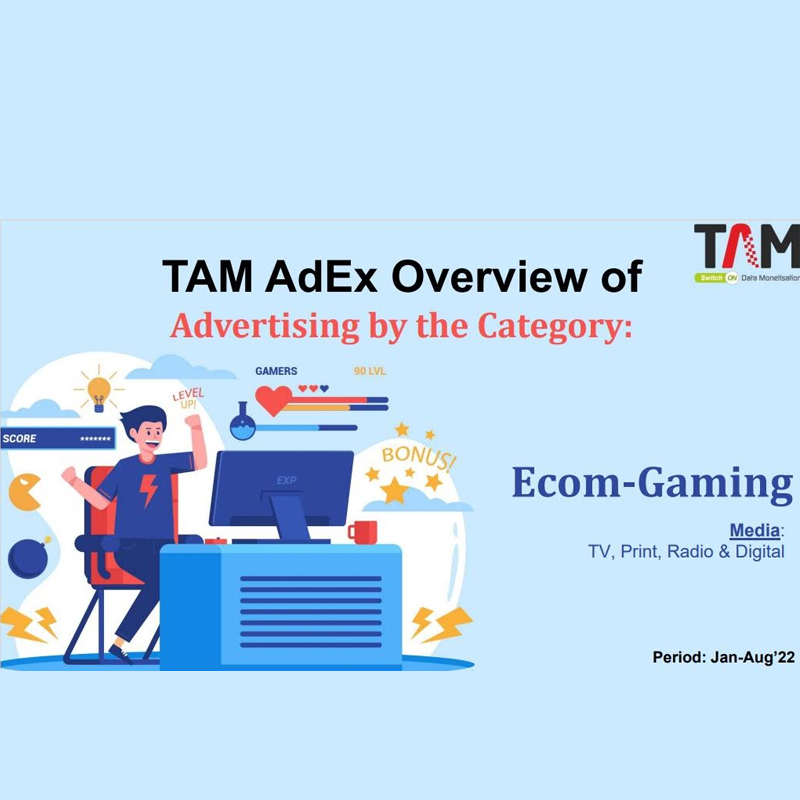
  • Ecom-gaming’s TV ad volume doubled in January to August’ 22: TAM AdEx report

    Ecom-gaming’s TV ad volume doubled in January to August’ 22: TAM AdEx report

    Mumbai: TAM AdEx has released an e-commerce-gaming cross-media report for January to August 2022, highlighting the advertising volumes of all mediums (television, print, radio, and digital) by the category.

    According to the report, ecom-gaming ad volumes on television increased two-fold between January and August 2022 compared to the corresponding period in 2021.

    The top 10 advertisers accounted for more than 90 per cent of ad volumes during the same period, and 35 plus brands advertised on television from January to August 2022, of which the top 10 shared 91 per cent of ad volumes.

    Advertisers in the e-commerce-gaming category preferred TV ad sizes ranging from 20 to 40 seconds. Between January and August 2022, 20 to 40-second and less than 20-second ads combined for a 99 per cent share of category ad volumes. Adding to this, more than 20 exclusive brands were advertised under the ecom-gaming category from January to August 2022.

    The news genre alone accounted for 44 per cent of the category’s ad volume, while sports came in second place. Top three channel genres grabbed 79 per cent of ad volumes’ share.

    The news bulletin is the most popular programme genre among the brands on television. News bulletins and feature films together added 47 per cent of the category’s ad volume.

    On TV, prime time was the most preferred time band, followed by the afternoon. More than 70 per cent of total ad volume was accounted for by the prime, afternoon, and morning time bands.

    The report, comparing January to August 2022 with the previous year of the same period, mentioned that the ad space in the ecom-gaming category dropped by 27 per cent in print media.

    Galactus Funware Technology stood as the top advertiser with a 40 per cent share of ad space during the current period.

    Moreover, the top 10 advertisers accounted for more than 90 per cent of the ad space.

    The Hindi language was on top with a 41 per cent share of ad space. The top five publication languages together added 93 percent of the category’s ad space.

    From January to August 2022, the general interest publication genre accounted for nearly 100 percent of the category’s ad space.

    Speaking about the digital space, the report stated that the sector’s ad insertions saw a growth of 27 per cent in January to August 2022 compared to the previous year.

    The top 10 advertisers shared 59 per cent of the ad insertions during the current period.

    From January to August 2022, display ads accounted for more than 60 per cent of all category ad insertions. Desktop video had a 30 per cent share of the digital platforms, followed by desktop display, which had a 28 per cent share.

    During the period from January to August 2022, the top ten advertisers had a 59 per cent share of ad insertions, with Head Digital Works topping the list with a 12 per cent share.

  • Gaurav Dhawan is Times Network’s new CRO

    Gaurav Dhawan is Times Network’s new CRO

    Mumbai : Times Network has promoted Gaurav Dhawan as its chief revenue officer. Gaurav will be in charge of the network’s broadcast ad revenue operations as well as the monetisation strategy for the network’s bouquet of channels covering Hindi and English news, entertainment, and branded content.

    Times Network managing director & CEO MK Anand said, “Given Gaurav’s successful background leading go-to-market teams and his relentless focus that drives sustained growth, the decision to move him into the Chief Revenue Officer role was clear. He’s already proven to be a strong leader and I’m confident he will continue to drive our strong revenue growth strategy.”

    Dhawan is a Times Network stalwart who has played a pivotal role in shaping the brand’s market leadership and has been passionately involved in scaling revenue and new opportunities throughout his tenure with the network.

    Talking about his new role, Dhawan said, “I’m excited and honoured to helm this mandate. I have been associated with Times Network for over 17 years and it is heartening to see the Network’s commendable growth over the years, demonstrating market dominance in its respective genres. This is an exciting phase as we continue to build new opportunities for our Hindi news brands and optimize emerging revenue streams and strategic partnerships to propel the network’s growth.”

    Gaurav has over 26 years of experience in the media and entertainment industry, and has a proven track record of driving businesses to profitability, impacting solutions, and innovating to deliver aggressive revenue expectations and sustained growth for businesses in television, print, and web.