Tag: Premium content

  • Prasar Bharati to monetise its premium and archival content

    Prasar Bharati to monetise its premium and archival content

    Mumbai: Prasar Bharati has approved a policy on monetisation of archival and premium content of All India Radio, Doordarshan and new units of the public broadcaster.

    “This policy will ensure that archival and premium contents of Prasar Bharati are syndicated to third parties through an open and transparent mechanism of e-auction, in order to fetch maximum market value of content on-demand basis,” it said in a statement.

    The broadcaster observed that TV channels as well as new channels on OTT are looking for good saleable content. This has created a demand for programme content of Prasar Bharati in India and overseas for the purpose of broadcast as well as streaming. The possibility for monetising this content requires a well-defined content syndication policy, it noted.

    As per the policy, the public broadcaster will monetise its available content through e-auction to third parties for linear broadcasting (TV/Radio) and on-demand viewing/listening through internet platforms. The available content will be curated into compelling catalogues for the purpose of syndication at the catalogue level.

    An online portal will be created for the management of the entire life cycle of the syndication from registration to grant of rights, payment and content sharing. The e-auction may be held for global linear broadcast rights, global on-demand rights, India linear broadcast rights and India on-demand rights, it said on Thursday.

  • ‘Den of pirates’: Why OTTs should tackle Telegram soon

    ‘Den of pirates’: Why OTTs should tackle Telegram soon

    KOLKATA: There is no dearth of OTT platforms in India, and which one is the most popular is a matter of debate. But what is very evident is Telegram’s overwhelming popularity as an alternative to providing free access to any new movies or shows launched on these platforms. The wide availability and easy access to pirated shows is making the messaging app more appealing day by day to a section of internet users. Even as OTT platforms burn mounds of cash to roll out premium content, such piracy could eat up a significant revenue going forward.

    Soaring popularity of Telegram

    Make a list of all recent popular shows or original movies that dropped on streaming services – Scam 1992, Mirzapur Season 2, Ludo, Naxalbari – and you’ll already find every single one of them on Telegram. Students who don’t earn yet but are keen to watch these programmes, thus, go the pocket-friendly way by downloading the Telegram app. And another section of users who have subscription to a few OTT platforms but don’t want to shell out money to watch just one show on a different, unsubscribed platform, use the app as well. Moreover, the simplicity in downloading content both in terms of mechanism, required time and data – unlike Torrent – has made it a den of pirates.

    “Telegram is a vast source of VOD content; many groups offer updated content of newly released movies and series, even with subtitles in different languages. We have seen certain titles appear on Telegram within a few hours of release. Pirates are increasingly using such groups as a way to easily share, exchange and sell this content without being exposed to malware prevalent on the dark web,” Synamedia chief intelligence manager-security Ted Rose said.

    During a webinar hosted in late October by Indiantelevision.com, SonyLIV technology head Manish Verma also acknowledged that Telegram is evolving as a potential threat. He added that it is very important for the platforms to stop piracy with content acquisition and content production costs increasing – be it for original content or live sports events.

    How pirates use the platform

    Synamedia’s Rose shared that streaming pirates are increasingly using Telegram groups as a way to distribute links to consumers. In fact, streaming of live events can be found on the messaging app as links that direct users to open internet streaming websites. The app can only share files that are stored on its cloud service or links to other sites.

    On the other hand, there are Telegram groups that share stolen M3U links to different subscription-based pirate IPTV networks. These links are updated daily and usually contain information on the content available on each pirate network. Rose went on to share that pirates have taken to Telegram, as well as the dark web, to share and sell OTT subscribers’ stolen credentials.

    “It is really a game of cat and mouse. If there are repeated claims of infringement, Telegram will shut down a group. Removal of a channel can be more difficult for a pirate to recover from, although some pirates can pre-empt this by notifying consumers in advance of backup channels they can use should the first group or channel be removed,” he added.

    Surge in piracy during Covid2019

    With a massive uptick in the use of streaming services during the pandemic, Telegram piracy has also seen a huge surge as well. As sporting events came to a halt in the wake of the crisis, pirates were scrambling for other ways to fill the revenue gap. As a result, OTT providers with premium VOD content and originals emerged as hot targets at that time.

    According to data shared by Markscan, a firm that provides digital IP protection to entertainment companies, piracy on telegram skyrocketed by 1092 per cent, or about 11 times, during lockdown.

    How can the law help?

    Although there are anti-piracy laws in India, it is tough to track the breach happening on Telegram due to encryption. Moreover, it becomes more difficult to take legal steps as the platform itself is legitimate despite the fact that there is pirated content available, according to Kaushik Moitra, partner at Bharucha and Partners.

    Moitra explained that Telegram is not under liability to take pirated content off until someone files a complaint. Hence, it is not possible for Indian law enforcement to actively track the infringement. He noted that the onus is on individual OTT platforms to track whether or not any illegitimate link is being circulated on the messaging app so the latter can take it down immediately. However, he mentioned that Telegram will be put on notice if the OTT platforms opt for John Doe order for pre-infringement injunction.

  • OTT platforms may see scarcity in long-format premium content in H1- FY22

    OTT platforms may see scarcity in long-format premium content in H1- FY22

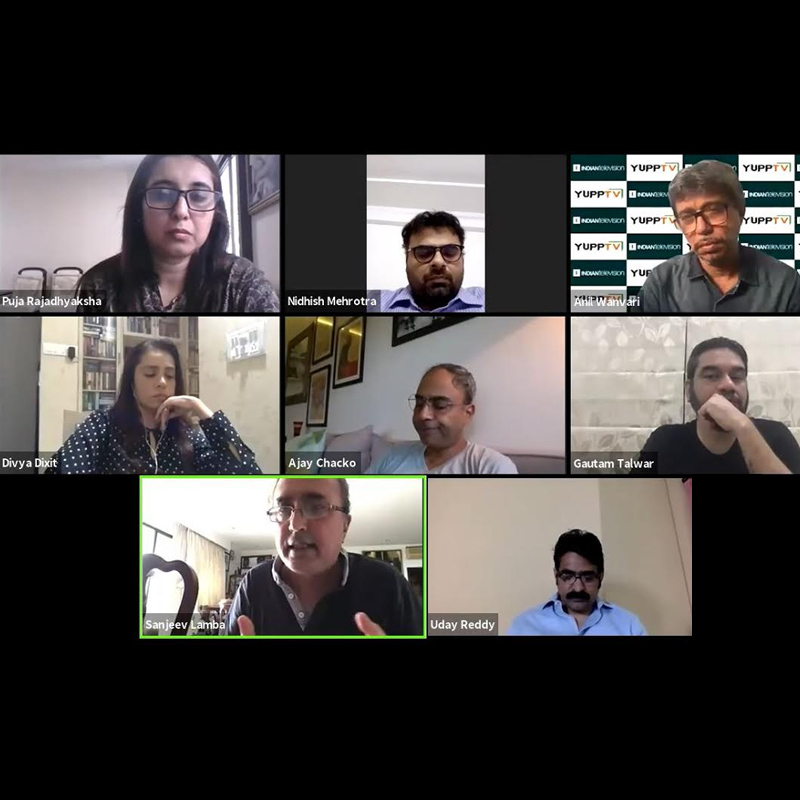
    KOLKATA: It may be the heyday of over-the-top (OTT) platforms but it’s not like the pandemic will not have any impact on their operations. While everything appears great on the surface, the constraints of shooting large-scale projects are going to affect the pipeline of long-format premium originals in the first half of FY22, according to executives who spoke at ‘Future of OTT content and its evolution in India’, hosted by Indiantelevision.com. Being cautious of the situation, the platforms are going to evolve content formats which can be shot amid all the constraints.

    MX Player chief content officer Gautam Talwar accepted that it would run out of shows which were shot before lockdown by the end of the year. The platform is trying to see if it can change the narrative and also trying to explore if there are shows which can be produced within the given constraints. He added that it would look at smaller shows which can be put together in fewer locations with fewer artists, but with interesting stories. Talwar emphasised that OTT platforms have to adapt to the environment. Hence, MX Player will get into the shoot with smaller shows.

    The other players also agreed that there will be a lag in long-format premium content at least for the first half of next financial year.

    Arre co-founder and CEO Ajay Chacko said that the impact of the pandemic will actually be felt in the next financial year from a release perspective. He stated that six months of not being able to shoot would definitely reflect on the content line up of FY 22. While asked if shooting in international locations is a viable idea, he clearly stated that would not be an economic model.

    Hungama Originals executive producer Sanjeev Lamba agreed to his peers’ views but also highlighted that it also depends on what kind of business the platform is in. According to him, the way people are getting affected is going to be different.

    “We believe in mixing up shows. We don’t believe in mega, large scale forever. For us, a small set of shows have worked really well. It’s actually the mass India that is growing for us constantly and mass India loves that. For us, the shoots have already started. We will start launching two-three originals month-on-month from November itself. The idea is to reverse the track of feeling the financial pinch in the Q1 of next FY,” said ALTBalaji marketing, analytics & direct revenue SVP Divya Dixit.

    Eros Now content head Puja Rajadhyaksha said that the industry and the format will evolve with the situation. She added that Eros Now will also look at doing shorter format which can be shot in the next four-five months. Talwar added that the lag in long-format content would not impact users as there is a demand for all types of content with good stories. 

  • MX Player’s content play for OTT platform launch

    MX Player’s content play for OTT platform launch

    MUMBAI: In the last two years, India’s media and entertainment industry has witnessed the emergence of several over-the-top (OTT) players. With an ambition to gain a foothold in the burgeoning OTT space, Times Internet  recently acquired a majority stake in Seoul-based MX Player. While the company is yet to reveal the exact launch timelines, the last quarter of this year is likely to mark the entry of another big-ticket aspirant. With a team of 150 employees, the platform is prepping up for its grand launch with at least five to six premium shows.

    Like many other OTT platforms, MX Player also intends to tap into the millennial audience, the age group of 18-35. Despite the mushrooming of digital platforms, young India is hungry for more content, making the play easier for new entrants.

    MX Player content head Gautam Talwar thinks the need for content has not been satiated by the current television offerings.

    “We are understanding their specific need states and making sure that the programming is aligned to satisfying those need states via our original programming and curated licensing strategy,” he said in an interaction with Indiantelevision.com.

    Talwar claims that the local video platform has approximately 65 million daily active users and 175 million monthly active users who are spread across the country. They want to cater to those consumers specifically with 50000 hours to 100000 hours of premium curated licensed content along with the originals.

    However, the content head says they want to mainly focus on originals. He is optimistic about showcasing 20-25 original shows for the year 2018 – 2019, slating five to six shows for the launch. The content will not be limited to fiction only.

    For offering premium content, the streamer is working with noted faces from both the film and television industry.

    “We have directors like Shashanka Ghosh( Veere Di Wedding), Shashant Shah (Chalo Dilli/ Dasvidaniya) Samar Sheikh (Girl in the city/ Bobby Jasoos), Siddharth.P.Malhotra (We are family/ Hichki), Gautham Menon (Ondraga Films) in the fiction space along with working with writers like Habib Faisal (Do Dooni Chaar/ Ishaqzaade) and Abbas Tyrewala (Maqbool and Jaane Tu Ya Jaane Na) to develop some key shows for us. We are also making sure that we leverage our internal group strength by having WWM (Filmfare/Femina) produce a show that has all the top regional celebrities on one of our key show. Similarly, we are working with the best of the non – fiction teams in the industry with new formats and thinking that we believe will appeal to this new generation of consumers,” he said.

    To enrich its library, they are looking at leveraging both their house production team and talent from within the industry. Apart from riding on the back of the Times Studio, they are also working with producers and production houses from outside the industry.

    Victor Tango, music director Shameer Tandon, Sunshine Productions are already working with the team and talks are on with a whole bunch of external producers who have put out good content across mediums. The platform will leave no stone unturned for providing customers with a seamless experience, with Talwar highlighting that MX player will be “investing more than industry averages on the product, tech as well as content”.

    To stand out in the crowded Indian OTT landscape, content differentiation and deep pockets for effective marketing of the product is essential. While customer acquisition will not be a challenge for MX Player, but to build a loyal fan base the content will have to be extremely compelling.

    “Our differentiation is at multiple levels. At a product level, we have acquired probably the best product in the market since it has been the top 10 apps on the play store for a very long period of time along with having a massive consumer base already. Along with that we believe our focus of Original premium content and curated licensed content would differentiate us and finally our business model which is AVOD would help with consumers who won’t have any barriers to sampling and consuming our content at will,” Talwar commented.

    Interestingly, the platform will focus on South Indian market with Tamil, Telugu content from the get go. They have a bunch of premium curated web series, which have been licensed as well as originals specific for the target audience. Moreover, the streamer has some big originals, due for a year end release, in its pipeline for the Indian market.

    It is certain that the Times group will use all its might to promote the brand well, with OOH playing a key role in the media mix. With the launch of MX Player, not only will consumers have more content options, the industry too will be benefitted. On the other hand existing players, especially, international streaming giants Netflix and Amazon will see some potential competition.

  • Premium content to drive mobile industry

    Premium content to drive mobile industry

    MUMBAI: Mobile data services are the next wave of growth for the mobile communications industry amid the increasingly saturated subscriber base.

    While messaging will continue to be the main revenue contributor in most emerging and developing mobile data markets, much of the growth potential also lies in premium content. Greater 3G (third generation) coverage and deployment, expanding regional subscriber base, declining cost of advanced multimedia handsets, and the race to secure a continuous stream of content through partnerships are likely to drive growth of mobile data revenues.

    New analysis from global growth consulting company, Frost & Sullivan Asia Pacific Premium Content Market, reveals that the market – covering 13 major Asia-Pac economies – earned revenues of $9.4 billion in 2005 and is estimated to reach $32.9 billion by end-2011.

    Frost & Sullivan industry manager Janice Chong says, “Subscribers in most Asia-Pac countries have strong preference for local content, which creates the impetus for the fast-growing mobile content market. The pace of 3G adoption, to a certain extent, influences the development of premium content applications by providing greater bandwidth and faster data transmission.”

    The Asia Pacific mobile data market is forecast to grow at a CAGR (compound annual growth rate) of 17.9 percent between 2005 and 2011. Messaging revenues still constitute the majority of operator-generated data revenues. In 2005, messaging accounted for approximately 39.6 percent of total operators’ data revenues (excluding revenue share of third-party content providers).

    The total premium content market, which includes both operator and third-party content provider revenues, held 29.5 percent of total mobile data revenues in 2005, and is expected to register a CAGR of 23.2 percent from 2005 to 2011.

    In certain Asia Pacific countries, the revenue share ratio skews in favour of mobile operators. As a result, content providers receive a small revenue split. Moreover, content providers are required to pay hefty royalties for applications to music label companies and associations. These factors have in some ways hindered the growth of the premium content industry in selected countries. While the revenue share model employed in Japan, South Korea and China may seem relatively favourable to content providers, similar business models may not apply to other countries across the region.

    Chong adds, “In markets such as Indonesia and the Philippines, mobile operators typically retain 60 to 70 per cent of the revenue from sale of content, while content providers receive the remaining smaller portion.

    “Content providers in such countries believe that they deserve a larger revenue share considering that the cost of content development is entirely borne by them.”

    This however is inherently characteristic in markets outside of Japan and South Korea, primarily due to the high use of SMS (short messaging services) based applications which contribute to low data traffic usage. The lack of a satisfactory level of revenue from data traffic usage would mean that operators will tend to seek a higher revenue share from content downloads to compensate for the low data traffic revenue.