Tag: Prasar Bharti

  • DTH subscriber growth down in second quarter

    DTH subscriber growth down in second quarter

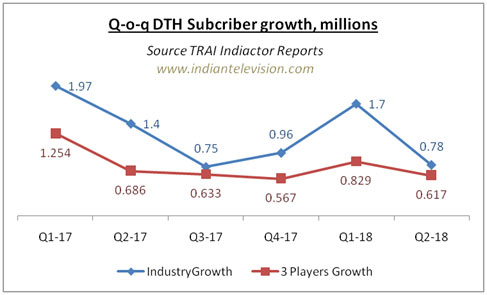
    BENGALURU: The carriage industry and more specifically the direct to home or DTH industry had a disappointing fiscal year 2017 (FY-17, year ended 31 March 2017) in terms of subscriber growth. Going by the subscriber numbers data of the six private DTH players in India provided by the Telecom Regulatory Authority of India (TRAI) in its Indicator Reports of the Indian Telecom Sector. This dismal performance seems to have spilled over to the second quarter of financial year 2017 (FY-18, year commenced on 1 April 2017 until 31 March 2018) as per TRAI data for the quarter ended 30 September 2017 (Q2-18, quarter under consideration). The industry could add just 2.47 million subscribers during the first six months (first 2 quarters, 1 April 2017 to 30 September 2017) as compared to the 3.37 million subscribers it added during the corresponding year six-month period the year before. Active DTH subscribers added in Q2-18 were just 0.78 million as compared to 1.4 million in Q2-17.

    Further, as reported by us earlier, despite the sunset date for DAS IV having passed, the DTH industry had not been able to leverage the opportunity that it was presented with. Earlier, TRAI numbers for the six private players in the DTH industry showed a very poor growth rate of just 0.96 million and 5.08 million during the quarter and year ended 31 March 2017 (Q4-17, FY-17) respectively. This figure is far lower – less than one-third of the 17.38 million active DTH subscribers that were added in fiscal 2016 by the six.

    Please refer to the figure below – The three players whose numbers are available in the public domain and whose combined q-o-q subscriber growth has been represented in the figure are Dish TV, Airtel DTH and Videocon d2h

    public://1_6.jpg

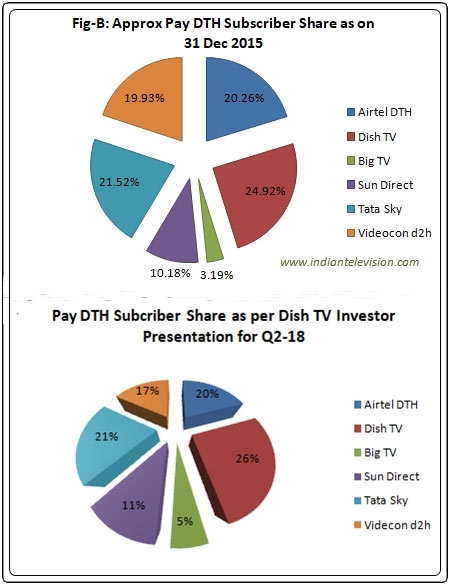
    Let us understand the status of the DTH industry at the end of September 2017. The six private DTH players are – Dish TV, Tata Sky, Airtel Digital Services (Airtel DTH), Videocon DTH, Sun Direct, and the Anil Ambani-led Reliance Big TV (Big TV). It may be noted that Big TV announced closure of its operations since November 2017. The three players – Dish TV, Airtel DTH and Videocon d2h represented approximately 63 to 65 percent of the active pay-TV DTH subscribers at the end of September 2017. Please refer to figure below for subscriber share of the private DTH players as per data in the public domain:

    public://2_1.jpg

    Besides the six private pay DTH players, Doordarshan’s (DD) Free Dish DTH service is a major player in terms of subscribers with an estimated 22 million as per the numbers available in the public domain. It must however be noted that an exact number for registered or active subscribers is not available even with DD, since this is a free DTH service. When the announced Dish TV Videocon d2h merger happens, the merged entity will probably be one of the largest DTH players in the world in terms of subscriber numbers.

    According to an E&Y report titled ‘India’s Free TV’ released in July 2017, among the DTH operators in India, DD Free Dish has grown to become the largest with its estimated 22 million subscribers which E&Y predicted could cross 40 million over the next two to three years.

    A number of reasons can be attributed to this dismal performance – two of the chief ones that are touted over the recent past by most players in media and entertainment industry – demonetisation in November 2016 and the implementation of GST. Another important reason could be that DTH is considered a premium service – by all the stakeholders in the carriage ecosystem with the resulting perception that procurement as well as monthly subscription will be premium and hence a deterrent for the consumer. While some players such as Dish TV have been making attempts to come up with packages that it perceives should attract the masses, but, results as per TRAI data seem to indicate otherwise. Yes, Dish TV is the largest private player in the country that has come up with different pricing models under different brands. Whether unwittingly or not, most of the other players present themselves as premium players and seem to have done little in that direction.


  • Govt to help revitalise DD under ‘autonomous Prasar’, dubs censors as ‘facilitators’ within law

    Govt to help revitalise DD under ‘autonomous Prasar’, dubs censors as ‘facilitators’ within law

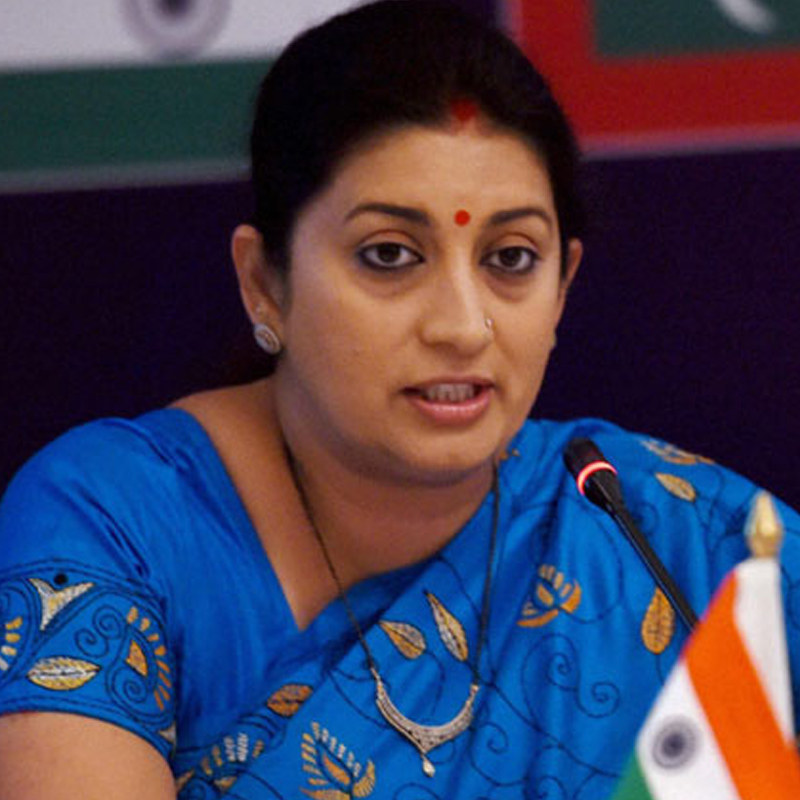
    MUMBAI: Union information and broadcasting minister Smriti Irani on Friday said the government saw agencies including the Censor Board “as facilitators” within the ambit of the law. Irani was speaking at a World Economic Forum-India Economic Summit session moderated by film maker Karan Johar in New Dlhi.

    She added that the government would consider a suggestion to help bring out a television series on freedom fighters to be telecast on the pubcaster Doordarshan.

    Defending the central government on demonetisation and the way Good and Services Tax (GST) regime was implemented, she said that the NDA was voted to power to change the status quo by taking difficult decisions. She said that those decisions were taken with a view to simplify the tax regime, increasing tax compliance, widening the tax base and increasing productivity.

    Revitalising Doordarshan: At an earlier event — CyFy 2017, by Observer Research Foundation, Irani had said that the government was planning to revitalise Doordarshan. She spoke of the government’s problems in improving the functioning of the Doordarshan as it was under the jurisdiction of an autonomous body — the c
    However, Irani made it clear that she would also like the Doordarshan to be a world-class channel which Indians and the diaspora would be proud of.

    The government, the minister said, was also planning to promote positive storytelling, and added that it would promote the film “Lunchbox” at the upcoming Goa International Film Festival. India, she said, had several good writers, actors, and other creative artistes capable of making world-class films, but the problem arose when the producer looked at the balance sheet.

    The minister opined that the social media by and large had brought balance with the main media, since it could criticise biased articles and commentaries in newspapers which was not possible a few years ago. She agreed with the Swedish prime minister Carl Bildt who had said: “The norms and values of the internet should be the values and the norms of society.”

  • DTH subscriber growth on upswing in first quarter?

    DTH subscriber growth on upswing in first quarter?

    BENGALURU: Is the DTH subscriber growth in the first quarter of fiscal 2017 (Q1-18, quarter ended 30 June 2017, current quarter) on an upswing?  Of the six private players in the Indian DTH ecosystem, three are publically listed and their numbers are available in the public domain. Two players, Airtel DTH and Dish TV, have indicated a quarter-on-quarter growth in number of subscriber additions. Telecom Regulatory Authority of India (TRAI) has yet to release subscription numbers for Q1-18.

    Airtel has indicated subscriber additions of 0.499 million for Q1-18 as compared to 0.228 million for the previous quarter (quarter ended 31 March 2017, Q4-17, previous quarter). Dish TV reported adding 0.186 million subscribers as compared to an estimated 0.165 million additions for the previous quarter.

    The third player – Videocon d2h reported adding 0.13 million subscribers in Q1-18 as compared to the slightly higher 0.14 million for Q4-17. It may be noted that subscriber numbers are generally rounded off by the players in their reports, in some case to an extent of 10,000. Also, the sum of the net subscriber additions per quarter may not be equal to the overall subscribers reported as added in a fiscal by the companies because of subscriber churn and rounding off.

    Please refer to the figure below:

    public://F1_18.jpg

    As reported by us earlier, despite the sunset date for DAS IV having passed, the DTH industry had not been able to leverage the opportunity that it presented. Financial results of  Airtel Digital TV (Airtel DTH), Dish TV, and Videocon DTH show poor subscriber adds in the quarter ended 31 March 2017 (fourth quarter, Q4-17). As a matter of fact, subscriber additions in Q4-17 was the lowest that the three Indian major operators reported in a quarter for the financial year ended 31 March 2017 (FY-17). The combined subscribers for all the three players grew 8.33 percent to 41.23 million in FY-17 from 38.06 million in FY-16. In FY-16, the three players had added about 65 percent more subscribers in absolute numbers at 4.93 million as compared to the 3.81 million added in FY-17.

    The DTH industry witnessed a slowdown in subscriber growth even in fiscal 2016. Combined subscriber additions of the three pay-direct to home operators in India for the annual period ended 31 March 2016 (FY-16) vis-à-vis the previous year (FY-15) grew by 14.8 percent.  This subscriber growth rate was however was much lower than the growth that these entities had in FY-15 at 24.7 percent as compared to FY-14.

    The current DTH scenario in India

    Dish TV is at present the largest private DTH player in the country in terms of number of subscribers. The three players – Airtel DTH, Dish TV and Videocon d2h represent about 60 to 65 percent marketshare of the pay-TV DTH industry subscribers. The other three players are Tata Sky, Sun Direct and Big TV. Please refer to the figure below for the estimated subscriber marketshare of the private pay-TV players.

    public://F2_9.jpg

    The government’s FreeDish DTH service is the largest DTH player by far in terms of subscribers with an estimated 22million or 2.2 crore subscribers in 2016 as per the KPMG-FICCI Indian Media and Entertainment Industry Report 2017 (KPMG-FICCI M&E Report 2017) titled Media for the Masse: The Future Unfolds. It must however be noted that an exact number for registered or active subscribers is not available since this is a free DTH service. Also, the proposed merger of Videocon d2h with Dish TV will create the largest private television carriage player in India and quite likely the second largest in the world, be it cable, internet television or DTH or any other.


  • DTH subscriber growth slows down even further

    BENGALURU: Despite the information and broadcasting (I&B) ministry extending the deadline for phase IV of cable television digitisation by three months to 31 March 2017, owing to the “unsatisfactory progress of installation of set top boxes (STBs) in phase IV areas”, reports submitted by the carriage industry indicate that subscriber additions in the extended period have been low.

    Financial results of companies or entities from the carriage industry whose financial and limited operational data is available in the public domain – Airtel Digital TV (Airtel DTH), Dish TV, and Videocon DTH show poor subscriber adds in the quarter ended 31 March 2017 (fourth quarter, Q4-17). As a matter of fact, subscriber adds in Q4-17 was the lowest that the three Indian major operators reported in a quarter for the financial year ended 31 March 2017 (FY-17). The combined subscribers for all the three players grew 8.33 percent to 41.23 million in FY-17 from 38.06 million in FY-16. It maybe noted that subscriber numbers are generally rounded off by the players in their reports, in some case to an extent of 10,000. In FY-16, the three players had added about 65 percent more subscribers in absolute numbers at 4.93 million as compared to the 3.81 million added in FY-17.

    Please refer to the figure below:

    public://dth-1.jpg

    The DTH industry witnessed a slowdown in subscriber growth even in the previous year.Combined subscriber additions for the annual period ended 31 March 2016 (FY-16) vis-à-vis the previous year (FY-15) grew by 14.8percent of the three pay-direct to home operators in India.  This subscriber growth rate was however a little less than half that these entities had in FY-15 at 24.7 percent as compared to FY-14.

    Let us see where the three pay DTH players considered in this paper stand in the Indian DTH eco-system

    Airtel DTH, Dish TV and Videocon d2h have about two thirds (65 percent) of market share of the DTH universe by private players in India. Of the other three players, according to a TRAI report Tata Sky has a market share of 23 percent, while Sun Direct and Reliance have a market share or 10 percent and 2 percent respectively. It may be noted that at present probably the largest DTH player in India could be the government’s FreeDish, but since it is a free service, no subscriber data is available even with Prasar Bharati. Please refer to the chart below:

    public://dth2_0.jpg

  • Eleven categories of Prasar Bharati employees in employment in February 1999 got upgraded payscales: Rathore

    Eleven categories of Prasar Bharati employees in employment in February 1999 got upgraded payscales: Rathore

    NEW DELHI: The Government had granted upgraded pay scales to 11 categories of the then existing employees of Prasar Bharati pertaining to Engineering and Programme Cadres on 25 February 1999.

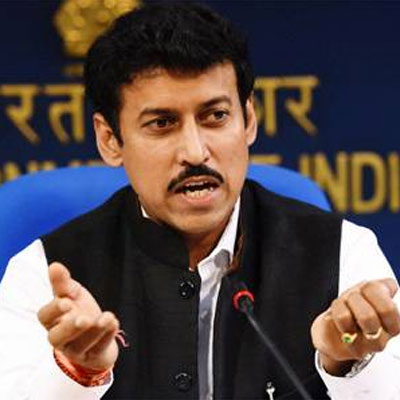
    Minister of State for Information and Broadcastng Rajyavardhan Rathore told Parliament that Prasar Bharati has granted upgraded pay scales to 484 employees of subordinate Engineering and Programme cadres who had joined Prasar Bharati after 25 February 1999 following Court orders.

    Answerng a question, he said the decision on the proposal received from Directorate General of All India Radio has been linked to the Speaking Order dated 9 December 2014, issued by the Ministry towards implementation of an Order dated 10 November 2014 of the Central Administrative Tribunal (CAT), Ernakulam Bench, in a Contempt Petition filed by Federation of Doordarshan Core Professionals (FDCP) who were seeking upgraded pay scales as were granted to 11 categories of employees vide order dated 25 February1999.

    But he said the matter was sub judice as the order of 9 December 2014 had been challenged by the employees associated with FDCP in a fresh OA before the Central Administrative Tribunal, Ernakulam Bench.

  • Eleven categories of Prasar Bharati employees in employment in February 1999 got upgraded payscales: Rathore

    Eleven categories of Prasar Bharati employees in employment in February 1999 got upgraded payscales: Rathore

    NEW DELHI: The Government had granted upgraded pay scales to 11 categories of the then existing employees of Prasar Bharati pertaining to Engineering and Programme Cadres on 25 February 1999.

    Minister of State for Information and Broadcastng Rajyavardhan Rathore told Parliament that Prasar Bharati has granted upgraded pay scales to 484 employees of subordinate Engineering and Programme cadres who had joined Prasar Bharati after 25 February 1999 following Court orders.

    Answerng a question, he said the decision on the proposal received from Directorate General of All India Radio has been linked to the Speaking Order dated 9 December 2014, issued by the Ministry towards implementation of an Order dated 10 November 2014 of the Central Administrative Tribunal (CAT), Ernakulam Bench, in a Contempt Petition filed by Federation of Doordarshan Core Professionals (FDCP) who were seeking upgraded pay scales as were granted to 11 categories of employees vide order dated 25 February1999.

    But he said the matter was sub judice as the order of 9 December 2014 had been challenged by the employees associated with FDCP in a fresh OA before the Central Administrative Tribunal, Ernakulam Bench.

  • BARC India wins the ‘Make In India Award for Excellence – 2015’

    BARC India wins the ‘Make In India Award for Excellence – 2015’

    MUMBAI: At a function in Ahmedabad today, Team Make In India conferred the ‘Make In India Award for Excellence -2015’ to BARC India.


    A JIB, launched in April 2015, BARC India is extremely happy to be the recipient of this prestigious award in its year of launch itself and that too in the first year of the Award’s institution. Attended and inaugurated by Kalraj Mishra (Cabinet Minister) and Chief Guest and Shri. Govindbhai Patel, MOS for Science and Technology, the event took place at Mahatma Mandir, Gandhinagar, Gujarat (Venue for Vibrant Gujarat).


    In its pursuit of measuring “What India Watches”, this early recognition and first Award – is inspiration for Team BARC India which is focusing on its ‘Make In India’ belief through its locally manufactured ‘BAR-O-meter’ at 1/6th cost of globally available meters thus providing scalability in future for robust and accurate data for generations to come.


    Team BARC India, thanks all its stakeholders, associates and executives along with members of its Technical Committee, Board of Directors, the apex bodies of IBF, AAAI, ISA and the Government of India and Prasar Bharti for their combined support and help in building the World’s largest television audience measurement system.

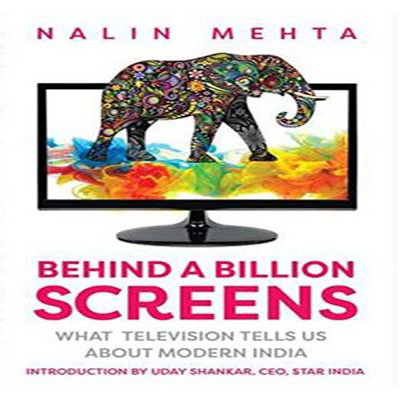
  • Nalin Mehta’s ‘Behind a Billion Screens’ examines Indian TV industry

    Nalin Mehta’s ‘Behind a Billion Screens’ examines Indian TV industry

    MUMBAI: India is a country where television forms the most important part of one’s life. Everybody watches television, everybody has an opinion on it and everybody thinks they know exactly what is wrong with it. 


    It’s a topic that often raises a lot of heat and smoke but too little light. Throwing some light on this trend of television is author and journalist Nalin Mehta’s new book ‘Behind a Billion Screens.’


    The book closely examines how television works in India, how TV channels make their money or not, how this is changing and what this means for the cacophony that appears on our screens.


    The book, which was initially going to be a joint effort by Star India CEO Uday Shankar and Mehta, was later written independently by the latter.
    The book answers key questions like:


    • Who owns Indian television? Just how much is it controlled by politicians, corporations and real estate companies? What are the patterns of control nationally and across regional languages? How does India compare with other countries and why does this matter?


    • What explains television’s terrible crisis of content? Is there really no market for intelligence in India and is dumped down content the only thing that audiences want? Why do channels keep behaving like Bollywood producers of the 1980s who kept churning out the same old tired formula films till a new multiplex-savvy breed of film-makers started challenging old orthodoxies? Is there a talent problem or management problem or a crisis of business models?


    • What is wrong with current government controlling system on television and why this ‘terrible-backend’ needs to change? Indian television continues to be controlled by outdated regulations, even as it is mired in public battles for greater regulation, as called for by Justice Katju. Studying the role of the Ministry of Information and Broadcasting, Telecom Regulatory Authority of India (TRAI), state governments and the judiciary, this book answers just how much control the state still has on broadcasting, why its jugaad nature of regulation is now unsustainable and why a major change is needed.


    • Does self-regulation work? How did self-regulatory bodies governing television come into being and what has been their factual record? Has self-regulation made any difference to programming or is it simply a chimera only designed to keep government out?How does India compare to other countries?
    • Does public broadcasting still matter, what exactly is wrong with Prasar Bharti and how can it be fixed?


    • Is television becoming irrelevant in the digital age? How is television shape-shifting in response to mobiles and the net, how are companies changing their businesses and programming, where is India going and how different is India from the rest of the world.


    The book highlights how India’s $15 billion media and entertainment industry – including television, print, radio, digital media – is growing at roughly 14 per cent a year. This, by some accounts, is impressive, benefitting immensely from the tailwinds of GDP growth of the last decade. But the stark fact is that even at $15 billion, India’s entire media taken together is just about one fourth the size of Google ($59 billion in revenues) – a fourteen-year-old company that is younger than most major Indian TV channels.


    “Let us not even go that far. If the entire Indian media was a company, it would rank seventh or eighth in India! Media is a globally growing industry but our participation in that ecosystem is zero and India is hardly factored into the global thought process of technology or content,” the book points out.


    Mehta, in the book, highlights how India is drunk on its own volumes: the largest number of newspapers in circulation, the second largest number of television viewers and millions of digital consumers. Digital, in particular, is an indictment of our creative and strategic limitations.


    “We have over 700 million mobile screens and yet we do not have a relatively unique content proposition for the medium. So, our ability to convert that into corresponding value is disappointing. Both in business and creative terms, the Indian media and entertainment sector still remains much smaller than it should be in a country of 1.2 billion people,” the book says.


    Even at these volumes, the reach as a percentage of population is not spectacular. India has 100 million households with no television, their time spent on it is abysmally low when compared to global standards; some 350 million people read the newspaper – but that tells us how many do not read!


    Mehta points out that in television, India needs a lot more content and this will come not only by scaling up production but through a fundamental transformation of the ecosystem. Resources, talent and every related facet have to evolve dramatically. For example, the production infrastructure in Mumbai, studio space, access to talent is creaking and unable to keep pace with the demand.


    Despite all the gloom and doom, India’s media and entertainment sector has consistently delivered impressive growth rates for the past few years. But, this is not a sector whose value is measured just by the size of its financial contribution. Media and entertainment remains central to defining the direction of India’s social and economic path; its work remains key to the imagination and inspiration of a billion Indians every day; and its health will be central to the ethos and values of the society we collectively shape.


    Mehta, through the book, says that with Narendra Modi’s new government in place, since May 2014, there is a renewed focus on reassessing things and trying to improve them. 

    “We need to make the case, for example, digitisation is not just about putting boxes and laying cables. It entails a fundamental transformation of the way we look at media and there is an opportunity for Indian media and content to move from just being a provider of entertainment content to being a creative industry, like the IT sector, for example, that plays a much larger role in the overall economic vision for the country,” Mehta opines in the book.


    He further writes that the media has been more than just a silent victim. Too often, the news media has focused on what is sensational rather than what is important. Too often, the point of news seems to be to reduce the extraordinary diversity of the country to the most banal, a contest between extremes that canonly be resolved through a shouting match on live television. With singular dominant narratives, the trend seems to be to create heroes on a particular day only to label them as thugs and crooks the next.


    Until recently, for a long time the media–government equation seemed like a broken relationship, and one that has had dire consequences for both the industry as well as the government. The failure to establish credibility and importance meant the industry perennially stayed on the back foot, defending itself against every new wave of regulation aimed only at curtailing its wings further. In return, governments were not able to leverage either the impact that mass media can have in India or harness the power of media as an economic engine that can create jobs and wealth.


    The book, in order to put things in perspective, says, “As a $15 billion industry, we employ over six million people. This can be so much more significant and meaningful. According to official estimates, about fifteen million people are entering the job market every year while the country is generating only about three million new jobs a year. This means that we are adding, as filmmaker Shekhar Kapur eloquently put it, a city of unemployed people as big as Delhi every year. And yet, the lens often used to look at this industry is largely one of glamour and propaganda and the biggest debate is on how to control and contain it.”


    There are 161 million cable and satellite homes but the measured universe so far is much smaller. “I do not know how many subscribers I have with a particular MSO and the MSO doesn’t know how many households his LCO delivers the signals to. The same is true in advertising too. The country’s premier media agencies can’t even seem to agree on a fact as basic as the size of the advertising market. One leading agency recently estimated the total market size to be Rs 35,000 crore, while the other, equally illustrious, estimated it to be Rs 29,000 crore. A variance of no less than 20 per cent! The ambiguity in data for other sectors of the media and entertainment industry is no less. Numbers are supposed to be the foundations of rational business decisions but how can we make decisions when professionals in the business of numbers can’t get their numbers straight?”


    Reacting on the book, Shankar said, “Nalin is probably the best media academic in India…this book is a seminal contribution to the evolving debate about the role of the Indian media.”


    Author and India Today Group consulting editor Rajdeep Sardesai added, “Excellent… an incisive and much needed study of how television is changing in India.”
    Times Now editor in chief Arnab Goswami said, “Fantastic… Nalin has beautifully pieced together the real, untold story behind the sound bytes.
  • DD to continue showing World Cup 2015 matches: Supreme Court

    DD to continue showing World Cup 2015 matches: Supreme Court

    NEW DELHI: Disposing off the application by Star Sports seeking vacation of an interim stay ordered earlier, the Supreme Court today ruled that Doordarshan will continue to show the World Cup 2015 cricket matches and share the feed with cable operators. 
     
    The apex Court had on 10 February stayed a judgment of the Delhi High Court of 4 February, which had said that Prasar Bharati cannot share its signals with cable operators.
     
     
    The Supreme Court directive came on an appeal by Prasar Bharati, which had taken the plea that the law was clear as far as the Sports Broadcasting Signals (Mandatory Sharing with Prasar Bharati) Act 2007 and the must carry clause were concerned. Even the High Court had refused to strike down the Act or the must carry clause.
     
     
    The order today is by way of disposing the application by Star Sports seeking a vacation of the stay order. However, the matter will now come up for hearing in due course for detailed arguments. It is learnt from legal sources that the case may come up for further arguments in June.
     
     
    In an additional affidavit filed at the instance of the apex court, Star Sports had said that it was losing around Rs 290 crore every year by sharing its sports signals with Doordarshan and was expecting to lose around Rs 120 crore by sharing the telecast of the World Cup this year. (Under the Act, the rights holder gets 75 per cent of the revenue from the telecast on DD. The remaining 25 per cent is retained by DD.)
     
     
    On the suggestion by Star Sports that DD should run a separate channel without the signals of the World Cup for cable operators or run a scroll that the World Cup telecasts are not meant for cable operators, Attorney General Mukul Rohatgi had yesterday pointed out that DD had 1400 transmitters all over the country and it was technically not feasible for DD to run a separate channel. Rohatgi told the court that it was mandatory for a private channel under the Sports Act and the Cable TV Network Act to share the feeds of matches of “national importance” with Prasar Bharati for providing it on DD’s free-to-air terrestrial channels.
     
    The apex court had on 17 February asked the pubcaster to give its response on the possibility of launching a separate channel. Justice Ranjan Gogoi and Justice Pinaki Chandra Ghose extended the interim order allowing Doordarshan to telecast the matches. 
     
    Senior advocate P. Chidambaram on behalf of ESPN and Star Sports said Prasar Bharati could create a mirror image of the World Cup telecast, which does not go to cable operators.
     
     
    Star Sports said its experts could help Prasar Bharati in creation of a channel that only carried entertainment programmes minus the World Cup telecasts.
     
    In its judgment, the High Court had refused to strike down the must carry clause of 2000 under which cable operators have to carry signals of Doordarshan, and also the Sports Broadcasting Signals (Mandatory Sharing with Prasar Bharati) Act 2007.
     
     
    A bench of Justices Badar Durrez Ahmed and Sanjeev Sachdeva passed the order on the plea of Board of Control for Cricket in India (BCCI), ESPN and Star who had contended that cable TV operators were getting live feeds through DD channels free of cost, resulting in loss of revenue for them.
     
     
    In the order, the Court had said: “The appeal as well as writ petition (civil) 8458/2007 are allowed to the extent that the live broadcasting signal shared by ESPN/STAR by virtue of the Sports Act with Prasar Bharati, shall not be carried in the designated Doordarshan channels under the must carry obligation cast by the Cable TV Network Act on cable operators. This shall operate prospectively.”
     
     
    In its directive, the Court had observed that while the advertisement revenue received by DD in respect of the shared content of the sports channels was to be shared in the ratio of not less than 75:25, “it still does not cater to the loss of subscription revenue” by ESPN and Star.

    BCCI, Nimbus Communications Ltd and the two sports channels (ESPN and Star) had challenged the high court’s single judge November 2007 order rejecting their pleas that no cable television network, Direct-to-Home (DTH) Network, multi-system network or local cable operator could broadcast such sports events without a licence from the content owners.  

  • Star Sports incurs Rs 290 crore annual loss by sharing signals with DD; SC reserves order

    Star Sports incurs Rs 290 crore annual loss by sharing signals with DD; SC reserves order

    NEW DELHI: Prasar Bharati today categorically ruled out the possibility of running separate channels for showing ICC Cricket World Cup matches live.


    This assertion was made in the Supreme Court, which later reserved orders on the appeal by Prasar Bharati against the order of the Delhi High Court, which had earlier this month directed Doordarshan not to share live signals of the matches with cable operators.


    The apex court had on Tuesday asked the pubcaster to give its response on the possibility of launching a separate channel.


    Justice Ranjan Gogoi and Justice Pinaki Chandra Ghose extended the interim order allowing Doordarshan to telecast the matches.


    Senior advocate P Chidambaram on behalf of Star Sports said Prasar Bharati could create a mirror image of the World Cup telecast, which does not go to cable operators.


    Star Sports said its experts could help Doordarshan in showing entertainment programmes on its channel at the time when World Cup telecast is on.


    Attorney general Mukul Rohatgi on behalf of Prasar Bharati said that this was technically not feasible.


    Rohatgi denied a contention made by Chidambaram that DD had in fact set up a separate channel at the time of the last Commonwealth Games. He said the channel had merely donned new colours in keeping with the Games.


    Star Sports and Prasar Bharati filed their respective additional affidavits as directed by the Court on 17 February.


    Star Sports said in its affidavit that it had incurred loss of Rs 290 crore last year for sharing sports signals with Doordarshan and was expected to incur a further loss of Rs 120 crore for the World Cup telecasts alone this year.


    In its judgment, the High Court had refused to strike down the must carry clause of 2000 under which cable operators have to carry signals of Doordarshan, and also the Sports Broadcasting Signals (Mandatory Sharing with Prasar Bharati) Act 2007.


    A bench of Justices Badar Durrez Ahmed and Sanjeev Sachdeva passed the order on the plea of Board of Control for Cricket in India (BCCI), ESPN and Star who had contended that cable TV operators were getting live feeds through DD channels free of cost, resulting in loss of revenue for them.


    In the order, the Court had said, “The appeal as well as writ petition (civil) 8458/2007 are allowed to the extent that the live broadcasting signal shared by ESPN/STAR by virtue of the Sports Act with Prasar Bharati, shall not be carried in the designated Doordarshan channels under the must carry obligation cast by the Cable TV Network Act on cable operators. This shall operate prospectively.”


    In its directive, the Court had observed that while the advertisement revenue received by DD in respect of the shared content of the sports channels was to be shared in the ratio of not less than 75:25, “it still does not cater to the loss of subscription revenue” by ESPN and Star.


    BCCI, Nimbus Communications Ltd and the two sports channels (ESPN and Star) had challenged the High Court’s single judge November 2007 order rejecting their pleas that no cable television network, Direct-to-Home (DTH) Network, multi-system network or local cable operator could broadcast such sports events without a licence from the content owners.