Tag: Prasar Bharati

  • #Retrace2021: Inching towards a connected future of audience measurement

    #Retrace2021: Inching towards a connected future of audience measurement

    Mumbai: It was for the first time since the 1960s, that Nielsen’s measurement lost a “seal of approval” from the industry that uses it, as leading advertisers and TV networks sought alternate means of counting their audiences. The TV measurement company had long faced criticism from the Video Advertising Bureau (trade organisation representing the advertising sales departments of networks and distributors) over undercounting the TV viewing during the pandemic, and the exclusion of broadband-only homes. The months-long feud culminated in the suspension of accreditation of Nielsen’s national and local TV ratings service by the Media Ratings Council, effective mid-September 2021.

    Also read: Nielsen loses accreditation for TV measurement service

    Matters were further compounded by NBCUniversal launching a measurement RFP in August, calling for “measurement independence”. In September, even as Nielsen CEO David Kenny acknowledged the gap and bias in measurement as a result of the exclusion of broadband-only homes representing nearly 30 per cent of TV households in some local markets, ViacomCBS announced its partnership with software and data platform, VideoAmp for TV measurement data. The move opened the way for other networks to explore alternative means of counting their audiences.

    Also read: ViacomCBS teams up with VideoAmp for TV Measurement after Nielsen loses accreditation

    At the centre of this growing dissatisfaction with the panel-based measurement system was the Connected-TV revolution and the under as well as misrepresentation of the large universe of the audience that has either completely cut the cord or is consuming both linear and CTV across devices and platforms. The industry was clamouring for a unified identifier that could bring about fundamental changes in the current measurement system which oversimplifies viewing across CTV by extending linear TV measurement standards to it and/or combining two viewing data sets that do not have common metrics.

    Hopes were now pinned on Nielsen ONE, Nielsen’s single cross-media product providing reach and frequency metrics by delivering a holistic, deduplicated view of both content and ad performance regardless of screen, device or platform.

    Laying the groundwork for implementing the new flagship currency across local, national and digital measurement towards the end of September, Nielsen announced the “Impressions First Initiative” for impression-based buying and selling in local markets across the US, as well as the integration of Broadband-Only Homes into local measurement in January 2022. The impression-based currency will deliver a more complete, precise and representative audience measurement, along with the added benefit of enabling cross-platform audience measurement, it said. 

    Going full-throttle on its digital transformation, in October Nielsen unveiled a new brand campaign, including a new identity, reflecting the company’s focus on delivering digital-first and global-first media solutions in three areas—measurement, audience outcomes and content services. The shift signaled the combining and enhancing its measurement solutions into the single cross-media measurement solution, Nielsen One.

    Announcing the year’s biggest development and the culmination of a long wait, on 21 December 2021, Nielsen unveiled the first iteration of Nielsen ONE, ‘NielsenONE Alpha’ with Disney and MAGNA as participants. The newest deduplicated ad-measurement will continue to evolve with new feature additions, enhancements, and model improvements leading up to the launch of the final product in the fourth quarter of 2022.

    Aligning India with the global digital shift  

    While the connected TV/OTT ecosystem in India is not as well developed and deeply entrenched yet, it is relevant here to recall Barc India’s intent to initiate ‘one video view’ measurement, announced in September 2020 by ex CEO Sunil Lulla. At the height of the TRP scam that broke out around the same time, a section of the industry had expressed doubt regarding some stakeholders derailing the ratings agency’s efforts and intentions to bring forth a unified, cross-platform measurement system.

    Also read: Nielsen to launch new commercial metrics to track individual ads on TV

    The TRP committee formed in the aftermath of the scandal recommended measures to reinstate faith in the current rating system by strengthening corporate governance within Barc India at the board level through independent technical oversight, term limits, and wide representation that minimises conflicts of interest. The 39-page report also pushed for the formation of multiple rating agencies in competition to Barc India and creating a specialised regulator to oversee all of them.

    Even as it addressed the pitfalls in linear TV measurement, the four-member panel led by Prasar Bharati CEO Shashi Shekhar Vempati laid down the framework for a comprehensive transformation and democratisation of the country’s rating systems and standards in line with the global shift towards digital.

    Considering the increasing convergence between STBs and smart media devices and the emergence of hybrid boxes capable of both CAS compliant linear TV viewing and internet streaming-based OTT viewing, the committee recommended a Return Path Data (RPD) mandate in all future STBs deployed by Distribution Platform Operators (DPOs). It also noted the emergence of smartphone-based apps capable of interacting with such hybrid boxes as paving the way for additional avenues for RPD data capture and relay.

    Further, it suggested the government/regulator examines incentives and policy interventions including FDI norms in the media audience measurement technology space so that India emerges as the hub for global innovation in this sector.

    Acknowledging the growth in digital advertising as well as the trend of linear TV viewing over interfaces other than traditional televisions and beyond the threshold of conventional households, the committee stressed the need for regulatory interventions to foster innovation while allowing for value chains to evolve, keeping pace with global trends and local market dynamics.

    “A hallmark of digital innovations over the past few decades has been disintermediation within value chains and disruption across industry domains, leveling the playing field and spurring competition. The world of linear television ought to be no exception to such disintermediation between buyers and sellers of media. There are no reasons why new models of advertising such as platform-based advertising, location-based advertising, programmatic advertising, etc must not emerge,” it said while adding that the guidelines prescribed must not privilege any one business model over another, nor create barriers to the emergence of more efficient business models.

    The above recommendations are both practicable and necessary considering the pace at which television viewing is evolving in India. As per mediasmart’s India CTV Report 2021, CTV viewing in India is on a significant uptick and increased by 31 per cent, compared to 81 per cent globally. Even though India is still a young market, it has tremendous potential for CTV adoption by consumers. In April 2020, 21 per cent of CTV viewing households were cord-cutters (households who cut the cord within the past five years), whereas 22 per cent were cord-nevers (households with no cable/satellite subscription in the past five years).

    Ormax Media research pins the Indian OTT audience universe at 353.2 million people, translating into a penetration of 25.3 per cent. According to various other estimates, the figure including YouTube is roughly 500 million. As regards CTV adoption, Madison’s Q2 report revealed that smart TV shipments grew by almost 65 per cent, claiming an 80 per cent share of the total TV shipments. Their massive adoption was fuelled by starting price points as low as Rs.15000.

    Given that TV as a medium still has considerable scope for growth in India, preparing for a connected future may seem like a long shot at this juncture. However, the Indian market which is often typecast as ‘underdeveloped’ is also a curious one where the digital revolution is being brought about by smartphones that have outmaneuvered PCs as the primary or base medium. With the current regulatory regime that seems to accelerate the clear segmentation of audience between Free Dish and streaming services by allegedly disincentivising Pay/Cable TV, we might be in for more surprises. 
  • Prasar Bharati invites applications for acquisition of ready-made TV content

    Prasar Bharati invites applications for acquisition of ready-made TV content

    Mumbai: Public broadcaster Prasar Bharati has invited applications for acquisition of ready-made TV content. The applications should be submitted via the content acquisition portal of Prasar Bharati by 7 February.

    The broadcaster has specified that the content must be targeted towards an audience of children and young adults up to the age of 18 in the languages specified on the portal. The applied content should not have been aired either fully or partly from any free-to-air distribution platform like DD Free Dish in the territory of India through terrestrial, cable or direct-to-home mode during the previous three calendar years.

    The content should be about half hour or one hour long and for a license period of one year or three years or on a perpetual basis for multiple telecasts on multiple channels of Doordarshan and should be provided in XDCAM 4:2:2 format on a hard disk.

    The applicant is required to submit a non-refundable processing fee of Rs 10,000 plus 18 per cent GST in respect of each proposal. The processing fee is not payable in respect of proposals from ministries/departments/undertakings either of central government or state government.

    The content rights holder who got themselves registered at the content acquisition portal in response to the notification on 11 October 2021 issued under policy guidelines for acquisition of licensed ready-made audio-visual content need not register again.

  • DD channels reached over 680 million viewers in 2021: MIB

    DD channels reached over 680 million viewers in 2021: MIB

    Mumbai: Prasar Bharati, through its twin network of Doordarshan and All India Radio has reached millions of viewers in India and worldwide in 2021, according to a statement issued by the ministry of information and broadcasting (MIB) on Friday. Reaching more than 190 countries and 790 cities across the globe, Prasar Bharati’s NewsOnAir app clocked a listenership of over 214 million, it said.

    In the year gone by, DD channels across the country together clocked a viewership of more than six billion, reaching over 680 million viewers to deliver content in various regional languages and dialects.

    With audiences spanning across 190+ countries, more than 185 YouTube channels of Doordarshan and All India Radio together registered more than a billion views in 2021. Their watch time for the entire year was 94 million hours, said the statement.

    [[{“fid”:”1054319″,”view_mode”:”default”,”fields”:{“format”:”default”,”alignment”:””,”field_file_image_alt_text[und][0][value]”:false,”field_file_image_title_text[und][0][value]”:false},”link_text”:null,”type”:”media”,”field_deltas”:{“2”:{“format”:”default”,”alignment”:””,”field_file_image_alt_text[und][0][value]”:false,”field_file_image_title_text[und][0][value]”:false}},”attributes”:{“height”:351,”width”:624,”class”:”media-element file-default”,”data-delta”:”2″}}]]

    [[{“fid”:”1054329″,”view_mode”:”default”,”fields”:{“format”:”default”,”alignment”:””,”field_file_image_alt_text[und][0][value]”:false,”field_file_image_title_text[und][0][value]”:false},”link_text”:null,”type”:”media”,”field_deltas”:{“3”:{“format”:”default”,”alignment”:””,”field_file_image_alt_text[und][0][value]”:false,”field_file_image_title_text[und][0][value]”:false}},”attributes”:{“height”:351,”width”:624,”class”:”media-element file-default”,”data-delta”:”3″}}]]

    [[{“fid”:”1054339″,”view_mode”:”default”,”fields”:{“format”:”default”,”alignment”:””,”field_file_image_alt_text[und][0][value]”:false,”field_file_image_title_text[und][0][value]”:false},”link_text”:null,”type”:”media”,”field_deltas”:{“4”:{“format”:”default”,”alignment”:””,”field_file_image_alt_text[und][0][value]”:false,”field_file_image_title_text[und][0][value]”:false}},”attributes”:{“height”:351,”width”:624,”class”:”media-element file-default”,”data-delta”:”4″}}]]

    [[{“fid”:”1054349″,”view_mode”:”default”,”fields”:{“format”:”default”,”alignment”:””,”field_file_image_alt_text[und][0][value]”:false,”field_file_image_title_text[und][0][value]”:false},”link_text”:null,”type”:”media”,”field_deltas”:{“5”:{“format”:”default”,”alignment”:””,”field_file_image_alt_text[und][0][value]”:false,”field_file_image_title_text[und][0][value]”:false}},”attributes”:{“height”:228,”width”:829,”class”:”media-element file-default”,”data-delta”:”5″}}]]

    Other than general entertainment and news, the public broadcaster also delivered on its mandate of ensuring that Covid-19 awareness messages, free consultation with doctors, and important government guidelines reach every person in the remotest corners of the country.


  • Prasar Bharati invites applications for vacant MPEG-2 slots in 56 e-auction

    Prasar Bharati invites applications for vacant MPEG-2 slots in 56 e-auction

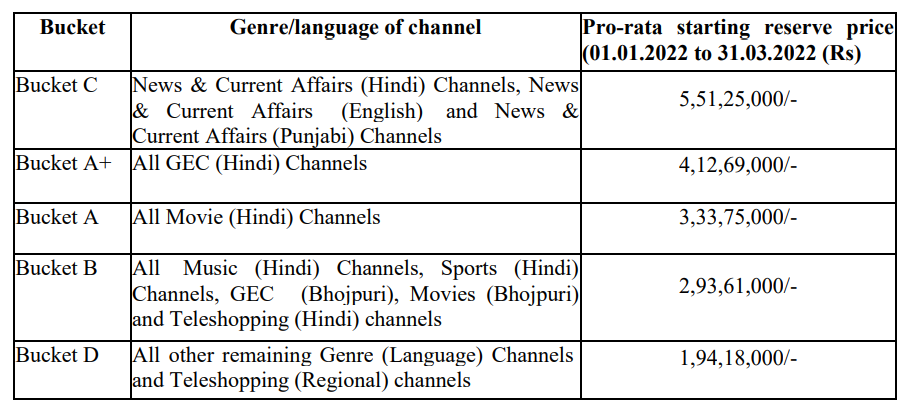
    Mumbai: Prasar Bharati has invited satellite TV channels to bid for vacant MPEG-2 slots on DD Free Dish DTH Platform through the 56th e-auction. Successful bidders would be distributed on the platform for the allotment period between 1 January and 31 March 2022.

    The bidding process shall be open to all language genre channels starting at a reserve price of Rs 1.94 crore and going up to Rs 5.51 crore.  The e-auction, if required, will be conducted on 24 December and the last date to submit applications is on 23 December by 3 p.m.

    The public broadcaster has categorised TV channels into different buckets in accordance with the genre/language of the channel and defined a starting reserve price for the allotment period.

    Only satellite channels licensed by the ministry for information and broadcasting for downlinking in India would be allotted slots on DD Free Dish. Only license holder company or their authorised distributor partners can apply for allocation of DD Free Dish slots.

    Applicants must also pay a mandatory non-refundable processing fee of Rs 25,000 and participation fee of Rs 1.5 crore. For unsuccessful bidders, the participation fee will be refunded within three weeks after the declaration of the results of e-auction. For successful bidders, participation fee will be adjusted in the final installment of the carriage fee/bid amount.

  • Prasar Bharati developing next generation broadcast solution

    Prasar Bharati developing next generation broadcast solution

    Mumbai: Prasar Bharati has entered into an MoU with IIT Kanpur to develop next generation broadcast solution/roadmap for digital terrestrial broadcasting consistent with emerging standards such as 5G broadcast.

    “The sanction for the Proof of Concept (PoC) of next generation broadcasting has also been conveyed to IIT Kanpur,” the minister of information and broadcasting Anurag Thakur told the Lok Sabha on Tuesday. “The selection of an appropriate next generation broadcast technology and Digital Terrestrial Transmission (DTT) roadmap of Doordarshan depends upon evaluation of this PoC.”

    Speaking at the CII Big Summit last month Prasar Bharti CEO Shashi Shekhar Vempati had also stressed upon the need for convergence across infrastructure and content creation.

    He said that if the collaboration with IIT Kanpur is successful it will be possible to directly receive broadcast signals on smartphones in future. “In the event of a high-viewership event like the Indian Premier League (IPL), there is no reason why millions of users need to receive that content on a unicast mode through the internet. If this works, all of the content can be delivered directly on broadcast frequencies to people on their smartphones or smart TVs,” he said.

    The public broadcaster is already working on bringing convergence across TV and radio so that a lot of exclusive radio content can be made visually rich and available for TV audiences. PM’s ‘Mann Ki Baat’ was the first such example. Prasar Bharati is following the same format where a camera is put up in the studio all-day long for another show ‘Rangoli’.

  • MIB gives an extension to broadcasters on TV rating committee’s report

    MIB gives an extension to broadcasters on TV rating committee’s report

    Mumbai: The ministry of information and broadcasting (MIB) has granted an extension on the deadline seeking comments from broadcasters on the report on ‘Guidelines for TV Rating Agencies in India’ till 30 November.

    Major broadcasting associations including the Indian Broadcasting and Digital Foundation (IBDF), News Broadcasters Association (NBA), and News Broadcasters Federation (NBF) have received the report.

    The MIB had reached out to broadcasters earlier in the month seeking their comments by 17 November on the report. The report was submitted by a committee instituted by MIB on 4 November 2020 and led by Prasar Bharati chief executive officer Shashi Shekhar Vempati. The committee submitted its 39-page report in January.

    Govt committee seeks to set up a specialised regulator for media ratings in India

    The comprehensive report highlights 20 recommendations of the committee to restore faith in the integrity of the TV rating system in India. The committee was formed in response to the TRP scam that broke out in October last year where three TV channels were named by Mumbai Police for allegedly tampering with rating data.

    As reported previously by Indiantelevision.com, the recommendations made by the committee in their report were aimed towards strengthening corporate governance at Broadcast Audience Research Council (Barc) India which is the premier TV audience measurement company in the country. There were also recommendations pertaining to the technical aspects of the TV measurement system like the use of return-path data (RPD), instituting a regulatory mechanism for media rating agencies, adopting an open data ecosystem, and moving towards hybrid audience measurement.

    The four-member committee included IIT Kanpur professor of the statistics department of mathematics and statistics Dr Shalabh, C-DOT executive director Dr Rajkumar Upadhyay and Decision Sciences Centre for Public Policy professor Pulak Ghosh.

  • Govt committee seeks to set up a specialised regulator for media ratings in India

    Govt committee seeks to set up a specialised regulator for media ratings in India

    Mumbai: The committee on TRP ratings formed by the government has pushed for the formation of multiple rating agencies in competition to Barc India, and recommended creating a specialised regulator to oversee all of them.

    The 39-page report submitted by the committee early this year has recently been shared with Broadcast Audience Research Council (Barc) India and other broadcasters to take the discussions forward. The committee led by Prasar Bharti CEO Shashi Shekhar Vempati was constituted last year in the aftermath of the TRP scam in Mumbai.

    According to the report, the regulation of multiple rating agencies should be a specialised function that requires a suitable regulator and cited Securities and Exchange Board of India (SEBI) in regulating credit rating agencies and Media Ratings Council in the United States as successful examples. As per the committee, the regulator can look at end-to-end regulation of audience measurement in India and also provide for an Appellate Authority to redress grievances and mediate disputes between stakeholders and rating agencies with appropriate powers.

    The committee to review the ‘Guidelines on TV Rating Agencies in India’ had made a total of 20 recommendations to the ministry of information and broadcasting (i&b) that includes both immediate and long-term measures that need to be taken to restore faith in the integrity of TV rating system in view of emerging technology trends and market dynamics.

    Most of the recommendations made by the committee in their report accessed by Indiantelevision.com are aimed at strengthening corporate governance at Barc India at the board level. The recommendations have also laid down specific measures to bring independent oversight of Barc India, mandate the use of return-path data, increase the competitiveness in the TV rating space, and put in place a specialised regulatory mechanism for media rating agencies in India.

    It felt that industry stakeholders must come to a consensus over acceptable business practices to ensure faith in ratings. It also recommended that the government may consider temporarily suspending its license to Barc India until it and stakeholder bodies have complied with directives issued by MIB.

    After consultation with stakeholders such as Barc India, MDPL, Zappr Media, Nielsen India, and Tata Sky AMS, the committee had issued several specific and sweeping recommendations on the technical aspects of TV rating measurement in India.

    It found that there was a broad consensus among industry stakeholders in favour of leveraging return data capabilities. However, apart from Barc and a few platforms, there was a lack of ubiquity in approach or consistency in investment in RPD by platforms.

    It also recommended that RPD should be made mandatory for set-top-boxes (STBs) deployed by distributed platform operators (DPOs). “The increasing convergence between STBs and smart media devices and in view of the emergence of hybrid boxes capable of both CAS compliant linear TV viewing and internet streaming-based OT, the committee sees fewer technical barriers to enable RPD capabilities within households” it noted.

    Adding further, it said, “Smartphone-based apps are capable of interacting with such hybrid boxes paving the way for additional avenues of RPD data capture and relay.”

    The collection of viewership data by DPOs is to be governed by privacy norms prescribed by the government/regulator. The sale of such data by DPOs should be governed by guidelines for TV rating systems. A joint industry working group with representation from all relevant stakeholders and independent experts may be set up to specify norms for an industry-wide RPD mandate, according to the report.   

    The report noted that crowdsourcing approaches could be economical alternatives to RPD and should be open to rating agencies to enrich panel-based measurement. However, it noted that owing to the nascent stage of innovations in cloud-based computing and artificial intelligence and the small pool of talent and expertise with an understanding of TV ratings and media audience measurement domain in India, any integration of crowdsourced data is best left to the discretion of stakeholders.

    Another interesting recommendation by the committee for the imperative is to adopt an open data ecosystem. It drew on the experience of similar data efforts in domains such as digital payments (UPI, India stack) and account aggregator system for credit rating (Sahamati), noting that algorithms and raw datasets should be made available to academics and independent researchers to analyse, validate and enrich.

    The committee observed the global shift towards hybrid audience measurement spanning multiple channels (TV+digital) and the rapid technology innovation hastening this shift. It stated that guidelines prescribed by MIB should not be a barrier to the emergence of more efficient business models that are in pace with global trends and local market dynamics.

    Led by Prasar Bharati CEO Shashi Shekhar Vempati, the four-member team also included – IIT Kanpur, professor of statistics, department of mathematics and statistics, Dr Shalabh; C-DOT executive director Dr Rajkumar Upadhyay; Decision Sciences Centre for Public Policy professor Pulak Ghosh.

    The television rating system in India had come under scanner in October 2020 when Mumbai Police claimed in a press briefing that they have probed a case of manipulation of TRPs and found some incriminating evidence. The police said the accused were allegedly bribing the households to keep a particular channel running, leading to several arrests. Three news channels, Republic TV, Fakt Marathi, and Box Cinema were named in an alleged TRP tampering scam. BARC had also temporarily suspended the publishing of weekly data for news channels, which remains in limbo till date.

  • Prasar Bharati to monetise its premium and archival content

    Prasar Bharati to monetise its premium and archival content

    Mumbai: Prasar Bharati has approved a policy on monetisation of archival and premium content of All India Radio, Doordarshan and new units of the public broadcaster.

    “This policy will ensure that archival and premium contents of Prasar Bharati are syndicated to third parties through an open and transparent mechanism of e-auction, in order to fetch maximum market value of content on-demand basis,” it said in a statement.

    The broadcaster observed that TV channels as well as new channels on OTT are looking for good saleable content. This has created a demand for programme content of Prasar Bharati in India and overseas for the purpose of broadcast as well as streaming. The possibility for monetising this content requires a well-defined content syndication policy, it noted.

    As per the policy, the public broadcaster will monetise its available content through e-auction to third parties for linear broadcasting (TV/Radio) and on-demand viewing/listening through internet platforms. The available content will be curated into compelling catalogues for the purpose of syndication at the catalogue level.

    An online portal will be created for the management of the entire life cycle of the syndication from registration to grant of rights, payment and content sharing. The e-auction may be held for global linear broadcast rights, global on-demand rights, India linear broadcast rights and India on-demand rights, it said on Thursday.

  • Prasar Bharati launches content acquisition portal

    Prasar Bharati launches content acquisition portal

    Mumbai: Public broadcaster Prasar Bharati on Thursday announced that it has launched a content acquisition Portal to enable ease of doing business in the process of online content acquisition.

    In its 158th meeting held on 15 November 2019, the board of Prasar Bharati had approved an online content acquisition policy for off the shelf content, in a bid to ensure transparency, accountability and ease of doing business in the process of content acquisition.

    According to the policy, the pubcaster intends to procure ready-made TV content (Hindi) on a license basis for its various analogue and digital channels and platforms. The content will be procured for multiple telecasts over multiple channels across DD networks and digital platforms. Rights would be acquired for a period of one year, three years or perpetually.

    The rights holders who wish to offer their content are required to get registered on the Prasar Bharati content acquisition portal by 31 October.

  • Prasar Bharati to phase out most analog terrestrial TV transmitters by March

    Prasar Bharati to phase out most analog terrestrial TV transmitters by March

    Mumbai: Public broadcaster Prasar Bharati has clarified that with the exception of 50 analog terrestrial TV transmitters placed in strategic locations, it will phase out the rest of the obsolete technology by the end of March.

    The pubcaster said that till now 70 per cent of all analog transmitters have been phased out and rest are being sunset in a phased manner while ensuring appropriate measures are taken for redeployment and manpower.

    The statutory body governing All India Radio and Doordarshan network addressed misinformation put out by certain media outlets that it was planning to shut down its DD Silchar and DD Kalaburagi channels. “Prasar Bharati has made it clear that these DD centres shall continue to generate program content for broadcasting on the satellite channels of Doordarshan dedicated to their respective States, apart from maintaining their presence on digital media via YouTube and on social media. For instance, program content generated by DD Silchar and DD Kalaburagi shall now be broadcast on DD Assam and DD Chandana respectively,” it said in a statement.

    “Prasar Bharati has been swiftly phasing out obsolete broadcasting technologies like Analog Terrestrial TV Transmitters, paving way for paradigm shift to emerging technologies and new content opportunities,” it added.

    The pubcaster stated that analog terrestrial TV is an obsolete technology and phaseout of the same is in both public interest and national interest as it makes valuable spectrum available for new and emerging technologies such as 5G apart from reducing wasteful expenditure on power.