Tag: Prasar Bharati

  • Parliamentary Committee pushes for DD Kisan launch during current fiscal

    Parliamentary Committee pushes for DD Kisan launch during current fiscal

    NEW DELHI: A Parliamentary Committee has said that the Information and Broadcasting Ministry (MIB) should complete all remaining infrastructural and studio up-gradation work for Doordarshan’s Kisan Channel scheme during the current fiscal itself. The Committee also asked MIB to judiciously spend the Rs 35 crore, which has been earmarked for content.


    The Standing Committee on Information Technology, which also examines issues relating to MIB urged the Ministry and Prasar Bharati to focus on areas of advancement of the channel by generation of rich content and ensure active participation of experts in the field of agriculture and agronomy so that the dedicated Kisan Channel proves to be an advancement over the Krishi Darshan Programmes and that the farmers benefit out of it.


    The Committee noted that the Scheme of Kisan Channel had been approved during the year 2014-15 with an initial allocation of Rs 100 crore: Rs 90 crore for Doordarshan and Rs 10 crore for All India Radio (AIR).


    A Ministry source told Indiantelevision.com that the allocation to AIR was for content generation for the DD Kisan TV channel.


    However, the Committee said that the budget estimates allocation was reduced to Rs 26 crore at the revised estimates stage, which was utilized fully during the year 2014-15.


    The Ministry informed the Committee that the BE allocation for the Scheme was reduced owing to factors such as gestation period involved in carrying out research for writing script authenticated by Agricultural Scientists and experts preparing rich content.


    The Committee stressed the significance of a channel like this in an agrarian country like India where issues like dissemination of real time information on farming techniques, water conservation, organic farming, etc. hold crucial importance to the farmers.


    With regard to the targets, the Committee noted that earmarking of a dedicated studio had been made; 51 professionals had joined the channel against 67 posts advertised; and efforts had been made to impart training and orientation of manpower working in Kisan Channel from the Indian Agricultural Research Institute (IARI). Integrated automated play out system for the channel had been installed and apart from procurement of equipment, the Direct-to-home facility had been upgraded.


    During the year 2015-16, the Ministry proposes to spend Rs 10 crore on infrastructure development and Rs 35 crore on generating content for the channel.


  • Parliamentary Committee lambasts Govt on lax approach towards Sam Pitroda report

    Parliamentary Committee lambasts Govt on lax approach towards Sam Pitroda report

    NEW DELHI: A Parliamentary Standing Committee has once again lashed at the Information and Broadcasting Ministry and Prasar Bharati for failing to make any headway in implementation of the Sam Pitroda Committee Recommendations.


    The Standing Committee on Information Technology, which also examines issues relating to the I&B Ministry, said it was “disquieting to note that there has not been much headway in the implementation of the recommendations of the report, which was presented to the Government in February 2014.”


    For the first time, the Parliamentary Committee, which had castigated the government on this issue just a few months earlier, has given the Ministry a period of three months in which to submit a report of action taken.


    It noted that the Expert Committee had been constituted to review the institutional framework of Prasar Bharati, including its relationship with the Government.


    “There seems to be lack of coordination and cohesion between the I&B Ministry and Prasar Bharati in so far as implementation of these recommendations are concerned, because Prasar Bharati claims to have taken several operational and policy initiatives separately, particularly in the absence of any clarity from the Government about the acceptance of the Sam Pitroda Committee’s entire range of recommendations,” the Committee said.


    Taking a serious note, the Parliamentary Committee said that it took “a serious view of this casual and lackadaisical approach of the Government on such an important matter.”


    Considering that the overall action plan of Prasar Bharati was getting delayed, the Committee recommended that the Ministry should come out with a definite action plan for the implementation of the recommendations of the Expert Committee in a time-bound manner.


    Meanwhile, the Committee also said the Ministry may suitably amend the provisions of the Prasar Bharati Act 1990 so that the functional autonomy of Prasar Bharati envisaged in the Act is not diluted and the much desired autonomy for the national broadcaster is secured.


    It noted that the Group of Ministers (GoM) on Prasar Bharati had reviewed the Prasar Bharati Act 1990 and recommended certain amendments to improve the governance in Prasar Bharati. But the Committee had been told that these contentious Sections were not covered in the GoM recommendations.


    The Committee said it had been given to understand that the sections in the Prasar Bharati Act 1990, which empower the Central Government to regulate the recruitment conditions in Prasar Bharati are impinging upon the autonomous character of the organization.


    It was informed that the Ministry is in the process of assessing and analysing the proposals made in the Prasar Bharati (Broadcasting Corporation of India) Amendment Bill. 


  • Parliamentary Committee to review Prasar Bharati working, wants feedback from govt

    Parliamentary Committee to review Prasar Bharati working, wants feedback from govt

    NEW DELHI: The Parliamentary Standing Committee will review the working of Prasar Bharati ‘in due course’ particularly with regard to human resource and financial problems. The committee has also asked the pubcaster to apprise it of the action taken so far on the Sam Pitroda Committee recommendations.


    The Parliamentary Standing Committee on Information Technology, which also examines issues relating to Information and Broadcasting Ministry (MIB) has noted in its recent report that it is aware that the Government is also undertaking a study following responses received from various stakeholders to the Sam Pitroda Committee report being placed on the website of the Ministry.


    The Committee noted that Prasar Bharati has been suffering from financial problems as well as human resource related issues ‘for the last so many years’.


    The Sam Pitroda Committee had given its report in January 2014, the Standing Committee noted. Pitroda had submitted 26 recommendations in the areas of (i) Governance and Organisation, (ii) Funding, (iii) Human Resources, (iv) Content, (v) technology, (vi) Archiving, (vii) Social Media and (viii) Global Outreach.


    The recommendations address issues of financial and administrative autonomy of Prasar Bharati to ensure that it is approximately positioned to execute its role as a genuine public broadcaster.


    The Standing Committee also took note of the fact that the MIB had asked Prasar Bharati to prepare an action plan for undertaking certain reviews, studies and audits suggested by the Sam Pitroda Committee, which have a critical bearing on future action plan of the Government. 


    The high-level committee under veteran technocrat Sam Pitroda had stressed the need for constituting a Parliamentary Committee as originally envisaged in the Prasar Bharati Act 1990 to ensure that the pubcaster discharges its duties in accordance with the provisions of the Act and Government defined duties.


    It recommended reorganization of the pubcaster Board to make it a professionally managed body and make it more effective in guiding the organisation.


    Noting that Prasar Bharati’s vision must be to become a genuine ‘public broadcaster’ as against a ‘government broadcaster,’ the report said there is need to effect complete transfer of ownership and management of assets and Human Resource to Prasar Bharati ‘to make the organization administratively and financially autonomous of Government.’


    A Regulatory Body has to be set up to ensure public accountability of Prasar Bharati with respect to all content broadcast on its television and radio networks. The Regulatory Body should be a sub-committee of the Prasar Bharati Board.


    Interestingly, the Committee has suggested setting up of Prasar Bharati Connect (PBC) as the third arm of the public service broadcaster, independent of Doordarshan and All India Radio, to expand the social media. PBC should be mandated to manage the various social media initiatives of all the wings of Prasar Bharati. It also wants Prasar Bharati’s social media strategy.


    The Committee was set up in 28 January, 2013 and had decided to set up 11 working groups on different issues and has come out with a report on eight main areas: governance and organization, funding, human resource, content, technology, archiving, social media and global outreach.


    The Committee suggests amending the 1990 Act where necessary so as to impart genuine and effective autonomy to the organization.


    Referring to funding, the report said that there is need to undertake a professional study to develop a funding mechanism for Prasar Bharati that addresses the need for autonomy with financial accountability. Such a funding model should include government funding, internal resource mobilisation and private investment. There is need to monetise all available archival and other assets of Prasar Bharati as soon as possible to enhance funding, and augment funding of social messaging through cross-subsidising such content through entertainment-led programming and by co-opting industry through their corporate social responsibility (CSR) budgets.


    Pitroda had said in reply to a question after submitting his report that the time of licensing TV or radio sets as was being done around five decades earlier could not be revived at it was an old concept.


    Referring to Human Resource, he said the pubcaster should be enabled with the power to frame rules and regulations for its employees without seeking prior approval of the Government.


    The committee said there was need to create an effective recruitment system to attract the best talent and allow the hiring of skilled professionals and encourage and initiate steps for absorption of Government employees as full-time employees of Prasar Bharati, after an appropriate screening process. The ones who remain in Government may be considered for absorption in other departments within the government as is done in other cases.


    Referring to content, Pitroda stressed the need to scale up allocation of funds for content generation to 50 per cent of the total expenditure within a period of five – seven years. The Committee wants a review of all existing channels and content of DD and AIR, based on their relevance, output and viability and phase out those where there is sub-optimal utilisation of resources.


    There should be encouragement of outsourcing of content creation to external producers to attract high quality and diverse programming and creation of distinct brand identities for different TV and radio channels, and define the content strategy for each.


    Referring to Technology, the Committee wants expansion of the satellite and digital cable TV operations to meet the obligation of public service broadcasting. There is need to digitalise the present AM radio system to a new digital radio transmission after due evaluation subject to cost and availability of DRM receivers. In the transition period, FM may be expanded according to demand.


    It stressed the need to selectively digitalize terrestrial TV operations based on commercial viability.


    Any further expansion of and investment in digital terrestrial telecast should be suitably evaluated after field reviews and assessment of developments in the telecom sector, it said.


    Interestingly, the Committee wanted involvement of the private sector to expand the broadcasting market with a view to effectively utilise the infrastructure being built by Prasar Bharati to enable faster growth in the receiver ecosystem.


    On archives, it recommended state-of-the-art digital archives for consolidating and preserving DD and AIR’s content: both existing as well as that being currently generated. There is expansion of scope to make it the National Audio-Visual Archives so as to consolidate and support all other government initiatives.


    The Committee wants dedicated, multi-platform channels created for dissemination of Prasar Bharati’s archival products: both open access and for monetization.


    Referring to Global Outreach, it wanted the creation of a world-class broadcasting service benchmarked with the best in the world using next-generation opportunities, technologies, business models and strategies.

  • Prasar Bharati looks to exploit archived music on digital platform

    Prasar Bharati looks to exploit archived music on digital platform

    NEW DELHI: Prasar Bharati is looking at different ways to exploit music in its vast archives by taking it online.


    Speaking exclusively to Indiantelevision.com, Prasar Bharati CEO Jawhar Sircar said that Prasar Bharati was examining how music available in the archives of All India Radio (AIR) and Doordarshan (DD) could be exploited by putting it on the digital platform.


    Sircar informed that DD alone had over 200,000 hours of recordings in its archives. Of this, 4,000 hours was ready to be published and another 20,000 had been digitally restored.


    Additionally, he said that the pubcaster was also considering a proposal to provide a scroll free-of-charge to cultural organizations to announce their forthcoming programmes on DD Bharati.


    On a separate note, Prasar Bharati has also instructed the news wings of both AIR and DD to cover all important events simultaneously and then share the inputs. Sircar said that the instruction had first been given over a year ago and admitted that there were still cases where this was not being done. He said that the directive included events like lectures or lecture demonstrations, biographical works, and the best performances of any artiste.


    Responding to another query, Sircar said that short wave radio had to be kept alive for diplomatic reasons but the medium wave was gradually being moved to FM so that all 850 million mobile users in the country will get access to this. Vividh Bharati had already been put on FM. 

  • DD to set up four new channels in the north eastern part of India

    DD to set up four new channels in the north eastern part of India

    NEW DELHI: Pubcaster Doordarshan is working towards launching four channels in the north east in the near future.


    Three of these channels will be in Guwahati, Imphal, Arun Prabha (Itanagar), and “Ma-Mi-Na” (Aizawl).


    While presenting his budget in February, Information and Broadcasting Minister Arun Jaitley who also holds the Finance Portfolio had said Prasar Bharati was actively working on a 24×7 television channel for the north-east, for which the clearance of the Standing Finance Committee headed by the I&B secretary had been forwarded to the pubcaster on 24 September.


    The channel was expected to provide a strong platform to rich cultural and linguistic identity of the region.


    However, Prasar Bharati has proposed that the existing north east channel be trifurcated by launching two additional 24X7 satellite channels for north eastern region designated as Arun Prabha Itanagar and “Ma-Mi-Na” Aizawl.


    The proposal is under finalization for circulation to appraisal agencies.


    The proposed Arun Prabha channel will cater to the states of Arunachal Pradesh and Sikkim and the second channel will cater to the states of Nagaland, Mizoram and Manipur and the third to Assam and Meghalaya.


    While applauding this move, the Parliamentary Standing Committee on Information Technology which also examines I&B said recently that these projects are needed to be implemented on a priority basis and specific time-frames be prescribed within which the channels would be operationalised. The Committee wanted to be apprised of the progress.


    It can be noted that at present there is a single 24X7 north east channel which is inadequate to meet the aspirations and needs of the vast north eastern region of the country, comprising eight states where multiple languages and dialects are followed.


  • Indian pubcaster needs to re-invent in era of digital advancement

    Indian pubcaster needs to re-invent in era of digital advancement

    MUMBAI: While the general consensus on the role of a public service broadcaster (pubcaster) is that it provides not much “newsy” content, the BBC definitely remains a role model, even for private news channels.


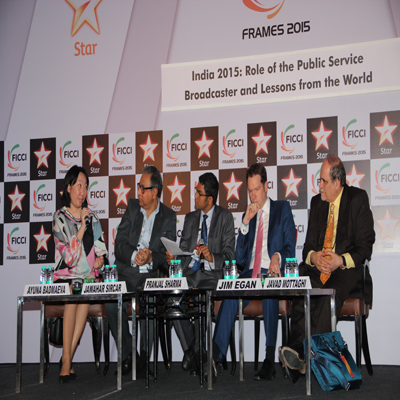
    This was the underlying theme that was discussed on a panel discussion titled ‘India 2015: Role of the Public Service Broadcaster and Lessons from the World’ at FICCI Frames 2015.


    The panel comprised Prasar Bharati CEO Jawhar Sircar, BBC Global News CEO Jim Egan, ABU secretary general Javad Mottaghi and VGTRK Digital Television Russia deputy CEO Ayuna Badmaeva. The session was moderated by Zee Network’s The Appointment host and FICCI advisor Pranjal Sharma.


    The session began with Sircar speaking on the role of Prasar Bharati in the country so far. According to him, the pubcaster had been able to streamline the entire country’s emotional unity together in a multi culture nation. It also played the heritage aspect role as it broadcast mythological shows like the Ramayana. “Show me a single broadcaster, who covers every island of the country across its geographical spectrum. India’s cultural unity was achieved because of a public service broadcaster,” he emphasised.


    Elaborating on how her network functions in Russia and on its role, Badmaeva informed that the network had 18 brands under its umbrella. “We started in 2009 with a factual entertainment channel. We work across Russia and our role is to fill the gap where other networks do not cover its citizens,” she said.


    Egan added, “What is most important for a public service broadcaster is to make the good popular and make the popular good. It is very important that a pubcaster reaches out to every citizen.”


    Posing a question, Sharma asked whether the government should decide what’s good for the public? Mottaghi replied saying that the first word “public” of Public Service Broadcaster referred to all groups of society. Hence its duty was to serve the public. “It has to be public oriented content versus commercial oriented content. We talk about issues such as health, culture, education and what society needs, which is not so much part of commercial news channels,” he opined.


    On being questioned by Sharma as to how Doordarshan ensures that it gets viewers to watch its content, Sircar conceded the fact that DD’s content was definitely not at par as compared to what the BBC was known for world over.


    For Sircar, the issue was related to both creativity and funding. “If the BBC could use 75 per cent of its funding on content, India could use only 10 per cent,” he said.


    Throwing an insightful statistic, which governed the theme of the discussion that followed, Sircar said, “While internationally, double digits dollars were spent per person for creating content. However, in India only 40 cents per person is spent on creating content. If you spend 40 cents, you get content worth 40 cents too.”


    Badmaeva then spoke on how the pubcaster tried remaining relevant in Russia in the ever-evolving digital age. She said, “While linear TV ratings are going down, people consumed content via smartphones and tablets. People also bought their content from cable operators. For us, our network is driven by both profit and reach.” She went on to add the Russian pubcaster has in recent time produced a documentary, which delivered the same rating as the Winter Olympics.


    Egan informed on how the BCC stayed relevant in a dynamic media space. “Every household is driven by a $20 subscription. The idea is about universality. While a part of it to remain relevant is about content, it is also about access, technology and reach. We innovate based on demand. In the digital age, it is how audiences engages with the content,” he said. He then added that around 270 million of the BBC’s audiences was out of the United Kingdom.


    Speaking on the now banned documentary India’s Daughter, which was a joint co-production between various production houses and the BBC, Egan said, “It had the highest values of journalism and the challenge is to avoid being ghettotised as just a pubcaster.”


    Sircar added that DD Sahayadri too had much of its content produced by private production houses. “Own it, don’t stone it,” he said. He also mentioned that when the pubcaster decided to air the Aamir Khan-helmed show Satyamev Jayate, he was questioned by ministers if a show where people washed their dirty linen in public was good for the channel. Sircar was of the opinion that because the show touched public issues, the pubcaster should air it.


    Touching upon the case of Star Sports, which went to court over the pubcaster airing the ICC Cricket World Cup, Sircar said that the pubcaster just followed a court order, which stated that in addition to profit making, the people of India are to be allowed to watch games via cable through terrestrial means. “Because of a very small cartel, which has a few channels, it will lead to monopolising of sports events,” he highlighted.


    Sircar informed that his goal was now focussed on two things. Firstly, increasing the number of channels on Free Dish from the current 50 to 112 and secondly, to use DD’s 1400 transmitters to create FM bands. “If FM has to reach mobiles, smaller circles of 50 kilometers will be created,” he said.


    He went on to add that a process was underway where 15 out of 20 channels could be auctioned. However, he refused to share details.


    Touching upon Sircar’s “40 cent” remark, Egan concluded the session saying, “In a country like India with a large population, 40 cents could add up to $500 million a year. It is a question about a national strategic choice. In some countries a pubcaster would weep tears of joy with this amount of money.”

  • Prasar Bharati and Qatar Media Corp join hands to exchange radio & TV programmes

    Prasar Bharati and Qatar Media Corp join hands to exchange radio & TV programmes

    NEW DELHI: Prasar Bharati and Qatar Media Corporation agreed to exchange of content that highlights the national characteristics, cultural and heritage, social events, festivals and competitions of both the countries.


    A memorandum of understanding (MoU) signed between the two also provides for exchange programmes for journalists, experts, technicians, specialists etc in the field of electronic media, radio and television.


    The MoU is aimed at enhancing the mutual bonds of friendship and to increase co-operation in the field of broadcasting between the two countries.


    The signing ceremony took place in Hyderabad House, New Delhi, in the presence of Prime Minister Narendra Modi, Qatar’s Emir Sheikh Tamim Bin Hamad Al-Thani, Indian and Qatari delegates.


    The Indian side was represented by Prasar Bharti CEO Jawhar Sircar and the Qatar side by its Ambassador to India Ahmed Ibrahim Abdulla Al Abdulla.


    There will be no commercial use of the content to be shared, according to the MoU. The aim is also to strengthen their co-operative relationship in the field of radio and television; and improve mutual understanding of political, economic, social and scientific aspects of the countries.


    Attempts will be made to explore opportunities for co-production between the two pubcasters.


    The aim will also be to encourage cooperation and coordination in efforts and attitudes in the regional and international forums, conferences, and meetings related to the radio and television field.


  • Broadcasters need to come together to resolve copyrights issues by private parties

    Broadcasters need to come together to resolve copyrights issues by private parties

    NEW DELHI: Describing the ‘absymal ignorance’ about copyright issues as a ‘paralysis of analysis’, Prasar Bharati CEO Jawhar Sircar today asked broadcasters to interact with each other to overcome hurdles instead of living in fear of copyright rights.


    He said that Internet rights holders never had these problems because they interacted with each other. There was need for broadcasters to ‘come out’ and talk, since fears about copyright rights were unfounded.


    Sircar also stressed on clarity of purpose and not mere convoluted jargon with regard to copyright, while addressing the 21st Asia-Pacific Broadcasting Union Copyright Committee Meeting and Forum here.


    He said there was need for interlocutors such as the ABU to resolve these issues, and India was ready to support the initiative.


    Prasar Bharati chairman A Surya Prakash emphasized the challenges related to copyright, piracy and intellectual property rights. He referred to the treasure that digitization was helping to revive and retain but the issue of copyright often cropped up here.


    All India Radio director general F Sheheryar said copyright issues were growing by ‘leaps and bounds’ and therefore it was necessary to know the copyright laws.


    ABU secretary general Javed Mottaghi said it was vital for broadcasters in the region to talk to each other and sort out issues.


    He said ABU fully supported the World Intellectual Property Rights Organisation Treaty and this would be stressed in the next session on WIPO at Geneva.


    ABU was planning to increase its support to the Copyright Committee but the Committee must come out with a long-term plan, which ABU will support financially in the next financial year beginning in July.


    ABU has 180 active members and many of them have common points. He referred in this connection to a meeting of broadcasters from the Pacific Ocean lslands held in Samoa.


    The meeting of ABU in Tashkent will also take up copyright issues, he added. The ABU General Assembly will be in Istanbul in October. The Union will also enhance its online presence and enable webinars amongst members.


    There would be an important ABU Radio meet this year and there was need to support the community radio stations.


    He said the Union wanted to enroll more members as the African Union of Broadcasters had done.


    One way of resolving copyright issues was to form a national pool in every country to have a common voice. ABU had already drafted a model for this and could be accessed by members.


    Referring to issues raised with regard to problems created by sports rights holders, he wanted a regulatory framework to be built.


    A list could be drawn up of the sports events that people are interested in and for which there is need to obtain broadcast rights by public service broadcasters from the private rights holders. The ABU Sports Department could help in this regard.


    He was responding to points made by Doordarshan deputy director general Rafiq Masoodi and All India Radio additional director general Rajiv Kumar Shukla, who both felt private players often created hurdles, even as they referred to the Manadatory Sharing of Sports Signals with Prasar Bharati Act, which had made things easier.


    Shukla also lamented that radio was often not given the kind of imporetance that television received.


    MTV Sri Lanka group director Suranga Jayalath said there was need for a joint approach on the issue. He felt that traditional forms of advertising including radio and television remained dominant despite multi-platforms emerging in broadcasting.


    CCTV China deputy director of the Copyright Management Department Yan Bo said that a meeting on sports copyright issues was slated to be held in Beijing this year. The ABU Copyrights Committee was very active in this regard. 


    The committee members of the Forum are of the opinion that to ensure protection of copyrights, constant and timely discussion with government is necessary.


    The Copyright Committee meets annually to discuss, share, analyze and to inform members on copyright, intellectual property rights, broadcasting rights, piracy, and various other related issues and case studies from the Asia-Pacific region and beyond. Experts from this field gather every year to advise the members on the changing trends in the broadcasting industry, as to how we can protect our rights. Stakeholders involved in this forum are lawyers, copyright practitioners and specialists. The committee urges the members to attend this forum to deliberate on the copyright and protection related issues, to further gain support for the broadcasters treaty intended to protect them from piracy.


    The core discussion points across the three day Forum will be WIPO Standing Committee on Copyright & Related Rights session; Broadcast Laws and Protection Report; Future Projects and Suggestions; Legal Challenges and Directions for Broadcasters in the Digital Era; and the Cloudy Business of Copying (Panel Discussion).


    The meeting is being attended by more than fifty representatives from overseas apart from those from Prasar Bharati, Doordarshan and AIR.


  • FICCI FRAMES: Prasar Bharati CEO Jawhar Sircar to speak on pubcaster & revenue

    FICCI FRAMES: Prasar Bharati CEO Jawhar Sircar to speak on pubcaster & revenue

    NEW DELHI: Prasar Bharati chief executive officer Jawhar Sircar will be addressing the annual FICCI FRAMES convention commencing in Mumbai on how a public broadcaster can still earn revenue.


    Sircar’s talk is on “India 2015: Role of the Public Service Broadcaster and Lessons from the World.”


    The three day convention from 25 – 27 March will extensively cover discussions on various issues related to the media sector centred around the theme – how to make India a Global Entertainment Superpower.


    Sircar said, “There is no nation in the world that does not have a decent public broadcaster and some of them like BBC or NHK Japan or the Korean Broadcasting System are legends, mainly because their nations, people and their governments wanted them to be so and help them succeed. India cannot be an exception as it is the only public broadcaster, which operates from the icy peaks of Kargil to our lonely borders in Arunachal, right down to Andaman and every possible corner of India: without ever looking at short-term commercial gains.”


    This panel discussion is scheduled on the second day of the entertainment and media conclave and will be moderated by business journalist Pranjal Sharma featuring BBC Global News CEO Jim Egan and Russia’s largest media corporation and public broadcaster – VGTRK deputy CEO Ayuna Badmaeva.


    The other key participant is Asia Pacific Broadcasting Union (ABU) secretary general Javad Mottaghi, who is a special invitee at FICCI FRAMES 2015.


    FICCI secretary general Dr A Didar Singh said, “The discussion would provide greater clarity on how to maximise the efforts of public service broadcasting, and also how institutions like Prasar Bharati can balance their programming mandate with effective revenue generation, and remain relevant in the digital era.”


    The session will explore the relevance, importance and space for Public Service Broadcasting in today’s ‘always connected’ world which offers a multitude of choices by way of content, delivery platforms and engagement channels.


  • Prasar Bharati asks for additional Rs 112 crore for supplementary demands

    Prasar Bharati asks for additional Rs 112 crore for supplementary demands

    NEW DELHI: An additional sum of Rs 111.98 crore has been sought by Finance Minister Arun Jaitley for providing additional grants-in-aid – General of Rs 1.98 crore, and grants-in-aid – salaries Rs 110 crore for Prasar Bharati.


    The demands have been made in the Supplementary Demands for Grants tabled in Parliament by Jaitley, who also holds the Information and Broadcasting portfolio.


    A sum of Rs 1.5 crore has been demanded for meeting additional expenditure towards providing grants-in-aid – general for National and International Children’s Film Festival under the Plan Scheme; Promotion of Indian cinema through film festivals and film markets in India and abroad.


    Grants-in-aid – salaries totalling Rs 1.85 crore has also been sought towards providing to the Children’s Film Society, India (Rs 4 lakh), Satyajit Ray Film and Television Institute in Kolkata (Rs 83 lakh), Indian Institute of Mass Communications (Rs 80 lakh) and Press Council of India (Rs 18 lakh).


    In the case of these three demands, the Minister said, “As savings are available in the same section of the grant, a token supplementary is sought.”


    A sum of Rs 5.7 crore has been demanded for upgradation of the Siri Fort Complex (Rs 40 lakh), building infrastructure of Films Division (Rs 50 lakh), and the Electronic Media Monitoring Centre (Rs 4.8 crore). The Minister has said, “Taking into account the savings of Rs 2.49 crore available in the same section, a technical supplementary for the balance amount of Rs 3.21 crore is sought as equivalent savings are available in the revenue section of the grant.”


    In addition, the supplementary demands for grants have sought a sum of Rs 3.24 crore as capital outlay.