Tag: Prasar Bharati

  • Placement of channels on DD Free Dish on 1 March

    Placement of channels on DD Free Dish on 1 March

    MUMBAI: A few days ago, Prasar Bharati had invited applications from private channels for participating in its 38th online e-auction for filling up of 54 vacant of MPEG-2 slots on its DD Free Dish DTH service. It has furnished details on the upcoming process which will see channel placements take place on 1 March.

    Interested private channels were requested to submit their applications along with requisite documents and demand drafts on or before 6 February 2019 by also mentioning the genre and language of the channel. Scrutiny of the application will be done from 6-8 February 2019. The e-auction will be held from 11 February 2019 onwards followed by the issuing of allotment letters by 20 February. All payments must be made by 28 February. International Public Broadcasters licensed by the MIB can also participate in e-auction for MPEG-2.

    Categorisation of TV channels in different buckets in accordance with genres/language of channel and their respective reserve price for allotment of slots on DD Free Dish through e-auction is as below:

    The starting price for e-auction for the next slot, if available in the same bucket shall be increased by minimum incremental amount of Rs 5 lakh from the starting price of e-auction of immediate previous slot of the same bucket.

  • CCEA approves “Broadcasting Infrastructure and Network Development” scheme of Prasar Bharti

    CCEA approves “Broadcasting Infrastructure and Network Development” scheme of Prasar Bharti

    MUMBAI: The Cabinet Committee on Economic Affairs (CCEA) chaired by the Hon’ble Prime Minister Shri Narendra Modi today gave its approval to the proposal of the Ministry of Information and Broadcasting (MIB) regarding PrasarBharati's"Broadcasting Infrastructure and Network Development" scheme at a cost of Rs.1054.52 crore for 3 years from 2017-18 to 2019-20.

    Out of Rs. 1054.52 Crore, an amount of Rs. 435.04 Crore is approved for the continuing schemes of All India Radio and an amount of Rs 619.48 Crore is approved for the schemes of Doordarshan. The continuing schemes of AIR and Doordarshan are at different stages of implementation and are scheduled to be completed in phases.

    The cabinet also approved the launch of DD Arun Prabha Channel from Itanagar, Arunachal Pradesh to fulfil the aspirations of people of North East Region. In addition to this, 1,50,000 DTH sets have been approved for distribution in different states in the country which will help people in the border, remote, tribal and LWE areas to watch Doordarshan's DTH programmes.

    Provisions have been kept for modernisation of existing equipment/facilities in studios which are essential to sustain the ongoing activities and also for High Definition Television (HDTV) transmitters at Delhi, Mumbai, Chennai and Kolkata. Setting up of Digital Terrestrial Transmitters (DTTs) at 19 locations and Digitization of Studios at 39 locations, DSNG (Digital Satellite News Gathering) Vans at 15 locations and Upgradation of Earth Stations at 12 locations have also been approved.

    For All India Radio, the Scheme provides for FM expansion at 206 places, digitalisation of studios at 127 places are envisaged. FM expansion programme will benefit 13 per cent additional population of the country to listen the AIR programmes. Besides 10 KW FM transmitters would be set up along Indo-Nepal Border while 10KW FM transmitters would be set up in J&K Border. These will significantly improve the Radio and TV coverage along the border areas.

  • Prasar Bharati fills up 4 vacant MPEG-2 slots on DD FreeDish

    Prasar Bharati fills up 4 vacant MPEG-2 slots on DD FreeDish

    MUMBAI: Prasar Bharati-led free direct-to-home (DTH) service DD FreeDish has allocated MPEG-2 slots to four channels. The four slots have been allocated to Aajtak Tej, Republic Bharat, Surya Samachar and Kushboo Bangla. The first three channels are from the news category with Republic Bharat to launch on 26 January, while the fourth is a Bengali GEC.

    “Based on the applications received for interim placement of channels on currently vacant MPEG-2 slots on DD FreeDish on pro-rata basis, 4 slots have been allocated to Aajtak Tej (news), Republic Bharat (news), Surya Samachar (news) and Kushboo Bangla (Bengali GEC),” Prasar Bharati informed on Twitter.

    The public broadcaster invited applications for interim placement of channels on currently vacant MPEG-2 slots on DD FreeDish on pro-rata basis for the period 26 January 2019 to 28 February 2019. Interested private satellite TV channels were requested to submit their applications along with all requite documents and demand drafts/fee on or before 24 January latest by 12 pm.

    “Good to see a Bengali GEC channel take up a slot on DD FreeDish. Gives us much hope that the upcoming eAuction next month will expand regional/language diversity on DD Free Dish taking it beyond the Hindi belt,” Prasar Bharati CEO Shashi Shekhar Vempati commented.

    Earlier this month, DD Free Dish e-auctions were resumed under a revised policy. Vempati said e-auctions will be based on a differential pricing to be determined by the genre or language of channels. He also said a key consideration of the new policy was to increase the diversity of content available on DD Free Dish and to expand its reach across India especially within the non-Hindi speaking states.

    The e-auction of slots  on DD Free Dish was arbitrarily called off in 2017 while the last e-auction of DD Free Dish took place in July 2017. Earlier, DD Free Dish used to hold e-auctions once every couple of months to award vacant channel slots to private broadcasters.

  • DD India to reposition as English channel; digital platform to launch before elections

    DD India to reposition as English channel; digital platform to launch before elections

    MUMBAI: Even as all the private media houses are gearing up for the general election, public broadcasters Doordarshan and All India Radio (AIR) are not lagging in their attempts to make hay out of the most lucrative season for news channels.

    According to ThePrint, DD India will be revamped and positioned as an English news channel for the global audience soon while AIR is planning to launch a 24×7 news stream in the next few weeks. Apart from this, Prasar Bharati News Service, a 24×7 digital platform for the global audience, is also set to begin in the next few weeks which is conceptualised along the lines of BBC and CNN in 2017 by a panel headed by Prasar Bharati chairman A Surya Prakash.

    The digital platform will broadcast international news to a global audience to counter anti-India narratives in the foreign media. According to reports, the platform will be an app-based interface that will offer services in multiple languages and publish news in the form of text, video, podcast and alerts.

    About the content, Vempati said, “The contents on these channels will be guided by the Prasar Bharati Act, which lays out quite clearly the mandate of the public service broadcaster.”

    The plan for the new 24X7 AIR stream is to broadcast news bulletins primarily in English and Hindi which will go live in the next few weeks.

    “AIR did not have any such channel. News bulletins were broadcast sporadically in gaps across the AIR network,” Prasar Bharati CEO Shashi Shekhar Vempati told ThePrint.

    A 24×7 stream, officials said, will help expand the reach of AIR news significantly, running parallel to AIR’s recent decision to share its unaltered news feed with private FM channels as a pilot project.

    FM radio channels are currently not allowed to produce and broadcast their own news bulletins, so the move will help the wider dissemination of AIR news since nearly 235 private radio stations across India have already registered with Prasar Bharati to source AIR news content.

  • 38th DD Free Dish e-auction on 11 February: Key highlights of revised policy

    38th DD Free Dish e-auction on 11 February: Key highlights of revised policy

    MUMBAI: The 38th DD Free Dish e-auction for 54 vacant MPEG-2 slots will be held from 11 February. The Prasar Bharati Board on Tuesday gave a green signal to e-auctioning of DTH slots on DD Free Dish. The public broadcaster will resume the allocation of slots based on a revised policy, confirmed Prasar Bharati (PB) CEO Shashi Shekhar Vempati. He thanked the Board, MIB secretary Amit Khare and minister Rajyavardhan Singh Rathore for their support.

    The e-auctioning of slots on DD Free Dish was arbitrarily called off in October 2017. Earlier, DD Free Dish would conduct the e-auction every couple of months to award vacant channel slots to private broadcasters. The last e-auction was held In July 2017.

    With the pubcaster set to kick-start the much-awaited e-auctions, here are the key highlights of the revised policy:

    · The e-auctions will be based on a differential pricing to be determined by the genre (language) of channels. Private broadcasters desirous of carriage on DD Free Dish will have to declare the same to be eligible to bid in e-auctions.

    · To lower the entry barrier for genres (languages) that are currently under-represented on DD Free Dish the differential pricing for slots is split into five disparate buckets as opposed to the 2 buckets based on which e-auctions were previously held.

    · Different genres (languages) have been grouped within these five buckets with differential reserve pricing for slots in respective buckets.

    · To promote the new DD Free Dish authorized set top boxes, the new policy also envisages invitational pricing for channels to also take up MPEG4 slots in addition to the existing MPEG2 slots.

    · The new policy also makes it attractive for channels from a cash flow standpoint through better payment terms. This will ease the burden on channels while lowering the entry barrier for channels.

    According to the PB CEO, a key consideration factored in by the new policy was to increase the diversity of content available on DD Free Dish and to expand its reach across India especially within the non-Hindi speaking states.

    The government-owned DTH platform has had a good run since its launch and is now desired beyond rural areas as well. According to industry experts, the DTH platform now has close to 30 mn subscribers.

    While there are numerous advantages of Free Dish, some private broadcasters feel it offer a threat to distribution platform operators (DPOs).

  • Prasar Bharati to TRAI: OTTs streaming live TV should mandatorily carry all Doordarshan channels

    Prasar Bharati to TRAI: OTTs streaming live TV should mandatorily carry all Doordarshan channels

    MUMBAI: Public broadcaster Prasar Bharati has suggested to the Telecom Regulatory Authority of India (TRAI) that certain norms be made mandatory for OTT providers, in order to bring them on a level playing field with TV broadcasters and not just limit their comparison to telecom service providers (TSPs). OTT providers should abide by certain rules including one that OTT platforms streaming live TV should mandatorily carry all Doordarshan channels like DTH, MSOs or cable operators do.

    Under these regulations, Prasar Bharati is of the view that those OTT services should be included that provide audio/video content or broadcast services such as live, delayed or on-demand content. Such apps ‘should comply’ with basic regulatory and legal conditions which could be a subset of those that currently exist for TV broadcasters.

    Prasar Bharati made these suggestions as part of its comments to a recent TRAI consultation paper. While the consultation paper only looks at comparing OTTs to TSPs, Prasar Bharati feels that since several OTTs are providing content that is parallel to linear TV, it is only fair that when rules are made, it is taken into account that they not only substitute TSPs but even traditional broadcasters. After this, the type of service provider should also be made a criterion for creating regulatory and licensing norms.

    Prasar Bharati feels that currently, OTTs have a free reign but if OTT providers are relaying news content then they should register with the Ministry of Information and Broadcasting (MIB). The need for regulation, in this case, is especially high given the rising incidences of fake news and mischievous reporting. The regulations will also make OTT providers accountable and responsible especially if some content could be deemed to be ‘against national security’.

    It also brought into focus the system of audience measurement that has been established for linear TV and the same should also be applicable when these channels are shown live on OTT platforms.

    Prasar Bharati also sees the positive side of OTTs being helpful during calamities and natural disasters where it could prove as an important tool for broadcast. For this, it says that there needs to be synergy between various stakeholders.

    TRAI released a consultation paper on regulatory framework for OTT communication services in November. “The authority has chosen in this consultation to focus only on regulatory issues and economic concerns pertaining to such OTT services as can be regarded the same or similar to the services provided by TSPs,” TRAI said in the release. The paper mainly focused on issues regarding the relationship between OTTs and TSPs.

    The pubcaster has strongly advocated for basic regulatory and legal conditions to be applied to OTT providers offering broadcast services through internet.

  • Prasar Bharati CEO on convergence and public b’casting

    Prasar Bharati CEO on convergence and public b’casting

    MUMBAI: Prasar Bharati’s CEO Shashi Shekhar Vempati, while dwelling on convergence and its relevance to India’s pubcaster, opined that it was important to understand the changes happening in terms of media consumption and distribution to evolve and plan for the future ahead.  

    “As a public broadcaster, we really have to face these forces of convergence if we have to transform ourselves for the next decade and beyond. Historically, our work force was trained to operate in the world of broadcast engineering and now they have to make the shift to digital and information technology,” Vempati said, adding why it was important for his colleagues to think “digital first” in terms of creation, packaging and presentation.

    Dwelling on the convergence happening at various levels of the Indian media and entertainment sector, Vempati said it was happening at three levels — at the consumer consumption level, platform and distribution level and regulatory level.

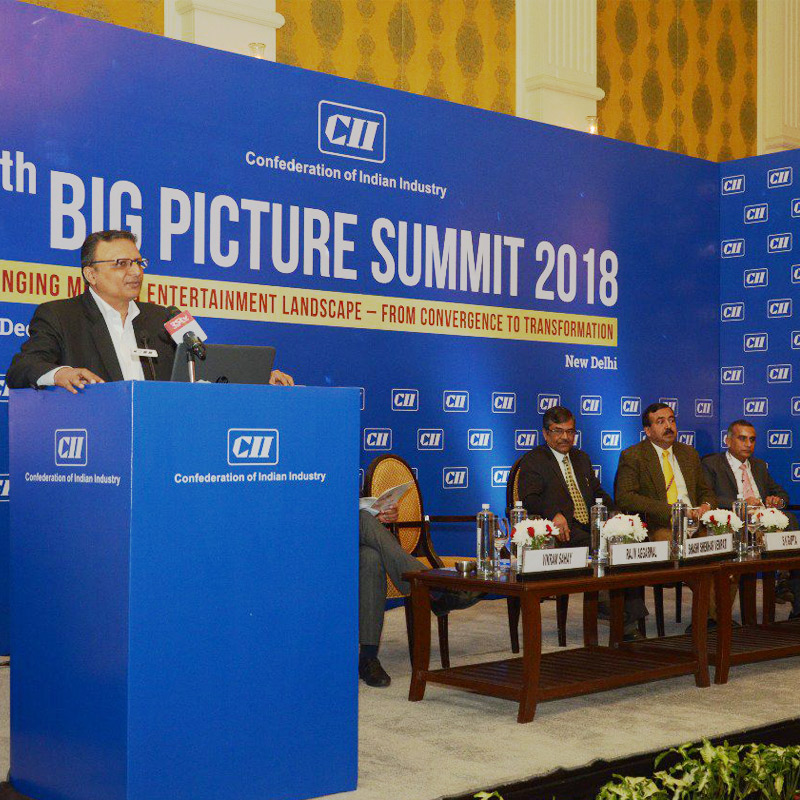
    “The convergence at the consumer level is way ahead of both the platforms and regulatory frameworks,” he stressed while delivering an address at the CII Big Picture Summit 2019 at New Delhi yesterday.

    According to Vempati, while the industry debated convergence and its pros and cons, the consumer was embracing the trend without a fuss, adapting to the various ways of consumption of the media.  

    Analysing the effect of these changes from a pubcaster’s point of view, he said Prasar Bharati was looking at the immediate outcome of the transformation on how content is discovered, measured and, more importantly, monetised.

    Without mincing words, he admitted that the content industry was today kind of trapped in a binary outlook where content monetisation was restricted to either advertising revenue or driven by subscription.

    Giving an example of consumer embracement of convergence, Vempati said Prime Minister Modi’s `Mann Ki Baat’ (Thoughts from the PM) was a prime example of convergence of technology. It is heard not only on All India Radio, which remains a primary source of dissemination of such messages but also consumed online and on traditional television.

    Dwelling on the reach of media — electronic and online — Vempati said, on one hand, there was linear TV, which is measured with set sample panels, and on the other hand there was the digital platform where measurement happened real time. On the issue of audience measurement, he said, TRAI has recently issued a consultation on how there was a need to re-think audience measurement. “So, I think there is another area of transformation that is likely to happen in the near future,” he added.

    On the topic of audience measurement and its fallout on ad revenues for TV channels, Vempati said experience has highlighted that the consumer wants a more flexible pricing model, especially when popular programmes like cricket matches are telecast by private sector TV channels, which demand that the consumer pays to watch.

    There is a need to look at a combination pricing model, which enables consumers to watch popular programmes, including sporting events, at a comparatively lower price or on FTA platforms like Doordarshan.

    “As a public broadcaster one of the greatest learning for me has been that if you have quality content there is an audience for it,” Vempati said giving an example of Rajya Sabha TV, a parliamentary news channel that is not actively marketed and promoted, but has over a million followers online.

    The pubcaster has not spent a dime advertising it anywhere and it is not even measured by BARC India, but on YouTube Rajya Sabha TV has a following that’s legion simply because of quality content it produces, Vempati said.

    Emphasising how technology and pubcasting can merge to deliver useful services, Vempati gave the example of a pilot project undertaken by Doordarshan in Bengaluru, in association with private sector players like Microsoft, to deliver to government-run schools educational programmes on DD’s digital terrestrial network that was lying under-utilised.

    “It’s a great example of convergence and transformation,” Prasar Bharati CEO said, adding that it also meant regulatory framework had a lot of catching to do as policy-makers viewed broadcasting and telecom services in silos, which is not the case now.
  • DD has no plans to buy rights of cricket WC ’19 & Tests: MIB

    DD has no plans to buy rights of cricket WC ’19 & Tests: MIB

    NEW DELHI: Ministry of Information and Broadcasting (MIB) has stated that national broadcaster Doordarshan will continue relying on existing laws to air live and shared signals of relevant international cricket matches, the rights for which may be with some private broadcaster, while clarifying there were no plans to directly acquire rights for Tests or the cricket World Cup 2019.

    Quoting inputs from Prasar Bharati, parent of Indian pubcasters DD and All India Radio, MIB Minister Rajyavardhan Rathore told fellow parliamentarians that “live telecast of cricket matches” was being done on Doordarshan Sports channel under the Sports Broadcasting Signals (Mandatory Sharing with Prasar Bharati) Act, 2007, which was passed by the Parliament and notified the same year. These matches included the ongoing cricket series between India and England comprising three T20s and three one-dayers.

    “The Act enjoins upon the rights holder to share with Prasar Bharati, live broadcasting signals of sports events of national importance for which they hold broadcast rights to enable Prasar Bharati to re-transmit the same on its terrestrial and DTH networks,” Rathore explained.

    However, the government did not explain as to why it did not insist on shared TV feeds of five-day Test matches.

    Incidentally, Star India, managers of several sports channels and rights holders of IPL and several other cricket properties, which were acquired on payment of several billions of dollars, had filed a case in the Supreme Court against unencrypted signals of DD’s satellite-delivered channels not only spilling over to other countries, but also pirated by distribution platforms within India too during cricket matches. Star got a favourable directive from the apex court in 2017, though Prasar Bharati had described it as an opportunity. as it helped it to bring the focus back on DD Sports channel.

    Meanwhile, answering to other queries raised by parliamentarians on cricket, Rathore admitted there was “no proposal to acquire the broadcast rights” for live telecast of Test series between India and England, and the Cricket World Cup in 2019. The broadcast rights for India region for the ongoing England tour of India lies with Sony Pictures Networks India.

    DD Can’t Be Compared To Private Sector TV Channels’

    Pointing out that DD’s programming is more focused on issues of public interest like health, education, empowerment, social justice, etc., the Minister said that the pubcaster’s programmes could “not be be compared” with private channels as both have totally different objectives and programming formats.

    However, Doordarshan is striving to provide “impactful and meaningful” programmes to become the “preferred channel of choice of people”, Rathore said, adding it was a constant endeavour of DD to modernize its infrastructure and improve the quality of programmes.

    “Doordarshan has undertaken a comprehensive plan to improve the programme content, and look and feel of all national and regional channels in DD network,” the Minister said, highlighting that efforts were being made to empanel creative agencies that can work for better look and feel of the channel(s).

  • MIB & Prasar Bharati make up, sign agreement on funds’ release

    MIB & Prasar Bharati make up, sign agreement on funds’ release

    NEW DELHI: After lot of heartburning and media statements, the Ministry of Information and Broadcasting Ministry and Prasar Bharati, which runs Doordarshan and All India Radio (AIR), have inked an agreement that was required for the release of financial allocation to the pubcaster, PTI reported today quoting an unnamed source.

    The agreement or the memorandum of understanding (MoU) was signed between the broadcaster and the ministry in the last week of May, the source added.

    Autonomous bodies getting grants-in-aid from the government are required to sign a memorandum of understanding (MoU) with the ministry concerned for the release of the financial allocations made in the Union Budget by the federal government.

    Besides Prasar Bharati, MIB has also signed MoUs with the Indian Institute of Mass Communication (IIMC), Film and Television Institute of India (FTII) and Satyajit Ray Film and Television Institute in the last week of May, the source added.

    In April, the ministry released Rs 365 crore (Rs. 3,650 million) to Prasar Bharati after it signed the MoU following months of standoff between the two sides on various contentious issues during the time when Smriti Irani was the senior minister. Subsequently she was shifted out of the ministry.

    The ministry releases an amount of around Rs 200 crore (Rs. 2 billion) to Prasar Bharati every month and a major share of it goes to payment of salaries.

    The MIB had earlier released Rs 1,989 crore (Rs. 19.89 billion) to Prasar Bharati as grants-in-aid for payment of salaries to its employees.

    In early March, Prasar Bharati CEO S S Vempati, in response to media reports, had said that Rs 208 crore released by the public broadcaster towards payment of salaries to its staff on 28 February 2018 were from its own reserves.

    Reacting to the news report, the ministry had issued a statement saying that the Prasar Bharati had not signed an MoU as required by autonomous bodies for getting grants-in-aid.

    Also Read:

    MIB calls for ‘fiscal prudence’ in Prasar Bharati

    Prasar Bharati’s policy on DD Free Dish to be out soon

    Prasar Bharati’s main role is of pubcaster, not revenue generator, says Rathore

  • Prasar Bharati Board approves finalising FreeDish policy

    Prasar Bharati Board approves finalising FreeDish policy

    MUMBAI: The Prasar Bharati board, at a meeting held on Monday, decided to finalise the FreeDish policy. According to an Asian Age report, the public service broadcaster gave its approval to Doordarshan which operates the entity. The finalised version will be submitted to Ministry of Information and Broadcasting (MIB).

    According to the referred report, the policy is likely to consider MIB’s direction to stop all e-auction of channels. However, in last meeting the decision was delayed with a fear that the directive could “wreck the finances of Prasar Bharati”.

    Meanwhile, PTI reported that the broadcaster was earlier asked by the MIB to review the continuation of FreeDish. It felt that the programme benefited only private channels and brought recurring liability to the government. FreeDish boasts a reach of 22 million subscribers.

    The matter had reached the Telecom Disputes Settlement Appellate Tribunal last year when channels reacted to its decision to suspend auctions after which an interim order allowed channels to continue at a pro rata basis till it decides on a new policy. The halting of auctions was done soon after Smriti Irani took charge as MIB minister. FreeDish was also looking at MPEG4 technology to carry more channels. Currently, it holds 80 channels.

    Also Read:

    DD Free Dish looks at  advertising for monetisation 

    10 FreeDish slots may fall vacant by Oct-end as renewals hang fire