Tag: Prasad Pimple

  • AI rewires adland: Programmatic performance is the new marketing must-have

    AI rewires adland: Programmatic performance is the new marketing must-have

    MUMBAI: No bots were harmed in the making of this conversation—but several were summoned. At Indiantelevision.com’s Media Investment Summit 2025, the panel ‘The Future of Programmatic & Performance Advertising: How Smart Can AI Get?’ brought together a league of marketers who’ve all but handed over their media briefs to machine learning.

    Moderated by Deloitte south Asia ED Irvinder Ray, the session explored how programmatic advertising has gone from being a budget line item to becoming the spine of digital media strategy.

    Kotak Life Insurance EVP & head – digital business Prasad Pimple laid out the insurance conundrum, “Not all customers can buy all products. We filter prospects by income band, age, and even eligibility”. With such a defined funnel, precision targeting is critical. “Everything we do today is data-informed, whether the data comes from our CRM or platforms like Google”, he added.

    AI, for Kotak, is now part of the underwriting pipeline, campaign segmentation, and even voice-based customer profiling—making programmatic indispensable for performance and compliance alike.

    Fino Payments Bank head of marketing Prashant Choudhari backed automation with a marketer’s pragmatism. “At any given point, at least 50–60 per cent of my media budget is programmatic. It helps with frequency capping, cost control, and better storytelling”, he said.

    Choudhari explained how programmatic empowers smaller brands to punch above their weight. “It frees up time to work on narrative and creativity. Technology does the grunt work, and marketers focus on emotion”, he added.

    “Walking into a bar and being greeted by name is personal. Being handed your usual drink without asking—that’s personalisation with memory”, said PayU Payments head of marketing Argho Bhattacharya. He used the analogy to illustrate how programmatic media and zero-party data allow brands to predict—not just reflect—consumer needs.

    Bhattacharya cited how PayU moved from cohort-based messaging to individual targeting. “We no longer set campaigns by clusters. We do it by individual intent”, he said, citing PIN-code-level targeting for telecom dealers and energy providers, which delivered a campaign click-through rate (CTR) of 2.9 per cent and a brand uplift of 25 per cent.

    Sachdeva also introduced the idea of always-on learning loops—real-time feedback mechanisms that adapt messaging based on ambient conditions like AQI, rain alerts, or commute times. “We don’t just predict needs. We mirror the environment”, he added.

    Blis associate director sales Ishika Sharma focused on creative optimisation and exclusion logic. “We ran a campaign where creatives changed not just by city, but by street, down to the PIN code”, she said. The campaign avoided targeting existing customers by mapping Wi-Fi footprints and excluding IPs already associated with a service.

    She warned against overstepping. “Too much targeting becomes surveillance. We must balance personalisation with respect”, she added.

    VDO.AI CBO Akshay Chaturvedi explained how AI helps balance brand building with performance. “We used AI to layer performance KPIs over branding campaigns, so nothing was wasted. A single video could deliver awareness and CTR”, he said.

    Chaturvedi also stressed multi-channel orchestration. “We use our own AI engine to decide what content to push where—Youtube, Zee5, Whatsapp, or the client’s CRM. It’s all synchronised”, he said.

    The panel agreed that programmatic has shifted from being a media tool to a business enabler. Whether it’s AQI-based insurance ads or pizza shops pinging you mid-commute, the future of advertising is smarter, faster, and sharper.

    As Ray concluded, “Tech can find the segment. But it takes human insight to tell the story. AI and marketers aren’t in competition—they’re co-authors”.

  • IBS 2024: Addressable advertising – Fast forward for platforms, brands & advertisers

    IBS 2024: Addressable advertising – Fast forward for platforms, brands & advertisers

    Mumbai: Reaching the right audience has always been a key challenge in marketing. Addressable advertising is changing that, offering a way to connect businesses with consumers more directly and effectively. Traditional advertising often spreads resources too thinly, failing to engage the intended audience. Through data and technology, addressable advertising targets specific audience segments, making marketing campaigns more effective and enhancing customer experience. The panel discussed addressable advertising, how it works, its benefits for marketers and consumers, and its role in transforming marketing and building experiences that matter.

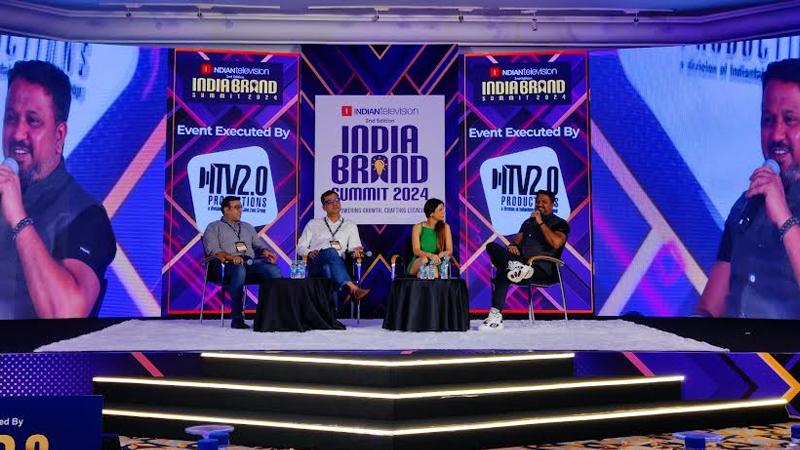
    At India Brand Summit 2024, held in Mumbai, the session was moderated by Good Ants Media founder & CEO Parul Menghani and the speakers were Kotak Life EVP & head of digital business unit, Prasad Pimple, Tata Communications global head – Digital, Experiential & Content Marketing, Saugata Bagchi, and Donear Group, AVP Group Brand Marketing, Aakash Mishra.

    Parul kicked off the session by asking Saugata the challenges that needs to be addressed in addressable advertising to which he said, “Addressable advertising and programmatic advertising share some similarities but also have distinct differences. Addressable advertising focuses on delivering targeted communication across various multimedia channels, while programmatic advertising showcasing the automated buying and selling of ad space. Though they often work together, addressable advertising encompasses a broader range of media, including connected TV and out-of-home (OOH), which programmatic may not always target depending on the campaign.”

    He further delved into the global and local marketing efforts, as it is essential to consider cultural nuances; strategies that succeed in India may fail in Spain, and vice versa. Language barriers also play a crucial role; contextualization goes beyond simple translation to include understanding and respecting cultural sensitivities. Additionally, regulatory differences can impact marketing strategies; for instance, certain advertising approaches might be more permissible in one country than another.

    Moving on, Prasad said, “f your goal is to connect with your audience rather than just focusing on metrics like website visits, you may miss out on immediate customer engagement. Therefore, if your objective isn’t just about these numbers, you should consider top-of-funnel metrics like awareness and consideration, which are also measurable. Ultimately, the focus should always be on the overarching goal of the brand. At the end of the day, everyone is concerned with return on investment. With the rise of digital strategies, tracking this becomes more accessible.

    Aakash emphasised on how effective targeted or addressable advertising isn’t only about placement; it’s also about the content of the message. “I’ve been part of this organization for nearly a year, and it’s easy for competitors to hire a brand ambassador. For example, why focus on celebrities like Shah Rukh Khan or Ranbir Kapoor endorsing products? They command millions, but we need to rethink our approach,” says Mishra.

    The panelists and Parul brought a delightful energy to the discussion on addressable advertising. Each panelist contributed unique perspectives, sparking thought-provoking dialogues that illuminated the evolving landscape of advertising. Parul skillfully guided the conversation, ensuring that all voices were heard and that the discussion remained informative. 

  • MIS 2024: Catering to the digital India narrative – brands leveraging automation

    MIS 2024: Catering to the digital India narrative – brands leveraging automation

    Mumbai: The Media Investment Summit 2024 which is being held on 4 April at Novotel, Mumbai is a dynamic platform that aims to bring together minds from the brand, media, advertising, digital & TV fraternity to explore the ever-evolving landscape of content, Adtech, Martech, metaverse and Web 3.0, the evolution of traditional media planning and buying, data and privacy infringement and ROI on advertising.

    The day-long affair is to make sure to tantalise the thoughts of those looking for answers to myriad topics under the branding, advertising, TV, digital media planning, and buying roof.

    The session will cover the multifaceted role of brands leveraging automation in the digital India narrative, providing insights into the opportunities, challenges, and impact on various sectors of the economy.

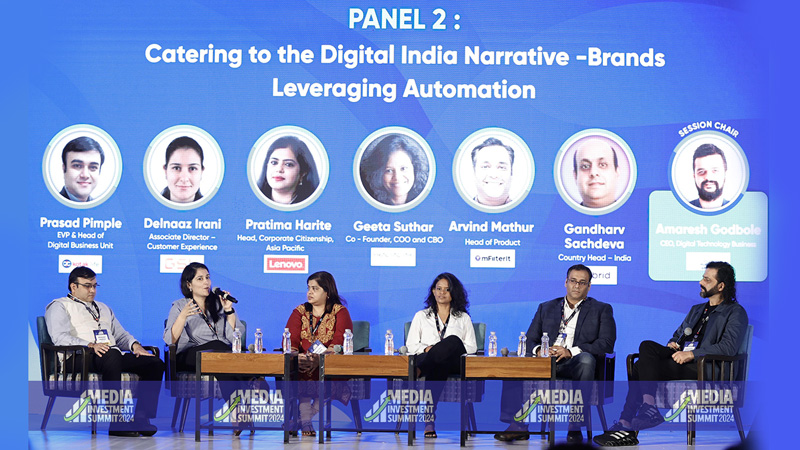
    The session of the event is chaired by Publicis Groupe India CEO digital technology business Amaresh Godbole, consisting of panelists including – Kotak Life EVP & head of digital business unit Prasad Pimple, GSK associate director – customer experience Delnaaz Irani, Lenovo head, corporate citizenship, Asia Pacific Pratima Harite, Fractal ink Design Studio Pvt Ltd co-founder, COO and CBO Geeta Suthar and mFilterIt head of product Arvind Mathur.

    Talking about financial services being the most automated industry, Godbole asked Pimple about his insights, “I agree that the way the overall technology stack has been created, it has helped most of the brand and industries to build on automation into the purchase journeys as well as the overall customer experience management but we’re not as fortunate as the leaning business where it is simplified in terms of just financial underwriting based on credit score.”

    He also spoke about financial and medical underwriting still remaining unautomated, and that a lot of work has also happened in terms of the automation perspective on the customer experience part of it. He also said, “In terms of automation, significant progress has been made in enhancing customer experience throughout the marketing funnel, from building awareness to tracking it, transitioning to consideration, purchase intent, actual purchase, and finally sharing purchase information with relevant media platforms.” He also spoke a bit about CKYC, EKYC, and the UPI moment in India during the pandemic, among other topics.

    Answering Godbole’s question on the challenges in automation, in the pharma industry, Irani said, “The challenge is integrating doctors into the marketing funnel with a clear strategy for exclusive communication and validation.”

    Moving on, Harite said, “When we talking about the automation i think we should look at the work for human kind project that we looked at where we were thinking of how do you revitalise millets using technology.”

    Sharing her thoughts on automation, Suthar said, “Process optimisation has largely been digitisation. We identify things that are manually done or they’re not efficient and then we figure out ways in which to digitise them, put them on the cloud or some service somewhere and then join the dots to make everything seamless.”

    Mathur then spoke about deploying technology, including AI and generative models, to monitor and distinguish between positive and negative elements within the system. He also spoke about the guardrails that need to be made around systems.