Tag: Prannoy Roy

  • NDTV promoters get clean chit from SEBI in disclosure case

    NDTV promoters get clean chit from SEBI in disclosure case

    MUMBAI: NDTV promoters Prannoy Roy, Radhika Roy and firm RRPR Holdings can breath a sigh of relief as the Securities and Exchange Board of India (SEBI) has cleared them of charges related to delayed disclosure of company details at the end of the financial year 2011-12. Proceedings against the company have been disposed.

    At the end of every financial year, promoters need to disclose shareholding and voting rights details within 7 working days after 31 March. NDTV was alleged to have delayed this by 64 days to the BSE and one day to the NSE for the FY 2011-12.

    SEBI stated that after investigation, it found them to have made the requisite disclosures to both the trading bodies within the stipulated time. While the BSE admitted that it had reported an incorrect receipt date while the NSE clarified that it got the details in time.

  • Republic TV tops once again as genre ratings fall

    Republic TV tops once again as genre ratings fall

    BENGALURU: Republic TV juggernaut continued its relentless dominance of the Indian English News genre according to Broadcast Audience Research Council of India (BARC) weekly viewership for week 40 of 2017 (Saturday, 30 September 2017 to Friday, 6 October 2017). The Arnab Goswami led channel has been leading the genre right from its launch 22 weeks ago in week 19 of 2017.

    However, BARC data for top 5 English News channels (All India (U+R) : NCCS AB : Males 22+ Individuals) reveals that the combined viewership of the top 5 channels of the genre plunged to lowest ever since week 22 of 2017. Also, Republic TV’s ratings in week 40 of 2017 were the lowest ever since its commencement. It may be noted that week 21 ratings have not been considered in this paper, because the other channels supported by the News Broadcasting Association had stripped their BARC audio watermarks to disallow viewership measurement in protest against what they termed as unfair practices by Republic TV. The errant channels returned to the BARC fold in week 22 of 2017.

    Republic TV with 840,000 weekly impressions (Sums) for week 40 of 2017 led the genre, followed by the channel it had disposed from numero uno position when it was launched – The Times Group’s flagship English News channel Times Now that stood at second place with 717,000 weekly impressions (Sums). The previous lowest viewership ratings of Republic TV was in weeks 25 and 27 of 2017 – 868,000 weekly impressions (Sums).

    The Prannoy and Radhika Roy led NDTV 24 x 7 climbed to third place in the genre with 347,000 weekly impressions (Sums) in week 40 from fifth rank in week 39 when it had garnered 328,000 weekly impressions (Sums).

    NDTV 24×7 was followed by India Today Television at fourth place in week 40 of 2017 with 338,000 weekly impressions (Sums). In week 39 also the channel was ranked fourth with 353,000 weekly impressions (Sums). CNN News 18 dropped two ranks to fifth place in week 40 of 2017 with 244,000 weekly impressions (Sums). The channel had scored 368,000 weekly impressions (Sums) in week 39.

    Overall, the Indian English News genre lost viewership in week 40 of 2017 – the combined ratings of the top 5 channels was 2,486,000 weekly impressions the lowest since week 22 of 2017 when the combined ratings of the top 5 channels was 2,463,000 weekly impressions. In week 39, the combined viewership of the top 5 English News channels was 2,888,000 weekly impressions. Please refer to the figure below for the combined ratings of the top 5 English News channels for weeks 1 to 40 of 2017.

    public://barc-republic.jpg

  • The television business news conundrum

    The television business news conundrum

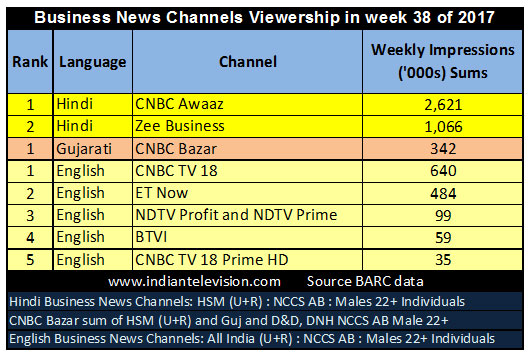
    BENGALURU: There are two major Hindi Business News television channels in India – CNBC Awaaz and Zee Business. In 2017, until week 37 (Saturday, 9 September 2017 to Friday, 15 September 2017), CNBC Awaaz has been leading the genre in terms of viewership. Zee Business, despite it lower ratings, has viewership that almost equals the viewership of the top 5 English Business channels!

    Here are some details – the combined viewership of the top 5 English Business News channels in week 37 of 2017 as per Broadcast Research Council of India (BARC) All India (U+R) : NCCS AB : Males 22+ Individuals was 1.411 million weekly impressions, with CNBC TV 18 leading with 0.652 million weekly impressions. It may be noted that among the five top English Business News channels is an HD channel – this is CNBC TV 18 Prime HD.

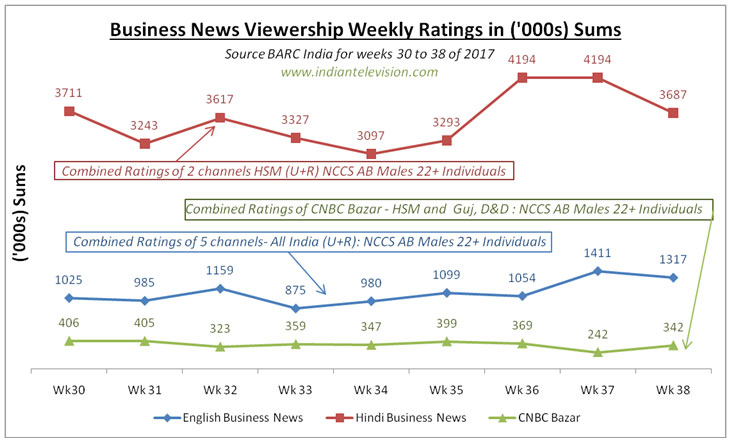
    Compare this with the combined viewership of the two Hindi Business News channels –  4.194 million weekly impressions, with CNBC Awaz scoring a massive 3.029 million weekly impressions and Zee Business 1.165 million weekly impressions according to BARC data for Hindi Business News -HSM (U+R) : NCCS AB: Males 22+ Individuals.  Examination of BARC data for weeks 30 to 38 of 2017 reveals that CNBC TV 18 has been leading the English Business News channels, followed by the Times Groups ET Now at second place. 

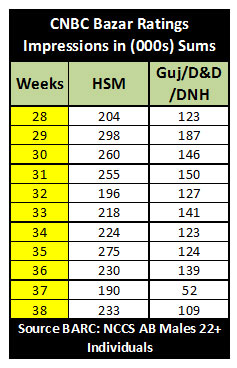
    BARC data for the only Gujarati Business channel in India – CNBC Bazar reveals that for some weeks, the channel has higher viewership in the HSM market than the third placed English Business News channel. On combining the channels ratings for the Gujarat and the Daman & Diu (D&D)and Dadra and Nagar Haveli (DNH) markets with its HSM ratings, CNBC Bazar’s ratings sometimes exceed the ratings of the second placed English Business News channel ET Now. Please refer to the chart below for week 38 of 2017 ratings of Business News channels:

    public://cnbc.jpg

    Please refer to the chart below for comparison of the combined weekly ratings of the Hindi and the English Business News genre and CNBC Bazar. For CNBC Bazar also the TG is NCCS AB: Male 22+ Individuals.

    public://cnbc1.jpg

    On 5 June 2017, the Prannoy Roy headed NDTV Network took its English Business News channel NDTV Profit off air. The channel, which was earlier turned into a hybrid of business news and entertainment, became a full-time infotainment and entertainment channel with a new name NDTV Prime. Industry sources say that the reason for shutting the business news part of the channel was to cut costs and maximise the potential of entertainment content. It may be noted that the combined ratings of the English Business News channels in the charts above include the ratings of NDTV Profit/Prime, since BARC says that the channel has not informed it as yet about the changes in the genre. Arising from this, the actual combined ratings of the top 5 English Business News channels could be even lower.

    Please refer to the table below for breakup of CNBC Bazar’s ratings

    public://cnbc2.jpg

    The first reaction is that there seems to be an oversupply of English Business News channels in India. The second one is that local language Business News channels in Hindi and Gujarati backed by strong networks seem to be doing better than their English language genre peers based on BARC ratings. Viewers are used to a number of English financial terms, and HSM and local language audiences understand what is being presented to them. India’s growing financial might, India’s growing market, demography that is skewed towards the youth, will attract more and more investors that will need reliable, prompt and correct news, information about their planned investments, about the fate of their assets, about the stock markets and other asset classes. And these reasons could also result in the English Business News channels viewership remaining steady. Maybe the current eco system can support more of the local language Business News channels, but this conclusion has to be supported by additional studies.

    CNBC TV 18, CNBC Awaaz and CNBC Bazar are a part of the Mukesh Ambani controlled Network 18, while Zee Business is a channel that is a part of the Essel group that runs a number of channels through various companies. ET Now is a part of the Times Group, one of the oldest and respected media groups in India. A degree of reliability and professionalism is expected from and is delivered by these channels. At the same time, the growth, reliability and ease of availability of useful information on the internet is and will continue to be one of the main competitions for the Business News genre is a fact. Channels that fail to deliver to consumers expectations are likely to fail.

  • SpiceJet’s Ajay Singh may take control of NDTV, latter denies (updated)

    SpiceJet’s Ajay Singh may take control of NDTV, latter denies (updated)

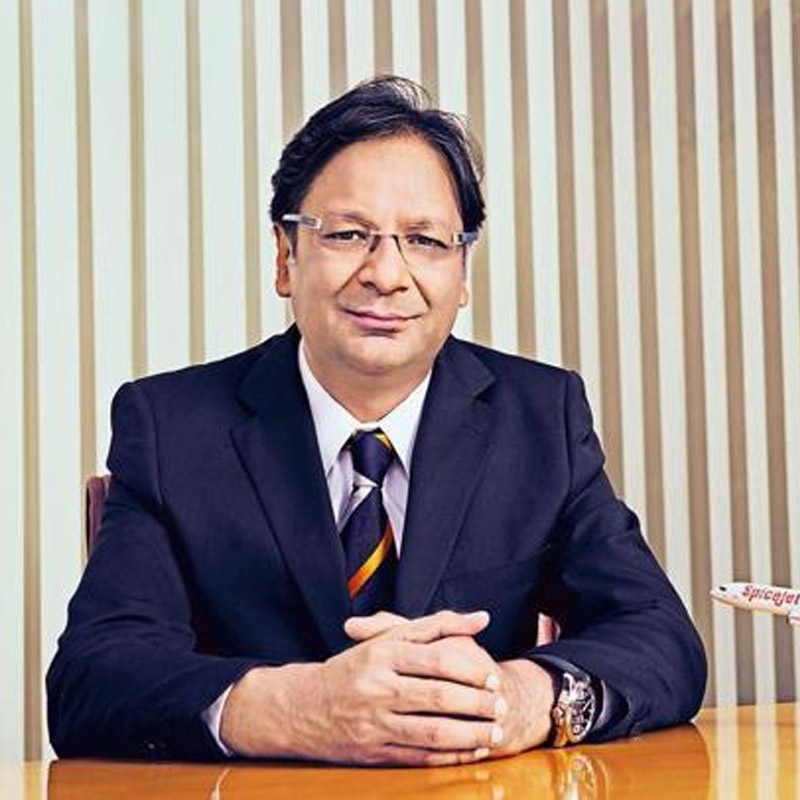
    MUMBAI: NDTV may change hands as its founders — Prannoy Roy, Radhika Roy and the promoter firm RRPR Holding — are facing a CBI probe for allegedly concealing a share transaction. A senior NDTV official, however, told the Hindu that the reports were untrue.

    Singh, it was earlier reported, will have controlling stake in NDTV of around 40 per cent and the promoters Roy and his wife will hold around 20 per cent in the company.

    Sources had told the Indian Express that SpiceJet CMD Ajay Singh, of who was also part of the BJP’s 2014 poll campaign, has bought a majority holding in the news channel. Ajay Singh is set to take control of NDTV along with editorial rights, the source was quoted as saying

    The CBI had in June conducted searches at the residences of the Roys. Refuting the allegations, NDTV had said that the CBI had filed its FIR based on a complaint by a “disgruntled” former NDTV consultant.

  • NDTV restructures biz & newsroom amidst reports of layoffs

    NEW DELHI: Buffeted by allegations of tax evasion and money laundering, which are being contested in appeal tribunals, one of India’s first private sector TV news organization NDTV has said it is reorganizing newsroom set-up and resources available to adapt to changing technologies like MoJo or mobile journalism.

    Stating that the restructuring was “not just about cost-cutting”, the Prannoy Roy-family promoted NDTV in a statement on Monday said, “Like other news broadcasters around the world, NDTV is reorganizing its newsroom and resources to focus on mobile journalism. NDTV has always been an early adapter of new technology and we are the first major network in India whose reporters are all trained in using mobile phones to shoot stories.”

    The statement comes amidst media reports that NDTV has handed pink slips to about 70 staffers, comprising mostly technical personnel and camerapersons. Outlook magazine, quoting unnamed sources, in a report on its website said on Monday that the number of “retrenched staff is likely to be between 60 and 70 of which around 35 camerapersons have been made redundant with the introduction of high-grade smartphones”.

    It must be clarified here that Indiantelevision.com could not independently verify or confirm the news on staff being laid off at NDTV.

    However, NDTV’s official statement, also given to the Bombay Stock Exchange (BSE), on Monday dropped ample hints about retrenchment of staffers owing to funds crunch.

    “This (the restructuring of business and newsroom ops to rely on MoJo) is not just about cost-cutting, though that is certainly, for us, like any other responsible business, an important factor in operations. Mobile journalism means reports are lightning-quick and much more efficiently produced, a priority for any news company,” NDTV said.

    Pointing out it would be “irresponsible” to viewers and shareholders, apart from being “archaic” to maintain decades-old templates of how to shoot and edit, NDTV defended itself on collateral damages of restructuring.

    “NDTV has long been valued for its commitment to its employees — our record on attrition across more than 20 years is testament to this and spoken of across the industry. We have ensured fair compensation for those employees affected by our restructuring,” the company stressed.

    Dwelling on the need to revamp, NDTV clarified like all businesses, broadcasting models too change and evolve and, hence, the “need to restructure” and keep pace with the digital world of journalism.

    What does MoJo mean? Live camera crews for coverage of finance minister Arun Jaitley’s briefing at Delhi’s Press Information Bureau, for example, have been replaced by a single reporter. The reporter doubles up as a journalist and cameraperson using high-end mobile phones and modern mobile networks to connect with the studio via Skype and other such similar services to cover the event or do a PTC (piece to camera, a TV jargon to explain when a TV news journalist comes on camera to report an event and answer queries from the studio).

    The news of retrenchment and business restructuring comes close on the heel of news that a tax tribunal had, reportedly, upheld claims made by the tax department on taxes not paid by NDTV, which has, however, contested the claims saying it was witch-hunt unleashed by the Modi government for standing up to media arm-twisting.

    “The court cases (relating to tax evasion) that are an attempt to punish NDTV for its award-winning objective journalism do not influence how we run and operate our newsroom. The emphasis on restructuring is rooted in the broader financial climate, our commitment to controlling costs and, most importantly, our move to consolidate on our core business, quality news content,” the statement said.

    ALSO READ:

    Tribunal upholds tax demand, NDTV intends to challenge order

    NDTV gets slapped with higher tax dues notice

    NDTV issues response to govt charges


  • ALTBalaji is essentially everything that Balaji on TV is not: Sameer Nair

    MUMBAI: It was in the year 1994 that Sameer Nair was hired as a director-producer in the television industry. Shortly later, he became Star Movies’ executive producer.

    In the following years, he controlled acquisitions of movies for Star in India, and subsequently became its programming head. He eventually became the CEO of Star TV-India, a position he enjoyed till 2007. In 2008, Nair became the CEO of NDTV Imagine, a Hindi general entertainment channel from the NDTV stable, which went off air in 2011. In 2012, after quitting NDTV Imagine, Nair partnered with a few ex-colleagues and founded few startups in the media sector. In 2014, Nair became part of Ekta Kapoor’s Balaji Telefilms, a company that he had given break while in Star TV. He joined as group CEO and expanded Balaji’s digital business. In a recent development, just before Balaji and Reliance Industries announced that the latter has taken an equity stake in BLT a shade less than 25 per cent, Nair announced his departure from BLT end July.

    Nair was one of the speakers at indiantelevision.com’s second edition of Vidnet2017, held mid-July. He had a one-on-one conversation with Indiantelevision.com consulting editor Anjan Mitra.  Edited excerpts from the conversation:

    Has being in Balaji different from what you’ve been doing at Star and Imagine TV or even at a startup company?

    First of all, I have been associated with Balaji for many years because we used to work with them in Star. Balaji is primarily a television production house and is one of the most successful television production houses in India. And, the plan with Balaji was that how do you take a business like this and scale it up. How do you grow 10x? For example, for a company that is already having eight to nine shows on air, we have 20 per cent market share in general entertainment Hindi fiction. We make some movies too. So how do you grow 10x? We can’t go from 8 shows to 80 shows. So the sense was we have to go from being a B2B business to being a B2C business, which is where this plan of creating a (digital) platform came up. Now, if you could take all the Balaji shows today and put it on one channel, then that one channel would become the #1 channel. But obviously that ship has sailed and we couldn’t have started one more GEC channel. So it became clear that we should go B2C and should go digital (OTT). We should create content for it and act on our key strength, which is content creation.

    Which segment of the Balaji media business drives the revenues?

    Currently, television, obviously. TV is our base business where all the money comes from. But the future will be the digital business, which is Alt Balaji that we launched on April 16, 2017. That’s where the future is.

    How is Alt Balaji different?

    Balaji is known for its daily soaps on TV…shows that have been extremely popular and also have been criticized (for regressive themes, at times). Alt Balaji is essentially everything that Balaji on TV is not! The kind of content that we get to create (for Alt) is stuff that’s not available on TV; that you don’t see on TV and is exclusive to a platform. And, it’s in the fiction space because that’s what we specialize in. This is a big market. We have chosen to be in the OTT SVOD space.

    But critics say that the Indian digital realm is still more of traditional broadcasters, TV companies putting content available on linear or traditional television onto a digital platform. Do you agree with this line of thinking?

    It’s true. It’s common sense. Whenever a new medium starts and it grows, it lives off content from an old medium. That’s the way it goes. When satellite TV started in India, it was living off the English language programming from the West. Then English language programming was dubbed into Hindi and finally original Hindi and regional language programming came. It’s a process of evolution. Logically, if you got to put the content out there into a new medium, by default, Star’s Hotstar would put its own TV shows. In fact, that drove a lot of the viewership (to the digital platform) to start with. But as it goes forward, if you can get content everywhere, then why would you pay for it? If you actually want people to pay for anything, then it (content) has to be good and exclusive and people must see value in it.

    You mean content that you once famously described “between Narcos and Naagin”. Has that median changed or are you still grappling to traverse that terrain?

    In India in the 2000 (decade), we did the ‘K’ soaps — `Kyunki’, `Kahaani Ghar…’, etc. In 2017, that is pretty much the staple on Indian television, almost after a generation has gone. So, what we have missed as an evolutionary step is premium subscription television — the likes of HBO and Showtime. The closest India came to premium subscription television was, may be, Star One. So that’s where the opportunity is. The need (today) is the world between `Narcos’ and `Naagin’. It’s a world between a Colors Infinity and Colors — in all languages, not just in Hindi. And, that’s what we (at Balaji) are going after.

    I was reading an interview of Reed Hastings where he said that new shows, especially when they are released, do affect the seasonality of the business and the bottomlines. Do you feel in India it is still the same story or India is still an evolving drama?

    Even if you look at the TV business, the content business tends to work like that. So, in the Diwali quarter, your spends are up and your revenues too go up. However, I think, the big difference between Netflix and traditional content houses is if you have a subscriber model, then you have a basket of programming for a basket of revenue.

    Would you like to share some of the numbers?

    I am not going to share the numbers, but I can tell you what we are doing and why we think what we are doing makes sense.

    Why are you shying away from numbers?

    I am going to come to that. I got to build up to it. What we are doing is we are creating fiction shows— 10 to 12 or 15 episodes in a series and with multiple seasons going forward. We will give five episodes free. So we don’t have a one-month free scheme. What we have is every series of ours is free for the first five episodes — three episodes you can see on YouTube, two you can see on the app and then it means you have liked it; which means you are hooked on to it. We are going to ask you for some (subscription) money then. That’s the play we are aiming at. There are some things you want to pay money for and some you would not. For a movie like `Dangal’, a big section of the audience in India gave Aamir Khan Rs 300-400 crore (Rs. 3-4 billion in ticket sales) despite being aware that the film would come on TV for free technically, in a few months (of its theatrical release). But they still thronged the theatres and bought tickets. There is a draw that (good) content has…where people want to pay and see it. Our sense is to create content that people would want to watch and pay for.

    Coming back to numbers, we have got a great start. We have got about four-five million downloads. We have got subscriptions from day one, primarily because we are in five-episode free model. I can’t give you subscription numbers, but we are doing well compared to the market now. We have got subscriptions from about 70 countries. Most people have taken the quarterly pack and not the annual pack, which is fair I guess. They may first want to sample the content and see how the service is. We have got good reaction to our content.

    People who have downloaded your app are mostly of the Indian diaspora?

    Indians mostly. It’s an Indian and Indian diaspora game. It’s all in Hindi for now. We have done one Tamil show and are going to do one Bengali show. But it’s targeted towards Indians primarily. So we are not yet in the foreign (audience and non-Hindi speaking) space.

    What are the expansion plans for Alt Balaji?

    For first couple of years, we are going to focus on content, build up customer base and do content in multiple languages. We are doing content in Hindi, Tamil and Bengali. We want to add Gujarati, Punjabi and Telugu too, which we are planning to launch within 18 months time.

    The sense that I get from feedback that even the big OTT players don’t know where the revenue is going to come from in India. What is Alt Balaji’s point of view on revenues and business model, considering you are quite a late entrant?

    We are looking at the revenue from a subscription point of view and we are not in the AVOD space. We are not looking for advertising support. Within the SVOD space, our business plan is to spend some amount of money on content and getting to a certain number of paying subscribers by the end of two to three years, which takes us to break-even. That’s the plan. And, for that, the kind of content we are creating is premium subscription television content — the kind India has not seen so far. We are putting it out there (and) giving consumers the opportunity to sample it. We think the market is pretty large. There are two million homes that are watching Star World or Colors Infinity and there are 165 million (TV) homes that actually a Colors or a Star Plus reaches. The in-between audience, say about 25-30 million homes, today are already spending Rs.1000 to Rs. 2000 on a combination of Internet, entertainment and telecom (per month). They have two-three smartphones, have a DTH connection and watch one or two movies in a month. These guys will potentially spend $10 more per month in the next five years. That figure when you take to 25 million homes becomes a $3 million market. Now, what will they spend it on? They will spend it on OTT services, watching new movies. So, we are focusing on those 25 million homes, which will, in the next five years, probably become 25-40 million homes. Out of that, we want a fair share.

    By 2019-2020 you will reach the breakeven point. So, where are the stumbling blocks? Which are the three biggest stumbling blocks for digital platforms in India?   

    One of the big stumbling blocks used to be the connectivity issue. We used to wonder how this is going to work and how would we reach the consumers. Call-drops and bad connectivity is a problem. But in the last year or so, with the kind of push Jio is doing, the (digital) highways are being built. Second big stumbling block would be, would people pay? We keep saying that Indians get everything for free and that’s like a constant refrain. But ideally you pay for everything. You get nothing for free. If you go to a temple, you got to put money in the pooja thaali for blessings. So, I think people will pay. They are paying for movies, IPL matches…In fact, people have always paid for TV. For all this drama around ‘Indians like to get everything for free’, ever tried to not pay for your cable connection? They’ll (LCOs) just cut it (connection) off. Right? And, from 1992 this is going on. The third stumbling block would be if consumers are willing to pay, what are they going to pay for? That’s where the content comes in. Already, almost all of us have become Netflix subscribers. It may be expensive, but for a certain set of audience it is good to go. Amazon has come along too. So, these are the three key things and they are being addressed.

    In all this, do you feel somewhere the government can be helpful in removing the stumbling blocks?

    I don’t know actually. But government should stay far away from it. This is going reasonably well. Private players are helping in building infrastructure and are building businesses. Let market forces decide.

    At the moment, it is almost like ‘free for all’ without any regulations for the digital players; something like what cable and satellite TV was once upon a time before MIB and TRAI waded into it in 2003-04 onwards. How do you view the growth of the digital world vis-a-vis regulations or its absence?

    This is a tough one because the Internet is open; so technically at this point of time you can go out on the net and find porn too. Now going forward, more and more people will create (digital) content and somebody will push the boundaries and maybe or maybe not the government decides to regulate it. Ideally, if the players together are not creating obscene content just for the sake of creating obscene content, that would be the best self-regulated environment. But it is a big a market; too many content creators are out there and it’s hard to assume things. But I feel there are already some rules and regulations in place.

    And where do the OTT platforms fit into the Indian debate of net neutrality?

    Obviously, there should be net neutrality. I think all the OTT platforms are now pushing for net neutrality. If we don’t have net neutrality, then it would be like the TV business’ carriage phase, which still persists, though it has gone down because of the digitization.

    Is the digital world at the moment a content driven business or a technology driven business?

    Well, it’s a combination of both. Tech is equally important.
     

  • Tribunal upholds tax demand, NDTV intends to challenge order

    NEW DELHI: The Income Tax Appellate Tribunal (ITAT) has upheld a tax demand raised on investments of USD 150 million by a US television network in NDTV in 2008, an order that the Indian company said has “numerous inconsistencies and contradictions”. With the tribunal’s 14 July 2017 order upholding the tax demand, penalty proceedings are likely to commence shortly.

    NDTV had assured shareholders that it would seek necessary legal advice and appeal against any adverse ITAT order. On its web site, it stated: “This is with reference to reports in certain section of the media as well as social media regarding the rejection by the Income Tax Appellate Tribunal (ITAT) of an appeal filed by the Company against the assessment order for tax demand of Rs. 450 crore for the assessment year 2009-10. The ITAT order has not yet been uploaded. Once the order is uploaded, the Company will advise shareholders of the implications thereof.”

    In a stock exchange filing, NDTV said it was surprised at ITAT dismissing the appeal it had filed against the tax demand, according to a PTI news report, which quoted the company as saying, “It is important to note foremost that the ITAT has accepted that there was no round-tripping or money laundering, as was alleged by income tax department.”

    The tax department had alleged that Rs 218.30 crore (Rs. 2183 million) was the tax that was sought to be evaded on investment of Rs 642.54 crore (Rs. 6425.4 million). It had sought a penalty of Rs 436.8 crore (Rs. 4368 million) at the rate of 200 per cent of tax evaded.

    It confirmed invocation of Sec 69A of Income tax Act (dealing with ‘unexplained money’ addition) and upheld that “transaction used principally as a devise for the distribution/ diversion of sum to the Indian entity” and that “the beneficial owner of the money is the assessee”.

    PTI quoted NDTV as saying: “Surprisingly, the ITAT has dismissed the appeal filed by the company as not being maintainable but at the same time adjudicated the appeal filed by the income tax department (ITD) against the same assessment order. It is inconceivable how appeal filed by the ITD against the assessment order is maintainable before the ITAT but the company’s appeal emanating from the same order is not maintainable.”

    “Surprisingly, the ITAT has upheld the addition under Section 69A of the Act, purely on conjectures and surmises, ignoring the evidence adduced by the company including the annual reports of the investors,” NDTV was quoted as having said, “The legal advice received is that a consistent view has to be taken and it appears that the order had been passed in a haste and the above inconsistencies have arisen because of a hurried order. We have been advised that Section 69A of the Act is applicable only when money is found in possession of a taxpayer but not accounted for in the books of accounts.

    “However, the said section has no application in the present case since admittedly, investment made by NBC Universal (admittedly then subsidiary of the GE Group) through its step down subsidiary, Universal Studios International BV, was duly recorded in the books of accounts of the company’s subsidiary, viz, NDTV Networks International Holdings BV.”

    Stating that it will continue to fight the “misguided case” made by income tax department, NDTV said it is “exploring all options available to it in accordance with law.

    ALSO READ:

    NDTV issues response to govt charges

    NDTV gets slapped with higher tax dues notice


  • NDTV moves Delhi HC challenging CBI raids

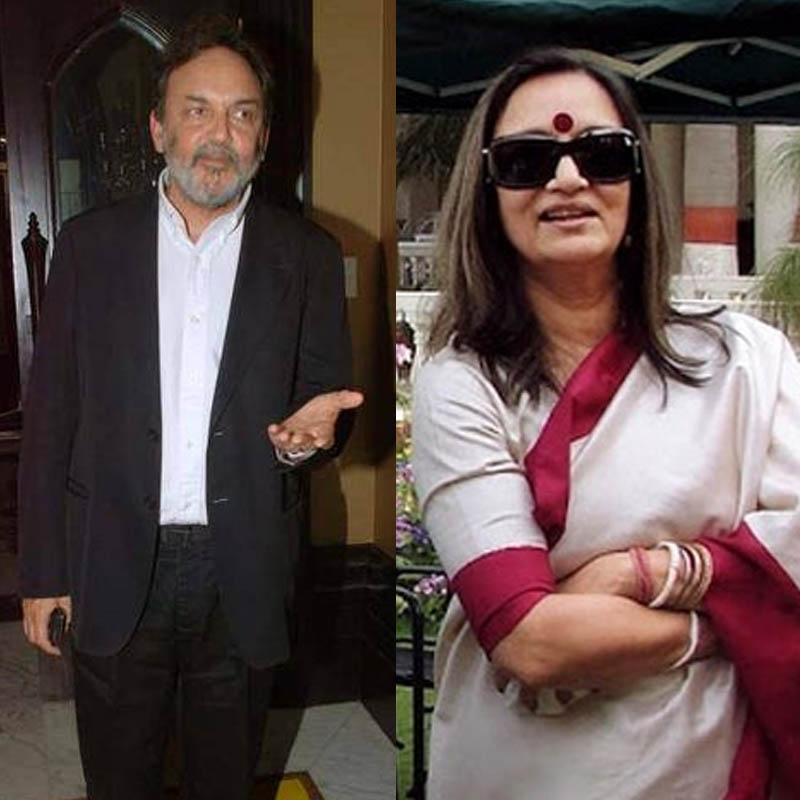
    NEW DELHI: The Prannoy Roy family-promoted NDTV has moved the Delhi High Court challenging the raids conducted by Central Bureau of Investigation (CBI) in the residence of its promoters.

    In a notice to the Bombay Stock Exchange and National Stock Exchange, the company said, “NDTV and its promoter company filed a writ in the Delhi High Court (on 6 July 2017) challenging the CBI raids and the FIR (first information report) issued by CBI. NDTV is pleased that the court has directed the CBI to submit a status report by 21 September, 2017.”

    The publicly traded company, which also at one time had investments from American company GE via a group media company for a venture, further informed the stock markets it would not like to comment on the matter further as it was “now sub- judice”.

    In June 2017, the CBI had raided the residence of the Roy family alleging that the promoters and a private company linked to the Roys, RRPR Holding Private Ltd, were involved in defrauding a private sector bank, ICICI Bank, and allegedly causing it losses involving loans extended in 2008.

    The raids had come within a few days after a female NDTV news anchor had politely ticked off a belligerent spokesperson from the Bharatiya Janata Party (BJP), the lead political party in the NDA government that rules the country, during a TV debate, which had prompted a large section of the Indian society, including the Roys, to dub the raids by federal investigating agency as a “witch hunt” against media not toeing a government-handed political narrative.

    Minister for information and broadcasting M. Venkaiah Nadu, however, last month had brushed aside criticism relating to government efforts to muzzle a free media saying the CBI raids and media freedom were two unconnected issues.

    For NDTV — considered a sort of media nursery for TV journalism in India after the country allowed in mid-1990s private sector players to enter the business of broadcasting dominated till then by pubcaster Doordarshan and All India Radio — this was not the first brush with controversy. Earlier also unsubstantiated allegations relating to financial misdeeds had been leveled against NDTV and some group companies.

    ALSO READ:

    News Broadcasters Association expresses concern over NDTV raids

    Update: No politics in raids at NDTV offices, CBI must have received some info, says Naidu

  • NDTV resolutions confirm re-appointment of Roys & sale of subsidiaries

    MUMBAI: NDTV, in a communique to the secretary, BSE Limited, and assistant VP, Listing Department, National Stock Exchange of India, signed by the company secretary Navneet Raghuvanshi, confirmed that four special resolutions as mentioned in the Postal Ballot Notice dated 11 May, 2017, have been passed by the members through postal ballot (including e-voling) with the requisite majority.

    The resolutions were: Re-appointment of Prannoy Roy as the executive co-chairperson of the company and payment of remuneration, re-appointment of Radhika Roy as the executive co-chairperson of the company and payment of remuneration, sale of entire equity stake by NDTV Lifestyle Holdings Limited, NDTV Convergence Limited and NDTV Worldwide Limited, each a material subsidiary of the Company, in NDTV Ethnic Retail Limited, another material subsidiary of the company, to Nameh Hotels & Resorts Private Limited and sale of 2% equity stake by NDTV Networks Limited, a material subsidiary of t he company, in NDTV Lifestyle Holdings Limited (Lifestyle Holdings), another material subsidiary of the Company, to Nameh Hotels & Resorts Private Limited and thereby ceasing the control over Lifestyle Holdings and NDTV Lifestyle Limited, another material subsidiary of the company.

    Practicing company secretaries Hemant Kumar Singh and Prashant Kumar Balodia were appointed as the scrutinizer(s) by the company to conduct the postal ballot (including e-voting) process in fair and transparent manner. They submitted their report on 23 June, 2017.

  • Probing NDTV & officials’ collusion to defraud ICICI, not repayment: CBI

    MUMBAI: Reports in a section of the media have raised certain issues and the statement issued by NDTV has levelled certain allegations against the CBI investigation in the case relating to the promoters of NDTV and others, a CBI statement said.

    It is clarified that searches have been carried out at the premises of the promoters and their offices based on search warrants issued by the Competent Court. CBI has not conducted any search of registered office of NDTV, media studio, news room or premises connected with media operations, the statement added.

    CBI fully respects the freedom of press, and is committed to the free functioning of news operations.

    CBI has registered the case based on the complaint of a shareholder of ICICI bank and NDTV after carrying out due diligence. Denigrating the allegations at this stage of investigation and wrongly accusing the agency of acting under pressure is uncalled for and an attempt to malign the image of the CBI. The investigation is being conducted as per the due process of law and under the jurisdiction of the Court of law. The result of investigation will be filed before the competent Court of law based on the evidence adduced during investigation, the statement added.

    It has been mentioned in the statement of NDTV that NDTV and its promoters have never defaulted on any loan. The allegations under investigation are not regarding the default in loan repayment; but relate to the wrongful gain of Rs 48 crore to the promoters – Dr. Prannoy Roy, Radhika Roy, RRPR Holdings Pvt Ltd and a corresponding wrongful loss to the ICICI bank arising from their collusion and criminal conspiracy, the statement added.

    It is alleged in the complaint that the promoters of NDTV, acting in criminal conspiracy with unidentified officials of ICICI bank, violated section 19(2) of the Banking Regulation Act, the Master Circular DBOD No. Dir B90/13.07.05/98-99 dated 28.08.1998 of the Reserve Bank of India and in furtherance of the conspiracy, ICICI bank took the entire shareholding of the promoters in NDTV (nearly 61%) as collateral, and then accepted prepayment of the loan by reducing the interest rate from 19% p.a to nearly 9.5% p.a and as a consequence thereof, causing a wrongful loss of Rs 48 crore to ICICI bank and a corresponding wrongful gain to the promoters of NDTV, the statement added.

    NDTV, in its statement, questions the jurisdiction of CBI by stating that ICICI is a private bank. It is clarified that the Supreme Court, in the case of Ramesh Gelli vs CBI of 2016, held that the provisions of Prevention of Corruption Act, 1988 are applicable to the officials of private banks. Therefore, the CBI has jurisdiction to take up investigation of the cases of private banks, the statement added.

    CBI is committed to carrying out the investigation expeditiously and in accordance with the due process of law.