Tag: Prabhoo

  • MCOF-MicroScan broadband package for Maharashtra LMOs

    MCOF-MicroScan broadband package for Maharashtra LMOs

    MUMBAI: We have often heard broadband delivered over cable TV is pure moolah. Now, last mile operators (LMOs) in the western state will also be able to pocket some of that courtesy the Maharashtra Cable Operator Federation (MCOF) and Mumbai-based MircoScan Computers which signed a proposal on 17 December to promote a special purpose vehicle (SPV) under the name SCOPE.

    “This is a joint venture with Microscan which will help provide high speed broadband service to all LMOs,” says MCOF president Arvind Prabhoo. Microscan is an ISP and fibre infrastructure provider to telcos in Mumbai and Pune.

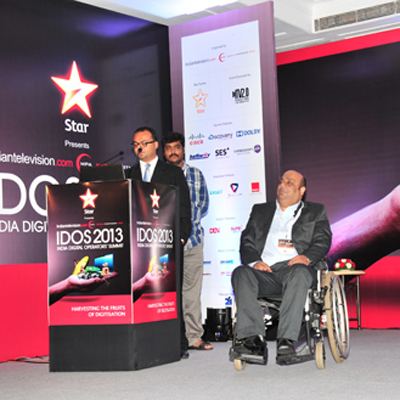
    “Broadband until now wasn’t well structured in the LMO universe,” points out Prabhoo, who had earlier, in September during the India Digital Operators Summit 2013 (IDOS) organised by Indiantelevision.com in Goa mentioned about the huge pipeline lying with the LMOs which was being unutilised. “We needed an internet service provider to partner with us to provide high speed internet to serve consumers in a better way,” he reveals.

      
    Microscan provides fiber to the homes under an arrangement with Sterlite Technologies and MCOF has pooled in LMO fibre rings for optimising mutual resources. “SCOPE will offer true high speed broadband services under BOLT, the trade mark announced by it a few weeks ago,” says Prabhoo. 

    The deal was signed between Prabhoo and Microscan managing director Sandeep Donde on Tuesday. “This is set to alter the broadband service space in a major way,” adds Prabhoo.

    Microscan, which was established in 1996, by engineer turned entrepreneur Donde has more than 450 km of underground fibre. “The partnership will help us provide standardised broadband services to the existing 1500 MCOF members and also those who join later,” he informs.

    Microscan will provide an internet speed ranging between 2 mbps-50 mbps to the end user with a compression ratio of 1:1 or 1:8 as per their choice. “We have our own infrastructure across Maharashtra. This is a strategic partnership with MCOF, through which we will provide internet connection to all its members,” says Donde.

    According to Prabhoo, it is the broadband service that will give a push to the ARPUs for cable TV operators. “Broadband will help LMOs monetise customers.”

    Donde assures that the internet speed available will be standardised and at a lower price. “The rates could vary from Rs 300 to Rs 2,000 to the end customer,” informs Donde.

    Says Prabhoo, “Though the service tariff is low in comparison to other players providing the service, the LMOs will make more money than in any other arrangement they would have entered into.” 

    Not disclosing the revenue share model, Donde says, “We are still working on it.”

    The LMOs through Microscan can enjoy services like, ‘thin client internet connections’, ‘local area cloud’ and ‘content anywhere.’ “We will also be providing value added services like video-on-demand,” informs Donde. 

    Microscan, which has MSO DigiCable as one of its clients, incidentally holds a DAS license in 38 cities and an IPTV license for Mumbai. 

    “What we are offering is certainly a treat for cable TV subscribers and which may be a threat for legacy players,” concludes Prabhoo.

  • Hathway-MCOF show way forward on digitisation

    Hathway-MCOF show way forward on digitisation

    MUMBAI: The government-mandated DAS has been in limbo for a few months now. Even as set top boxes have rolled out in phase I and phase II towns, the issue of Consumer Application Forms (CAFs), despite claims by all, has yet to be resolved completely with the collections of these falling short of the mark. Then multisystem operators (MSOs) and last mile operators (LMOs) have been having a faceoff with the latter claiming ownership of their subscribers, while the MSOs have been insisting that they are pouring in investments hence they have the right to the cable TV viewer.

    But now a ray of hope seems to be emerging from behind the dark clouds with at least a couple of MSO working on what could be a model which could provide a solution to the vexatious problem of who owns the cable TV consumer: the MSO or the LMO? And in the process it would most likely give a real impetus to the realisation of the financial benefits of digitisation, and encourage its acceptance and spread nationally.

    Indiantelevision.com gives you an exclusive peep at what is being planned by one of the MSOs – the Viren Raheja-led Hathway Cable & Datacom – with the Arivnd Prabhoo-led Maharashtra Cable Operators’ Federation (MCOF).

    The two met on 5 December and agreedin principle that the MSO will share its subscriber management system (SMS) with its last mile operators – albeit in a limited capacity. Hathway, through this initiative, has taken a step forward in allowing the LMOs to bill the end consumers.

    “It is a great and welcoming move by Hathway,” says MCOF president Arvind PrabhooThe meeting between the duo was a result of the letter sent by MCOF to all MSOs, as a move to ensure smooth rollout of digitisation. It should be noted that MCOF had written to all MSOs after the Telecom Regulatory Authority of India (TRAI) gave MSOs the final deadline for starting gross billing by 15 December and submitting CAFs by 31 December.

    Calls to Hathway officials did not get a response. But sources close to India’s most evolved cable TV MSO admitted to indiantelevision.com that “yes, we have given the LMOs the right to bill and become the owners of their consumers. They are our trade partners and we want their rights to be maintained. And yes we want them to conduct their business using our SMS.”

    Hathway, apparently, has suggested two options to take things forward.

    The first is for smaller LMOs who who have a few 100 subscribers. The MSO says it could handle the billing for them. The LMO will function as the collection agent, earning a commission in the process for the subscribers who are part of his network. Hathway will be responsible for taxes in this case – including entertainment tax and service tax, wherever applicable.

    The second option is for larger LMOs with subscribers running into thousands and tens of thousands. These LMOs will be permitted to log online into the Hathway SMS with a unique ID and password and manage their subscribers, and even generate bills for them. If they choose this option, then they will be responsible for all the taxes and paperwork.

    Says the source close to Hathway.: “This system not only maintains the rights of the LMO over their consumers, but also makes the operation simpler for us. If we have to bill, activate, deactivate or change plans for all subscribers, we will have to set up those many call centres and infrastructure. It is easier for the customer as well, since for them the LMO is the touch point.”

    Hathway has been holding road shows all over Maharashtra to educate LMOs about its process and explaining to them that each of them can activate or deactivate boxes assigned only to them. Sessions have been held in Mumbai, Pune, Pimpri, Aurangabad, among other cities.

    However, there are still a couple of issues which have to be clarified and agreed upon between MCOF and Hathway. The first is in the area of revenue shares between the MSO and the LMOs. While Hathway has proposed a graded 60:40 to 57:43 split between MSO and LMOs, the latter would like it to be higher – say in the region of 45 per cent- in favour of the cable operators.

    The second issue that needs finalisation is: in whose name should the bill be raised – the LMO or Hathway?

    MCOF and Hathway are expected to meet this week to resolve these and any other issues that could crop up as well.

    “Hathway is the only MSO that has taken a step forward and has shown interest in resolving issues. Other MSOs have yet not approached us for any meeting,” says Prabhoo.
    Prabhoo need not worry. The floodgates may open sooner than he expects.

  • TRAI meets MCOF’s Prabhoo on LMO issues

    TRAI meets MCOF’s Prabhoo on LMO issues

    MUMBAI: It was at indiantelevision.com & MPA’s (Media Partners Asia) India Digital Operators Summit (IDOS) that Mumbai-based cable TV heavyweight and MCOF (Maharashtra Cable Operators Federation) president Arvind Prabhoo first presented to India’s cable, DTH, regulatory and broadcast leaders the local cable TV operators’ perspective. Everyone was impressed including Telecom Regulatory Authority of India (TRAI)’s advisor N. Parameswaran, who said the regulatory body would like him to come and present at its headquarters in Delhi.

    The wheelchair bound Prabhoo did exactly that three days ago on 6 November when he presented the LMO’s viewpoint once again before the TRAI’s N Parmeshwaran, Wasi Ahmed, S K Singhal and G S Kesarwani.

    Prabhoo once again highlighted the issues that are bothering the LMOs and the role they can play in phase III and phase IV of digitisation.

    “There is a crisis in DAS I and II areas regarding LMO-MSO relationship,” says Prabhoo, adding that it was important to address the problems. Prabhoo has told TRAI that his major concern was the MSO-LMO-subscriber relationship. Subscribers belong to LMOs who collect money from them and give it to the MSOs who in turn pass it on to broadcasters. However, the MSOs believe that subscribers belong to them and not to the LMOs.

    Prabhoo also raised the issue of uneven pricing of packages in cities like Mumbai. He wants all MSOs to have similar packages so that it is convenient for a subscriber to migrate and that will even make money collection easier. At the same time, clarity on a-la-carte channels is missing even today.

    He also brought to fore the issue regarding the ownership of set top boxes (STBs). He thinks it is a big bone of contention. “On one hand, customers think they own the STBs, while the MSOs think that STBs are their property,” he remarks. “This disallows customers from migrating from one provider to another using the same STB when he shifts to a new place with a new provider and if he does, the LCO is held responsible for it. Because of this, many subscribers are shifting from cable to DTH, as it seems to be more convenient.”

    Since there’s no fixed revenue sharing deal between the MSOs and LMOs, Prabhoo came up with few solutions. He suggested that for an FTA (Free to Air) channel the sharing between MSO and LMO can be 20:80, while for pay channels it can be 75:25.

    He also suggested that the price of a STB can be reduced and a free basic broadband service be given to communicate by mail. Another suggestion was to rename the LMOs as Horizontal Connectivity Provider Agency (HCPA).

    Prabhoo also brought to TRAI’s notice the issue of entertainment tax. The 42B licenses of LMOs have not been renewed since two to three years and yet the tax is being collected from them. TRAI seemed to be unaware about the issue and has told to get in touch with the chief secretary of Maharashtra soon. They also said that as a regulator they had done everything they could.

    “There needs to be more interaction between LMO, MSO, broadcaster and TRAI if we need a proactive solution to address all our concerns,” concludes Prabhoo.