Tag: post covid

  • Retail advertising on TV surges by 55 per cent in Jan-Aug: TAM data

    Retail advertising on TV surges by 55 per cent in Jan-Aug: TAM data

    Mumbai: Retail ad volumes surged by 55 per cent in January-August over the same period last year, according to data provided by TAM Media Research. The month of February saw the highest ad volumes’ share for the retail sector for both 2021 and 2020.

    There were 450+ new brands that advertised under the retail industry compared to last year. The period between March-June witnessed a dip for both 2020 and 2021 due to the effects of Covid-19. Ad volumes have gotten back on track from July onwards.

    Retail jewellers had 57 per cent share of ad volumes followed by retail electronics/durables (16 per cent) and retail clothing/textiles/fashion (13 per cent). The top three categories account for more than 80 per cent of the ad volumes for the industry. The top five advertisers were Lalithaa Jewellery Mart (19 per cent), Kalyan Jewellers (six per cent), Vasanth & Co (five per cent), Malabar Group of Companies (five per cent), and The Chennai Silks Group (four per cent).

    The top ten new retail brands on TV were Thangamayil, Sweet Truth, Pothys Swarna Mahal, Patanjali Gramin Arogya Kendra, Oxygen Digital Shop, Malabar Gold Precia/Era, H&M Hennes & Maurtiz, Ashirwad Gold Mine, My G Future, and Rajakumari Gold & Diamonds.

    Retail advertisers’ most preferred channels to advertise were News (57 per cent) followed by GEC (20 per cent), music (12 per cent) and movies (9 per cent). The top three channels account for almost 90 per cent ad volumes of the retail sector. News bulletins, feature films, and film songs were the preferred program genres.

    The preferred time band for retail brands was the primetime slot between 6 p.m to 12 am that had 34 per cent share of ad volumes. This was followed by afternoon and morning time bands at 22 per cent and 18 per cent, respectively.

  • Innovation, design & experience tech needed to meet consumer expectations in new normal: Report

    Innovation, design & experience tech needed to meet consumer expectations in new normal: Report

    Mumbai: It is widely accepted that Covid-19 has accelerated digitisation across every industry in every market. 2020 saw marketers double down on innovating their products and services specifically to pivot in response to Covid-19. 83 per cent of marketers agree that there can no longer be any disconnect between what a brand promises and what it delivers for its customers, communities, and employees, according to a new annual study by global creative experience agency Isobar, assessing the evolution of customer experience design.

    The report ‘Isobar CX Survey 2021: The Rise of Connected Experience’ with insights from over 800 global CMO’s indicates clear agreement between CMOs globally of a permanently transformed approach to marketing post-covid. 86 per cent of marketers agree that every touchpoint can and should tell the brand story, from comms to commerce. Innovation, integration of the brand promise, and delightful interactions enhanced by technology were named as the top three key ingredients needed in the creation of brand experiences. 82 per cent of marketers revealed they are investing or have already invested in creativity and digital technologies to create brand differentiation. Research was conducted in August 2021 via online questionnaires completed by 800 CMOs and marketing directors in eight markets, including India, for this purpose.

    Alternative sensorial brand experiences are on the rise with 86 per cent of marketers saying creating brand design systems for a multi-sensory world is increasingly important, and 36 per cent asking specifically for new craft skills designed for a multi-sensory world from their agency partner. In a first for the industry, Isobar has validated some of these assumptions with CMOs stating that creativity is critical to differentiation in this digital world, with the boundaries of content, commerce, and culture blurring irrevocably.

    The results reveal a ‘new normal’ for marketers, with the overwhelming majority in agreement that innovation, design, and experience technologies are needed to meet consumer expectations post-covid. The results overwhelmingly show an increase in creating new sensorial experiences, delivered through experience technologies and demanding a new set of craft skills that are imperative to creating differentiation.

    Touch-free technologies, gestural technologies, voice interfaces, and virtual brand properties including avatars, idols, products experiences, and configurators are all being increasingly adopted. This is an extension of the findings of the report from 2020 that saw significant marketer adoption of ‘experience technologies’ such as voice, AR, and IoT alongside a significant increase in the value CMOs placed on ideas and innovation in shaping CX strategy. 

    “What stands out is that experience has become an even bigger focus for how consumers are making choices around the brands they invite into their lives. The connected future has arrived—innovation and new experience technologies are now critical in creating differentiation and growth. But it’s a connected experience – creativity that crosses touchpoints, senses, and communities, and that is driving this future. This survey is a call to arms for everyone in the industry to step up or be lost in a sea of sameness,” said dentsu head of innovation and design and Isobar managing partner Sven Huberts.

    Authored by Isobar’s global teams of creative and innovation experts, the report aims to offer insight into how the marketing industry is responding to the changing needs of brands today and to provide inspiration and tools to help the creation of delightful and differentiated experiences of tomorrow.

    “The term ‘Experience’ has changed forever. In a post-pandemic world, for a brand to lead from a customer-centric position, experiences can no longer afford to be one-dimensional. The findings of the survey published in ‘The Rise Of Connected Experience’ report, will give readers a more comprehensive view of a customer’s journey and deep insights into what is driving customer experience,” added dentsu Creative India CEO Amit Wadhwa.

    The report describes the fundamental changes to the way brands are increasingly being built and uses global case studies from Isobar’s client partners including KFC, Philips, Beats, and Volkswagen to illustrate how marketers are shifting strategy. Some of the key changes are that there can no longer be any disconnect between what a brand promises and what customer experiences, and virtual experiences will become as real, human, and valuable as offline experiences. It also summarised that the boundaries between content and commerce, shopping, and storytelling will be blurred beyond recognition. The report also predicts that as digital experiences are called on to build distinctive brand encounters, a new skill set will be needed at the intersection of craft and innovation.

    “The pandemic upended a marketer’s playbook, challenging leaders to position themselves at the forefront of the longer-term shifts in consumer behaviour that result from disruption. However, even at this time of flux, it’s possible to regain a strong foothold and find familiarity by keeping a real-time pulse on evolving customer preferences. Customers are more trusting of what technology can do and they are seeking new experiences that line up with their renewed way of life. I believe the Isobar CX Survey is the ideal destination to source for insights on driving growth in a post-Covid world,” Isobar India group CEO Heeru Dingra commented. 

  • Great ideas can never be locked down: FCB India’s Rohit Ohri

    Great ideas can never be locked down: FCB India’s Rohit Ohri

    From JWT to Dentsu to FCB India, that’s how the career pans out for FCB India group chairman and CEO Rohit Ohri. Within a year of joining FCB India, he had bagged the title of ‘One of India’s Most Trusted CEOs of 2017’.

    FCB India also has an array of offerings to meet the end to end communication needs of its clients – two creative agencies –  FCB Ulka and FCB Interface, Lodestar UM – media planning and buying, FCB Digital, FCB Healthcare, FCB Cogito Consulting for brand consulting, FCB Asterii for analytics, FCB Aquila for activation and FCB Neon brand PR and FCB FuelContent.

    Having managed advertising communications for  top brands such as Amul, Tata, Indian Oil, Hamdard, Horlicks, etc., over the years, FCB  India  has grown to become one of the top fully integrated marketing communications companies. Recently, the company also had 38 shortlists at The One Show 2020.

    With close to three decades of experience, Ohri has been able to catapult brands into fame and the vision stays the same even during the ongoing lockdown. Indiantelevision.com’s Shikha Singh spoke to Ohri to understand how the lockdown has prevailed for him and the company, being creative during a pandemic, his top learnings from the lockdown and the future of the sector. 

    Edited excerpts: 

    You are heading a group which has three agencies under its umbrella. How is each of them faring in the thick of this crisis? Could you and how did you prepare them for this before the lockdown?  

    One of the things that we did was to go into the work-from-home mode a week before it was mandated by the government. Because of that what we managed to do was get our systems in place. So, all the staff got trained on technology platforms like Zoom and Microsoft to stay connected. We started a 24/7 IT helpline to address our employee’s queries.

    What are you doing with the projects which were already underway?

    A number of projects had to change because the environment has changed so dramatically. Many industries have had to shut down their manufacturing facilities. But our 600+ factories are working night and day manufacturing ideas that build our brands and our clients’ businesses even in these hard times. Great ideas can never be locked down. That’s why we’ve launched an initiative branded – ‘Ideas Unlocked’.  We believe these ideas will help our clients’ brands unlock new, meaningful and authentic connections with their consumers.

    How are things panning out with each of them now that we are more than a month into lockdown? Have clients kept you busy?

    We have a global EXCOM every week. I’m doing meetings with my board every week as well. Every fortnight, I’m doing town halls with all employees. The CEOs and office heads are doing weekly and daily meetings with their teams. So, the workflow is very carefully planned for each day and everybody is reporting at the end of the day as to what they managed to finish that day. For the wellbeing of our employees, we are offering them classes to upgrade themselves and their skills, especially in the digital space. We are heavily emphasizing on L&D, where we offer our employees with a list of courses they could undertake from various organisations. We are also doing a talent showcase where an employee from our office comes on Instagram to share their talent with the FCB family. We have partnered with Doctor 24×7, an app-based service which provides our employees with the opportunity to speak with doctors and health specialists across the country at any time.

    Have summer product launches died down because of Covid2019? 

    A number of product launches which were expected in May and June have got pushed. We have partnered with XP&D and BE.Live to launch a digital platform that can be used by brands for engagement and launches. Effectively moving offline experiences online.

    Does that mean the summer boom time quarter is going to be a washout? What are you doing to plug the gap?

    We are doing a lot, in terms of delivering to our clients and brands. But obviously, Q2 will be negatively impacted. However, we believe that brands should not lose their voice in times of crisis. Brands may need to pivot on their core promise and create new relevance for themselves.

    Consumers are walking through a long dark Covid2019 tunnel. Brands can either wait for the light at the end of that tunnel or light up that tunnel for consumers. We believe brands need to walk by the side of their consumers during this time of need.

    What did the first few days teach you and your teams about your business? How have senior management and other employees responded? 

    Till this SarsCov2 crisis came upon us, we did not have an official WFH policy. Honestly, I was not a believer. I didn’t think we could be effective in working from home. We have a very young talent in our agency and I thought they would get distracted and in the process not be able to work at optimum levels. Fortunately, I’ve been proven completely wrong. The kind of dedication that everybody is showing in this WFH situation is amazing! All the meetings are happening on time and are super productive.

    This, in my opinion, will be a big reboot in the ways-of-working of the advertising industry. It is actually a fantastic experience.

    What inputs have the senior management given to you? 

    I am part of the FCB Global Executive Committee. At the EXCOM, we share experiences and learnings; truly invaluable learning at this point of time. This current crisis has no playbook. Understanding what’s happening around the world and how people are coping in the current times is helping each one of us create our own playbooks.

    Has the lockdown helped show up manpower flab where we earlier could not see it or chose to ignore it? Will we see a total freeze on hiring and will we see layoffs and salary cuts in this industry?

    How organisations behave in times of crisis will determine how they will fare in the post-crisis-world. I believe companies cannot shrink themselves to greatness. In the advertising industry, people are our only assets. If an agency is looking to bounce back strongly from a crisis, it will need a highly motivated and talented team.

    Layoffs and furloughs of employees to protect company profitability are self-inflicted wounds. Wounds that can turn grievous in the post-crisis period. Undoubtedly, cost-cutting measures in this period are critical and companies need to axe all non-productive costs.  

    Is the ad industry going to de-grow 10-20 per cent in 2020?  

    There are talks about the global economy shrinking. India’s GDP has been projected to come down to zero. It is not just the ad industry, but every industry is suffering. That is the most unfortunate outcome of the recession. Pundits are forecasting that it’s going to take us till 2022 to come back to the 2019 level. What exactly is going to be the percentage of de-growth is very hard to say. It all depends on how soon we come out of this crisis and what economy-boosting measures the government introduces. If we come out of this quickly and there are enough incentives and economic packages by the government to help the industry come back on their feet, then we could be restricted to between 10 to 20 per cent of de-growth over 2019. But if the lockdown continues till June, there will be severe economic repercussions.

    What steps could you take to get the network you head back into the fast growth lane?

    The most important thing is that we are preparing for the new normal. We will definitely have a pre-covid and a post-covid era going forward. So, AC, i.e., after covid, is really going to be a whole different world.  If we really want to kickstart our business and quickly move into a recovery phase we need to help clients connect with their consumers in the new normal. We are currently doing large-scale research which will map consumer behaviour changes among consumers in the entire pre-covid and post-covid phase. With these findings, we are looking to advise clients about the big consumer shifts that may happen in different categories. This will, hopefully, enable them to create new relevance for their brands.

    Further, our partnership with XP&D and Be.Live will help brands take offline experiences online. We feel that after the lockdown is over, offline experiences will be very few and far between. We now have the capability to execute large brand launches, dealer meets and employee meets etc., online.

    We’ve also just launched Retail: DAY 1. This is a partnership with Networkbay and will enable us to reimagine retail experiences for brands.

    Now that TV has revived aggressively, has your faith in the medium strengthened?

    Television is and will always be a powerful medium. Audio-visual today is not restricted to the TV screen. Mobile is the new entertainment screen.

    The print medium is, unfortunately, facing some crippling challenges. Unfortunately, a majority of the people have stopped taking newspapers. This was a golden opportunity for the print medium to reinvent itself. Newspapers have gone online. The problem is that the online version is a replica of the offline version. And on the phone, it’s really hard to read. The format needed to be recast for the mobile screen. It is similar to running a television film online.  Being adaptive will perhaps be the most critical skill needed for survival in the new post-covid world.

  • Dineout unveils India’s first end-to-end contactless dining suite

    Dineout unveils India’s first end-to-end contactless dining suite

    MUMBAI: Dining out and restaurant tech platform Dineout  has launched the country’s first end-to-end ‘contactless dining suite’ for Indian restaurants to ensure they have the right seamless plug-and-play technology and sanitation requirements to support no-contact dining for the foreseeable future.

    The brand’s in Resto Contactless Dining suite covers the entire dining experience from pre-ordering to the contactless valet, seating, menu, and payments. Online feedback systems have also been put in place that will collect real-time feedback on the dining experience

    Dineout co-founder and CEO Ankit Mehrotra said, “Dineout is on a mission to make restaurants a safe harbour for diners as they re-open for business soon. We believe the role of tech in this post-COVID-19 era is to establish trust and build confidence in the minds of consumers, and our new inresto Contactless Dining Suite would help the F&B industry adjust to the new normal as everything from informing diners about the restaurant’s new safety measures, booking a table, pre-ordering dishes to minimise waiting time, seamless takeaway, contactless payments and ensuring superior hygiene standards are the need of the hour for the entire hospitality industry. Our product suite will ensure complete peace of mind for diners as they enjoy exciting experiences and create new memories at their favorite restaurants in town.”

     Absolute Barbecues CEO Prosenjit Roy Choudhury said, “The Post-COVID decade would be a test for restaurants to earn the respect & trust of their customers. As responsible entrepreneurs, we realise the amount of faith customers put in us when they dine at our outlets, and this product suite by Dineout will help fellow restaurant owners across the country revive their business and adjust to the new demands of the ever-evolving hospitality industry.”

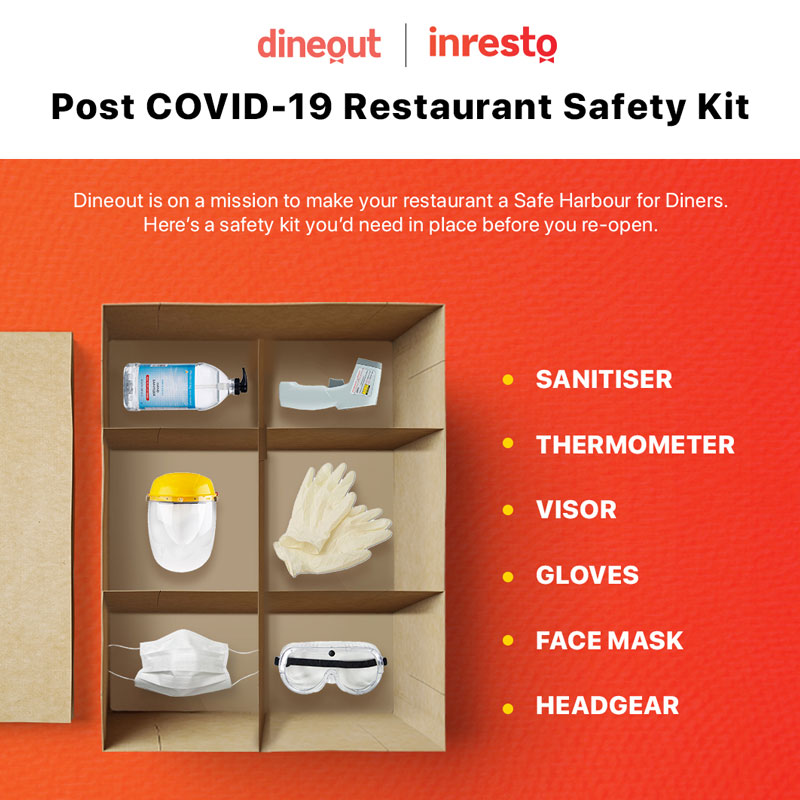
    Besides unveiling the ‘contactless dining suite’ to help restaurants survive and thrive in a post-COVID-19 world, Dineout will also provide a PPE Safety Kit for Restaurants and ensure hygiene measures at the restaurant. Not only should our diners be safe but it applies to all our kitchen and wait staff too. Dineout is also facilitating the COVID-free certification for restaurants through a licensed lab in order to ensure that all the microbiological tests are in place before restaurants restart post the lockdown. Users can see the certified restaurants on the Dineout App with their audit rating. This will help them make an informed decision and are assured of the safety and hygiene standards, which will go a long way in building consumer confidence.