Tag: political parties

  • Apex Court sets up panel to study issuance of ads glorifying politicians

    Apex Court sets up panel to study issuance of ads glorifying politicians

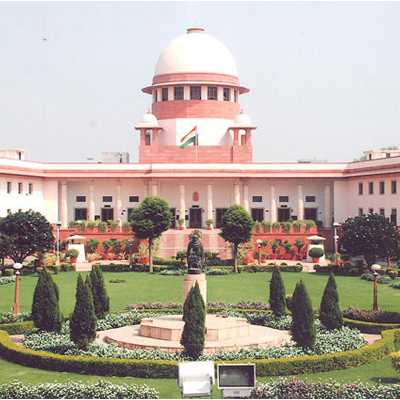
    NEW DELHI: The Supreme Court has formed a three-member panel to frame guidelines to regulate government advertisements glorifying politicians in media.


    The apex court bench headed by chief justice P Sathasivam said that the existing guidelines of the Directorate of Advertising and Visual Publicity (DAVP) do not cover such advertisements.


    The panel will be headed by Prof NR Madhav Menon, founder director of Bangalore’s National Law University. TK Vishwanathan, former Lok Sabha secretary general and senior advocate Ranjit Kumar are the other two members of the panel. The report has to be submitted to the court in three months.


    The court has asked Information and Broadcasting Ministry secretary Bimal Julka to coordinate the meetings of the committee.


    The court passed the order on a public interest litigation (PIL) filed by the NGOs Common Cause and the Centre for Public Interest Litigation (CPIL) pleading it to frame guidelines. The petition sought issuance of guidelines for curbing ruling parties from taking political mileage by projecting their leaders in official advertisements.


    Counsel for Common Cause, Meera Bhatia, had earlier said that the glorification of politicians linked to the ruling establishment, in order to attain political mileage at the cost of public exchequer, was violative of Article 14 of the constitution.


    But counsel representing CPIL, Prashant Bhushan, had told the court that there was nothing wrong in issuing advertisements and informing the public about the programmes of the government. However, he had said such advertisement campaigns become arbitrary and malafide when aimed at gaining political mileage.

  • News Nation readies second channel launch as it celebrates first anniversary

    News Nation readies second channel launch as it celebrates first anniversary

    MUMBAI: As the country heads into general elections, there’s a regional Hindi news channel being added.


    As it celebrates its first anniversary today, News Nation, a national Hindi news channel, has geared up to enter the regional news channel space with the launch of a channel for the states of Uttar Pradesh and Uttarakhand.


    News Nation’s news channel for Uttar Pradesh and Uttarakhand is all set to be launched on 19 February. The new channel already has 200 employees on board. The dry runs of the news channel are on but the name of the channel has not yet been disclosed.


    The Uttar Pradesh/Uttarakhand channel will operate from two main offices in Lucknow and Dehradun and have bureaus in 10 other cities, including in Varanasi, Jhansi, Meerut and Agra.


    News Nation’s Senior Editor Ranjeet Kumar will be the editorial head of the Uttar Pradesh/Uttarakhand channel.


    The channel on the launch day will be available to all cable TV viewers in the two states as well as to subscribers of DTH television service provider Freedish.


    News Nation has invested almost Rs 50 crore in its second news channel. A marketing campaign for the new channel, like in the case of News Nation, will follow a month after the launch.


    The new channel will initially be free of advertisements. “We have a rule that we let the people sample the content we have, get the ratings and then reach out to advertisers,” says News Nation CEO and Editor-in-Chief, Shailesh Kumar.


    The programming of the channel will be youth focussed. The vibrant colours of the two states will reflect in the logo as compared to the neutral logo of the national channel.


    The Uttar Pradesh/Uttarakhand news channel will not have the usual programming focussed on entertainment, crime and astrology. The channel will have hard news but minus any sensationalism. “You can compare News Nation to any international channel,” says Kumar buoyantly.


    The network has ambitious plans to expand its presence in the country. “We are currently studying markets to identify areas that are lacking good quality news channels and after that we will choose our locations,” says Kumar. He also added that there is no restriction on staying just in the Hindi Speaking Market (HSM).


    According to TAM data provided by the channel, News Nation has garnered an average of 68 TVTs between weeks 3 and 6 for CS 15+ age group in the HSM.


    News Nation is looking at signing annual advertisement deals with various clients before the election season sets in. Currently, it only has four to five minutes of advertising per hour.


    After having built a credible space for itself within a year, News Nation is optimistic that its first regional channel will also achieve similar success.


    “The road for us was not easy as this is an extremely cluttered genre. We clearly understood that there was a need for a Hindi news channel which was aggressive yet relevant, a channel based on pure news content yet blooming with new ideas and therefore, we came up with News Nation and within months of its launch it crossed over its competitors in terms of ratings,” says Kumar.

  • Campaigning on the web? Get a certification, says EC

    Campaigning on the web? Get a certification, says EC

    NEW DELHI: The world has gone digital and so has the Indian political system. With more and more political parties using social media for election campaigns, the election commission (EC) has now directed the chief electoral officers of all states and union territories that details of the social media accounts of the candidates (besides the recognised political parties) who are contesting elections have to be communicated to the commission.


    Candidates and political parties will now have to keep the EC posted about their social media accounts and websites used for campaigning, expenditure incurred for maintaining the sites and development of advertisement. Besides, the model code of conduct will also become applicable on the social media.  


    According to the commission, a candidate having an account on Facebook, Twitter, YouTube or even apps, has to update the commission with their email ids.


    The EC has also stated that campaigning on the web will require pre-certification from competent authorities. No political advertisement can be released to any internet-based website, including social media sites without this pre-certification. This certificate is issued by the media certification and monitoring committees at the district and state level.


    Not only this, candidates and political parties in the statement submitted to the EC have to include all expenditure incurred on advertisements on social media. This includes: payments made to internet companies and websites for carrying their advertisements, money paid for developing such content for the web, as well as salaries and wages paid to the workers employed to maintain the social media accounts.


    The commission has also stated that the model code of conduct will be applicable to the content posted on the internet. However, the commission will consult the Communication and Information Technology Ministry on the content posted by persons other than the candidates and political parties.

  • No entry for states, political parties, religious bodies into broadcasting: Trai

    NEW DELHI: The Telecom Regulatory Authority of India today ruled out the entry of political parties into broadcasting, and also said religious bodies may not be permitted to own their own broadcasting stations and teleports.

    Similarly, state governments, urban and rural local bodies etc should not be allowed entry into broadcasting, noting that their interests can be adequately met by Prasar Bharati by imposing certain public service broadcasting obligations on private broadcasters. Trai has also recommended that the state governments and their organs should stay away from distribution activities.

    Trai also said certain public service broadcasting obligations be imposed on broadcasters in the country. The preparation of content for public service broadcasting may be done by individuals including private broadcasters, NGOs, social action groups, in addition to Prasar Bharati, DAVP, state governments and their organs.

    The Central Government (Ministry of Information and Broadcasting) may set up a regular body to approve and certify programmes as being fit for broadcast as part of the public service broadcasting obligation.

    To begin with, every private broadcaster may be mandated to carry such approved programmes at least for a total duration of 30 minutes in a week.

    Trai took this decision after considering the relevant Constitutional provisions, the Constituent Assembly debates, the recommendations of the Sarkaria Commission and the judgments of the Supreme Court, and feedback received from the stakeholders.

    These recommendations have been made by Trai in its report on “Issues relating to entry of certain entities into Broadcasting and Distribution activities”. It said in order to provide funds for such public service broadcasting programmes, a Fund known as the Public Service Broadcasting Obligation Fund should be established on lines similar to the Universal Service Obligation (USO) Fund in the telecom sector, and by imposing an annual Public Service Broadcasting Obligation levy on the private broadcasters in the country and a predetermined share from the percentage of gross revenue being paid by the identified stakeholders in the broadcasting sector.

    With reference to political parties, Trai said broadcasting channels provide “reasonable access” to recognized political parties during the run up to elections to Parliament and to the State Legislative Assemblies.

    The Ministry of Information and Broadcasting may seek the guidance of the Election Commission and may frame appropriate guidelines in this regard, having regard to the importance of the free flow of information to the public during the electoral process.

    In case permission has earlier been granted to any religious body for a television channel, provisions should be made for “an appropriate exit route within a time limit of three to four years to such religious bodies.”

    Denial of entry to religious bodies would be in conformity with the secular fabric of the Constitution. Trai has recommended that the disqualifications as contained in the relevant provisions of the Broadcasting Bill 1997 (which could not be enacted into law) regarding disqualification of religious bodies may be incorporated in the proposed new legislation on broadcasting.

    However, such disqualification should not be construed to mean that religious contents in the broadcasting channels is to be disallowed. Such religious content should be in conformity with the appropriate content code or programme code as prescribed from time to time by the government.

    The Ministry of Information and Broadcasting had requested Trai, by its reference dated 27 December, 2007, to examine the matter of allowing certain entities including State Governments, urban and local bodies, 3-tier Panchayati Raj bodies, publicly funded bodies, political bodies and religious bodies to enter into broadcasting activities which may include starting of broadcast channels or entering into distribution platforms such as cable services and DTH.

    Trai released a Consultation Paper on 25 February 2008 on the issues arising out of the reference. The Consultation Paper covered issues as to whether it would be in the interest of the broadcasting sector and in the interest of the public at large to permit the Union government and its organs, the state governments and their organs, urban and rural local bodies, political bodies, religious bodies etc. to enter into broadcasting and distribution activities like cable TV and DTH. The consultation paper also raised the issue whether permitting the state governments and their enterprises to enter into broadcasting sector would have impact on the Centre-State Relationship and the inter-se relationship among the states.

    This was followed by an Open House Discussion (OHD) held in New Delhi on 16 April 2008. The Authority has, after carefully examining several Constitutional and legal issues arising out of the reference and after carefully considering the views of stake-holders and the prevailing international practices, arrived at these final recommendations.

    As far as entry of state governments into distribution platforms such as cable TV, DTH, etc. is concerned, the Authority says the country already has six DTH operators, about 6000 multi-system operators, and nearly 60,000 cable operators. In the interest of fair competition and a level playing field, and considering the need to ensure proper enforcement mechanism equally applicable to all the players in the field, suitable provisions for exit route within three to four years have been provided wherever state governments and their organs have entered such distribution activity.

    For similar reasons and the need to prevent misuse of distribution platforms by any of the players on political or other considerations and also the need to prevent any problems relating to enforcement measures against the service providers involved, Trai has recommended that urban and local bodies, political bodies, religious bodies and other publicly funded bodies may not be permitted into distribution activities like cable television and DTH.