Tag: PM Narendra Modi

  • CNBC-TV18 Zetwerk Smart Manufacturing Summit 2024: Marking a decade of ‘Make in India’

    CNBC-TV18 Zetwerk Smart Manufacturing Summit 2024: Marking a decade of ‘Make in India’

    Mumbai: Aligned with PM Narendra Modi’s vision of Atmanirbhar Bharat and commemorating the tenth anniversary of the ‘Make in India’ initiative, India’s manufacturing sector has registered unprecedented success, with FY22 exports soaring to US$ 418 billion. To celebrate this feat, and look at the future of the manufacturing growth and prospects in India, CNBC-TV18, in collaboration with Zetwerk, is holding the Smart Manufacturing Summit 2024.

    Scheduled for the 28 and 29 of February, this two-day mega event brings together industry stalwarts, policymakers, and innovators to explore smart manufacturing and its role in shaping India’s industrial landscape. With over 25 sessions, 50 dignitaries, and 500 delegates, the summit promises to facilitate extensive knowledge exchange, strategic insights, and visionary discourse.

    Eminent personalities including Rajeev Chandrashekhar, Minister of State for Skill Development & Entrepreneurship, Electronics & IT; Dr Jitendra Singh, Minister of State for PM’s office, Personnel, Public Grievances and Pensions; Rajesh K Singh, Secretary, Department for Promotion of Industry and Internal Trade (DPIIT); Anurag Jain, Secretary, Ministry of Road, Transport and Highways (MoRTH); S. Krishnan, secretary, Ministry of Electronics and Information Technology (MEITY); Subhas Chandra Lal Das, Secretary, Ministry of Micro, Small and Medium Enterprises (MSME); Arunish Chawla, Secretary, Department of Pharmaceuticals; R.C. Bhargava, chairman, Maruti Suzuki; Dr. Anish Shah, Group CEO and MD, Mahindra Group and PV Sindhu, Indian Badminton Player, among others, will grace the event with their presence.

    The summit will dwell on aspects such as sustainable manufacturing, future-ready factories, disruptive innovations, and the role of women leaders in Industry 4.0.

    Some of the important sessions include ‘Green & Smart: Transforming India with Renewable Energy’, ‘Building Factories of the Future: CXO Roundtable’, among others. Moreover, the event will feature a special Start-Up Showcase highlighting India’s most innovative manufacturing startups, followed by a felicitation ceremony recognizing smart manufacturing companies that have excelled in their endeavour.

    “The CNBC Zetwerk Smart Manufacturing Summit 2024 signifies a pivotal moment in India’s manufacturing landscape. This summit serves as a forum for key industry figures to network, mobilize perspectives, and propel the shift towards intelligent and streamlined manufacturing methodologies,” remarked News18 Studios’ president S. Shivkumar. “We are delighted to lead the dialogue in partnership with Zetwerk, to mobilize efforts for substantial change, and contribute to the India manufacturing story.”

    “India’s manufacturing sector is undergoing transformational times to help the Indian economy reach the $5 trillion mark. Achieving this goal requires collaboration between industry leaders, innovators, and policymakers. The CNBC Zetwerk Smart Manufacturing Summit 2024 aims to bring them together. The summit will delve into major trends shaping sunrise sectors like renewables, automotive, consumer electronics, and aerospace & defence. Through policy discussions and industry deliberations, the conference aims to unlock opportunities and empower MSMEs across these crucial sectors.” said Zetwerk Manufacturing Businesses Pvt Ltd head of marketing Amrit Raj.

    The summit aims to advance India’s position as a leader in manufacturing, highlighting the nation’s commitment to self-sufficiency and supporting local initiatives. It emphasizes the vital role of this approach in India’s path to economic resilience, self-reliance, and increased global competitiveness.

  • ABP News-CVoter Poll: Modi Govt likely to return in 2024, South presents NDA challenge

    ABP News-CVoter Poll: Modi Govt likely to return in 2024, South presents NDA challenge

    Mumbai: The first opinion poll conducted by ABP News and CVoter before the 2024 Lok Sabha elections has thrown up interesting insights, bringing to light the public sentiment across the country on a range of issues, besides the choice of party and the prime minister post.

    According to the survey, the ABP News-CVoter opinion poll has predicted a third term for the NDA, with the ruling alliance getting 295-335 seats out of the total 543. The Congress, together with the opposition bloc I.N.D.I.A, is projected to get 165-205 seats, with Others settling for 35-65 seats. Zone-wise projections show BJP/NDA bagging 80-90 seats out of 153 in the East Zone, the highest 150-160 seats out of 180 in the North Zone, 45-55 out of 78 in the West Zone, and 20-30 out of 132 in the South Zone. The South is the only zone where the BJP/NDA is behind, with the Congress/I.N.D.I.A projected to win 70-80 seats. In the other three zones, the INC/I.N.D.I.A is projected to get 50-60, 20-30, and 25-35 in the East, North, and West, respectively.

    In the states too, the NDA appears to be comfortably ahead, according to the ABP News-CVoter opinion poll, with all BJP-ruled states, such as Madhya Pradesh (27-29), Chhattisgarh (9-11), Rajasthan (23-25), and Uttar Pradesh (73-75), looking to vote for NDA candidates. In Congress-ruled Karnataka too, the BJP is projected to win 22-24 seats with a vote share of 52 per cent against the Congress’ 4-6 seats and 43 per cent vote share. In MP, Chhattisgarh and Rajasthan, the Opposition alliance is projected to get only 0-2 seats each.

    The states where the Congress and I.N.D.I.A are ahead are – Telangana (9-11), Punjab (INC 5-7, AAP 4-6), Bihar (21-23) and Maharashtra (26-28). In West Bengal, where the I.N.D.I.A seat share will be a matter of debate, ruling Trinamool Congress could get 23-25 seats and INC+Left- 0-2, against the BJP’s 16-18, if the elections are held now.

    ABP News-CVoter also carried out a snap poll during which it asked total of 13,115 respondents across the 543 Lok Sabha constituencies a range of questions and found interesting responses. According to the snap poll, PM Narendra Modi is overwhelmingly ahead as the country’s choice for the top post, with 58.6 per cent people willing to bring him back for a third term. Given only two candidates to choose from, Rahul Gandhi and Narendra Modi, a majority of the respondents picked the latter. Gandhi was, however, ahead in the race in three states and one UT and lagged with a margin of around 10 percentage points in two states (Telangana and Haryana). The southern states of Kerala and Tamil Nadu, besides Punjab in the north, kept the Congress leader ahead of Modi. Overall, Rahul Gandhi drew 32% votes for the PM post, with 4.4 per cent and five per cent respondents, respectively, picking ‘None of them’ and ‘Can’t say’ as their answer.

    On the question of how satisfied people are/were with the work of the current Prime Minister, a total of 47.2 per cent of people across India said they were “very much satisfied” with PM Narendra Modi’s work, while 30.2 per cent said they were “satisfied to some extent” and 21.3 per cent said they were “not at all satisfied”.

    An overwhelming majority answered in the affirmative when asked if the leadership changes made by BJP in Madhya Pradesh, Rajasthan and Chhattisgarh after registering victory in the recent assembly elections will benefit the party in 2024. In contrast, the response was mixed to a similar question posed in reference to the leadership changes made by Congress.

    Further, people across states (from both rural or urban areas) and groups think unemployment will be the main issue in the 2024 Lok Sabha elections, and a majority of them believe the issue of caste census won’t help the Opposition. A majority of people also think the BJP should form an alliance with the JD(S) in Karnataka, and that the party will give a tough fight to the Trinamool Congress in West Bengal.

    On questions related to Rahul Gandhi, the response was mixed when asked if his Bharat Jodo Yatra will help the Congress in LS polls, but more than 50 per cent of people on average said he, as Priyanka Gandhi Vadra, should contest the election from Uttar Pradesh. Rahul Gandhi wins hands down as the most preferred PM candidate from the I.N.D.I.A bloc. The respondents were given Nitish Kumar, Mamata Banerjee and Arvind Kejriwal as other options to choose from.

    The ABP News-CVoter opinion poll also found that a majority of the respondents think I.N.D.I.A. will not remain united till the 2024 elections. Also, 37.6 per cent people said they were “very much satisfied” with the work of the Central government led by BJP.

    To a question about what they think about “today’s India”, 45.1 per cent people said they found the country moving forward and their life too, while 25.3 per cent said the country is moving forward but not their life, and 22.4% said both the country and their life are in a poor state.

    Methodology:

    The survey findings and projections are based on CVoter Opinion Poll CATI interviews (Computer Assisted Telephone Interviewing) conducted among 18+ adults statewide, all confirmed voters.

    Survey date: 15 December to 21 December, 2023
    Sample size – 13,115
    Seats Covered 543
    Margin Of Error: .+_/_- 5% 
    Confidence Level: 95%

  • Sansad TV launched, PM Modi calls it a new chapter in India’s democratic system

    Sansad TV launched, PM Modi calls it a new chapter in India’s democratic system

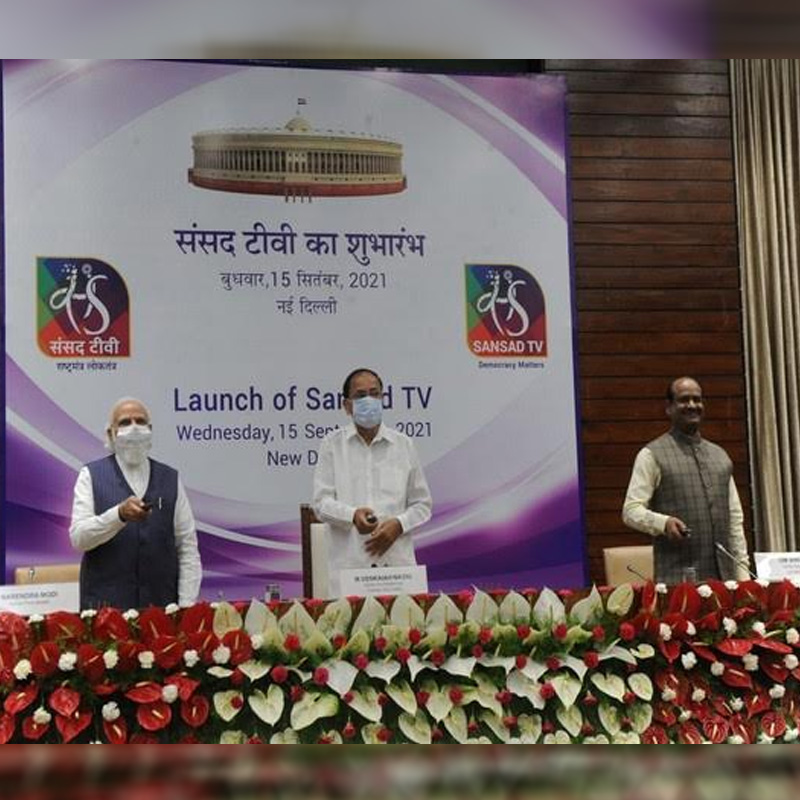
    New Delhi: Prime minister Narendra Modi on Wednesday launched Sansad TV, highlighting it as another important chapter in India’s parliamentary system.

    The channel has been created by merging Lok Sabha TV and Rajya Sabha TV and will be led by retired IAS officer Ravi Capoor who was appointed as the chief executive officer of the channel early this year.

    Launching it jointly with vice president M Venkaiah Naidu and Lok Sabha Speaker Om Birla, Modi said it is very important that the common man connects with Parliament and feels he is part of it. 

    Addressing the event, the PM lauded the transformation of the channel associated with the Parliament in accordance with rapidly changing times, especially when the 21st century is bringing revolution through dialogue and communication.  

    “While it is said that ‘content is king, but in my experience ‘Content is Connect’ said PM Modi, adding that, when one has better content, people automatically engage with it. As much as this applies to the media, it is equally applicable to our parliamentary system as there is not only politics in Parliament, there is also policy. He emphasised that common people should feel the connect with the proceedings of the Parliament. He asked the new channel to work in that direction.

    Terming the launch of Sansad TV as a “new chapter in the story of Indian democracy”, Modi said, the country is getting a medium of communication and dialogue in the form of Sansad TV which will become a new voice of the nation’s democracy and people’s representative.

    Sansad TV is likely to have two channels, with Lok Sabha and Rajya Sabha sessions telecast live on each. It will be available in Hindi and English.

    The two former entities, LS TV and RSTV were launched in 2006, and 2011 respectively. 

  • PM Narendra Modi to feature in Discovery’s iconic and hugely popular franchise ‘Man Vs Wild’ with world renowned survivalist and adventurer Bear Grylls

    PM Narendra Modi to feature in Discovery’s iconic and hugely popular franchise ‘Man Vs Wild’ with world renowned survivalist and adventurer Bear Grylls

    MUMBAI: The energetic Prime Minister of the world’s largest democracy, plus a fearless and renowned adventurer and India’s oldest National Park situated in the lush green forests of India’s Uttarakhand, where wild animals roam free…Sounds interesting?
    This is what the world will watch during the historic Discovery Exclusive, ‘Man Vs Wild with Bear Grylls & PM Modi.’ 
    This special episode, which has been shot in the Jim Corbett National Park, will be a frank and freewheeling journey, throws light on wildlife conservation, highlighting issues related to environmental change. The adventurous pair even have to make a raft & cross a jungle river together! 

    Intimate and interesting:

    One of the most unmissable parts of the programme is the Indian Prime Minister talking at length about his own experiences of living in the midst of nature and demonstrating his adventurous side.

    Speaking about the show, Prime Minister Narendra Modi, said, “For years, I have lived among nature, in the mountains and the forests. These years have a lasting impact on my life. So when I was asked about a special programme focussing on life beyond politics and that too in the midst of nature I was both intrigued and inclined to take part in it. For me, this show presents a great opportunity to showcase to the world India’s rich environmental heritage and stress on the importance of environment conservation and living in harmony with nature. It was a great experience spending time in the jungle once again, this time with Bear, who is blessed with indefatigable energy and quest to experience nature at its purest.”

    Privilege to take PM Modi on an adventure:

    “It is such a privilege to be taking Prime Minister Modi on an adventure into the Indian wilderness and I feel truly honoured to get to spend time with this remarkable world leader. The wild reminds us that we need each other and that together we are stronger. I am so excited to spend time with the PM and to get to know the man who leads this great nation,” said, Bear Grylls.

    12th August, 9 PM: 

    Man Vs Wild With Bear Grylls and PM Modi will premiere simultaneously on 12 Discovery channels in India including Discovery Channel, Discovery HD World, Animal Planet, Animal Planet HD World, TLC, TLC HD World, JEET Prime, JEET Prime HD, Discovery Science, Discovery Turbo, Discovery Kids and DTamil on Monday, August 12, 2019 at 21:00 hrs. The premiere on Discovery and Discovery HD World will be available in 5 languages including English, Bengali, Hindi, Tamil and Telugu. 
    This special episode will be showcased in more than 180 countries across the world on Discovery network of channels.

    Megha Tata, Managing Director – South Asia, Discovery Communications India, said, “We are honored to host Prime Minister Narendra Modi in this historic episode of ‘Man Vs Wild’. We hope that by harnessing the power of the Prime Minister and the global premier on Discovery, the show will create awareness about India’s rich biodiversity and sensitise people about the importance of conservation of wild animal species.”

    Man Vs Wild With Bear Grylls and PM Modi is produced for Discovery Communications India by Bear Grylls Ventures & Electus a Propagate company, where Bear Grylls, Delbert Shoopman, Rob Buchta and Elizabeth Schulze are executive producers and Ben Simms is co-executive producer.

  • DEN to launch 4k, ‘open’ STBs, give a leg-up to HD, b’band services

    NEW DELHI: The Sameer Manchanda-promoted DEN Networks Ltd is planning to launch feature-rich 4k and `open’ set-top-boxes in the near future, apart from continuing to push its HD STBs. The reason: enrich consumer experience and keep pace with evolving global trends, which have started reflecting in a price-sensitive Indian market too.

    As digitisation of Indian cable TV services rolls on with the final analog sunset date of 31 March 2017 not far off, DEN is also aiming to push its broadband service in approximately 20 more towns and cities over an year.

    Speaking to Indiantelevision.com, DEN CEO SN Sharma said, “We do plan to launch 4k boxes over the next six months and are also working on an ‘open’ box to keep pace with evolving technologies and global trends very much visible in markets like the US and Europe. Such boxes would be rich in features like digital video recorder, in-built apps and go a long way in changing consumer experience.”

    Would the strategy to launch 4k and feature-rich boxes work in a price sensitive market like India? While admitting limitations to such boxes in terms of gaining mass popularity, especially as supply of 4K programming is still scarce, Sharma added, “As consumer behaviour has changed and is still changing, we feel there would be a sizable number of buyers for high-end boxes, including HD, if properly marketed to consumers.”

    Further explaining the reason behind this renewed push for HD and other consumer-enriching boxes, though comparatively costlier than the present ones, he said DEN is attempting to “keep pace” with DTH services, which had an advantage of starting off as a digital service unlike analog cable trying to convert to digital and other technologies like OTT.

    “We aim to seed in the market at least one million HD boxes over the next 12 months,” Sharma elaborated, adding, “I was surprised to get feedbacks from consumers and partner LCOs after touring small towns. There’s a fairly good demand for HD boxes in such places too. And, sitting in metros, we used to think consumers in small places of India would not be able to afford HD boxes, which are certainly costlier than the normal boxes given to them earlier. Our HD initiative has started.”

    According to figures available with the government and some investors, DEN has deployed 200,000 boxes in digitisation’s phase 3 and 4 with digital subscribers of the company contributing Rs. 10.2 crore or Rs 102 million in Q3 of FY 2016-17 to the overall quarterly revenue kitty. Overall subscriber base is 10+ million.

    The vigour with which cable services, especially digital, are being pushed is not without reason too. Apart from evolving with times, financial results too have shown concentration on the company’s core business (cable TV services) yields dividends. For example, amongst the few other highlights of FY17Q3, cable subscriptions registered a strong growth of 15 per cent quarter-on-quarter. Not only digital addressable system (DAS) phase 1 EBITDA stood at 30+ per cent, DAS phase 3’s monetisation was Rs. 65 (inclusive of taxes) as on December ’16.
    Expanding cable business also throws up other options at revenue generation. Sharma’s remit from the company board and investors is also to focus on increasing the broadband business of DEN bringing hi-speed broadband network to consumers’ homes, which is perfectly in line with PM Modi’s vision of `Digital India’.

    DEN plans to launch its broadband services in 15 to 20 new towns over the next six to nine months. And the confidence to give this segment of the business a leg up has come from the fact that broadband EBITDA got even for Q3 FY’17 despite the freebie blitz unveiled by Reliance Jio and other telcos during that time.

    According to data available, DEN added 20k broadband subscribers in Q3 FY’17 with the total subscriber base being 159,000; the figure for homes-passed standing at 864,000. While the year-on-year growth for broadband business was 82 per cent as on Q3, the total revenue and ARPU for the quarter were Rs 210 million and Rs 752, respectively.

    Keep tuned in for Sharma’s full-length interview coming soon on Indiantelevision.com where he speaks on an array of subjects from reasons behind renewed focus on core business of the company, shedding loss-making investments, the way Indian landscape has changed with digitisation, DEN’s insistence on cable subscription collections, getting future-ready to whether M&A is an option to fuel company’s growth.

  • Indian players have an edge over global OTT platforms: Akamai’s Sidharth Pisharoti

    Indian players have an edge over global OTT platforms: Akamai’s Sidharth Pisharoti

    Starting from one of the biggest Information Technology companies, Wipro Technologies, as a technical facilitator, he pursued young professionals program in general management from Indian Institute of Management, Calcutta. Soon after attaining a degree, he joined American content delivery network (CDN) and cloud services provider Akamai Technologies, Inc. as a relationship manager of emerging customer group in December 2006. Presently serving the company as the regional VP for media in APAC and Japan, Sidharth Pisharoti is a goal-oriented professional known for his alertness in innovating and bringing in new ideas to improve business processes.

    In an interview with indiantelevision.com’s Megha Parmar, Pisharoti shares interesting insights on a variety of topics, including the growing OTT space in India, impact of 4G, changing consumer behavior and the way forward for the entire digital eco-system. Edited excerpts from the interaction:

    Akamai Technologies, Inc. is an American content delivery network (CDN) and cloud services provider headquartered in Cambridge, Massachusetts. The company’s advanced web performance, mobile performance, cloud security and media delivery solutions are said to be revolutionizing how businesses optimize consumer, enterprise and entertainment experiences for any device, anywhere.

    Edited excerpts from the interview:

    Q: Akamai provides several products like web performance, cloud security, media delivery, etc. In a country that’s increasingly getting digital, who would be your Indian customers and how are each of these products faring?

    Akamai is very focussed on India. We are the largest content delivery platform in the world, which also applies to India. We have 3000+ servers, 59 networks across 14 cities in India. If you look at our customer base, we probably have 265 customers here and these are across different industry verticals. We have the customers who are amongst the top five IT services, media services, commerce services segments, apart from top three three stock exchanges in the country. So, whether you talk about IT, media and entertainment, e-commerce, retail or finance, we have customers across all these verticals.

    Q: Over The Top (OTT) is the new buzzword in India as the number of players, both global and local, grows. What is your take on it?

    If we focus on the media and OTT space, it is growing at   fast pace in India. If you look at the number of OTT platforms that are providing content, it is increasing by the day and so are the audience. The good news here is that not just the services are available, but the consumer pattern, behaviour and the adoption too are growing by the day. Earlier, there was a notion that mostly sports, cricket and live cricket are in demand. But that notion has changed a lot in the recent past. It’s not just live content but also on-demand content, episodic content and anytime content that is available out there which is being consumed by the users.

    Q: What could be the reasons for this change in consumer behaviour and consumption patterns?

    What is happening now is that there are more smart phones being available in the market. Even at Akamai, a big chunk of our delivery is happening to smart phones apart from the traditional internet devices. There are two major developments in India.

    First, the smart phone market has changed and accessibility has improved. Today, you can get a decent Android device at Rs 4,000, which is pretty affordable as compared to what it was four-five years ago. Second, the overall infrastructure has improved. Not just launch of Reliance Jio has spurred on other players, but availability of 4G across the different networks has improved too as compared to what it was one year ago. Today, 4G is available almost throughout the country and with Jio’s arrival the reach has further improved.  

    Both the factors are equally important for any kind of content to be consumed, especially when you are talking about OTT, which is primarily consumed by personal computing devices. The screen size is getting smaller and the consumers are increasing. We are moving away from demography of people who believed in the family viewing experience to having a personal single screen for each member in the house.

    Q:When you say more people are consuming more on smart phones, is the time spent on viewing too increasing? If yes, who are these people and what are they watching?

    The viewing time is definitely increasing. If we look at purely episodic content as video on demand (VOD), the viewing time has increased from what it was 18 months ago.  The average time spent was 5-7 minutes, but it has gone up to as high as about 18-20 minutes now. This is a three-fold jump than what the average session brings in. We are seeing an improvement in the viewing time because of these two reasons. Content providers are ready to provide good quality videos without any buffering or start time. That is the experience the consumer wants — he wants a television-like experience. Because content creators are able to provide uninterrupted content, the viewership is going up. It is not yet as big as TV’s, but it is getting there.

    People are watching from across various demographics though we are yet to nail down a particular type of individual watching. We are having difficulty in pinpointing that as of now, but consumers from tier 2 and tier 3 cities and towns are increasing and are coming to our platform.

    Q: What do you think will be the impact of 4G in India? Do you think it will open up choked and inadequate availability of bandwidth?

    Absolutely. We are already seeing 4G’s effects. More and cheaper bandwidths are available with consumers that are improving consumptions. The consumption was not that great earlier because of two factors. One, the availability and affordability of good quality phones and, second, data costs were high. Even four month back, before the launch of Jio, we were talking about Rs 200/ GB. Today we are talking about Rs 50 per GB. I think, in a year from now even this is going to substantially come down. Data has to become like any other affordable commodity. When it becomes the new normal for the consumers, the industry is obviously going to be impacted.

    Q: While players are still experimenting with their models, what, according to you, will stay in long term?

    See, you have to shift the deal. The consumer will either pay for content or for data. Expecting them to pay for both the things is pushing it a bit too much. Today, the reason behind content creators predominantly offering ad-driven content is because they can’t charge for it as the consumer is already paying for the data. When data becomes cheaper, that is when these creators or broadcasters with their platforms can charge for the content.

    To answer your question, it has to be a dual approach. There has to be content that is available on the `freemium’ model with some part being free of cost, that is advertising-supported, and some behind the pay wall for which the subscribers will need to pay. The Indian consumers will adapt to this model slowly. The day data becomes cheaper and easily accessible, that day content providers can make lot more earnings from subscription perspective.

    Q: When you talk about `freemium’ model, payment gateways remain a crucial part. Will making payments online become easier with ongoing digitization and government push towards cashless transactions in the aftermath of currency demonetisation?

    If you had asked me that question a month ago, I would have said this is definitely a challenge. But, now with demonetization happening and the country trying to moving to a cashless economy, cajoled by the PM Modi government to increase of digital wallets, etc, the scenario is undergoing a change. That is good news for all the online players. Not just OTT, but anyone who is selling or buying online benefits from these changes.

    I think in the medium to long term, the problem will resolve, but, right now, not many consumers are comfortable transacting online. It’s less of being comfortable or paying than choosing what they should pay for. For them, paying for data and content is like a double whammy. With data becoming cheaper, consumers will be willing to pay for content. With the new norms that the government is pushing, it will be easier for the consumers to pay through digital wallets.

    Q: A lot of online content creators are betting big on the kids’ space with original content. Do you think there’s demand for kids’ content in India?

    I think it’s a very good genre to be in. If you remove T-Series and Eros content, some of the biggest YouTube channels in India focus on kids’ content and would definitely have large subscriber base. Such channels have original content created by small companies who are purely creating it for kids. So people who are producing kids’ content are going to be benefitted. It is a big genre, which is has eluded the focused of big OTT players.

    Q: What about the regional markets in India?

    Not many players have looked at it separately and are primarily providing content in Hindi or English. If you look at the OTT space today, some of the big players do have regional content, but their catalogue of regional content is not as complusive as their Hindi catalogue. Though a small quantity of original regional content is being produced, OTT platforms are also syndicating it content from some of the south  Indian media houses. Eventually, each of these markets, for example states of Kerala,  Andhra Pradesh or Tamil Nadu, will have one local OTT player who will be the biggest local player in that market with local content. And, there will be cross syndication. So the national players will definitely syndicate content of all languages, but local players will focus on content of their region’s language and will syndicate content from other languages. I think that is the future. Just like the television space where there a few national level TV channels and many in local languages.

    We will have one or two big OTT players — we are already seeing the emergence of two very big ones platforms at a national level — and then we will see each of the Indian states having one big local player.

    Q: But will that not clutter the space or confuse the consumers? What if they want international as well as their regional content together on one platform?

    The current and future generations are the new subscribers or consumers who are getting online. They are already digital and understand only the digital language.  For many of these consumers TV or cable is non-existent as most of their video consumption is online. Unlike in the US, where there are two large players who are catering to the whole market, the scenario in India is different because in the West primarily there is one language (English) that is popular. We have a huge population with different cultures, speaking different languages and dialects and, hence, there is space for more than just two local players.

    Q: Apart from infrastructure problem, what are the other challenges in the current digital space?  

    Another challenge is to put together the video eco-system. Most of these OTT  companies or the media houses are used to broadcast business because that is their bread and butter. In the last 20 years, they have been working on broadcast and they know that after the content is ready, they have to push it through satellite or cable to people’s homes. But digital is a different ball game. Once the content is prepared, it has to go through its own video platform for it to be ready for a satellite or mobile phone. The biggest challenge is the digital media workflow. The first step is content preparation, which basically means that once you get content that’s to be broadcast, you have to encode it or convert it into a format that can be consumed digitally. Then, you have to re-package it to ensure that it fits all the different softwares on different devices.

    The next step is to transport it to all these formats, repackage it again to make sure storage is proper for a content management system and then send it to a content delivery platform. Then you have to get it on your video player and how do you plan to use it in your analytics and reports. This entire media platform workflow is not easy to manage and is a big challenge when lot of people move from traditional broadcast or regular online streaming to a pure OTT platform. The complexities are very high and that is a challenge.

    Q: Online video consumption has also increased digital piracy. Isn’t this a big challenge for content owners too?

    The good news is that there are lot of companies, including us, who offer security services. Using these services combined with DRN, content protection is possible. Security is like insurance. Can someone give you a 100 percent security? No. But, can you give 99.9 per cent security? Yes. Simply because technology is available today. Whether it is securing your application or data centre or media content, Akamai has a a range of security offerings, which help the media customers to help the customers.

    Second, I also believe that piracy exists when there is non-availability of content or when it is expensive to acquire or view. It happens when someone finds some content at a cheaper price than the legal content. But, today content providers are either giving it for free or are offering it at a very nominal price. Hence, they are killing piracy by making content more accessible. People who are involved in digital piracy are not succeeding because that content is anyway available in high quality on a particular device at affordable rates. So, why would a person go and buy pirated content? This is the case for majority of content. Digital piracy is slowly getting killed. The only problem is movies. But again with platforms like Hotstar, they are releasing movies within four-five weeks of a movie’s release.

    Q: Different mix of companies have got into digital space with even DTH operators now active in this space. Who will be the next bunch of customers for them? What is the scenario there?

    It’s an interesting proposition. I believe you will probably have only one leader in that space too. On one hand, you have folks like Tata Sky who have already moved to that model and are leading in that space. On the other hand, you have dittoTV , which offers you a TV-kind of a service. And, then you have telcos like Reliance Jio, which gives similar kind of service. It will be interesting to see how that plays out. I think there will be a consolidation eventually. I don’t think that for a pure play of a bouquet of channels service,  like each of these players are offering, you can have three to four players.

    It’s about curated content, original content and watching content from wherever the consumer wants. As the market is so fragmented, some of the content syndication deals will be interesting. But, I think they will all reach a point wherein they will realise that rather than syndicating the content, it is better to have it under own network as it is more lucrative. When this happens, you will stop seeing content syndication as well. We have to wait and watch. From DTH point of view, we can have more than one large player.

    Q: Do you see Netflix becoming successful in India? Should the Indian platforms worry about its entrance?

    Netflix, as of right now, is a very urban Indian phenomenon. It produces some original content and some premium content that is consumed by a certain section of the population. It can also turn out that their content strategy for India changes in the longer run. As of now, Netflix is not eating into the viewership base of a Hotstar or a Voot. Both these platforms have their separate viewership base, but that might change when the content that they offer changes or gets popular in India.

    I think these Indian players air some of the shows on their platform first before they go on TV. They air some shows before 24-hour of its TV release. Though it is premium subscription, it is available. So, it is not catch-up television. Their strategy is if-you-want-content-before-TV- we-are-providing-it. Eventually, consumers will start accepting that. That is the plan — consumers should first come to a digital platform and then move on to traditional TV broadcast.

    In the longer run, unless global players have a different content strategy for India, I don’t think they can have (subscriber) numbers like some of these local players do. I think the local players have a big edge over Netflix or any other global platform. Incidentally, globally too Netflix has changed its strategy and has started producing original content. It could be either the studios have stopped giving them content or are giving content at a that makes it difficult for content to be monetised by the OTT platform. So, Netflix has started becoming a media house itself. Same thing has to be India specific.

    Q: What are your predictions for the digital eco-system in the year 2017?

    The future should see is decent amount of consolidation.  In terms of pure play Indian content, I think the players who are leading, will continue to lead at a national level. Locally, there is space for few players that will cater to certain languages. Over the next two to three years, content syndication will go down as each of these platforms will get more consumers and, in turn, generate revenues through subscription. Global players will definitely enter India and will get only a handful of subscribers unless their content strategy is different. To achieve that, they will have to spend a lot of energy, resources and money in India. We can probably have maximum of 10 OTT players — three at national level, two global and couple of local providers.

  • Indian players have an edge over global OTT platforms: Akamai’s Sidharth Pisharoti

    Indian players have an edge over global OTT platforms: Akamai’s Sidharth Pisharoti

    Starting from one of the biggest Information Technology companies, Wipro Technologies, as a technical facilitator, he pursued young professionals program in general management from Indian Institute of Management, Calcutta. Soon after attaining a degree, he joined American content delivery network (CDN) and cloud services provider Akamai Technologies, Inc. as a relationship manager of emerging customer group in December 2006. Presently serving the company as the regional VP for media in APAC and Japan, Sidharth Pisharoti is a goal-oriented professional known for his alertness in innovating and bringing in new ideas to improve business processes.

    In an interview with indiantelevision.com’s Megha Parmar, Pisharoti shares interesting insights on a variety of topics, including the growing OTT space in India, impact of 4G, changing consumer behavior and the way forward for the entire digital eco-system. Edited excerpts from the interaction:

    Akamai Technologies, Inc. is an American content delivery network (CDN) and cloud services provider headquartered in Cambridge, Massachusetts. The company’s advanced web performance, mobile performance, cloud security and media delivery solutions are said to be revolutionizing how businesses optimize consumer, enterprise and entertainment experiences for any device, anywhere.

    Edited excerpts from the interview:

    Q: Akamai provides several products like web performance, cloud security, media delivery, etc. In a country that’s increasingly getting digital, who would be your Indian customers and how are each of these products faring?

    Akamai is very focussed on India. We are the largest content delivery platform in the world, which also applies to India. We have 3000+ servers, 59 networks across 14 cities in India. If you look at our customer base, we probably have 265 customers here and these are across different industry verticals. We have the customers who are amongst the top five IT services, media services, commerce services segments, apart from top three three stock exchanges in the country. So, whether you talk about IT, media and entertainment, e-commerce, retail or finance, we have customers across all these verticals.

    Q: Over The Top (OTT) is the new buzzword in India as the number of players, both global and local, grows. What is your take on it?

    If we focus on the media and OTT space, it is growing at   fast pace in India. If you look at the number of OTT platforms that are providing content, it is increasing by the day and so are the audience. The good news here is that not just the services are available, but the consumer pattern, behaviour and the adoption too are growing by the day. Earlier, there was a notion that mostly sports, cricket and live cricket are in demand. But that notion has changed a lot in the recent past. It’s not just live content but also on-demand content, episodic content and anytime content that is available out there which is being consumed by the users.

    Q: What could be the reasons for this change in consumer behaviour and consumption patterns?

    What is happening now is that there are more smart phones being available in the market. Even at Akamai, a big chunk of our delivery is happening to smart phones apart from the traditional internet devices. There are two major developments in India.

    First, the smart phone market has changed and accessibility has improved. Today, you can get a decent Android device at Rs 4,000, which is pretty affordable as compared to what it was four-five years ago. Second, the overall infrastructure has improved. Not just launch of Reliance Jio has spurred on other players, but availability of 4G across the different networks has improved too as compared to what it was one year ago. Today, 4G is available almost throughout the country and with Jio’s arrival the reach has further improved.  

    Both the factors are equally important for any kind of content to be consumed, especially when you are talking about OTT, which is primarily consumed by personal computing devices. The screen size is getting smaller and the consumers are increasing. We are moving away from demography of people who believed in the family viewing experience to having a personal single screen for each member in the house.

    Q:When you say more people are consuming more on smart phones, is the time spent on viewing too increasing? If yes, who are these people and what are they watching?

    The viewing time is definitely increasing. If we look at purely episodic content as video on demand (VOD), the viewing time has increased from what it was 18 months ago.  The average time spent was 5-7 minutes, but it has gone up to as high as about 18-20 minutes now. This is a three-fold jump than what the average session brings in. We are seeing an improvement in the viewing time because of these two reasons. Content providers are ready to provide good quality videos without any buffering or start time. That is the experience the consumer wants — he wants a television-like experience. Because content creators are able to provide uninterrupted content, the viewership is going up. It is not yet as big as TV’s, but it is getting there.

    People are watching from across various demographics though we are yet to nail down a particular type of individual watching. We are having difficulty in pinpointing that as of now, but consumers from tier 2 and tier 3 cities and towns are increasing and are coming to our platform.

    Q: What do you think will be the impact of 4G in India? Do you think it will open up choked and inadequate availability of bandwidth?

    Absolutely. We are already seeing 4G’s effects. More and cheaper bandwidths are available with consumers that are improving consumptions. The consumption was not that great earlier because of two factors. One, the availability and affordability of good quality phones and, second, data costs were high. Even four month back, before the launch of Jio, we were talking about Rs 200/ GB. Today we are talking about Rs 50 per GB. I think, in a year from now even this is going to substantially come down. Data has to become like any other affordable commodity. When it becomes the new normal for the consumers, the industry is obviously going to be impacted.

    Q: While players are still experimenting with their models, what, according to you, will stay in long term?

    See, you have to shift the deal. The consumer will either pay for content or for data. Expecting them to pay for both the things is pushing it a bit too much. Today, the reason behind content creators predominantly offering ad-driven content is because they can’t charge for it as the consumer is already paying for the data. When data becomes cheaper, that is when these creators or broadcasters with their platforms can charge for the content.

    To answer your question, it has to be a dual approach. There has to be content that is available on the `freemium’ model with some part being free of cost, that is advertising-supported, and some behind the pay wall for which the subscribers will need to pay. The Indian consumers will adapt to this model slowly. The day data becomes cheaper and easily accessible, that day content providers can make lot more earnings from subscription perspective.

    Q: When you talk about `freemium’ model, payment gateways remain a crucial part. Will making payments online become easier with ongoing digitization and government push towards cashless transactions in the aftermath of currency demonetisation?

    If you had asked me that question a month ago, I would have said this is definitely a challenge. But, now with demonetization happening and the country trying to moving to a cashless economy, cajoled by the PM Modi government to increase of digital wallets, etc, the scenario is undergoing a change. That is good news for all the online players. Not just OTT, but anyone who is selling or buying online benefits from these changes.

    I think in the medium to long term, the problem will resolve, but, right now, not many consumers are comfortable transacting online. It’s less of being comfortable or paying than choosing what they should pay for. For them, paying for data and content is like a double whammy. With data becoming cheaper, consumers will be willing to pay for content. With the new norms that the government is pushing, it will be easier for the consumers to pay through digital wallets.

    Q: A lot of online content creators are betting big on the kids’ space with original content. Do you think there’s demand for kids’ content in India?

    I think it’s a very good genre to be in. If you remove T-Series and Eros content, some of the biggest YouTube channels in India focus on kids’ content and would definitely have large subscriber base. Such channels have original content created by small companies who are purely creating it for kids. So people who are producing kids’ content are going to be benefitted. It is a big genre, which is has eluded the focused of big OTT players.

    Q: What about the regional markets in India?

    Not many players have looked at it separately and are primarily providing content in Hindi or English. If you look at the OTT space today, some of the big players do have regional content, but their catalogue of regional content is not as complusive as their Hindi catalogue. Though a small quantity of original regional content is being produced, OTT platforms are also syndicating it content from some of the south  Indian media houses. Eventually, each of these markets, for example states of Kerala,  Andhra Pradesh or Tamil Nadu, will have one local OTT player who will be the biggest local player in that market with local content. And, there will be cross syndication. So the national players will definitely syndicate content of all languages, but local players will focus on content of their region’s language and will syndicate content from other languages. I think that is the future. Just like the television space where there a few national level TV channels and many in local languages.

    We will have one or two big OTT players — we are already seeing the emergence of two very big ones platforms at a national level — and then we will see each of the Indian states having one big local player.

    Q: But will that not clutter the space or confuse the consumers? What if they want international as well as their regional content together on one platform?

    The current and future generations are the new subscribers or consumers who are getting online. They are already digital and understand only the digital language.  For many of these consumers TV or cable is non-existent as most of their video consumption is online. Unlike in the US, where there are two large players who are catering to the whole market, the scenario in India is different because in the West primarily there is one language (English) that is popular. We have a huge population with different cultures, speaking different languages and dialects and, hence, there is space for more than just two local players.

    Q: Apart from infrastructure problem, what are the other challenges in the current digital space?  

    Another challenge is to put together the video eco-system. Most of these OTT  companies or the media houses are used to broadcast business because that is their bread and butter. In the last 20 years, they have been working on broadcast and they know that after the content is ready, they have to push it through satellite or cable to people’s homes. But digital is a different ball game. Once the content is prepared, it has to go through its own video platform for it to be ready for a satellite or mobile phone. The biggest challenge is the digital media workflow. The first step is content preparation, which basically means that once you get content that’s to be broadcast, you have to encode it or convert it into a format that can be consumed digitally. Then, you have to re-package it to ensure that it fits all the different softwares on different devices.

    The next step is to transport it to all these formats, repackage it again to make sure storage is proper for a content management system and then send it to a content delivery platform. Then you have to get it on your video player and how do you plan to use it in your analytics and reports. This entire media platform workflow is not easy to manage and is a big challenge when lot of people move from traditional broadcast or regular online streaming to a pure OTT platform. The complexities are very high and that is a challenge.

    Q: Online video consumption has also increased digital piracy. Isn’t this a big challenge for content owners too?

    The good news is that there are lot of companies, including us, who offer security services. Using these services combined with DRN, content protection is possible. Security is like insurance. Can someone give you a 100 percent security? No. But, can you give 99.9 per cent security? Yes. Simply because technology is available today. Whether it is securing your application or data centre or media content, Akamai has a a range of security offerings, which help the media customers to help the customers.

    Second, I also believe that piracy exists when there is non-availability of content or when it is expensive to acquire or view. It happens when someone finds some content at a cheaper price than the legal content. But, today content providers are either giving it for free or are offering it at a very nominal price. Hence, they are killing piracy by making content more accessible. People who are involved in digital piracy are not succeeding because that content is anyway available in high quality on a particular device at affordable rates. So, why would a person go and buy pirated content? This is the case for majority of content. Digital piracy is slowly getting killed. The only problem is movies. But again with platforms like Hotstar, they are releasing movies within four-five weeks of a movie’s release.

    Q: Different mix of companies have got into digital space with even DTH operators now active in this space. Who will be the next bunch of customers for them? What is the scenario there?

    It’s an interesting proposition. I believe you will probably have only one leader in that space too. On one hand, you have folks like Tata Sky who have already moved to that model and are leading in that space. On the other hand, you have dittoTV , which offers you a TV-kind of a service. And, then you have telcos like Reliance Jio, which gives similar kind of service. It will be interesting to see how that plays out. I think there will be a consolidation eventually. I don’t think that for a pure play of a bouquet of channels service,  like each of these players are offering, you can have three to four players.

    It’s about curated content, original content and watching content from wherever the consumer wants. As the market is so fragmented, some of the content syndication deals will be interesting. But, I think they will all reach a point wherein they will realise that rather than syndicating the content, it is better to have it under own network as it is more lucrative. When this happens, you will stop seeing content syndication as well. We have to wait and watch. From DTH point of view, we can have more than one large player.

    Q: Do you see Netflix becoming successful in India? Should the Indian platforms worry about its entrance?

    Netflix, as of right now, is a very urban Indian phenomenon. It produces some original content and some premium content that is consumed by a certain section of the population. It can also turn out that their content strategy for India changes in the longer run. As of now, Netflix is not eating into the viewership base of a Hotstar or a Voot. Both these platforms have their separate viewership base, but that might change when the content that they offer changes or gets popular in India.

    I think these Indian players air some of the shows on their platform first before they go on TV. They air some shows before 24-hour of its TV release. Though it is premium subscription, it is available. So, it is not catch-up television. Their strategy is if-you-want-content-before-TV- we-are-providing-it. Eventually, consumers will start accepting that. That is the plan — consumers should first come to a digital platform and then move on to traditional TV broadcast.

    In the longer run, unless global players have a different content strategy for India, I don’t think they can have (subscriber) numbers like some of these local players do. I think the local players have a big edge over Netflix or any other global platform. Incidentally, globally too Netflix has changed its strategy and has started producing original content. It could be either the studios have stopped giving them content or are giving content at a that makes it difficult for content to be monetised by the OTT platform. So, Netflix has started becoming a media house itself. Same thing has to be India specific.

    Q: What are your predictions for the digital eco-system in the year 2017?

    The future should see is decent amount of consolidation.  In terms of pure play Indian content, I think the players who are leading, will continue to lead at a national level. Locally, there is space for few players that will cater to certain languages. Over the next two to three years, content syndication will go down as each of these platforms will get more consumers and, in turn, generate revenues through subscription. Global players will definitely enter India and will get only a handful of subscribers unless their content strategy is different. To achieve that, they will have to spend a lot of energy, resources and money in India. We can probably have maximum of 10 OTT players — three at national level, two global and couple of local providers.

  • PM Narendra Modi will appear on Frankly Speaking on Times Now

    PM Narendra Modi will appear on Frankly Speaking on Times Now

    MUMBAI: Prime Minister Narendra Modi will speak to Times Now editor-in-chief Arnab Goswami in an exclusive interview on ‘Frankly Speaking’. After union Home Minister Rajnath Singh and Finance Minister Arun jaitley, TIMES NOW is back again with one of the biggest interviews of the year. This would be PM Modi’s first appearance on the show after he took his oath. Watch Prime Minister Narendra Modi, in an exclusive and candid interview, just when Narendra Modi government completed two years, at 2PM today (Monday, June 27, 2016), only onT IMES NOW.

  • PM Narendra Modi will appear on Frankly Speaking on Times Now

    PM Narendra Modi will appear on Frankly Speaking on Times Now

    MUMBAI: Prime Minister Narendra Modi will speak to Times Now editor-in-chief Arnab Goswami in an exclusive interview on ‘Frankly Speaking’. After union Home Minister Rajnath Singh and Finance Minister Arun jaitley, TIMES NOW is back again with one of the biggest interviews of the year. This would be PM Modi’s first appearance on the show after he took his oath. Watch Prime Minister Narendra Modi, in an exclusive and candid interview, just when Narendra Modi government completed two years, at 2PM today (Monday, June 27, 2016), only onT IMES NOW.