Tag: PM Modi

  • 2016’s top hashtag trends

    2016’s top hashtag trends

    MUMBAI: From Brexit, to GST, to US elections and now demonetisation, 2016 has been an eventful year so far, and continues to throw googlys at us in the last few remaining days (Tamil Nadu CM’s death). No wonder the netizens were exceptionally chatty on Twitter this year.

    The country’s trending moments became worldwide conversations on Twitter, be it PM Modi’s revolutionary demonetisation reform (Most Influential Moment of the Year), Delhi’s rising pollution problem, the debut of Global Citizen Festival in India, and the Bollywood glam at the Filmfare Awards.

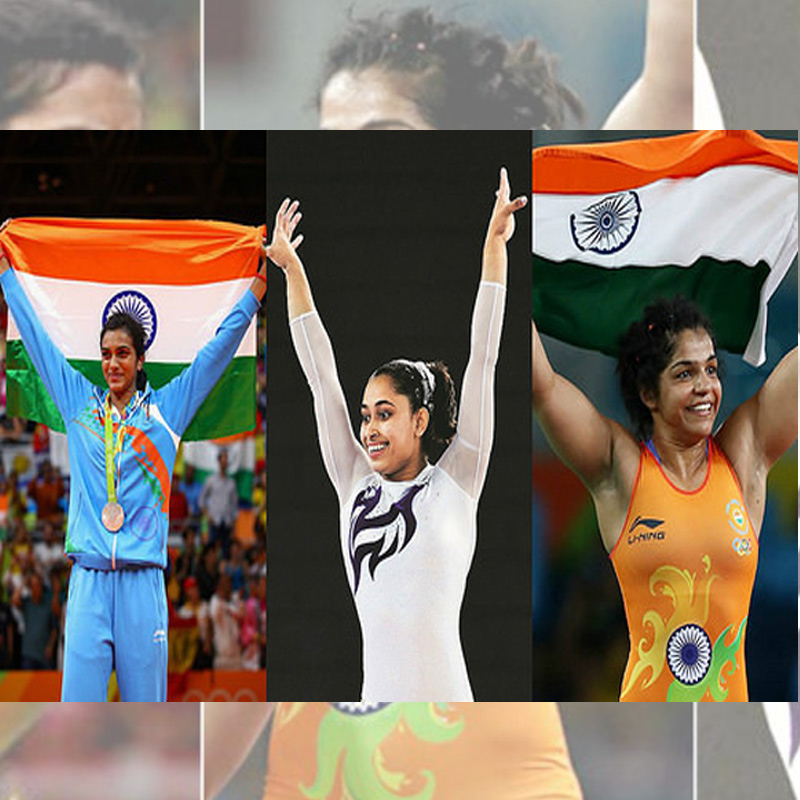
    PV Sindhu, Sakshi Malik, and Dipa Karmakar, India’s women athletes that won a million hearts on Twitter during the Olympics made #Rio2016 the Top Hashtag Trend of the Year on Twitter. Their medal victories and near-misses inspired women everywhere, and showcased a spirit of unwavering determination and grit.

    Virat Kohli’s Tweet in support of Anushka Sharma was the Golden Tweet or the most Retweeted Tweet of 2016.

    According to Twitter India, Twitter reflected and influenced Indian society that was united together in celebration, victory, protests, revolutionary reforms, crises, and significant cultural moments.

    To commemorate that, the micro blogging site has released a list of highlights from Twitter’s 2016.

    Hashtags are the anchors of any solid conversation; they enable users to discover and participate in what others are talking about for an issue they care about. With 7 of the top 10 hashtags this year related to the #Rio2016 Olympics and #WT20 cricket, sports dominated the trending Twitter conversations for the nation. The government’s flagship programme, #MakeInIndia is also one of the most popular Hashtag Trends of the year with its global appeal.

    1. #Rio2016

    All conversations surrounding this exciting sporting global moment converged on Twitter, as Indians Tweeted using the #Rio2016 hashtag. The hashtag united the country in this moment of national prominence and the Tweets reflected the pride, thrill and joy of Indians everywhere as Indian athletes won medals at the Olympics and received well-deserved cheers on the platform.

    2. #IndvsPak

    The two national teams enthralled fans with a cut-throat match in the group stage of the ICC WT20 tournament. The cricket mania took Twitter by storm as aficionados from either side of the border Tweeted fervently with #IndvsPak to join the conversation on the platform onMarch 19th.

    3. #WT20

    The apex international championship of Twenty20 cricket was religiously Tweeted about by the nation’s ardent cricket lovers. Fans rejoiced at every six and coped together with every wicket by using the #WT20 hashtag from March 15 – April 3.

    4. #IndvsAus

    India battled it out against the Aussies in the group stage of the WT20 tournament. Enthusiastic Indians Tweeted their support for the national team with the #IndvsAus hashtag and celebrated the national win when India beat Australia on March 27th.

    5. #MakeInIndia

    The Government of India uses Twitter to promote their flagship #MakeInIndia programme that encourages companies to manufacture their products in India. The Government shared updates on new deals, joint ventures and tech transfers using this hashtag around the world. Large corporations as well as SMBs across various verticals also Tweeted regarding developments related to this global #MakeInIndia initiative.

    6. #IndvsWI

    India vs West Indies was the penultimate knockout semi-final game in the WT20 tournament. #IndvsWI trended all day on March 31st and Tweets regarding the much anticipated match took over the Twitter timeline. West Indies won the match and millions of broken-hearted Indians still stood strong with Team India, in a display of true passion.

    7. #IndvsBan

    Indians around the world were united with #IndvsBan as fans Tweeted to fellow cricket lovers and joined the conversation on March 23rd. India clinched the thrilling WT20 match by defeating Bangladesh by 1 run and Twitter reflected the sentiments of this joyous moment.

    8. #PVSindhu

    India’s 1.2 billion people stood behind PV Sindhu (@Pvsindhu1) as she set out to compete against world #1 Carolina Mari in the Olympic Badminton Women’s Final. She became the first Indian woman to win a silver medal at the Olympics and Indians took to Twitter to congratulate her. #PVSindhu became an inspiring story for women empowerment as young women, mothers, and well-known women icons in India came together on Twitter to celebrate her victory.

    9. #surgicalstrike

    Debates and discussions ensued on Twitter after the Indian Army carried out a surgical strike against Pakistan on September 29th, following the Uri Attack. The nation stood divided in favour of or against this choice of action that led to a significant number of casualties of Indian soldiers.

    10. #JNU

    Jawaharlal Nehru University Students’ Union (JNUSU) president Kanhaiya Kumar was slapped with sedition charges and arrested on February 13th for a speech he gave at an event held on campus to mark the third anniversary of terror convict Afzal Guru’s hanging. The#JNU hashtag took Twitter by storm as people debated over serious issues such as condemning freedom of speech that this arrest reflected.

  • PM Modi to be tourism mascot; ad agency screening under way

    PM Modi to be tourism mascot; ad agency screening under way

    MUMBAI: The leader is the natural ambassador. Why would there be any need to create a brand or national identity from celebrities/socialites? The nationalist is India’s most well-known face.

    Prime Minister Narendra Modi is all set to be the mascot of the Incredible India campaign with the Tourism Ministry deciding to finally drop plans to bring in any Bollywood stars, including Amitabh Bachchan, for the role which was vacant after ouster of Aamir Khan earlier this year.

    Earlier, names of leading stars Amitabh Bachchan and actress Priyanka Chopra were doing rounds for the campaign aimed at promoting India as a favourite tourist destination abroad.

    No Bollywood actor will now be engaged for the campaign targeted at attracting foreign travellers. Video footages of Modi during the last two-and-a-half years where he has talked about tourism in India and abroad will be utilised for the campaign, a senior ministry official told PTI.

    The ministry is planning to use — for audio and radio release — two types of communications of different durations where Modi had talked about the uniqueness and diversity of the various places in the country, the official said.

    The ministry is presently “working on selecting the footages”, the official said, adding that the campaign would be released in the next 40-45 days as the Indian tourism season starts by November-end due to favourable weather as also the Christmas holidays and New Year celebrations.

    The official said the process of selecting the agency, which will carry out the task of running the campaign, is also under the process.

    Earlier, the tourism minister Mahesh Sharma had endorsed Modi’s persona for the role, saying he is the “best face” to promote the Incredible India campaign. He had asserted that the country has witnessed a jump in the tourists inflow from the countries the prime minister had visited. He had said that the ministry need not have any Bollywood face for the campaign.

    Sharma said that the perception about India had changed significantly in the last two years with Prime Minister Modi visiting a host of countries during the period. So, who else could be the better face for Indian tourism than the Prime Minister, he added.

    A senior ministry official, supporting Sharma’s remarks, said the tourist inflow from countries such as the Australia, the UK, the US, Germany, Fiji, Brazil, Canada and Myanmar, among other, had witnessed a significant jump after the PM’s visit there.

    Though it was believed that Khan was eased out for his remarks on perceived intolerance, the ministry had maintained that he was not hired as the contract with the advertising agency had expired.

  • PM Modi to be tourism mascot; ad agency screening under way

    PM Modi to be tourism mascot; ad agency screening under way

    MUMBAI: The leader is the natural ambassador. Why would there be any need to create a brand or national identity from celebrities/socialites? The nationalist is India’s most well-known face.

    Prime Minister Narendra Modi is all set to be the mascot of the Incredible India campaign with the Tourism Ministry deciding to finally drop plans to bring in any Bollywood stars, including Amitabh Bachchan, for the role which was vacant after ouster of Aamir Khan earlier this year.

    Earlier, names of leading stars Amitabh Bachchan and actress Priyanka Chopra were doing rounds for the campaign aimed at promoting India as a favourite tourist destination abroad.

    No Bollywood actor will now be engaged for the campaign targeted at attracting foreign travellers. Video footages of Modi during the last two-and-a-half years where he has talked about tourism in India and abroad will be utilised for the campaign, a senior ministry official told PTI.

    The ministry is planning to use — for audio and radio release — two types of communications of different durations where Modi had talked about the uniqueness and diversity of the various places in the country, the official said.

    The ministry is presently “working on selecting the footages”, the official said, adding that the campaign would be released in the next 40-45 days as the Indian tourism season starts by November-end due to favourable weather as also the Christmas holidays and New Year celebrations.

    The official said the process of selecting the agency, which will carry out the task of running the campaign, is also under the process.

    Earlier, the tourism minister Mahesh Sharma had endorsed Modi’s persona for the role, saying he is the “best face” to promote the Incredible India campaign. He had asserted that the country has witnessed a jump in the tourists inflow from the countries the prime minister had visited. He had said that the ministry need not have any Bollywood face for the campaign.

    Sharma said that the perception about India had changed significantly in the last two years with Prime Minister Modi visiting a host of countries during the period. So, who else could be the better face for Indian tourism than the Prime Minister, he added.

    A senior ministry official, supporting Sharma’s remarks, said the tourist inflow from countries such as the Australia, the UK, the US, Germany, Fiji, Brazil, Canada and Myanmar, among other, had witnessed a significant jump after the PM’s visit there.

    Though it was believed that Khan was eased out for his remarks on perceived intolerance, the ministry had maintained that he was not hired as the contract with the advertising agency had expired.

  • After Jio storm, PM Modi interview on Network18 channels

    After Jio storm, PM Modi interview on Network18 channels

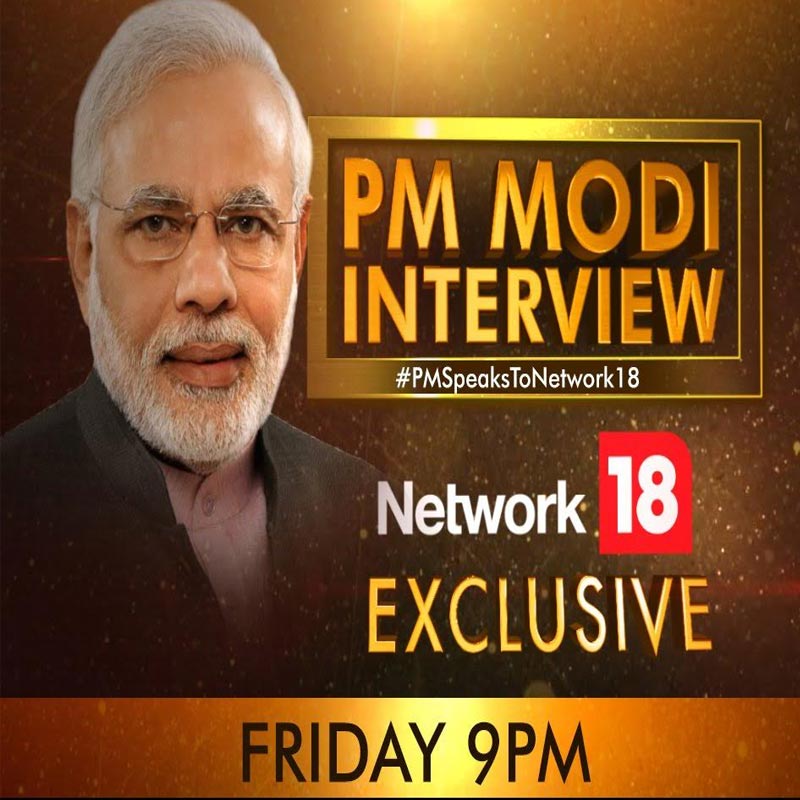
    MUMBAI: A day after Reliance Industries CMD Mukesh Ambani created a media storm with his detailing the Reliance Jio roadmap, following it up today with front page ads on Jio in major newspapers today with a photo of PM Modi, which has been interpreted by some as the PM endorsing the telecom service, Network18 channels will telecast an interview with Modi at prime time.

    At the half-way mark of the present NDA-led government, PM Modi talks to Network18 Group Editor Rahul Joshi in an exclusive interview where the former dwells on a range of important topics from politics to economy to sport to Indian culture and heritage.

    In the 75-minute interview, PM Modi also discusses other topics like UP elections, black money, attacks on Dalits, Kashmir strife, state of the Indian media, the Lutyens Delhi culture and about himself too — his working style, what keeps him going, his inspirations and influences and the legacy he would like to leave behind.

    Network18 group and the various media properties housed within it are controlled by Reliance Industries Ltd after it bought out the network’s founder Raghav Bahl and other investors about a couple of years back.

    Referring to the spate of anti-Dalit atrocities and statements across the country, Modi says: “All those who were self appointed guardians were trying to create tension in the country. They did not like (it) that Modi is with the Dalits. That Modi devotes himself to tribals. I am. I am devoted to the development of all the Dalit, oppressed, under-privileged and deprived. Those who see this as an obstruction to their politics are the ones creating trouble. And this is why they are levelling baseless allegations. All those who have fed this country the poison of caste divide have destroyed this country. They must stop giving political tones to social problems. We must go forwards with a purpose. And I want to ask the society also…are these incidents befitting of a civilised society?”

    In a clear denunciation of communal and caste tensions, the Prime Minister minces no words cautioning politicians, specially from his own party, the BJP: “And I want to tell the politicians also..i will ask my party leaders also.. reckless statements, saying anything about anyone or any person’s community…media will come to you… they need their TRP.. but you are answerable to the nation… and that is why, all those living in public life.. whether political or social workers.. even if we are representing a particular community… for the benefit of the country’s unity, society’s unity… for the sake of bonhomie.. we must be extra vigilant.”

    Speaking of the Uttar Pradesh election coming in the next few months, the Prime Minister said voters have to choose between the BJP’s development agenda and the opposition’s caste and community led vote bank politics.

    “The poison of casteism and communal vote bank have caused enough damage in our country. The biggest obstacle to strengthening our democracy is the vote bank politics. There was no atmosphere of vote bank politics in last general elections, there was the atmosphere of development of politics. After 30 years people of section of our society unitedly voted for a majority government. An entire section of our society has made a shift. It’s possible that the people of UP will do a similar thing for betterment of UP, they will vote keeping development in their mind.”

    The Prime Minister says he has never nurtured thoughts of carrying out a vendetta against his political opponents. “First, from a political standpoint, I have neither thought about this and nor will I do so in the future. I have been a state CM for 14 years. And history is testimony that I have never opened any file due to political considerations. I have never been accused of this either. It has been over two years here too. the government has given no instruction to open any file. The law will take its own course. I have no right to indulge in any cover up. You saying that we haven’t spared any dynasty isn’t correct. Second point, The first decision of my first cabinet immediately after assuming office…a matter stuck for 4 years in the previous regime… a matter that was raised by the SC also…the matter of setting up an SIT on the issue of black money. We have constituted the SIT, it is doing its work also. The SC is monitoring the progress also. Another important work that we have done is to have such a strong black money law that no one dare send black money abroad. So this is a job that we have done. No new black money.”

    Referring to reports of differences between the executive and the judiciary, Modi describes it as a “totally wrong perception”. On his commitment to the judiciary, Modi says: “This government goes by rules, law and the constitution. There is no scope for any confrontation or tension with any constitutional institution. There must be as much warmth with judiciary as needed for constitutional decorum. I try my best to maintain as much decorum as possible.”

    On the economic front, the Prime Minister is enthused by the passage of the Goods and Services Tax (GST) Bill, terming it as “the biggest tax reform” : “This reform will bring a big change in India. Very few people in the country pay taxes. Some people pay taxes because they are patriotic, they want to to do something for the country. Some pay taxes because they don’t want to break the law. Some pay to avoid any trouble. But most don’t pay because the process is no complicated, they think they might get stuck in the process and won’t be able to come out. GST will simplify tax payments so much that anyone who wants to contribute to the country will come forward. Secondly, today if you go and eat at a hotel, the bill will come with this cess, that cess… And people send on Whatsapp, so much bill and so much cess… all this will end.”

    He says the Indian economy was his government’s toughest challenge in 2014. This is how he contextualizes the situation when he came to power: “You are right, there was a negative atmosphere and that had an echo effect. The country’s traders and industrialists had started looking out. There was a paralysis in government. On one hand it was this situation on one hand. On the other we had to face two successive droughts. Third, there was a slowdown in the global economy. So there were a series of challenges.”

    The Prime Minister says a series of steps to revive the economy are now bearing fruit: “First of all, in our country, whatever is talked about is seen to be reform. If it isn’t talked about, it isn’t seen as reform. It shows our ignorance. Actually, reform to transform. I say in my government: Reform, Perform and Transform. And since I am sitting for an interview, I would say Reform, Perform, Transform and Inform. Take ease of doing business. Our ranking is improving very quickly. This is not possible without reform. Our systems, processes, forms were so complicated. Now there were reformed, so our rankings are going up. A UN agency has said that from 10 in the next two years, we could be at number three. These small things need to be improved. Even today there is license raj in some areas, that needs to go. This is an important reform that is happening at every level, administrative, governance, legal.”

    Modi does not duck the question on the reasons for criticisms about a sluggish economy. He reveals he had wanted to place a white paper on the country’s economy before presenting his government’s first budget. But what made him not to? “I see that because of your integrity and decorum, you didn’t ask me this question bluntly. Most people do… Modiji in the last two years what mistake did you make? Today I think, before presenting the first Budget, I should have placed a White Paper in Parliament on the economic situation in the country. This thought had come to me. I had two paths. Politics told me that I should put out all the details. But the nation’s interest told me that this information would increase the hoplessness, the markets would be badly hit, it would be big blow to the economy and the world’s view of India would get worse… it would have been very difficult to get the economy out of that…I chose to stay silent at the risk of political damage in the national interest. At that time the situation in public sector banks was coming out and how budget numbers were moved around… I didn’t put these details out in public. It hurt us, we were criticised, it was made to look like it was my fault. But I took the political damage in the country’s interest and the result of that I am being able to fix things, despite shortcomings.”

    He says the “impact of all these issues from the past impacted private investment like non-performing assets of banks, that I am trying to fix now”. The Prime Minister says he prefers the full route over a short cut to economic revival: “I held a session with bankers and told them there will be no call from the government to you. These things would have tightened the screws. Despite that, the pace at which roads are being made, railways is expanding, six fold increase in electronic goods manufacturing, these things show we haven’t taken short cuts. And my motto is, as it says on railway platforms, ‘short cut will cut you short’. We don’t want to take any short cuts and the results are showing. Anyway the situation has improved, we don’t have to worry about these things but let me tell you about the days in the beginning, in May 2014, I chose the tough path. And when unbiased people analyse the situation, I am confident they will be surprised.”

    Reiterating his warning to black money boarders about tough action after September 30, the Prime Minister says he is tackling corruption at all levels – a monumental challenge to his government. “I’m grateful to you that you have accepted that there is no high level corruption . If Ganga is clean at Gaumukh then Ganga will gradually become pure while flowing down. You may have noticed that we have taken many steps which have neutralised chances of any corruption. For instance we have shifted the gas subsidy system into the Direct Benefit Scheme. Ghost clients who used to wrongly enjoy the benefits of gas subsidy are no longer there. Chandigarh was being supplied 30 lakh litres of kerosene. Using technology we stopped providing kerosene to those houses which have gas connection and electricity. And we provided gas connections to those who earlier didn’t have. That’s how we made Chandigarh kerosene free and saved 30 lakh litres of kerosene from being sold in the black market. The Haryana chief minister was telling me he is going to make eight districts kerosene free by this November. You would know our farmers used to be desperate for urea and used to buy from black market. Black-marketeers ruled. In some states the farmers buying urea from black market were even lathi-charged. You must have noticed there is no news of urea shortfall these days. No queuing up of farmers anywhere, no lathi-charge anywhere and black marketing has stopped. And why it is not happening anymore. Earlier the urea meant for farmers used to land up in chemical factories on the sly. Chemical factoroies used to process this as raw material and brought out finished products. They used to get urea cheap. Chemical factories and middlemen enjoyed the cream. We started neem coating of urea. As a result even one gram of urea cannot be used by chemical factories and now entire urea is 100 per cent being used for cultivation only. Additionally, we raised production of urea by 20 lakh tonnes. We also neem coating imported urea. No only that, tribals in Gujarat who were engaged to collect neem seed for this purpose have started extracting neem oil while neem coating and they have earned up to 10 to 12 crore rupees . This is a win-win situation. Corruption and difficulties both gone. Likewise we can do away with low level corruption through policy decisions and using technology. You will start liking at low level what you liked at top level.

    Not much given to talking about himself or his private thoughts, the Prime Minister did perk up when asked how he sees himself portrayed in India’s history: “Why the person who loves to live in his present should worry about history? One must not make that mistake in ones’s life. Unfortunately, in our country, governments, political parties, leaders always tried hard to make their own image. What if we had dedicated to build the image of our country rather than our own? Image of this country is the unending legacy of 1.25 billion people. Modi is just one of those 1.25 billion Indians, nothing more. Modi’s identity must get lost among those 1.25 billion people. There will be no greater joy if Modi is lost in the pages of history.”

  • After Jio storm, PM Modi interview on Network18 channels

    After Jio storm, PM Modi interview on Network18 channels

    MUMBAI: A day after Reliance Industries CMD Mukesh Ambani created a media storm with his detailing the Reliance Jio roadmap, following it up today with front page ads on Jio in major newspapers today with a photo of PM Modi, which has been interpreted by some as the PM endorsing the telecom service, Network18 channels will telecast an interview with Modi at prime time.

    At the half-way mark of the present NDA-led government, PM Modi talks to Network18 Group Editor Rahul Joshi in an exclusive interview where the former dwells on a range of important topics from politics to economy to sport to Indian culture and heritage.

    In the 75-minute interview, PM Modi also discusses other topics like UP elections, black money, attacks on Dalits, Kashmir strife, state of the Indian media, the Lutyens Delhi culture and about himself too — his working style, what keeps him going, his inspirations and influences and the legacy he would like to leave behind.

    Network18 group and the various media properties housed within it are controlled by Reliance Industries Ltd after it bought out the network’s founder Raghav Bahl and other investors about a couple of years back.

    Referring to the spate of anti-Dalit atrocities and statements across the country, Modi says: “All those who were self appointed guardians were trying to create tension in the country. They did not like (it) that Modi is with the Dalits. That Modi devotes himself to tribals. I am. I am devoted to the development of all the Dalit, oppressed, under-privileged and deprived. Those who see this as an obstruction to their politics are the ones creating trouble. And this is why they are levelling baseless allegations. All those who have fed this country the poison of caste divide have destroyed this country. They must stop giving political tones to social problems. We must go forwards with a purpose. And I want to ask the society also…are these incidents befitting of a civilised society?”

    In a clear denunciation of communal and caste tensions, the Prime Minister minces no words cautioning politicians, specially from his own party, the BJP: “And I want to tell the politicians also..i will ask my party leaders also.. reckless statements, saying anything about anyone or any person’s community…media will come to you… they need their TRP.. but you are answerable to the nation… and that is why, all those living in public life.. whether political or social workers.. even if we are representing a particular community… for the benefit of the country’s unity, society’s unity… for the sake of bonhomie.. we must be extra vigilant.”

    Speaking of the Uttar Pradesh election coming in the next few months, the Prime Minister said voters have to choose between the BJP’s development agenda and the opposition’s caste and community led vote bank politics.

    “The poison of casteism and communal vote bank have caused enough damage in our country. The biggest obstacle to strengthening our democracy is the vote bank politics. There was no atmosphere of vote bank politics in last general elections, there was the atmosphere of development of politics. After 30 years people of section of our society unitedly voted for a majority government. An entire section of our society has made a shift. It’s possible that the people of UP will do a similar thing for betterment of UP, they will vote keeping development in their mind.”

    The Prime Minister says he has never nurtured thoughts of carrying out a vendetta against his political opponents. “First, from a political standpoint, I have neither thought about this and nor will I do so in the future. I have been a state CM for 14 years. And history is testimony that I have never opened any file due to political considerations. I have never been accused of this either. It has been over two years here too. the government has given no instruction to open any file. The law will take its own course. I have no right to indulge in any cover up. You saying that we haven’t spared any dynasty isn’t correct. Second point, The first decision of my first cabinet immediately after assuming office…a matter stuck for 4 years in the previous regime… a matter that was raised by the SC also…the matter of setting up an SIT on the issue of black money. We have constituted the SIT, it is doing its work also. The SC is monitoring the progress also. Another important work that we have done is to have such a strong black money law that no one dare send black money abroad. So this is a job that we have done. No new black money.”

    Referring to reports of differences between the executive and the judiciary, Modi describes it as a “totally wrong perception”. On his commitment to the judiciary, Modi says: “This government goes by rules, law and the constitution. There is no scope for any confrontation or tension with any constitutional institution. There must be as much warmth with judiciary as needed for constitutional decorum. I try my best to maintain as much decorum as possible.”

    On the economic front, the Prime Minister is enthused by the passage of the Goods and Services Tax (GST) Bill, terming it as “the biggest tax reform” : “This reform will bring a big change in India. Very few people in the country pay taxes. Some people pay taxes because they are patriotic, they want to to do something for the country. Some pay taxes because they don’t want to break the law. Some pay to avoid any trouble. But most don’t pay because the process is no complicated, they think they might get stuck in the process and won’t be able to come out. GST will simplify tax payments so much that anyone who wants to contribute to the country will come forward. Secondly, today if you go and eat at a hotel, the bill will come with this cess, that cess… And people send on Whatsapp, so much bill and so much cess… all this will end.”

    He says the Indian economy was his government’s toughest challenge in 2014. This is how he contextualizes the situation when he came to power: “You are right, there was a negative atmosphere and that had an echo effect. The country’s traders and industrialists had started looking out. There was a paralysis in government. On one hand it was this situation on one hand. On the other we had to face two successive droughts. Third, there was a slowdown in the global economy. So there were a series of challenges.”

    The Prime Minister says a series of steps to revive the economy are now bearing fruit: “First of all, in our country, whatever is talked about is seen to be reform. If it isn’t talked about, it isn’t seen as reform. It shows our ignorance. Actually, reform to transform. I say in my government: Reform, Perform and Transform. And since I am sitting for an interview, I would say Reform, Perform, Transform and Inform. Take ease of doing business. Our ranking is improving very quickly. This is not possible without reform. Our systems, processes, forms were so complicated. Now there were reformed, so our rankings are going up. A UN agency has said that from 10 in the next two years, we could be at number three. These small things need to be improved. Even today there is license raj in some areas, that needs to go. This is an important reform that is happening at every level, administrative, governance, legal.”

    Modi does not duck the question on the reasons for criticisms about a sluggish economy. He reveals he had wanted to place a white paper on the country’s economy before presenting his government’s first budget. But what made him not to? “I see that because of your integrity and decorum, you didn’t ask me this question bluntly. Most people do… Modiji in the last two years what mistake did you make? Today I think, before presenting the first Budget, I should have placed a White Paper in Parliament on the economic situation in the country. This thought had come to me. I had two paths. Politics told me that I should put out all the details. But the nation’s interest told me that this information would increase the hoplessness, the markets would be badly hit, it would be big blow to the economy and the world’s view of India would get worse… it would have been very difficult to get the economy out of that…I chose to stay silent at the risk of political damage in the national interest. At that time the situation in public sector banks was coming out and how budget numbers were moved around… I didn’t put these details out in public. It hurt us, we were criticised, it was made to look like it was my fault. But I took the political damage in the country’s interest and the result of that I am being able to fix things, despite shortcomings.”

    He says the “impact of all these issues from the past impacted private investment like non-performing assets of banks, that I am trying to fix now”. The Prime Minister says he prefers the full route over a short cut to economic revival: “I held a session with bankers and told them there will be no call from the government to you. These things would have tightened the screws. Despite that, the pace at which roads are being made, railways is expanding, six fold increase in electronic goods manufacturing, these things show we haven’t taken short cuts. And my motto is, as it says on railway platforms, ‘short cut will cut you short’. We don’t want to take any short cuts and the results are showing. Anyway the situation has improved, we don’t have to worry about these things but let me tell you about the days in the beginning, in May 2014, I chose the tough path. And when unbiased people analyse the situation, I am confident they will be surprised.”

    Reiterating his warning to black money boarders about tough action after September 30, the Prime Minister says he is tackling corruption at all levels – a monumental challenge to his government. “I’m grateful to you that you have accepted that there is no high level corruption . If Ganga is clean at Gaumukh then Ganga will gradually become pure while flowing down. You may have noticed that we have taken many steps which have neutralised chances of any corruption. For instance we have shifted the gas subsidy system into the Direct Benefit Scheme. Ghost clients who used to wrongly enjoy the benefits of gas subsidy are no longer there. Chandigarh was being supplied 30 lakh litres of kerosene. Using technology we stopped providing kerosene to those houses which have gas connection and electricity. And we provided gas connections to those who earlier didn’t have. That’s how we made Chandigarh kerosene free and saved 30 lakh litres of kerosene from being sold in the black market. The Haryana chief minister was telling me he is going to make eight districts kerosene free by this November. You would know our farmers used to be desperate for urea and used to buy from black market. Black-marketeers ruled. In some states the farmers buying urea from black market were even lathi-charged. You must have noticed there is no news of urea shortfall these days. No queuing up of farmers anywhere, no lathi-charge anywhere and black marketing has stopped. And why it is not happening anymore. Earlier the urea meant for farmers used to land up in chemical factories on the sly. Chemical factoroies used to process this as raw material and brought out finished products. They used to get urea cheap. Chemical factories and middlemen enjoyed the cream. We started neem coating of urea. As a result even one gram of urea cannot be used by chemical factories and now entire urea is 100 per cent being used for cultivation only. Additionally, we raised production of urea by 20 lakh tonnes. We also neem coating imported urea. No only that, tribals in Gujarat who were engaged to collect neem seed for this purpose have started extracting neem oil while neem coating and they have earned up to 10 to 12 crore rupees . This is a win-win situation. Corruption and difficulties both gone. Likewise we can do away with low level corruption through policy decisions and using technology. You will start liking at low level what you liked at top level.

    Not much given to talking about himself or his private thoughts, the Prime Minister did perk up when asked how he sees himself portrayed in India’s history: “Why the person who loves to live in his present should worry about history? One must not make that mistake in ones’s life. Unfortunately, in our country, governments, political parties, leaders always tried hard to make their own image. What if we had dedicated to build the image of our country rather than our own? Image of this country is the unending legacy of 1.25 billion people. Modi is just one of those 1.25 billion Indians, nothing more. Modi’s identity must get lost among those 1.25 billion people. There will be no greater joy if Modi is lost in the pages of history.”

  • Venkaiah Naidu gets additional charge of MIB; Manoj Sinha bags Communications portfolio

    Venkaiah Naidu gets additional charge of MIB; Manoj Sinha bags Communications portfolio

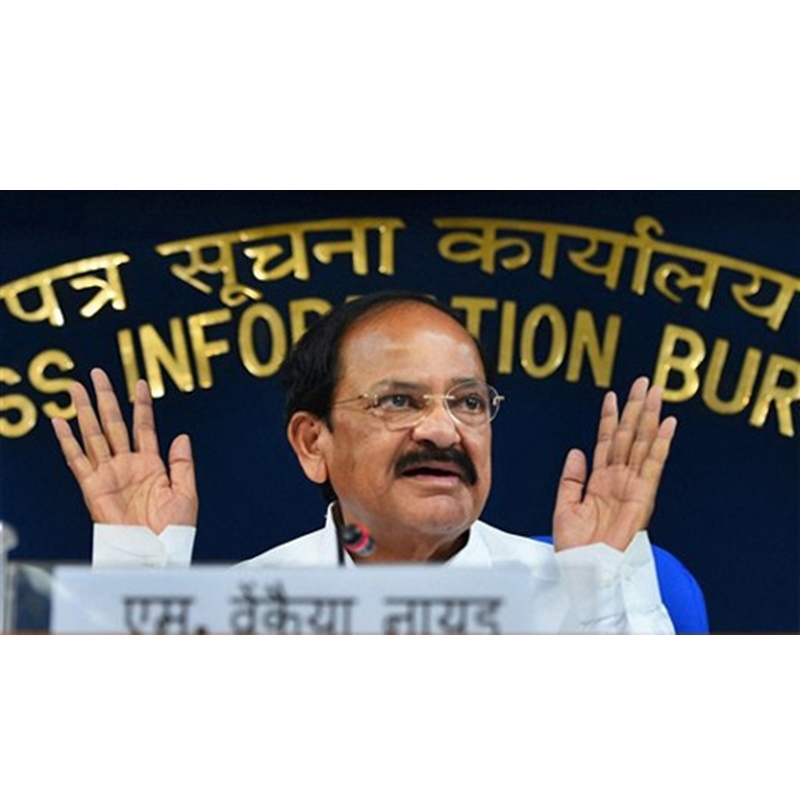
    NEW DELHI: M. Venkaiah Naidu is the new boss for India’s media and entertainment sector at Ministry of Information & Broadcasting (MIB) as the senior minister replacing Arun Jaitley who continues to be country’s finance minister.

    Similarly, there’s a new Communications boss at the Capital’s Sanchar Bhawan that houses one part of the Ministry of Communications & Information Technology (MoCIT). Manoj Sinha will hold independent charge of Communications portfolio in the bifurcated MoCIT.

    Earlier MoCIT minister Ravi Shankar Prasad retains control over IT & Electronics departments in MoCIT, while being given additional charge of Ministry of Law.

    Prime Minister Narendra Modi affected a reshuffle of his Cabinet on July 5, 2016, bringing in new people as senior and junior ministers and re-jigging portfolios of some existing ministers. With the induction of the newcomers, the council of ministers has been expanded to 78 members.

    Both Naidu and Sharma, at the helm of crucial ministries, have additional responsibilities too.

    While Naidu also holds charge at Ministry of Urban Development Housing and Urban Poverty Alleviation, Sharma too is a junior minister at Ministry of Railways.

    Naidu will be accompanied at MIB by Olympics medallist-turned-politician Rajyavardhan Singh RathoreRajyavardhan Singh Rathore, who continues as the junior minister.

    It remains to be seen how quickly the new ministers grasp complex issues such as digitisation, broadcast licences, content regulations, Net Neutrality, spectrum auctioning, while keeping pace with newer technologies being embraced by India’s media & entertainment and communications sectors.

    Political observers of India’s complicated polity were divided in their opinion on whether the Cabinet reshuffle reflected talents been rewarded or people given ministerial berths with an eye on some up and coming State-level elections that are crucial for the nationalist BJP, which leads the government in New Delhi.

  • Venkaiah Naidu gets additional charge of MIB; Manoj Sinha bags Communications portfolio

    Venkaiah Naidu gets additional charge of MIB; Manoj Sinha bags Communications portfolio

    NEW DELHI: M. Venkaiah Naidu is the new boss for India’s media and entertainment sector at Ministry of Information & Broadcasting (MIB) as the senior minister replacing Arun Jaitley who continues to be country’s finance minister.

    Similarly, there’s a new Communications boss at the Capital’s Sanchar Bhawan that houses one part of the Ministry of Communications & Information Technology (MoCIT). Manoj Sinha will hold independent charge of Communications portfolio in the bifurcated MoCIT.

    Earlier MoCIT minister Ravi Shankar Prasad retains control over IT & Electronics departments in MoCIT, while being given additional charge of Ministry of Law.

    Prime Minister Narendra Modi affected a reshuffle of his Cabinet on July 5, 2016, bringing in new people as senior and junior ministers and re-jigging portfolios of some existing ministers. With the induction of the newcomers, the council of ministers has been expanded to 78 members.

    Both Naidu and Sharma, at the helm of crucial ministries, have additional responsibilities too.

    While Naidu also holds charge at Ministry of Urban Development Housing and Urban Poverty Alleviation, Sharma too is a junior minister at Ministry of Railways.

    Naidu will be accompanied at MIB by Olympics medallist-turned-politician Rajyavardhan Singh RathoreRajyavardhan Singh Rathore, who continues as the junior minister.

    It remains to be seen how quickly the new ministers grasp complex issues such as digitisation, broadcast licences, content regulations, Net Neutrality, spectrum auctioning, while keeping pace with newer technologies being embraced by India’s media & entertainment and communications sectors.

    Political observers of India’s complicated polity were divided in their opinion on whether the Cabinet reshuffle reflected talents been rewarded or people given ministerial berths with an eye on some up and coming State-level elections that are crucial for the nationalist BJP, which leads the government in New Delhi.

  • ‘Writing such a book can be risky but it is in Dr Subhash Chandra’s nature to take risks:’ PM Modi

    ‘Writing such a book can be risky but it is in Dr Subhash Chandra’s nature to take risks:’ PM Modi

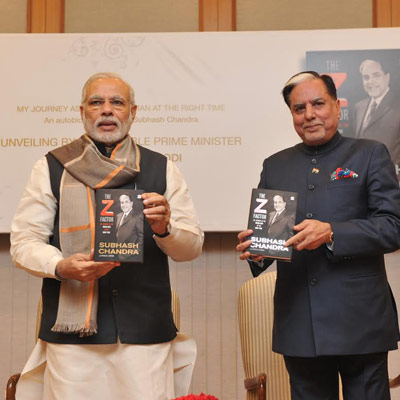
    NEW DELHI / MUMBAI: Prime Minister Narendra Modi today described Essel Group founder and chairman Dr Subhash Chandra as a person who has never been afraid of taking risks.


    Releasing Dr Chandra’s autobiography The Z Factor: My Journey as the Wrong Man at the Right Time, Modi said that writing such a book can be risky, but it was in Dr Chandra’s nature to take risks.


    “Writing a biography is daunting task. It is commendable that Subhash Chandra has accomplished that so soon. It is also challenging to keep everyone in mind when writing a biography, which makes penning down an autobiography even more risky. But taking risk is second nature to Subhash ji, and this very nature is possibly also responsible for his success in life. I haven’t read the book yet due to time constraints and being out of touch with the habit of reading but plan to do so soon,” Modi said.


    Additionally, he also stressed on Dr Chandra’s efforts in caring for the weaker sections of society. Modi tweeted, “Released @_SubhashChandra ji’s book, ‘The Z Factor.’ Spoke about his work for weaker sections of society.”


    He added that he always urged students to read biographies. “Whenever I meet students I ask them to read biographies of great personalities as it bring them closer to the history and events of a time and helps them understand it better.”


    The Prime Minister also said that he appreciated Dr Chandra’s community service initiatives, particularly in the field of education.


    Modi also recounted some anecdotes about his earlier interactions with the media giant and thinker.


    Dr Chandra in his opening speech thanked a host of people like Purushotam Gupta, Vijay Dhar, Rajendra Mittal, Gulshan Sachdeva, Rajan Issac, Ashok Kurien, India TV chairman Rajat Sharma, TV9 managing editor Ravi Prakash, Vijay Jindal and his former colleague Pradeep Guha, who have been with him through this journey in the industry.


    He also thanked ANI editor-in-chief Sanjeev Prakash and ANI news editor Smita Prakash, who he said taught him what “news” was and at the same time also learnt the same from him.


    Recalling an incident from his younger days, when he demanded a Fiat car from his father, which was then priced at Rs 16,000, Dr Chandra said that he fulfilled that dream at the age of 21 when he bought a second-hand Fiat car with his own money. “What I mean to say is that if there is focus and determination, then you can achieve success in life,” he said.


    Saying how he had now slowly distanced himself from the business of making money and handed over the reigns to his brothers and sons, Dr Chandra said that he often told them to work in such a way that would always benefit the country and its people. 


    The Z Factor: My Journey as the Wrong Man at the Right Time has been written by Dr Chandra along with Pranjal Sharma.


    Recalling how he came to know of Dr Chandra, Prime Minister Modi recounted his early days as a party worker when he was introduced to Dr Chandra’s father Nand Kishore Goenka, who gradually connected the two.


    The panelists for the event were M J Akbar and Vallabh Bhansali, who interacted with Dr Chandra at the launch session. Also in attendance were India Today founder and editor-in-chief Aroon Purie and COO Kalli Purie,  India TV chairman Rajat Sharma and top-notch politicians like Mulayam Singh Yadav and Amar Singh amongst others. From the entertainment world, actors like Anupam Kher and Akshay Kumar were in attendance.


    The book is published by Harper Collins and will be available in stores from 21 Januaryonwards. Additionally, it is already available on Flipkart and Amazon India for pre-orders.


    The book promos, event updates, and excerpts will also be available on social media sites like Twitter and Facebook.


    Dr Chandra revolutionised the Indian television industry by launching the country’s first satellite Hindi channel Zee TV in 1992 and later the first private news channel, Zee News.


    Dr Chandra has diversified business interest across various sectors like television, newspaper, cable, direct-to-home, satellite communications, theme parks, online gaming, education, flexible packaging, infrastructure development and multiplexes.

  • ‘Writing such a book can be risky but it is in Dr Subhash Chandra’s nature to take risks:’ PM Modi

    ‘Writing such a book can be risky but it is in Dr Subhash Chandra’s nature to take risks:’ PM Modi

    NEW DELHI / MUMBAI: Prime Minister Narendra Modi today described Essel Group founder and chairman Dr Subhash Chandra as a person who has never been afraid of taking risks.


    Releasing Dr Chandra’s autobiography The Z Factor: My Journey as the Wrong Man at the Right Time, Modi said that writing such a book can be risky, but it was in Dr Chandra’s nature to take risks.


    “Writing a biography is daunting task. It is commendable that Subhash Chandra has accomplished that so soon. It is also challenging to keep everyone in mind when writing a biography, which makes penning down an autobiography even more risky. But taking risk is second nature to Subhash ji, and this very nature is possibly also responsible for his success in life. I haven’t read the book yet due to time constraints and being out of touch with the habit of reading but plan to do so soon,” Modi said.


    Additionally, he also stressed on Dr Chandra’s efforts in caring for the weaker sections of society. Modi tweeted, “Released @_SubhashChandra ji’s book, ‘The Z Factor.’ Spoke about his work for weaker sections of society.”


    He added that he always urged students to read biographies. “Whenever I meet students I ask them to read biographies of great personalities as it bring them closer to the history and events of a time and helps them understand it better.”


    The Prime Minister also said that he appreciated Dr Chandra’s community service initiatives, particularly in the field of education.


    Modi also recounted some anecdotes about his earlier interactions with the media giant and thinker.


    Dr Chandra in his opening speech thanked a host of people like Purushotam Gupta, Vijay Dhar, Rajendra Mittal, Gulshan Sachdeva, Rajan Issac, Ashok Kurien, India TV chairman Rajat Sharma, TV9 managing editor Ravi Prakash, Vijay Jindal and his former colleague Pradeep Guha, who have been with him through this journey in the industry.


    He also thanked ANI editor-in-chief Sanjeev Prakash and ANI news editor Smita Prakash, who he said taught him what “news” was and at the same time also learnt the same from him.


    Recalling an incident from his younger days, when he demanded a Fiat car from his father, which was then priced at Rs 16,000, Dr Chandra said that he fulfilled that dream at the age of 21 when he bought a second-hand Fiat car with his own money. “What I mean to say is that if there is focus and determination, then you can achieve success in life,” he said.


    Saying how he had now slowly distanced himself from the business of making money and handed over the reigns to his brothers and sons, Dr Chandra said that he often told them to work in such a way that would always benefit the country and its people. 


    The Z Factor: My Journey as the Wrong Man at the Right Time has been written by Dr Chandra along with Pranjal Sharma.


    Recalling how he came to know of Dr Chandra, Prime Minister Modi recounted his early days as a party worker when he was introduced to Dr Chandra’s father Nand Kishore Goenka, who gradually connected the two.


    The panelists for the event were M J Akbar and Vallabh Bhansali, who interacted with Dr Chandra at the launch session. Also in attendance were India Today founder and editor-in-chief Aroon Purie and COO Kalli Purie,  India TV chairman Rajat Sharma and top-notch politicians like Mulayam Singh Yadav and Amar Singh amongst others. From the entertainment world, actors like Anupam Kher and Akshay Kumar were in attendance.


    The book is published by Harper Collins and will be available in stores from 21 Januaryonwards. Additionally, it is already available on Flipkart and Amazon India for pre-orders.


    The book promos, event updates, and excerpts will also be available on social media sites like Twitter and Facebook.


    Dr Chandra revolutionised the Indian television industry by launching the country’s first satellite Hindi channel Zee TV in 1992 and later the first private news channel, Zee News.


    Dr Chandra has diversified business interest across various sectors like television, newspaper, cable, direct-to-home, satellite communications, theme parks, online gaming, education, flexible packaging, infrastructure development and multiplexes.

  • ‘Too much of sensation, not enough sense; too much of Delhi, not enough on the rest:’ Rajdeep Sardesai

    ‘Too much of sensation, not enough sense; too much of Delhi, not enough on the rest:’ Rajdeep Sardesai

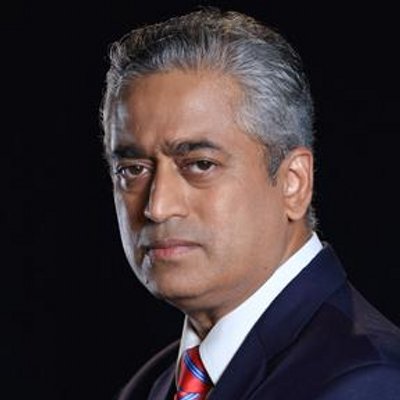
    ‘Main zindagi ka saath nibhaata chala gaya,’ is the song that you hear when you call him. With a journalistic experience of 26 years in print and television specialised in covering national politics, this man lets his work do the talking for him. He has never abandoned hard hitting real life stories behind his brand name and has always been open and unbiased about his thoughts. Known for his fearless coverage of news and love for music, he is none other than India Today Group consulting editor Rajdeep Sardesai.

    He is also the author of 2014: The Election that Changed India. Sardesai started his career in 1988 and entered television journalism in 1994. He has bagged several awards for his journalistic excellence. Known for his humble nature and love towards his family, cricket, music, food and news, Sardesai has seen the struggle for a byline in print to an anchor on TV news channel.

    Speaking to Indiantelevision.com’s Megha Parmar, Sardesai sheds some light on PM Narendra Modi, his new hire, social media trends and the big stories witnessed in 2015.

    Read on:

    2015 was all about PM Modi traversing the world… to countries far and wide. Do you believe news channels did justice to the coverage? Don’t you think it was more about discussing his wardrobe choices and pondering about the purpose of him visiting a country rather than putting light on other important ones?

    PM Modi travelling to different parts of numerous countries is just one part of the insight. There are lots of other insights to it. If you see from his point of view, his visits abroad are his highlights. I think no Prime Minister has ever got such coverage before. Manmohan Singh had also travelled to as many countries as Modi in his tenure as a PM, but we didn’t see any coverage on that. Modi is known by his nature and is a great showman. Be it his trip to San Francisco or his trip to Australia, he knows what will sell. Talking about if we did justice to the coverage, I think yes, we did manage to highlight few other important details behind his visit. Having said that, I have also observed that many a times TV news channels act more like cheerleaders and not as journalists while covering such stories.

    In your book, ‘2014 The Election that Changed India,’ you mention about being neutral towards Modi. How difficult was it for you to remain neutral after covering what happened in 2002?

    The 2002 riots have affected me and as an observer I have the right to question politicians and criticise them. The book is my perception on where I stand on Modi. I have just put down my views about the same in my book. I share strong feelings with what happened back in 2002.

    How difficult was it to let go a channel that you had built from scratch? How has been your journey with the India Today Group so far?

    It was very difficult to part ways from the channel. That has been the most emotionally and professionally difficult decision of my life. Talking about the India Today Group, the journey has been good so far. They have been very supportive and have allowed me journalistic freedom and that’s what I value more than anything else.

    Indian media went bonkers over the Sheena Bora case, was it really required or was it simply another way of pleasing the voyeur in us?

    Frankly, it was not required at all. In my view, it’s just an example of how sensationalism replaces sense. The fact though lies that it was indeed a great news story. Mother killing a daughter story is always going to be a great news story. Having said that, we could have covered it much better. We could have laid down many facts than going into so much of gossip and trivia. We lacked on showing less facts, which needed to be covered. It was a big story. But the two questions that are to be asked is, the proportion i.e. did we over cover it and secondly, did we focus more on gossip and trivia and not facts?

    Has the age of a neutral journalist gone? Do anchors or journalists have to start taking sides?

    I don’t want to use the word neutral but according to me the age of the serious journalist, who takes up journalism seriously is under serious threat. A serious journalist would like to do stories beyond what was done in the Sheena Bora case. I don’t think we as journalists should be limited in our thoughts. Though few organisations believe in the idea that unless he or she does not take a strong stand about something, the viewers will be confused. Therefore they resort to taking sides at times for the sake of a strong position. A journalist should always push himself and should be hungry to get something exclusive and unique from a story.

    You voiced your opinion on how news channels missed the bus on the Chennai floods coverage. What steps can be taken by news broadcasters to ensure that this doesn’t happen again?

    The way out is to realise that there is a world beyond Delhi. We need to change our mindset. It is just with the mindset of the people. They have to change their mindset and have to understand that news is not only about Delhi. We followed the Nepal story better than what we did for Chennai floods and we should ask ourselves the reason behind this. I think every big story should be covered in a major way by not restricting ourselves to demographic boundaries.

    Do you think journalists are under threat from people or do you believe that social media is acting as a threat too? Can it affect the newsrooms on what stories to be followed through its trends?

    I don’t think it is a threat. I think social media is a gift to us. One can and should always try to use social media more creatively and constructively. We can’t follow social media just because of the trends or the #tags. It can be a great source of information for good stories. It can play as a compliment to the journalists. But if you only follow what is trending on Twitter or the ‘masala’ on Facebook, then I don’t think we are utilising social media to its fullest.

    If there is a large group on social media that follows me but still targets me, I take pride in that. I have the right to dissent just like everyone but you cannot abuse me. People have to understand what role we as journalists have to play in society.

    Talking about social media affecting newsrooms, today a company can fix the #trends. If the newsrooms get influenced by it, it’s terrible and I think one needs to re-think about what he is exactly trying to do by resorting to such things.

    Do trending #tags like presstitutes bother you?

    It bothers me deeply. It bothers me more because it came from a minister who used such kind of a language. I think and strongly believe that General VK Singh owes an apology to journalists for using that word in the manner he did. And the unfortunate part is that if the ministers do it, then the public will also resort to such things. They will also say that journalists are ‘presstitutes.’ There will be a few journalists who may have done a few things you could object to, but still you can’t use such words. It’s a very unfortunate word and I am sorry to say that a minister has used such a word. Twitter is a double-edged sword. As I said, it can be a great source of information or it can be a deadly aggregator of hate and anger that targets people and will lead on to building enemies. 

    Your views on the usage of the keyword intolerance and the way it was ridiculed.

    I think the way it began was unfortunate. In our country there is so much of threat that even if I give you a serious answer someone will object to it. It’s not about intolerance or religious intolerance. It’s about the lack of respect towards someone’s viewpoint. If I say something you don’t agree with, you might get angry and call me anti-national. That troubles me. India is an extremely tolerate country in many ways. What we are losing is our capacity to listen to the other side’s point of view. I think we need to get some perspective behind this entire debate and we should realise that we need to have a dialogue with each other. Everyone is saying their own thing and moving away in the society, which is not leading any of us to a logical conclusion.

    Is there a reason behind the profession attracting so much of negative criticism in the society?

    I think the fact is that we as journalists have also somewhere lost our way. We have lost our moral compass. We tend to do things sometimes in a manner that it’s bound to face criticism. It’s not that we can hide from that. We are also involved in it. If you mix sense with sensation, there will be people commenting ‘yeh toh nautanki hi karte hai.’ If you reduce a studio to a fish market, people will point fingers at you. But it still does not justify the use of words like ‘presstitiutes.’

    A few days back Harsha Bhogle said how he no longer understood television and its role in sport when he came across young journalists and their obsession with negativity because their editor would not allow anything that was non-confrontational, not aggressive or demanding. What do you have to say about this?

    I am an optimistic. I myself believe that we should have more positive stories. I myself try to do at least one positive story in a day. I agree that there is too much of negativity currently, and you need to have more positive feel-good stories as well. But that doesn’t mean that journalists should abandon negative stories. When there is a negative story, we will obviously have to report it. If in a 24 hours new channel, we cannot see one positive story then there is something wrong and we have to rectify that. It’s all about proportion; cover the Sheena Bora case but don’t cover it at the expense of the other news. Cover other news, but don’t cover it at the expense of the Chennai floods.

    Will we soon see TV news divided into two parts? Debates and News?

    I think viewers are tired of what many of the news channels are providing them. I know it’s a staple diet in the news space; but it is the cheapest way of doing journalism. Getting five people in the studio and making them fight is cheap. It doesn’t cost you much. The viewers want different ways of stating factual information from you. It will work but not in the long run.

    With growing competition, news channels have to witness a fight of breaking news first. What is your take on that?

    The thing about being first is the most stupid thing that you can have in journalism. It is stupid to go through this ‘tamasha’ of who breaks it first. What is important is the way you write and interpret it rather than being the first to break it. Breaking news at one level is breaking down now.

    Is digital gradually taking over TV when it comes to breaking news? What should news broadcasters be doing to keep the TV news audience enact?

    Yes I think so. I think earlier TV was the first resource for information. The traditional is losing its importance now. I think we will have to do much more quality stuff. Quality differentiating news is the need of the hour. The future is about quality and not quantity. The quicker the media changes its working structure; the lesser the TV channels will have to worry about its audience. They will follow the news channels eventually.

    Should ratings determine the editorial strategy as only few people have meter boxes whereas there are so many digital followers of the news channels? Is it fair to curate content for people meters and forget the followers?

    I think we should be conscious about ratings but it cannot decide content, in my view. Content should be decided on the basis of quality. If you give out quality content, you will get good enough ratings in the long run. The system itself is so flawed, that you cannot have ratings to decide your content. It is definitely unfair for the followers who are not a part of the ratings. In the end, we would be left pleasing and entertaining the people rather than enlightening them with quality news.

    Your views on the declining standards of news media is no secret. Where do you think news went wrong in 2015?

    One of the stories that we missed out in this year is Chennai floods. We did not cover it properly in the early days. Later on it was good. The first part wherein Chennai was being hit by the floods is something that I would call as our failure. We have to move beyond the Delhi centric view of the world. And I still think that we tend to focus more on the sensation element rather than on the sense.

    The other one is the Sheena Bora case and how we covered it. I personally enjoyed covering the Bihar elections where I was talking to the people and not the politicians. I think you can cover politics differently and not only through politicians. I think there is too much of sensation, not enough of sense and too much of Delhi, not enough coverage on the rest.

    Will 2016 also see news going the HD way? Is it the need of the hour?

    I think so. But even that depends on the economics of the channel. I don’t think at this moment news channels are going that way. Economically it doesn’t make sense to me. I am sure it will happen in a year or two.

    What will you advise young igniting minds who aspire to be journalists?

    To the evolving mindset I will suggest to keep your minds free and open to ideas. Always be passionate about news and never force your mind towards anything.