Tag: Players

  • IPL 2025 auction: A day of big spending

    IPL 2025 auction: A day of big spending

    MUMBAI: Surprises galore! That’s what the day one of Tata IPL 2025 Mega Auction/player draft in Jeddah, Saudi Arabia threw up yesterday with some players being bought for astounding prices and some going unsold. Overall, the managements of the 10 teams spent Rs 467.5 crore, purchasing 72 players, of which 24 players were international players.

    Amongst the biggest eyeopeners was the Rs 27 crore sticker price that Lucknow Super Giants paid to acquire the swashbuckling Rishabh Pant, making him the most expensive cricketer in the league’s history. Earlier, Punjab Kings coughed up Rs 26.75 crore for Shreyas Iyer  breaking the Rs 24.75 crore record set for Mitchell Starc by Kolkata Knight Riders in 2024.

    Kolkata Knight Riders also almost broke the bank by shoveling Rs 23.75 crore for  all arounder Venkatesh Iyer. Leggie Yuzvendra Chahal became the most expensive Indian spinner ever in IPL as Punjab Kings  picked him for Rs 18 crore. Pacer Arshdeep Singh who was the first player to be put on the blocks during the auction was also purchased by Punjab Kings for an astounding Rs 18 crore, using the right to match card, beating out Sunrisers Hyderabad in the process. Amongst the players who went shockingly unsold included: Devdutt Padikkal, David Warner and Piyush Chawla.

    When the day began, a total of 574 players were  shortlisted from an initial pool of 1,574 names. This included 208 overseas players, 12 uncapped overseas talents, and 318 uncapped Indian players. Mallika Sagar stood up as the auctioneer for the whole period of the auction.

    IPL Auction 2025 Rajiv Shukla

    Chennai Super Kings had held on to  Ruturaj Gaikwad, MS Dhoni; Ravindra Jadeja, Shivam Dube and Matheesha Pathirana while Mumbai Indians had retained Hardik Pandya. Rohit Sharma, Suryakumar Yadav, Jasprit Bumrah and Tilak Varma. On the other hand Royal Challengers Bengaluru retained Virat Kohli, Rajat Patidar and Yash Dayal and Sunrisers Hyderabad retained Heinrich Klaasen, Pat Cummins, Travis Head, Abhishek Sharma, Nitish Kumar Reddy.

    While Delhi Capitals players retained Axar Patel, Kuldeep Yadav, Tristan Stubbs, Abhishek Porel. Punjab Kings had decided to continue with only Shashank Singh and Prabhsimran Singh. Gujarat Titans retained Rashid Khan, Shubman Gill, Sai Sudharsan, Rahul Tewatia, Shahrukh Khan  even as Lucknow Super Giants retained Nicholas Pooran, Ravi Bishnoi, Mayank Yadav , Ayush Badoni and Mohsin Khan. Rajasthan Royals held on to Sanju Samson, Yashasvi Jaiswal, Riyan Parag, Dhruv Jurel, Shimron Hetmyer and Sandeep Sharma even as Kolkata Knight Riders retained Rinku Singh, Varun Chakravarthy, Sunil Narine, Andre Russell, Harshit Rana and Ramandeep Singh.

    This gave Punjab Kings  a purse of Rs 110.5 crore when the auction commenced,; Rajasthan Royals, Rs 41 crore; Royal Challengers Bengaluru, Rs 83 crore, Delhi Capitals, Rs 73 crore;  Lucknow Super Giants, Rs 69 crore;  Gujarat Titans, Rs 69 crore; Chennai Super Kings,  Rs 55 crore; Kolkata Knight Riders, Rs 51 crore; Mumbai Indians, Rs 45 crore and Sunrisers Hyderabad,  Rs 45 crore.

    Sanjeev Goenka Lucknow Super Giants


    The players who were bought today included:  

    Kagiso Rabada (by  Gujarat Titans for Rs 10.75 crore); Jos Buttler (Gujarat Titans, Rs 15.75 crore); 
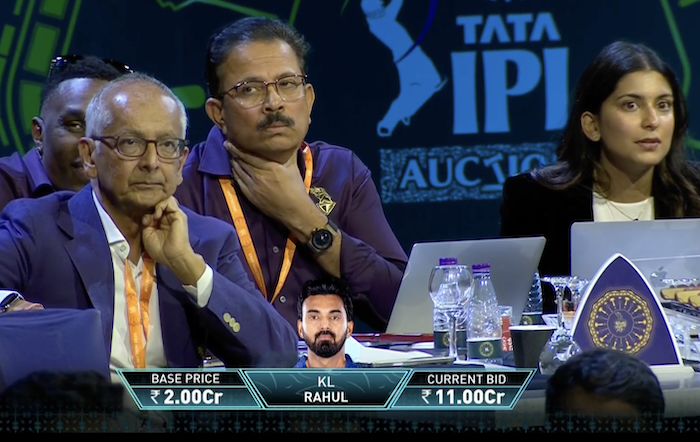
    Mitchell Starc (Delhi Capitals, Rs 11.75 crore); Mohammed Shami (Sunrisers Hyderabad, Rs 10 crore); David Miller (Lucknow Super Giants, Rs 7.50 crore);  Mohammed Siraj (Gujarat Titans, 12.25 crore); Liam Livingstone (Royal Challengers Bangalore, Rs 8.75 crore); K.L. Rahul (Delhi Capitals, Rs 14 crore); Harry Brook (Delhi Capitals, Rs 6.25 crore); Aiden Markram (Lucknow Super Giants, Rs 2 crore);  Devon Conway (Chennai Super Kings, Rs 6.25 crore); Rahul Tripathi (Chennai Super Kings, Rs 3.40 crore); Jake Fraser-McGurk (Delhi Capitals, Rs 9 crore); Harshal Patel (Sunrisers Hyderabad, Rs 8 crore); Rachin Ravindra (Chennai Super Kings, Rs 4 crore); Ravichandran Ashwin  (Chennai Super Kings,  Rs 9.75 crore); Marcus Stoinis (Punjab Kings; Rs 11 crore);  Mitchell Marsh (Lucknow Super Giants; Rs 3.40 crore); Glenn Maxwell goes (Punjab  Kings, Rs 4.20 crore); Quinton de Kock (Kolkata Knight Riders, Rs 3.60 crore); Phil Salt (Royal Challengers Bangalore, Rs 11.5 crore); Rahmanullah Gurbaz (Kolkata Knight Riders, Rs 2 crore);  Ishan Kishen (Sunrisers Hyderabad, Rs 11.25 crore);  Jitesh  Sharma (Royal Challengers Bangalore, Rs 11 crore); Josh Hazlewood (Royal Challengers Bangalore, Rs 12.50 crore); Prasidh Krishna (Gujarat Titans, Rs 9.5 crore); Avesh Khan (Lucknow Super Giants,  Rs 9.75 crore); Anrich Nortje (Kolkata Knight Riders, Rs 6.5 crore); Jofra Archer (Rajasthan Royals, Rs 12.5 crore); Khaleel Ahmed (Chennai Super Kings, Rs 4.80 crore); T. Natarajan (Delhi Capitals, Rs 10.75 crore); Trent Boult (Mumbai Indians, Rs 12.5 crore); Maheesh Theekshana (Rajasthan Royals, Rs 4.40 crore);  Rahul Chahar (Sunrisers Hyderabad,Rs 3.20 crore); Adam Zampa (Sunrisers Hyderabad, Rs 2.40 crore); Wanindu Hasaranga (Rajasthan Royals, Rs 5.25 crore); Noor Ahmad (Chennai Super Kings, Rs 10 crore); Atharva Taide (Sunrisers Hyderabad, Rs 30 lakh); Nehal Wadhera (Punjab Kings, Rs 4.20 crore); Karun Nair (Delhi Capitals; Rs 50 lakh), Angkrish Raghuvanshi (Chennai Super Kings, Rs 3 crore); Abhinav Manohar (Kolkata Knight Riders, Rs 3.20 crore); buy Nishant Sindhu (Gujarat Titans, Rs 30 lakh); Naman Dhir (Mumbai Indians, Rs 5.25 crore); Sameer Rizvi (Delhi Capitals, Rs 95 lakh); Abdul Samad (Lucknow Super Giants, Rs 4.20 crore); Harpreet Brar (Punjab Kings, Rs 1.50 crore); Vijay Shankar (Chennai Super Kings, Rs 1.20 crore); Mahipal Lomror (Gujarat Titans, Rs 1.70 crore); Ashutosh Sharma (Delhi Capitals, Rs 3.80 crore); Vishnu Vinod (Punjab Kings, Rs 95 lakh); Aryan Juyal (Lucknow Super Giants, Rs 30 lakh); Anuj Rawat (Gujarat Titans, Rs 30 lakh); Robin Minz (Mumbai Indians, Rs 65 lakh); Kumar Kushagra (Gujarat Titans, Rs 65 lakh); Akash Madhwal (Rajasthan Royals, Rs 1.20 crore); Mohit Sharma (Delhi Capitals, Rs 2.20 crore); Vyshak Vijaykumar (Punjab Kings, Rs 1.80 crore). Vaibhav Arora (Kolkata Knight Riders , Rs 1.80 crore); Yash Thakur (Punjab Kings, Rs 1.60 crore); Simarjeet Singh (Sunrisers Hyderabad, Rs 1.5 crore); Suyash Sharma (Royal Challengers Bangalore, Rs 2.6 crore); Manav Suthar (Gujarat Titans, Rs 30 lakh); Kumar Kartikeya Singh (Rajasthan Royals, Rs 30 lakh); Mayank Markande (Kolkata Knight Riders, Rs 30 lakh); Karn Sharma (Mumbai Indians, Rs 50 lakh) and Rasikh Dhar (Royal Challengers Bangalore, Rs 6 crore). 
     

  • VIVO Pro Kabaddi Season 6 gives fans the power to choose their players

    VIVO Pro Kabaddi Season 6 gives fans the power to choose their players

    MUMBAI: Riding on the back of 5 phenomenal seasons, VIVO Pro Kabaddi, scheduled to take place on the 30th and 31st of May 2018 in Mumbai, will witness a stronger fan engagement this season. VIVO Pro Kabaddi launched a contest on their official website by giving fans a chance to don the owner’s hat this season. Fans get a chance to pick players for their favourite team,  fans can select 3 players for their team – a Raider, a Defender and an All-rounder. Fans can log onto https://www.prokabaddi.com/fan-voice, select their favourite team and choose players who they think will make it to their favourite team till May 30th –  the first day of the auction.

    VIVO PKL Season VI Player Auction from the broadcasters perspective:

    Taking the player auctions a notch higher is the introduction of the Bid-o-Meter, a graphical representation, similar to a speed-o-meter with three distinct ranges (Steal| Fair| Ambitious) for television only. While a bid for a player is active, the needle of the “Bid-o-Meter” will move along the range according to the current bid price till it settles on the final bid, this is done through a backend algorithm that has been tried and tested. The Bid-o-meter uses an analytical algorithm to determine the fair price range for only “Category A Domestic Players” who will be part of the auction process.

    Total Number of players:

    A total of 422 players will be drafted into the auction pool of which 58 are Overseas players and 87 are players from the Future Kabaddi Heroes Programme (FKH), a nationwide talent scouting programme. The auctions will witness player representation from 14 other countries including Iran, Bangladesh, Japan, Kenya, Republic of Korea, Malaysia, Sri Lanka. The two-day auction will mark the first event for Season VI, with the franchises coming together to build their teams. Out of the 12 franchises, 9 have chosen their Elite Retained Players and the remaining 3 will construct their teams from scratch.

  • DTH players revise subscription packages upwards

    DTH players revise subscription packages upwards

    MUMBAI: Bogged down by multiple taxation and regular hikes in taxes like service and entertainment, Indian direct-to-home (DTH) service providers have decided to pass on the burden to their customers.

    DTH operators like Dish TV, Tata Sky, Airtel digital TV and Videocon d2h are raising base pack prices. In the case of Dish TV and Videocon d2h, the uptick is to the tune of 10 per cent for all their packages.

    They say an increase is inevitable as they have been absorbing taxes for far too long and the industry viability itself is coming into question because the players have been bleeding.

    Airtel digital TV has hiked its base pack price from Rs 158 to 175 per month effective 9 April. Videocon d2h’s price hike comes into effect from 10 April. Dish TV was the first to hike prices of monthly subscription packages by 10 per cent effective 4 April.

    Tata Sky has increased prices for individual plans unlike the uniform hike by Dish TV and Videocon d2h. Some like Reliance Digital TV are still adopting a wait and watch policy.

    However, the DTH operators have also provided price protection to their customers by giving them an option to save money by recharging for a longer duration.

    Under the regulation, existing customers are protected from a price hike which can only be implemented after six months from the day it comes into effect.

    Dish TV COO Salil Kapoor says that DTH operators were absorbing the burden of service tax till now and have decided to pass it on to the customers to reduce that burden.

    “We have hiked prices by 10 per cent across the board. We are just passing the burden of service tax on to the customers,” says Kapoor.

    Tata Sky MD and CEO Harit Nagpal is of the opinion that the price hike is not just about service and entertainment tax.

    “The input costs have gone up, the cost of content has also gone up plus there is inflation. The DTH operators have been dropping prices till now so this (price hike) is just one little step in the right direction by DTH operators,” explains Nagpal.

    Videocon d2h CEO Anil Khera elucidates: “Service tax has been increased and entertainment tax in many states has also been increased so we are gradually passing the burden on to the customers.”

    A Reliance Digital TV spokesperson said that the company is evaluating hiking prices, “Yes, we are at present evaluating different options. At this stage, it is difficult to say how much would it be and when,” the spokesperson states.

    The spokesperson adds, “Also, as an industry we are heavily burdened with statutory levies (to the extent of around 35 per cent) – the recent decision to increase the Customs Duty on STBs by 5 per cent has only added to this burden.”


  • Players releases in New Zealand with 11 prints

    Players releases in New Zealand with 11 prints

    MUMBAI: Abbas-Mustan’s upcoming release seems to have the biggest release in New Zealand.

    It is said that the distributors there have released the film with 11 prints in two of the biggest cinemas –Event and Hoyts-in the country

    It is said that the craze for Players has grown since it was extensively shot there. It is because of this that the film has garnered tremendous mileage.

    Starring Abhishek Bachchan, Neil Nitin Mukesh, Bobby Deol, Sikander Kher, Aftab Shivdasani, Bipasha Basu and Sonam Kapoor, the film is
    based on the 2003 Hollywood blockbuster, Italian Job.

    Forum Films, the distributor of Players in New Zealand, hopes of a huge opening in New Zealand.

    The earlier biggest release in New Zealand was that of Don2 that released with 9 prints.
     

  • Players and Agneepath to release in January

    Players and Agneepath to release in January

    MUMBAI: Breaking away from the practice of keeping away from big ticket films in the opening month of the year till yet, filmmakers are gearing up to release the films in January net year.

    Slated for January are two mega-budget films, Abbas-Mustan‘s Players that releases on 6 January and Karan Johar‘s Agneepath that releases on Republic Day. Meanwhile, the Vidya Balan-starrer Kahaani and Ratan Jain‘s Tezz have been pushed ahead.

    “Though the year would have started on a cracking note if Agneepath would have clashed with Tezz, but unfortunately that has been averted. But there‘s enough buzz about Players to keep the anticipation high,” observed trade analyst Taran Adarsh.

    Apart from these two, there are almost eight to 10 mid to small-budget films that would release in the opening month. They are 3 Bachelors, Chaalis Chauraasi, Chaar Din Ki Chandni, Ghost, It‘s My Life, Sadda Adda, Tutiya Dil and Ghantey Mein 5 Crore.

    Filmmakers have for long been wary of releasing their films in the month of January, but now they have realised that a well-marketed, good product will work no matter the time of the release while a bad product will flop no matter how auspicious the date of release.

    But all that finally changed this year, after four of the seven films released were declared hits thus breaking the January jinx.

  • Players in mobile entertainment value chain need to work together to grow business

    Players in mobile entertainment value chain need to work together to grow business

    MUMBAI: One of the sessions on the last day of Frames dealt with Mobile Entertainment. The session was moderated by Hungama.com CEO Neeraj Roy. The speakers were Mauj CEO Arun Gupta, Indiagames CEO Vishal Gondal, Qualcomm’s Vishal Gupta, Nokia Asia Pacific director rich media, music and games Jawahar Kanjilal, Tata Teleservices VP content and applications Pankaj Sethi and Mobile Entertainment Forum Asia chairman Stefan Rust.

    Rust says that for the mobile business to fulfill its potential the various stakeholders – the network infrastructure providers, the content aggregators, gaming publishers – must work together. Engineering resources must work with studios to figure out the best devices to reach consumers.

    Kanjilal said that while Nokia is known as a provider of mobile phones, to enable communication, it has developed a phone that can store 3000 songs and has a three mega pixel camera. In India, the company will introduce Visual Radio in the coming months . This allows a user to listen to radio stations. In this way there is a convergence of electronics and communication.

    Sethi points out that Tata Indicom caters to both the premium segment and the lower end of consumers. “On the high end side, we have introduced audio and video streaming capabilities. We are looking by the end of the year to have a full length music delivery service.

    Digital video delivery on the mobile will come to pass. Our low end customers have voice and SMS capabilities. So, we have introduced a voice station. Here, we take content from films, the stock exchange and reconfigure it in such a way that it sounds like a radio station. Gaming is a huge area. Even Tata Indicom’s prepaid customers download games like hell.”

    Gondal stressed on the role that gaming will play on the mobile platform. “People from the Indian entertainment industry underestimate the potential of gaming. Every month a million games are downloaded in the country. Contrary to perception in some quarters, price is not the determining factor. In fact, users perceive a high priced game better. That is why our new Harry Potter game at Rs15 a play did so well. Gaming is being more in the smaller towns compared to the major metros. It is played during office time, college time and dinner time. The fact that it is played during dinner means that it is taking away time from television, movie viewing and internet surfing.

    “The problem is that Bollywood movies are not conducive to making games from their films. We need to work out a creative way for this. India has an opportunity to provide services for international firms looking for ideas and execution of them. Our low cost and talent gives us an edge.”

    Arun Gupta pointed out that the mobile is slowly becoming the third screen. It is a Rs 6 billion business. It is expected to grow to around Rs 45 billion in 2010. However, there are challenges. One of them lies in the fact that outside the CDMA network the number of handsets that provide ruich media content is limited. On the GSM side, the data network is weak. So it takes time to download a game. Another important area that needs improvement is customer care and customer education. In the UK, a study said that 60 per cent of mobile users want to access mobile content but do not know how to go about it. In India, the problem can be multiplied many times over.

    Therefore mobile service providers and content publishers need to come out with ad campaigns to spread awareness. “I don’t know if a game has ever been pushed. In South Korea, due to clever marketing some game developers are celebrities.”

    Rust says that there are issues to be sorted in the arena of digital rights management (DRM). “I do not think of DRM as an anti-piracy measure. I think of it as enabling consumers to purchase music digitally. I don’t see why a person who has bought a piece of music digitally cannot play it on his iPod, computer and other devices. If it can be done with a hard copy then, why not with a digital one? Music companies needed to go beyond selling an album of 20 songs. They need to see how they can sell single songs and maximize each song’s revenue potential.”

    Gondal said that Indian mobile firms are more intent on pushing the consumer. “We must focus on pulling the consumer in through killer content. That is what Apple did with its iPod and iTunes. It got killer content and did innovative marketing. The iPod is seen as cool to have. If this pull factor is not created then there is no incentive for the consumer to go in for handset that enables rich media features. When the photo scam came about there was a sudden demand for Bluetooth.

    Pull will help the customer to go beyond just using the mobile as a voice tool”

    As far as mobile TV is concerned, Kanjilal pointed out that DVB-H trials being done abroad by Nokia show that television on the mobile is often consumed at home. This helps channels to be seen. In the future, one might have a situation where there are five television screens at home. He noted that standardisation on the DVB-H system has helped. It is an open system. Therefore it is cost effective as a distribution medium.