Tag: personal care

  • Palmolive bets on mood-boosting suds to capture India’s stressed millennials

    Palmolive bets on mood-boosting suds to capture India’s stressed millennials

    MUMBAI: Colgate-Palmolive India has unleashed its latest weapon in the battle for bathroom shelf space: a trio of body washes designed to tackle the daily grind of India’s perpetually knackered urban professionals.

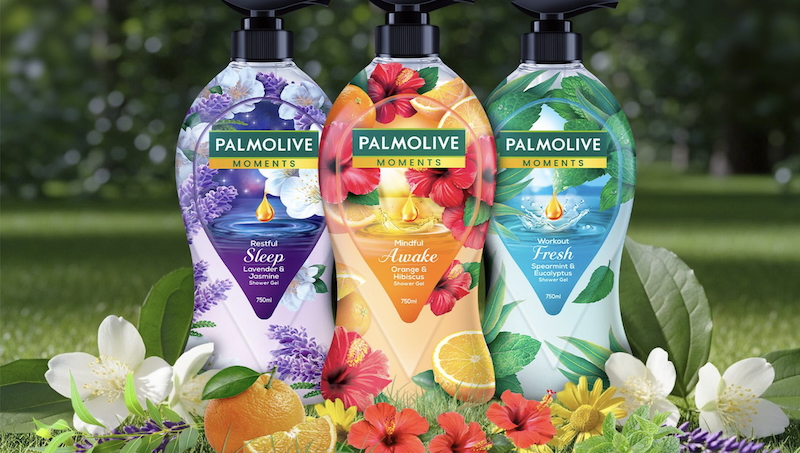
    The Palmolive Moments range arrives with scientific-sounding credentials and mood-altering promises that would make a aromatherapist blush. Three variants target specific moments of millennial misery: “Mindful Awake” for groggy mornings, “Workout Fresh” for post-gym recovery, and “Restful Sleep” for winding down after another caffeine-fuelled day.

    “Today’s young, urban consumer leads an active and intense life,” declared Colgate-Palmolive India director of marketing  Swati Rao Jeyakumar. She painted a portrait of the target customer as someone perpetually “wired-but-tired”—struggling to sleep, waking up groggy, and feeling battered after workouts.

    The company’s answer involves patented fragrance technologies with names like VivaScentz and Meta SleepTech, promising scents that linger for six to eight hours. Mindful Awake pairs orange and hibiscus to jolt morning zombies back to life, whilst Workout Fresh combines spearmint and eucalyptus for post-exercise revival. Restful Sleep deploys the usual suspects—lavender, jasmine and chamomile—to allegedly ease the transition to slumberland.

    Priced at Rs 660 for 750ml pump packs, the range targets consumers willing to pay premium prices for promises of sensorial transformation. The products are rolling out across major e-commerce platforms including Amazon, Flipkart and Nykaa, reflecting the brand’s focus on digitally savvy shoppers.

    Colgate-Palmolive’s foray into mood-targeting personal care reflects the broader premiumisation of India’s Rs 45,000-crore personal care market. As consumers increasingly seek products that promise more than basic cleansing, brands are scrambling to create emotional connections through increasingly elaborate formulations and marketing narratives.

    Whether Indian consumers will pay premium prices to transform their shower routine from “ordinary to sensorial” remains to be seen. But with urban stress levels showing no signs of abating, Palmolive’s bet on therapeutic bathing might just strike a chord with India’s frazzled masses.

  • Q3 FY 2025: Hindustan Unilever Ltd & the art of growing steadily

    Q3 FY 2025: Hindustan Unilever Ltd & the art of growing steadily

    MUMBAI:  India’s leading FMCG company Hindustan Unilever Limited (HUL) has reported steady financial results for the third quarter (Q3) and the nine-month period ended 31 December 2024. With a strategic focus on premiumisation, innovation, and cost optimisation, HUL demonstrated resilience amidst market challenges and rising input costs.

    Q3 2025 ended 31 December 2024, saw HUL record a total income of Rs 16,050 crore, a 1.7 per cent  increase from Rs 15,781 crore in the same quarter of the previous year. Its revenue from operations stood at Rs 15,559 crore, driven by solid performances in  the home care and food categories. Profit before exceptional items and tax remained steady at Rs 3,474 crore even as net profit rose 2.1 per cent to Rs 2,989 crore as against Rs 2,925 crore in Q3 2024. 

    Operating expenses were well-managed at Rs 12,576 crore, indicating efficient cost control. Home care vertical was a stellar performer with revenue climbing Rs 5,739 crore, with segment profit at Rs 1,086 crore, underscoring its role as a key growth driver. The beauty and well being vertical also saw revenues swelling to Rs Rs 3,556 crore, although profits declined slightly to Rs 1,018 crore due to higher input costs. And the food segment was a steady performer awith revenue at Rs 3,745 crore and proft as Rs 755 crore. 
    Ice-cream business
    On a nine month basis, HUL’s total income reached Rs 48,159 crore, up 1.9 per cent  from Rs 47,266 crore in the corresponding period of the previous year. Revenue from operations stood at Rs 46,759 crore, showcasing steady consumer demand. Profit before tax grew to Rs 11,053 crore, while net profit increased by 6.1 per cent  to Rs 8,196 crore. The home care category recorded a nine month revenue of Rs 17,143 crore, supported by premiumisation and product innovation. The beauty & well being vertical generated Rs 10,258 crore, benefiting from a focus on personal care products while the foods tranche delivered consistent revenue of Rs 11,398 crore, reflecting effective competitive pricing strategies. 

    During the quarter, HUL split its beauty & personal care division into two new segments—beauty & wellbeing and personal care—to enhance strategic focus and operational efficiency. Prudent management of raw material costs and advertising expenditure helped mitigate the impact of rising input costs and currency fluctuations.  A continued shift towards premium product offerings in home care and beauty & wellbeing bolstered overall performance. 

    Additionally, it got clearance from its board  (based on the recommendation of the independent and audit committees) to dissect the ice-cream business from HUL and fuse it with its wholly owned subsidiary Kwality Wall’s (India) Ltd. Following this, Kwality Walls will issue shares to all the HUL shareholders in a 1:1 ratio.. The ice-cream business had a turnover of Rs 1,595 crore in the year ended 31 March, 2024, that is 2.7 per cent of HUL’s turnover, and it has some great brands in Cornetto, Magnum and Kwality Walls. The demerger creates a leading ice-cream company listed on the stock exchange which will be given wings to fly with a separate managed allowed to focus on its growth. 

    The demerger followed a decision by Hindustan Unilever’s parent company in the UK to carve out its ice-cream business into a separate company. The rationale behind this separation was that in ice-cream has a different operating model, including differentiated infrastructure for supply and distribution, capital allocation needs, distinct channel landscape and go- to-market strategy. minimalist

    HUL also announced that it has agreed to acquire  90.5 per cent of the Rs 500 crore turnover  Uprising Science Pvt Ltd – which is behind the Minimalist hair care and skin care products range.  The HUL board agreed to a price tag of Rs 2,670 crore at a pre-money enterprise valuation of Rs  2,955 crore (and a primary infusion of Rs  45 crore) for the acquisition of the shares from  the sellers which include co-founders Mohit Kumar Yadav and . Rahul Yadav,  Peak XV Partners Venture Investments VII, Surge Ventures II, and Twenty Nine Capital Partners (General Partner). The transaction is expected to be completed in Q1 of FY 2026. Following that, HUL will acquire the remaining 9.5 per cent of Uprising’s  equity within two years.

    Minimalist will join the portfolio of brands in HUL’s  beauty & wellbeing division led by executive director Harman Dhillon. The current Minimalist team led by Mohit and Rahul will continue to operate the business in collaboration with HUL. 

  • Tam AdEx: Celebrity endorsements dominate 32 per cent of TV ads in H1 2024

    Tam AdEx: Celebrity endorsements dominate 32 per cent of TV ads in H1 2024

    Mumbai: The latest report from Tam AdEx India for January to June 2024 highlights a key role of celebrity endorsements in television advertising. This period saw 32 per cent of total TV ads being endorsed by celebrities, with film actors contributing more than 75 per cent of the celebrity ad space.

    The food & beverages sector emerged as the largest contributor, making up 28 per cent of total celebrity-endorsed ads. The food & beverages, personal care/personal hygiene, and household products sectors collectively represented over 50 per cent of celebrity-endorsed ads. Among these, ads in the food & beverages sector saw a dominance of male celebrities, while the personal care segment was led by female endorsers. Categories such as toilet/floor cleaners and aerated soft drinks topped the list, with toilet cleaners alone holding an eight per cent share.

    Film stars, sports personalities, and TV actors were the main contributors to the 32 per cent of ads featuring celebrity endorsements. The top three most visible celebrities during this period were Akshay Kumar and Shahrukh Khan, each with five per cent visibility, followed closely by Amitabh Bachchan with four per cent. Akshay Kumar maintained an impressive 22 hours per day of ad visibility across channels.

    The dominance of the food & beverages sector was clear, while personal care/personal hygiene and household products followed closely. With 28 per cent of the overall ad volumes, the food & beverages sector continued to attract top male celebrities, whereas personal care remained the preferred category for female endorsers.

    In the first half of 2024, Akshay Kumar was the most visible celebrity, followed by Shahrukh Khan, Amitabh Bachchan, and M.S. Dhoni. Six of the top ten celebrities, including Amitabh Bachchan and Kiara Advani endorsed more brands than they did during the same period in 2023. Sports personalities like M.S. Dhoni also made a notable impact. Additionally, power couples like Ranbir Kapoor and Alia Bhatt led the pack in couple endorsements, contributing to more than 18 per cent of the total ad space. Akshay Kumar and Twinkle Khanna followed with 16 per cent, making couple endorsements a growing trend.

  • What India shopped from D2C brands in 2023

    What India shopped from D2C brands in 2023

    Mumbai:  Beauty and personal care (BPC) products in the burgeoning D2C segment emerged as the largest selling category in India after about 3.7 lakh packs of Vitamin C Serum were sold during 2023, according to GoKwik’s network data report.

    The highest repeat rate was also observed in BPC at 30 per cent, followed by fashion at 28 per cent. The electronics category saw one of the lowest repeat rates, at 14 per cent.

    “D2C brands are increasingly becoming shopper favourites. Shoppers are consistently finding value in shopping from these brands. As a result, the repeat order rate of the most shopped categories has also seen a significant increase. With exclusive deals, loyalty points and offers, deepening markets and evolving trust in these brands, we can expect further growth in this industry.” Said GoKwik co-founder and CEO Chirag Taneja.

    He further added that 2023 marked another significant year for D2C brands and contributed to their growth. From obtaining funding to omnichannel expansion or becoming listed on the stock exchange, D2C brands have proved they are here to stay and grow.

    While shoppers continued to shop various products from the D2C brands, one significant product emerged as the winner, Vitamin C Serum. With over 3.7 L orders, this product clocked the most orders on GoKwik’s network of D2C brands, and emerged as a phenomenon, cementing its position in the skincare routine of Indian shoppers.

    With 3.4 L orders, sunglasses came in the second spot as one of the shoppers’ favourites on the GoKwik network while Skincare Combos ranked third with 2.1 L orders.

    Online premium memberships also seemed to be a hot favourite amongst D2C shoppers last year which could also be an indication of growing trust and loyalty for particular brands. Gift cards too had a huge demand from shoppers, possibly becoming a popular gifting option during the festive season.

    “Shoppers buying directly from a D2C brand reflects growing trust in the products available on the brand website with no risk of counterfeits, etc especially when it comes to beauty and cosmetics,” Chirag added.

    The top three products in terms of the highest orders in this category were Vitamin C Serum, closely followed by Night Cream and Hair Growth Serum.

    Fashion stood tall clocking the second-highest number of orders. This could be indicative of the individuality in the space of fashion which is leading to an increase in the number of brands in subcategories that align with shopper needs. Here, the highest-selling products were Men’s T-shirts, both in black and white and black tops for women.

    Healthcare products secured the third position in order volume, showcasing how rapidly Indian shoppers are becoming health-conscious and trusting D2C brands to cater to their needs. The top-selling products in this category were Immunity Kits and Ayurvedic Oil.

    The highest-selling items in the electronics category, as seen on the GoKwik network, were Wireless earphones followed by Smartwatches.

    Furthermore, products related to hair-related concerns have spiked, especially in metro cities (Delhi, Mumbai, Bangalore, Kolkata) as Hair Serum and Hair Gummies were the most ordered products there.

    Interestingly, one person from Gurgaon ordered SPF 50+ sunscreen 942 times last year. Onion shampoo remained the top choice of another shopper in Delhi who bought the product 514 times. Even in the cold paradise of Srinagar, De-Tan cream was ordered 44 times. In Bangalore however, scalp massager became a shopper’s favourite, as a customer ordered it over 80 times in a year.

    GoKwik houses over 1200 eCommerce brands in its network including Lenskart, Neemans, Man Matters, Purplle, Shoppers Stop, etc, ranging from fashion, beauty, health and nutrition, electronics and other key categories of the online shopping space. 

  • Winston India expands men’s category with Nut Groomer 2.O

    Winston India expands men’s category with Nut Groomer 2.O

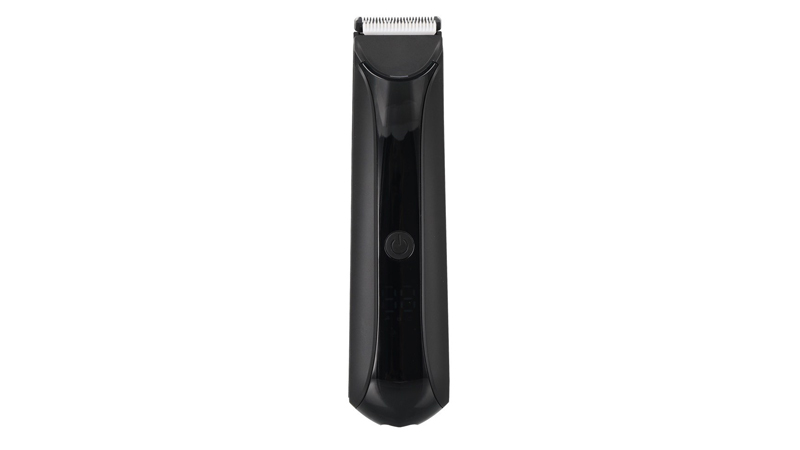
    Mumbai: Winston India upgrades the men’s grooming category with the launch of Winston Nut Groomer 2.0. This new, cutting-edge product sets a new standard in men’s grooming innovation. This new product is more advanced than the brand’s previous launch Winston India Nut Groomer.

    This new innovative product introduces a groundbreaking light function that will give you clear vision and impeccable results while you groom yourself. This sophisticated grooming companion boasts a digital display, a powerful 7000 RPM motor, and Ceramic Stainless Steel Blades that guarantee a seamless trimming experience. The IPX7 water-resistant design ensures durability and convenience. That’s not all, the device comes with a unique 3-second travel lock to safeguard you against accidental activation. A long press of the power button locks the device, giving you peace of mind while you are traveling.

    Winston India co-founder Himanshu Adlakha shared his excitement by saying, “We are extremely proud to present Winston India Nut Groomer 2.0, it is a commitment to innovation and user satisfaction. This tool is not just a device but a grooming experience which is specifically made to match with a modern man’s lifestyle. We believe in simplicity and efficiency and this product embodies these values and provides smooth grooming solutions for every need. You can avail this product from our official website and upgrade your day-to-day routine.”

    Now say goodbye to nicks, cuts and irritation with Winston India Nut Groomer 2.O and equip yourself with advanced skin protection technology. The inclusion of 4 comb attachments further enhances customization and provides a smooth grooming solution for everyone.

    Apart from this, Winston India will end its financial year with an amazing turnover of 15 crores and also plans to establish its brand identity in the men’s grooming market by selecting a brand ambassador. The brand continues to expand its products, and its quality and innovation will define the brand for years.

  • Better Body Bombay unveils new exotic spa personal care ranges

    Better Body Bombay unveils new exotic spa personal care ranges

    Mumbai: Better Body Bombay (bbb), the quintessential personal care brand is thrilled to announce the launch of seven exotic personal care ranges that promise a rejuvenating and pampering experience for all.

    As a clean beauty brand committed to offering consciously curated products tailored to the Indian skin type, bbb has established itself as a trusted name in the realm of personal care. With a vision to provide holistic care from head to toe, bbb has introduced these new ranges to cater to the diverse needs of its discerning customers.

    “Each of our new ranges is a celebration of Bombay’s rich culture and diverse landscapes, encapsulated in a bottle. We believe that self-care should be an indulgent experience, and our products are designed to make you feel pampered and rejuvenated,” said bbb CEO Sandeep Saxena.

    The Milk & Forest Honey range offers a delightful blend of milk and forest honey, enveloping you in a comforting embrace reminiscent of sunny days and sweet nostalgia. Meanwhile, the aloe vera & coconut range nourishes your skin, leaving it supple and deeply moisturized, as if drenched by the soothing rains.

    For those seeking to revitalize their hair, the Onion range provides the perfect solution, infusing your locks with the revitalizing potency of onion extract. The tea tree & Kaffir lime range purifies and uplifts with its botanical medley, evoking the sounds of the woods and the freshness of nature.

    Calm by the sea, bbb’s lavender & chamomile range, transports you to a tranquil oasis of calmness after a hectic day, while the Blood Orange range energizes your senses with its invigorating aura.

    Lastly, the pistachio & argan oil range offers pure goodness in the form of nourishing argan and pistachio oils, ensuring an instant boost that uplifts your spirits and prepares you for the day ahead.

    At bbb, the launch of these new personal care ranges is a testament to their unwavering commitment to providing quality products that cater to diverse needs while promoting self-care and self-indulgence.

  • Morphy Richards launches ‘Oh So Rich’ campaign for personal grooming line

    Morphy Richards launches ‘Oh So Rich’ campaign for personal grooming line

    Mumbai: Morphy Richards –India’s leading premium kitchen and domestic appliances brand, has announced its entry into the personal grooming and styling products category. Driven by the purpose of ”Happiness Engineered,” Morphy Richards caters to the consumer’s need for intuitive, user-friendly products that deliver happiness through product design and functionality.

    The brand launches a series of digital films under the “Oh so rich” digital campaign which teases the viewers with glimpses of the new personal grooming range of products. The range of products will cater to men and women and includes trimmers, body groomers, hair dryers with diffusers, and hair straighteners available in rich colours and dynamic designs. The price range starts from Rs 699/- across online platforms and offline stores and is already a cult favourite.

    Commenting on the category launch, Bajaj Electrical Ltd COO – consumer products business Ravindra Singh Negi said, “Self-care and grooming are some of the biggest trends we’re seeing among young Indian consumers, with both women and men making it a part of their daily routine. When we spoke to our consumers, we realised that while the outcome of grooming is an external appeal, the process is very intimate and personal. Morphy Richards is known to offer functional and aesthetic products that add happiness to everyday life. Our robust products, thoughtful simplicity, and originality in design will be the core differentiators. With the festive season around the corner, these products make perfect gifts as well – with the range catering to men and women cutting across various price points to fit every budget.”

    Morphy Richards is a legacy, a story of engineer meets salesman, technology meets humanity, and function meets form. Driven by the purpose of ”Happiness Engineered,” Morphy Richards caters to the consumer’s need for intuitive, user-friendly products that deliver happiness through product design and functionality. In 2022, they extended their trademark agreement for 15 years to continue producing, marketing and selling the home appliances in India and neighbouring territories.

  • Nagessh’s SilverEdge looking to stir the D2C market; eyes Rs 25 mn revenue

    Nagessh’s SilverEdge looking to stir the D2C market; eyes Rs 25 mn revenue

    Mumbai: He might have contemplated his thoughts and decisions prior to this story, but not anymore. Curry Nation Brand Conversations (CNBC) co-founder Nagessh Pannaswami (a first-generation entrepreneur, an ad veteran along with famous ad woman, Priti Nair) has now made a move to the brand side by launching SilverEdge. SilverEdge is the country’s first ever personal care and wellness brand to specifically target adults aged 40 and above (generally known as mature adults).

    After working at agencies such as Clarion (now Bates Chi & Partners), Lowe Lintas (now part of the Mullenlowe Lintas Group), McCann Erickson (now McCann World Group), and BBDO, and spending a significant portion of his career managing FMCG and telecom businesses, Nagessh founded Curry Nation, which is now a creative powerhouse, having created brands from the ground up to make them formidable in the categories in which they operate.

    Eventually, the brand entrepreneurial bug bit him, and he incorporated Really Useful Enterprise in December 2021. The brand SilverEdge was born in May 2022, with Nagessh’s innate need and desire to do something different. It was his personal experience of suitable products being unavailable that led him to give shape to an idea whose time had come. “Having built so many brands for clients, I wanted to give shape to a brand of my own. Today, D2C has opened up a lot of avenues. I wanted to utilise this opportunity and a latent need to plug the gap in the market,” quipped SilverEdge CEO & founder Nagessh.

    But why a name such as SilverEdge? The broad age group of 40 to 60 is called the “silver age,” and the silver economy is a thing of the near immediate future. The current population of people aged 40 to 60 is 310 million, and it is expected to grow by 37 per cent to 426 million by 2040 (source: Statistica). It is growing faster than the youth segment, but no brand addresses their age-specific needs. “SilverEdge as a brand gives you the edge in your silver years. That’s how the brand has been conceptualised,” stated Nagessh.

    Revenue, market size and competition

    Talking about revenue numbers, SilverEdge is eyeing approximately Rs 25 million in the first year of the brand’s operations. Considering strategy, the brand wants to be the go-to ‘destination’ for mature adults in the wellness and personal care space. Eventually, the platform will provide them with tips across a spectrum of ageing solutions. Nagessh specified, “Our ultimate vision is to lead the pro-age solution in India by providing specially curated age-specific products for mature adults.”

    SilverEdge, the mother brand, has six variants: SilverEdge Beauty Elixir (age defence), SilverEdge Joint Care, SilverEdge Immuno Enhance, SilverEdge Energy Booster, SilverEdge She Power, and SilverEdge Lung Defence.

    The Indian nutraceutical market will be an approximately Rs 18 billion market by 2025. There are a host of players in this industry, such as Wow Health, Bbetter, Prorganiq, Bionova, Bodywise—a slew of D2C brands, and also legacy brands like Himalaya.

    Also, the Indian skin care market is estimated to be worth Rs 11 billion by 2025. SilverEdge will not lag behind—very soon it will be launching its skin care range for mature adults, and also a few more nutraceutical products by the turn of 2023. Accessories are also on the horizon, confirmed Nagessh.

    The fact is, SilverEdge has embarked on a behaviour change mission. On one hand, there are no direct competitors to the brand since nobody is targeting the group that SilverEdge is talking to. But on the other hand, every brand in the wellness and personal care segment is a competition for it, said Nagessh.

    Digital, influencer marketing and advertising

    Digital has been the keyword for all brands starting in 2019. Considering that a person like my mum had a tough time handling and learning how to use a smartphone when it was launched, one tends to wonder how responsive this group of mature adults is to the digital medium. Nagessh revealed that SilverEdge’s website has been up and running for some time, and the response has been encouraging. The mature adults segment is active on social media, with Facebook being the lead medium, followed by WhatsApp and LinkedIn. Covid has advanced technology adoption across all population strata, and this segment isn’t lagging behind either.

    Like most brands adopting the influencer marketing route in a robust manner, SilverEdge is likely to follow suit. All the levers of digital marketing will be pushed at various points in time. Influencer marketing is an essential part of the brand’s marketing mix for specific targeting of the audience. SilverEdge is looking at influencers, but of a different sort. Aged 45 years and above, this is a whole new segment of influencers who are gaining traction in the social media space—they have a lower number of followers, but their bond with and traction from their followers is strong.

    SilverEdge is obviously targeting the followers of these influencers, so that there is less wastage of advertising money and more traction for the brand.

    The spectrum of marketplaces is another opportunity that the brand has leveraged. SilverEdge is listed on many and will soon be available at various touch points where its customers exist in the digital purchase journey.

    Nagessh stated that they would go brand first when describing SilverEdge’s advertising and marketing strategy. They would focus solely on brand building and behaviour change communication. These are the two pillars of the brand’s communication strategy. “We understand the need to create a lighthouse brand and be the beacon of change in this category,” he said.

    Targeting mature adults – a decision

    India has the world’s largest youth population, with nearly 66 per cent of the total (more than 808 million) under the age of 35, and nearly 40 per cent between the ages of 13 and 35. Despite the fact that targeting this age group would have been more profitable, Nagesh stuck to his decision to target mature adults. He emphasised, “There isn’t a single brand that speaks to the desires and aspirations of mature adults. Can you beat that? It’s almost as if this age cohort doesn’t exist for the marketeers! The mature adult segment in India is a neglected and underrepresented market from a product and services perspective.”

    Mature adults, by the time they turn 40, are well settled in life. A large chunk of their worldly responsibilities are almost taken care of (EMI’s, children’s basic education, stability in their jobs). They have all the time in the world to pursue their passion and do things that they would have probably sacrificed in their youth to pursue career stability.

    “With the cultural changes happening around us, men and women are now responding to ageing with a drive to improve aspects of their lives that they’ve been unhappy about over the years. Some are even willing to uproot their lives for betterment. They are also looking for specific curated products and services that cater to their aspirations. All this led us to walk on a path where no one had ventured in the past and guided the launch of SilverEdge,” pointed out Nagessh.

    Backed by research

    A lot of research, data collection, testing, checking responses, etc., was involved in bringing out the final product. The team at SilverEdge did a lot of consumer listening and ethnographic studies. It was how, on their probing, most of the consumers comprehended that there were no brands targeting them. The latter also realised that they had been using the same legacy products for a long time and that they may no longer be serving their purpose.

    One of SilverEdge’s most essential and obvious findings was that India is undergoing a cultural change. Mature adults are no longer resigned to living a life of seclusion or minimalism. More and more mature adults are picking up passion projects, whether it’s singing, travelling, adventure sports, etc. The retirement corpus, which was stashed away for some unforeseen event and as an inheritance for the younger generation, is now being used for self-fulfilment and self-gratification.

    Additionally, children are egging their parents to live a fuller life. Now, as people are ageing, they realise that they don’t want to turn back the body clock or hinder the natural progression of ageing. However, they want to ensure that they remain healthy for the long run. Today, more and more mature adults are taking their health into their own hands. Nagessh calls them the ‘proactive healthy agers.’ And that is the audience SilverEdge is singling out and catering to through the range of its products.

    “Doesn’t this audience of mature adults have aspirations? desires? need to be fulfilled? Why should they be using the same set of products that they have been using for years? It’s a proven fact that as people age, their nutrition and skin care needs change. They need age-specific solutions, and that’s where SilverEdge steps in,” explained Nagessh.

    Trends and innovations

    Noting the recent trends, increasingly in nutraceuticals, consumers are taking health into their own hands. They want to prolong their good health and keep illnesses and niggles away. They are willing to pick these products off the shelf. These are the proactive health-seekers. They believe in the power of preventive health management.

    In personal care, consumers are looking for targeted solutions. Consumers today are content with their appearance and their skin. In fact, most don’t want to cycle through the natural process of ageing. They know that the biological clock is ticking. And they won’t get the same youthful look back ever again. But what they really want to do is to extend their good skin health a few more years to retain their natural radiance. Any product willing to do this is welcome in their kitty.

    Speaking about the innovations that one can look forward to in the beauty, wellness, and personal care market, which caters to mature adults, Nagessh signed off, “There will be ingredient-led and claim-led innovations.”

  • Vicks ropes in Ranveer Singh and Samantha Prabhu for new campaign

    Vicks ropes in Ranveer Singh and Samantha Prabhu for new campaign

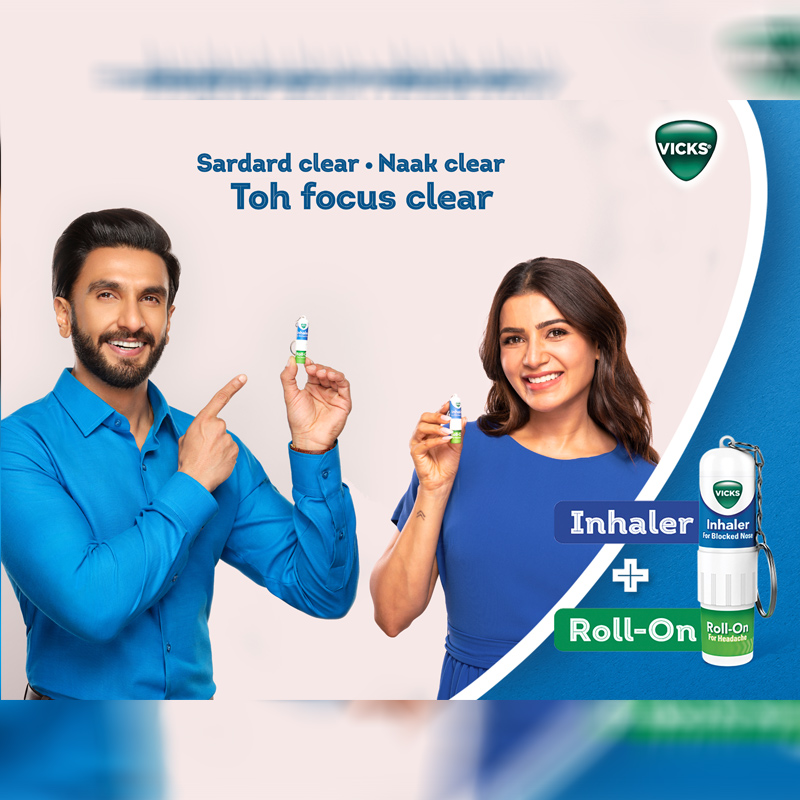
    Mumbai: India’s leading cold and flu solution, Vicks, has rolled out a new campaign film for its two-in-one roll-on inhaler.

    South star Samantha Ruth Prabhu joins Vicks’ brand ambassador, Bollywood superstar Ranveer Singh, for the campaign.

    The campaign film smartly depicts how an individual is unable to focus on daily activities when they suffer from a headache and a blocked nose.

    The duo came together in the film to showcase the benefits of the Vicks’ two-in-one roll-on inhaler, with Samantha as a police officer, stopping a sickly Ranveer, who is seen breaking the signal. Ranveer is shown to have trouble focusing and tells Samantha about his terrible runny nose and headache. Samantha then hands him a Vicks’ inhaler with a two-in-one benefit, which gives Ranveer instant relief from his blocked nose and headache.

    Expressing his excitement for the newly launched campaign, Procter and Gamble Indian Subcontinent category leader for personal healthcare Sahil Sethi, said, “In India, inhalers have been synonymous with Vicks. We are excited to have Ranveer and Samantha come together for the very first time, to share the double benefits of Vicks’ two-in-one roll-on inhaler in providing relief from both – a blocked nose and headache.”

    Speaking on the campaign, Vicks’ brand ambassador Ranveer Singh said, “I loved the thought behind this campaign, and it was great teaming up with Samantha for Vicks. We all go through blocked noses and headaches quite often amidst our hectic schedules, and facing both symptoms together can negatively impact our focus. The Vicks’ two-in-one roll-on inhaler is smart as well as handy to use and is sure to become a go-to product for many of us.”

    “My family and I have been Vicks’ users for as long as I can remember, and hence this campaign was a perfect opportunity for me. Through this film, we are trying to convey that Vicks’ two-in-one roll-on inhaler is a pocket-friendly way to tackle colds and headaches, even when you are outside and not at home!,” commented Samantha Ruth Prabhu on her association with Vicks.

  • 61% consumers watch online video content like YouTube/OTT on their mobile/home TV: Axis My India Sep CSI Survey

    61% consumers watch online video content like YouTube/OTT on their mobile/home TV: Axis My India Sep CSI Survey

    Mumbai: Axis My India, a leading consumer data intelligence company, released its latest findings of the India Consumer Sentiment Index (CSI), a monthly analysis of consumer perception on a wide range of issues.

    According to reports, 20 per cent of consumers are planning to shop more this festive season. On media consumption, 61 per cent mentioned that they watch online video content either on their mobiles or connected TV. 32 per cent mentioned that they notice advertising on TV, followed by digital (26 per cent). An interesting observation was on app usage. On average, nine apps are used by a smartphone user.

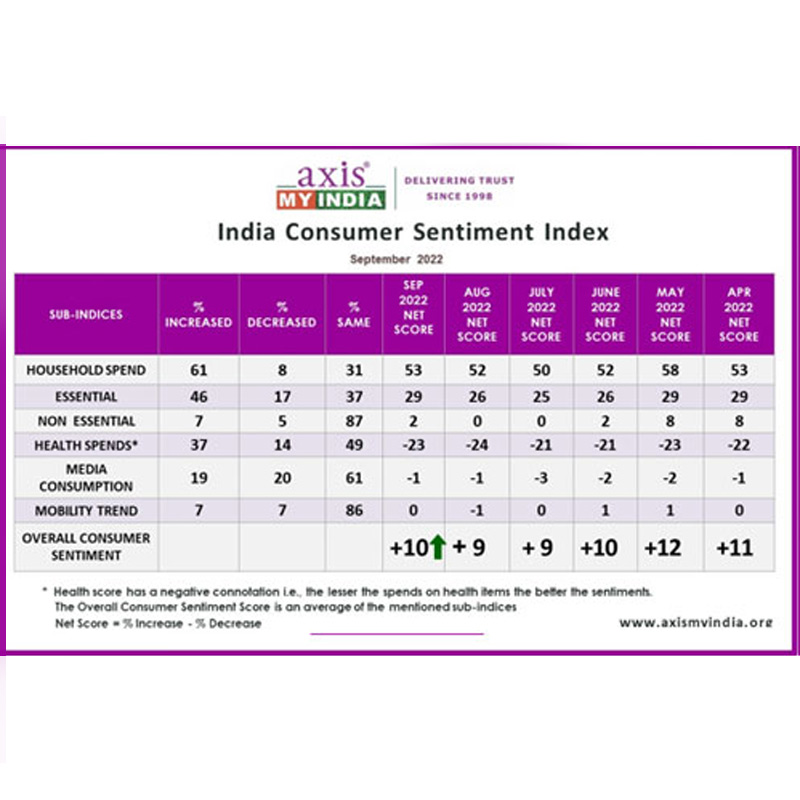
    The net CSI score for September, calculated by percentage increase minus percentage decrease in sentiment, is at +10, from +9 last month, reflecting an increase of one point. The sentiment analysis delves into five relevant sub-indices: overall household spending; spending on essential and non-essential items; spending on healthcare; media consumption habits; and mobility trends.

    Key Findings:

    •     Overall, household spending has increased for 61 per cent of families, which is the same as in August. The net score, which was +52 last month, has increased by +1 to +53 in September.
    •     Consumption of media remains the same as the previous month, i.e., 19 per cent. The overall net score, which is -1 in September, also remains the same.
    •     Mobility has increased for seven per cent of families, representing a one per cent increase over the previous month.
    •     Spending on essentials like personal care and household items has increased for 46 per cent of the families, which is an increase of one per cent from last month. The net score, which was at +26 this month, has increased by +3 to +29.
    •     Spending on non-essential and discretionary products like air conditioners, cars, and refrigerators has increased for seven per cent of families, which reflects an increase of one per cent from last month. The net score, which was at nil last month, has improved to +2 this month. This could reflect the spirit of the festive season approaching.
    •      Consumption of health-related items has increased for 37 per cent of the families, which reflects a decrease of one per cent from last month. The health score, which has a negative connotation i.e., the less spent on health items, the better the sentiments, has a net score value of -23 for September, as compared to -24 last month.

    On topics of current national interest:

    •      In an attempt to understand consumers’ engagement with mobile apps, the survey discovered that, on average, consumers have nine apps on their smartphones. 16 per cent use a minimum of 4–8 apps on their smartphone, and 22 per cent have more than eight apps. A significant 24 per cent mentioned that they use a feature phone.
    •     In order to determine which medium advertisements are more likely to be noticed, the survey discovered that a majority of 32 per cent notice ads on TV, while 26 per cent notice them on online media. It was also discovered that only 17 per cent notice ads on social media platforms, 15 per cent in print, six per cent in outdoor and two per cent on radio.
    •      The survey further revealed that a majority of 61 per cent watch online video content like YouTube or OTT on their mobile/home TV.
    •     Digging deeper into the festive spirit, the survey shows that 20 per cent plan to shop more this festive season compared to last year. However, 32 per cent plan to shop the same as last year.
    •     According to the Axis My India Consumer Sentiment Index Survey, 48 per cent of consumers shop/purchase more products during the festive season as compared to the rest of the year.
    •      Exploring farmers’ sentiments towards new tractors, the survey found out that 10 per cent are planning to purchase new tractors in the coming year, while three per cent and two per cent plan to do so within six months and three months, respectively. For reasons like smaller land size, renting, or affordability, a significant 86 per cent of farmers don’t own a tractor.

    The survey was carried out via computer-aided telephonic interviews with a sample size of 10014 people across 32 states and UTs. 68 per cent belonged to rural India, while 32 per cent belonged to urban India. In terms of regional spread, 23 per cent belong to the northern parts while 24 per cent belong to the eastern parts of India. Moreover, 29 per cent and 23 per cent belonged to the western and southern parts of India, respectively. 59 per cent of the respondents were male, while 41 per cent were female. In terms of the two majority sample groups, 32 per cent reflect the age group of 36-year olds to 50-year olds, while 31 per cent reflect the age group of 26-year olds to 35-year olds.

    Axis My India chairman and MD Pradeep Gupta said, “After compromising the past two festive seasons because of the pandemic and its related constraints, this year consumers are expected to shop more during festivities. One can already witness a slight increase in expenses across essential and discretionary products. Further improvement in mobility sentiments highlights the fact that more and more people are enjoying the stores’ and malls’ experiences of discovering, shopping, and gifting.”

    He further added, “This sentiment is also extended among the Indian farmers, wherein a significant percentage of 15 per cent intend to buy a brand new tractor in the next one year. This is thus a crucial time for the Indian advertising business as spending is expected to bring a lot more returns than usual. As more and more people (61 per cent) are watching online video content (YouTube/OTT) on their mobile/home TV and thereby noticing ads across TV, online and social media platforms, it is of utmost importance for the media industry to tap the right medium for addressing differentiated consumer needs.”