Tag: pay TV

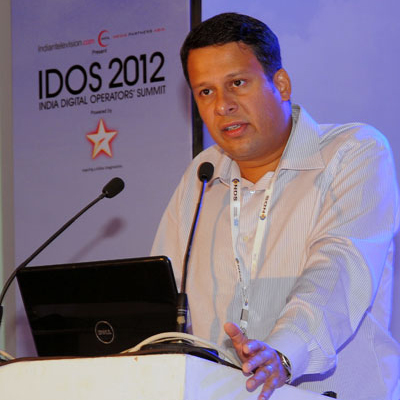
  • “India is not yet mature for RIO deals”: Sanjev Hiremath

    “India is not yet mature for RIO deals”: Sanjev Hiremath

    The current scenario in India is not very viable to allow for reference interconnect offer (RIO) to take off. No broadcaster would want to be on a RIO agreement because the moment you are on RIO, your distribution is affected. Broadcasters want their channels to be carried by all operators and also in good packs for maximum reach.


    Subscription too would be lower at least initially. The RIO rate X subscribers on CPS basis will mostly likely be lower than the existing negotiated price for that channel.


    India is not yet an addressable pay TV subscription market and RIO deals will not work anytime soon; neither for the broadcaster nor for the DPO. The addressable billing system, consumer communication and B to C marketing needs to kick-in. 


    Currently, broadcasters want reach and DPO wants carriage or at the least it does not want to pay for the channel and keep its content cost down. There is competition among DPOs too and cost of content is critical to all. RIO is a regulatory mandate in the absence of a deal and a good basis for negotiations. Money saved on carriage on RIO (as there is no carriage) can be used for discounts to structure deals. 


    In the immediate future, some channels will get impacted due to poor uptake or because of it being a niche or premium channel. Some of these channels will likely go on RIO especially stand alone ones. As and when billing for content gets established we move to a more mature market where broadcasters will get decent subscription revenues, niche channels will be able to survive and premium channels will make more money being a-la-carte on a CPS deal.


    We are in a transition phase of moving to the real objective of DAS, pay as per channels viewed/subscribed – in short, ADDRESSABILITY!


    (These are purely personal views of consultant Sanjev Hiremath and indiantelevision.com does not necessarily subscribe to these views.)

  • Warner Bros and Sky Deutschland extend movie rights contract

    Warner Bros and Sky Deutschland extend movie rights contract

    BENGALURU:  Sky Deutschland and Warner Bros. International Television Distribution (WBITD) announced that they have agreed to an early extension of their cooperation for several more years. The long-term contract between Sky and Germany’s top film distributor includes on demand rights for all current new movies during the pay-TV window as well as exclusive pay-TV rights to all Warner movies across several platforms. Film fans will be able to continue enjoying exclusive access to the most recent cinema blockbusters from Warner as television premieres on Sky. Upcoming highlights include films such as “Interstellar”, “Horrible Bosses 2”, “Magic in the Moonlight”, “Mad Max: Fury Road” , and “Der Nanny” from Matthias Schweighöfer.


    Content will also be available whenever and wherever subscribers want it via non-linear services Sky Go and Sky Anytime. In addition to current first broadcasting rights, Sky is acquiring exclusive pay-TV rights to a comprehensive package of high quality library films including rights for Sky Go and Sky Anytime.


    Sky Deutschland executive vice president, programming Gary Davey said, “Warner Bros. has been one of Sky’s closest and strongest partners for years. And now we’re pleased to announce a multi-year extension. We would like to thank Warner for its trust and look forward to continuing this successful cooperation. In the future, film fans will be able to keep on enjoying the wide-ranging movie offering that is only available on Sky.”


    “We are incredibly pleased to be continuing our long-standing relationship with Sky Deutschland,” said WBITD president Jeffrey R. Schlesinger. “As our television business continues to evolve and consumer behaviours shift to include more options for viewing our content, it is important to have a smart, sophisticated and marketing-savvy partner like Sky in Germany and Austria to showcase our films in the first pay TV window. “


    Rupert Murdoch’s 21st Century Fox is in the process of selling its majority stake in Sky Deutschland to UK based BskyB which is also taking full control of Fox’s Sky Italia and will combine the three pay-TV groups to form Europe’s largest pay-TV service with 20 million subscribers.

  • IDOS 2014: India’s broadcast, DTH & cable television industry’s captain congregate

    IDOS 2014: India’s broadcast, DTH & cable television industry’s captain congregate

    MUMBAI: Heads of India’s pay TV, distribution and broadcast sector are headed for Goa between 25 and 27 September 2014 for the industry’s annual confab – The India Digital Operators Summit (IDOS) – 2014. In its third edition, IDOS 2014’s theme is ‘Digitisation: The Next Big Push.’ 

     
    Organised by IndianTelevision.com and Media Partners Asia (MPA), it unites stakeholders across the value chain to drive meaningful dialogue and facilitate practical solutions to drive the content and distribution markets forward.


    The three day summit will kickstart with HBO hosting the most awaited party of the season on 25 September at The Leela in south Goa. 


    The highlight for the three day conference is TRAI chairman Rahul Khullar who will address the gathering on ‘Policy, practices and the way forward – The Next Five Years for Indian Television.’

    Day two of the summit will commence with a keynote on the ‘State of the TV Nation’ by Indiantelevision.com founder, CEO and editor in chief Anil Wanvari and MPA executive director Vivek Couto. 


    A panel comprising leading investment analysts and investors will next discuss the key drivers of industry economics and value creation and if digitisation extension dates will cause concerns for investors and ROI.


    ‘Unity and The Way Forward for the Next Five Years’ will be another topic for discussion at the upcoming summit. During the session, industry leaders will be seen discussing on how there is a need to converge upon and the urgency of proper execution in the coming months. The other sessions will see brainstorming on ‘Specialized content and channels in the digital ecosystem’, ‘Broadband and the digital economy – A focus on ground deployments’, ‘In focus: The growth of alternative video platforms’ and ‘Technology shifts in Indian Pay-TV’ among others.


    Amongst the headline names who are slated to attend and speak include: Star India CEO Uday Shankar, Zee TV CEO Punit Goenka, TRAI principal advisor N Parmeswaran, FoodFood promoter Sanjiv Kapoor, Dish TV CEO RC Venkateish, Videocon d2H CEO Anil Khera, Hathway Cable & Datacom MD and CEO Jagdish Kumar, Siti Cable CEO VD Wadhwa, DEN Networks CEO SN Sharma, Mybox CEO Amit Kharbanda, Scripps Networks Asia Pacific head Derek Chang,  Ortel CEO BP Rath, among others. 


    Says Indiantelevision.com founder, CEO, and editor in chief Anil Wanvari: “For decades, it has been seen as a land of promise. But India’s $7.5 billion television industry has somehow or the other belied that potential. Forced by the government to digitise, India’s TV distribution ecosystem has been struggling to get its act together. While set top boxes (STBs) have been rolled out, transparent customer billing, pricing deals between content owners and distributors, and conditional access have yet to occur seamlessly. This has left industry precisely at the same spot it was at before digitisation was mandated.”


    Adds Media Partners Asia executive director Vivek Couto:  “Revenue leakages continue, and industry discord has only heightened, amongst broadcasters, cable and DTH satellite operators. Clearly, key changes are required with the Government recently calling for an extension to the digitisation deadline to December 2015 for phase III and December 2016 for phase IV. It is in this perspective we expect IDOS to play a key role in getting likeminded  professionals from industry to come together to analyse the just completed phase I and phase II of digitisation and brainstorm for a better phase III and phase IV.”


    The title partner for the event executed by ITV 2.0 Productions is Star India. The summit partners are BBC World News, Cisco, Discovery Channel, HBO Defined HBO Hits, SES, Surewaves and Videocon D2H. The associate partners are Akamai, Asiasat, CSG International, DEN, Hathway and Scripps Network. Broadband India Forum is the support partner, while 24 Frames Digital is the webcast partner. The media partners for the event are Avishkar, Cable Quest, Radioandmusic.com, Satellite @ Internet India and Tellychakkar.com


    IDOS is to be held at the Hotel Leela in south Goa between 25-27 September 2014.

  • DTH sector in India to grow sales at 19 per cent CAGR between 2013-18: MPA

    DTH sector in India to grow sales at 19 per cent CAGR between 2013-18: MPA

    MUMBAI: India’s direct-to-home (DTH) satellite pay-TV sector remains a growth oriented industry with significant potential for strategic and financial investors, according to a new report published by Media Partners Asia (MPA).


    The report, entitled ‘India DTH Market Overview–Key Dynamics & Future Outlook’, forecasts that India’s DTH pay-TV sector will generate revenues of $ 4.04 billion by 2018, a CAGR of 19 per cent from $ 1.71 billion in 2013 and by 2023 the sector will generate revenues of $ 5.6 billion. In an earlier report, MPA had said that the DTH active subscriber base will increase from 37 million in 2013 to 60 million by 2018 and 70 million by 2023. This implies a 39 per cent share of the overall market by 2023 and a 56 per cent share of the digital pay-TV market.


    DTH operators have been working together to improve the overall economics for the business by reducing the amount of free viewing offered to new subscribers and recalculating the incentives dealers receive for renewing subscriptions.


    ARPU growth, according to the report, will be partially limited as DTH expands nationally, with low-income homes coming into the mix, although MPA sees a greater contribution from high- ARPU HD subscribers. According to the report, HD represented 6.9 per cent of the total active DTH base in 2013; which MPA expects to grow to 16.1 per cent by 2018 and to 20.1 per cent by 2023. MPA sees total DTH ARPUs expanding from $ 4.0 per month in 2013 to $ 5.7 by 2018.


    Digital TV (DTV) has started to gain widespread acceptance across consumer households in India, driven largely by the growth of DTH satellite pay-TV platforms. Data from MPA indicates that DTV penetration, including digital cable and digital free and pay DTH platforms, has grown from less than 1 per cent in 2006 to 46 per cent as of 31 December 2013.


    The six DTH pay-TV operators in the market have in aggregate contributed to 23 per cent penetration as of 31 December 2013, providing a level of market leadership due to superior capitalisation and a stronger consumer focus built around product strength and innovation, including tiering, HDTV and DVR services.


    “DTH operators have been working together to improve the overall economics for the business by reducing the amount of free viewing offered to new subscribers and recalculating the incentives dealers receive for renewing subscriptions. ARPU growth will be partially limited as DTH expands nationally, with low-income homes coming into the mix, although we also see a greater contribution from high-ARPU HD subs. HD represented 6.9 per cent of the total active DTH base in 2013; we expect this to grow to 16.1 per cent by 2018, and to 20.1 per cent by 2023,” said MPA India VP Mihir Shah.


    Key market trend highlights of the report:


    Rational focus: Operators are increasingly focused on growing profits as opposed to solely increasing volume, often at the expense of profitability. As a result, operators have increased their basic prices, while at the same time reducing the trade margin arbitrage by Rs 200-250 to minimise rotational churn. Although subscriber additions post October 2011 have witnessed some slowdown. According to MPA both the quality of subscribers and ARPUs will continue to improve going forward.


    DTV mandate: MPA believes that the implementation of mandatory cable digitisation by the government will be an important catalyst for growth in the DTH sector. DTH operators are relatively well positioned due to the strength of their B2C businesses (as opposed to B2B approaches amongst cable MSOs) and their experience and investment in tiering, subscriber management and billing and sales and marketing. In addition, as part of its reforms, the government has now permitted international companies to own up to 74 per cent of cable and DTH platforms.


    HD penetration: As per MPA’s report, HD penetration will grow significantly in the future, rising from less than 7 per cent of active DTH subscribers currently to over 20 per cent by 2020. MPA’s estimates are based on benchmarks in the US, UK, Latin America and Southeast Asia. In the UK, incumbent DTH operator BSkyB currently has more than 50 per cent of its subscriber base adopting HD. Malaysia’s Astro has also demonstrated laudable rates with 49 per cent penetration at present on its DTH platform. Increase in HD channel offering is critical for growth in HD penetration. However for some of the mature global operators, MPA sees HD penetration as a percentage of total subscribers capping out at 60-65 per cent.


    Upside capped by tax and regulation: A ~30 per cent drain of gross DTH subscription revenues – comprising a 12 per cent service tax, 8-10 per cent entertainment tax and a 10 per cent license fee – continues to hamper the industry’s ability to improve profitability. Although industry stakeholders are lobbying the government to change the license fee terms and make deductions based on adjusted gross revenue, these are yet to be finalised. A further cap on future industry upside comes in the form of spectrum issues resulting from the absence of an open skies policy that would allow DTH operators to directly source transponder capacity from foreign satellite operators, as opposed to the current system of going through the Indian Space Research Organisation’s (ISRO’s) commercial arm Antrix.


    Consumer proposition, technology key to future subscriber additions: Ramping up subscriber additions as analog cable subscribers turn to digital will largely depend on the consumer proposition offered by the DTH and cable operators. Gaining an increased share of new subscribers will hinge on designing and marketing innovative and simple packaging structures, bearing in mind that analog cable subscribers are used to an all-you-can-eat single package structure. Technology will also be key, as compression standards and middleware deployed by operators will play a crucial role, though not immediately visible, in differentiating service offerings and providing HD and value added services (VAS) such as interactive services, 3D and VoD.

  • Only 70 per cent of the Indian pay-TV market will be digitised by 2023: MPA report

    Only 70 per cent of the Indian pay-TV market will be digitised by 2023: MPA report

    MUMBAI: The process of digitisation in India currently seems to be stuck in limbo. Even with several deadlines being set, the country doesn’t seem to have progressed much even in digital addressable systems (DAS) phase II, let alone phases III and IV. A new report from Media Partners Asia (MPA) has predicted key findings about the cable and DTH industry in India between 2013 and 2023.


    It expects the next five years to be a period of robust growth of India’s pay-TV market. MPA projects that the pay TV industry in the country will grow from $7.4 billion in revenue in 2013 to $12.3 billion by 2018.


    The growth in revenue will be equal to an average annual growth rate of 11 per cent between the years 2013 to 2018. By 2023, it expects the industry to generate revenues of approximately $ 16.4 billion. The findings by MPA were published in the report ‘India Pay-TV and Broadband-Future Trends’.


    The study states that by the end of 2013, India had approximately 65 million paying digital subscribers. MPA projections indicate that only 70 per cent of the Indian pay-TV market will be digitised by 2023.


    The total number of TV households in India is currently pegged at around 160 million with nearly 20 million on terrestrial only. This will be the growth opportunity for alternative platforms as cable and DTH will find it unviable to penetrate into the interiors of the country. The Ministry of Information and Broadcasting (MIB) has given a deadline of 31 December 2014 for completion of digitisation. If one goes by the MPA report, India has a long way to go for 100 per cent digitisation.


    From 2015 to 2017 will see an upward trend as DAS will take off in phase III and IV areas. After 2017, the time will be for consolidation and monetisation as subscriber growth will decelerate.


    While the growth during 2009 to 2013 was driven by volume, the next five years will be led by average revenue per user (ARPU). At the end of the 2018, pay TV subscribers will hit 165 million and by 2023, it will be 180 million. This implies a long term penetration of 80 per cent.


    The growth will also give wide space for alternative platforms such as Doordarshan-owned Free Dish, headend-in-the-sky (HITS) and over-the-top media (OTT) apart from cable and DTH, which will address the need gap between TV households and pay TV subscribers.


    DTH industry revenues are expected to reach $4 billion by 2018 and $5.5 billion by 2023. This will be due to healthy subscriber additions from 2014 to 2016 and by improved churn and suspension management. The active DTH subscriber base is expected to grow from 37 million in 2013 to 60 million by 2018 and 70 million by 2023. Thus, DTH will have a 39 per cent share of the pay-TV market by 2023 and 56 per cent share of the digital market.


    MPA predicts that the total digital cable subscribers will be 50 million by 2018 and 55 million by 2023. Digital cable conversion will shoot up from 29 per cent in 2013 to 48 per cent by 2018 and 50 per cent by 2023. This will enable growth in cable broadband. It expects share of cable in the fixed broadband market to grow from 6 per cent to nearly 15 per cent from 2013 to 2023.


    The projected total pay-TV channel revenues for broadcasters, including advertising and subscription will grow from $3.3 billion in 2013 to $6 billion by 2018 and $8.3 billion by 2023.


    Meanwhile the pay-TV ad market is expected to grow at 8.6 per cent CAGR over 2013 to 2023 while broadcaster subscription revenues are expected to grow at 11.3 per cent over the same period. This will be due to improved macro-economic conditions, sub-segmentation of existing genres and new advertiser categories.


    “The Indian market is important because of its accessibility for global media distributors and investors and its high levels of pay-TV penetration. Ever changing regulations are destabilising but the government’s DAS mandate will be an important catalyst while improved supply side factors, including healthy financial markets and investments from international strategists are also critical,” says MPA India VP Mihir Shah.

  • Tata Sky launches the first ever Scholarship on television

    Tata Sky launches the first ever Scholarship on television

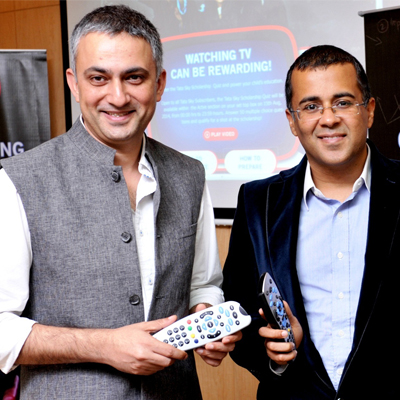
    MUMBAI: Tata Sky, the leading digital Pay-TV player in the country, has taken edutainment to the next level by announcing the launch of the first ever Scholarship for kids that can be availed through television. Author & motivational speaker Chetan Bhagat has been roped in to promote the Tata Sky Scholarship Quiz – a gratifying concept of edutainment.

    For the first time ever television will be the medium of participation for children to win the edutainment based Tata Sky Scholarship. Tata Sky subscribers will be able to participate in the quiz on 15th August’14 by simply answering questions on television, with a click of their Tata Sky remote control, from the comfort of their homes.

    Vikram Mehra, Chief Commercial Officer at Tata Sky explained, “The varied range of learning channels and interactive services for children on Tata Sky has been an apt medium to deliver edutainment and knowledge based content, as kids always grasp more from what they see and hear. Now with the Tata Sky Scholarship Quiz we look forward to quizzing and rewarding children across the country, for their vast exposure to educative content.”

    Tata Sky will roll out scholarships worth Rs. 20 lakhs with top 10 winners being entitled to a scholarship worth Rs. 2 lakhs each. Tata Sky is also launching a kid’s campaign titled – ‘Ab Bachchey Seekhein TV se…’, conveying the fact that television is a good learning aid for children.

    Promoting the TataSky Scholarship Quiz, Chetan Bhagat said, “It gives me great pleasure to be associated with Tata Sky. Their unique edutainment platform gives a great opportunity for children to learn through television. The scholarship provides an impetus to fulfil their future dreams and aspirations.”

  • Russia to ban ads on C&S pay-TV channels

    Russia to ban ads on C&S pay-TV channels

    MUMBAI: Even as broadcasters in India are fighting tooth and nail with the Telecom Regulatory Authority of India (TRAI) to rollback the ad cap regulation that restricts satellite TV channels from airing more than 12 minutes of advertisements per hour, a completely different situation has just cropped up in Russia.


    A new bill that has gone through three stages of hearings in one week is just waiting for approval from the President of Russia. The state Duma has passed a bill banning advertising on cable and satellite pay TV channels that will be effective from 1 January 2015. The bill has been created for a level playing field between Russia’s free to air (FTA) cable channels and those that monetise by both ads and subscription.


    Channels that are available on a paid basis as well as those that are encoded will be included in the ad ban. National, universally accessible and terrestrial channels will not come under the ban. Last week, a letter was sent by few Russian channels requesting the government to think through before passing a bill of such nature. The letter mentioned that of the 270 C&S channels in Russia, 150 will be threatened due to this bill, leading to an increase in the price of pay TV.


    According to reports by Association of Communication Agencies of Russia, advertising revenue from digital and satellite channels last year was just 2.6 per cent of total TV ad market as compared to the rest taken by FTA channels ($ 4.4  billion).


    Across the world, the standard rate of advertisement is 12 minutes per hour including the UK, Germany, Ireland, Norway and Argentina.


    Zee Russia is one Indian broadcaster that is present in Russia.

  • MPA issues Asia Pacific pay TV slowdown warning

    MPA issues Asia Pacific pay TV slowdown warning

    MUMBAI:  Digital pay TV is slowing down in Asia. That was the key takeaway from Media Partners Asia (MPA) executive director Vivek Couto’s annual report on the Asia Pacific market during the Asia Pacific Operators Summit in Bali, last week.


    MPA estimates are that entire Asia Pacific pay television ecosystem added 26 million net new customers in 2013, the lowest annual growth since 2007. This reflects a marked deceleration in China and India as well as softer growth in Southeast Asia, especially Thailand, which was the weak link in the region.


    MPA which was until this year bullish on the digital pay-TV universe in Asia Pacific seems to have turned cautious if not bearish. It says that net new additions will accelerate in APAC over 2015-16, largely due to some gains in India associated with next, delayed phase of digitisation but the general trend is one of deceleration. Overall, MPA has downgraded pay TV growth for the region at 9 per cent CAGR until 2018.  Adjusted for multiple subscriptions, the data firm indicates that pay-TV penetration will increase from 52 per cent market share in 2013 to 60 per cent by 2018. 


    In India, phase I and II of digitisation boosted growth in 2012 but with that done and amidst various structural factors plus the macro environment along with currency depreciation, growth slowed in 2013. “Now we see the next delayed phase of digitisation that is phase III, boosting net new subscribers to 8 million a year in 2015 and 7 million in 2016 before decelerating again by 2018,” informed Couto.


    He estimates that on an active paying basis, India has more than 60 million paying digital subscribers. Of this, while 37 million come from DTH, 23 million is from cable. 


    “Over the last 24 months, it’s been a transitionary process for the cable industry in India. While in the analogue regime, the multi system operators were at Rs 11 per subscriber, in the digital era, the MSOs are now getting anywhere between Rs 50-70 in Mumbai and Delhi. They will now need to get to Rs 100-110 to start breaking even on video excluding carriage,” said Couto.


    Net additions in southeast Asia slowed by almost half last year from 3.7 million to 1.9 million and the two big DTH platforms in Indonesia in particular and Malaysia contributed more than 45 per cent to that growth.  According to MPA, the net additions will reaccelerate in southeast Asia to about 2 – 2.5 million a year driven largely by Indonesia, steady growth in Malaysia and the Philippines but the expectation is that disruption to continue in Thailand and only incremental growth to show up in Vietnam while Singapore will remain somewhat flat.


    The brakes have been slammed on cable TV growth in China – the other large TV market globally – courtesy direct competition from IPTV, internet TV (the most popular of which are services provided by Wasu, LeTV, XiaoMi and BesTV’s own OTT service platform), and to some extent, online video. Couto said that IPTV in China saw a steady growth of 5.6 million net additions in 2013, driven by content and increasing broadband reach.


    North Asia, consisting of Hong Kong, Taiwan, Japan and Korea, saw a rise last year only because of Korea, which contributed 80 per cent to growth due to new customers on IPTV and DTH in a market where penetration exceeds 100 per cent.


    “Looking at the macro landscape, you can see pay-TV penetration marginally improve in China over the next five years and this will deliver real pay models, driven largely by IPTV. It might improve further as operators become challenged by the new regulatory policy that establishes a set-top box internet-TV model. A number of online video operators have formed partnerships to enter into the internet TV space,” informed Couto.


    In China, India and Indonesia too, the growth in TV houses and wireless broadband users will drive increases in consumption of content. Fixed broadband subscribers across the APAC region will increase too, from 310 million in 2013 to 400 million by 2018 – driven by China, India, Thailand, Philippines and Australia.


    For Couto, the growth of video on demand (VOD) is now starting to take shape.  “Our metrics just cover pay-TV but this 13 per cent average annual growth to almost US$ 4 billion is driven by China, Korea and Japan while in southeast Asia, Malaysia is the clear market leader with Astro being the best,” he said.

  • More youth ‘cutting the cord’ in US, says new study

    More youth ‘cutting the cord’ in US, says new study

    NEW DELHI: Young viewers in the United States are streaming more and say they are less loyal to their pay TV service, according to a new survey conducted for new TV network Pivot.


    The 2014 survey found that young – 18 to 34 years old – viewers with pay TV service are spending as much time watching traditional TV – 39 per cent of their viewing – as they did in 2013. But the amount of time spent streaming is up to 43 per cent of their time from 37 per cent last year.


    More of those 18 to 34 years age group who subscribe to pay TV and stream video – 35 per cent – say they are looking to leave pay TV for a broadband-only lifestyle, up from 27 per cent last year.


    The actual number of young viewers who have cut the cord and use broadband only to access video was flat at 13 per cent. But the number of these “independent broadbanders” who say they are happy streaming and do not plan to return to pay TV increased to 9 per cent from 8 per cent last year.


    The survey was conducted for Pivot by research company MarketCast which surveyed 2,515 adults in the 18 to 49 years bracket, in April.

  • Verimatrix appoints Steve Oetegenn as president

    Verimatrix appoints Steve Oetegenn as president

    NEW DELHI: Steve Oetegenn is all set to take over as the president of Verimatrix to assist the company to grow its pay-TV operator base.


    Oetegenn will support the growth of Verimatrix especially when several large digital video operators are transitioning to an IP-centric network infrastructure. He will also continue to lead the sales and marketing efforts.


    Before joining Verimatrix, he was COO of MediaSec Technologies, a provider of digital watermarking; COO of Argus Systems Group, a provider of internet server security software, and CEO of DCE Communication, a provider of business messaging systems.