NEW DELHI: Contrary signals seem to be emanating from the government on conditional access system (CAS).
India’s information and broadcasting ministry officials say that CAS rollout is on schedule, but the prime minister is understood to have conveyed to the I&B minister today that while implementing any policy decision the interest
of the consumer should be kept in mind.
Coming out of a meeting with the Prime Minister AB Vajpayee, India’s information and broadcasting minister Ravi Shankar Prasad today told journalists that the prime minister has said that the interest of the consumer should be kept into account, while implementing a policy decision.
Does this mean that deferment of CAS deadline is likely? Looks not, if Prasad and his ministry’s secretary are to be believed.
To some journalists, Prasad, reportedly denied any deferment, while I&B ministry secretary Pawan Chopra said, “As of now, everything is on schedule.”
If the interest of the consumer is to be kept in mind, then the deferment of the 14 July deadline looks a certainty. Will Prasad have the guts to stand by what he has said earlier on sticking to the 14 July deadline, even while safeguarding the consumer’s interest?
A tough call to make for Prasad.
Tag: Pawan Chopra
-
PM to Prasad: keep consumer in mind
-
Prasad rules out extension of CAS deadline
NEW DELHI: India’s information and broadcasting minister Ravi Shankar Prasad today categorically ruled out any extension of the 14 July deadline of CAS and also attempted to convey to broadcasters that since bundling of pay channels would not be allowed, earlier they come out with the individual pricing of each pay channels, the better.
The minister also hinted that neighbouring townships of the metros — like Noida and Gurgaon near Delhi — here CAS is being sought to be implemented in the first phase may be included for a rollout.
In turn, representatives of the cable industry assured the minister that orders for a sizeable number of set-top boxes, needed to route pay channels in a CAS regime, have been placed — 2 million boxes by Siti Cable and over 2.5 lakh by HTMT (along with a committed capacity of an additional 1.25 million boxes).
Another topic that came up for discussion was the issue of variable pricing of pay channels in the same city depending on the socio-economic strata of the cable consumer.
Pointing out that discounting of pay channels’ prices is an issue between the content and service provider where government does not see itself playing any role, Prasad, however, emphasised that whatever may be the case, the pay channels would have to be necessarily routed through set-top boxes.
According to government sources, the representative of the Hinduja-owned HTMT, which manages the INCablenet in various cities told the minister, that ICICI has evinced interest in making available funds for procuring boxes. This probably would be the first case of a private sector financial organisation coming out to extend financial help to a sector like cable that has always been considered by banks and financial institutions as a high-risk business.
The sources also said that interestingly INCablenet representative expressed his concern over the delaying tactics being adopted by broadcasters on pay channels’ price vis-?-vis the investment already made by the company in anticipation of a timely rollout of CAS.
INCablenet is one MSO that seems to have become the target of most broadcasters in Mumbai where `switching off’ is concerned.
In a meeting today with the multi-system operators, the first of a new series of meeting that the government would have with the stakeholders of the broadcasting and cable industry to facilitate a smooth rollout of CAS, the minister while allaying some fears of the cable industry, also expressed his concern at the delay on the broadcasters’ part to come out with the pricing of individual pay channels.
The minister reiterated that the government would not allow any form of bundling of pay channels. Last week, I&B ministry secretary Pawan Chopra in an interview first made this fact official with indiantelevision.com.
This move may put paid to some thoughts the broadcasters may be harbouring on cobbling together a super bundle of channels cutting across various bouquets.
Prasad also heard the other concerns of the cable industry and, according to the sources, conveyed to the MSOs that if need be, the government would step in to facilitate an early announcement of the individual pricing
of pay channels by broadcasters.
Today’s meeting was attended by senior executives from Siti Cable, INCablenet, Hathway, RPG and Spectranet, amongst others. After this meeting, it is expected that a meeting with broadcasters would be scheduled. -
Government to issue notification disallowing post-CAS bundling
NEW DELHI: The local law of the land cannot be taken for granted and its adherence should be must.
This seems to be the strict message that the Indian government is giving out to broadcasters, cable operators, MSOs and others on the contentious and
controversial issue of conditional access (CAS) and its implementation in the four metros from 14 July.
For the first time, the government also officially confirmed that they are planning to bring in another notification of rules under an existing Act to see that broadcasters don’t resort to any sort of bundling — cutting across present bouquet lines — in a post-CAS regime.
“If a certain law has been passed by Parliament, it should be adhered to. Those who feel that dilly-dallying tactics (on CAS) can be resorted to, should think otherwise,” information and broadcasting ministry (I&B) secretary Pawan Chopra told indiantelevision.com today. This stance of his is in line with what he told pubcaster Doordarshan, yesterday, in an interview.
According to Chopra: “Bundling of any channel cannot be allowed under the present rules and if there is any lacunae, then we are thinking of notifying additional rules on this. Every cable operators has to display the individual price of every pay channels and the consumer must be free to choose whatever he wants without feeling any additional financial burden.”
However, a bureaucrat’s job, as anywhere in the world, is to pacify everybody. In line with that, the I&B ministry also plans to hold meetings with broadcasters on the issue of unbundling of channels and the maximum retail price of pay channels. “We’ll take the convenience of the broadcasters too, into consideration so that they don’t feel robbed of any level playing field,” Chopra said.
The government also feels that “continuing lobbying” by broadcasters and others would not be of much help as the policy guidelines have been framed after much deliberations. And this also includes the availability (or the lack of it) of set top boxes (STB) which would be needed to route the pay channels through. No STB, no pay channels.
According to Chopra: “If a certain section of the industry feels that delaying the implementation of CAS would solve problems, then we don’t think so. Even if CAS implementation, for instance, is deferred by six months,
then also the situation is likely remain the same as it would on 14 July. So, why insist on one-city rollout?” Yes, the government has a point.
But so do the broadcasters. The broadcasters, at least some of them, are contending that because adequate number of STBs is not likely to be readily available by 14 July at affordable prices, there would be chaos in the four metros. Yes, that’s likely to happen.
If one looks at the situation from the government’s side, the thing is, if the industry has failed to iron out issues, including that of boxes, in six months time, the chances of them getting sorted in another six months time are less. What guarantee is there that the broadcast and cable industry would not crib after February 2004 (taking into account a six month extension on rollout does become a reality)?
Still, the government is willing to lend its ears to the broadcasters and sweeten the CAS pill a bit for those think it is too bitter.
According to government officials, if the broadcasters want to have dual feeds of their (pay) channels and come to an understanding with the service providers that in certain areas — for example, where people from the
economically weaker section live and cannot affort boxes for pay channels — they won’t charge the cable ops for the household, then the government would not interfere in that process.
“Such subsidisation (of pay channels) is between the content and service provider where the market forces are coming into play. The government does not see there is any need to interfere,” senior government official explained. No wonder Star News has already started a so-called free to air feed for downlinking in non-urban areas in an effort to, what Star says, increase penetration.
But this dual feed route is something that many a broadcaster managing pay channels may be contemplating as it looks like an honourable escape route from the days of lofty statements that “no pay channels would turn free to air”. Especially if the government is willing to look the other way. -

DD, AIR call off strike for time being
NEW DELHI: The programming staff association of Doordarshan and All India Radio have deferred a decision to go on strike from today. The decision comes after an assurance of redress of their grievances from Prasar Bharati chief executive K S Sarma and Information and Broadcasting secretary Pawan Chopra, after a series of meetings held last week.
However, indiantelevision.com learns that it has been conveyed to the authorities concerned, that the various contentious issues should be resolved as soon as possible and a broad decision should be arrived at, preferably, within a week’s time.
Pointing out that he appreciates the association’s decision to defer the proposed strike, which would have certainly affected DD and AIR’s functioning partly, chief executive of Prasar Bharati, K S Sarma, said, ” Meetings were held both at Prasar Bharati and the information and broadcasting ministry last week and we are seized of the matter. Ways to redress grievances of the programming staff are being worked out.”
Till the time of writing this report, the association representatives could not be contacted for comments on latest developments.
The programming staff association,one of the three associations in Prasar Bharati, while threatening to start a stir, had said in a statement last week, “The association is trying to attract attention of the authorities towards the acute shortage of programme staff which is hampering the efforts to meet competition from other channels and increase the revenue of the organisation to make it self reliant.”
Indiantelevision.com also learns from government sources that I&B secretary Chopra met up with the association representatives on Saturday and conveyed to them that a package involving promotion and training of programming staff has been almost finalised by the ministry for implementation soon.
“In the wake of all this, the association was requested to reconsider its decision to go on strike from this week,” a government source said, adding that the association in-principle agreed to defer the proposed stir for some time.
However, there seems to be some rift amongst the three associations in Prasar Bharati that still functions like a government organisation with unions often holding authorities to ransom in a bid to make them agree to their demands.
The other two associations – the programming welfare association and the one which has Indian Information Service employees as its members, are not part of the proposed stir. Government sources also indicated that the present stir threat is nothing but “arm-twisting tactics,” especially when a ‘babu’ culture of mediocrity still rules Prasar Bharati.
DD and AIR has about 13,000 programming staff on its rolls as part of a 40,000-odd employee base of Prasar Bharati Corporation that has been modeled on another public service broadcaster, British Broadcasting Corporation.
-
MV Kamath to be next Prasar Bharati chairman
MUMBAI: Noted right-wing columnist MV Kamath will be the next chairman of the Prasar Bharati Board.
A three-member committee headed by vice-president Bhairon Singh Shekhawat has recommended Kamath’s name for the post, information and broadcasting Minister Sushma Swaraj has been quoted as saying by the Press Trust of India.
PTI quoted Swaraj as saying Kamath has given his verbal consent for the post to secretary, I&B, Pawan Chopra.
The Prasar Bharati chairman’s post had been lying vacant ever since Prof UR Rao, a former head of the country’s premier space research institute, ISRO, quit last year citing personal reasons.
When Rao quit in August last year, media speculation had pointed to veteran journalist and seniormost member of the Prasar Bharati board BG Verghese as a possible candidate. Kamath is the third chairman of the board after the late Nikhil Chakravarthy and Rao.
Kamath, who was made a member of the board last year, has worked in several news organisations and was editor of the now defunct Illustrated Weekly.
The three-member committee comprises the Press Council chairman and a government nominee, besides the vice-president. -
Govt looks to cutting equipment import duties; pushing TV software exports
NEW DELHI: The Indian government is looking at giving a major fillip to exports of TV software and films from India this year and also get some concessions to the media and entertainment industry by having the various duties on import of equipment rationalised or lowered.
According to government sources, the information and broadcasting secretary Pawan Chopra is slated to meet the representatives of the hardware and software sector early next week to discuss the issues in this regard as a part of a pre-Budget meeting.
The sources indicated that Chopra’s thrust would be to elicit response from the industry as to what all should and can be done to give a major fillip to exports of TV software and films, an area which the government feels has great potential as a revenue earner.
Information and broadcasting minister Sushma Swaraj recently had told indiantelevision.com that this financial year film exports especially had crossed Rs 9 billion.
One of the concerns of the broadcasting industry has been a high duty regime and the Indian Broadcasting Foundation had also petitioned the I&B ministry to influence the finance ministry to rationalise duties on import of equipment.
Broadcasting Council formation
A senior official of the I&B ministry indicated that work has started on formulating a paper on the formation of a broadcasting council, ahead of the enactment into a law of the Convergence Communication Bill (CCB).
The proposed Broadcasting council, to monitor content on TV channels, would be equivalent to the content bureau as envisaged in the CCB which has run into problems with a parliamentary committee, after collating feedback from various section, had observed that the time may not be ripe yet to have an all-encompassing convergence law.
A bill has to be moved in the Indian Parliament if Swaraj wants to push ahead with the broadcasting council which, anyway, would not have any regulatory powers. -
Swaraj stresses role of media in combating terrorism
NEW DELHI: The media has an important role and responsibility in fighting and isolating forces of terror. The battle is to be fought by the journalists, not with guns and tanks, but with their pens and words, information and broadcasting minister Sushma Swaraj said here today.
Inaugurating a Foundation Course in Journalism for a group of 15 Afghan journalists at the Indian Institute of Mass Communications, here today, Swaraj said that the forces of terrorism are still active in our region, and pose a threat to the peace and progress of humanity.
The minister said that the journalists must contribute in the reconstruction and re-building process. The newspapers in Afghanistan, should not only inform the citizens of the country, of the initiatives and programmes of the Afghanistan Government, they should also comment on what needs to be done further, Swaraj said.
Secretary, information and broadcasting, Pawan Chopra, said the electronic media, especially television, plays a great role in initiating thought and action through information. He said India has undergone a revolution in electronic media and the friends from Afghanistan must make the best use of their exposure in this field.
The course is designed to develop trained manpower to meet challenges of the times and more so when the image and the events in the country need to be projected in the right perspective and development and reconstruction efforts of the government need media and information support. Fifteen journalists and government media officers are attending the two-month course.
-
Speeches at the Inaugural Address
Pawan Chopra, secretary of the I&B mministry observed that we were living in rapidly-changing, exciting times and we must keep pace with the changing trends and not slow down. He said whatever policy decision was taken in this regard would be implemented by his ministry without any delay. Maharashtras deputy CM, Chhagan Bhujbal reminded the gathering that his government had done its best to make Dadasaheb Film City a dream project. There were 15 studios of which nine were air-conditioned and two more would have this facility. Film City is attracting not only Sony and Universal Studios, but also producers from Denmark, South Korea and Sri Lanka. Another achievement is that Adlabs have opened their IMAX theatre. The government is taking keen interest in the multiplex but I cant announce the policy now because the assembly session is on. But it will be announced before the end of the session, he said.
Bobby Bedi who chalked out the two-day sessions said he was thrilled with the overwhelming response. We have the support from the financial institutions and the government. We have got recognition which has catalysed the entire effort and our industry will be on par with any other industry, he gushed. Formally welcoming Sushma Swaraj and Amitabh Bachchan, FICCI president Chirayu R Amin said, We started with a dream two years ago to corporatise the film industry. What had seemed nebulous then has become a reality today. According to me Sushma Swaraj is friend, philosopher and guide to the industry and the proof is the large turnout. The aim of this convention is to bring Indian film industry on par with Hollywood in quality. IDBI has played a crucial role in this growth.
Lalit Modi, chairman of the entertainment committee, wanted India to create a dent in the global market by laying grounds for a dynamic corporate film industry. DTH has opened up another avenue for TV entertainment is no longer marginalized. One sixth of the population of the world is Indian and if imaginatively marketed, Indian products have four times a better chance than its American counterparts, he added. IDBI chairman SK Chakraborty said that the reason he was participating in the convention despite the gruelling year-ending season, was because of the tremendous response. He thanked Sushma Swaraj for taking keen interest in funding films. In our board meeting on March 16, we have sanctioned Rs 100 crore for funding films, ranging from Rs 5 crore to Rs 25 crore per film. But I insist on quality. I will not compromise on this aspect, he said pointing out that money was no problem as he had sanctioned Rs 1000 crore to a project.
MS Banga, chairperson of Hindustan Lever, had the audiences rapt attention when he made his points with characteristic lucidity. He said it was a crucial point in the evolution of the entertainment industry as the opportunities are huge and immense. India is getting richer and enormous change is taking place in the mindset of people from self-denial to self-indulgence. Let me cite an example. It is not just films, TV, video or music but cricket, too, is drawing high TRPs. Changes are taking place much faster in moffusil and rural areas. I do a lot of travelling and I find that there is an increase of 40 to 50 per cent in the consumer products. Tea is found everywhere and anytime. But films have a very short life compared to tea. You can reduce the risk by knowing the pulse of the market and finding ways and means to getting your ideas tested.
We need better marketing: Bachchan
Amitabh Bachchans speech was candid and he expressed satisfaction that entertainment was finally being considered serious business. My brother and I gave a serious thought to setting up a business in 1980. We figured that if Hollywood was the second largest export earner for America, why cant India, which is the largest film producing country in the world? But it was only in 1995 we realized that the time was ripe. We decided to bring films, TV, Video, music and stage shows under one roof and usher in a corporate culture. But our mistake was that we overlooked the unique way films are made in India. Normally, a film is made in stages as producer shoots a song, then some action scenes to attract distributor and expects instalments to come from financier and distributor to complete the film. Not every producer can be a Yash Chopra, Feroze Khan or Subhash Ghai. We had recruited the best from the corporate sector. But there was a problem in management, with 80 per cent of our time lost in telling them what to do and only 20 per cent of the time left for creativity. That is where things started going haywire. I am glad that now the coporatising is a reality thanks to Subhash Ghai and Pritish Nandy and others. Our films are seen all over the world, but the crying need is efficient marketing. Within our country we need more accountability from distributors. In the West, producers come to know all about film business at the press of a button. It is sad that producers dont know how his film is being exploited and how to get his dues. That is why those in the trade keep saying God alone knows, so often, he quipped. -

Two-day Ficci Frames 2001 convention kicks off today
India’s most significant global convention of the entertainment industry, Ficci Frames 2001, organised by the Federation of Indian Chambers of Commerce and Industry, begins today at Hotel Regent, in Mumbai’s western suburb of Bandra.
The two-day event will see major players from the entertainment industry, right from business leaders, representatives of the government’s decision making bodies, stars, broadcasters, cable TV industry, and the advertising sectors out in force. They will be participating in the discussions, and workshops at the convention.
Its main idea: converge cinema, television, audio, cable, together and focus to bring about an upgradation of quality, content and professional management of the entertainment industry, similar to that seen in Hollywood.
Nearly 116 representatives of the various segments of entertainment from all over India will be present. Among those attending: Sushma Swaraj, union minister for information and broadcasting, Pawan Chopra, secretary, ministry of I&B, Anil Baijal, CEO Prasar Bharati; V Chandrasekaran, chairman and CEO Pentamedia Graphics Ltd; Amit Khanna, CEO Reliance Entertainment; Markand Adhikari, vice-chairman and managing director SABe TV; Shabana Azmi, MP; Ronnie Screwvala, chairman and MD UTV; Lalit Modi of Modi Entertainment; director Shyam Benegal, and film stars Amitabh Bachchan and Shah Rukh Khan.
Top-notch representatives of the entertainment world will also speak on issues and hold discussion panels. For instance Discovery chief Kiran Karnik, SET’s Kunal Dasgupta, Bhuvan Lall, executive director IBF will be speaking on the regulatory framework of broadcasting.
Munesh Khanna, country had, corporate finance, Arthur Anderson, will make a presentation on the present status and future of the entertainment industry. Bonds contracts, insurance, and debt financing in the entertainment industry will also be brought up for discussion.
A lot is being promised, right from a glimpse into the business of story telling by Mahesh Bhatt to the art of content creation by Ekta Kapoor, creative head of Balaji Telefilms. Meanwhile, Ravina Raj Kohli, CEO HFCL Nine Broadcasting, will be talking on the business of commissioning programmes by TV networks and distinguished movie-maker Ramesh Sippy will speak on the relevance of big screen entertainment for the small screen.
-
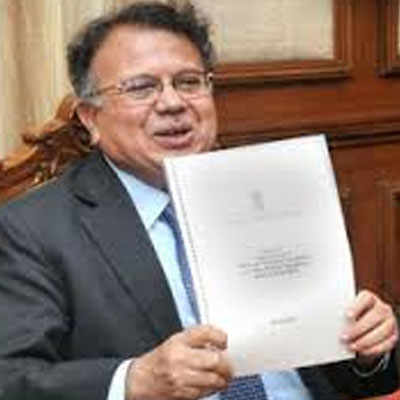
RR Shah shifted from I&B ministry
The acting CEO of Prasar Bharti, RR Shah, has been shifted out of the information and broadcasting (I&B) ministry , the Economic Times reported on Tuesday. He held the rank of additional special secretary.
In a related move, Pawan Chopra, additional secretary in the Cabinet Secretariat, is to take over as secretary I&B in place of YN Chaturvedi, who retires on Wednesday, 31 January.
Shah’s shifting is bound to revive speculation as to whether his days at the helm of Prasar Bharti are numbered. Shah’s term came to an end on 31 December but he was granted a six-month extension pending a replacement being found.
Two names that have cropped up as possible successors are Kiran Karnik, MD Discovery India, and Deepak Shourie, formerly with Zee Telefilms.