Tag: Pathaan

  • Shemaroo Contentino: Flying in for a perfect landing

    Shemaroo Contentino: Flying in for a perfect landing

    MUMBAI: Shemaroo Contentino managing partner Murtuza Kagalwala often  looks out of his office in Andheri East close to Mumbai’s international airport and sees another plane take off. And it makes him smile. He does this several times a day. The more the flights that take off, the more his business grows. 

    Here are some facts: domestic travel by Indians is expected to  reach 325 million by 2030 and over 35 million Indians now live abroad. As a corollary, demand for Indian content is rapidly increasing. International travel by Indian nationals is expected to skyrocket from 64 million trips in 2023 to 160 million by 2030, with outbound travel spending projected to surge from $42 billion to $144 billion during this period.

    Shemaroo Contentino  – a subsidiary of Shemaroo Entertainment – is expected to be one of the major beneficiaries of this travel surge. It is one of the major providers of inflight entertainment to airlines, and claims to have captured 90 per cent of the premium Indian content space. Its content is available over 130 carriers globally – from Air India, Emirates, Qatar Airways, Singapore Airlines, Etihad Airways, among others. 

    For airlines serving the Indian diaspora and other international markets, Shemaroo Contentino’s content catalogue makes it an ideal solution for airlines catering to passengers from diverse linguistic backgrounds. It offers over 3,000 movies, more than 25,000 TV episodes, and 1,500 plus music tracks, digital series, in over 15 languages. Some of the most popular recent blockbuster movies in the list include Pathaan, Maharaja, Premalu, Nach Ga Ghuma, Jatt & Juliet 3, Toofan, Jhamkudi, and many more. 

    . “We’re proud to be at the forefront of providing Indian content for inflight entertainment,” said Kagalwala. “Our deep understanding of the global Indian diaspora, coupled with our ability to deliver culturally resonant content, truly sets us apart. As national and international travel among Indians continues to soar, we remain committed to shaping the future of inflight entertainment. Our goal is to make every journey more enjoyable and engaging, transforming long flights into memorable experiences—with the perfect movie or show just a click away.”

    That should help  the company to have an even smoother  take off. 

  • OTT in 2023: A year of moderate success as streaming platforms hit the sweet spot

    OTT in 2023: A year of moderate success as streaming platforms hit the sweet spot

    Mumbai: In the ever-evolving landscape of entertainment, Over-The-Top (OTT) streaming platforms have become the go-to destination for consumers seeking on-demand content. From Disney+Hotstar to Netflix, Amazon Prime, Sony LIV, and JioCinema, it’s evident that streaming services have found the elusive sweet spot, achieving a year of moderate success. This success can be attributed to several factors, including content innovation and evolving user experiences.

    According to a report by Ormax Media, they have released select findings of the report, which reveal that the Indian OTT audience universe is currently at 481.1 million (or 48.11 Crore) people. This translated into a penetration of 34 per cent. The report defines an OTT audience who watched at least one online video (free or paid) in the last one month. The report breaks down this universe by gender, age, NCCS, pop strata, states, and cities.

    The report also revealed that there are currently 101.8 million active paid (B2C) OTT subscriptions in India, across 36.4 Million SvOD (B2C) audiences, i.e., an average of 2.8 subscriptions per paying audience member. B2C subscriptions in the report refer to subscribers who have taken a membership directly with the OTT platform, in contrast with B2B subscriptions, which are via telecom packs offered by various operators. Mumbai, Delhi and Bengaluru are the top three cities on paid subscriptions, with more than six million active paid subscriptions each.

    Regulations

    Another highlighting moment of this year was the introduction of the Broadcasting Services (Regulation Bill) 2023. According to the experts, the government’s move to regulate OTT video streaming apps like Netflix, Disney+Hotstar, SonyLiv, etc., under the bill, could affect content innovation and autonomy, derailing the growth path, experts said. Content on OTTs works on a “pull model”, wherein consumers choose the content. As such, any stringent programme and advertising codes might lead to content censorship and affect the audience experience.

    Once the Bill becomes an Act, it would bring streaming platforms such as Netflix and Hotstar completely within the ambit of the ministry of information and broadcasting (MIB) without having to rely on the Information Technology Rules, 2021, government officials said.

    The policy experts however said that first, the Bill should clearly mention if this would supersede the IT Act and second, the government can only amend certain codes of ethics in the IT Act instead of bringing them under a new legislation.

    Sports

    Disney+ Hotstar emerged as a powerhouse in 2023, with its decision to offer cricket tournaments — the Asia Cup and the ICC Men’s Cricket World Cup — free to its mobile users in India. With this, they have set new benchmarks for viewership, redefining the cricketing landscape. The highly anticipated final clash between team India and Australia has not only etched itself into the chronicles of sporting history but has also become the most-watched event ever on both linear TV and digital streaming. It recorded a peak concurrency of 13 Crore viewers on TV and 5.9 crore peak concurrency on Disney+ Hotstar (Digital).

    With the success of both the cricket tournaments, Disney+ Hotstar has also announced this year’s season of Pro Kabaddi League will be available to stream for all the mobile users in India starting 2 December 2023.

    Movies and series of 2023

    Hindi movies like Pathaan, Jawan, Animal, Vaccine War, Gadar 2 Tiger 3, OMG 2, Adipurush etc garned well at the box office and OTT platforms as well.

    There has been a plethora of series from The Railway Men, Kohrra, Trial By Fire, Chamak Scam 2003: The Telgi Story to Taaza Khabar, Farzi, Dahaad, The Night Manager, Citadel etc.

    According to a press statement from Jio Cinema stated that the platform registered 245 crore video views and 540 crore votes across the two months that Bigg Boss OTT 2 streamed on the platform. It also claimed to be the highest viewership for a live streamed event in India, after IPL.

    Reality OTT shows like Shark Tank India Season 2, MasterChef India Season 7, Kaun Banega Crorepati (KBC) Season 15, also fared well at Sony LIV.

  • The Big Picture with Shashank Srivastava, as he shares insights on Marketing, Media & Movies

    The Big Picture with Shashank Srivastava, as he shares insights on Marketing, Media & Movies

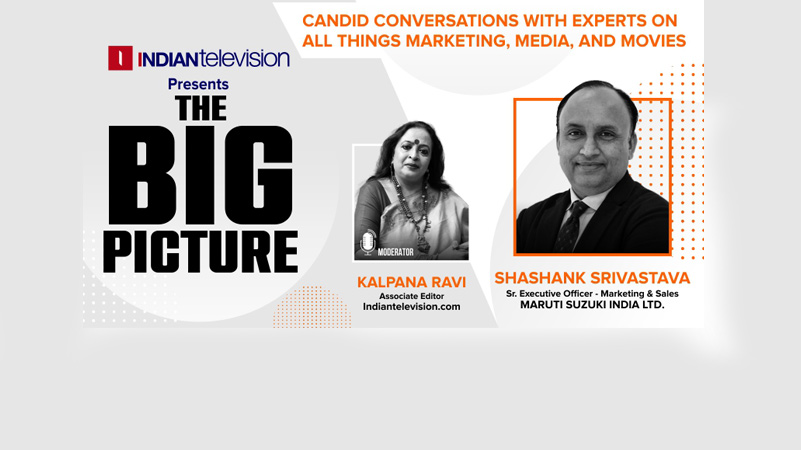
    Mumbai: The power of movies on television, often referred to as “The Big Picture”, has impacted how we consume entertainment, making it an essential part of our lives. Not only that, the synergy of Movies and TV has also proven to be lucrative for brands who want to reach India at large and impact their daily lives. In a series of chats with marketers and media veterans, we discuss all things related to marketing, media and especially movies. I am your host, Kalpana Ravi, Associate Editor Indiantelevision.com and today my guest today is Shashank Srivastava – Senior Executive Director of Sales and Marketing – Maruti Suzuki India Ltd.

    Edited excerpts

    On your early life, about how you grew up and what has been your experience.

    My hometown is Bhopal and I did my initial schooling there. Then I did my engineering, I was always out of Bhopal after that. I did my MBA from IIM Ahmedabad, post which I joined Maruti Suzuki. And that was a long time back, just out of college. And this is actually 33 years I have been in this industry. People asked me this question as to why the how, and why this long innings in Maruti Suzuki? The clear answer is that this is one industry, which I really love. It’s always cars, it has always been my passion, starting from my school days. Therefore, I wanted to join an organisation, which was in this industry. Maruti Suzuki, of course, has been leading organisations for a very long time. That’s how I came into Maruti Suzuki. It gave me a lot of good experiences across different areas of work. That’s how I kept on with Maruti Suzuki. I’m glad because we did contribute a lot to the industry. I feel that I have also been a part of that contribution to the Indian economy.

    On your connection with cars

    I started driving the car when I was in the seventh standard. My father used to have an Ambassador car. In those days, cars had these radiators, so we had to fill the water to cool the engine down. I was given the task of cleaning the car every morning and putting that water on the radiator. Once in a while I started, I started the car as well, and started driving a little bit just about 10 metres. I’m not sure that my father ever knew about this. But my mother clearly knew about this activity of mine. I’m not sure whether she told this to my father because he didn’t say anything. That’s how I started driving the car and started getting to have the feel of the car.

    On choosing to be a marketer in the automobile sector.

    It’s basically a consumer perspective and I thought that as a consumer, what should be what product it should be, what it should mean to a consumer. So, I got interested in the technicalities of the car in the mind of the consumer of the car, and that is how I started thinking about the products especially automobiles from a consumer perspective. For that obviously, during my course, in my MBA at the at IIM Ahmedabad but I mastered in you know, there was a subject I had to choose to specialise in and I chose marketing and it gave a very structured sort of knowledge a very structured approach to the entire consumer behaviour, consumer mind and how companies should make products and how to market them and that is how I chose marketing.

    On sharing some highlights from your journey so far

    There are many actually. Starting from the early 90s, you had a very high tax structure, the penetration of cars was just around two cars per 1000 people. Today it is 32. When I joined Maruti Suzuki, we had two other car manufacturers in the industry, the total sale was about 50,010 per annum. Today, we are selling 50,000. Maybe in the industry, we are selling almost 40 lakh this year. From about 50,000 to 40 lakhs, I have seen these changes happening in the last 30 years, not only in terms of volumes, which I just mentioned, also in terms of the different segments which emerged earlier. The Maruti 800 was being used by everybody, the bureaucrat, the businessman, the family guy, the young boys and the girls. But today, you see a lot of segmentation. So, you have family cars like the Ertiga, the Sedan’s then you have the SUVs, which were earlier a rougher sort of thing as technology has changed immensely. While volumes have changed, segments have changed and the consumers themselves have changed. You see a lot of digitalization in the industry today, which means the consumer buying process itself has changed. The type of buyer also has changed and the income level of the buyers has changed. In that sense, there has been a complete change from what it was 30 years ago, and each of these changes has been a highlight. For example, when the new Swift came in, it started a new segment which people thought would never exist, but it did then we had the Esteem. It was also a segment which suddenly came in. Therefore, each of these moments are like highlights of the last 30 years and I have been very lucky to be a witness to almost all of them.

    On some of the memorable campaigns you have worked on work

    One good thing about the large experience is also that I have been part of most of the memorable campaigns actually, because Maruti’s a 40-year-old company and I have worked for more than 33 years. In essence, the theme of those campaigns also defines how the consumer has been changing. So initially, there was a campaign about fuel efficiency. There was one Sardar Ji campaign that became a rage because it really defined in a very nice way how fuel efficiency is so dear to consumers. Those times consumers were obviously the first criteria for car purchase was the running cost and therefore, the second campaign on the network, which was about a guy who goes up to Ladakh somewhere, and he says, Is there a hotel? There is no hotel and he says there is a Maruti Suzuki service station. And they say yes, there is. So even in remote areas, that was a great campaign on fuel efficiency. Of course, some really good campaigns on the products as well. Like the new alto campaign, we had a blue-eyed boy campaign and so on and so forth. So, there are and there is one other campaign which is the corporate car campaign, which was about how Maruti Suzuki cars are integral to Indian consumers. It was a campaign which had a lot of elements of the brand being ubiquitous as it was everywhere. So that was another campaign, which I really loved and the consumers loved them too. And it became a talking point in the advertising world as well. So, some of these campaigns are really memorable. Even after 20-25 years, when I think about them, they really lift my spirits, because I’ve been part of them.

    On your thoughts on Bollywood movies making record-breaking numbers this year

    Indian consumers are really big movie fans. If you see this year, some of the movies have really done well in the theatres like Pathaan, Gadar 2, Jawaan, Kantara etc. Then down south KGF and RRR, have all done business in excess of 500 crores. So it’s encouraging not only for the film industry but also if you look at it from an advertisers’ point of view, it’s really very encouraging. In fact, when a movie does well at the theatre, you also have a high anticipation of the OTT and Television as well, because there will be a World TV premiere of these blockbusters as well. They tend to garner a lot of buzz because of them doing well in the theatre. Some of the movies have delivered extremely good numbers on television. Obviously, in a media strategy, we have tried to leverage these movies for our brands and going forward, I think we will continue to do that. One point about this is obviously the evolution of the OTT, there is a lot of content which are now available to consumers. So of course, he’s spoilt for choice in that sense, but even OTT premieres are big, and hence for the advertisers, I think we need to analyse the ROI very diligently and invest on both TV and OTT to get the best ROI. And that’s what Maruti Suzuki has been doing.

    On watching movies on television creating value and impact that offer your brands?

    It creates immense value because it is about memory structure as they say. It is not just about one advertisement or FCT that you put on. Of course, if you look at marketing as an investment and not as an expense, then what it does is build a longer-term brand value and these values come from these memory structures like watching a movie together with the family so, that becomes a brand conversation, which happens because of the family watching together. There are other memory structures like logos for example, or the packaging design, or, the visual treatment of the product itself, if you look at our Maruti Nexa product, for example, the design language is different. So there is also brand communication through the design language, we call it crafted futurism. So, therefore, I think these memory structures are extremely powerful, and very valuable for any brand. So, therefore, these memory structures are extremely powerful and very valuable for any brand. What it does is, it probably requires a small investment to keep the brands on top of the mind, because the investments have grown over time. That’s how those memory structures have evolved. These are the things which have a greater cultural relevance. Brands that see the advantage of this approach, will succeed and their ROI will grow. And we at Maruti Suzuki, feel that these occasions such as the ones that you mentioned, are really great opportunities for marketers.

    On the current media spectrum of TV and digital contributing a winning mix for a marketeer and on the overall effectiveness of TV plus digital advertising

    I’m glad that you said what is the ideal mix, rather than a lot of people who asked this question, which is better, is it TV or is it digital, because obviously, you have to strike the right balance between television and digital and find out the best way to reach the TG. For example, television is great, because for automobiles, if you really want to create imagery, the stickiness of the imagery is good on television, because you can have a large video format there. That’s essential, especially when you are launching a product. Also, the television media today in India has got a larger reach. So, if you’re trying to build a quick reach, and if you want to create imagery for brand positioning, initially, television is a great medium. However, in the funnel, if you look at the marketing funnel, as you go down for consideration and the actual conversion, then you need to have a more personalized message for consumers, their digital becomes more accurate, better, and less wasteful. Therefore, digital platforms obviously have got unparalleled, targeting capabilities because it allows marketers to reach specific audience segments and send personalized messages. That’s great for converting to an actual sale. And therefore, you need to have a mix of both television as well as, digital. It depends on the product category. A category such as car, imagery is very important. Because the category is different from the finance product, it also depends on the specific target audience, if you’re looking at really young consumers, who consume a lot of media in the digital sphere, obviously, you have to spend more money on digital. It also depends on your campaign objective, or even on the creative integration, the creative which is there. If you’re looking at performance measurement, obviously, that’s also one important thing because you can have a better measurement of the digital thing. It also depends on budget constraints. So, I would say that the media effectiveness and the mix are determined by the reach & engagement, if you want reach then TV. It definitely provides that broader reach and mass appeal, digital channels offer targeted engagements and personalised interactions. If you look at brand building, obviously, TV excels in brand building and emotional storytelling, digital platforms, drive performance marketing and maybe measurable results. So, a synergistic effect is what we are looking at. Therefore, a mix is good. In our case, the mix currently is about 30 per cent digital, television is about 40 per cent and the rest is print, radio, OOH and cinema.