Tag: Partha Rakshit

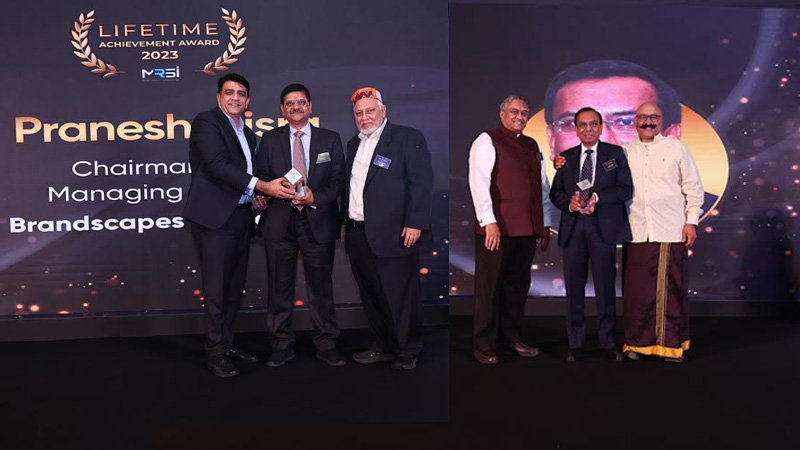
  • MRSI’s honours Partha Rakshit & Pranesh Mishra with Lifetime Achievement at Golden Key Awards 2023

    MRSI’s honours Partha Rakshit & Pranesh Mishra with Lifetime Achievement at Golden Key Awards 2023

    Mumbai: The Market Research Society of India (MRSI) instituted the Golden Key Awards in 2019 to recognize the contribution of insights for the growth of India’s market research and insights industry. Among the many categories, MRSI each year also recognises the industry’s veterans for their significant contribution.  MRSI’s Golden Key Awards 2023  honoured Partha Rakshit and Pranesh Mishra, two of India’s most notable personalities from across the research and insights industry for the Lifetime Achievement Award.

    One of India’s most respected market research professionals, Partha Rakshit has over five decades of experience. He currently serves on the Board of the NorthPoint Centre of Learning, wherein he guides their marketing research, media and analytics programs. Rakshit last served as the managing director South Asia at Nielsen, from where he retired in  2010.

    Among his many achievements, Rakshit was a key member in the committee that worked on formulating and establishing SEC variables in India. He served as MRSI’s President from 1992-94. He was a founding member of the National Readership Survey Council. He served as a Member of the Board of Governors of the Advertising Standards Council of India (ASCI) during 1996 to 2016 and its President from 2013-2014. Rakshit was recognized for a new method for election forecasts in India which enabled the adoption of much lower sample sizes. Rakshit holds a Master’s degree in Management from the Jamnalal Bajaj Institute of Management Studies, Mumbai.

    Pranesh Mishra, the second awardee, is the chairman and managing director at global marketing analytics and insight consulting company Brandscapes Worldwide which he founded in 2008. His 40-plus years’ experience covers strategic leadership roles in marketing, brand development, advertising, and consumer insights across several consumer products and services.

    Prior to Brandscapes Worldwide, Mishra was associated with Lowe & Partners, MashreqBank, Pathfinders, among other organizations. Moreover, he led brand and communications strategy development for Fortune 500 brands including  Unilever, Visa, Coca-Cola, Johnson & Johnson, and HSBC. A Physics graduate from Delhi University and an MBA from the Indian Institute of Management, Ahmedabad, Mishra is a passionate student of human insights.

    The Market Research Society of India extend their gratitude to both Partha Rakshit and Pranesh Mishra for their valuable contribution to the Indian and global research and insights sector.

  • Government stops teleshopping advertisements that violate ASCI code

    Government stops teleshopping advertisements that violate ASCI code

    MUMBAI: In a recent development, the Ministry of Information and Broadcasting (MIB) through an advisory has barred broadcasters from airing advertisements that have been found in violation of the Advertising Standards Council of India’s (ASCI) code.


    MIB compiled a list of ads that made unsubstantiated claims and violated the provision of code for self-regulation as well as provisions under Drug & Magic Remedies (Objectionable Advertisements) Act, 1954 and has now asked broadcasters to ensure strict compliance of the advertising code in the Cable Television Networks Act (CTN).


    ASCI chairman Partha Rakshit said, “This is another feather in the cap of ASCI, in its efforts to make advertising more responsible. We were finding that some advertisers on TV channels, especially Tele Shopping Networks, were not complying with the ASCI decisions. We submitted the list to the Inter Ministerial Committee (IMC) of the MIB for their consideration. Based on that, IMC observed that any violation of ASCI code also violates the Advertising Code enshrined in the CTN Act and its rules. In short, IMC has directed that advertisements found to violate the ASCI code cannot be carried on TV channels.” 


    The advisory sent by MIB states that ‘non-compliance of ASCI’s code of self-regulation is a violation of rule 7 (9) of the Advertising Code contained in the CTN Rules. The CTN code and rules state that ‘no advertisement which violates the code of self-regulation in advertising, as adopted by ASCI for public exhibition in India, from time to time, shall be carried in the cable service’. Therefore, ASCI decisions are not just bound for compliance by advertisers but also by TV channels.’ 


     Some of the products in the MIB’s Advisory list  which violated the ASCI code in terms of their advertising and advertisers not complying with the ASCI’s decision to uphold the complaint are Fairpro (Telemart Shoppi Network), Ayurvedic Roopamri Fairness Cream (WWS SkYshoP P), Celebrity Lift (RTC Enterprises), GLO Intense Brightening System (B Lab), Rashi Ratan Topaz Ring (Quick Telemall Marketing), Maha Dhan Lakshmi Yantram Musli Power Xtra (Kunnath Pharmaceuticals), Brain  Smart GTM (Teleshopping), Bhairavi Sadhana- Devishree Foundation Trust, Shaktivardhan Vaccume Therapy, Sandhi Sudha Oil (Telemart Shopping Network), MadhuSanjivani (JMD Teleshopping), Addiction Killer (SK Shopping),  Easy Slim Tea , Maha Dhan Lakshmi Yantram etc.


    Earlier this week, ASCI had issued stringent guidelines on advertisements for fairness creams, barring companies from depicting dark-skinned people as inferior to their fairer counterparts and not to depict them as unhappy, unattractive or depressed.

  • Fairness products can’t show dark skinned people as unattractive or unhappy

    Fairness products can’t show dark skinned people as unattractive or unhappy

    MUMBAI: For all those who are tired of watching fairness cream advertisements and the way they portray people with dark skin, some relief is here. The self-regulatory body for the advertising industry of the country, Advertising Standards Council of India (ASCI) released a set of final guidelines for the advertising of skin lightening and fairness products.

    Adding to the earlier draft, after seeking industry and public feedback, ASCI’s new guidelines will ensure that advertisements of skin whitening products do not depict people with dark skin as somehow inferior to fairer people.

    The guidelines that are to be used while creating and assessing advertisements in this category include:

    • Advertising should not communicate any discrimination as a result of skin colour. These ads should not reinforce negative social stereotyping on the basis of skin colour. Specifically, advertising should not directly or implicitly show people with darker skin as unattractive, unhappy, depressed or concerned. These ads should not portray people with darker skin as, at a disadvantage of any kind, or inferior, or unsuccessful in any aspect of life.

    • In the pre-usage depiction of product, special care should be taken to ensure that the expression of the model/s in the real and graphical representation should not be negative in a way which is widely seen as unattractive, unhappy, depressed or concerned.

    • Advertising should not associate darker or lighter colour skin with any particular socio-economic strata, caste, community, religion, profession or ethnicity.

    • Advertising should not perpetuate gender based discrimination because of skin colour.

    Commenting on the new guidelines, ASCI Chairman Partha Rakshit said, “Setting up these new guidelines for the skin lightening and fairness products will help advertisers comply with ASCI code’s Chapter III 1 b which states that advertisements should not deride any race, caste, colour, creed or nationality. Given how widespread the advertising for fairness and skin lightening products is and the concerns of different stakeholders in society, ASCI saw the need to set up specific guidelines for this product category.”

    “As a self-regulating body, it is important to have the advertisers’ buy-in to the guidelines, and we are happy to note that both the industry and the consumer activists’ groups have welcomed these guidelines” he added.

    Currently brands like ‘Fair & Lovely’, ‘Fair & Handsome’, ‘Clean and Clear Fairness Cream’, ‘Olay Natural White’, ‘Lakme Perfect Radiance’, ‘Pond’s White Beauty’, ‘Loreal Paris Pearl Perfect’ etc are advertising for skin lightening products.

  • Self-regulation is fine, but there is a need for govt backing: Parida

    Self-regulation is fine, but there is a need for govt backing: Parida

    NEW DELHI: Even as it acknowledges the role of self-regulation in curbing misleading advertisements, the government feels there is a role for powerful execution backed by a government authority.


    Consumer Affairs Ministry joint secretary Manoj Parida said that the Advertising Standards Council of India (ASCI) should have ex-officio members as part of its consumer complaint council meetings.


    At the outset, Parida said an advertisement is one that ‘gives casual leave to human intelligence’. Addressing a round-table on the subject of misleading advertisements organised by the Federation of Indian Chambers of Commerce and Industry (FICCI), he said the biggest problem in India was the low rate of literacy which resulted in the average consumer falling for any promises made through advertisements.


    While he acknowledged the role of the ASCI, he said it was a ‘friendly organisation’ of a few business houses. He said this was why self-regulation had not worked very well. There is a need to create an army of ‘ad monitors’.


    Even the courts have suggested setting up of an inter-ministerial committee for the purpose of checking misleading advertisements, he noted. He said the newly-formed inter-ministerial monitoring committee which is being constituted with the sole aim of monitoring misleading advertisements for protecting consumers could serve as the missing executive arm to ASCI. The committee will monitor misleading advertisement and unfair trade practices and suggest steps accordingly, he added.


    He noted that one major lacuna in the Consumer Act was that it only gave judicial remedy and therefore many consumers did not complain as court processes take much longer and there is no consumer protection agency.


    He also said there was need to put more money into creating consumer awareness.


    Elaborating on the role of ASCI and its future plans, ASCI Chairman Partha Rakshit said the council had been working since 1985. Since the Information and Broadcasting Ministry had given it recognition for hearing complaints, any direction given by it through the ministry’s IMC also applied to non-members. The ASCI worked on the three principles of honesty, decency and fairness.


    It was also incorrect to say that it only worked through friends since its Consumer Complaint Committees (CCC) had members of the civil society as well and the complaints were therefore heard by laymen. There were two CCC meets every week, each having around 14 members.


    In any case, two-thirds of the advertisements that appeared in the media were given out by ASCI members, though he admitted that this may work out to just around ten per cent of the companies in the country. He claimed that there was 85 per cent compliance with ASCI directions. He stressed that ASCI does not always wait for complaints and also takes suo motu action and some ads are suspended even before telecast.


    He said the bulk of countries around the world worked through self-regulation and India was no exception. Its 350 members included advertisers, advertising agencies, media and consultants.


    He said there was need to obtain legal authority for enforcing compliance of ASCI decisions by the print media, since the Cable TV Networks Regulation Act 1995 took care of TV.


    ASCI plans to cover print and social media (in internet) more extensively and Google and Yahoo had already come on board. It is also launching an online training programme on ASCI regulations targeted at young copywriters, agency executives and product managers in manufacturing/service companies.


    Speaking on consumer rights and remedies with regard to misleading advertisements, Germany’s GIZ consumer policy & protection Ruth Anna Buettner said that misleading and unfair practices were a global phenomenon. She added that the purpose of regulation should be proper functioning of markets and protection of individual consumer, mainly his contractual rights. Worldwide there are two ways of enforcement, one via public authority the other via courts, both accompanied by self-regulation institutions.


    Deliberating on the regulatory framework for misleading advertisements, Aazmeen Kasad and Law Practice Consultant owner Aazeen Kasad  said that to keep a vigil on the increasing incidents of misleading advertisements, the Central Consumer Protection Council (CCPC), apex body for consumer protection in India, has recently decided to draft guidelines to safeguard consumer interest from false advertisements in the country and set up a sub-committee to suggest strategies to deal with celebrity endorsements.


    FICCI FMCG Committee chairman & ITC ED Kurush Grant said all stakeholders – the NGOs and consumer forums, industry, self-regulatory body and the government – had unanimously agreed to work towards similar solution of empowering self-regulation. FICCI would work closely with ASCI and the Ministry of Consumer Affairs to tackle the menace caused by misleading advertisements.

  • ASCI shortens its complaint redressal to 12 days

    ASCI shortens its complaint redressal to 12 days

    MUMBAI: Tired of waiting? Well, now you won’t have to. The advertising content self-regulatory body, the Advertising Standards Council of India (ASCI) will now deliver its Consumer Complaints Council’s (CCC) decision on a complaint against an objectionable advertisement within a span of on an average of just 12 days from the date the complaint is received.


    ASCI’s chairman Partha Rakshit said, “ASCI’s effectiveness and credibility as an advertising self-regulatory organisation has increased several fold with speedier redressal of complaints and high compliance of its CCC’s decisions by advertisers. Regulatory bodies like MIB, DCA, FSSAI and FDA now recognise and support our self-regulation work with the inclusion of the ASCI in the Inter- Ministerial Monitoring Committee formed to review misleading ad content.”


    With the public and regulators demanding that  ads which are a) misleading or make false claims, b) indecent , c) showing hazardous activities and d) unfair to competition should be promptly removed or modified , ASCI has taken effective action to reduce  the complaint processing turnaround time from 45 days two years back to just 12 days on an average currently.


    Some of the actions taken by ASCI to achieve this unparalleled turnaround time are:


    1) From monthly meetings two years ago, the CCC now meets weekly by having two CCCs instead of one earlier and total number of CCC members moving up from 21 to 28.


    2) The turnaround time taken at ASCI to process the complaint and time provided to the advertiser to respond to the complaint has been significantly reduced with the use of email and technology.


    3) Intra industry complaints among ASCI members are being resolved in just seven days via Fast Track Complaint (FTC) process which was introduced in 2012. FTC, which handled 30 complaints in 2013-2014 has been very popular among ASCI members who are seeing real time and cost savings by not taking the matter to the courts on intra industry ad content disputes.


    4) In the recent past ASCI also introduced ‘Suspension Pending Investigation’ (SPI) by which ASCI can order an extremely objectionable ad to be removed immediately pending investigation and decision of the CCC.


    Under its National Advertising Monitoring Service (NAMS), ASCI has also started tracking in print and on TV of all ads against which complaints have been upheld. And results show that over 90 per cent of such “upheld complaints” ads do not reappear or are appropriately modified.  ASCI has now started reporting non-compliant upheld ads (i.e. upheld ads which reappear) to regulatory authorities such as the Ministry of Information & Broadcasting (MIB), the Drug Controller General of India (DCGI), the Medical Council of India (MCI), the Ministry of Health and Family Welfare, and the Food Safety & Standards Authority of India (FSSAI) for taking action as per the law of the land.


     The faster complaint turnaround time and improved compliance upheld complaint decisions by ASCI has taken place at the same time when number of complained ads processed by ASCI has increased more than 10 times. In 2011-2012 number ads processed by ASCI were 176 which post the NAMS initiative in 2012-2013 increased to 784 and for April 2013 to February 2014 period (11 months), ASCI has handled complaints against 1833 ads.

  • ASCI appoints Partha Rakshit as the new chairman

    ASCI appoints Partha Rakshit as the new chairman

    MUMBAI: Partha Rakshit Associates’ proprietor Partha Rakshit was unanimously elected as the chairman at the board meeting of The Advertising Standards Council of India (ASCI).
    ASCI’s biggest task in the coming year is to more vigorously disseminate ASCI’s guidelines through training programs believes Partha Rakshit

    The incoming chairman, Partha Rakshit said, “The last couple of years have seen a sea change in ASCI’s approach to self regulating advertising content. Earlier, we acted primarily on complaint received by the public. In May 2012, ASCI setup NAMS, a system of monitoring all new TV and print ads released across India, where trained professionals screened each ad to assess whether it meets ASCI’s code on honest and ethical advertising. This pro-active step has enlarged ASCI’s role as a self regulatory body manifold. I believe ASCI’s biggest task in the coming year is to more vigorously disseminate ASCI’s guidelines through training programs to the advertisers and ad agencies who create the ads and to media who release them, so that the proportion of new ads that meet ASCI’s standards is high at the stage of release itself. ASCI will also liaise more closely with regulators to ensure that ads which do not comply with CCC’s upheld complaint decision are acted upon as per the law of the land”.

    The outgoing chairman of the association, Arvind Sharma said, “Last year has been a very eventful year for ASCI. The NAMS Initiative which has seen a fivefold increase in the Ads complained against (from 177 to 788) has won ASCI the prestigious EASA Silver Award for Best Practices. The CCC now meets every week and approx complaints against 200 Advertisements are deliberated upon every month. Set up of the Online Complaints and Monitoring Services (OCMS) in the new look ASCI website also has started getting complaints against ads coming in from consumers in large numbers. ASCI has also introduced Suspension Pending Investigation where an Advertiser is asked to suspend an Ad immediately pending investigation when that Ad appears to be in serious breach of the Code.’

    Agro Tech Foods director Narendra Ambwani was elected as the vice-chairman; and Mediabrands CEO Shashidhar Sinha was appointed the Honorary Treasurer.
    The other members of the new Board of Governors are: Hemant Bakshi (Hindustan Unilever), Shantanu Khosla (Procter & Gamble Hygiene & Health Care), Jayant Singh (Glaxo SmithKline Consumer Healthcare) from the advertisers, Rajan Anandan (Google India), Sunil Lulla (Times Television Network), Benoy Roychowdhury (HT Media), I. Venkat (Eenadu) from the media industry and the likes of Subhash Kamath (BBH Comms India), Arvind Sharma (Leo Burnett), Srinivasan Swamy (R.K. Swamy BBDO). Allied Professions: Dilip Cherian (Perfect Relations), S.K. Palekar (S.P. Jain Institute of Management), Abanti Sankaranarayanan (CIABC) from the advertising agencies.

    During the year 2012-13, the Consumer Complaints Council (CCC) met 24 times and considered 3007 complaints against 788 advertisements. Of these, complaints against 642 ads were upheld, while 144 were not upheld and 2 were considered non-issues. In 590 cases, the complaint upheld ads have been voluntarily withdrawn or modified as per the CCC’s decisions resulting in over 91% compliance rate.